On: 26 April 2014, At: 04:21 Publisher: Routledge
Informa Ltd Registered in England and Wales Registered Number: 1072954 Registered office: Mortimer House, 37-41 Mortimer Street, London W1T 3JH, UK
International Journal of Science
Education
Publication details, including instructions for authors and subscription information:
http://www.tandfonline.com/loi/tsed20
Developing a Multi
‐dimensional
Instrument for Assessing Students’
Epistemological Views toward Science
Chin‐Chung Tsai a & Shiang‐Yao Liu ba
National Chiao Tung University , Taiwan b
National Kaohsiung Normal University , Taiwan Published online: 15 Jun 2012.
To cite this article: Chin‐Chung Tsai & Shiang‐Yao Liu (2005) Developing a Multi‐dimensional Instrument for Assessing Students’ Epistemological Views toward Science, International Journal of Science Education, 27:13, 1621-1638, DOI: 10.1080/09500690500206432
To link to this article: http://dx.doi.org/10.1080/09500690500206432
PLEASE SCROLL DOWN FOR ARTICLE
Taylor & Francis makes every effort to ensure the accuracy of all the information (the “Content”) contained in the publications on our platform. However, Taylor & Francis, our agents, and our licensors make no representations or warranties whatsoever as to the accuracy, completeness, or suitability for any purpose of the Content. Any opinions and views expressed in this publication are the opinions and views of the authors, and are not the views of or endorsed by Taylor & Francis. The accuracy of the Content should not be relied upon and should be independently verified with primary sources of information. Taylor and Francis shall not be liable for any losses, actions, claims, proceedings, demands, costs, expenses, damages, and other liabilities whatsoever or howsoever caused arising directly or indirectly in connection with, in relation to or arising out of the use of the Content.
This article may be used for research, teaching, and private study purposes. Any substantial or systematic reproduction, redistribution, reselling, loan, sub-licensing, systematic supply, or distribution in any form to anyone is expressly forbidden. Terms & Conditions of access and use can be found at http://www.tandfonline.com/page/terms-and-conditions
Vol. 27, No. 13, 28 October 2005, pp. 1621–1638
ISSN 0950-0693 (print)/ISSN 1464-5289 (online)/05/131621–18 © 2005 Taylor & Francis
DOI: 10.1080/09500690500206432
RESEARCH REPORT
Developing a Multi-dimensional
Instrument for Assessing Students’
Epistemological Views toward Science
Chin-Chung Tsai
a* and Shiang-Yao Liu
baNational Chiao Tung University, Taiwan; bNational Kaohsiung Normal University, Taiwan
Taylor and Francis Ltd TSED120626.sgm 10.1080/09500690500206432 International Journal of Science Education 0950-0693 (print)/1464-5289 (online) Original Article 2005 Taylor & Francis Ltd 00 0 0000002005 Chin-ChungTsai
Institute of Education & Centre for Teaching EducationNational Chaio Tung [email protected]
The purpose of this study was to describe the development and validation of an instrument to identify various dimensions of scientific epistemological views (SEVs) held by high school students. The instrument included five SEV dimensions (subscales): the role of social negotiation on science, the invented and creative reality of science, the theory-laden exploration of science, the cultural impacts on science, and the changing features of science. Six hundred and thirteen high school students in Taiwan responded to the instrument. Data analysis indicated that the instru-ment developed in this study had satisfactory validity and reliability measures. Correlation analysis and in-depth interviews supported the legitimacy of using multiple dimensions in representing student SEVs. Significant differences were found between male and female students, and between students’ and their teachers’ responses on some SEV dimensions. Suggestions were made about the use of the instrument to examine complicated interplays between SEVs and science learning, to evaluate science instruction, and to understand the cultural differences in epistemological views of science.
Introduction
The science education community has witnessed a paradigm shift from logical positivism or empiricism to constructivism in recent decades (Tsai, 2003). The contemporary epistemological views of science place great emphasis on the tentative, historic, and humanistic features of scientific knowledge that attempt to associate scientific issues, claims, and practices with the larger social and cultural contexts (Abd-El-Khalick & Lederman, 2000; Hodson, 1993). Such a shift initiated reform
*Corresponding author. Institute of Education & Center for Teacher Education, National Chiao Tung University, Hsinchu, Taiwan. Email: [email protected]
movement in science curricula and teaching approaches (Duschl, 1990; McComas, 1998).
Developing adequate understandings about the nature of science is viewed as one important component of scientific literacy (American Association for the Advance-ment of Science, 1990; Millar & Osborne, 1998; National Research Council, 1996). The term “nature of science” refers to epistemology of science, which generally addresses the issues including the assumptions, values, and conceptual inventions in science, consensus making in scientific communities, and characteristics of scientific knowledge (Ryan & Aikenhead, 1992). Intensive research efforts have been devoted to examining learners’ Scientific Epistemological Views (SEVs). The research find-ings suggest that students’ epistemological views of science may guide the acquisi-tion of scientific knowledge (Songer & Linn, 1991), and shape their orientaacquisi-tions to learning science (Edmonson & Novak, 1993; Lederman, 1992; Tsai, 1998a, 1999a, 2000a). That is, the more students understand that scientific knowledge is constructed based on scientists’ agreed paradigm, evidence, and negotiation, the more likely they are to employ meaningful strategies in science learning, and have better attitudes toward science. It is apparent that SEV is an important indicator for educators to predict students’ learning and to prepare science instruction.
In the literature, several lists of descriptors have been assigned to the characteristics of scientific knowledge and its development. McComas, Clough, and Almarzroa (1998) found a consensus for the epistemology of science in eight international science education standards documents, and recommended 14 objectives for K-12 science instructions. Those generally refer to the tentative, empirical based, creative, theory-laden, and social/cultural embedded feature of scientific knowledge. Abd-El-Khalick, Bell, and Lederman (1998) further suggest the inclusion of the distinctions between observation and inference as one important aspect. Relevant studies also showed that one’s epistemological views may be complex and often fragmented (Abd-El-Khalick & Lederman, 2000; Duell & Schommer-Aikins, 2001). In summary, these researchers all advocated the multidimensionality of SEV.
Moreover, our previous research findings revealed that students often reflect on the cultural aspect of the scientific enterprise in the interviews, and suggested that this aspect should be incorporated into science curriculum especially in non-western contexts (Liu, 2003; Tsai, 1999b, 2002). Some major assertions of the constructivist epistemology were proposed in Tsai’s (1998b) paper and they were used to formulate interview questions in the subsequent studies (Tsai, 1999b, 2002). The constructivist-oriented SEVs assert that scientific knowledge is an invented reality, which is developed through the use of agreed theories, shared forms of evidence, and social negotiations in the scientific community. The interview dimensions used in this study (e.g., theory-laden feature of science exploration, invented nature of scientific knowl-edge) are, in general, consistent with the main objectives suggested by McComas et al. (1998) presented previously, but with special emphasis on the cultural components in science.
The interview data in Tsai’s (1999b) study were also compared with the quantita-tive data collected from Pomeroy’s (1993) questionnaire of probing students’ SEVs.
The researcher found that students’ questionnaire results showed an inconsistency with their interview narratives and that questionnaire items did not explore an important dimension, the role of social negotiation in science community, which was considered to be particularly important. Moreover, the study conducted by Tsai (2002) explored a case teacher’s SEV change as a result of implementing Science– Technology–Society (STS) instruction. The researcher found that the change in the case teacher’s epistemological views was revealed on different dimensions. For example, the teacher’s view changed from empiricist (or positivist) to constructivist on the invented and theory-laden dimensions of science after implementing STS instruction, but showed no difference on some other dimensions of scientific epistemology. The results suggested that the case teacher expressed quite different views across different SEV dimensions. These findings further support the need for developing a multi-dimensional instrument for assessing SEVs.
Purposes of the Research
The major purpose of the current study was to develop an instrument that could be used to identify various dimensions of SEVs held by high school students. The dimen-sions of the instrument were based on the conceptual framework developed in the previous study (Tsai, 1999b) that students’ interview responses were used to formulate some question items. In addition, some items were modified from other existing instru-ments (for example, Pomeroy, 1993). Many question items especially focused on the social- and cultural-dependent nature of the development of scientific knowledge. Follow-up interviews were further conducted to show the validity of the instrument. After the development of this instrument, the sampled students’ science teachers were also asked to respond to the new instrument. Comparisons were made between students’ and their teachers’ SEVs in order to explore any differences in their views.
Method
The Instrument
The dimensions of the instrument were based on the conceptual framework devel-oped in the previous studies (Tsai, 1998b, 1999b, 2002), which suggested a five-dimension framework of representing student SEVs. Interview details collected in the studies were incorporated to inform the design of the question items. Two science education experts were also involved in the development of the instrument, particularly for the assistance of its content validity. The definition of each dimen-sion is described in the following.
“The role of Social Negotiation” (SN) means that the development of science relies on communications and negotiations among scientists (the constructivist-oriented view). The opposite position (empiricist or positivist-aligned view) is that science is a process of individual exploration, mainly depending on personal efforts. Examples of items in this dimension are:
● New scientific knowledge acquires its credibility through its acceptance by many scientists in the field.
● Contemporary scientists have agreed upon an acceptable set of standards with which to evaluate scientific findings.
The dimension of “Invented and Creative nature of science” (IC) is to assess whether students understand that scientific reality is invented rather than discovered (the constructivist-oriented view). In addition, it has the notion that human imagi-nation and creativity is important for the growth of scientific knowledge. Examples of items are:
● Scientists’ intuition plays an important role in the development of science.
● Some accepted scientific knowledge comes from human’s dreams and hunches. “The Theory-Laden exploration” (TL) dimension addresses the idea that scien-tists’ personal assumptions, values, and research agendas may influence the scientific explorations they conduct (the constructivist view). An opposite (empiricist-aligned) view asserts that scientific knowledge is derived from totally objective observations and procedures. Example items include:
● Scientists can make totally objective observations, which are not influenced by other factors. (empiricist-oriented view, scored in reverse)
● Scientists’ research activities will be affected by their existing theories.
The dimension of “the Cultural impacts” (CU) refers to the culture-dependent nature of the development of scientific knowledge. Traditional science instructions often portray science as a western product and overlook different ways of knowing in different cultures. Typical items are:
● Different cultural groups have different ways of gaining knowledge about nature.
● Scientific knowledge is the same in various cultures (empiricist-oriented view, scored in reverse).
“The Changing and Tentative feature of science knowledge” (CT) refers to the conceptual change of scientific progression. It asserts that scientific knowledge is always changing and its status is tentative (constructivist-oriented view), which opposes the idea that science provides the truths of the nature (empiricist-aligned view). Examples of items in this dimension are:
● The development of scientific knowledge often involves the change of concepts.
● Contemporary scientific knowledge provides tentative explanations for natural phenomena.
These dimensions basically cover the issues related to the epistemology of science proposed by Ryan and Aikenhead (1992), which include the assumptions and concep-tual inventions in science, consensus making in scientific communities, and features of scientific knowledge. The instrument also placed an emphasis on the cultural impacts on the development of science (i.e., CU dimension). This dimension may be
particularly valuable for the educators and students in non-western contexts. All of the aforementioned items were presented on a 1–5 Likert scale. Students’ responses were scored to represent their SEVs. For the constructivist-oriented perspective items, a “strongly agree” response was assigned a score of 5 and a “strongly disagree” response assigned a score of 1, while items stated in an empiricist-aligned view were scored in a reverse way. Students having strong beliefs regarding the constructivist view for a certain dimension (i.e., subscale) thus attained higher scores on the subscale; on the other hand, students with empiricist-aligned SEVs for a certain subscale would have lower scores. This way of scoring students’ SEV responses was similar to that employed by Tsai (1998a, c, 1999b), who used another instrument (i.e., Pomeroy, 1993) to represent students’ SEVs (however, only in a single dimension).
Sample
The sample included 613 high school students (301 males and 312 females) from eight high schools across north, central, and south areas of Taiwan. For each school, two or three classes were selected. These students were in 21 classes and taught by 21 different science teachers. They were in various social-economic backgrounds and science achievement.
Interviews
After the development of the instrument, the students were categorized into three groups based on their sum scores of all SEV subscales. The first group of students, who scored top 15% of the SEV instrument, could be viewed as a “constructivist-oriented” group. The second group was an “average” group, which scored close to the mean of the subject students group. The final group of students, which could be viewed as a relatively “empiricist-aligned” group, had the bottom 15% scores with the instrument. For each group, four students were randomly selected with an equal ratio of both genders. This way of selecting students for interviews was the same as that utilized by Tsai (1998a). Therefore, each group included two males and two females. The interview questions basically followed the five dimensions. Some major interview questions, which were mainly employed by Tsai (1998a, 1999b, 2002), are presented in the following:
1. The role of social negotiations in science community (e.g., Do other scientists influence one scientist’s research work? Is science a process of individual explo-ration, mainly depending on personal efforts? How? How do scientists examine others’ research findings?)
2. The invented and creative nature of science (e.g., Do scientists “discover” or “invent” scientific knowledge? Why? How does creativity play a role in science?) 3. The theory-laden quality of scientific exploration (e.g., Does theory play a role on scientists’ exploration or observations? How? Do scientists have any expec-tation before conducting the exploration? Why?)
4. The cultural impacts on science (e.g., Do different cultural groups of people have different types of “science”? How? Does culture influence the development of scientific knowledge? How?)
5. The changing and tentative feature of science knowledge (e.g., After scientists have developed a theory, does the theory ever change? Does the development of scientific knowledge involve the change of concepts? How?)
All of the interviews were conducted in Chinese by a trained research assistant. The interviews were audiotaped, and were later transcribed by the assistant. Then, the authors analyzed and interpreted the interview data. One of the authors translated the interview data cited in this paper (presented later). The translated data were further examined by a second independent Chinese speaker, who actually listened to the interview tapes.
Teachers’ SEVs
This study also used the new instrument to explore the SEVs held by the teachers of the sampled students. The selected students’ science teachers (coming from 21 classes) were also asked to respond to the instrument and some comparisons were made between students and their teachers’ SEVs. As stated previously, a total of 21 science teachers taught the students sampled, and 19 of them responded to the SEV instrument finally.
Results
Validity and Reliability of Assessment
An initial pool of items for each dimension (subscale) included seven items. Each item employed a five-point Likert response format with scores of 1 (strongly disagree) and 5 (strongly agree). As stated earlier, items stated in reverse (empiricist or positiv-ist perspective) were scored in a reverse mode. Therefore, a high score indicated the constructivist view was accepted.
A principle component factor analysis was performed on the data for the initial 35 items. As a result, 16 items with factor loading less than 0.50 were omitted. Analysis of the items found five factors with eigenvalues greater than 1.0 (3.12, 2.22, 1.92, 1.49, and 1.30 based on the factor order in Table 1), accounting for 53% of vari-ance. These five factors were considered a valid representation of the overall struc-ture of the instrument, which properly demonstrated the multi-dimensional construct of SEV. Results in Table 1 show that six items corresponded to the “Social negotiations in science community” dimension (α = 0.71), four items corresponded to the “Invented and creative nature of science” dimension (α = 0.60), and three items, respectively, represented the subscales of “Theory-laden exploration” (α = 0.68), the “Cultural impacts” (α = 0.71), and the “Changing and tentative feature of science knowledge” (α = 0.60). The alpha coefficients for the five subscales (rang-ing from 0.60 to 0.71) and the entire instrument (0.67) indicated a satisfactory
(although not very high) level of internal consistency. Hatcher and Stepanski (1994) have claimed that, for social science studies, a Cronbach alpha coefficient even low as 0.55 can be recognized and accepted for statistical consideration. A full list of the items finally selected is presented in Appendix.
Patterns of Students’ Responses
Table 2 shows the means, standard deviations, and range of responses of SEV dimen-sions assessed by the instrument. It is noted that the mean score of students’ responses in the “Cultural impacts” subscale was the lowest among all subscales
Table 1. Rotated factor loadings and Cronbach’s alpha values for the five subscales of the SEV
instrument Factor 1, SN Factor 2, IC Factor 3, TL Factor 4, CU Factor 5, CT
Factor 1: The role of social negotiations (SN), α = 0.71
SN 1 0.585 SN 2 0.572 SN 3 0.548 SN 4 0.756 SN 5 0.717 SN 6 0.622
Factor 2: The invented and creative nature of science (IC), α = 0.60
IC 1 0.679
IC 2 0.553
IC 3 0.815
IC 4 0.653
Factor 3: The theory-laden exploration (TL), α = 0.68
TL 1* 0.732
TL 2 0.808
TL 3* 0.714
Factor 4: The cultural impacts (CU), α = 0.71
CU 1* 0.756
CU 2* 0.767
CU 3 0.681
Factor 5: The changing and tentative feature of science knowledge (CT), α = 0.60
CT 1 0.701
CT 2 0.677
CT 3 0.808
Eigenvalues 3.115 2.215 1.920 1.487 1.296
Notes: * scored in reverse manner, factor loading less than 0.40 omitted. Overall alpha, 0.67. Total
variance explained, 53%.
(3.65) with the largest standard deviation (SD = 0.83, range between 1 and 5). Taking the instrument as suitably constructed, this finding implied that the students had probably diverse or even dichotomous views about the cultural-dependent feature of knowledge development in science. On contrary, the mean score in the “Changing and tentative feature” dimension was the highest (4.22). The result, consistent with Lederman and O’Malley’s (1990) findings, suggested that high school and younger students generally accepted the tentativeness of scientific knowledge.
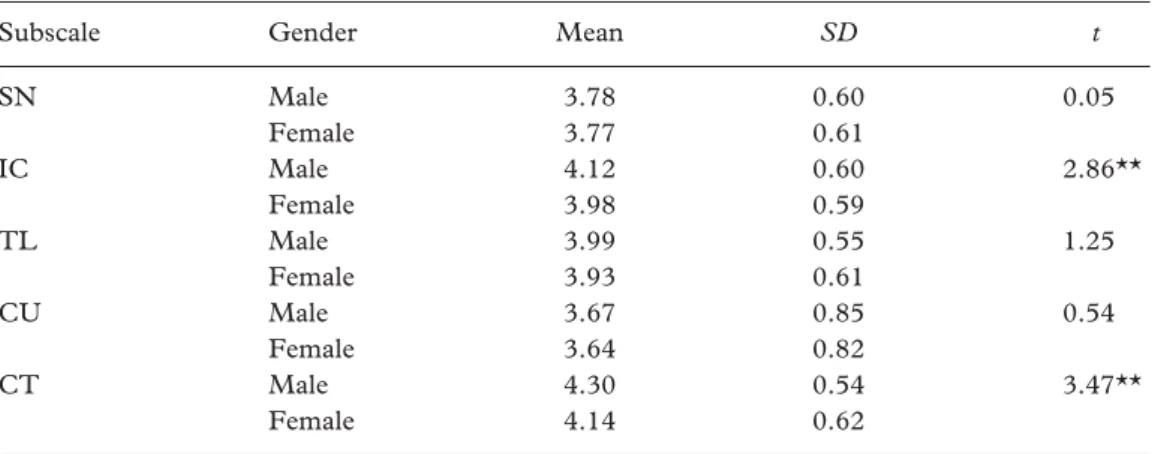
Further analysis of gender differences indicated that male students gained signifi-cantly higher scores than female students on the “Invented and creative nature” (4.12 versus 3.98) and “Changing and tentative feature” subscales (4.30 versus 4.14) (t = 2.86 and 3.47, respectively; p < 0.01). For the other three subscales, mean scores from male and female students were not statistically different (Table 3).
Correlations of SEV Dimensions
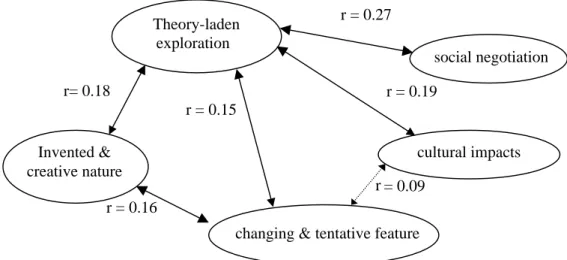
The correlations among the five dimensions are presented in Table 4. The coefficients ranged between almost 0 and 0.27, indicating a high degree of independence for all subscales. An examination of significance revealed some interesting relationships among the SEV dimensions. Figure 1 maps the statistically significant relationships
Table 2. Students’ scores on each SEV subscale
Factor Mean SD Range
SN 3.77 0.60 1.67–5
IC 4.05 0.60 2.25–5
TL 3.96 0.58 2–5
CU 3.65 0.83 1–5
CT 4.22 0.59 2.33–5
Table 3. Gender differences on the subscales
Subscale Gender Mean SD t
SN Male 3.78 0.60 0.05 Female 3.77 0.61 IC Male 4.12 0.60 2.86** Female 3.98 0.59 TL Male 3.99 0.55 1.25 Female 3.93 0.61 CU Male 3.67 0.85 0.54 Female 3.64 0.82 CT Male 4.30 0.54 3.47** Female 4.14 0.62
Notes: male n = 301, female n = 312. ** p < 0.01.
based on the analyses presented in Table 3. The “Theory-laden exploration” dimen-sion was correlated with those of “Social negotiation,” “Cultural impacts,” “Chang-ing and tentative feature,” and “Invented and creative nature.” Results obtained from this measurement implied that students who recognized the theory-laden nature of scientific knowledge were more likely to appreciate the social negotiations in science community and to understand the invented, tentative, and cultural embedded feature of science. Therefore, the “theory-laden exploration” concept was probably the core component of all the SEV dimensions considered in this study. The philosophical perspective may also support this finding. The idea of the “theory-laden exploration,” possibly initiated by Kuhn (1962, 1970), plays an important role in shaping and developing the constructivist epistemology (Tsai, 1998b, 2003). For instance, because scientists’ research work is guided by their existing theories, the theories in different cultures may lead to different ways and thus different outcomes of scientific exploration. Also, the scientific investigation is based upon some existing, but tenta-tive, theoretical frameworks; therefore, the status of the derived knowledge is always changing.
Figure 1.The significant correlations among subscales
exploration social negotiation r= 0.18 Invented & creative nature cultural impacts r = 0.16 = 0.09 changing & tentative feature r = 0.15
r r = 0.27 Theory-laden
r = 0.19
Figure 1. The significant correlations among subscales
Table 4. The correlations among the subscales
SN IC TL CU CT SN 1 0.07 0.27** 0.00 0.03 IC 1 0.18** 0.01 0.16** TL 1 0.19** 0.15** CU 1 0.09* CT 1 Notes: * p< 0.05 ** p< 0.01
The dimension of “Social negotiation” has a relatively high correlation with the “Theory-laden” dimension, but not with others. A possible trend shown in students’ responses was that while referring to the idea that scientists share agreed paradigm in conducting investigations, students were likely to recognize that scientists’ research activities can be affected by their existing theories. In other words, these students believed that some major theories many scientists had high consensus would guide their research work. Except for the TL dimension, the SN dimension seemed to be much independent from the other aspects of SEVs.
Interview Results
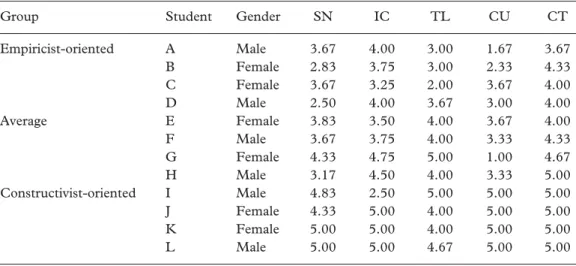
As stated previously, a total of 12 students were selected for in-depth interviews. These students came from three major groups on the basis of their sum scores of all subscales: the relatively “empiricist-aligned” SEV group, the “average” SEV group, and finally the “constructivist-oriented” group. Their individual scores on each subscale are presented in Table 5. According to Table 5, students categorized in the “empiricist” group, scoring the bottom 15% on the instrument, might also express some neutral or constructivist-oriented perspectives about their SEVs (e.g., Student A’s responses on the SN, IC, TL, and CT subscales). Therefore, this group was viewed as relatively “empiricist-aligned,” as their lower scores were compared with the students as a whole. In addition, their detailed scores on each subscale also supported aforementioned claims that students’ SEVs might be complicated and fragmented, and that they might express different positions across different SEV dimensions. For instance, Student A had 1.67 on the CU subscale, but gained 4.00 on the IC subscale in the 1–5 Likert scale. Student G attained 1 point on the CU subscale (indicating a strong agreement for an empiricist-aligned view for the subscale), but she had a score of 5 on the TL subscale (suggesting a strong agree-ment for a constructivist-oriented perspective for the subscale). Student I was
Table 5. The interviewed students’ scores on each subscale
Group Student Gender SN IC TL CU CT
Empiricist-oriented A Male 3.67 4.00 3.00 1.67 3.67 B Female 2.83 3.75 3.00 2.33 4.33 C Female 3.67 3.25 2.00 3.67 4.00 D Male 2.50 4.00 3.67 3.00 4.00 Average E Female 3.83 3.50 4.00 3.67 4.00 F Male 3.67 3.75 4.00 3.33 4.33 G Female 4.33 4.75 5.00 1.00 4.67 H Male 3.17 4.50 4.00 3.33 5.00 Constructivist-oriented I Male 4.83 2.50 5.00 5.00 5.00 J Female 4.33 5.00 4.00 5.00 5.00 K Female 5.00 5.00 4.00 5.00 5.00 L Male 5.00 5.00 4.67 5.00 5.00
another example. He had a low score of 2.5 on the IC subscale, the lowest score among the 12 interviewed students; however, he attained full scores (i.e., 5) on the TL, CU, and CT subscales. These findings, again, indicate the fact that this multi-dimensional instrument can tape students’ understandings on different aspects of scientific knowledge and more fully describe students’ SEV positions.
Students’ scores on the CU subscale also supported an aforementioned interpre-tation that they had possibly more diverse views about the cultural-dependent feature of knowledge development in science. For instance, students A and G had very low score on the subscale (1.67 and 1, respectively), but students I, J, K, and L all obtained a full score (i.e., 5) on the same subscale. The interview responses, which will be reported later, provide some insights into students’ thoughts about culture. Some students seemed to view science as universal knowledge transcend-ing cultural boundaries, while others reflected on the differences between western and eastern cultures. This reveals an interesting pattern that needs further investi-gation.
Students’ interview results could help the examination of the validity of the instru-ment. Some representative interview results on each dimension (or subscale) are presented in the following:
1. The role of Social Negotiation dimension (SN) (an overall average score of 3.77 on this subscale among all surveyed students):
Student D (subscale score, 2.5): I think the growth of scientific knowledge relies on the theories created by some “Big figures,” rather than on the discussion or negoti-ation in the scientific community. For example, Einstein proposed a new, perhaps very strange, theory might help science progress a lot.
Student G (subscale score, 4.33): The development of science requires the discus-sion and debates among scientists … Also, they can share some new findings for the further development of knowledge or theories.
Student K (subscale score, 5): Certainly, scientific knowledge is the product of the discussion, debates, and imagination among scientists … The scientific findings should be re-examined by other scientists … by either re-conducting the research or a lot of argumentations. Otherwise, everyone can simply propose some ideas or findings and then become a scientist.
2. The Invented and Creative nature of science dimension (IC) (an overall average score of 4.05 on this subscale among all students):
Student I (subscale score, 2.5): Scientific knowledge is clearly discovered. It is already there for scientists to find out.
Student E (subscale score, 3.5): In my view, some scientific knowledge is discov-ered, while some is invented. When relevant information is not enough, scientists may invent some theories to explain the natural phenomena. When information is quite enough, scientists can discover the knowledge.
Student K (subscale score, 5): Scientific knowledge is created by scientists to explain the natural phenomena. It allows scientists’ imagination. As it is invented, it may be changed later.
3. Theory-Laden exploration dimension (TL) (an overall average score of 3.96 on this subscale among all students):
Student C (subscale score, 2): The most important value of scientific knowledge comes from the objectivity of observations and data gathering. Scientists do not involve their personal perspectives when conducting research.
Student H (subscale score, 4): Scientists certainly have some expectations before the conduct of research. Their existing theories will influence their expectations. They also try to see what they expect.
Student L (subscale score, 4.67): Scientists’ work is influenced by their theories. These theories guide them to plan and implement the research work.
4. Cultural Impacts dimension (CU) (an overall average score of 3.65 on this subscale among all students):
Student G (subscale score, 1): I don’t think cultures have influences on scientists’ research work. Science is independent from cultural impacts. Science can be shared by different cultures.
Student A (subscale score, 1.67): People in all cultures have the same science. Correct scientific knowledge can work everywhere.
Student J (subscale score, 5): The process of developing scientific knowledge is affected by the cultures … For instance, Chinese culture has its way of explaining natural phenomena, although it is now not a widely acceptable way.
5. The Changing and Tentative feature of science knowledge (CT) (an overall aver-age score of 4.22 on this subscale among all students—almost all of the selected students for interviews showed an agreement with the constructivist view)
Student B (subscale score, 4.33): Science is always changing. When new findings are revealed, some existing theories may be changed.
Student H (subscale score, 5): When more and more advanced instruments are invented in the future, new observations and findings will be revealed. The scien-tific knowledge, now we perceive as correct, will be changed.
Student L (subscale score, 5): Contemporary scientific knowledge does not provide the final answer for the nature. It will be refined all the times.
These results indicate that students’ interview responses were quite consistent with their subscale scores as assessed by the instrument. As asserted by Tsai (1998a), the high consistency might stem from the interviewee selection strategy because students with maximum SEV variations and with somewhat extreme SEVs (i.e., the first and final groups) were selected for interviews. Nevertheless, the consistency also displayed adequate validity of the instrument in assessing students’ SEVs in various dimensions.
Teachers’ SEVs
After developing the instrument, it was used to survey the SEVs held by the science teachers of the students sampled in this study. The same question items (a total of
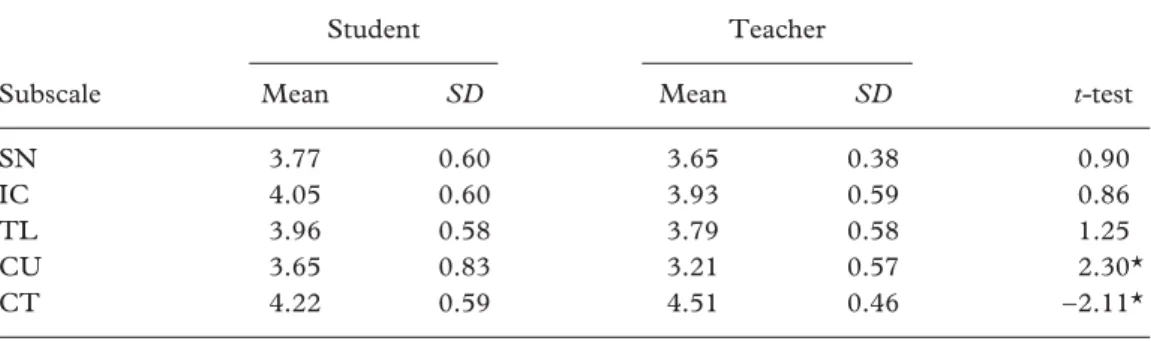
five subscales with 19 items) and scoring method were administered. Nineteen among the 21 science teachers responded to the SEV instrument. The teachers’ responses (n = 19) are presented in Table 6. Clearly, the teachers expressed a very strong agreement with the constructivist view on the changing and tentative feature of scientific knowledge (CT subscale, mean = 4.51, SD = 0.46). They had the lowest average scores on the “cultural impacts on science” subscale (CU subscale, mean = 3.21, SD = 0.57). Interestingly, students also gained the highest scores on the CT subscale, and had the lowest scores also on the CU subscale. Table 6 further made a series of comparisons between students’ and teachers’ SEVs. The science teachers seemed to have lower average score than their students on all subscales except the CT subscale. However, the t-test indicated no significant differences on the SN, IC, and TL subscales between students and teachers. Nevertheless, the students tended to show statistically more agreement toward the cultural impacts on science than did their science teachers (t = 2.30, p < 0.05). On the other hand, the teachers tended to more believe in the changing and tentative feature of scientific knowledge than did their students (t = −2.11, p< 0.05).
Conclusions and Implications
Data analysis indicated that the instrument developed in this study has satisfactory validity and reliability measures. The instrument contributes to existing tools for assessing various aspects of SEVs. Edmonson and Novak’s (1993) study had illustrated the dynamic relationship between students’ SEVs and their orientations to learning science. Students who held constructivist views tended to use meaningful learning strategies, while those who were identified as logical positivists or empiri-cists tended to be rote learners. The studies completed by Songer and Linn (1991), Linn and Eylon (2000) and Tsai (1998a, 1998c, 2000b) revealed similar findings that students with constructivist-oriented SEVs tended to attain better science learn-ing outcomes than those with empiricist-aligned SEVs. This multi-dimensional instrument, therefore, can be used to diagnose students’ SEVs, and provides detailed analyses of complicated interplays between SEVs and science learning.
Table 6. The differences between students’ and teachers’ SEVs
Student Teacher
Subscale Mean SD Mean SD t-test
SN 3.77 0.60 3.65 0.38 0.90 IC 4.05 0.60 3.93 0.59 0.86 TL 3.96 0.58 3.79 0.58 1.25 CU 3.65 0.83 3.21 0.57 2.30* CT 4.22 0.59 4.51 0.46 −2.11* Note: * p < 0.05.
Results showed different patterns of student responses on the five subscales. This group of students held probable diverse or even dichotomous views about the cultural-dependent feature of science (if the instrument was perceived as adequately developed). Our previous studies (Liu & Lederman, 2002; Tsai, 1999b) have found that Taiwanese students tended to hold a stereotypic image that science was a western product, and science did not exist in Chinese or Taiwanese culture. Such a stereotype is probably changed through experiencing the instruc-tion about the nature of science, especially from the historical perspective. It implied that students’ responses to the items seemed to reflect whether or not they have been offered opportunities to contact the issues regarding the history of science or relevant information. However, this implication needs more evidence to verify.
The other significant differences revealed in male and female students’ responses regarding the creative and tentative nature of the scientific knowledge were intrigu-ing. Some studies had implied that female students tended to show lower interest, participation, and less confidence in learning science than males (Jovanovic & King, 1998; Kenway & Gough, 1998; Trankina, 1993). This study further suggested that female students might not well perceive the creative and tentative nature of science as male students did. Tsai (1999b) argued that some instructional activities (e.g., STS-oriented instruction) could help female high school students acquire a better understanding about the constructivist-oriented epistemological views of science. If using this instrument as pre-tests and post-tests, researchers could easily examine the detailed changes of students’ SEVs through some instructional interventions. Different types of instruction (implicit and explicit) may have emphases on different SEV dimensions (Tsai, 1999b) and the growth of students’ views may vary. Clearly, this multi-dimensional instrument can be used to evaluate the effectiveness of rele-vant types of science instruction.
During the process of factor analysis, several question items were omitted due to low factor loadings. However, some of those items were previously considered as good ones that might elicit relevant SEVs. It is probable that the deleted items contained complex concepts that might influence respondents’ thinking and responses. There is a need to design more items for some subscales.
Recent research has awakened an interest in cross-cultural comparisons in people’s views of science (Cobern, 1989; Gutman, 1992). Examples such as Aiken-head and Otsuji’s (2000) study showed that Japanese teachers viewed science as a holistic perspective about natural phenomena, while Canadian teachers tended to hold a reductionist view of science. Apparently, it is worthwhile to compare the differences and commonalities among populations with different cultural back-grounds. The instrument developed in this study contained many question items focused on the social and cultural-dependent nature of the scientific enterprise, which may generate more productive data to help science educators understand the cultural differences of SEVs.
This study also conducted some student interviews for their SEVs. The results showed that students’ interview responses were fairly consistent with their subscale
scores as assessed by the instrument. The inconsistency between questionnaire results and interview narratives found in Tsai’s (1999b) study has greatly reduced when the SEVs are classified into multiple dimensions for exploration as shown in the current study. The use of multiple dimensions in representing student SEVs in the instrument may enhance its validity.
Finally, this study also surveyed a few teachers’ SEVs and revealed some SEV similarities and differences held by teachers and their students. Teachers might project their personal interpretations of the science enterprise into classroom discourse (Lederman, 1992; Ogunniyi, 1982; Tsai, 2002) and students might be exposed implicitly to their teachers’ SEVs (Kichawen, Swain, & Monk, 2004). Further studies should be conducted to examine how teachers’ SEVs may be related to their teaching beliefs, strategies, and behaviors. The instrument reported in this study can be used to investigate a large group of teachers’ SEVs with different dimensions that would help explore some tactics to improve teachers’ SEVs and then probably to influence students’ learning.
Acknowledgement
Funding of this research work was supported by National Science Council, Taiwan, under grant numbers NSC 93-2511-S-009-006 and NSC 93-2511-S-009-007.
References
Abd-El-Khalick, F., Bell, R.L., & Lederman, N.G. (1998). The nature of science and instructional practice: Making unnatural natural. Science Education, 82, 417–436.
Abd-El-Khalick, F., & Lederman, N. G. (2000). Improving science teachers’ conceptions of nature of science: A critical review of the literature. International Journal of Science Education,
22, 665–701.
Aikenhead, G. S., & Otsuji, H. (2000). Japanese and Canadian science teachers’ views on science and culture. Journal of Science Teacher Education, 11(4), 277–299.
American Association for the Advancement of Science. (1990). Science for all Americans. New York: Oxford University Press.
Cobern, W. W. (1989). A comparative analysis of NOSS profiles on Nigerian and American preservice, secondary science teachers. Journal of Research in Science Education, 26, 533–541. Duell, O. K., & Schommer-Aikins, M. (2001). Measures of people’s beliefs about knowledge and
learning. Educational Psychology Review, 13, 419–449.
Duschl, R.A. (1990). Restructuring science education. New York: Teachers College Press.
Edmondson, K. M., & Novak, J. D. (1993). The interplay of scientific epistemological views, learning strategies, and attitudes of college students. Journal of Research in Science Teaching,
30, 547–559.
Gutman, M. C. (1992). Cross-cultural conceits: Science in China and the West. Science as Culture,
3, 208–239.
Hatcher, L. & Stepanski, E. J. (1994). A step-by-step approach to using the SAS system for univariate
and multivariate statistics. Cary, NC: SAS Institute.
Hodson, D. (1993). In search of a rationale for multicultural science education. Science Education,
77, 685–711.
Jovanovic, J., & King, S. S. (1998). Boys and girls in the performance-based science classroom: Who’s doing the performing. American Educational Research Journal, 35, 477–496.
Kenway, J., & Gough, A. (1998). Gender and science education in schools: A review “with attitude.” Studies in Science Education, 31, 1–30.
Kichawen, P., Swain, J., & Monk, M. (2004). Views on the philosophy of science among under-graduate science students and their tutors at the university of Papua New Guinea: Origins, progression, enculturation and destinations. Research in Science & Technological Education,
22(1), 81–98.
Kuhn, T. S. (1962, 1970). The structure of scientific revolutions. Chicago, IL: University of Chicago Press.
Lederman, N. G. (1992). Students’ and teachers’ conceptions of the nature of science: A review of the research. Journal of Research in Science Teaching, 29, 331–359.
Lederman, N. G., & O’Malley, M. (1990). Students’ perceptions of tentativeness in science: Development, use, and sources of change. Science Education, 74, 225–239.
Linn, M. C., & Eylon, B. (2000). Knowledge integration and displaced volume. Journal of Science
Education and Technology, 9, 287–310.
Liu, S.-Y. (2003). Conceptions of the nature of science and worldviews of preservice elementary
science teachers in Taiwan. Unpublished doctoral dissertation, Oregon State University,
Cornwallis, Oregon.
Liu, S.-Y., & Lederman, N. G. (2002). Taiwanese gifted students’ views of nature of science.
School Science and Mathematics, 102, 114–123.
McComas, W. F. (Ed.). (1998). The nature of science in science education: Rationales and strategies. Dordrecht, The Netherlands: Kluwer Academic Publisher.
McComas, W. F., Clough, M., & Almazroa, H. (1998). The role and character of the nature of science in science education. In W. F. McComas (Ed.), The nature of science in science education:
Rationales and strategies (pp. 3–39). Dordrecht, The Netherlands: Kluwer Academic Publisher.
Millar, R., & Osborne, J. (1998). Beyond 2000: Science education for the future. London: King’s College.
National Research Council. (1996). National science education standards. Washington, DC: National Academy Press.
Ogunniyi, M. B. (1982). An analysis of prospective science teachers’ understanding of the nature of science. Journal of Research in Science Teaching, 19(1), 25–32.
Pomeroy, D. (1993). Implications of teachers’ beliefs about the nature of science: Comparison of the beliefs of scientists, secondary science teachers, and elementary science teachers. Science
Education, 77, 261–278.
Ryan, A. G., & Aikenhead, G. S. (1992). Students’ preconceptions about the epistemology of science. Science Education, 76, 559–580.
Songer, N. B., & Linn, M. C. (1991). How do students’ views of science influence knowledge integration? Journal of Research in Science Teaching, 28, 761–784.
Trankina, M. L. (1993). Gender differences in attitudes toward science. Psychological Reports, 73, 123–130.
Tsai, C.-C. (1998a). An analysis of scientific epistemological beliefs and learning orientations of Taiwanese eighth graders. Science Education, 82, 473–489.
Tsai, C.-C. (1998b). Science learning and constructivism. Curriculum and Teaching, 13, 31– 52.
Tsai, C.-C. (1998c). An analysis of Taiwanese eighth graders’ science achievement, scientific epistemological beliefs and cognitive structure outcomes after learning basic atomic theory.
International Journal of Science Education, 20, 413–425.
Tsai, C.-C. (1999a). “Laboratory exercises help me memorize the scientific truths”: A study of eighth graders’ scientific epistemological views and learning in laboratory activities. Science
Education, 83, 654–674.
Tsai, C.-C. (1999b). The progression toward constructivist epistemological views of science: A case study of the STS instruction of Taiwanese high school female students. International
Journal of Science Education, 21, 1201–1222.
Tsai, C.-C. (2000a). Relationships between student scientific epistemological beliefs and percep-tions of constructivist learning environments. Educational Research, 42, 193–205.
Tsai, C.-C. (2000b). The effects of STS-oriented instruction on female tenth graders’ cognitive structure outcomes and the role of student scientific epistemological beliefs. International
Jour-nal of Science Education, 22, 1099–1115.
Tsai, C.-C. (2002). A science teacher’s reflections and knowledge growth about STS instruction after actual implementation. Science Education, 86, 23–41.
Tsai, C.-C. (2003). The interplay between philosophy of science and the practice of science education. Curriculum and Teaching, 18, 27–43.
Appendix: The instrument of assessing scientific epistemological views used in this study
The role of social negotiation (SN)
1. New scientific knowledge acquires its credibility through the recognition by many scientists in the field.
2. Scientists share some agreed perspectives and ways of conducting research. 3. The discussion, debates, and result sharing in science community is one major
factor facilitating the growth of scientific knowledge.
4. Valid scientific knowledge requires the acknowledgement of scientists in rele-vant fields.
5. Contemporary scientists have agreed upon an acceptable set of standards with which to evaluate scientific findings.
6. Through the discussion and debates among scientists, the scientific theories become better.
The invented and creative nature of science (IC)
1. Scientists’ intuition plays an important role in the development of science. 2. Some accepted scientific knowledge comes from human’s dreams and hunches. 3. The development of scientific theories requires scientists’ imagination and
creativity.
4. Creativity is important for the growth of scientific knowledge.
The theory-laden exploration (TL)
1. Scientists can make totally objective observations, which are not influenced by other factors.*
2. Scientists’ research activities will be affected by their existing theories.
3. The theories scientists hold do not have effects on the process of their explora-tion in science.*
The cultural impacts (CU)
1. People from different cultural groups have the same method of interpreting natural phenomena.*
2. Scientific knowledge is the same in various cultures.*
3. Different cultural groups have different ways of gaining knowledge about nature.
The changing and tentative feature of science knowledge (CT)
1. The development of scientific knowledge often involves the change of concepts. 2. Contemporary scientific knowledge provides tentative explanations for natural
phenomena.
3. Currently accepted science knowledge may be changed or totally discarded in the future.
* presented in an empiricist-aligned or positivist-oriented perspective.