L SCHEME
FOR REG1
CODING
ALGORITHM*
Hsu-Tung Chen, Liang-Gee Chen, Sheng-Chieh Huang, Tsung-Han Tsai, Hao-Chieh Chang
Department of Electrical Engineering, National Taiwan University,
No.
1,
Roosevelt Road, Sec. 4,
Taipei, Taiwan, R.O.C.
ABSTRACT
Based on the packet loss rate and the frame loss rate experiment in the practical Intemet environment, a novel adaptive network control scheme is proposed for region-based hybrid coding
algorithm. In comparison with the sourcdchannel coding [ 11, this
adaptive network control scheme is presented to reduce 50%
frame loss rate during the Intemet weak day use condition and
58% frame loss rate during the Internet peak day use condition.
In the video conference system, the compressed multimedia data
is transmitted to receiver by network. The network need to
guarantee the real time transmission, low delay, and low packet
loss rate. In the past researches, there are the sourcdchannel
coding [l] and automatic repeat request (ARQ) [2] mechanism to
solve the packet loss problem. In this paper, a novel adaptive network control scheme is applied to the region-based hybrid coding algorithm [3] for solving the packet loss problem of the multimedia compressed data.
ASED HYBRID CODING
ALGORI~HM
There are two important properties in the video conference system. In first, camera is fixed in video conference application. Secondly, a partocipant appears in front of an unchanged background, and moves almost slowly. The information of the background can be removed for reducing the computation loading and the network congestion.
'This work was supported by National Science Council under
Grant NSC 87-2215-E-002-028.
0-7803-4455-3/98/$10.00
01998
IEEE
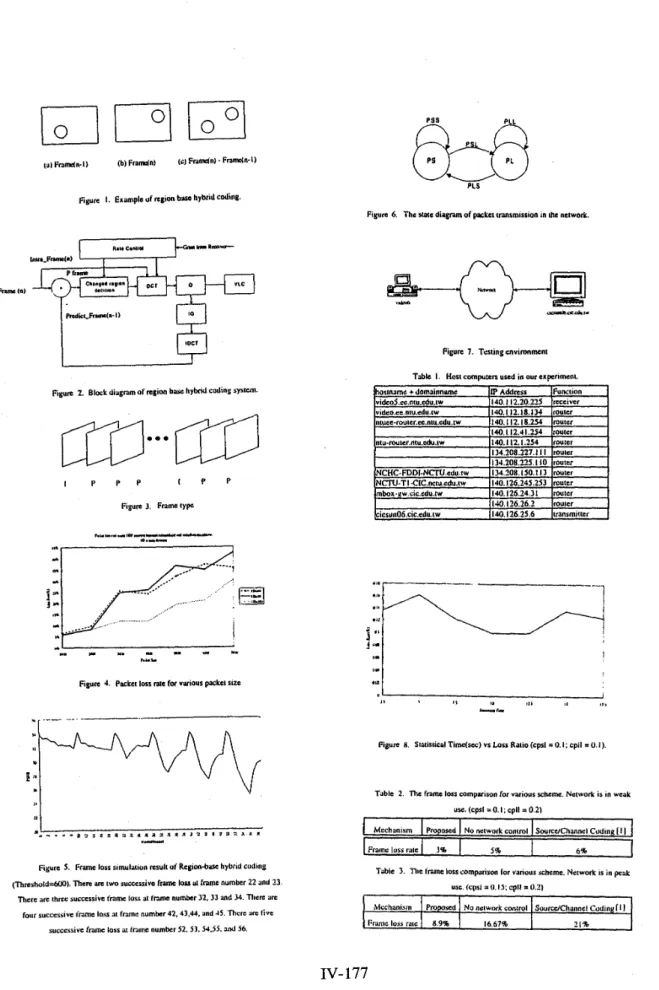
The following example explains the region-based hybrid coding algorithm. A circle object moves in consecutive frames from lower left to upper right as shown in Fig.
1
(a) and Fig 1 (b). The difference of two frames is shown in Fig. 1 (c). It is obvious that the changed region is the two circle objects. It is only necessary to encode the two objects.The region-based hybrid coding algorithm is shown in Fig. 2. In
the coding algorithm, the I frame is Intra-Frame(n) and the P
frame is Frame(n)
-
Predict-Frame(n-I) as shown in Fig. 3. TheI frame coding algorithm and P frame coding algorithm are
described in the following:
2.1
I frame Coding Algorithm
The I frame is encoded as still image. The following is the I
frame coding algorithm:
Step
I:
Iframe is divided into many 8x8 blocks.Step 2: For each block in Iframe, do the following processing:
{ do-SxS-DCC quantization; run length coding; VLC;
add to transmission buffer container; )
2.2 P frame Coding Algorithm
Step I: Pframe is divided into many 8x8 blocks.Step 2: Calculate MAE (Mean Absolute Error) for per block. Step 3: For each block in Pframe, do the following processing:
{ $(MAE > threshold)
{ do-8xS-DCZ
quantization; run length coding;
VLC;
add to transmission buffer container;))
The MAE (Mean Absolute Error) and threshold are used to
identify the changed blocks in
P
frame.3. ADAPTIVE NETWORK CONTROL
SCHEME
The design of the adaptive network control scheme is based on
the packet loss rate of the UDP protocol experiment and the frame loss simulation of the region-based coding algorithm on
Internet. The two experiments are described in the following:
3.1 The Loss Rate
of
the
UDP
Protocol
Experiment:
This experiment is performed at peak use of network and heavy load of cicsun06 (load=1.2) as shown in Fig.4. The TD is time division (ms) between the two successive packet transmissions. There are two results shown in this figure. In first, the larger packet size will have higher probability of packet loss at the same time division. Secondly, the longer time division will have lower packet loss rate at the same packet size.
3.2 The Frame
Loss Simulation of the Region-
based Coding Algorithm
Without retransmission of the lost frame, the Fig. 5 represents that the packet arrival process is highly correlated with the successive packet drops. When there are more than three successive frames loss, the PSNR value of the frame will decline quickly and video quality will be poor.
3.3 Adaptive Network Control Scheme Using First
Order Markov Model
According the above two experiments result, a novel adaptive network control scheme is proposed for the region-based hybrid coding algorithm. In this scheme, the successive packet loss
condition can be detected and the frame loss rate can controlled with the adjustment of the frame transmission threshold.
The packet
loss
condition can be detected with the transmission status between the transmitter and the receiver. After receiver gets a video packet, it sends a grant to transmitter immediately.So, the packet loss condition can be counted and the first order Markov model is used to simulate the behavior of the network as shown in Fig. 6 . In this model, there are two states and four parameters described as following:
PS:
the state of a successful packet.PL: the state of a loss packet.
P S S the probability of a successful packet following a successful packet.
P S L the probability of a successful packet following a loss packet.
PLS: the probability of a loss packet following a successful packet.
PLL: the probability of a loss packet following a loss packet. The two equations can be got as following:
PSS
+
PSL = 1P L L + P L s = l
Based on the above model, a novel network control scheme is designed to adapt the video transmission. This scheme degrades
or upgrades the server transmission rate depending on feedback message from receiver on the control channel.
When the PSL and the PLL are small, it is hard to become the PL
status from the
PS
status, but easy to become thePS
status from the PL status. The two conditions ( PSL>
cpsl ) or ( PLL > cplf )are used as criteria. The cpsl and cpll criteria parameters are the
probability of the packet loss and used to detect the satus of the packet loss. The cpsl and cpll criteria parameters are adjusted
according the necessity of the users.
If the packet loss rare is high, the rhreshold of the region-based hybrid coding algorithm is increased to reduce the data rate of the
changed blocks in the P frame. When network is in weak use, the threshold is decreased to get high video quality. The adaptive network control scheme is described as following:
if (( PSL > cpsl ) or ( PLL
>
cpll)) ( if (threshold<
800) threshold+=
50; else ( if (framerate>
1) framerate = frame - I ; ) ) else ( if (threshold>
100) threshold -= 50; else(if (framerate < IO)
framerate = frame
+
1 ;) )The threshold is bounded between 150 and 800. If the threshold is equal to 800 and packet loss rate is still high, theframerate will be reduced to low down the packet loss rate. The transmitter adjusts PSS and PLL according to statistical data from receiver. Based on the practical Intemet experiment, the network condition can be represented by sampling data each 10 seconds.
4. EXPERIMENTAL RESULTS
The adaptive network control scheme is tested on the 120 seconds salesman sequence. The spatial resolution is 320x240 for 8-bits gray level. The Internet transmission experiments are carried out between the video5 workstation and the cicsun06 workstation as shown in Table. 1. and in Fig. 7.
As shown in Fig. 8.. the different statistical time is used to
understand network condition by applying the adaptive control scheme. When the 10 seconds are chosen as the statistical time, the packet loss rate is the lowest.
Table. 2. shows the comparison of frame loss rate for various scheme. Testing time is at 08:OOam during periods of weak day use. Table. 3. represents the frame loss rate during network peak day use. Because the network control scheme can adjust coding strategy according network condition, the frame loss rate is lower
than sourcdchannel coding in [l]. In comparison with the sourcdchannel coding in [ 11, this adaptive network control scheme is presented to reduce 50% frame loss rate during the Internet weak day use condition and 58% frame loss rate during the Internet peak day use condition.
5.
CONCLUSIONS
A novel adaptive network control scheme for region-based hybrid
coding algorithm is proposed in the above sections. The first order Markov model is used to control the network behavior. It is to meet the bandwidth of the network by minimizing data rates of transmitter. From the results of the real Internet experiments, this adaptive network control scheme is superior to the source/ channel coding.
REFERENCE
[l]. J. C. Bolot et al., "Adaptive Error Control for Packet Video in the Internet," Proceeding of IEEE Intemal Conference on Image Processing, 1996.
[2]. Y. Chen etal., "A robust Coding Scheme for Packet Video," IEEE trans. on Commun., Vol. 40, No. 9, pp. 149 1
-
1501, 1992.[3]. H. T. Chen, P. C. Wu, Y. K. Lai, and L. G. Chen, "A multimedia Video Conference System: Using Region-based Hybrid Coding," IEEE trans. on Consumer Electronics, Vol. 42, No. 3, pp. 781-786, 1996,
Figure 1. Ermple of region b;w hybrid coding.
.
?I
Figure 6. The swtc diagnm of p r k e t transmission in the nelwork.
*
(
Fipre 7. Testins environment
Table I. Host computers used in our experiment.
Mechanism Frame loss rete
Figure 2. Block dkegnm of region b i w hybrid codins system.
Proposed No network control SourcdChannel Cdinp. l l I
5% 6%
3%
I P P P I P P
Figure 3, Fnme type
Fnmc Ius> retc
I IJo.126.16.2 !muter
icsun06.cic.edu.tw ]I4Olo.l26.2S.6 Itransmitter
16.67% 11%
1.9%
L
L. Y Y. .u .D u *.
hub.
Figure 4. Packet loss rate for vuriour packet stze
Figure 5. Frame loss simulation result of Region-bilx hybrid coding
(Threshold=MX)). There are two successive frame IOU ul f m c number 22 and 23 Thcrc arc thrcc successive fnme loss at fnme number 32.33 Md 34. There arc
four succes?itve ireme loss x f r a m number 42,4394. and 45. There arc live
successive f m e loss ill frame number 52. SI. 54.55. and 56.
nu
r---~
Figure n. Statistical T i m d x c ) VI Loss Ratio (cpsl = 0.1: cpll = 0.1).