行政院國家科學委員會專題研究計畫 成果報告
台灣地區肝細胞癌資料庫之建立與管理
研究成果報告(完整版)
計 畫 類 別 : 個別型 計 畫 編 號 : NSC 95-3112-B-002-029- 執 行 期 間 : 95 年 08 月 01 日至 96 年 07 月 31 日 執 行 單 位 : 國立臺灣大學醫學院臨床醫學研究所 計 畫 主 持 人 : 陳祈玲 共 同 主 持 人 : 周玉山、廖運範、黃秀芬 計畫參與人員: 碩士級-專任助理:蔡依倫、黃映嘉 處 理 方 式 : 本計畫可公開查詢中 華 民 國 96 年 10 月 31 日
行政院國家科學委員會補助專題研究計畫成果報告
台灣地區肝細胞癌資料庫之建立與管理
計畫類別:■ 個別型計畫 □ 整合型計畫
計畫編號:NSC95-3112-B-002-029
執行期間:95 年 8 月 1 日至 96 年 7 月 31 日
計畫主持人:陳祈玲
共同主持人:廖運範、陳培哲、黃秀芬
計畫參與人員:蔡依倫、黃映嘉
成果報告類型(依經費核定清單規定繳交):□精簡報告 ■完整報告
本成果報告包括以下應繳交之附件:
□赴國外出差或研習心得報告一份
□赴大陸地區出差或研習心得報告一份
□出席國際學術會議心得報告及發表之論文各一份
□國際合作研究計畫國外研究報告書一份
處理方式:除產學合作研究計畫、提升產業技術及人才培育研究計畫、列
管計畫及下列情形者外,得立即公開查詢
□涉及專利或其他智慧財產權,□一年□二年後可公開查詢
執行單位:台灣大學醫學院臨床醫學研究所
中 華 民 國 96 年 10 月 31 日
中文摘要:
關鍵詞:肝細胞癌,關聯式資料庫,資料及檢體庫。 肝細胞癌是最常見的一種肝臟腫瘤,在國內每年約有 8000 人被診斷罹患此種癌症,除了少數 可以手術切除的有較好的存活率外,目前對此癌症並無有效的治療方法。雖然國內已有許多 專家學者投入對此癌症的研究並獲得不錯的進展,但因為要收集足夠的肝細胞癌病人需要投 入大量的人力物力,而且僅以個人或單一家醫院要收到足量更是曠日費時。為了能加速對肝 細胞癌的成因有更進一步的瞭解並進而加速對於其治療方法的研究進展,我們計畫將遵循一 個標準流程有系統地自全國各合作醫院收集肝細胞癌相關檢體及病人的臨床、病理及流行病 學的相關資料,並據此建立一個大型的檢體庫及資料庫供全國的研究學者申請使用。預計這 些合作醫院將包含北、中、南各大醫學中心以期能收集到最大量的病人並有全國地域上之代 表性。所有在這些合作醫院被新診斷出來的肝細胞癌病人,在住院期間我們的研究護士將會 在取得書面的同意書後對病人作一些個人基本資料的問卷調查及抽血。對於將被安排接受手 術的病人,我們將會在病人接受肝臟手術時,收集手術摘除下來的肝臟組織並送往病理部給 病理科醫師作病理學上的檢查及初步之處理後,速將組織予以低溫冷凍保存並送往組織庫。 這些病患的問卷及病例摘要下來的臨床資料,都定期的被送到我們的資料處理中心由中心的 人員完成資料的處理並放入電腦中,資料中心的工作人員並會依此建立一個關聯式資料庫, 並利用微軟結構式查詢語言(Structured Query Language SQL) 來處理任何與資料有關的問 題,如資料的取得、新增、更新、刪除、彙整與統計運算,建立一個資料倉儲(data warehousing), 以便能為研究人員提供一致性的資料。此外我們也已建立一個網站提供有興趣者可以對這個 資料庫有初步的了解,並在此網站上下載申請表格以提出申請使用。一個由專家組成的委員 會將會定期審查並決議是否予以所要求之資料及檢體。當這個委員會決定要給予檢體及資料 時,資料及檢體庫會將所需的檢體及相關資料整理好並提供給申請者。這將會是全亞洲,甚 至全世界第一個也將會是最大的針對肝細胞癌所設立的檢體及資料庫,相信對台灣肝癌的研 究將會有極大的助益。我們希望不只建立肝細胞癌的檢體及資料庫,更希望藉此結合各大醫 學中心及研究機構內所有對肝癌研究有興趣的學者成立一個研究網絡 (research network),進 而加速肝癌的研究並進一步找到有效的治療方法。本年度關聯式資料庫 (relational data base management system) 的架構已建立完成,並開始將所蒐集到的資料整理並儲存於此資料庫中 以便開始資料庫管理之運作,截至目前爲止,我們已收集超過 2000 名肝癌病人,包括 1139 個腫瘤檢體、1685 個血液檢體以及 1047 個 Paraffin block 在這個檢體庫中,而這些病人的 臨床以及流行病學以及病理相關資料皆已儲存在資料庫中,隨時提供申請者使用。目前已有 五位研究者申請使用檢體及其相關資料,這是台灣第一個也是最大的針對肝細胞癌所設立的 檢體及資料庫。當一切都以建立完成並且可以很平順的運轉後,我們期待每年可以爭取到維 持此資料庫順利運轉的經費,以便繼續對台灣地區肝癌的長期研究有所貢獻。Abstract:
Key words: Liver cancer, Quality control procedure, relational database management system.
Up to date, there were more than 2000 liver cancer patients consented to either the
questionnaire interview and chart review or blood drawn and obtain their liver tissues. Among them, there were 1139 dissected liver tissues,1685 blood samples, and 1047 paraffin blocks had been collected and stored.
Quality control procedure
Quality assurance of the epidemiological data will be conducted by research assistant from coordinating center to repeat 10% of the questionnaire interviewed via phone interview of the patients. For clinical and pathological data, the research assistant in coordinating center will also repeat 10% of the chart review. The research nurses keyed in the questionnaire and chart
abstraction by using ACCESS data entry forms specifically designed for this study and the data was sent to this core once a month. This computerized data was then be checked by computer software for logic and other possible errors and will be sent back to the research nurses for correction.
Database establishment progress Hardware, software purchasing and setup:
All computer hardware including server, workstations, data archive back-up system and the MSSQL software we finally decided to use for the designing of the relational database were all purchased and setup and ready for use.
Relational database establishment:
We have established a database using relational database management system that will contain the clinical, pathological and virological information collected from the HCC patients collected for the main tissue bank. This relational database management system has the ability to query data spatially and provide internet accessibility via the World Wide Web, and will provide direct access to the approved users. So far, there were more than 200 study subjects whose questionnaire and chart review information had been uploaded in the database and can be queried via internet.
Web site establishment
The apache web server is used for rendering content for browser-based client applications. There are four components of the website including FAQ management system, application management system, database inquiry management system and database data management system. Once the dataset is verified, the metadata will be automatically posted to our WWW site. The goal will be using this web site as the primary mode of information dissemination for all principal investigators of this network, scientists, the scientific community, and the public. This web site is currently under designing and construction and will be open in the end of June.
The database inquiry management system will include a standardized list of keywords that forms the foundation for searching the WWW site. A user may either travel through the hierarchy of research categories to locate datasets of interest or may utilize a keyword search. When viewing
the data, the structure of our home page allows the approved users to access the data files containing the actual rows and columns of data that they are allowed to access.
Interaction with other two cores
The database management core is closely interacted with the other two cores- virological core and pathological core because all three cores are intertwined and need to work together to assure the success of this network. We meet monthly and communicate via phone to solve the problems encountered together.
BACKGROUND:
Hepatocellular carcinoma (HCC) was ranked the fifth in cancer incidence and it was estimated that one million cases occur and causes half a million deaths annually worldwide(1). In Taiwan, approximately 8000 were newly diagnosed with liver cancer annually, and among those with histological confirmation, around 80% were hepatocellular carcinomas and was ranked first in cancer incidence and mortality in men. Vaccination program against hepatitis B virus (HBV) infection have reduced HCC incidence in Taiwanese children (2,3) but the incidence of HCC is rising in developed countries – mostly due to hepatitis C virus infection (4). Although major viral and environmental risk factors have been identified, the oncogenic pathways leading to malignant transformation of liver cells remains unclear (5). For these reasons, HCC was picked up as the target diseases by NRPGM. HCC has been investigated by many individual investigators from different institutes and has produced some very interesting results that require more comprehensive study to confirm or to advance. As most previous studies were carried out by individual PI, the study cases and samples are limited and sometimes, not so representative. Besides, each PI had to collect and organize their cases, databases for several years before he or she could start. In addition, outcome-related research requires human tissue specimens in sufficiently large numbers and with long follow-up times to allow statistically valid analyses. Most current studies are limited by small sample sizes, single institution selection bias, and limited follow-up data. These have become a major bottleneck for a high-quality and international competitive research program. Therefore it is very important to establish an HCC research network consists of four components including clinical, pathological, virological and epidemiological as well as biospecimens on a large group of newly diagnosed HCC patients. The key for the success of this network is a high-quality, efficient and user-friendly computerized database that can link the above mentioned four components together. We propose to set up a relational database management system that has the ability to query data spatially and provide internet accessibility via the World Wide Web, and will provide direct access to the approved users. This will enable us to provide secure, long-term data storage and make high quality data easily accessible to other researchers in a timely fashion. We will achieve these goals through three techniques: an organized and efficient data tracking system, secure data archiving procedures, and fully utilizing World Wide Web (WWW) site. In the end, we hope to establish and maintain an open and friendly HCC research platform to encourage Taiwan’s investigators to join, to use this resource to conduct more high-quality basic and clinical research.
Access to well-qualified tissue and other biospecimen is fundamental to a high quality biomedical research on hepatocellular carcinoma (HCC) in Taiwan. It has been hampered by the limited access to large numbers of HCC tissue samples with associated clinical and outcome data. Therefore we propose a plan to develop a HCC-network for the exchange of de-identified clinical information on consented tissue samples available to national researchers.
Specific aims for this year:
1. To maintain the database and provide secure, long-term data storage and make high quality data easily accessible to other researchers in a timely fashion. We will achieve these goals through three techniques: an organized and efficient data tracking system, secure data archiving procedures, and fully utilizing World Wide Web (WWW) site.
2. To establish and maintain an open and friendly HCC research platform to encourage Taiwan’s investigators to join, to use this resource to conduct more high-quality basic and clinical
research and feedback their main research outcome to the network.
3. The data management center will seek ways to cooperate with the Bioinformatics core facility of NRPGM in order to facilitate outcome study data originated from this project like genomic study.
METHOD:
There are approximately 2000 microscopically confirmed, newly diagnosed hepatocellular carcinoma cases per year that are registered in the National Cancer Registry in Taiwan. We plan to form a nation-wide study network including major teaching hospitals with substantial number of HCC patient, which cover north, central, southern parts of the most populated areas in Taiwan. We expect to collect approximately 700 HCC cases per year from these collaborating hospitals and with a total of 2000 in the 3-year study period.
Operation Procedure:
The hepatologists in the collaborating hospitals, once they make a diagnosis of HCC on their patients, will inform the coordinating center which will be located at a designated central office. The research assistant who will be assigned to each hospital will be in charge of: 1) making contact with the patient once the diagnosis is made and asking for the permission to participate in the study by signing the informed consent 2) conducting a personal interview using a structured questionnaire 3) for resectable HCC, obtaining tumor tissue either directly from operation room or from pathology lab and the complete pathological reports 4) for both resectable and non-resectable HCC, blood specimen will be collected whenever possible.
The questionnaire will then be sent to the coordinating center and be re-checked, coding and key-in in the study site and the coordinating center will perform double-check and all the quality control procedures and manage the data. The blood samples will be processed first in the hospital and then sent to the virological core for assay and stored. Resected tissue will be snap-frozen and then transported to the pathological core lab for processing and storage, while a series of quality control
procedures will be adapted to ensure the quality. All information accrued from virological and pathological cores will be sent back to the data management core for storage. To overcome the possible difficulty of identifying all newly diagnosed HCC cases in the collaborating hospitals, we will periodically check with National Cancer Registry and National Major Diseases Certification System. It is possible that the cases we collect are other histological type of liver cancer rather than HCC since we need to start all the data collection procedure as soon as a clinical diagnosis is made to ensure tumor tissue can be obtained right after the operation, and this may occur before the pathological confirmation. A great effort will be made to obtain HCC tumor tissue for as many cases as possible since this is the main goal of this study. For non-resectable HCC, we will try to obtain their biopsy specimen whenever possible and feasible. Figure 2 shows a flowchart of all biospecimens and data collection procedure.
Clinical, Pathological, Virological and Epidemiological Information:
At each hospital, research nurse will conduct standardized interviews with the patients using structured questionnaire as soon as the HCC diagnosis is made and better before the operation. This risk factor questionnaire will include questions on demographic information (age, gender, National ID numbers etc.), lifestyle questions (cigarette smoking, alcohol consumption, dietary habits dtc.), personal medical history (major diseases like hypertension, diabetes, cardiovascular disease etc.) as well as family history of liver disease (a similar questionnaire can be seen in appendix). In addition, detailed clinical information as well as final pathological information will be obtained by direct review of and extraction of information from patient charts. Clinical information will include: age at diagnosis, clinical TNM stage and grade of the disease, treatment received etc. Pathological information will include: final pathological diagnosis, pathological staging, tumor size, lymph node examination results etc.
Quality control procedure
Quality assurance of the epidemiological data will continue to be conducted by research assistant from coordinating center to repeat 10% of the questionnaire interviewed via phone
interview of the patients. For clinical and pathological data, the research assistant in coordinating center will also repeat 10% of the chart review. The research nurses keyed in the questionnaire and chart abstraction by using ACCESS data entry forms specifically designed for this study and the data was sent to this core once a month. This computerized data was then be checked by computer software for logic and other possible errors and will be sent back to the research nurses for
correction.
Data Delivery, Verification and Storage
Contact with the participating investigator in virological, pathological cores and coordinating center is maintained throughout the duration of the project and data are submitted to the data
management core no later than three months following the end of the study. For experiments that use the biospecimens provided by this network, data are submitted directly to the data management core. The staff in data management core will then verify each dataset with its data description to ensure that there are no inconsistencies between the actual data and the metadata. Immediately following verification, we will update the database by storing each dataset as a separate table in the database and relating it to the metadata via a dataset ID code. Daily data management will
accomplish the collection of new data, extension of existing spatial data, and maintenance of metadata.
Data Archiving
The staff in data management core will archive the data and metadata by storing them together in one ASCII text file per dataset. Using this format for data storage ensures readability over the long term. Datasets are stored redundantly via the following methods to provide security against accidental data loss or destruction:
1. Hard disk on a workstation (daily) 2. Back-ups on CD (weekly)
3. Archives on high-density 8-mm cartridges (quarterly)
Data will be saved in duplicate on 8 mm tapes in the original format, with the second copy stored in a separate location from the first.
Usage and Application for data:
This HCC research network will run and operate for at least three years. To save the time and trouble, the database and tissue/biospecimen bank will be open to HCC investigators from participating medical centers and other facilities under a fair mechanism supervised by a research committee who are an independent group of experts in HCC and other fields of biomedical research. In addition, this network will form a communication and discussion forum to expedite the research. A web site will be established to serve as interface between tissue bank and researchers who are interested in using the tissue and associated information. Instructions on how to apply for specimens and information will be available from the web site. Investigators will be requested to first submit a letter of intent indicating their proposed study and tissue requirements. This letter of intent will be reviewed by the research committee strictly on the basis of scientific merit, by taking into consideration the aims, significance and methodology of the proposed research, and they will also consider the statistical strength of the proposal and the utilization of clinical and epidemiological data. The center will approve requests based on the recommendations of the research committee and the availability of specimens. Once the application is approved, the Coordinating and Data Management center will be in charge of identification and procurement of
samples for the request and transfer to the researcher. The detailed flowchart for application procedure is shown in Figure 3.
Tissues will be provided on a rotating basis and given a priority as follows:
• First priority will be investigators from collaborating institutes or peer-reviewed funded investigators, including investigators from NRGGM and NSC.
• Second priority will be new investigators and investigators developing new projects in academic centers or non-profit research institutions.
• Third priority will be other investigators including those who are associated with for-profit research institutions.
Data Access
Some of the descriptive statistics (e.g., number of the cases collected, numbers of tissues available, etc.) of the metadata will be made publicly accessible as soon as they are received from the investigator. Datasets will be available to the authorized users after the review committee permits their access. All the variables that may lead to the identification of the study subjects (e.g., National ID numbers, names, phone numbers and address etc.) will be concealed and some restriction of data access will be implemented depending on the requests.
Data Tracking System
The implementation of data tracking system will start before data are collected. Investigators must submit a request form to the data manager as part of the procedure to conduct research. The form contains specific information about the study that the data manager logs into the tracking system. After entering preliminary information about a project into the system, the data manager tracks the progress of the dataset from data collection through to availability on the WWW site. This data tracking system will increase the efficiency of data entry into the system, improves project-wide awareness of the scope of research activities at any given point in time, and improves overall data quality by providing consistency among datasets through standardized data collection forms.
How can this network support the ongoing HCC research projects and the future ones?
There are several ongoing HCC research projects that can also benefit from this network because we can supplement them with the cases we collect either their risk factor and clinical
information or biospecimens needed for laboratory work. For future HCC study, we will be able to provide not only biospecimens and related information, but a network to serve as a platform to integrate all studies together to save their time and money.
RESULT:
Coordinating and Patient Recruitment Progress:
We have proposed and successfully set up a HCC research network (Taiwan Liver Cancer Network, TLCN) in the current three-year project (2005-2008). Originally, we planned to include 13 medical centers covering whole Taiwan for this network. However, due to a big reduction of the grant budget, we finally only coordinated five major medical centers from north to south of Taiwan (NTUH, CGMH-Linko, VGH-Taichung, CGMH-Kaohsiung, VGH-Kaohsiung) to recruit HCC patients for TLCN. We have collected resectable and non-resectable HCC cases in these collaborating medical centers, using standardized protocols to collect biosamples and clinical information. The structure and the flowchart for data and biosample collection are shown in Figure 1 and 2.
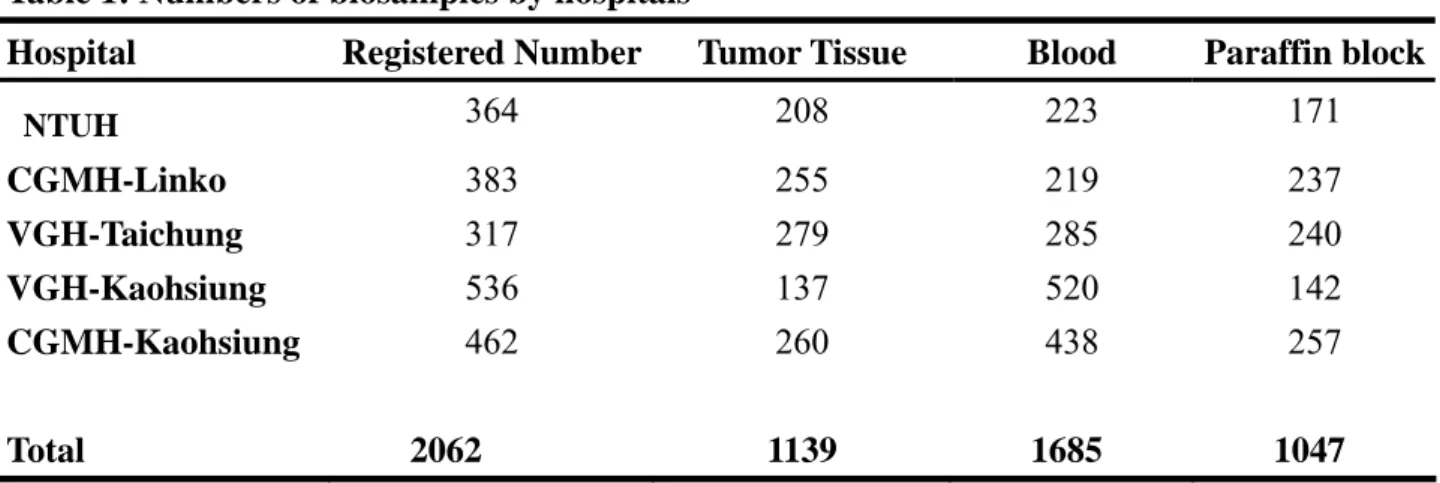
Up until July 2007, there were more than 1700 liver cancer patients consented to either the questionnaire interview and chart review or blood drawn and obtain their liver tissues. Among them, there were 1139 dissected liver tissues, 1685 blood samples and 1047 paraffin blocks that had been collected and stored (Table 1).
Database Management Progress:
We have established a database using relational database management system that will contain the clinical, pathological and virological information collected from the HCC patients collected for the main tissue bank. This relational database management system has the ability to query data spatially and provide internet accessibility via the World Wide Web, and will provide direct access to the approved users. So far, there were more than 1500 study subjects whose questionnaire and chart review information had been uploaded in the database and can be queried via internet.
Quality assurance of the epidemiological data is conducted by research assistant from coordinating center to repeat 10% of the questionnaire interviewed via phone interview of the patients. For clinical and pathological data, the research assistant in coordinating center also repeats 10% of the chart review. The research nurses keyed in the questionnaire and chart abstraction by using ACCESS data entry forms specifically designed for this study and the data was sent to this core once a month. This computerized data was then be checked by computer software for logic and other possible errors and will be sent back to the research nurses for correction.
There were 1281 recruited patients whose data were all checked and uploaded in the database stored in internet and ready for query. Among them, 1116 were pathologically (84%) or clinically (image plus elevated α fetoprotein level) confirmed HCC cases. Table 2 shows that these HCC patients were aged between 13and 88 with a mean age of 58, and 80% of them were male. Most
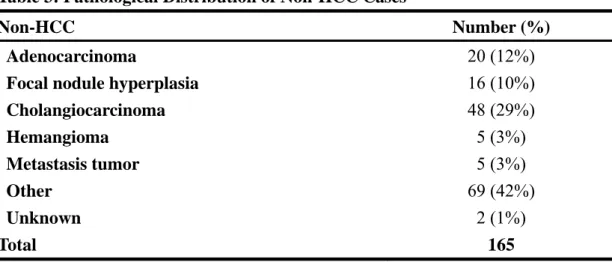
of them (69%)were with Grade II and Grade III tumors. About 59% of them were HBV carriers and 22% were anti-HCV positive, and 18 (2%) of them were positive for both HBsAg and anit-HCV. Half of the tumors when diagnosed were within 2 cm to 5 cm range and about a quarter of them had tumor greater than 5 cm. There were 178 (16%) patients with more than one family members affected with HCC (Table 2). Among 165 resected tumor tissue we have collected, 48 (29%) were pathological confirmed cholangiocarcinoma, 20 (12%) were adenocarcinomas and 16 (10%) were focal nodule hyperplasia (Table 3).
User Application Progress:
The database and tissue/biospecimen bank was open to HCC investigators since the beginning of 2007, from participating medical centers and other facilities under a fair mechanism supervised by a research committee who are an independent group of experts in HCC and other fields of biomedical research. A web site was established to serve as interface between tissue bank and researchers who are interested in using the tissue and associated information. Instructions on how to apply for specimens and information and “Letter of Intent”(LOI) as well as “Biosample Request” forms are available from the web site. The investigators are requested to first submit a LOI indicating their proposed study and tissue requirements and this LOI will be reviewed by the research committee strictly on the basis of scientific merit, by taking into consideration the aims, significance and methodology of the proposed research, and they will also consider the statistical strength of the proposal and the utilization of clinical and epidemiological data. The center approves requests based on the recommendations of the research committee and the availability of specimens. Once the application is approved, the investigators need to submit a “Biosample request form” indicating types and numbers of biosamples they request. The Coordinating and Data Management center is charge of identification and procurement of samples for the request and transfer to the researcher. Up to date, there were four PI’s submitted LOI’s and three of them were approved and one is under reviewing process, and the shipping of biosamples and related clinical information are under way. Almost all basic scientists dealing with tumorigenesis from various medical schools are all very interested in this network when we introduce our network to them. And they all said they will apply for it in the near future. The most important next step to keep this network highly functional is to ensure the high quality of the biosamples and build-up a thorough clinical database especially the follow-up and survival data. Currently, the TLCN has successfully collect more than 1700 patients within 2 years, and has been opened for biosample application since the beginning of 2007. This network will be able to achieve its initial goal of 2000 cases in its first 3-year- period. In addition, this network will form a communication and discussion forum to expedite the research.
DISSCUSSION:
There are several ongoing HCC research projects that can also benefit from this network because we can supplement them with the cases we collect either their risk factor and clinical information or biospecimens needed for laboratory work. For future HCC study, we will be able to provide not only biospecimens and related information, but a network to serve as a platform to integrate all studies together to save their time and money.
Promote broad applications and usage of the biosamples and the database
The user committee of TLCN will meet regularly for managing the sample application and the operation of the network. Currently, the TLCN already established the standard application process and all of the necessary paper works. We will make an effort to let researchers be aware of this network by sending emails or putting advertisement on the entrance website of NSC and NRPGM.
Promote feedback of data from researchers back to TLCN
The ultimate goal of this network is to provide good quality biosamples and related
information to researchers to help them fasten up their research. In addition, we will ask them to feedback the data resulting from using biosamples from this network after the researchers think it’s ready to share with other researchers. We are collaborating with Advance Bioinformatic Core of NRPGM to be prepared to expand this network to not only providing biosamples and related clinical, epidemiological and virological information, but to serve as a platform for information center for HCC research.
It is anticipated that there will be more and more applicant for this HCC tissue network for all kinds of biosamples or clinical and epidemiological data. In order to meet the requests from PIs of various background, high quality and abundant biosamples along with good clinico- pathological data is necessary. This 3-year's project is aimed to fulfill this goal. We will also keep a good data base of all the application's proposal and results if available, so that new applicants can search their interested field and avoid unnecessary or repetitive studies. By using data and specimens from this network, the PI’s will be able to fasten up their research progress without the time-consuming data collection process. In addition, this collection will avoid the selection bias that is typical of single institution collections, which improves the likelihood that results obtained from studies using samples from this network will be more directly representative and applicable to HCC patients in Taiwan. Because we plan to continuously update follow-up and outcome information, studies performed using our biosamples can also be updated in future years as new follow-up data become available. The success of this tissue bank and network will be measured by the ability of the investigators it provides tissue and information to conduct meaningful and scientifically break-through studies on hepatocarcinogenesis pathways, prognostication and treatment of hepatocellular carcinoma.
Figure 1:
RN
Q Interview &
Standardized
Chart Abs
.
Hardcopies of Q
and Abs. Forms:
Check for errors
Computerized data:
Logic check
10%
Double Key-in
Periodically
Reinforcement
10% Key Questions
Re-interview
Re-abstract
Errors
Errors
Errors
Quality Control Procedures
Quality Control Procedures
Table 1: Numbers of biosamples by hospitals
Hospital Registered Number Tumor Tissue Blood Paraffin block
NTUH 364 208 223 171 CGMH-Linko 383 255 219 237 VGH-Taichung 317 279 285 240 VGH-Kaohsiung 536 137 520 142 CGMH-Kaohsiung 462 260 438 257 Total 2062 1139 1685 1047
Table 2: Numbers of HCC cases by hospital and Selected characteristics uploaded in database Hospitals and Selected Characteristics Number (%) / Mean (SD)
NTUH 181 (16%)
Chang-Kung Memorial Hospital Linko 264 (24%) Taichung Veteran Hospital 230 (21%) Chang-Kung Memorial Hospital Kaoshiung 253 (23%) Kaoshiung Veteran Hospital 188 (17%)
Total 1116 Age 58.1 (12.4) (13~88) Gender Male 896 (80%) Female 220(20%) Grade I 62 (6%) II 333 (30%) III 438 (39%) IV 94 (8%) Can’t be accessed 33 (3%) Unknown 156 (14%) Viral Status
HBsAg (+) and anti-HCV (-) 653 (59%) HBsAg (-) and anti-HCV (+) 241 (22%) HBsAg (+) and anti-HCV (+) 63 (6%) HBsAg (-) and anti-HCV (-) 18 (2%)
Unknown 141 (13%) Tumor size < 2 cm 274 (25%) > 2 - < 5 cm 526 (47%) > 5 cm 234 (21%) Unknown 82 (7%)
Numbers of family member affected with HCC
0 677 (61%)
1 140 (13%)
> 2 38 (3%)
Table 3: Pathological Distribution of Non-HCC Cases
Non-HCC Number (%)
Adenocarcinoma 20 (12%)
Focal nodule hyperplasia 16 (10%) Cholangiocarcinoma 48 (29%) Hemangioma 5 (3%) Metastasis tumor 5 (3%) Other 69 (42%) Unknown 2 (1%) Total 165
REFERENCE:
1. El-Serag HB. Hepatocellular carcinoma: an epidemiologic view. J Clin Gastro 2002;35(Suppl. 2):S72-S78.
2. Chang MH, Chen CJ, Lai MS, Hsu HM, Wu TC, Kong MS et al. Universal hepatitis B vaccination in Taiwan and the incidence of hepatocellular carcinoma in children. N Engl J Med. 1997;336:1855-9.
3. Chang MH, Shau WY, Chen CJ, Wu TC, Kong MS, Liang DC et al. Hepatitis B vaccination and hepatocellular carcinoma rates in boys and girls. JAMA. 2000;284:3040-3042
4. El-Serag HB, Mason AC. Rising incidence of hepatocellular carcinoma in the United States. N Engl J Med. 1999;340:745-50.
5. Kao JH, Chen DS. Recent research progress in hepatocellular carcinoma. J Formos Med Assoc 2002;101:239-48.