國 立 交 通 大 學
電信工程學系
博 士 論 文
高速下行鏈路封包存取及多載波直接序列
分碼多重接取系統之無線電資源管理
Radio Resource Management for HSDPA and
MC-DS-CDMA Systems
研 究 生:張志文
指導教授:王蒞君博士
and MC-DS-CDMA Systems
A Dissertation Presented to The Academic Faculty
By
Chih-Wen Chang
In Partial Fulfillment
of the Requirements for the Degree of
Doctor of Philosophy in Communication Engineering
Department of Communication Engineering National Chiao-Tung University
April, 2006
I
摘要
無線電資原管理在未來的無線電系統中之服務品質控制及系統容量
最佳化扮演了很重要的角色。在本篇論文中,我們針對了寬頻分碼多
重接取之高速下行鏈路封包存取系統及多載波直接序列分碼多重接
取系統中幾個重要的無線電資源管理議題進行深入的研究。
在本論文的第一個部份中,我們著重在寬頻分碼多重接取之高速
下行鏈路封包存取系統所使用的平行多通道停止並等待混合自動重
傳要求機製中所謂的停滯問題之研究。當停滯的情況發生時,接收端
會持續的等待一個不會被重傳的封包並且中斷了將媒體存取控制層
所接收的封包送往上層的程序。依據一個新的評量標準,稱為間空處
理時間,我們提出了一個評量三種停滯防止機製的分析模型,其中包
含了以計時器為基礎、以視窗為基礎以及以指示器為基礎的停滯防止
機製。從分析及模擬結果中我們發現,以指示器為基礎之停滯防止機
製是三種機製中表現最好的方法。最後,我們更進一步分析以指示器
為基礎之停滯防止機製在交錯式排程法中的系能表現。我們所提出的
分析方法具有下列幾個優點:(一)有助於決定平行多通道停止並待
待自動重傳要求之通道數目以及在限定間空處理時間情況下,系統之
允許控制政策可容納的滿載用戶數量;(二)有助於媒體存取控制層
II
及視窗大小之設計。
在本論文的第二部份中,我們則探討了多載波直接序列分碼多重
接取系統中之功率控制、碼通道分配以及子載波功率分配之無線電資
源管理議題。首先,我們分析了功率控制錯誤及完整多重接取干擾對
多速率多載波直接序列分碼多重接取系統中上行鏈路的影響。我們發
現(一)功率控制錯誤會加重多重接取干擾的嚴重性,反之亦然;
(二)
增加頻域及時域之展頻增益會增加系統對功率錯誤反應的敏感度;
(三)較大的功率控制錯誤所會造成的多樣性增益下降在頻域展頻比
時域展頻更為顯著。
而在於多載波直接序列分碼多重接取系統的下行鏈路中,我們發
展了一套以多重接取干擾系數為基礎之干擾防止碼通道分配法。多重
接取干擾系數可用來衡量加諸於多載波直接序列分碼多重接取系統
中碼通道的干擾量。藉由數據結果的呈現,我們驗證了干擾防止碼通
道分配法能有效的降低碼通道所受的干擾量並且維持高水準的碼通
道允許率。再者,我更進一步提出了混合子載波功率與碼通道分配法
以提升在多重接取干擾下之訊號品質。
總結而言,我們探討了使用了多通道停止並等待自動重傳要求之
III
關係。再者,我們分析了多載波直接序列分碼多重接取系統上行鏈路
在功率控制誤差及多重接取干擾雙重影響下的性能表現。最後,我們
研究多載波直接序列分碼多重接取系統下行鏈路中如何在干擾量較
小的條件下分配碼通道以及如何分配子載波功率之議題。
Abstract
Radio resource management (RRM) plays a key role in quality-of-service (QoS) con-trol and capacity optimization for future wireless systems. In this dissertation, we investigate several critical RRM issues in the high speed downlink packet access (HS-DPA) of wideband code division multiple access (WCDMA) system and the multi-carrier direct-sequence code division multiple access (MC-DS-CDMA) system.
In the first part of this dissertation, we focus on the stall issue of the paral-lel multi-channel stop-and-wait (SAW) hybrid auto-retransmission request (HARQ) mechanism for the HSDPA of WCDMA system. In the stall situation, the receiver may wait for a packet that will be no longer be sent by the transmitter and stops delivering the medium access control (MAC) layer packets to the upper layer. We present an analytical approach to evaluate three stall avoidance schemes the timer-based, the window-timer-based, and the indicator-based schemes based on a newly proposed performance metric gap processing time. We demonstrate that the indicator-based stall avoidance scheme outperforms the timer-based and the window-based schemes. Finally, we further derive the closed-form expression for the gap-processing time of the indicator-based stall avoidance mechanism when applying the interleaving schedul-ing. The developed analytical approaches have several advantages including: (1) help determine a proper number of processes for the parallel SAW HARQ mechanisms and the number of acceptable fully loaded users for an admission control policy subject to the gap processing time constraint; (2) facilitate the MAC/radio link control (RLC) cross-layer design for the RLC timeout and RLC window size.
In the second part of this dissertation, we focus on the RRM issues in the MC-DS-CDMA systems, including power control, code admission, and subcarrier power allocation. We first analyze the joint effects of the power control errors (PCE) and the complete MAI in the multi-rate uplink MC-DS-CDMA system. We find that (1) the effect of PCE can exacerbate the impact of the complete MAI, or vice versa;
(2) increasing frequency or time domain spreading gain results in a higher sensitivity to the PCEs; (3) a larger PCE can possibly make the frequency domain diversity diminish faster than the gain obtained from the time-domain spreading.
For the downlink MC-DS-CDMA system, we develop an MAI-coefficient-based interference avoidance code assignment scheme. The MAI coefficient can be applied to quantitatively predict the MAI effect imposed on a particular code in a multi-rate MC-DS-CDMA system. We show that the proposed interference avoidance code assignment method can effectively reduce the MAI in a multi-rate MC-DS-CDMA system, while maintaining a very good call admission rate. Moreover, we further propose a joint subcarrier power allocation and code assignment scheme to optimize the received signal quality in the presence of MAI.
In summary, we investigate the performance tradeoffs between the gap process-ing time and throughput of the multi-process SAW HARQ mechanism in the HSDPA system. Moreover, we analyze the joint effects of PCEs and MAI in the uplink MC-DS-CDMA system. Finally, we investigate how to assign a code with less MAI and how to allocate the subcarrier power allocation for the downlink MC-DS-CDMA sys-tem.
Acknowledgments
First of all, I would like to express my deeply gratitude to my advisor Dr. Li-Chun Wang. Not only the important insights to research problems, encouragement, and support, he also taught me how to have a strong will power and how to be optimistic. Without his advice, guidance, comments, and all that, this work could not have been done. He indeed opened a door to the future for me.
Special thanks to my mates of Wireless Network Lab in NCTU. They gave me kindly help in many aspects. Anderson Chen, seated next to me, gave me many helpful suggestions. Yi-liang Lin and Tom Lee encouraged me every time when I felt frustrated. Wei-Cheng Liu helped me very much in the mathematic class. All in all, I was so lucky to have all the lab mates.
In the end, I have a lovely lady, I-Tin Lee, to thank. She gave me sincerely mental and emotional support and kept me company during this long journey. She indeed made every thing colorful. I would like to thank my dear sisters, too. They always warmly back me up. Most importantly, I am deeply indebted to my great parents whose love and understanding have been accompaning me through these years.
Abstract i
Acknowledgements iii
List of Tables viiii
List of Figures x
Glossary of Symbols xv
1 Introduction 1
1.1 Problem and Solution . . . 2
1.1.1 Analysis of Stall Avoidance Mechanisms for HSDPA in the WCDMA Systems . . . 3
1.1.2 Analysis of a Stall Avoidance Mechanism with Scheduling for HSDPA in the WCDMA System . . . 4
1.1.3 Effects of Power Control Errors and Complete Multiple Access Interference on Uplink MC-DS-CDMA . . . 5
1.1.4 Interference Avoidance Code Assignment for Downlink MC-DS-CDMA . . . 7
1.1.5 Joint Interference Avoidance Code Assignment and Subcarrier Power Allocation for Downlink MC-DS-CDMA . . . 10
1.2 Dissertation Outline . . . 11
2 Background and Literature Survey 12
2.1 HSDPA . . . 12
2.1.2 Multi-Process SAW HARQ Mechanism . . . 13
2.1.3 The Stall Issue in Parallel SAW HARQ . . . 14
2.1.4 Gap Processing Time . . . 14
2.2 MC-DS-CDMA . . . 18
2.2.1 Literature Survey . . . 18
2.2.2 Power Control Mechanism . . . 20
2.2.3 Two-Dimensional OVSF Code Tree . . . 21
2.2.4 Grid Representation of a 2-D Code Tree . . . 22
3 Analysis of Stall Avoidance Mechanisms for HSDPA in the WCDMA Systems 27 3.1 The Stall Avoidance Schemes . . . 28
3.1.1 Timer-Based Scheme . . . 28
3.1.2 Window-Based Scheme . . . 29
3.1.3 Indicator-Based Scheme . . . 32
3.2 Performance Measure and System Assumptions . . . 34
3.2.1 Gap Processing Time . . . 34
3.2.2 Assumptions . . . 37
3.3 Analysis of Timer-Based Stall Avoidance Scheme . . . 37
3.4 Analysis of Window-Based Stall Avoidance Scheme . . . 41
3.5 Analysis of Indicator-Based Stall Avoidance Scheme . . . 47
3.6 Numerical Results and Discussions . . . 55
3.6.1 Average Gap Processing Time of the Timer-Based Scheme . . 57
3.6.2 Average Gap Processing Time of the Window-Based Scheme . 60 3.6.3 Average Gap Processing Time of the Indicator-Based Scheme 64 3.6.4 Probability Mass Function of the Gap Processing Time . . . . 68
3.7 Chapter Summary . . . 70
4 Analysis of a Stall Avoidance Mechanism with Scheduling for HSDPA
4.1 ISA Mechanism . . . 72 4.1.1 Principles . . . 72 4.1.2 Problem Formulation . . . 75 4.1.3 Example . . . 80 4.2 Analysis . . . 85 4.3 Numerical Results . . . 92 4.4 Chapter Summary . . . 96
5 Effects of Power Control Errors and Complete Multiple Access Interfer-ence on Uplink MC-DS-CDMA 99 5.1 System Model . . . 99
5.1.1 Transmitted Signal . . . 99
5.1.2 Received Signal . . . 102
5.1.3 Assumption . . . 103
5.2 Effect of Complete MAI on BER Performance . . . 105
5.2.1 Motivation . . . 105
5.2.2 BER Performance . . . 107
5.2.3 The Statistics of the Decision Variable Yo,s . . . 111
5.3 Effect of PCE on BER Performance . . . 113
5.4 Numerical Results . . . 114
5.4.1 Discussions . . . 115
5.4.2 Impact of Complete MAI and PCE on Bit Error Probability . 118 5.4.3 Impact of Various Time-domain and Frequency-domain Spread-ing Factors . . . 120
5.4.4 Impact of Complete MAI and PCE on Capacity . . . 125
5.5 Chapter Summary . . . 126
6 Interference Avoidance Code Assignment for Downlink MC-DS-CDMA 129 6.1 Problem Formulation . . . 129
6.2 System Model . . . 130
6.2.1 Transmitted Signal . . . 130
6.2.2 Received Signal . . . 132
6.3 Impact of MAI . . . 133
6.3.1 MAI from High Data Rate Users (To > Tk(X)) : . . . 134
6.3.2 MAI from Low Data Rate Users (To ≤ Tk(X)) : . . . 135
6.3.3 MAI Coefficient . . . 137
6.4 Interference Avoidance Code Assignment Strategy . . . 138
6.4.1 Principles . . . 138
6.4.2 Example . . . 140
6.5 Simulation Results . . . 144
6.5.1 Simulation Setup . . . 144
6.5.2 Gaussian Approximation of MAI . . . 147
6.5.3 Comparison of Code Assignment Strategies . . . 147
6.6 Chapter Summary . . . 149
7 Joint Interference Avoidance Code Assignment and Subcarrier Power Allocation for Downlink MC-DS-CDMA 151 7.1 System Model . . . 152
7.1.1 Transmitted Signal . . . 152
7.1.2 Received Signal . . . 153
7.2 Subcarrier Power Allocation and Interference Analysis . . . 155
7.2.1 Subcarrier Power Allocation . . . 155
7.2.2 Interference Analysis . . . 156
7.2.3 MAI Coefficient . . . 160
7.3 Joint Subcarrier Power Allocation and Interference Avoidance Code Assignment Strategy . . . 161
7.3.1 Principles . . . 161
7.4.1 Simulation Setup . . . 164
7.4.2 Effect of Subcarrier Power Allocation . . . 166
7.4.3 Effect of Interference Code Assignment Strategy . . . 168
7.5 Chapter Summary . . . 170
8 Concluding Remarks 171 8.1 Gap Processing Time Analysis of Stall Avoidance Mechanisms for HS-DPA . . . 173
8.2 Performance of an Indicator-based Stall Avoidance Mechanism for HS-DPA with Interleaving Scheduling . . . 174
8.3 The Impact of Power Control Errors and Complete Multiple Access Interference on Uplink MC-DS-CDMA . . . 175
8.4 An Interference Avoidance Code Assignment Strategy for Downlink MC-DS-CDMA . . . 175
8.5 A Joint Subcarrier Power Allocation and Interference Avoidance Code Assignment Strategy for Downlink MC-DS-CDMA . . . 176
8.6 Suggestions for Future Research . . . 177
Appendices 179
A Derivation of V ar[R(τk(X), θ(X)k,i,j)] in (5.18) 179
B Derivation of V ar[R(To, θ(X)k,i,j)] in (5.19) 181
C Performance of Downlink MC-DS-CDMA 183
D Performance of Downlink MC-DS-CDMA with Subcarrier Power
Allo-cation 185
Bibliography 188
3.1 An example of the statuses in a 4-process SAW HARQ mechanism for a Type-II gap being detected by receiving new packets in three processes and old packet in one process. . . 33
3.2 The Simulation Environment . . . 56
4.1 Nomenclatures of symbols . . . 74
4.2 An example of a Type-II gap being removed by the indication of re-ceiving both new and old packets in a 4-process SAW HARQ mechanism. 81
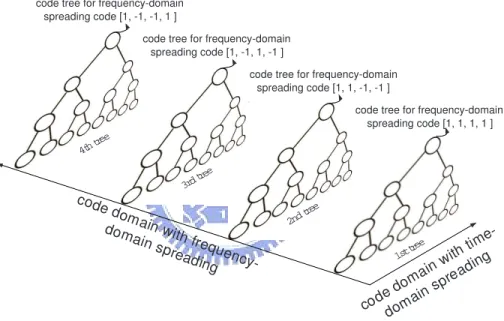
1.1 A two dimensional OVSF code tree when the frequency-domain spreading factor is four. . . 9
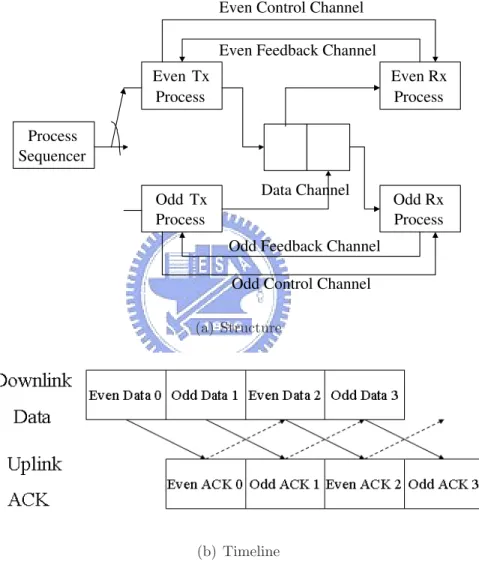
2.1 The structure and timeline of the dual-process SAW H-ARQ mechanism. . . 15
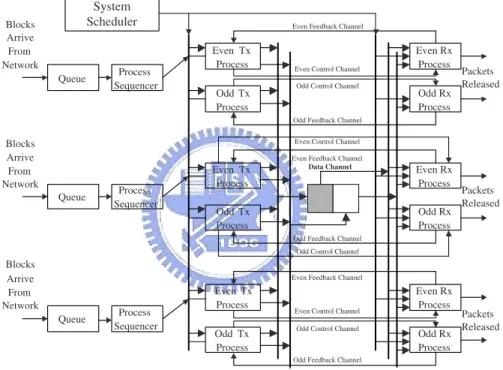
2.2 The dual-process SAW HARQ mechanism with multiple users. . . 16
2.3 A example of the stall issue in a qual-process SAW H-ARQ, where packet 0 is lost and packets 1, 2, and 3 are successfully received in the reordering buffer. . . 17
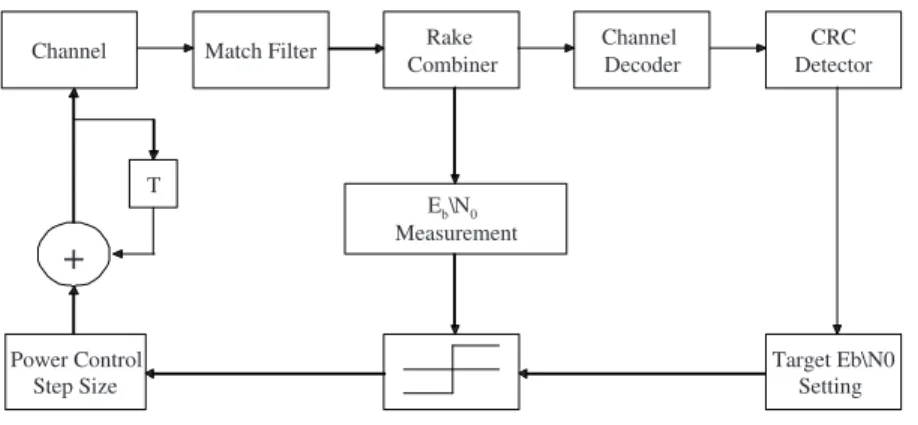
2.4 The block diagram of the closed-loop power control scheme. . . 21
2.5 An one dimensional OVSF code tree. . . 23
2.6 An illustrating example of allocating a code with frequency-domain spreading factor
M = 4 and time-domain spreading factor SF = 8 in the 2D code tree. . . . 25 2.7 The grid representation of Fig. 2.6 for the code resources in the MC-DS-CDMA
system with time and frequency domain spreading. . . 26
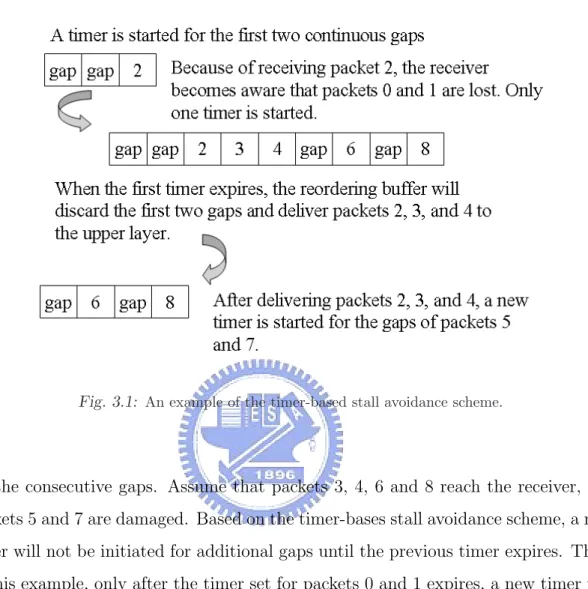
3.1 An example of the timer-based stall avoidance scheme. . . 29
3.2 An example of the window-based stall avoidance scheme with the detection window size equal to seven. . . 31
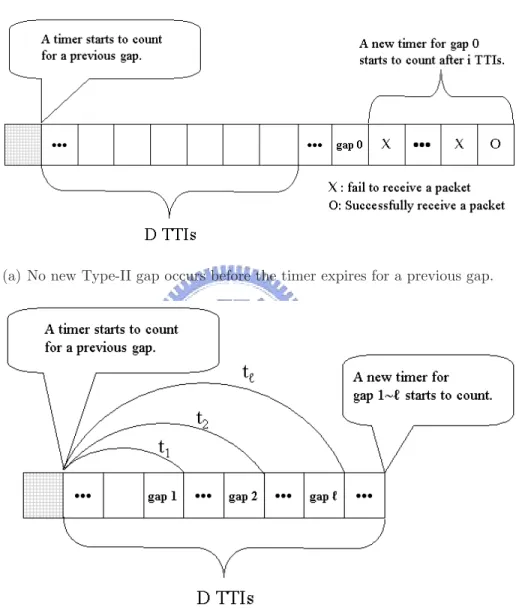
3.3 Two scenarios for the timer-based stall avoidance scheme to remove a Type-II gap. 39
3.4 An illustrative example of the seat allocation in a detection window for the window-based stall avoidance scheme. . . 42
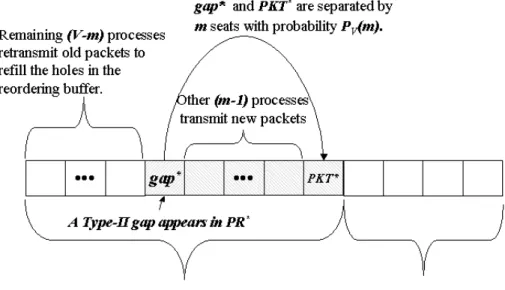
3.5 An illustration for the gap processing time of the indicator-based stall avoidance scheme. . . 51
3.7 The average gap processing time of the timer-based stall avoidance scheme with different timer expiration for the 4-process SAW HARQ mechanism in the Rayleigh fading channel with Doppler frequency of 100 Hz. . . 58
3.8 The number of acceptable fully loaded users of the timer-based stall avoidance scheme versus the numbers of allowable retransmissions (hr) for various number
processes (V ) in the parallel SAW HARQ mechanism subject to a constraint of gap processing time 100 TTIs. . . 61
3.9 The average gap processing time of the window-based stall avoidance scheme with different window sizes for the 4-process SAW HARQ mechanism in the Rayleigh fading channel with Doppler frequency of 100 Hz. . . 62
3.10 The number of acceptable fully loaded users of the window-based stall avoidance scheme versus Eb/N0 with various number minimum allowable retransmissions
(hm= 3, 4, 5) in the 4-process SAW HARQ mechanism subject to a gap processing
time constraint of 100 TTIs. . . 65
3.11 The number of acceptable fully loaded users of the window-based stall avoidance scheme versus Pe with various number processes (V ) in the parallel SAW HARQ
mechanism subject to a gap processing time constraint of 100 TTIs. The minimum allowable retransmission (hm) is three. . . 66
3.12 Effect of the number of processes in the multi-process SAW HARQ mechanism on the gap processing time for the indicator-based avoidance scheme in the Rayleigh fading channel with Doppler frequency of 100 Hz . . . 67
3.13 The number of acceptable fully loaded users of the indicator-based stall avoidance scheme versus Pe with various number processes (V ) in the parallel SAW HARQ
mechanism subject to a gap processing time constraint of 100 TTIs. . . 69
3.14 The probability mass functions of the gap processing time for the timer-based, the window-based, and the indicator-based stall avoidance schemes, where the timer’s expiration D = 24 and the detection window size W = 20 with V = 6 parallel HARQ processes at Eb/N0= 14 dB.. . . 71
4.1 The monitoring procedure of the indicator-based stall avoidance mechanism with respect to a particular process. . . 78
4.2 The state transition diagram for the indicator-based stall avoidance mechanism. . 79
4.3 The flowchart of the operations for the indicator-based stall avoidance mechanism. 80
4.4 An illustration for the gap processing time of the indicator-based stall avoidance mechanism. . . 92
4.5 The impact of number of users on the average gap processing time for 4, 6, 8-process SAW HARQ mechanisms in a Rayleigh channel with Doppler frequency of 100 Hz and Pe= 0.12. . . . 94
4.6 The impact of number of processes in the multi-process SAW HARQ mechanism on the performance of average gap processing time for different Pes with 5 users in
the system. . . 95
4.7 The impact of the number of users on the average gap processing time with various packet error rates in a 6-process SAW HARQ mechanism. . . 97
5.1 The transmitter structure of the MC-DS-CDMA system using time and frequency domain spreading codes. . . 100
5.2 The receiver structure of the MC-DS-CDMA system using time and frequency domain spreading codes. . . 104
5.3 An illustrative example of inter-subcarrier interference for asynchronous users, where the misalignment between the reference user o and the interfering user k in group X by τ . . . . 107
5.4 Cumulative density functions of ζ = Go
PM
v=1|αo,s,v|2 for (M, Go) = (4, 2) and
(M, Go) = (8, 1). . . . 117
5.5 The impact of the joint effect of complete MAI and PCE on the error rate per-formance of the MC-DS-CDMA system with (M, Go) = (8, 8), (8,16), and (8,32),
5.6 The impact of PCE on the error rate performance of the MC-DS-CDMA system with a fixed frequency domain spreading factors (M = 8) and various time domain spreading factors Go = 8, 16 and 32 for M × max(Go) = 256, 512, and 1024,
respectively, when Eb/N0= 25 dB. . . 122
5.7 The impact of PCE on the error rate performance of the MC-DS-CDMA system with a fixed time domain spreading factors (Go = 16) and various frequency
do-main spreading factors M = 4, 8 and 16 for M × max(Go) = 256, 512 and 1024,
respectively, when Eb/N0= 25 dB. . . 124
5.8 The impact of PCE on the error rate performance of the MC-DS-CDMA system with various combinations of (M, Go) = (4, 16), (8,8), and (16,4), where M ×
max(Go) = 256 and Eb/N0= 25 dB. . . 125
5.9 The impact of complete MAI and PCE on the capacity of the multi-rate MC-DS-CDMA system with {(M, Go)} = {(8, 8), (8, 16), (8, 32)}. . . . 127
6.1 Flow chart of the interference avoidance code assignment strategy. . . 141
6.2 An illustration example of approximating MAI by Gaussian distributed random variable. The time- and frequency-domain spreading factors of the reference and single interfering users are SF = 16 and M = 8, respectively. . . . 148
6.3 Comparison of the average received Eb/N0 and call admission rate against the
effective traffic load for the RM, CF, and the IA+CF code assignment strategies, where the code pattern is [ 1 1 2 8 ], Eb/N0 = 12 dB at the transmitter, and the
required received Eb/N0= 5 dB. . . 150
7.1 Flow chart of the joint subcarrier power allocation and interference avoidance code assignment strategy. . . 163
7.2 Comparison between the proposed joint subcarrier power allocation and code as-signment strategy and the pure interference avoidance code asas-signment strategy in terms of the (a) average received Eb/N0; (b) call admission rate; and (c) standard
7.3 Comparison of (a) the average received Eb/N0 and (b) the call admission rate
against the effective traffic load for the proposed joint subcarrier power alloca-tion and code assignment (IA+CF+SPA), SPA-aided crowded-first-code assign-ment (CF+SPA), and SPA-aided random assignassign-ment (RM+SPA) strategies.. . . 169
Glossary of Symbols
• 2D , Two dimension
• 3G , Third generation
• ACK , Acknowledgement
• B3G , Beyond the third generation
• BER , Bit error rate
• CF , Crowd-first-code
• CRC , Cyclic redundancy check
• GHz , Giga hertz
• GPT , Gap processing time
• HARQ , Hybrid auto-retransmission request
• HSDPA , High speed downlink packet access
• IA , Interference avoidance
• ISA , Indicator-based stall avoidance
• MAC , Media access control
• MC-DS-CDMA , Multi-carrier direct sequence code division multiple access
• MIMO , Multiple input multiple output
• NACK , Negative acknowledgement
• NDI , New data indicator
• OFDM , Orthogonal frequency division multiplexing
• OVSF , Orthogonal variable spreading factor
• pmf , Probability mass function
• pdf , Probability density function
• PCE , Power control error
• PKT , Packet
• PR , Process
• QoS , Quality of service
• RM , Random
• RLC , Radio link control
• SAW , Stop-and-wait
• SF , Spreading factor
• SINR , Signal to interference and noise ratio
• SPA , Subcarrier power allocation
• STD , Standard deviation
• TSN , Transmission sequence number
• TTI , Transmission time interval
• UMTS , Universal mobile telecommunication services
• UTRA , UMTS terrestrial radio access
• WCDMA , Wide-band code division multiple access
• Au , User group, of which a user uses a time-domain spreading code the same as the reference user and a frequency-domain spreading code different from the reference user
• Bu , User group, of which a user uses a time-domain spreading code different from the reference user and a frequency-domain spreading code different the same the reference user
• Cu , User group, of which a user uses a time-domain spreading code and a frequency-domain spreading code both different from the reference user
• Ao, User group, of which a user uses a time-domain spreading code not orthog-onal to the reference user and a frequency-domain spreading code orthogorthog-onal to the reference user
• Bo , User group, of which a user uses a time-domain spreading code orthogonal to the reference user and a frequency-domain spreading code not orthogonal to the reference user
• Co , User group, of which a user uses a time-domain spreading code and a frequency-domain spreading code both orthogonal to the reference user
• BWc , Coherent bandwidth of fading channel
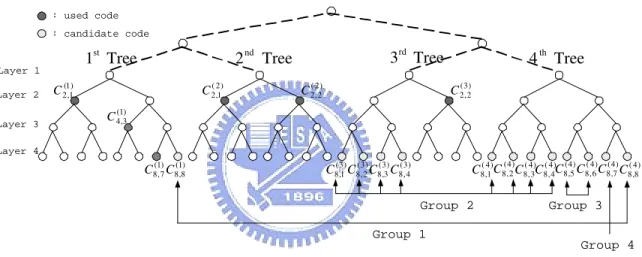
• C2(i)l−1,n , The n-th code of the code group in the l-th layer associated with the
i-th code tree
• Cn , The n-th code of a particular code set
• CV , The number of cycles involving all the processes in the multi-process SAW
HARQ mechanism required to remove a Type-II gap
• b , ln10/10
• b(X)k,i (t) , Waveform of user k of group X at the i-th substream
• b(X)k,i [h] , The h-th bit of user k of group X at the i-th substream
• bo,i(t) , Waveform of the reference user at the i-th substream
• c(X)k [j] , The j-th chip of the frequency-domain spreading code for the k-th user of group X
• co[j] , The j-th chip of the frequency-domain spreading code for the reference
user
• D , Expiry time of the timer
• Dp , Order of Hermite or Laguerre polynomials
• Eα , Event of P Rm being ruled out in the k-th cycle
• Eβ , Event of P R2 ∼ P Rm−1 being ruled out within the k-th cycle
• Eγ , Event of P Rm+1 ∼ P RM being ruled out within the (k − 1)-th cycle
• E1 , The event that process 1 enters the STOP state within the k-th cycle
• E2 , The event that the first m − 2 processes enter the STOP state within the
• E3 , The event that process m enters the STOP state at the k-th cycle
• E4 , The event that the last M − m processes enter the STOP state before the
k-th cycle
• EA , The event that process 1 is scheduling for transmission at the k-th cycle
• EB , The event that all the other (M − 1) processes enter STOP state before
the k-th cycle
• Eb , Bit energy
• Eo , Bit energy of the reference user
• fo , Main carrier frequency
• fi,j , Carrier frequency of the j-th carrier of the i-th substream
• fzv(·) , Probability density function of random variable zv
• fzkv(·) , Probability density function of random variable zkv
• hr , Number of allowable retransmissions
• IA , {NDI(rec) = NEW }
• IB , {{T SN(rec) 6= T SN∗} ∩ {NDI(rec) = OLD}}
• go(t) , Time-domain spreading code of the reference user
• gk(X)(t) , Time-domain spreading code of the k-th user of group X
• gk(X)[`] , The l-th chip of the time-domain spreading code of user k of group X
• Go , Time-domain spreading gain of the reference user
• GP T , Average gap processing time
• GP T0 , Average gap processing time for case (I) of the indicator-based stall avoidance scheme
• GP T1 , Average gap processing time for case (II) of the indicator-based stall avoidance scheme
• GP TI , Average gap processing time for case (I) of the indicator-based stall
avoidance scheme with interleaving scheduling
• GP TII , Average gap processing time for case (II) of the indicator-based stall
avoidance scheme with interleaving scheduling
• GP Tc , Constraint of the gap processing time
• GP Tindicator , Average gap processing time of the indicator-based stall
avoid-ance mechanism
• GP T (`) , Average gap processing time with ` Type-II gaps
• GP Ttimer , Average gap processing time of the timer-based stall avoidance
mechanism
• GP Twindow , Average gap processing time of the window-based stall avoidance
mechanism
• hm , Number of the minimum allowable retransmissions
• hr , Number of the allowable retransmissions
• H(t) , Unit step function
• Ik,s,v(X) , Multiple access interference from of v-th subcarrier in the s-th substream for user k of group X in downlink transmission
• IX,k(1) , Main subcarrier’s multiple access interference from user k of group X in uplink transmission
• IX,k(2) , Other subcarriers’ multiple access interference from user k of group X in uplink transmission
• IX,k(2)0 , Other subcarriers’ multiple access interference from user k of group X for case (a) in uplink transmission
• IX,k(2)00 , Other subcarriers’ multiple access interference from user k of group X for case (b) in uplink transmission
• Ioc, One average term of the multiple access interference from other subcarriers
• J(·) , Lagrange function
• KX , Number of users of group X
• L(X)k , Ratio of the bit duration of the reference user and the interfering user
k of group X
• Lg , Required TTIs to detect a Type-II gap
• M , Frequency-domain spreading gain
• n(t) , While Gaussian noise in the receiving end
• ns,v , White Gaussian noise of the v-th subcarrier in the s-th substream
• N0 , Power spectrum density of the while Gaussian noise
• Nd , Network delay
• Np , Number of required parallel processes in the multi-process SAW HARQ
to fully utilize the channel capacity
• N→A , NACK-to-ACK
• NDI(rec) , NDI of the received packet
• P (·) , Probability measure
• Pα(m, k) , Joint probability of events E1, E2, E3, and E4
• Pe , Packet error rate
• P (e) , Bit error rate
• P (e|x) , Conditional error probability with a given condition x
• PG , Probability of a Type-II gap
• Pk,i,j(X) , Transmission power of user k of group X at the j-th subcarrier in the
i-th substream
• Pk(X) , Transmission power of user k of group X
• Po , Transmission power of the reference user
• Po,i,j , Transmission power of the reference user at the j-th subcarrier in the i-th substream
• PTc , Chip waveform of a time-domain spreading code
• PT(X)
k , Bit waveform of user k of group X
• Psch , Probability of a process being scheduled
• Pk(m) , Probability of process P Rm being ruled out within the k-th cycle
• PN , Noise power
• Pnew , Probability of receiving a new packet
• Pold , Probability of receiving an old packet
• P Rm , The m-th process of the multi-process SAW HARQ
• Ps , Probability of successfully receiving a packet
• P(x`) , State probability vector of the multi-process SAW HARQ
• PV(m) , Probability of a new packet and a Type-II gap being separated by m
seats in the detection window
• Q(·) , Q-function, defined as Q(x) = √1 2π R∞ x e−t 2/2 dt
• Qd , Packet queuing delay
• ro(t) , Received signal of the reference user
• R(t, θ) , Auto-correlation function of the time-domain spreading code between
the reference and the interfering users during the time interval [0, t] with phase difference θ and subcarrier frequency difference fi,j − fs,v
• R(t, θ) , Auto-correlation function of the time-domain spreading code betweene
the reference and the interfering users during the time interval {t, To} with phase
difference θ and subcarrier frequency difference fi,j − fs,v
• R`(t, θ) , Auto-correlation function of the time-domain spreading code between
the reference and the interfering users during the time interval [`Tk(X), `Tk(X)+ t] with phase difference θ and subcarrier frequency difference fi,j − fs,v
• Re`(t, θ) , Auto-correlation function of the time-domain spreading code between
the reference and the interfering users during the time interval [`Tk(X)+ t, (` + 1)Tk(X)] with phase difference θ and subcarrier frequency difference fi,j− fs,v
• Rd , Packet reordering delay
• RL , The lowest transmission rate
• s(X)k (t) , Transmitted signal of user k of group X
• SR , Retransmission state of the multi-process SAW HARQ.
• ST , STOP state of the multi-process SAW HARQ
• S0 , REQUEST state of the multi-process SAW HARQ
• S1,S2 , RESCHEDULE state of the multi-process SAW HARQ
• Sc , State variable ∈ {ACK, NACK, N → A}
• SFt , Time-domain spreading factor
• SFf , Frequency-domain spreading factor
• tj , Elapsed time of the previous timer until the end of gap j
• T SN(rec) , TSN of the received packet
• Tc , Chip duration
• Td , Packet delivery delay
• To , Bit duration of the reference user after the serial-to-parallel converter
• Tk(X) , Bit duration of user k of group X after the serial-to-parallel converter
• Tb,k(X) , Bit duration of the source bit stream of user k of group X
• U , Number of substreams in the serial-to-parallel converter
• V , Number of parallel processes in the multi-process SAW HARQ
• x` , State variable of the `-th transmission cycle.
• X , Variable of user group
• yi , The i-th abscissa of the Hermite or Laguerre Polynomials
• Yo,s , Decision variable of the s-th substream for the reference user
• Yo,s,v , Output variable in the v-th subcarrier of the s-th substream for the
reference user
• z , Subcarrier distance between the j-th subcarrier of the i-th substream and
the v-th subcarrier of s-th substream the, defined as z = (i − s) + (j − v)U, where U is the number of the substreams in the serial-to-parallel converter
• zv , Random variable representing the channel gain of the v-th subcarrier of
the reference user, defined as zv = |αo,s,v|2
• zkv , Random variable representing the channel gain of the i-th subcarrier of
user k of group Ao, defined as zkv = |α(Ak,s,io)|2
• zv,s , The s-th abscissa of Laguerre polynomial for the v-th random variable
for the reference user
• zkv,s , The s-th abscissa of Laguerre polynomial for the v-th random variable
for the interfering user k
• αo,i,j , Channel’s amplitude of the reference user of the j-th subcarrier in the i-th substream
• α(X)k,i,j , Channel’s amplitude of user k of group X of the j-th subcarrier in the
i-th substream
• βo,s,v , Weights for a certain combining scheme of the reference user for the v-th subcarrier of the s-th substream
• γ , Received signal to noise ratio
• γc , The received signal to noise ratio of one particular subcarrier
• γM , Combination of the channel gain from M subcarriers
• λ , Average power control error
• λc , Call arrival rate
• λL , Lagrange multiplier
• λo , Power control error of the reference user
• λ(X)k , Power control error of user k of group X
• σe , Standard deviation of power control error
• σA
k , Area of the grid for user k of group A • σo , Area of the grid for the reference user
• ωi , The i-th weight factor of Hermite or Laguerre polynomails
• ωi, j , The j-th weight factor of Laguerre polynomails for the i-th random
variable
• ψo,i,j , Channel’s phase of the reference
• ψk,i,j(X) , Channel’s phase of user k of group X
• ϕo,i,j , Initial phase of the reference user
• ϕ(X)k,i,j , Initial phase of user k of group X at the j-th carrier of the i-th substream
• φi,j , Initial phase of the j-th subcarrier in the i-th substream
• φ(X)k,i,j , Phase of user k of group X of the j-th subcarrier at the i-th substream in the receiving end
• θk,i,j(X) , Phase difference between the reference user and the interfering user, defined as θk,i,j(X) = φ(X)k,i,j − φo,s,v
• ρ , Effective traffic load
• τ , Misalignment of transmission time between the reference user and the
interfering user
• τo , Propagation delay of the reference user
• τk(X) , Propagation delay of user k of group X
• δ , Power control error in the real domain, defined as 10log10λo
• ∆[`] , Random variable, defined as ∆[`] = ±1 with equal probability for arbi-trary positive integer `
• ∆f , Minimal frequency spacing between any two adjacent substreams with
the same subcarrier index
• µ(δ) , A function of the power control error, defined as µ(δ) =
q
10δ/10γc
1+10δ/10γc
• µc , Call departure rate
• ζ , Product of reference user’s time-domain spreading gain and the combination
of channel gain from M subcarriers, defined as ζ = Go
PM
v=1|αo,s,v|2
• Φ(1)j,τ , Phase difference between the main subcarrier of the reference user and the other subcarrier of the interfering user during the j-th chip of the reference user’s time-domain spreading factor, defined as Φ(1)j,τ = πz
Tc(2jTc+ τ − hTc) + θ,
• Φ(2)j,τ , Phase difference between the main subcarrier of the reference user and the other subcarrier of the interfering user during the j-th chip of the reference user’s time-domain spreading factor, defined as Φ(2)j,τ = πz
Tc((2j+1)Tc+τ −hTc)+θ,
where h and θ are given positive integer and phase
• κ , MAI coefficient
• E[·] , Operator to take the average value
• Eτ[·] , Operator to take the average over τ
• Eθ[·] , Operator to take the average over θ
• V ar[·] , Operator to take the variance value
• max(·) , Operator to take the maximal value
• min(·) , Operator to take the minimal value
• ∆κ(·) , Operator to calculate the incremental MAI coefficient of a code or code
set
Chapter 1
Introduction
As people are no longer satisfied with the conventional conversation service, the de-mand for versatile wireless multimedia services becomes a strong driving force for the birth of a new generation wireless communication systems. In recent years, the next generation wireless communication systems beyond the third generation (3G) will be developed to satisfy this increasing capacity demand. However, maintaining good quality-of-service (QoS), including the performance requirements of the end-to-end delay, error probability, call admission rate, and signal-to-interference-and-noise ra-tio (SINR) are essential for the B3G wireless systems. Thus, because radio resource management (RRM) techniques can improve the required QoS and the utilization of system capacity, the RRM techniques become the key to the success of the B3G wireless system. [1–5].
Specifically, power control and call admission control (CAC) are two important RRM techniques to decide the transmission power of a mobile terminal [6–9] and to determine whether a new session should be accepted [10–12], respectively. In the packet retransmission mechanism, the fast retransmission technique is an important technique to decide when and how to retransmit the erroneous packets [13–15]. Last, code assignment aims to select a good code for the new request [16–18]. In this dissertation, we study the aforementioned RRM techniques in two future systems, the high speed downlink packet accesss (HSDPA) in WCDMA and the multi-carrier direct-sequence code division multiple access (MC-DS-CDMA).
HSDPA, the alleged 3.5G system, is becoming an important feature for the wideband code division multiple access (WCDMA) system [19]. The objective of HSDPA in the WCDMA system is to provide a packet data service at rates up to 10 Mbits/sec [20, 21]. HSDPA integrates many techniques in both the physical and
MAC layers, including adaptive modulation and coding [22–24], fast packet schedul-ing [25–29], fast cell selection [30], multiple-input multiple-output (MIMO) antenna processing [31, 32], buffer overflow control [33], and fast HARQ mechanism [34].
MC-DS-CDMA, possessing both the advantages of the orthogonal frequency division multiplexing (OFDM) and spreading spectrum systems, has shown great potential for the next generation wireless communication systems [35–38]. The ad-vantages of the MC-DS-CDMA system includes the robustness against the frequency-selective fading channel, the flexibility in system design, and the low detection com-plexity [39–42]. In general, MC-DS-CDMA can be divided into three categories: multi-carrier CDMA with pure frequency spreading and MC-DS-CDMA with pure time spreading as well as joint time and frequency spreading (TF-domain spreading). By adjusting spreading gains in both time and frequency domains, MC-DS-CDMA with TF-domain spreading can outperform other two MC-DS-CDMA schemes in sup-porting versatile multi-rate services in diverse environments [43–46].
In the first part of this dissertation, we investigate the stall avoidance tech-niques to enhance the media access control (MAC) layer performance of a parallel multi-process stop-and-wait (SAW) hybrid automatic repeat request (HARQ) mech-anism in HSDPA. In the second part of this dissertation, we analyze the error rate performance of uplink MC-DS-CDMA. Last, we propose a novel code assignment strategy and a joint subcarrier power allocation and code assignment scheme for the downlink case. In the following, we discuss the problems and the solutions regarding the RRM issues of HSDPA and MC-DS-CDMA, respectively.
1.1
Problem and Solution
In this section, we will first briefly discuss how to resolve the stall issue in HSDPA. Then, we expound several important issues in MC-DS-CDMA, including the
influ-ence of power control errors (PCEs) on top of MAI, code assignment strategy, and subcarrier power allocation.
1.1.1
Analysis of Stall Avoidance Mechanisms for HSDPA
in the WCDMA Systems
The HSDPA for the WCDMA system adopts the mutli-process SAW HARQ mecha-nism to enhance channel utilization [47–52]. Nevertheless, the so-called stall problem of the multi-process SAW HARQ mechanism can be a bottleneck when delivering the MAC layer data to the upper layer, and can seriously degrade the quality of service (QoS) from the higher-layer user’s perspective. Specifically, the stall issue is defined as the situation when the transmitter mistakenly believes that a particular packet has already successfully reached the destination, while the receiver is still waiting for that lost or damaged packet in the retransmission process. The stall issue usually occurs when the negative acknowledgement (NACK) control signal is changed to an acknowledgement (ACK) control packet due to transmission errors in the wireless link. In this case, the transmitter will never send this packet and will make the re-ceiver wait for that lost packet forever. It has been reported that the probability of the NACK signal becoming the ACK signal can be as high as 10−2 for a high speed
mobile during handoff [53,54]. Thus, resolving the stall problem is the key to reducing the transmission delay in wireless data networks [55].
The objective of our work in this part is to develop analytical methods to eval-uate the performances of these three stall avoidance methods: the timer-based, the window-based, and the indicator-based schemes. To characterize the performances of the stall avoidance schemes, a new performance metric, called the gap processing time, is introduced. The gap processing time is defined as the duration starting when the sequence of MAC layer data have a gap due to a NACK-to-ACK error until the
receiver recognizes that this gap cannot be recovered by the MAC layer retransmission scheme. We derive the probability mass functions and the closed-form expressions for the average value of gap processing time of the three considered stall avoidance tech-niques. By simulations and analyses, we find that the indicator-based stall avoidance scheme significantly reduces the gap processing time compared to the timer-based and the window-based schemes. When applying these three stall avoidance schemes, the presented analytical approach can provide important information for determining a proper number of processes in the parallel SAW HARQ mechanism. It can also be used to design the allowable retransmissions for the timer-based and the window-based schemes. Furthermore, the number of acceptable fully loaded users can also be designed by the proposed analytical approach when the admission control and the gap processing time are jointly considered.
1.1.2
Analysis of a Stall Avoidance Mechanism with
Scheduling for HSDPA in the WCDMA System
This part presents the closed-form expression for the gap processing time of the indicator-based stall avoidance mechanism in the multi-process SAW HARQ mech-anism for multi-user case. The gap processing time is related to the MAC-layer scheduling policy. Currently, two scheduling policies are considered for the HSDPA system to allocate radio resource to multiple users: scheduling-by-bundle policy and interleaving scheduling policy [56, 57]. The former policy schedules each user by a series of time slots, while the later policy schedules time slots for multiple users one at a time. Therefore, with the scheduling-by-bundle policy, the gap in the reordering buffer can be detected earlier by consecutively receiving a series of packets. However, the scheduling-by-bundle policy does not exploit multiuser diversity gain. Thus, the interleaving scheduling policy is adopted more commonly in current systems since it
can exploit the multiuser diversity gain [27, 28]. We will focus on the interleaving scheduling policy to derive the analytical model for the gap processing time of the indicator-based stall avoidance mechanism. The relations between the gap processing time and some system parameters in the physical layer and the MAC layer, such as as packet error rates, the number of users and the number of parallel processes in the HARQ mechanism, can be investigated by the developed analytical model. Since the gap processing time affects the delay performance and quality of service significantly, the developed analytical approach can help evaluate the overall performance of the HSDPA system from the higher layer user’s perspective, while considering the lower physical layer impact.
1.1.3
Effects of Power Control Errors and Complete
Multiple Access Interference on Uplink
MC-DS-CDMA
Although MC-DS-CDMA has been extensively studied recently [39, 58–61], to our knowledge, the effects of power control errors (PCE) on MC-DS-CDMA seem to be neglected. Improper power control may significantly degrade the performance of the MC-DS-CDMA system. The key question is how to quantitatively analyze the impact of power control errors on the MC-DS-CDMA system. Unlike most current papers in the subject of MC-DS-CDMA assuming perfect power control, the first goal of this work is to investigate the impact of open-loop power control errors on the MC-DS-CDMA systems. In general, power control schemes can be divided into two categories: the closed-loop power control and the open-loop power control. The former technique is to combat the small scale fading such as the Rayleigh fading caused by multipath propagation, while the latter one aims to resolve the near-far effect, owing to the large-scale fading caused by path loss and shadowing, in a multi-user CDMA system. Note
that with open-loop power control to overcome the near-far effect, each subcarrier may still experience severe multi-path fast fading.
The second objective of this work is to analyze the effect of the complete multiple access interference (MAI) on top of power control errors for the multi-rate DS-CDMA system. To support various types of services in the 4G system, MC-DS-CDMA becomes an attractive technique because it can adapt transmission rates by dynamically changing time and frequency spreading factors. However, most an-alytical models for the MC-DS-CDMA system are mainly focused on the single rate case. In a multi-rate MC-DS-CDMA system, the MAI issue becomes more involved because the users with different transmission rates may cause different levels of the MAI. In addition, asynchronous transmissions among users is another critical perfor-mance issue. Asynchronous users may destroy the orthogonality between subcarriers in the MC-DS-CDMA system. To our knowledge, the effect of the complete MAI (i.e. the interference from the main subcarrier and all the adjacent subcarriers of other users) has not yet been fully investigated in the context of the multi-rate MC-DS-CDMA system. Hence, we are motivated to develop an analytical model to evaluate the effects of the complete MAI of asynchronous multi-rate users for the MC-DS-CDMA system.
In summary, we develop an analytical model to characterize the joint effects of both the PCE and the complete MAI for the multi-rate MC-DS-CDMA system. Applying the developed analytical model, we obtain some important insights into the performance issues of the MC-DS-CDMA system. First, when both PCE and the complete MAI are jointly considered, the effect of PCE can exacerbate the impact of complete MAI on MC-DS-CDMA, or vice versa. That is, the joint impact of complete MAI and PCE is actually severer than the summation of the performance degradation from the complete MAI and PCE individually. Second, increasing the maximum total spreading gain by either increasing frequency or time domain spreading gain
can enhance the error rate performance for the multi-rate MC-DS-CDMA system, but it is necessary to pay attention to the side effect of higher sensitivity to power control errors. Third, for the same total time and frequency spreading gain, an MC-DS-CDMA system with a larger frequency domain spreading factor outperforms the system with a larger time domain spreading factor. However, the performance differences between the two are shrunk as power control errors increase.
1.1.4
Interference Avoidance Code Assignment for
Downlink MC-DS-CDMA
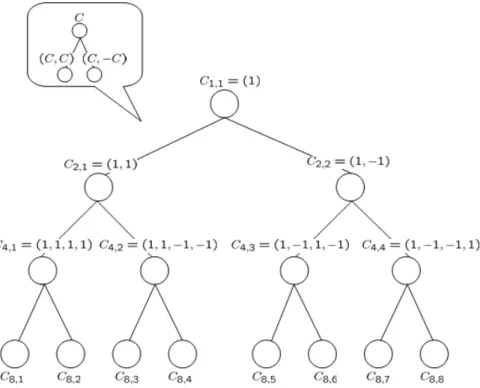
To enhance the capacity of the MC-DS-CDMA system, the spectrum is shared by users with distinct codes in either time domain or frequency domain. Figure 1.1 shows an example of an MC-DS-CDMA system with two-dimensional orthogonal variable spreading factor (OVSF) codes, where time- and frequency-domain spread gains are 8 and 4, respectively. In principle, the total spreading gain is equal to the product of the time domain spreading gain and the frequency domain spreading gain, and a combination of a time-domain code and a frequency-domain code is allocated to each user. Ideally, any two time-domain spreading codes without the ancestor and child relation in the OVSF code tree are orthogonal even with the same frequency-domain spreading code. Similarly, any two (even the same) time-domain spreading codes in two distinct frequency-domain code trees of Fig. 1.1 are orthogonal in regardless of the ancestor and child relation.
However, in a high-speed wireless system, the frequency selective fading im-pairs the orthogonality of spreading codes. Thus, to reduce the impact of frequency-selective fading on the orthogonality of time-domain spreading codes, the MC-DS-CDMA system adopts a serial-to-parallel process to convert a high speed data stream into multiple slower data streams. Thus, instead of frequency selective fading, it
is the flat Rayleigh fading that influences the data in each subchannel after domain spreading. Hence, in the downlink case, the orthogonality between time-domain spreading codes can be maintained and the multiple MAI of using the same frequency-domain spreading codes is eliminated. Nevertheless, frequency-selective fading can still affect the orthogonality of frequency-domain spreading codes. In a multi-rate MC-DS-CDMA system, the imperfect orthogonality of frequency-domain spread codes even cause different amplitudes of MAI due to various transmit power levels for supporting multi-rate services.
Accordingly, a challenging issue arises: how can an MC-DS-CDMA system effectively assign a combination of frequency- and time-domain spreading codes for multi-rate users to avoid different amplitudes of MAI in a frequency selective fading channel. Another important concern for code assignment is to sustain the com-pactness of the tree structure of the OVSF codes for improving the call blocking performance. In this work, we propose an interference avoidance code assignment strategy to consider both the MAI and call blocking performance simultaneously. The proposed interference avoidance code assignment strategy can reuse spreading codes in both the time and frequency domains to enhance capacity, while controlling the incurred MAI due to reusing the time-domain spreading codes. The key to the proposed interference avoidance code assignment scheme is the newly defined perfor-mance metric the MAI coefficient, which can quantitatively predict the incurred MAI before assigning a particular code. By choosing a code with the minimum in-curred MAI in the multi-rate multiuser MC-DS-CDMA system, the signal quality can be improved significantly. Furthermore, the proposed code assignment strategy sustains the compactness of the code tree structure, thereby achieving very good call blocking rate performance.
code tree for frequency-domain spreading code [1, -1, -1, 1 ]
code tree for frequency-domain spreading code [1, -1, 1, -1 ]
code tree for frequency-domain spreading code [1, 1, -1, -1 ]
code tree for frequency-domain spreading code [1, 1, 1, 1 ] 4th t ree 3rd tree 2nd t ree 1st t ree code dom ain w
ith frequen cy-dom ain sp reading code doma in wi th tim e-doma in sp readin g
1.1.5
Joint Interference Avoidance Code Assignment and
Subcarrier Power Allocation for Downlink
MC-DS-CDMA
In the multi-rate MC-DS-CDMA system with TF-domain spreading, subcarrier power is another degree of freedom. However, it is challenging to allocate subcarrier power in a multi-user environment. An optimal power allocation scheme with the maxi-mized received signal power may also produce excessive interference to other users, which may also lower the call admission rate. Thus, we are motivated to propose a joint subcarrier power allocation and code assignment aiming to maximize the sig-nal power through subcarrier power allocation while eliminating the MAI by a novel code assignment scheme. To achieve this goal, we first maximize the signal qual-ity by allocating subcarrier power. On top of these allocated subcarrier power, we develop a code assignment strategy to maintain high call admission rates with less MAI. We define a new performance metric named as MAI coefficient. Through the bit error rate analysis associated with the subcarrier power allocation, we show that the MAI coefficient can quantitatively predict the incurred MAI before assigning a spreading code. Thus, with the help of MAI coefficient, an interference avoidance code assignment can be designed to choose a code with the minimum incurred MAI. The simulation results show that the proposed joint subcarrier power allocation and interference avoidance code assignment strategy can significantly improve the received signal quality. Furthermore, the code assignment considers the 2-dimension code tree structure in assigning a code to a user. Thus, the code assignment can also maintain good call admission rates.
1.2
Dissertation Outline
This dissertation consists of two themes. The first part is to investigate the perfor-mance issues of the fast HARQ mechanism in the MAC layer of HSDPA. The second part aims to investigate several RRM issues in MC-DS-CDMA. We analyze the joint effects of both the PCE and the complete MAI for the multi-rate MC-DS-CDMA system with TF-domain spreading for uplink transmission. For the downlink MC-DS-CDMA, we propose an interference code assignment strategy to eliminate the MAI, while maintaining a high call admission rate. Furthermore, a joint subcarrier power allocation and code assignment strategy is proposed to further enhance the performance of the MC-DS-CDMA system.
The remaining chapters of this dissertation are organized as follows. Chap-ter 2 reviews the some pivotal subjects for both HSDPA and MC-DS-CDMA, e.g., the multi-process SAW HARQ, stall issue and gap processing time for HSDPA and two-dimensional orthogonal variable spreading factor (OVSF) code tree structure for MC-DS-CDMA. Literature surveys of some related works are also provided. In Chapter 3, we develop an analytical model to evaluate the performances of three stall avoidance methods: the timer-based, the window-based, and the indicator-based schemes. Chapter 4 derives the closed-form expression for the gap processing time of the indicator-based stall avoidance mechanism for multi-user case. Chapter 5 an-alyzes the impact of PCEs and the complete MAI on the multi-rate MC-DS-CDMA system. In Chapter 6, we propose an interference avoidance code assignment strat-egy for the multi-rate MC-DS-CDMA system by reusing spreading codes in both the time and frequency domains. To further improve the received signal quality, a joint subcarrier power allocation and code assignment schemes is proposed in Chapter 7. At last, Chapter 8 provides the concluding remarks and some suggestions for future works.
Chapter 2
Background and Literature Survey
In this chapter, we survey related works to the stall issue of HSDPA and the per-formance analysis, the code assignment strategy, and the power allocation of MC-DS-CDMA. We also introduce the background for the multi-process SAW HARQ mechanism, the stall issue, and the gap processing time for HSDPA. Then, we review the power control mechanisms, the two-dimensional (2D) OVSF code tree structure, and the associated grip representation of the 2D-OVSF code tree.
2.1
HSDPA
2.1.1
Literature Survey
To resolve the stall issue for the multi-process SAW HARQ, there are two main re-search directions in the literature. The first direction is to improve the reliability of control packets by increasing the power of ACK or NACK signals [53]. The second direction is to design stall avoidance schemes to inform the receiver to stop waiting for the missing and nonrecoverable layer packets [55–57,63,64]. With a notice issued by a stall avoidance mechanism, the receiver starts forwarding all the received in-sequence packets to the upper layers even with a gap in a series of packets. As a result, the higher layer protocol stack can earlier request the transmitter to retransmit the miss-ing packet. In [63], a timer-based stall avoidance mechanism was proposed to trigger a counter as soon as a gap appears in the HARQ reordering buffer. When the counter expires, the receiver starts forwarding received packets to the upper layer. In addition
to using a timer, a window-based stall avoidance mechanism in [64] utilized a sliding window to detect the stall situation earlier than the expiration of the timer. Recently in [55–57], the indicator-based stall avoidance mechanism applied the new data indi-cator (NDI) to monitor the activity of each HARQ process, thereby enhancing the capability to recognize the stall situation in sending the MAC layer data to the higher protocol layer. The basic principles of the indicator-based stall avoidance mechanism can be briefly introduced as follows. As long as all the HARQ processes are transmit-ting some other packets, instead of the expected missing packet, it is implied that the missing packet will not be retransmitted by the sender. Thus the receiver activates the process of forwarding data to the upper layer even before the timer expires or the window-based mechanism takes any actions. The performances of the above stall avoidance mechanisms were evaluated by extensive simulations in [34, 65, 66]. It was shown that a good cooperation between the radio link control (RLC) and MAC layers can reduce the peer-to-peer service data unit delay.
2.1.2
Multi-Process SAW HARQ Mechanism
The multi-process SAW HARQ mechanism is one of key techniques to provide the HSDPA service in the WCDMA system [19]. The basic idea of the multi-process SAW HARQ mechanism is to implement multiple parallel processes to fully utilize channel capacity, i.e. realize the so-called ”keeping the pipe full” concept. Fig. 2.1(a) illustrates a dual-process SAW HARQ device consisting of an even process and an odd process to service one user [67]. As shown in Fig. 2.1(b), while the even process is waiting for the acknowledgement of packet 0 from the receiver, the odd process starts sending packet 1. With two processes sending data alternatively, the dual-process SAW HARQ mechanism can utilize the channel capacity more effectively and achieve higher throughput. In general, the required number of parallel processesc (Np) to
fully utilize the channel capacity can be approximated by Np = RT T /T T I, where RT T is the round trip time and the time transmission interval (TTI) indicates how
often data arrives from higher layer to the physical layer.
Fig. 2.2 shows a scenario where a dual-process SAW HARQ device is serving multiple users. All the pairs of the source and destination devices share one downlink data channel. Thus, in the multi-user case, a system scheduler is responsible for selecting a particular customer to possess the right of using the shared channel.
2.1.3
The Stall Issue in Parallel SAW HARQ
The stall of delivering the MAC layer data to the upper layer is an important issue when providing real-time services (such as the streaming video or music) in the wire-less channel. The stall issue is the dilemma for the receiver waiting for a missing packet that will no longer be sent by the transmitter. Fig. 2.3 shows an example of the stall issue in a dual-process SAW HARQ mechanism. In the figure, a NACK-to-ACK error occurs when the first receive process sends a NACK signal for the lost packet 0 in the feedback channel. In this situation, the first transmit process starts sending packet 4 because it mistakenly believes that packet 0 has already successfully reached the destination. Clearly packet 0 will never be sent again, but the first receive process will continue waiting for packet 0. As a result, delivering MAC layer data to the upper layer is stalled, thereby degrading higher layer QoS performance for the delay-sensitive services.
2.1.4
Gap Processing Time
In this dissertation, the gap processing time is used as a performance measure to quantify the impact of the stall issue on the multi-process SAW HARQ mechanism. Here a gap means an idle space reserved for a lost packet in the reordering buffer of
Process Sequencer Even Tx Process Odd Tx Process Even Rx Process Odd Rx Process Data Channel
Even Feedback Channel
Odd Feedback Channel Even Control Channel
Odd Control Channel
(a) Structure
(b) Timeline
Queue Process Sequencer Even Tx Process Odd Tx Process Even Rx Process Odd Rx Process Even Feedback Channel
Odd Feedback Channel
Packets Released Blocks Arrive From Network Queue Process Sequencer Even Tx Process Odd Tx Process Even Rx Process Odd Rx Process Packets Released Blocks Arrive From Network Queue Process Sequencer Even Tx Process Odd Tx Process Even Rx Process Odd Rx Process Packets Released Blocks Arrive From Network System Scheduler
Even Feedback Channel
Odd Feedback Channel
Even Feedback Channel
Odd Feedback Channel
Data Channel
Even Control Channel Odd Control Channel
Odd Control Channel Even Control Channel
Even Control Channel Odd Control Channel
PKT 4 Packets arrive
from the upper layer Queue Qual Channel Selector 1st Tx 2nd Tx 3rd Tx 4th Tx 1st Rx 2nd Rx 3rd Rx 4th Rx PKT 3 PKT 2 PKT 1 PKT 4 PKT 1 PKT 2 PKT 3 PKT 1 PKT 2 PKT 3 Source Device Data Channel Reordering Buffer 1st HARQ 2nd HARQ 3rd HARQ 4th HARQ
Step 2 Step 3 Step 4
Step 1
The NACK of PKT 0 is received as ACK. PKT 0 is discarded at the first transmitter, and PKT 4 is ready for the next
transmission.
The first receiver is waiting for packet 0.
PKT 1
PKT 2
PKT 3
Fig. 2.3: A example of the stall issue in a qual-process SAW H-ARQ, where packet 0 is lost and packets 1, 2, and 3 are successfully received in the reordering buffer.
the receiver. Two types of gaps can be categorized in HSDPA: Type-I gap and Type-II
gap. If it is still possibly recovered in future retransmissions, we call this type of gap
the Type-I gap. In contrast, Type-II gap is the one that will never be sent again by the transmitter due to a NACK-to-ACK error. Whenever a Type-II gap appears in the reordering buffer, the process of sending packets to the upper layer is stalled.
The gap processing time is defined as the duration when a gap appears in the reordering buffer until the receiver confirms that it belongs to a Type-II gap. An HARQ process usually cannot easily distinguish a Type-II gap from a Type-I gap. Thus, a stall avoidance mechanism is required to detect the occurrence of the Type-II gap for the HSDPA system, and then to trigger the receiver to flush out the available packets in the reordering buffer to the upper RLC layer as well as this Type-II gap must be flushed out to the RLC layer. Next an RLC retransmission request is initiated for the missing Type-II gap [56, 57, 65].
2.2
MC-DS-CDMA
2.2.1
Literature Survey
Performance Analysis: In the literature, the studies on the performance of the MC-DS-CDMA system subject to power control errors and MAI can be summarized in two folds. On the one hand, from the standpoint of MAI, the authors in [68] analyzed the MAI’s effect from the main subcarrier for a single-rate MC-DS-CDMA system. In [69], the authors analyzed the effect of the other inter-subcarriers’ MAI in the MC-DS-CDMA system, but only for the single-rate case. The authors in [70] only analyzed the performance of the multi-rate multi-carrier DS-CDMA systems, but considered the effect of the MAI from the main subcarrier. On the other hand, from the view point of power control errors, most studies for the MC-DS-CDMA systems