行政院國家科學委員會專題研究計畫 成果報告
選舉制度與婦女參政﹕東亞三國經驗的比較(I)
計畫類別: 個別型計畫 計畫編號: NSC92-2414-H-002-014- 執行期間: 92 年 08 月 01 日至 93 年 08 月 31 日 執行單位: 國立臺灣大學政治學系暨研究所 計畫主持人: 黃長玲 報告類型: 精簡報告 處理方式: 本計畫可公開查詢中 華 民 國 93 年 12 月 27 日
I. Introduction
Most of the works on women’s political participation focused on women’s representation in national legislatures. Cross-country comparisons often examine three set of factors that might affect women’s representation: the political/institutional factors, the socioeconomic factors, and the cultural factors (Matland 1993; Kenworthy and Malami 1999; Reynolds 1999). Chief among the political/institutional factors, electoral systems have most often been cited as the key determining factor in the number of women elected to legislative office. However, recent evidence showed that electoral systems alone cannot do the magic. Countries that have the fastest growth rates of women legislators are those that adopted gender quota (Studlar and
McAllister 2002). In other words, along with the increasing number of women in politics, gender quota has become a widely accepted practice to promote gender parity.
The Scandinavian countries were the first ones that adopted a gender quota (Squires 1996). Their success since the 1970s in having more women in politics made other countries to follow suit. In the 1990s, 13 Latin American countries adopted a gender quota. The most significant change took place in Argentine. In 1991, the percentage of women in the Argentina national legislature was less than 5%. By 2002, however, that number jumped to almost 30%. France passed the gender parity law in 2000 and required all political parties to nominate equal number of men and women in local elections. Sweden, the country that has long been known for its egalitarian value and policies, officially adopted the “zebra system” in its nomination in1997 and now women consist of 45% of its national legislature.1 South Korea and Taiwan, two newly democratized Asian countries, also faced the demand from women’s organizations to implement gender quota.
This paper aims to explore the process of which feminist movement in these two countries interacted with various political forces to make gender quota a part of the political institution. Though it is widely recognized among students of East Asian politics that Korean social movement are better organized and more mobilized, I will argue in this paper that, by taking advantage of an existing institution and by framing the movement discourse in a gender-neutral style, Taiwanese feminists’ movement strategy allowed them to push their success beyond their organizational strength.
1
South Korean feminists, on the other hand, relied on the organizational strength of not only the feminist movement but also the social movement in general to force political parties to accept the demand. The difference of the movement strategy between these two countries is more related to institutional factors than socioeconomic factors or cultural factors.
II.
Taiwan: Party Competition and the Election-Driven Agenda
In Taiwan, the politics of gender quota was highly related to party competition and in recent years have become an election-driven agenda. Reserving seats for
women in national and local legislatures have been a constitutional practice in Taiwan. In the early 1990s, along with democratic development in Taiwan, activists in the feminist movement began to push for the increase of women’s representation in politics. The feminist movement circle was well aware that the number of the seats reserved in many legislative bodies had become lower than the number of the seats actually won by women. For example, in the 1991 National Assembly and the 1992 Legislative Yuan elections, the reserved seats for women were 19 and 10 respectively, but the actual numbers of women who won the elections were 31 and 12 (Liang and Ku 1995: 100). Moreover, feminists, scholars as well as activists, wanted to see not only the increase of women’s representation in legislative bodies but also women’s representation in other political bodies.
To increase women’s political participation Taiwanese feminists not only pushed for institutional changes within both the state as well as major political parties, but also changed their movement discourse and strategies. Instead of merely demanding more seats to be reserved for women in legislative bodies, feminists also wanted to set a gender quota for various political positions, not just elected offices. From the
feminist perspective the institutional design of the reserved-seats system had at least two drawbacks. First, the focus of the reserved-seats system was to protect women’s opportunities in political participation. Such a design would eventually stigmatize female politicians as incapable of being elected on their merits. Second, the reserved seats system as potentially unconstitutional because, compared to other politically under-represented groups, it gave women more opportunities to be represented in the political process (Tsai 1997:5-7). In contrast to the reserved seats system, a gender quota system has neither the stigma effect nor the unfairness problem. A gender quota system theoretically is “gender neutral”. That is, the goal or the function of a gender quota system is to maintain gender balance and the achieve gender justice, not to
protect or give advantages to either men or women. If men are over-represented in politics, then a gender quota system will be more beneficial to women. If women are over-represented in politics, then it will be more beneficial to men. Though in practice the gender quota system is helping women like the reserved-seats system, but to the feminists the spirits of these two systems are different because the former is more forward looking.
Once the movement discourse and goal was changed, Taiwanese feminists adopted a dual strategy to push for women’s political participation.2 On the one hand, they aimed to increase the reserved seats in legislative bodies, and, on the other hand, they advocated a gender quota for the cabinet, for the party’s nomination of election candidates, and for party offices. For increasing the reserved seats in legislative bodies, feminists proposed a constitutional amendment. The goal was to require all legislative bodies to have at least one-fourth of the seats reserved for women. During the National Assembly session in 1997, the media widely reported the demand made by feminists and optimistically predicted that increasing the reserved seats for women was the consensus among major political parties. However, because of male
politicians’ opposition, the amendment was not made. In the 1998 National Assembly session, increasing the reserved seats for women once again was reported as a likely amendment to be adopted. Unfortunately, the primary political issue during that National Assembly session was about the status and function of the National
Assembly itself. Members of the National Assembly reached the decision to abolish the National Assembly, thus the demand made by women’s organizations on
increasing the reserved seats did not get a chance to be voted on.
Though the demand for a constitutional amendment was not successful, women’s organizations saw fruitful results in the new Local Autonomy Law. After the failure in the 1997 session of the National Assembly, women’s organizations paid a visit to the Ministry of Domestic Affairs, and appealed to Yeh Jin-Feng, the female minister, to increase the reserved seats in all the councils of the cities, counties, villages, and towns, for every four elected councilpersons, one should be a woman, and this new law was put into practice in the January 2002 election for all local councils.
As for setting a gender quota for various political positions, the results have been mixed. Among all three areas that the feminists wanted to establish a gender quota system, the feminists achieved a greater degree of success in the political parties’
2
nomination of election candidates and in the party offices. Setting a gender quota for the cabinet, including all the positions appointed by the president, has been more difficult to achieve. Taiwan’s current ruling party, the Democratic Progress Party (hereafter DPP), was the first political party to adopt a gender quota system. In the process of pushing the DPP to adopt such a system, a leading feminist, Peng wan-Ru, played an indispensable role. Peng was an experienced feminist activists before she was appointed in 1994 the Director of the Women’s Department of the DPP. In a training camp for women interested in political careers, Peng learned from an
American feminist, Joe Freeman, that if women could achieve a critical number, such as one-fourth, in the legislative bodies, public policies would more likely reflect gender parity. Peng and other feminists who participated in this camp were very interested in this idea and Peng decided to work on establishing a gender quota system within the DPP.
In May 1996, the DPP formed a task force on revising the internal party rules. Due to Peng’s efforts, the task force decided to adopt a one-fourth gender quota for the nomination of election candidates and for the party offices (Lianhe bao 1996/5/6). This revision of the internal party rules, however, was not accepted by the DPP’s Central Executive Committee. Instead of directly adopting the one-fourth gender quota system, the committee decided to present two options for the DPP’s party
assembly to vote on. One was to set the gender quota at one-fourth, as Peng advocated, and the other was to set the gender quota at one-tenth (Lianhe Bao 1996/5/9). The DPP’s Central Executive Committee’s decision outraged Peng and some of the DPP female members. They held press conferences and appealed to the public for support for the one-fourth gender quota system (Zili Zaobao 1996/6/10). Peng herself, by this time, was nicknamed by many DPP members as “Peng One-Fourth.” (Li Bao
1996/6/10) Despite these efforts, the one-fourth gender quota system was not approved by the DPP Party Assembly. In the ensuing months, Peng took full
advantage of her connections with the feminist movement, and created a coalition of movement activists as well as DPP female members to continuously push the DPP to adopt the gender quota system.
In December 1996, the DPP held a provisional party assembly in Kaohsiung, and Peng went down to the southern city to lobby for the gender quota system. On
December 1, without knowing that Peng had disappeared the night before, the DPP party assembly passed the resolution to have a one-fourth gender quota for the nomination of candidates for all elected offices. In 1997, the following year, the DPP party assembly passed another resolution to establish a one-fourth gender quota for
the party offices. The DPP’s progressiveness was rewarded in the elections of city and county councils in January 1998. The party gained 18 new seats nationwide, and among these 18 newly elected council members 15 were women (Zili Wanbao 1998/1/25). It was clear that the gender quota system opened up new political space for the DPP. In spite of such a successful result, male party members, opposing the gender quota system, proposed an amendment to the party rules in May 1997. Because of the chauvinistic language used by these male members, female party members as well s the media reacted strongly to the amendment and the party assembly kept the gender quota system intact.
While the DPP adopted the gender quota system in the mid- to late 1990s, the KMT, the party that ruled Taiwan for half of the century by the mid-1990s, was not interested in promoting women’s political participation until it lost the 2000
presidential election. As early as in 1995, the KMTA’s Committee on Women’s Affairs published a white paper on women’s policies in which the committee had
recommended the KMT to follow the Scandinavian countries’ example of adopting a gender quota for the nomination of candidates for elections (Liang 1995: 109-111). The recommendation was that the KMT should gradually increase the nomination of women and eventually reached a goal of a 40% gender quota. This recommendation was not discussed by the KMT’s Central Standing Committee, let alone to be adopted by the KMT party assembly. Five years later, in June 2000, in the first party assembly after the KMT was defeated in the presidential election, the party representatives not only elected the first female vice chairperson in the party’s history, they also greatly changed the party leadership by electing a new Central Standing Committee. In the new Central Standing Committee, more than 30% of the members were women. The party also changed its internal rule and reserved one-fourth of the seats for women in the party assembly. Moreover, the party decided that in the future elections for the Legislative Yuan member, at least one-fourth of the candidates on the party list should be women.
In comparison with the DPP’s gender quota system, the KMT’s newly adopted system was less progressive in its policy concept but more progressive in its
calculation of the quota or the reserved seats. In terms of the policy concept, the KMT still used the term “reserved seats for women” instead of gender quota. The DPP’s system, as discussed earlier, was more forward-looking because gender quota in the long run might benefit men too. In terms of the calculation of the quota or the
reserved seats, however, the DPP’s calculation was not as friendly toward women, or the disadvantaged gender. The difference was a result of the different wordings in
these two parties’ internal rules. For the KMT, the one-fourth reserved seats for women meant that women’s seats should be “no less than” one fourth. For the DPP, however, the one-fourth gender quota meant that “for every four seats, there should be one seat for either a man or a woman,” depending on which gender was in the
minority position. Therefore, the DPP’s rule, in practice, would be more like a
one-seventh gender quota, instead of one-fourth, because the party tended to nominate as few women as possible.
While both the KMT and the DPP adopted the gender quota or reserved seats system for their internal party rules, the New Party, for a few years the third largest party but currently one has one seat in the Legislative Yuan, has been the party that consistently had the highest percentage of women on its nomination list—though the party never institutionalized a gender quota or reserved-seats system. Parties
established after 2000 such as the People First Party and the Taiwan Solidarity Union have yet to adopt either a gender quota system or a reserved-seats system. During the 2004 presidential election, women’s organizations tried to make the DPP promise to increase its gender quota to one-third. The DPP did not accept. The KMT-PFP coalition, however, surprisingly promised in its women’s policy white paper that, in the future, the KMT-PFP coalition will nominate at least 30% of women.
Compared to advances made within the political parties, feminists’ efforts in establishing a gender quota system for the cabinet positions have not been as
successful. Before the 2000 presidential election, the DPP candidate Chen Shui-Bian made a campaign promise to women’s organizations that, if he were elected the president, he would appoint a cabinet in which one-fourth of the cabinet members would be women. After he became the president, Chen Shui-Bian did keep his
promise, making Taiwan one of the top ten countries in the world in the percentage of women in the cabinet.3 Moreover, the new female cabinet members included the Minister of Domestic Affairs, Minister of Transportation, and Chairperson of the Mainland Affairs Council. These were all important and resourceful ministries. Therefore, these female ministers were not tokens in any sense, and the high
percentage of women in the new cabinet also widely attracted the media’s attention. A year and the half later, however, the percentage of female cabinet members dropped to 15% after the cabinet reshuffle in February 2002. Both the Minister of Domestic Affairs and the Minister of Transportation were replaced by men, and among the traditionally most important either ministries, none of the ministers are women. In
3
By the end of 1999, Dutch, the number 10th ranked country on the list, has a cabinet that 23.5% of the members were women. In Taiwan’s cabinet formed in May 2000, 25% of the members were women.
2004, when Chen Shui Bian was re-elected the president, the percentage of female cabinet members droppted to 13% though Chen appointed the first female vice premier in Taiwan’s history.
In addition to the cabinet positions, feminists also wanted to see the gender quota system applied to all presidential appointees. Under Taiwan’s constitutional structure, besides appointing cabinet members, the president has the power to appoint members of the Control Yuan and Examination Yuan, ministers without portfolio, and grand justices. Overall, Taiwanese women have made substantial progress since the
mid-1990s to increase their representation in politics. Table 1 below summarizes the current institutional arrangements on gender quota/reserved seats.
Table 1. Current Institutional Arrangements on Reserved Seats/Gender Quota in Taiwan Type Current Percentage of Women Reserved Seats/ Gender Quota Regulation Type Ministers 18.2 DPP Version of 25% Gender Quota Presidential Campaign Promise Control Yuan Member 10.7 DPP Version of 25% Gender Quota Presidential Campaign Promise Examination Yuan Member 15.8 DPP Version of 25% Gender Quota Presidential Campaign Promise Ministers and Presidential Appointees
Grand Justice 20 DPP Version of 25% Gender Quota Presidential Campaign Promise Legislative Yuan Members 22.2 10%-15% Reserved Seats Constitution Elected Offices Taipe / Kaohsiung City Council Members Taipei: 32.7 Kaohsiung:22.7
25% Reserved Seats Local Autonomy Law
City and County
Council Members
22 25% Reserved Seats Local Autonomy Law
KMT 25% Reserved Seats for Candidates on th Party List (District List Not Applied)
KMT Party Rule DPP DPP Version of 25% Gender Quota DPP Party Rule New Party No No PFP No No Party Nomination Rules TSU No No KMT 25% Reserved Seats for Candidates on th Party List (District List Not Applied)
KMT Party Rule DPP DPP Version of 25% Gender Quota DPP Party Rule New Party No No PFP No No Party Assembly Representatives TSU No No
Source: Compiled by Author
III.
South Korea: Against the Institutional Constraints
Historically South Korea has been behind Taiwan in women’s political
participation. Table 2 shows the percentage of women in national legislatures of these two countries. We can see that the percentage of women representatives in South Korea has been consistently lower than that of Taiwan. Since these two countries share a similar Confucian cultural background and have comparable socioeconomic performance, the institutional factors that might have caused such differences should become an interest of study. Before we move to the discussion of institutional factors, one rather important point about the cultural factors, especially the Confucian
tradition, should be addressed.
appreciated unevenly. That is, some portions of the code are upheld while others are observed in the breach. However, as Katha Pollitt (1999:27) once pointed out, “in its demand for equality for women, feminism sets itself in opposition to virtually every culture on earth.” The uneven application phenomenon is not unique to the Confucian tradition. It was almost a universal phenomenon for all non-western cultures that experienced modernity. Works that discussed women’s political participation in western countries tended to equate religious factors with cultural factors. This is also problematic in the cultural context of Confucianism since Confucianism is not exactly a religion, at least not in the Western Judo-Christian sense.
Table 2. Percentage of Women in Taiwan and South Korea’s National Legislature
South Korea Taiwan
Election Year % of Women Election Year % of Women 1948 0.5 1950 0.9 1954 0.5 1958 1.3 1960 0.4 1963 1.1 1967 1.7 1971 2.5 1969 9.1 1973 5.8 1972 11.1 1978 3.5 1975 10.8 1981 3.3 1980 10 1985 2.9 1983 11.3 1988 2.0 1986 8 1989 12.9 1992 2.7 1992 9.6 1996 3.0 1995 14.8 2000 5.9 1998 19.9 2004 13 2001 22.2
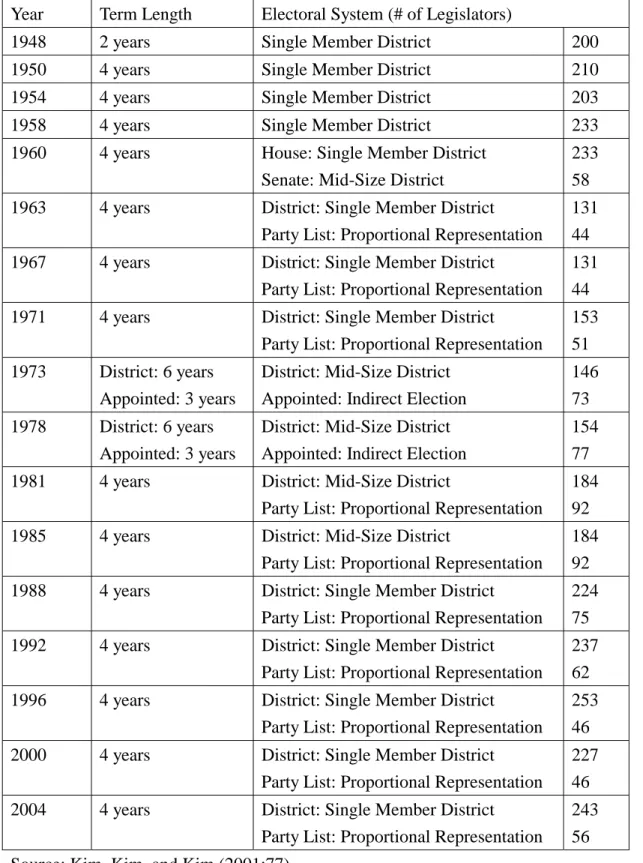
Table 3. The Changes of the South Korean Electoral Systems
Year Term Length Electoral System (# of Legislators)
1948 2 years Single Member District 200 1950 4 years Single Member District 210 1954 4 years Single Member District 203 1958 4 years Single Member District 233 1960 4 years House: Single Member District
Senate: Mid-Size District
233 58 1963 4 years District: Single Member District
Party List: Proportional Representation
131 44 1967 4 years District: Single Member District
Party List: Proportional Representation
131 44 1971 4 years District: Single Member District
Party List: Proportional Representation
153 51 1973 District: 6 years
Appointed: 3 years
District: Mid-Size District Appointed: Indirect Election
146 73 1978 District: 6 years
Appointed: 3 years
District: Mid-Size District Appointed: Indirect Election
154 77 1981 4 years District: Mid-Size District
Party List: Proportional Representation
184 92 1985 4 years District: Mid-Size District
Party List: Proportional Representation
184 92 1988 4 years District: Single Member District
Party List: Proportional Representation
224 75 1992 4 years District: Single Member District
Party List: Proportional Representation
237 62 1996 4 years District: Single Member District
Party List: Proportional Representation
253 46 2000 4 years District: Single Member District
Party List: Proportional Representation
227 46 2004 4 years District: Single Member District
Party List: Proportional Representation
243 56 Source: Kim, Kim, and Kim (2001:77)
If we take a look at the electoral system, one of the most cited institutional factors, then we do see the difference between these two cuntries. Unlike Taiwan that has had a constant electoral system (SNTV, single non-transferable vote) throughout the post-war years, Korea changed its electoral systems several times in the past few decades. Table 3 shows the difference electoral systems at different times. Because of the constant change of the electoral systems, feminists, even after Korea became democratized, have been fighting against the institutional constraints of electoral systems that are unfriendly toward women’s political participation.
It is widely recognized in the literature that the single member district is the most unfavorable electoral system for women’s political participation (Rule and Norris 1992; Dunleavy and Margetts 1995; Matland and Studlar 1996). As table 3 shows, South Korea since democratization in 1987 has had an electoral system that was tilted toward the single member district. Though the electoral system is a mixed one, the percentage of the seats decided by party lists only consist of 25% to 30% to the total seats in the National Assembly, South Korea’s national legislature. Since it is almost impossible to adopt gender quota for single member district, the effect of the gender quota, even if adopted, will be curtailed by the limited number of proportional seats.
Korean feminist activists and scholars have long pointed out the institutional constraint they faced. While they did not have enough control over the reform of the electoral system, they chose to make gender quota an institutional reform. In the process of making the demand of a gender quota, the Korean Women’s Associations United played a crucial role.4 Generally regarded as a coalition of radical women’s organizations, the Korean Women’s Associations United (hereafter KWAU) currently consist of more than 30 women’s organizations. The largest of these groups is the Women’s Society for Democracy, which is a multi-issue women’s rights group under the leadership of Professor Lee Hyo Jae, a member of the Sociology Department at the Ehwa Women’s University. Along with Lee Ou Jeong, appointed to the National Assembly in 1993 by the Democratic party and formerly the president of KWAU, she is seen by most feminist activists as a symbolic leader of the contemporary women’s movement in Korea.
The Korean Women’s Society for Democracy (hereafter KWSD) was founded in 1987 after the Women’s Society for Justice and Equality, which had been organized in 1983 to deal with women’s labor issues and the patriarchal system, died from internal
4
splits between members who advocated labor reforms, which would benefit women, and those who were more concerned with democratic reforms of the political system. In 1988 the KWSD had 150 active members and directed its attention to a wide range of issues that affect women, including women’s labor rights, prostitution, and sex torture. They are also involved in efforts to alter the Family Law. Members of the KWSD believed that unless Korean women can participate in the political process, these complicated issues will not be properly handled. The mainstream Korean society, dominated by a male-centered perspective, might treated these issues as women’s issues not the issues that are directly related to the quality of Korean democracy.
Along with the KWSD, the Korean League of Women Voters is also a major player in the gender quota issue. The Korean League of Women Voters is a small group, established in 1969, and modeled closely after the League of Women Voters in the United States. As an organization, it is concerned with voter participation and education. Particular interest in recent years has been the issue of local autonomy. The League is interested in home rule and is involved in educating voters about the
potential of local autonomy in what has been a highly centralized polity. The year 1991 was a turning point in the history of local politics in Korea. Local assemblies were reinstated for the first time since General park Chung Hee dissolved them immediately after the coup in May 1961. In order to elect representatives for the new local assemblies, the election of assemblies at the basic-level local government was held in March 1991. The assembly members of the higher level--provincial and metropolitan—governments took place in June of the same year. Women secured a tiny 1 percent of all seats in the local assemblies (Kim, Kim, and Kim 2001:84).
Members of the Korean League of Women Voters believed that women are more needed and better qualified to run the local assemblies. The pre-election mood at that time was also that many women would rn and win their seats. The results of the elections, however, clearly showed that women were still at a great disadvantage in local politics as well. Though disappointed at the results, the League still valued the fact that female candidates who ran in that election gained campaigned experience. The results also propelled the League to ponder upon institutional designs that would facilitate women’s political participation because they know the social value would not change overnight. According to a survey reported prior to the local election in 1991 by the Center for Korean Women and Politics, 46.3 percent of the public still perceived that the most important reason why there were so few women candidates in local elections was that “people have negative views on women going into politics.” Similarly, 40 percent of the candidates who ran in the local self-government election
in 1991 pointe out that the greatest disadvantage for female candidates was “voters’ preference for men over women.” (Kim, Kim, and Kim 1998: 155)
The 1991 local election result made the feminists activists realized that, without proper institutional arrangement, it would be difficult to increase women’s political participation. Kim Young Sam’s victory of the 1992 presidential election heightened the expectation of the activists. Known to be the first democratically- elected civilian president in South Korea’s history, Kim Yong Sam supported progressive causes in his younger years during his political career. Though Kim Yong Sam voiced support for women’s concerns, at that time high on the list of the concerns were issues of child care, implementation of the Equal Employment Act, and sexual violence. Not until the 1996 general election did feminist activists formally and specifically demanded a gender quota in the nomination of all political parties. The KWSD and the Korean League of Women Voters met leaders of the major political parties but did not gained enough support. Kim Yong Sam himself was not particularly enthusiastic about establishing gender quota either. At that time, women’s organizations already formed a coalition with other social movement organizations to monitor the activities of the National Assembly.
In 1997 when Kim Dae Jung was running for president, he publicly announced that gender parity would be one of his major policy goals. The announcement was recognized by women’s organizations as a friendly gesture. Feminist activists began to push for a gender quota in the nomination for the general election of 2000. This time, leaders of major political parties were more friendly toward the gender quota. One of the reasons that male leaders of the political parties changed their attitude was because the gender quota was no longer a demand of women’s organizations. It had become a demand of the social movement coalition. Social movement organizations created a coalition and began to have a special “outing campaign” for the 2000 general election. The Outing Campaign’s major goal was to make sure that corrupted politicians did not get elected. At the beginning the coalition had about 100 social movement organizations and civic groups. With the support of not only progressive but also mainstream media, the popularity of the campaign quickly increased. Polls show that more than 80 percent of Korean voters supported the campaign. By the election day, the campaign was already a national phenomenon. It turned out that 60% of the candidates who were targeted by the Outing Campaign did not get elected. In Seoul, 19 of the 20 targeted candidates did not get elected.
demand of women’s organizations. When the attention of the public as well as the social movement coalition was captured by whether or to what extent the campaign would succeed, other specific political demands were sidelined. Though all political parties, under the pressure of the social movement coalition, made the promise that they would adopt a gender quota in their nomination of candidates, only the
Democratic Party, led by president Kim Dae Jung, fulfilled the promise and filled 30% of the party list with female candidates. This result, though not satisfactory to feminist activists, was still regarded as a step toward the goal of institutionalizing gender quota.
After the general election of 2000, women’s organizations as well as scholars continue to argue the importance of gender quota. Progressive media such as Women’s News also did reports comparing the percentage of women in national legislature between South Korea and other countries. Scholars who did research on women’s political participation have long argued for the adoption of a gender quota. By the summer of 2003, demanding a gender quota in major political parties’
nomination of candidates, especially of the candidates of the party list, once again was a goal of social movement organizations. Through rounds of discussions and
negotiations, political parties finally agreed that they will fill half of the party list with female candidates. Feminist activists were concerned whether the political parties will deliver their promise. By constantly remind the public and the media, they basically used a “shaming” strategy to make sure that political parties would keep their promises of gender quota. The result proved the strategy to be a successful one. As shown in table 2, the percentage of women in South Korea’s National Assembly jumped from 5.9% to 13%.
While feminist activists made significant progress in establishing a gender quota in the political parties’ nomination of candidates, they made little advances in setting a gender quota for ministerial positions or offices of political parties. Among major political parties, women members consist anywhere between 20 to 40 percent of the total members. Throughout the 1990s, few women held decision-making positions in these political parties. For example, the Democratic Liberal Party, the ruling party during the presidential terms of Noh Tae Woo and Kim Yong Sam, reserved one seat for women on the party’s supreme council. Among the three deputy secretary generals and the eight members of the party advisory council, there was only one woman each. At the same time, there was no woman in the fifty-member party executive council. For officers of the party headquarters, 2 out of 57 directors, 2 out of 56 vice-directors, and 3 out of 79 departmental heads were women (Sun 2000:193-195). Though Kim
Dae Jung made more efforts to promote women, as discussed above, his political party, the Democratic Party only had few women leaders also. In the Democratic Party
during Kim Dae Jung’s term as the president, one of the eight supreme council
members was a woman. Among the seventy party executive members, only three were women. Whether it was the in the Democratic Liberal Party or in the Democratic Party, even when women held significant party positions, they were assigned to works related to the so-called “women’s affairs.”
Unlike their Taiwanese counterparts, South Korean feminist activists did not make gender quota a political demand for ministerial and party positions. One of the reasons they did not focus on these political domains was because the average service length of South Korea’s cabinet members tended to be short. According to South Korea’s constitution, the president’s term is five years and each president can only serve one term. Korean president usually reshuffle the cabinet during their term when they tried to gain political support. Therefore, most of the cabinet members served only two, or no more than three years in the government. As for the political party, the activists’ movement strategy was to push the change of the National Assembly first. They believed that as long as more women are elected into the national legislature, political parties will change their policies and become more willing to recruit and promote women.
Overall speaking, South Korea’s electoral system was not a favorable one for women’s political participation. Though the percentage of women had a significant increase in 2004, it could be reasonably predicted that this percentage might not be increased again in the near future unless the portion of the party list seats increases. It remains to be seen whether the political parties would adopt the gender quota in the 2006 local election. If the parties do, then, optimistically speaking, it would
eventually increase women’s chances to win seats in the single member district in the general election after female politicians accumulate their experience in running for the local assemblies.
IV.
The Challenge of Institutionalizing Gender Quota
I have emphasized the significance of the institutional factors in the above discussion. As we have seen, institutional environment has an impact on movement discourse and movement strategy. From fighting for the reserved seats to fighting for a gender quota, Taiwanese feminist movement framed the discourse in such a way
that women are giving up protection and privilege at the same time, in exchange for fair treatment. South Korea’s feminist activists had no such institutional environment to take advantage of. Moreover, Korean activists faced the constraints of an electoral system of which at least two thirds of the seats are elected through single member districts.
Though both South Korean and Taiwanese feminists achieved a certain degree of establishing gender quota in their respective political system. Whether gender quota could be further institutionalized as part of the political system remains to be a challenge in both countries. In Taiwan, the current ruling party has already
institutionalized gender quota in its internal rules. The feminist activists’ expectation, however, is that gender quota could be a practice adopted by all major political parties. If political parties are reluctant to do so, then there should be laws that require them to do that. In addition to the nomination of candidates, women’s organizations in Taiwan also pushed for a blanket application of gender quota in all political domain, including ministerial positions and party offices. Recent discussion of constitutional amendment even propelled some feminist leaders to suggest that gender quota should replaced the reserved seats article and be written into constitution.
In pursuing the institutionalization of gender quota, Taiwanese feminist activists actually face another challenge. Electoral system reform has been a political agenda for almost ten years. Currently the consensus between the ruling and the opposition party is that the SNTV system will be replaced by a mixed system like either the German or the Japanese one. This change could have a huge impact on the percentage of women in national legislature (Cox and Schoppa 2002; Shugart 2001). The impact of the electoral system change is particularly obvious when we look at the experience of other countries that also have a mixed system. In Australia, women hold 16% of the seats in the lower house of parliament, which is elected via a
single-member district system. In the upper house, which is elected in multimember districts, women hold 30% of the seats. In Germany, which used a mixed system for its lower house, 13% of the representatives elected in single-member districts are women, compared to 42% of those chose via party lists in multimember districts. And the share of women elected to New Zealand’s parliament jumped from 21% to 29% following a switch in the mid-1990s from single-member districts to a mixed system similar to Germany’s (Kenworthy and Malami 1999:262).
Currently the electoral system reform in Taiwan is at stagnation. It therefore remains to be seen whether or to what extent the reform will affect women’s presence
in national legislature. Taiwanese feminist activists in the past few years have
defended hard on the concept as well as the practice of gender quota. At the beginning, women’s organizations advocated the proportional representation system, since it has been the most compatible system with gender quota. When it became clear that the consensus of different political forces was to adopt a mixed system, women’s organization then advocated for a reasonable allocation of the seats between single-member districts and party lists. From the perspective of women’s
organizations, so far the draft of the electoral system reform proposed by either the ruling party or the opposition party was unsatisfactory mainly because the imbalance of the seats allocation. In other words, Taiwanese feminists are trying hard to avoid an institutional environment their Korean counterparts faced for years.
In addition to the limited number of party list seats in the electoral system, Korean feminists faced other challenges when they tried to institutionalize gender quota. While major political parties delivered their promises on gender quota in the 2004 general election, they were reluctant to make gender quota an institutionalized practice. Whether it was adopted as internal party rules or even laws, leaders of the political parties so far have killed such proposals. Given South Korean social
movement’s organizational strength and capacity for mobilization, if gender parity is regarded as a major issue of political reform, South Korean feminist activists should have an easier time to make gender quota an institutionalized practice. Regarding gender parity as a major goal of political reform, however, involves the change of social value not just among activists but also among ordinary citizens.
V. Conclusion
In a large-scale cross-country comparison of women’s political participation, Reynolds (1999: 572) made a straightforward conclusiont:
Democracy in itself is not necessarily a precursor to the presence of substantial numbers of women in political life. Rather, the determining factors are a nation’s familiarity with women in positions of power and the sociopolitical cultural acceptance of women as leaders, governors, and national administrators. Religious practices and ideological movements help determine the baseline for women, but these foundations can then be built upon (or perhaps bypassed) by women-friendly political institutions. Such friendly institutions may include list PR electoral systems and electoral quotas at both the legislative and the
candidate level. (emphasis added by author)
For Taiwanese and South Korean feminist activists, the key phrase in the above quotation was “by passed”, as I bolded them. Institutions, behaviors, and values affect and interact one another. While Taiwanese and South Korean women activists never stop to educate their society on the importance of gender parity, they also know that institutional reform cannot wait. Gender quota has been widely regarded as a
women-friendly institution, the experience of many newly democratized countries in Africa and Latin America in the 1990s already showed that this institution was not always a result of the change of social value. On the other hand, it could be the cause of value change when there is more presence of women in the political process.
The comparison of the experience of South Korea and Taiwan also showed the significance of existing institutions. Though Taiwanese male politicians might be as reluctant as Korean politicians to accept and implement gender quota, the
constitutionalized practice of reserving seats for women in legislatures of all levels did allow women activists a political space their South Korean counterparts did not have. In the social movement discourse, such political space allowed Taiwanese feminists sound like abandoning privilege rather than gaining advantage when they push for gender quota.
Throughout the world, women have made advances in national legislatures since the end of world war II. However, it has been only in the last decade or so that they have assumed a significant number of cabinet positions. While many countries implement gender quota at the legislative or candidate level, few countries adopt that practice for cabinet positions. How come the gender quota is not applied to cabinet position is itself an interesting question to explore. Overall speaking, even if South Korea and Taiwan adopt gender quota for elections candidates as well as cabinet positions, overcoming the gender stereotype remains an important task in promoting women’s political participation. There is a worldwide tendency to place women in the softer sociocultural ministerial positions, and the traditionally harder and politically more prestigious positions of economic planning, national security, and foreign affairs are relatively insulated from women. Women therefore should break not only the glass ceiling to fill top political jobs, they should also break the glass wall that confine their achievement in certain political areas. Gender parity ironically can be achieved only when gender quota becomes a meaningless institution.
References
Cox, K.E. and Schoppa, L.J. 2002. 'Interaction Effects in Mixed-Member Electoral Systems: Theory and Evidence From Germany, Japan, and Italy'. Comparative
Political Studies 35: 1027-1053.
Dunleavy, P. and Margetts, H. 1995. 'Understanding the Dynamics of Electoral Reform'. International Political Science Review 16: 9-29.
Kenworthy, L. and Malami, M. 1999. 'Gender Inequality in Political Representation: A Worldwide Comparative Analysis'. Social Forces 78: 235-269.
Kim, W. and Kim, E. 1998. The Reform of Electoral Systems and the Proposals for
Increasing Women's Political Representation. Seoul: Korean Women's Development
Institute. (in Korean)
Kim, W., Kim, E. and Kim, H. 2001. Korean Women's Political Partcipation after the
Liberation. Seoul: Korean Women's Development Institute. (in Korean)
Liang, S.-L. 1995. 'Research and Suggestions for the White Papers on Women's Political Participation' Conference on Policies for the Women in the Twenty-First
Century. Taipei. (in Chinese)
Liang, S.-L. and Ku, Y.-L. 1995. 'Taiwanese Women's Political Participation: Observations fro Inside and Outside of the Political Institution' White Papers on the
Situation of Taiwanese Women: 1995. Taipei: Shibao Wenhua.(in Chinese)
Massicotte, L. and Blais, A. 1999. 'Mixed Electoral Systems: A Conceptual and Empirical Survey'. Electoral Studies 18: 341-366.
Matland, R.E. 1993. 'Institutional Variables Affecting Female Representation in National Legislatures: The Case of Norway'. The Journal of Politics 55: 737-755.
Matland, R. and Studlar, D.T. 1996. 'The Contagion of Women Candidates in Single-Member District and Proportional Representation Electoral Systems: Canada and Norway'. The Journal of Politics 58: 707-733.
Matland, R. and Taylor, M. 1997. 'Electoral System Effects on Women's
Representation: Theoretical Arguments and Evidence From Costa Rica'. Comparative
Political Studies 30: 186-210.
Matland, R. 1998. 'Women's Representation in National Legislatures: Developed and Developing Countries'. Legislative Studies Quarterly XXIII: 109-125.
Moser, R.G. 2001. 'The Effects of Electoral Systems on Women's Representation in Post-Communist States'. Electoral Studies 20: 353-369.
Pollitt, K. 1999. 'Whose Culture?' in Cohen, J., Howard, M. and Nussbaum, M.C. (eds.) Is Multiculturalism Bad for Women? Princeton: Princeton University Press.
Reynolds, A. 1999. 'Women in the Legislatures And Executives of the World: Knocking at the Highest Glass Ceiling'. World Politics 51: 547-572.
Rule, W. and Norris, P. 1992. 'Anglo and Minority Women's Underrepresentation in the Congress: Is the Electoral System the Culprit?' in Rule, W. and Zimmerman, J. (eds.) United States Electoral Systems: Their Impact on Women and Minorities. New York: Praeger.
Shiratori, R. 1995. 'The Politics of Electoral Reform in Japan'. International Political
Science Review 16: 79-94.
Shugart, M.S. 2001. 'Electoral "Efficiency" and the Move to Mixed-Member Systems'.
Electoral Studies 20: 173-193.
Son, B. 2001. Women and Politics in the 1990s. Seoul: Dahae Publisher. (in Korean)
Squires, J. 1996. 'Quotas for Women: Fair Representation'. Parliamentary Affairs 49: 71-88.
Studlar, D. and McAllister, I. 2002. 'Does A Critical Mass Exist? A Comparative Analysis of Women's Legislative Representation Since 1950'. European Journal of
Political Research 41: 233-253.
Tsai, Z.-Z. 1997. 'Alternative Thinking toward the Article on the Reserved-Seats System for Women'. Newsletters on the Research of Women and Gender 44: 5-7. (in Chinese)