
Modeling and Analysis of Spatiotemporal Behavior of Multimedia in SMIL
6
0
0
全文
(2) Int. Computer Symposium, Dec. 15-17, 2004, Taipei, Taiwan.. Table 1. Comparison among MOPN, TPN, STRPN, and Presentation PN MOPN TPN STRPN Presentation PN manifestation plan for transform SMIL use PN to model combine PN model universal access temporal behavior temporal and spatial and SMIL to reach into PN relations between the Multi-level Objective moving multimedia Content Tree purpose object OCPN OCPN Classic PN Extended PN Classic PN access different optimize its delivery model temporal and emphasize workflow manifestation plan in schedule and utilize spatial property of and content Advantage any device the system resource multimedia representation adaptation not to discuss the not to describe cannot integrate into not to define spatial spatial arrangement spatial layout SMIL arrangement and Disadvantage spatiotemporal analysis The marking can be treated as a time marking.. appearing order and position among objects to express the learning objectives. In summary, SMIL has five major features, as follows: [11] Media Content: used to integrate existing variety of multimedia. Layout: used to coordinate the scope of content displaying. In our study, layout is a key factor which effects the final representation of content. Timing: synchronization control among media is the most important contribution for SMIL. There are two basic elements which are “sequence” and “parallel” in temporal domain. The corresponding attributes are “begin”, “end”, and “duration”. Linking: hyperlink function is similar with HTML. Adaptive: provide adaptive function to let people tailor content according to characteristics such as language, preference, and device capability. An example of playing SMIL file is shown in Figure 2.. Table 2. Formal Definition of a Petri Net [10] A Petri nets is a 5-tuple, PN = ( P, T , F , W , M 0 ) where: P = { p1 , p 2 ,L, p m } is a finite set of places, T = {t1 , t2 , L , tn } is a finite set of transitions, F ⊆ ( P × T ) ∪ (T × P ) is a set of arcs (flow relation) W : F → {1,2,3, L} is a weight function, M 0 : P → {0,1,2,3, L} is the initial marking, P ∩ T = ∅ 且P ∪ T ≠ ∅ A Petri nets structure N = ( P, T , F , W ) without any specific initial marking is denoted by N. A Petri nets with the given initial marking is denoted by ( N , M 0 ) .. Figure 1. Petri nets Graph SMIL is an XML-based extension markup language, which initiated from W3C. The currently version is 2.0. It provides a continuous multimedia presentation characterized with spatial and temporal synchronization of multiple integrated media which HTML limited. In SMIL, every resource can be treated as object. Each object has its own attributes or properties and described in metadata format, likes identification, title, description, format, and etc. SMIL provide an integrated markup platform to organize objects. The user or teacher can use SMIL to arrange the. Figure 2. Example of playing SMIL file During designing phase, user may not have a completely picture what he/her really wanted. User must wait for playing SMIL file then knows what exactly designed content is. Incorporated with Petri. 608.
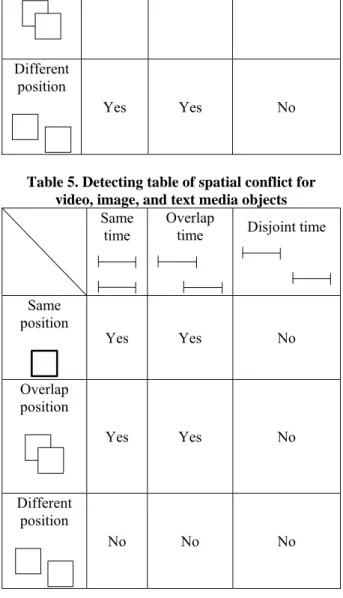
(3) Int. Computer Symposium, Dec. 15-17, 2004, Taipei, Taiwan.. nets, the designed scenario can be visualized to help user design [12]. From Figure 1, it is found that there are four basic elements used in Petri nets such as place, transition, arc, and token. They are the key elements to establish the relationship between PN and SMIL. The mapping is shown in Table 3. Table 3. Summary between Petri nets and SMIL Petri Place Transition Arc Token nets Object Scene Flow Play SMIL property transition path status. position. Different position Yes. Same position. 2.2 Temporal and Spatial Behavior Detecting To detect conflict among objects, we use three major conditions, i.e. disjoint, meet, and overlap in temporal and spatial domain to illustrate. There are nine interference types existed, as follows: (1) same time with same position (2) same time with overlap position (3) same time with different position (4) overlap time with same position (5) overlap time with overlap position (6) overlap time with different position (7) disjoint time with same position (8) disjoint time with overlap position (9) disjoint time with different position. Audio objects do not need to occupy spatial resource, but it is sensitive with the other audio and sound of video object. This characteristic is very different from other type of object. Therefore, we separate audio object and sound of video from other type to discuss. Audio emphasized temporal property. Video emphasized both temporal and spatial property. Image emphasized spatial property. Text emphasized spatial property Table 4 illustrates the detecting table of temporal conflict for audio and video media objects. Table 5 depicts the detecting table of spatial conflict for video, image, and text media objects. Table 4. Detecting table of temporal conflict for audio and video media objects Overlap Disjoint Same duration duration duration. Overlap. Yes. Yes. No. Yes. Yes. No. No. Table 5. Detecting table of spatial conflict for video, image, and text media objects Overlap Same Disjoint time time time. From Table 3, Place will be extended to define the attributes of multimedia objects, likes spatial and temporal information. Transition is responsible for the switching control among workflows. Arc represents the media workflow. Token will be the status of playing which represent as a black circle.. Same position. Yes. Yes. Yes. No. Yes. Yes. No. No. No. No. Overlap position. Different position. The comparison and feature between Table 4 and Table 5 is listed as shown in Table 6. Table 6. Table 4 and Table 5 use method Table 4 Table 5 Use Table check temporal check spatial Purpose conflicts conflicts between between media media objects objects Description 1. Row-spatial 1. Row-spatial relation between relation between two media two media objects. objects. 2. Column2. Columntemporal relation temporal relation between two between two media objects. media objects. 3. Media types: 3. Media types: audio, video. video, image and text. 1. Check 1. Check spatial Checking temporal conflict conflict between procedure between media media type. If. 609.
(4) Int. Computer Symposium, Dec. 15-17, 2004, Taipei, Taiwan.. type first. If yes, give warning 2. Then check table Table5 (spatial conflict) between media type. MOT is original time function of multimedia, MOT : P → τ MOT , where τ MOT = { y ∈ ℜ y ≥ 0} ,. yes, give warning 2. Then check is finish, it’s no temporal and spatial conflict between media type. MPT is playtime function of multimedia, MPT : P → τ MPT , where τ MPT = {z ∈ ℜ z ≥ 0} , with limitation that MOT ≧ MPT 3. Spatial Property: SP = ( X , Y ,W , H ) , X and Y are coordinate parameters of the upperleft corner of window for media object, X : P → Ψ X , where Ψ X = {r ∈ ℜ r ≥ 0} ,. 3. Formal Definition for Temporal and Spatial Conflict Analysis. Y : P → ΨY , where ΨY = {s ∈ ℜ s ≥ 0} ,. To analyze temporal and spatial conflict, we proposed a modified PN Reachability Tree method to detect spatiotemporal conflict behavior, which produced via PN-based SMIL authoring tool [12]. For the need of PN Reachability Tree, we first explain the PN Reachability Tree, and then expand the definition of MOPN to proposed SMILPN.. W is width function of media object, W : P → ΨW , where ΨW = {u ∈ ℜ u ≥ 0} , H is height function of media object, H : P → ΨH , where ΨH = {v ∈ ℜ v ≥ 0} , 4. ML = {ml1 , ml 2 ,K, ml n } is a set of modalities, and MOD is a modality function such that MOD : P → ML The firing rules are explained as follows. 1. If the place exist a token and corresponded MPT of temporal property (TP) is played out, then we called it “token unlock.” 2. For a transition, when corresponding input places have marked token and token is unlock, then these places can enable transition. An enabled transition will be fired, and then the token of input places will be removed. At the same time, the token of output places will also be added.. 3.1 Reachability Tree Logic Reachability tree logic (RTL) [13] is a branchingtime temporal logic in which the specification and verification is based on the reachability tree constructed from TPN. A branching-time temporal logic is built upon a linear-time temporal logic by associating two path quantifiers— for all (∀) and there exist (∃) to each firing sequence (path and firing sequence are used interchangeably in this paper). Reachability tree of RTL is different from the computation tree of CTL [14] in terms of the length of firing paths. The length of a firing sequence in a reachability tree is finite whereas the length of a path in a computation tree may be infinite. A path in a computation tree is as a full path because each path exhibits a full execution behavior of a computation. The primitive firing sequence is referred as the firing sequence from the initial marking (root) to any leaf node in a reachability tree. 4. Analysis of Temporal and Spatial Conflict In this section, we will show how the Reachability Tree method could analyze temporal and spatial behavior. An example of Multimedia plan, which modeled by proposed SMILPN is shown in Figure 3. The corresponding relations of spatial property (SP) among multimedia objects are illustrated in Figure 4. To verify the result from Reachability analysis, firing sequence σ is used to search objects deadlock and find the playing place at the same time. The mentioned model is expressed via PN Reachability Tree. We use Reachability Tree tool [15] to analyze this model, the result is shown in Figure 5. In addition, the corresponding properties of related places are listed in Table 7. Deadlock is a logical error in processes or workflow. Detecting deadlock does not mean the multimedia plan can be executed without any interference, likes spatial overlapped. Due to the Reachability Tree only can detect the deadlock in multimedia plan; we develop a detecting algorithm based on proposed SMILPN definition. This algorithm will analyze the spatial and temporal relations among objects in the multimedia plan. All possible conflict will notify author to modify.. 3.2 SMILPN Definition The proposed SMIL based Petri Net (SMILPN) is used to model and analysis the SMIL-based multimedia plan. The formal definition of SMILPN is as follows. SMILPN = {PN , TP, SP, ML} , where 1. PN = ( P, T , F ,W , M 0 ) is a formal definition of PN, 2. Temporal Property: TP = ( DEL, TO , MOT , MPT ) , DEL is a time delay function of multimedia, DEL : P → τ DEL , where τ DEL = {w ∈ ℜ w ≥ 0} , TO is a time out function of multimedia, TO : P → τ TO , where τ TO = {x ∈ ℜ x ≥ 0} ,. 610.
(5) Int. Computer Symposium, Dec. 15-17, 2004, Taipei, Taiwan.. Figure 3. An example modeling SMIL-based multimedia plan with corresponding properties. else if DEL(pi) < DEL(pj) (DEL(pi)+MIN(MPT(pi), MPT(pj)))-(DEL(pj)) is overlap duration time and interval between [T0+DEL(pj), T0+(DEL(pi)+MIN(MPT(pi), MPT(pj)))] else DEL(pi) = DEL(pj) (DEL(pi)+MPT(pi))-(DEL(pi)) is overlap duration time and interval between [T0+DEL(pi), T0+(MIN(MPT(pi), MPT(pi))] end if end for. Figure 4. The spatial relation of example.. then analyze M1, M2, and M3 till state end. Reachability Tree analysis steps are as follows. Step 1. Find out the spatiotemporal conflict and overlap duration of Mn states in Reachability Tree. For p1, p2, p5 of M1, the analysis as follows. Step 2. Find out the overlap duration by above Algorithm. (a) (b) (c) (d) (e) (f). Figure 5. Reachability Tree of example. Table 7. Property of Places in SMILPN model. p1:(0, 15, 15, 15, SP, video); p2:(0, 5, ∞, 5, SP, text); p3:(0, 5, ∞, 5, SP, text); p4:(0, 5, ∞, 5, SP, text); p5:(3, 20, 17, 17, SP, audio); p6:(0, 5, ∞, 10, SP, image); p7:(0, 15, ∞, 15, SP, image) p8:(0, 30, ∞, 30, SP, text). i=p1, j=p2 i=p1, j=p5 i=p2, j=p1 i=p2, j=p5 i=p5, j=p1 i=p5, j=p2. DEL(p1)=DEL(p2) → [T0, T0+5] DEL(p1)<DEL(p5) → [T0+3, T0+15] DEL(p2)=DEL(p1) → [T0, T0+5] DEL(p2)<DEL(p5) → [T0+3, T0+5] DEL(p5)>DEL(p1) → [T0+3, T0+15] DEL(p5)>DEL(p2) → [T0+3, T0+5]. Then remove the same interval, we could only select (a), (b), and (d). So we can show the overlap duration and interval as follows. Part “(a)”: p1, p2 overlap duration is (T0+5)-T0=5 and interval is from T0 to (T0+5), Part “(b)”: p1, p5 overlap duration is (T0+15)(T0+3)=12 and interval is from (T0+3) to (T0+15), Part “(d)”: p2, p5 overlap duration is (T0+5)-(T0+3)=2 and interval is from (T0+3) to (T0+5).. Then we are able to continue next step. Step 3. Find out the temporal and spatial conflict between multimedia objects in overlap duration by spatiotemporal conflict and type detecting table (Table 4 and Table 5). We use spatiotemporal detecting table to check overlap duration, spatial property (SP) and compare to multimedia modalities. Then it will notify that user whether the plan has spatiotemporal conflict or not. Part “(a)”: in overlap duration, p1 and p2 are “Overlap time” and “Different position”. By the. The algorithm is as follows. Algorithm: From places of initial marking M0 in the Reachability Tree to analyze the spatiotemporal conflicts of multimedia objects in overlap duration (including spatial overlap between multimedia objects and two audio played at the same time) for each i, j ∈ N, where T0 is total played time before if DEL(pi) > DEL(pj) (DEL(pj)+MIN(MPT(pi), MPT(pj)))-(DEL(pi)) is overlap duration time and interval between [T0+DEL(pi), T0+(DEL(pj)+MIN(MPT(pi), MPT(pj)))]. 611.
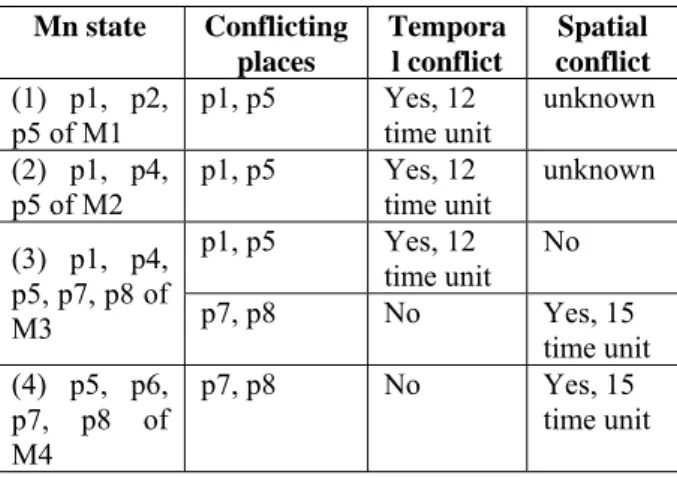
(6) Int. Computer Symposium, Dec. 15-17, 2004, Taipei, Taiwan.. detecting table, “video” and “text” have no temporal conflict and spatial conflict. Part “(b)”: in overlap duration, p1 and p5 are “Overlap time” and “Different position”. By the detecting table, “video” and “audio” have temporal conflict but no spatial conflict. Part “(d)”: in overlap duration, p2 and p5 are “Overlap time” and “Different position”. By the detecting table, “text” and “audio” have no temporal conflict and spatial conflict. Step 4. Final result Finally, we can find out p1 and p5 have temporal conflict and the overlap duration is 12 units.. theoretical study,” IEEE Transactions on Communications, 1976. [3] T. D. C. Little and A. Ghafoor, “Synchronization and Storage Models for Multimedia Objects,” IEEE Journal on Selected Areas in Communications, Vol. 8, No. 3, 1990, pp. 413427. [4] M. Woo et al., “A Synchronization Framework for Communication of Pre-Orchestrated Multimedia Information,” IEEE Network, pp.5261, Jan./Feb. 1994 [5] K. Jensen. “Coloured Petri Nets: Basic Concepts, Analysis Methods and Practical Use. Vol. 1, Basic Concepts.” EATCS Monographs on Theoretical Computer Science, pp 1-234. Berlin: Springer-Verlag, 1992. [6] Nabil R. Adam et al. “A Dynamic Manifestation Approach for Providing Universal Access to Digital Library Objects” IEEE Transactions On Knowledge And Data Engineering, Vol. 13, No. 4, pp.705-716 July/Aug. 2001 [7] S. M. Chung, A. L. Pereira, “Timed Petri Net Representation of the Synchronized Multimedia Integration Language (SMIL) of XML,” Proceeding of International Conference on Information Technology: Computers and Communications (ITCC’03), Apr., 2003. [8] Ping-Yu Hsu et al. “STRPN: A Petri-Net Approach for Modeling Spatial-Temporal Relations between Moving Multimedia Object” IEEE Transactions on Software Engineering, Vol. 29, No.1, January 2003. [9] Yu-Kuang Deng, Reuse and Adaptation Content Model for Multimedia Presentation, dissertation, 2002. [10] Tadao Murata, "Petri nets: Properties, analysis and applications", Proceedings of the IEEE, Vol. 77, NO. 4, pp.541-580, Apr. 1989. [11] L. Rutledge, "SMIL 2.0: XML for Web Multimedia" IEEE Internet Computing, pp.78-84, Sep.-Oct. 2001 [12] Stephen J.H. Yang, Norman W.Y. Shao, Kevin C.Y. Kuo, "A SMIL Editor and Rendering Tool for Multimedia Synchronization and Integration", National Computer Symposium 2003 ,Taiwan, page 56-62, Dec. 2003 . [13] Yang, S.J.H. et al., “Specifying and Verifying Temporal Behavior of High Assurance Systems Using Reachability Tree Logic”, IEEE 1998 High Assurance Systems Engineering Symposium, pp. 150-156, Washington D.C., USA. [14] M. Vazirgiannis et al., “Specifying and Authoring Multimedia Scenarios,” IEEE Multimedia, vol. 6, no. 3, pp.24-37, July-Sept. 1999. [15]Richard Scott Brink, A Petri Net Design, Simulation, and Verification Tool, appeared in http://www.csh.rit.edu/~rick/thesis/thesis.html.. Using the same ways, we can find out “(2) p1, p2, p5 of M2”, “(3) p1, p4, p5, p7, and p8 of M3”, and “(4) p5, p6, p7, p8 of M4”. The analysis result listed in Table 8. Table 8. Analysis result from reachability tree method Mn state Conflicting Tempora Spatial places l conflict conflict (1) p1, p2, p1, p5 Yes, 12 unknown p5 of M1 time unit (2) p1, p4, p1, p5 Yes, 12 unknown p5 of M2 time unit p1, p5 Yes, 12 No (3) p1, p4, time unit p5, p7, p8 of p7, p8 No Yes, 15 M3 time unit (4) p5, p6, p7, p8 No Yes, 15 p7, p8 of time unit M4. 5. Summary The proposed SMIL-based multimedia authoring environment, which combined SMIL and Petri net facilitate multimedia content generation. Although SMIL can provide excellent markup function on different type of multimedia objects, the spatiotemporal conflicts among objects are very difficult to detect and verify. All these temporal and spatial property of each object are modeled by proposed SMILPN. In this way, the designed content can be verified via Petri net analysis module. All the spatiotemporal conflicts could be effective detected, and then remind author to revise.. References [1] C. A. Petri, “Kommunikation mit Automaten,” PhD thesis, 1962 [2] Merlin and D. Farber. "Recoverability of communication protocols – implications of a. 612.
(7)
數據


相關文件
三、參加「大專校院社團評選」之社團,應於完成線上報名後,上傳核章後之 社團評選報名表(附件 1-1)、社團組織章程、社團簡介文字資料、校內 社團評選紀錄等
七、請各校踴躍推薦學生擔任評選委員(不限 1 名) ,推薦表及資格規定詳 如附件 3。請於線上填寫推薦表,並上傳核章後之掃描檔,於 110 年 1 月 29
依序填入該學生社團負責人之相關資訊,並於下方
2.本推薦表請於線上填寫完成,並上傳核章後之掃描檔,於 111 年 1 月 22 日(星期六)23 時 59
Performance metrics, such as memory access time and communication latency, provide the basis for modeling the machine and thence for quantitative analysis of application performance..
(It is also acceptable to have either just an image region or just a text region.) The layout and ordering of the slides is specified in a language called SMIL.. SMIL is covered in
– The futures price at time 0 is (p. 275), the expected value of S at time ∆t in a risk-neutral economy is..
happy linear modeling after Z = Φ(X ) Price of Nonlinear Transform.
