E
FFECT
OF
Z
IRCONIA
-M
ODIFIED
M
AGNESIA
I
NVESTMENT
ON
THE
C
ASTING
OF
P
URE
T
ITANIUM
Chun-Cheng Hung, Guey-Lin Hou, Chi-Cheng Tsai, and Ching-Cheng Huang
School of Dentistry, Kaohsiung Medical University, Kaohsiung, Taiwan.
Several investigations have examined magnesia-based investments for pure titanium casting. However, the thermal expansion value was insufficient at low casting temperatures and high interfacial reactivity occurred at high casting temperatures. The purpose of this investigation was to modify a magnesia-based investment by adding a heat-resistant mold material, zirconia, in different ratios to produce a more accurate titanium casting. The thermal expansion value was measured using a new precise automatic laser recording machine and pure titanium was cast using an argon casting machine. The marginal accuracy was measured using a stereomicroscope and the interfacial reactivity of the titanium was evaluated using X-ray diffraction analysis. The results indicate that adding different amounts of zirconia to a magnesia-based investment can increase its thermal expansion value and decrease the interfacial reactivity of the titanium. Maximal thermal expansion in the zirconia-modified investments significantly increased by 5–6 weight % (wt%) and peaked at 1.62% expansion. Selevest with 5 wt% zirconia had the smallest mean marginal discrepancy, 21.70 μm at 750°C. Analysis of variance indicates significant differences in marginal discrepancy between zirconia-modified investments (p < 0.001). Adding zirconia can also decrease the interfacial reactivity of the titanium. The data indicated that proper amounts of zirconia (5–6 wt%) added to a magnesia-based investment can produce a more accurate and less interfacial reactive pure titanium casting.
Key Words: pure titanium, casting, investment, thermal expansion
(Kaohsiung J Med Sci 2003;19:121–6)
Received: January 3, 2003 Accepted: February 21, 2003 Address correspondence and reprint requests to: Dr. Chun-Cheng Hung, School of Dentistry, Kaohsiung Medical University, 100 Shih-Chuan 1st Road, Kaohsiung 807, Taiwan.
E-mail: [email protected]
Pure titanium applications in dentistry are common. Pure titanium casting is technically much more sensitive to external parameters than conventional dental alloy casting. Titanium contamination with oxygen, hydrogen, and nitrogen during the casting procedure will result in alterations of its physical and mechanical properties. Several studies have focused on the casting of titanium [1–4]. Its reactivity with oxygen at elevated temperatures and low density make
the casting process difficult. Because of titanium’s high reactivity with silica investments, specially formulated mold materials containing alumina, magnesia, and calcia were developed [5–10]. In a previous study, we found that magnesia molds were one of the best investments for pure titanium casting, although they have an insufficient thermal expansion value at low casting temperatures and their chemical reactivity is prominent at high casting temperatures [11]. The purpose of this investigation was to modify the magnesia investment by adding a heat-resistant mold material, zirconia, in different ratios to produce a more accurate and less interfacially reactive titanium casting. The castability, marginal discrepancy, and interfacial reactivity were used to evaluate the effectiveness of these castings.
M
ATERIALSANDM
ETHODSThermal expansion measurement of investments
The original magnesia investment (Selevest CB, Selec Co., Osaka, Japan) used was composed of 65 weight % (wt%) magnesia as a refractory material and 30 wt% aluminous cement as a binder. Selevest CB was modified by adding 4–6 wt% zirconia (Zirconia, Acros Co., Morris Plains, NJ, USA), a heat-resistant mold material. Three specimens (10 mm diameter, 50 mm high) of different investment content were prepared and used for thermal expansion measurement. Thermal expansion was measured using a new automatic thermal expansion laser recording machine, TEM-1000 (Pantos, Nippon Co., Osaka, Japan). A heating cycle of 6°C/minute during heating to 800°C was followed by cooling to 200°C. Paired t-test was used to evaluate differences in thermal expansion by zirconia ratio.Marginal discrepancy measurement of castings
Wax patterns for mesio-occlusodistal (MOD) inlays were made using a tapered metal die (8 mm diameter, 7 mm high, 2 mm thick). Wax patterns were invested in casting rings (36 mm diameter, 46 mm high) with one sheet of kaowool liner (1 mm thick), and a sprue (3 mm diameter). The invested patterns were heated in a burn-out oven to 850°C, heat-soaked for 1 hour at 850°C, and cast at 800°C in original magnesia investments and at 750°C in modified magnesia investments. Commercially pure titanium (7 g, JIS grade 2; Ohara Co., Osaka, Japan) was cast into these burn-out investments using an automatic argon casting machine (Castmatic-S, Iwatani Co., Osaka, Japan). Five specimens were cast for each different investment content (from 4–6 wt%). Casting specimens were sand-blasted using 50 μm Al2O3. Marginal discrepancy insand-blasted casting specimens was measured on a metal die using a stereomicroscope (Nikon SM-2T, Tokyo, Japan) under a 5 kg constant load. The four measurement points were the corners of the mesial (M) and distal (D) parts of the MOD inlay, and the average of four readings, one at each point, was used as the discrepancy value. One-way ANOVA and Tukey’s honestly significant difference (HSD) test were used to analyze differences in the marginal discrepancy of the MOD inlay by zirconia ratio.
X-ray diffraction analysis of castings
The chemical reactivities of the occlusal outer surfacesof MOD titanium castings were evaluated using X-ray diffraction (XRD) analysis with an X-ray diffractometer (Rigaku D/max VIII, Tokyo, Japan) with CuK α radiation at 30 kV, 20 mA, and scan range of 2θ (20°C– 90°C). Phase identification was carried out using the JCPDS (Joint Committee on Powder Diffraction Standards) file.
R
ESULTSFigure 1 shows the thermal expansion curves of Selevest CB and Selevest CB with different zirconia ratios at various temperatures. The thermal expansion of Selevest CB was 1.12% at 800°C during a cooling cycle. Thermal expansion became 0.91% with the addition of 4.0 wt% zirconia, 1.09% with the addition of 4.5 wt%, 1.62% with 5.0 wt%, 1.59% with 5.5 wt%, and 1.48% with 6.0 wt% at 750°C during a cooling cycle. Two-sample t-tests showed that the mean thermal expansion was significantly different at 800°C in investments with 5, 5.5, and 6 wt% zirconia (p < 0.05), compared with Selevest CB.
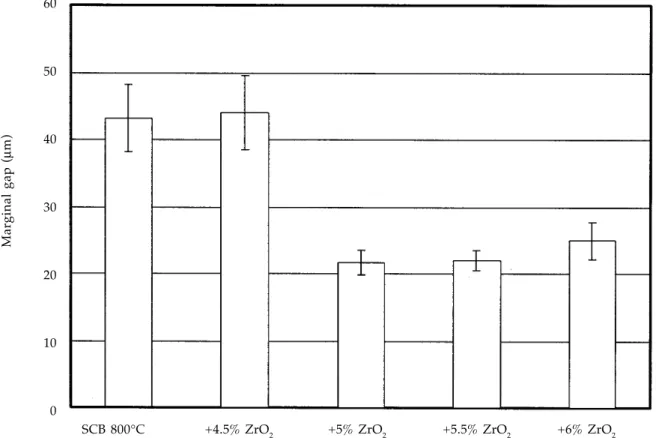
The mean marginal discrepancy in the MOD inlays using original Selevest CB at casting temperatures of 800°C was 43.23 ± 5.05 μm. The mean marginal discrepancies in the MOD inlays using Selevest CB containing 4.5, 5.0, 5.5, and 6.0 wt% zirconia were 44.00 ± 5.51, 21.70 ± 1.87, 22.00 ± 1.56 and 25.00 ± 2.81 μm, respectively, at a casting temperature of 750°C (Figure 2). One-way ANOVA and Tukey’s HSD test indicated that marginal discrepancy was significantly different in investments with 5.5 and 6.0 wt% zirconia (p < 0.001), compared with Selevest CB at a casting temperature of 800°C.
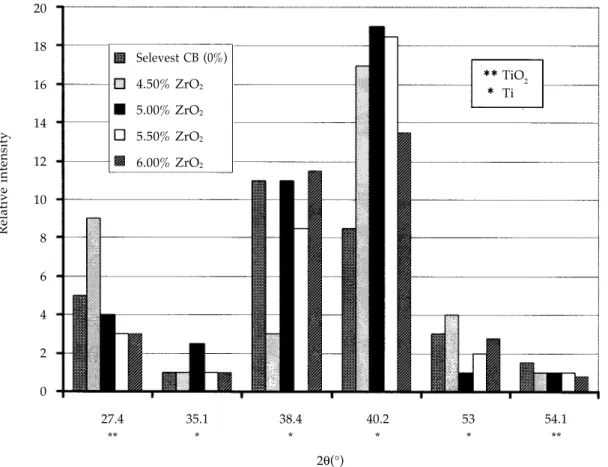
XRD analysis demonstrated that as the zirconia content of investments increased, the relative intensities of α-Ti increased and TiO2 decreased. XRD
patterns indicated that the higher the amount of zirconia, the greater the reduction in interfacial reactivity (Figure 3).
D
ISCUSSIONExpansion of the mold material is one of the most important factors in producing accurate castings. In this investigation, thermal expansion measurements were made using a precise automatic laser recording
Figure 1. Thermal expansion curves for Selevest CB with different zirconia (ZrO2) content at various temperatures. Selevest CB 4% ZrO2 4.5% ZrO2 5% ZrO2 5.5% ZrO2 6% ZrO2
Thermal expansion value (%)
Temperature (x 100°C) 1 2 3 4 5 6 7 8 8 7 6 5 4 3 2 1.5 1 0.5 0 –0.5
Figure 2. Marginal discrepancy in titanium castings using Selevest CB (SCB) with different zirconia (ZrO2) content (n = 5).
SCB 800°C +4.5% ZrO2 +5% ZrO2 +5.5% ZrO2 +6% ZrO2
60 50 40 30 20 10 0 Marginal gap ( μ m)
thermal expansion machine, TEM-1000, instead of a conventional dial gauge device. TEM-1000 can detect very small expansion values with a high accuracy of 1 μm and good reproducibility. The thermal expansion curves for Selevest CB with or without added zirconia illustrate similar expansion patterns. The rapid thermal expansion observed at temperatures of 550–650°C was due to zirconium oxidation [6]. Greater expansion at temperatures higher than 650°C could be obtained by adding proper amounts (5–6 wt%) of zirconia. Thermal expansion values differed significantly as zirconia content increased from 4.5 to 6.0 wt%.
Pure titanium was cast in a two-chamber automatic argon vacuum-pressure casting machine [12]. Typically, molten titanium is cast into a room-temperature [5] or preheated mold [2]. The vast difference between the mold and melting temperature causes rapid cooling and solidification of the metal and thereby produces the risk of inadequate mold fill
in thin sections. Therefore, a highly heat-resistant mold is needed when the thermal expansion technique is used. Since the maximal thermal expansion value was obtained at about 750°C, the mold was preheated to 750°C. The marginal gap in MOD castings using Selevest CB containing 5 wt% zirconia at 750°C had the highest thermal expansion value and also the smallest mean margin discrepancy value (Figure 2).
XRD analysis of the titanium casting showed a decrease in the relative intensity of α-Ti and an increase in TiO2 when the casting temperature was raised from
700 to 800°C. The intensity of α-Ti was very low while TiO2 increased remarkably when the temperature was
more than 900°C. XRD analysis of these castings revealed that the relative intensity of α-Ti increased and TiO2 decreased when the zirconia content was
increased (Figure 3).
In conclusion, the data from this study indicate that the proper amount (5–6 wt%) of zirconia added to
Figure 3. X-ray diffraction patterns of titanium castings using Selevest CB with different zirconia content. *Ti peak (2θ: 40.2°C, 38.4°C, 35.1°C); **TiO2 peak (2θ: 27.4°C, 54.1°C). Selevest CB (0%) 4.50% ZrO2 5.00% ZrO2 5.50% ZrO2 6.00% ZrO2 27.4 35.1 38.4 40.2 53 54.1 ** * * * * ** 2θ(°) TiO2 Ti Relative intensity 20 18 16 14 12 10 8 6 4 2 0
a magnesia-based investment can produce a pure titanium casting with more accurate marginal fit and lower interfacial reactivity.
A
CKNOWLEDGMENTSThis investigation was presented in part at the general session and exhibition of the International Association for Dental Research in Vancouver, Canada, in March, 1999. An NSC research grant (NSC87-2314-B037053) was greatly appreciated.
R
EFERENCES1. Blackman R, Barghi B, Tran C. Dimensional changes in casting titanium removable partial denture frameworks. J Prosthet
Dent 1991;65:309–15.
2. Mori T, Jean-Louis M, Yabugami M, Togaya T. The effect of investment type on the fit of cast titanium crowns. Aust Dent
J 1994;39:348–52.
3. Miyakawa O, Watanabe K, Okawa S, et al. Layered structure of cast titanium surface. Dent Mater J 1989;8:175–85. 4. Taira M, Moser JB, Greener EH. Studies of Ti alloys for dental
castings. Dent Mater 1989;5:45–50.
5. Ida K, Togaya T, Tsutsumi S, Takeuchi M. Effect of magnesia investments in the dental casting of pure titanium or titanium alloys. Dent Mater J 1982;1:8–21.
6. Togaya T. Clinical applications of titanium and its alloys: mold expansion. Proceedings of the 3rd International Symposium on Titanium in Dentistry, Sydney, 1995:119.
7. Miyazaki T, Tani Y, Suzuki E, Miyaji T. Application of CaO to dental investments. Jpn J Dent Mater 1987;6:334–9. [In Japanese] 8. Takahashi J, Kimura H, Lautenschlager EP, et al. Casting pure titanium into commercial phosphate-bonded SiO2 investment
molds. J Dent Res 1990;69:1800–5.
9. Takahashi J, Zhang J, Okazaki M. Effect of casting methods on castability of pure titanium. Dent Mater J 1993;12:245–52. 10. Takahashi H, Miyazaki T, Kawawa T. Accuracy of titanium
cast crowns obtained from calcia base mold. Clin Mater 1994; 16:155–60.
11. Hung CC, Lin WC, Hong JM. Effect of mold materials on casting of the pure titanium. Proceedings of the 4th International
Symposium on Titanium in Dentistry, Geneva, 1998:18.
12. Herø H, Syverud M, Waarli M. Mold filling and porosity in castings of titanium. Dent Mater 1993;9:15–8.