
中國醫藥大學機構典藏 China Medical University Repository, Taiwan:Item 310903500/46315
98
0
0
全文
(2) 謝辭 時光飛逝,兩年的研究生活晃眼及過,這段期間的學習和研究,首 先感謝這兩年來對我苦口婆心說教的指導老師-翁豐富副教授,在老師嚴 謹要求做事的態度、方法、邏輯以及解決問題的能力,使我增加進入職 場上所需求的能力,心中感謝老師這兩年來的指導與教誨。在論文口試 時,蒙嘉義大學陳清玉教授與本校的莊聲宏所長,對本論文辛苦的審查, 惠與寶貴的意見與指正,使本論文得以更臻完善,僅此敬致最誠摯的謝 意。 研究期間首先感謝藥化所提供良好的實驗環境及設備,像是抽氣 罩、中央真空系統以及走廊環境改善,並蒙郭盛助講座教授、莊聲宏所 長、黃麗嬌教授以及所上各位老師的關懷指導,還有龔語慧小姐這兩年 行政及大小事務上的幫忙,接著感謝所上的眾多學長姐在實驗及儀器使 用上的指導,最後感謝黃俞穎學長、王麗雅學姊、張濬璽學弟一路上也 幫了不少的忙,在此致上謝意。 最後感謝我的父母,因為我一路讀到研究所,感謝您們不辭辛苦的 為我賺取學費,使我未來步入社會時無負債的壓力,我的成就都是來自 你們給予的無條件的包容與支持,讓我面對挫折時可以無後顧之憂向前 邁進。這兩年來承蒙太多人的幫助與鼓勵,僅將此份論文獻給所有關心 我的親朋好友,共同分享這份成果及喜悅。.
(3) Contents Chart List.............................................................................................................III Abbreviation List.................................................................................................VI 中文摘要...........................................................................................................VII Abstract.............................................................................................................VIII Chapter 1 Introduction...........................................................................................1 Section 1.1 Pyrazoles derivatives as Antibacterial Lead Compound...............2 Section 1.2 Pyrazoles derivatives as Antifungal Lead Compounds.................6 Section 1.3 Pyrazoles derivatives as Anticancer Lead Compounds.................9 Section 1.4 Improved bioactivities by Amidinyl Group.................................12 Section 1.5 Antiproliferative of Formylated Amidinyl Pyrazole derivatives..14 Chapter 2 Research Approach............................................................................15 Chapter 3 Result and Discussion........................................................................17 Section 3.1 Chemistry....................................................................................17 Section 3.1.1 Synthesis of 5-amino-1,3-diphenyl pyrazole (1a–1e)...............18 Section 3.1.2 Synthesis of 1H-pyrazol-5-yl-N,N-dimethylformamidines (2a–2e)...........................................................................................................20 Section 3.1.3 Synthesis of Pyrazolyl-2-azadienes (3a–3e)............................22 Section 3.1.4 Synthesis of the de-amidination of methnimidamide (4a–4e)............................................................................................................27 I.
(4) Section 3.2 Biological evaluations.................................................................29 Chapter 4 Conclusion........................................................................................35 Chapter 5. Experimental Section........................................................................36. Section 5.1 General Procedure.......................................................................36 Section 5.2 Spectrum.....................................................................................39 Section 5.3 Cell lines......................................................................................50 Section 5.4 Growth inhibition assay..............................................................51 Reference..............................................................................................................52 Addendum............................................................................................................59. II.
(5) Chart List Figure 1 PNU-32945 and derivatives....................................................................1 Figure 2 Pyrazoles derivatives as antibacterial agent...........................................2 Figure 3 Pyrazoles derivative as antibacterial agent.............................................4 Figure 4 Pyrazophos..............................................................................................6 Figure 5 Furametpur, Penthiopyrad and Pyraclostrobin.......................................7 Figure 6 Melphalan and AB4..............................................................................12 Figure 7 Anthracycline and mecillinam..............................................................13 Figure 8 1H-pyrazol-5-yl-N,N-dimethylformamidines derivatives....................15 Figure 9 Pyrazolyl-2-azadiene derivatives..........................................................16 Figure 10 Methnimidamides derivatives.............................................................16 Figure 11 5-amino-1,3-disubstituted pyrazole derivatives..................................16 Figure 12 Pyrazole compounds...........................................................................35 Figure 13 1H NMR spectrum of compound 2a...................................................59 Figure 14. 13. C NMR spectrum of compound 2a..................................................59. Figure 15 IR spectrum of compound 2a.............................................................60 Figure 16 1H NMR spectrum of compound 2b...................................................61 Figure 17. 13. C NMR spectrum of compound 2b..................................................61. Figure 18 IR spectrum of compound 2b.............................................................62 Figure 19 1H NMR spectrum of compound 2c...................................................63 III.
(6) Figure 20. 13. C NMR spectrum of compound 2c..................................................63. Figure 21 IR spectrum of compound 2c..............................................................64 Figure 22 1H NMR spectrum of compound 2d...................................................65 Figure 23. 13. C NMR spectrum of compound 2d..................................................65. Figure 24 IR spectrum of compound 2d.............................................................66 Figure 25 1H NMR spectrum of compound 2e...................................................67 Figure 26. 13. C NMR spectrum of compound 2e..................................................67. Figure 27 IR spectrum of compound 2e..............................................................68 Figure 28 1H NMR spectrum of compound 3a...................................................69 Figure 29. 13. C NMR spectrum of compound 3a..................................................69. Figure 30 IR spectrum of compound 3a.............................................................70 Figure 31 1H NMR spectrum of compound 3b...................................................71 Figure 32. 13. C NMR spectrum of compound 3b..................................................71. Figure 33 IR spectrum of compound 3b.............................................................72 Figure 34 1H NMR spectrum of compound 3c...................................................73 Figure 35. 13. C NMR spectrum of compound 3c..................................................73. Figure 36 IR spectrum of compound 3c..............................................................74 Figure 37 1H NMR spectrum of compound 3d...................................................75 Figure 38. 13. C NMR spectrum of compound 3d..................................................75. Figure 39 IR spectrum of compound 3d.............................................................76 IV.
(7) Figure 40 1H NMR spectrum of compound 3e...................................................77 Figure 41. 13. C NMR spectrum of compound 3e..................................................77. Figure 42 IR spectrum of compound 3e..............................................................78 Figure 43 1H NMR spectrum of compound 4a...................................................79 Figure 44. 13. C NMR spectrum of compound 4a..................................................79. Figure 45 IR spectrum of compound 4a.............................................................80 Figure 46 1H NMR spectrum of compound 4b...................................................81 Figure 47. 13. C NMR spectrum of compound 4b..................................................81. Figure 48 IR spectrum of compound 4b.............................................................82 Figure 49 1H NMR spectrum of compound 4c...................................................83 Figure 50. 13. C NMR spectrum of compound 4c..................................................83. Figure 51 IR spectrum of compound 4c..............................................................84 Figure 52 1H NMR spectrum of compound 4d...................................................85 Figure 53. 13. C NMR spectrum of compound 4d..................................................85. Figure 54 IR spectrum of compound 4d.............................................................86 Figure 55 1H NMR spectrum of compound 4e...................................................87 Figure 56. 13. C NMR spectrum of compound 4e..................................................87. Figure 57 IR spectrum of compound 4e..............................................................88. V.
(8) Abbreviation List Cesium carbonate (CsCO3) Dimethylaminopyrium (DMAP) N,N-Dimethylformamide (DMF) Ethyl alcohol (EtOH) Hydrogen chloride (HCl) Methyl alcohol (MeOH) Phosphoryl chloride (POCl3) Potassium carbonate (K2CO3) Sodium hydroxide (NaOH) Triethylamine (NEt3). VI.
(9) 中文摘要 本論文是利用微波加速化學反應及化學選擇性控制方法,合成出 1Hpyrazol-5-yl-N,N-dimethyl-formamidine 和 pyrazolyl-2-azadiene 的兩類化合 物 , 將 5-amino-1,3-diphenyl pyrazole , 1H-pyrazol-5-yl-N,N-dimethylformamidines,pyrazolyl-2-azadiene,5-amino-4-formylpyrazoles 四類具構效 關係的化合物經由藥理活性篩選 (NCI-H661,NPC-TW01,Jurkat)。 其 結 果顯 示 1H-pyrazol-5-yl-N,N-dimethylformamidines 衍 生 物 2b, 2c , 2d 具 較 佳 的 藥 理 活 性 (IC50: 6.0~9.2μM) , 從 藥 理 活 性 也 指 出 在 pyrazole derivatives 須同時擁有 amidinyl 與 formyl 官能基才能增強藥理活 性。 H X DMF without pyridine X. N N N. POCl3, MW. X. NMe2 NaOH. CHO Y. NH2. NH2 N N. MeOH. CHO Y. 2a-2e. 4a-4e. N N. H Y. 1a-1e. X. N. NMe2. DMF with pyridine POCl3, MW. 1a. 2a. 3a. 4a. X = H, Y = H. N N Y. 1b. 2b. 3b. 4b. X = m-Cl, Y = Me, 1c. 2c. 3c. 4c. X = m-Cl, Y = Cl 1d. 2d. 3d. 4d. X = p-Br, Y = Me, 1e. 2e. 3e. 4e. X = p-Br, Y = Cl. VII. 3a-3e.
(10) Abstract Chemoselective microwave-assisted amidination was successfully developed to alternatively synthesize 1H-pyrazol-5-yl-N,N-dimethyl-formamidine and pyrazolyl-2-azadiene two classes compounds. All of the starting materials and resulting products were tested against NCI-H226, NPC-TW01, and Jurkat cancer cell lines to evaluate their difference in antiproliferative activities for realizing the structure activity relationship study. Following. the. SAR. result,. 1H-pyrazol-5-yl-N,N-dimethylformamidine. compounds 2b, 2c and 2d possessed the best potent with IC50 values in low micromolar range. On the other hand, we found that the formyl group at C-4 position and the grafted amidinyl group in the main core of pyrazolic molecule were necessary for the inhibitory activity H X DMF without pyridine X. N N N. POCl3, MW. X. NMe2 NaOH. CHO Y. NH2. NH2 N N. MeOH. CHO Y. 2a-2e. 4a-4e. N N. H Y. 1a-1e. X. N. NMe2. DMF with pyridine POCl3, MW. 1a. 2a. 3a. 4a. X = H, Y = H. N N Y. 1b. 2b. 3b. 4b. X = m-Cl, Y = Me, 1c. 2c. 3c. 4c. X = m-Cl, Y = Cl 1d. 2d. 3d. 4d. X = p-Br, Y = Me, 1e. 2e. 3e. 4e. X = p-Br, Y = Cl. VIII. 3a-3e.
(11) Chapter 1 Introduction Pyrazoles attract attentions due to their wide range of pharmacological properties; such as anti-asthmatic,1 antibacterial,2 anti-inflammatory,3 antifungal,4 anticancer,5 antiviral,6 anticonvulsant,7 and antimicrobial.8 The bioactivities of functionalized N-arylpyrazoles have been extensively studied9 and the C-5 substituted pyrazoles are also explored in the design of pharmaceuticals and agrochemical agents.10 Michael J. Genin11 in 2000 reported that novel 1,5-diphenylpyrazole nonnucleoside HIV-1 Reverse Transcriptase inhibitors, PNU-32945 and 1,5Diphenyl-3-(2-hydroxyethyl)-4-ethylpyrazole (Figure 1), were found to have excellent activity versus delavirdine-resistant P236L12 (IC50 = 1.1 μM) reverse transcriptase (RT) for inhibition of viral replication in cell cultures.. N N. N N. N. Me. Me OH. PUN-32945. 1,5-Diphenyl-3-(2-hydroxyethyl)-4-ethylpyrazole. Figure 1. PNU-32945 and derivatives Recently, the studies of pyrazole derivatives focus on antibacterial, antifungal, and anticancer as their key utilization . 1.
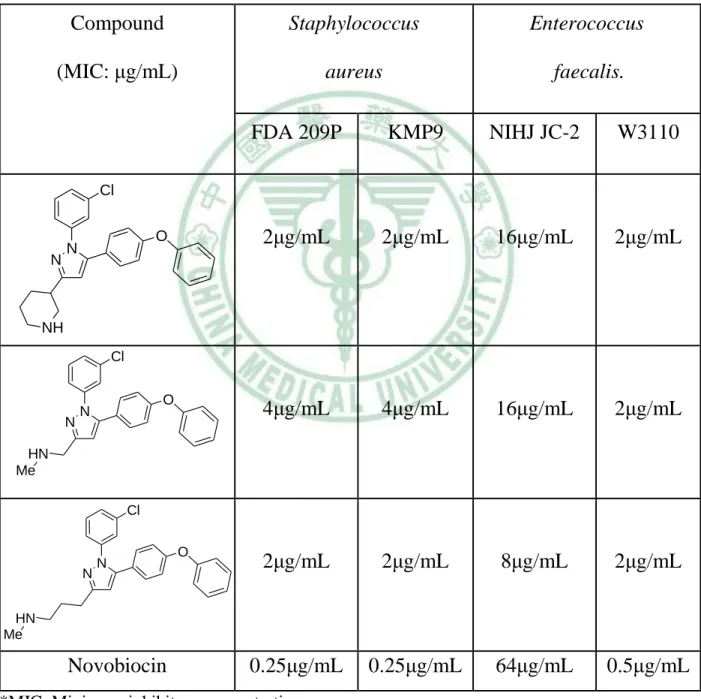
(12) Section 1.1 Pyrazoles derivatives as Antibacterial Lead Compound Akihiko Tanitame2a used a new screening system for the specific inhibitors of chromosome partitioning in Escherichia coli,13 and had previously reported that 4piperidyl moiety in pyrazole ring and 1-(3-chlorophenyl)-5-(4-phenoxyphenyl)-3(4-piperidyl)pyrazole (Figure 2) having a piperidine ring represents a series of bacterial DNA gyrase inhibitors that have effective antibacterial activity against Staphylococcus aureus and Enterococcus faecalis.14 Akihiko Tanitame have also demonstrated. that. 1-(3-chlorophenyl)-5-(4-phenoxyphenyl)-3-(4-piperidyl). pyrazole (Figure 2), shows improved DNA gyrase inhibition and target-related antibacterial activity.13a Moreover, 4-piperidyl moiety in pyrazole ring and 1-(3chlorophenyl)-5-(4-phenoxyphenyl)-3-(4-piperidyl)pyrazole. had. the. similar. inhibitory values against clinically isolated multidrug resistant Gram-positive bacteria with a minimal concentration. Cl. N. H N. O N. HN. N. O. HN. 5-(4-phenoxyphenyl)-3-(4-piperidyl)pyrazole 1-(3-chlorophenyl)-5-(4-phenoxyphenyl)-3-(4-piperidyl)pyrazole. Figure 2. Pyrazoles derivatives as antibacterial agent 2.
(13) Akihiko Tanitame transformed piperidyl functional group of 1-(3-chlorophenyl)5-(4-phenoxyphenyl)-3-(4-piperidyl)pyrazole to other functional groups and evaluated their antibacterial activity in vitro (Table 1).. Table 1. Antibacterial activity of the pyrazole derivatives Compound. Staphylococcus. Enterococcus. (MIC: μg/mL). aureus. faecalis.. FDA 209P. KMP9. NIHJ JC-2. W3110. 2μg/mL. 2μg/mL. 16μg/mL. 2μg/mL. 4μg/mL. 4μg/mL. 16μg/mL. 2μg/mL. 2μg/mL. 2μg/mL. 8μg/mL. 2μg/mL. 0.25μg/mL. 0.25μg/mL. 64μg/mL. 0.5μg/mL. Cl. N. O. N. NH Cl. N. O. N. HN Me Cl. N. N. O. HN Me. Novobiocin. *MIC: Minimum inhibitory concentration 3.
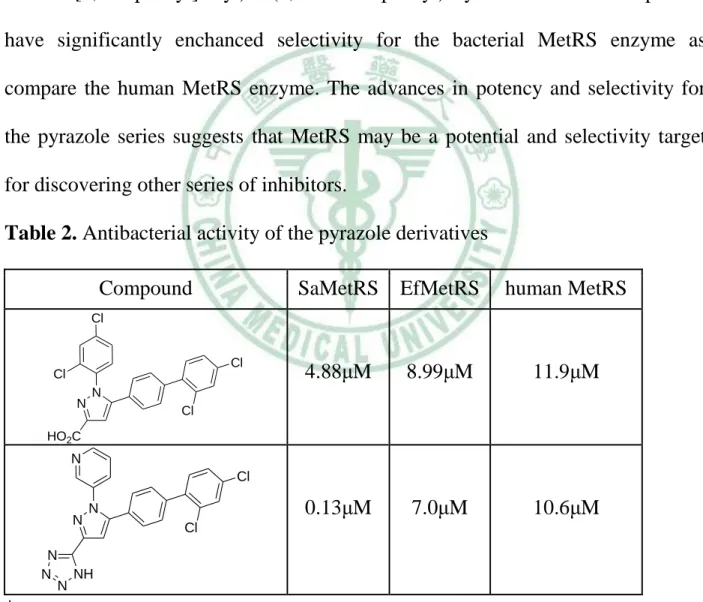
(14) The emergence of bacterial strains with resistance to currently marketed antibacterial agents has promoted interest in the discovery of noval antibacterial agents with novel modes of action.15 One set of potential new targets are the family of bacterial amino acyl-tRNA synthetases.16 These enzymes are necessary for bacterial growth and have been validated as drug targets by the reserch and development of pseudomonic acid, whose mode of action is the inhibition of bacterial isoleucinyl tRNA synthetase.17 Some of a broad program to discover bacterial tRNA synthetase inhibitors,18 1H3-carboxylic. acid-5-(2',4'-dichloro[1,1'-biphenyl]-4-yl)-1-(2,4-dichlorophenyl)-. Pyrazole (Figure 3) was determined as an inhibitor of methionyl-tRNA synthetase (MetRS) by high-throughput screening.19 It is a modest micromolar inhibitor of the bacterial MetRS enzyme from two important Gram positive bacterials, Staphylococcus aureus and Enterococci faecalis (SaMetRS and EfMetRS) but at same time it also inhibits human MetRS (hMetRS) at similar concentrations. As a result, in 2003, John Finn report that noval compounds with improved potency on bacterial MetRS and selectivity versus hMetRS. 2b Cl Cl. Cl N. N Cl. HO2C. Figure 3. Pyrazoles derivative as antibacterial agent 4.
(15) John Finn2b synthesized a series of pyrazoles with significantly improved potency on reducing bacterial methionyl-tRNA synthetase and had less effect on human methionyl-tRNA synthetase (Table 2). Optimization of a micromolar pyrazole enchance it’s selective antibacterial factor and further provided a set of submicromolar 1H-3-tetrazole-5-(2',4'dichloro[1,1'-biphenyl]-4-yl)-1-(2,4-dichlorophenyl)-Pyrazole. This compounds have significantly enchanced selectivity for the bacterial MetRS enzyme as compare the human MetRS enzyme. The advances in potency and selectivity for the pyrazole series suggests that MetRS may be a potential and selectivity target for discovering other series of inhibitors. Table 2. Antibacterial activity of the pyrazole derivatives Compound. SaMetRS. EfMetRS. human MetRS. 4.88μM. 8.99μM. 11.9μM. 0.13μM. 7.0μM. 10.6μM. Cl Cl. Cl N. N Cl. HO2C. N Cl N. N Cl. N NH N N. *MetRS: methionyl-tRNA synthetase, SaMetRS: Staphylococcus aureus methionyl-tRNA synthetase EfMetRS: Enterococci faecalis methionyl-tRNA synthetase 5.
(16) Section 1.2 Pyrazoles derivatives as Antifungal Lead Compounds Pyrazophos,4a (Figure 4) the first fungicide of this class to be commercialized, was marketed by Hoechst AG in 1974 to control powdery mildew in vegetables, and many pyrazole derivatives are now commercially available. The advantages, such as a new mode of action, wide spectrum, low toxicity toward mammalian cells, and favorable profiles to humans, have prompted chemists to design and synthesize novel pyrazole derivatives. O. H N N. EtO. S OEt P OEt O. pyrazophos. Figure 4. Pyrazophos Recently, pyrazole compounds, such as Furametpur, Penthiopyrad and Pyraclostrobin (Figure 5), have been found to have potential antifungal activities for the control of some plant diseases. With growing applications on their synthesis and bioactivity, chemists and biologists in recent years have paid more attention to the research of pyrazole derivatives20 (Figure 5).. 6.
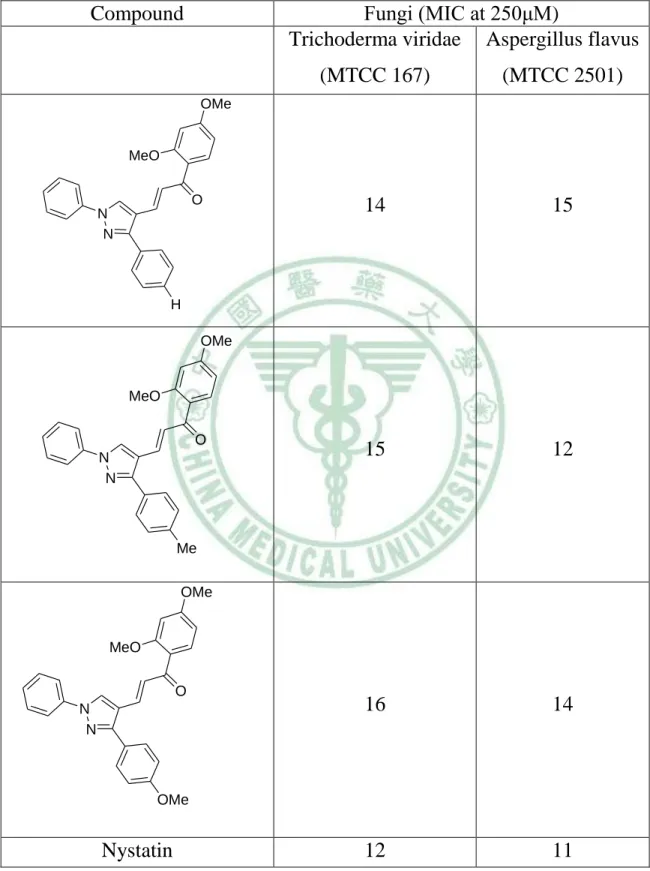
(17) O Me N N. N H Me Me. Cl. Me Me. N N. O. Furametpyr O Me N N. Pyraclostrobin. S. N H. CF3. O O O Me Me. Me Penthiopyrad. Me Me. Figure 5. Furametpur, Penthiopyrad and Pyraclostrobin. Synthesis of flavonols having C-2 position moiety in pyrazole was recently reported as potent antifungal and antibacterial agents.21,21b Furthermore, the presence of enone function in chalcone moiety with pyrazole ring also increased the biological activity.22 Babasaheb P. Bandgar4b reported the synthesis and biological activity of pyrazole chalcones as antifungal agents. The toxicity of the compounds was evaluated theoretically and experimentally have been defined their potential as safe leading compounds for bioavailability (Table 3).. 7.
(18) Table 3. Antifungal activity of pyrazole chalcone derivatives Fungi (MIC at 250μM) Trichoderma viridae Aspergillus flavus. Compound. (MTCC 167). (MTCC 2501). 14. 15. 15. 12. 16. 14. 12. 11. OMe. MeO O N N. H. OMe. MeO O N N. Me. OMe. MeO O N N. OMe. Nystatin *MIC: Minimum inhibitory concentration 8.
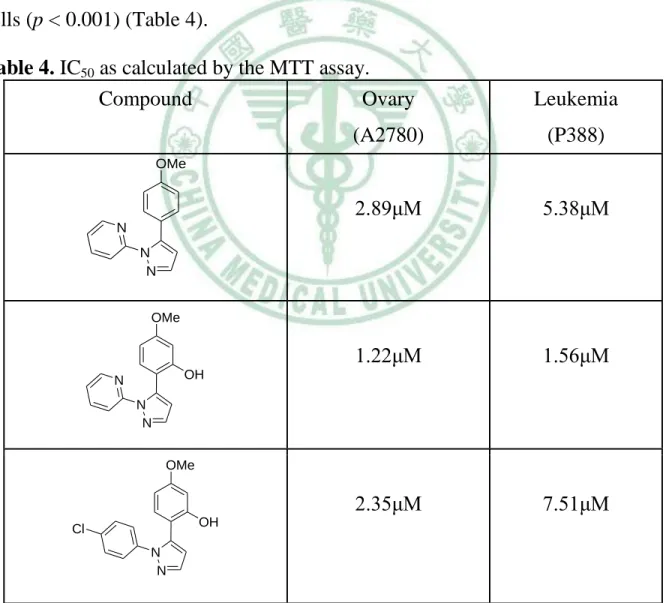
(19) Section 1.3 Pyrazoles derivatives as Anticancer Lead Compounds In 2011, Alessandro Balbi5a studied novel pyrazole derivatives on their antiproliferative activity in human ovarian adenocarcinoma A2780 cells and murine P388 leukemia cells (Table 4). In particular, three compounds were active on human ovarian adenocarcinoma A2780 (p < 0.001) and murine leukemia P388 cells (p < 0.001) (Table 4). Table 4. IC50 as calculated by the MTT assay. Compound Ovary. Leukemia. (A2780). (P388). 2.89μM. 5.38μM. 1.22μM. 1.56μM. 2.35μM. 7.51μM. OMe. N N N OMe. OH. N N N. OMe. OH. Cl N N. 9.
(20) Histone deacetylases (HDACs)23 are widely established enzymatic targets for multiple therapeutic applications.24 It is well accepted that therapeutic application of HDAC inhibitors depends on their isoform selectivity profile25 and their HDAC class, making isoform selective inhibitors an important issue in the design and development of novel HDAC-based therapeutics. In 2011, Pavel A. Petukhov,5b reported that diazide inhibitors for the two class I isoforms HDAC8 and HDAC3 may have particular value for the treatment of neuroblastoma, leukemia,26 and gastric, prostate, and colorectal cancer.27 And he found that novel diazide-containing pyrazole-based Histone deacetylase inhibitors have low nanomolar inhibitory activity against HDAC3 and HDAC8. The pyrazole-based inhibitor, Octanedioic Acid [1-(3-Azido-5-azidomethylbenzyl)-1Hpyrazol-4-yl]amide Hydroxyamide, exhibit one of the most active HDAC8 inhibitors reported in the literature with an IC50 of 17 nM (Table 5).. 10.
(21) Table 5. HDAC3 and HDAC8 Isoform Inhibitory Activity (IC50, nM) of PyrazoleBased Compounds Compound. N. O. N. H N. N H. N. O N H. H. HDAC3. HDAC8. 44 ± 5.8. 76 ± 5.0. 128 ± 9.8. 17 ± 3.0. OH. O. N H N3. IC50 ± SD (nM). H N O. N3. 11. OH.
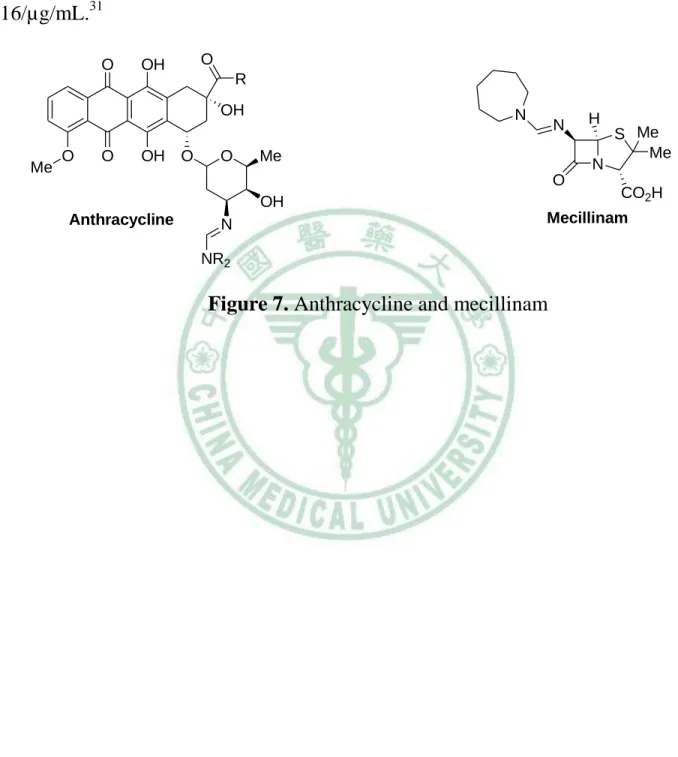
(22) Section 1.4 Improved bioactivities by Amidinyl Group Amidine analogue of melphalan and AB4 (Figure 6) have been found to have anticancer activity by decreasing the number of viable cells in both estrogen receptor-positive (MCF-7) and estrogen receptor-negative (MDA-MB-231) breast cancer cells. Although the cytotoxicity was concentration-dependent to both cell lines, it was more pronounced to MDA-MB-231 than in MCF-7. Anticancer activity of AB4 was shown to be more potent than melphalan in both MDA-MB231 and MCF-7, with IC50 values of 45 ± 2 and 62 ± 2 µM, respectively. Comparative to AB4, melphalan28 required higher concentration 130 ± 2 and 125 ± 2 µM for MDA-MB-231 and MCF-7. Cl H3COOC HN. OH. Me. O. H N. O Me. Me. O. H N. O. N Cl. NH Melphalan. Me. NH. AB4. Figure 6. Melphalan and AB4. Introducing an amidino group into the core molecule to enhance its antibacterial activity29 are still the subject of interest, such as penicillin. Moreover, antibiotic such as anthracycline (Figure 7) was shown to decrease toxicity and enhance anticancer activity.30 Similarly, amidine group in mecillinam (Figure 7) inhibited 12.
(23) Escherichia coli, Klebsiella spp., Enterobacter spp., Citrobacter spp., Shigella spp., and Salmonella spp. with a mean minimum inhibitory concentration of 16/µg/mL.31 O. OH. O R OH. Me. O. O. OH O. O. N. N. Me. N O. OH Anthracycline. H. S Me Me CO2H. Mecillinam. N NR2. Figure 7. Anthracycline and mecillinam. 13.
(24) Section 1.5 Antiproliferative of Formylated Amidinyl Pyrazole Derivatives Our laboratory had previous developed a new microwave-assisted amidination method by treating various primary amines including aromatic amines and pyrazol5-amines with amide solvents and POCl3 coupling agent. Based on our experimental data, the yielding formylation amidinyl pyrazole products seemed to be determinated by the dissociation of the substituting amides. Based on the growth inhibitory activity data, compounds with m-Cl-Ph and pBr-Ph groups at N-1 position and compounds with p-Me-Ph and p-Cl-Ph groups at C-3 position in pyrazolic ring possessed the most potent activity. In addition, the formyl group at C-4 position in the core pyrazolic ring is indispensable for the inhibitory activity (Table 6).32 Table 6. Bioactivity of Formylated Amidinyl Pyrazole Derivatives GI50 (M) for Antiproliferative activity. H X. N N N. X. Y. NCI-H661. m-Cl. H. 6.9. 6.4. 8.3. p-Br. H. 6.7. 7.4. 7.3. H. p-Me. 11.9. 9.7. 9.5. H. p-Cl. 8.6. 8.1. 7.9. NMe2 CHO Y. 14. NPC-TW01. Jurkat.
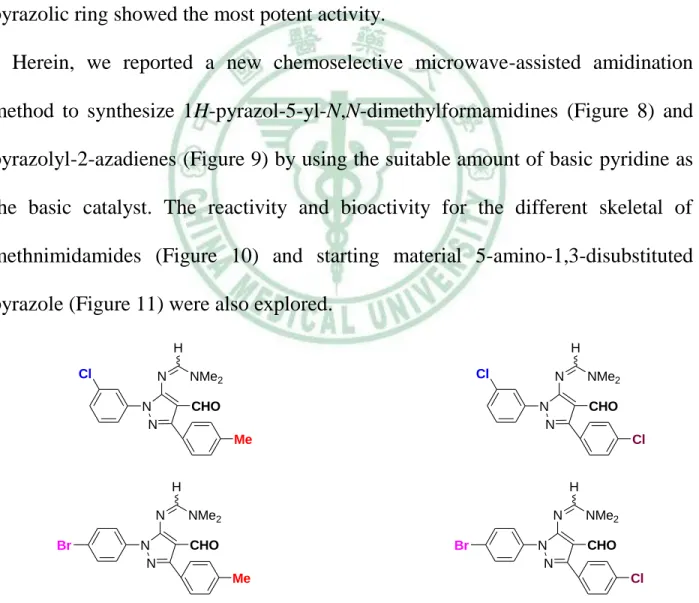
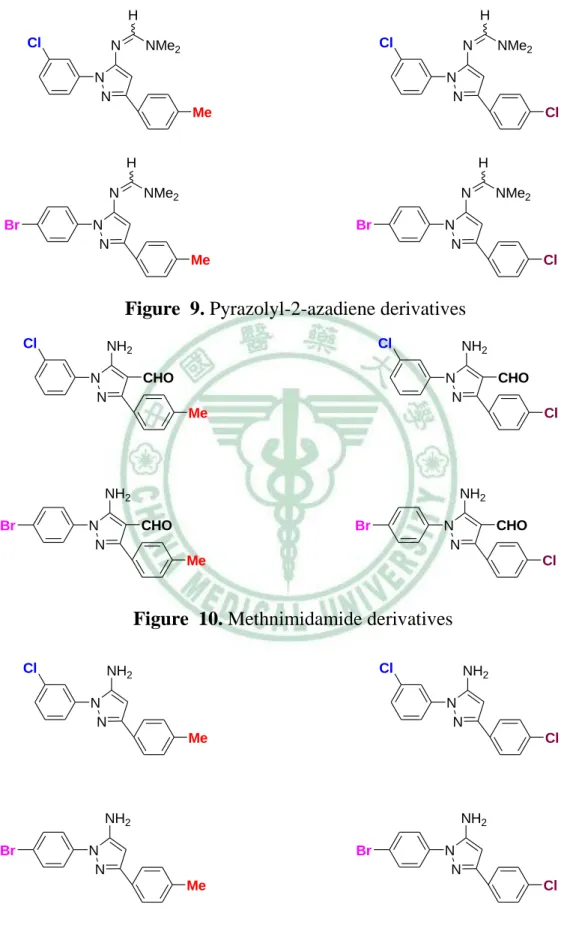
(25) Chapter 2. Research Approach. In 2010, our laboratory developed a newly microwave-assisted amidination method to prepare methnimidamide compounds by using 5-amino-1,3disubstituted pyrazoles, amide solvents, and POCl3.33 Accroding to the growth inhibitory activitive data, compounds with m-Cl-Ph and p-Br-Ph groups at N-1 position and compounds with p-Me-Ph and p-Cl-Ph groups at C-3 position in pyrazolic ring showed the most potent activity. Herein, we reported a new chemoselective microwave-assisted amidination method to synthesize 1H-pyrazol-5-yl-N,N-dimethylformamidines (Figure 8) and pyrazolyl-2-azadienes (Figure 9) by using the suitable amount of basic pyridine as the basic catalyst. The reactivity and bioactivity for the different skeletal of methnimidamides (Figure 10) and starting material 5-amino-1,3-disubstituted pyrazole (Figure 11) were also explored. H Cl. N. H Cl. NMe2 CHO. N N. N. NMe2 CHO. N N Me. Cl. H N Br. N N. H NMe2. N. CHO. Br. N N. NMe2 CHO. Me. Cl. Figure 8. 1H-pyrazol-5-yl-N,N-dimethylformamidine derivatives 15.
(26) H Cl. N. H Cl. NMe2. N N. N. NMe2. N N Me. Cl. H N Br. H NMe2. N. N N. Br. NMe2. N N. Me. Cl. Figure 9. Pyrazolyl-2-azadiene derivatives Cl. Cl. NH2 N N. CHO. NH2 CHO. N N Me. Cl. NH2 Br. NH2 CHO. N N. Br. CHO. N N. Me. Cl. Figure 10. Methnimidamide derivatives Cl. Cl. NH2 N N. NH2 N N. Me. Cl. NH2 Br. NH2. N N. Br. N N. Me. Cl. Figure 11. 5-amino-1,3-disubstituted pyrazole derivatives 16.
(27) Chapter 3. Result and Discussion. Results of this study showed that four series compounds including 5-amino-1,3diphenyl pyrazole (1a–1e), 1H-pyrazol-5-yl-N,N-dimethylformamidines (2a–2e), Pyrazolyl-2-azadienes (3a–3e), and methnimidamide (4a–4e) was successfully synthesized. All of compounds were tested for structure activity relationship and biological activity.. Section 3.1 Chemistry Our laboratory reported that if benzoylacetonitrile was allowed to react with phenylhydrazine in neat condition at reflux for 2.0 h, it will result in the synthesis of 5-amino-1,3-diphenyl pyrazole (1a–1e). A model procedure involved the treatment of 5-amino-1,3-disubstituted pyrazoles 1a–1e with POCl3 (~1.2 equivalent) in DMF at 30–40C with 100 W of microwave energy within 15– 20min was developed to synthesize 1H-pyrazol-5-yl-N,N-dimethylformamidines (2a–2e). The newly chemoselective methodology is applicable to transform compounds 1a–1e to the corresponding pyrazolyl-2-azadiene products 3a–3e without formyl group. A newly basic condition by using NaOH in MeOH solution was used to synthesize the de-amidination of methnimidamide (4a–4e).. 17.
(28) Section 3.1.1 Synthesis of 5-amino-1,3-diphenyl pyrazole (1a–1e) The traditional Synthetic method for the synthesis of 5-amino-1,3-diphenyl pyrazole was to react benzoylacetonitrile with phenylhydrazine under distinctive conditions. Distinctive conditions include: (a) heated in EtOH,34 (b) microwave irradiation,35 and (c) heated in acetic acid (Scheme 1). The first method was refluxing benzoylacetonitrile with the same equivalent of phenylhydrazine in EtOH for >8.0 h (see Scheme 1, path a).34 Product 5-amino-1,3 diphenyl pyrazole was generated in only 41% yield via tandem condensation and thermal cyclization. Another method was the use of microwave irradiation of benzoylacetonitrile with hydrazine in EtOH solution for >4.0 h to provide 5 amino1,3-diphenyl pyrazole in 58% yield (see Scheme 1, path b).35 These first two methods did not produce desired yield of 5-amino-1,3-diphenyl pyrazole. The third method was used acetic acid as the solvent could provide 75–85% yield of 5amino-1,3-diphenyl-pyrazole (see Scheme 1, path c). Benzoylacetonitrile was allowed to react with phenylhydrazine in neat condition at reflux for 2.0 h (see Scheme 1, path d). Our laboratory carried out the reaction in such neat condition that we successfully generated 94% yield of 5-amino-pyrazole.. 18.
(29) O CN. PhNHNH2 conditions. Conditions a. EtOH,reflux, >8.0 h, 41% b. EtOH, microwave, >4.0 h, 58% c. AcOH, temp., 75-85% d. neat, reflux, 2.0 h, 94%. Scheme 1. 19. NH2 N N. 1a-1e.
(30) Section. 3.1.2. Synthesis. of. 1H-pyrazol-5-yl-N,N-. dimethylformamidines (2a–2e) Scheme 2 illustrates the amidination of 5-amino-1,3-diphenyl pyrazole to the corresponding and the optimization of the reaction. A model procedure involved the treatment of 5-amino-1,3-disubstituted pyrazoles 1a–1e with POCl3 (~1.2 equivalent) in DMF at 30–40C with 100 W of microwave energy within 15– 20min. After work-up and purification by column chromatography on silica gel, the corresponding 1H-pyrazol-5-yl-N,N-dimethylformamidines 2a–2e were readily obtained in 77–97% yields (see Table 7; Scheme 2). In addition to grafting the amidinyl group on the main core of 5-amino pyrazole, the formyl group was also introduced at the C-4 position of pyrazolic ring. Compounds 2a–2e were fully characterized by spectroscopic methods.34 H X. X. NH2 N N. DMF Y. POCl3, MW. N N N. NMe2 CHO Y. 2a-2e 1a-1e X = H, m-Cl, p-Br Y = H, Me, Cl. Scheme 2. 20.
(31) Table 7. Result of Synthesis of Formylated Amidinyl Pyrazoles (2a-2e) 5-Amino-1,3-N,N-disubstituted pyrazoles. Methnimidamide (2a–2e). S.M. (1a–1e). X. Y. Products. Yields (%). 1a. H. H. 2a. 94. 1b. m-Cl. Me. 2b. 82. 1c. m-Cl. Cl. 2c. 81. 1d. p-Br. Me. 2d. 90. 1e. p-Br. Cl. 2e. 92. 21.
(32) Section 3.1.3 Synthesis of Pyrazolyl-2-azadienes (3a–3e) For the investigation of the effect of formyl group on activity, we evaluated the chemoselective microwave-assisted amidination methodology to prepare a series of pyrazolyl-2-azadienes 3a–3e without introducing a formyl group at C-4 position on pyrazolic ring as the comparing model. Initially, we chose 5-amino-1-3diphenylpyrazole 1a as modeling case and treated 1a with different inorganic or organic basic agents to quench the excess amount of active imineniun species or neutralize hydrochloride for diminishing the formation of the formylated methnimidamide product 2. The bases included sodium hydroxide (NaOH), potassium carbonate (K2CO3), cesium carbonate (CsCO3), triethylamine (NEt3), dimethylaminopyrium (DMAP), and pyridine. Firstly,. the. amidination. reaction. was. performed. on. 5-amino-1-3-. diphenylpyrazole 1a with-out basic catalytic agent as the blank study. The reaction only provided the formylated methnimidamide 2a in 94% yield. When the reaction was treated with 2.0 equivalent of inorganic base including sodium hydroxide (NaOH), potassium carbonate (K2CO3), and cesium carbonate (CsCO3), the methnimidamide product 3a without the formyl group was provided in poor yields, except for using cesium carbonate (see entries 2–4 of Table 8). For cesium carbonate, the methnimidamide product 3a was obtained in 78% isolated 22.
(33) yield with the recovery of a small amount of the starting materials 1a. On the other hand, the starting materials 1a and the small amount of the formylated methnimidamide compound 2a were simultaneously obtained in NaOH as basic catalytic agent. H X DMF without pyridine X. CHO Y. Vilsmeier Reaction 2a-2e. N N. H. Y 1a-1e. NMe2. N N. POCl3,MW,. NH2. N. X. N. NMe2. DMF with pyridine POCl3, MW. N N Y. Chemoselective Reaction 3a-3e. Scheme 3 When the same condition was applied to the commercially available organic bases including NEt3, DMAP, or pyridine, the methnimidamide product 3a without formyl group was obtained in 34–82% yields as the major product (see entries 5–7 of Table 8). Particularly, the best chemoselective result was achieved by using pyridine as the basic catalyst. The use of various equivalent of pyridine was also studied from 1.0 equiv to 4.0 equiv. We found that using 3.0 equivalent of pyridine can give pyrazolyl-2-azadiene product 3a in the best yield (97% yield, see entry 9 of Table 8). 23.
(34) Furthermore, the newly chemoselective methodology can be applicable to compounds 1a–1e to provide the corresponding pyrazolyl-2-azadiene products 3a– 3e without formyl group in 78–98% yields (see Table 9). The reliable chemoselective procedure involved the treatment of 5-amino-1,3-disubstituted pyrazoles 1a–1e with ~1.2 equivalent of POCl3 and 3.0 equivalent of pyridine in DMF at 30–40C with 100 W of microwave energy within 15–20 min. After workup and purification were performed, the desired pyrazolyl-2-azadiene products 3a– 3e without formyl group were obtained in 78–98% isolated yields (see Table 9; Scheme 3). Following the aforementioned studies, the chemoselective amidination reaction seemed determinate to the suitable amount of pyridine basic agent.. 24.
(35) Table 8. The basic catalyzed study for preparation of pyrazolyl-2-azadienes 3a without formyl group in the chemoselective microwave-assisted amidination Basic Agents Entry. Yield (%) Formylated Pyrazolyl-2methnimidamides (2a) azadienes (3a) -b 94. Catalyst. Equiva. 1. Without catalyst. -. 2. NaOH. 2. 27. -b,c. 3. K2CO3. 2. -b,c. 4. 4. CsCO3. 2. -b,c. 78. 5. Triethylamine (NEt3). 2. -b,c. 34. 2. -b,c. 50. Dimethylaminopyridine 6 (DMAP) 7. Pyridine. 2. 18. 82. 8. Pyridine. 1. 15. 75. 9. Pyridine. 3. -b. 97. 10. Pyridine. 4. 44. 53. a. based on the weight of 5-amino-1-3-diphenylpyrazole (1a). not detectable. c Starting material 1a was recovery. b. 25.
(36) Table 9. The results of chemoseletive amidination reaction for preparation of pyrazolyl-2-azadiene products 3a–3e H X. X. NH2. DMF with pyridine. N N Y. N. NMe2. N N. POCl3, MW. Y. 1a-1e. 3a-3e. 5-Amino-1,3-N,N-disubstituted. Pyrazolyl-2-azadienes (3a–. pyrazoles. 3e). S.M. (1a–1e). X. Y. Products. Yields (%). 1a. H. H. 3a. 97. 1b. m-Cl. Me. 3b. 91. 1c. m-Cl. Cl. 3c. 98. 1d. p-Br. Me. 3d. 93. 1e. p-Br. Cl. 3e. 78. 26.
(37) Section. 3.1.4. Synthesis. of. the. de-amidination. of. methnimidamide (4a–4e) To identify the essentiality of amidinyl group for the inhibitory activity study, a series of de-amidination compounds 4a–4e were sequentially prepared as the comparison model for the further structure–activity relationship study. When we searched the previous reported literature about de-amidination, only one method was found by using HCl aqueous solution.35 However, the purification procedure was troublesome, especially in neutralization procedure. Consequently we investigated a newly basic condition by using NaOH in MeOH solution. The reliable procedure involved the treatment of methnimidamide 2a–2e with two equivalent of NaOH at reflux in MeOH solution within 2–3 h. After the extraction work-up and simple purification through the short column chromatography on silica gel, the corresponding de-amidination 5-amino-4formylpyrazole products 4a–4e were obtained in 83–96% yields (see Table 10; Scheme 4). H X. N. X. NMe2. NH2. NaOH N N. CHO. MeOH. N N. Y. CHO Y. 2a-2e. 4a-4e. Scheme 4 27.
(38) Table 10. Result of Synthesis of 5-Amino-4-formylpyrazoles (4a–4e) 5-Amino-4-formylpyrazoles Methnimidamide (2a–2e) (4a–4e) S.M. (2a–2e). X. Y. Products. Yields (%). 2a. H. H. 4a. 92. 2b. m-Cl. Me. 4b. 85. 2c. m-Cl. Cl. 4c. 87. 2d. p-Br. Me. 4d. 83. 2e. p-Br. Cl. 4e. 96. 28.
(39) Section 3.2 Biological evaluations The growth inhibitory activity of all amidine compounds is evaluated against a panel of human cancer cell lines, including lung carcinoma (NCI-H226), nasopharyngeal (NPC-TW01), and T-cell leukemia (Jurkat) cells. The GI50 value is the concentration that results in a 50% decrease in the cell growth relative to an untreated control. All of starting materials 1a–1e were selected and used as the comparison model for the inhibitory activity study. Among of starting substrates, only compound 1d possessed the negligible inhibitory activity against three cell lines [the GI50 values of 1d are 54.3 M (NCI-H226), 80.2 M (NPC-TW01), and 45.0 M (Jurkat), see Table 11].. 29.
(40) Table 11. Antiproliferative activity of 5-amino-1,3-diphenyl pyrazole (1a–1e) X. NH2 N N Y. GI50 (M) a,b. Prozoles (1a–1e) Compounds X (N-1). Y (C-3). NCI-H226. NPC-TW01. Jurkat. 1a. H. H. 72.2. >100. 83.0. 1b. m-Cl. Me. 63.5. >100. 56.6. 1c. m-Cl. Cl. 75.1. >100. >100. 1d. p-Br. Me. 54.3. 80.2. 45.0. 1e. p-Br. Cl. 58.7. 64.4. 61.3. a. NCI-H226: human lung carcinoma; NPC-TW01: human nasopharyngeal carcinoma; Jurkat: human T-cell leukemia b All tested compounds were dissolved in 100% DMSO at a concentration of 20 mM as the stock solution. Cells were cultured without or in the presence of the methnimidamide derivatives at different concentrations for 72 h. Cell survival was determined by MTT assay. Drug molar concentration causing 50% cell growth inhibition (GI50) was calculated. Each value represents the mean ± SD of three independent experiments.. 30.
(41) Formylated methnimidamide 2a was also used as the comparison model for other analogs 2b–2e against the cancer cell lines. Compounds 2b and 2c containing the same m-Cl-Ph substituted group on N-1 position and either p-Cl-Ph or p-Me-Ph groups on C-3 position in pyrazolic ring displayed the better inhibitory activity against the three cancer cell lines with GI50 values between 7.2 M and 9.2 M (see Table 12). The results also showed that they were more active against NPCTW01 and Jurkat than NCI-H226. For compounds 2d and 2e with p-Br-Ph on N-1 position and either p-Cl-Ph or p-Me-Ph groups at C-3 position on pyrazolic ring, compound 2d showed the better inhibitory activity against the three cancer cell lines with GI50 values between 6.0 M and 8.2 M. Due to the bulky p-Br-Ph group and p-Cl-Ph groups on the N-1 and C-3 position of pyrazole not favoring to reach the blocking side, the poor result of bioactivity was observed in compound 2e. Following the structure activity relationship study results, compounds 2b–2d possessed the better activity than 2a and 2e. On the other hand, the antiproliferative activity data was consistent with our design approach and compound 2b–2d can be considered as the potency lead drugs.. 31.
(42) Table 12. Antiproliferative activity of 1H-pyrazol-5-yl-N,N-dimethylformamidines (2a–2e) H X. N N N. NMe2 CHO Y. Prozoles (2a–2e). GI50 (M). Compounds X (N-1). Y (C-3). NCI-H226. NPC-TW01. Jurkat. 2a. H. H. 31.4. 9.3. 23.5. 2b. m-Cl. Me. 8.9. 7.2. 7.8. 2c. m-Cl. Cl. 9.2. 7.4. 7.7. 2d. p-Br. Me. 8.2. 6.0. 6.7. 2e. p-Br. Cl. 62.9. >100. 38.9. a. NCI-H226: human lung carcinoma; NPC-TW01: human nasopharyngeal carcinoma; Jurkat: human T-cell leukemia b All tested compounds were dissolved in 100% DMSO at a concentration of 20 mM as the stock solution. Cells were cultured without or in the presence of the methnimidamide derivatives at different concentrations for 72 h. Cell survival was determined by MTT assay. Drug molar concentration causing 50% cell growth inhibition (GI50) was calculated. Each value represents the mean ± SD of three independent experiments.. 32.
(43) For the further the structure–activity relationship investigation, pyrapzolyl-2azadienes 3a–3e and de-amidination compounds 4a–4e were evaluated against three cancer cell lines as the comparison study. Following the antiproliferative activity result, the data indicated that compounds 3a–3e [GI50: > 59.8 M (NCIH226), > 60.7 M (NPC-TW01), and > 74.5 M (Jurkat)] and 4a–4e [GI50: > 8.5 M (NCI-H226), > 28.2 M (NPC-TW01), and > 34.4 M (Jurkat)] were less potent than compounds 2a–2d. The experimental result in Table 13 demonstrated the formyl group at C-4 position and grating the amidinyl group toward amino moiety at C-5 in pyrazolic ring are essential for the promotion of inhibitory activity. Furthermore, the data indicated that tendency for sensitivity is nasopharyngeal (NPC-TW01) > T-cell leukemia (Jurkat) cell > lung carcinoma (NCI-H266) for methnimidamide compounds 2a–2e.. 33.
(44) Table 13. Antiproliferative activity of Pyrazolyl-2-azadienes (3a–3e) and the deamidination of methnimidamide (4a–4e) H X. N. X. NMe2. NH2. N N. N N Y. CHO Y. 3a-3e. 4a-4e. GI50 (M)a,b. Prozoles (3a–3e, and 4a–4e) Compounds X (N-1). Y (C-3). NCI-H226. NPC-TW01. Jurkat. 3a. H. H. >100. >100. >100. 3b. m-Cl. Me. 80.9. >100. >100. 3c. m-Cl. Cl. 75.6. 92.7. 74.5. 3d. p-Br. Me. 73.9. >100. >100. 3e. p-Br. Cl. 59.8. 60.7. 84.9. 4a. H. H. >100. >100. 87.3. 4b. m-Cl. Me. 71.8. >100. 86.3. 4c. m-Cl. Cl. 79.7. >100. 78.9. 4d. p-Br. Me. 8.5. 28.2. 34.4. 4e. p-Br. Cl. 49.1. 59.7. 90.7. a. NCI-H226: human lung carcinoma; NPC-TW01: human nasopharyngeal carcinoma; Jurkat: human Tcell leukemia b All tested compounds were dissolved in 100% DMSO at a concentration of 20 mM as the stock solution. Cells were cultured without or in the presence of the methnimidamide derivatives at different concentrations for 72 h. Cell survival was determined by MTT assay. Drug molar concentration causing 50% cell growth inhibition (GI50) was calculated. Each value represents the mean ± SD of three independent experiments. 34.
(45) Chapter 4 Conclusion We have successfully developed a new chemoselective microwave-assisted amidination method to prepare 1H-pyrazol-5-yl-N,N-dimethylformamidines 2a–2e with the formyl group and pyrazolyl-2-azadienes 3a–3e without formylation by using pyridine as the basic agent. Furthermore, we have also evaluated the new deamidination methodology to prepare the 5-amino-4-formylpyrazoles 4a–4e as the compared study (Figure 12). Based on the growth inhibitory activity data, compounds 2b, 2c, and 2d with mCl-Ph and p-Br-Ph groups at N-1 position and p-Me-Ph and p-Cl-Ph groups at C-3 position in pyrazolic ring possessed the most potent activity. Following the structure activity relationship study, we have demonstrated that introducing formyl group at C-4 position and grafting amidinyl group in the pyrazole core molecule are necessary for the improved bioactivity. H X. X. NH2 N N. N N N. Y 1a-1e. H X. NMe2 CHO. N. X. NMe2. N N Y. 2a-2e. N N Y. 3a-3e X = H, m-Cl, p-Br Y = H, Me, Cl. Figure 12. Pyrazole compounds. 35. NH2 CHO Y 4a-4e.
(46) Chapter 5. Experimental Section. Section 5.1 General Procedure All chemicals were reagent grade and use as purchased. All reactions were carried out under argon or nitrogen atmosphere and monitored by Analytical thinlayer chromatography (TLC). Flash column chromatography was carried out on silica gel (230–400 mesh). Ethyl acetate and hexanes, purchased from Mallinckrodt Chemical Co., were dried and distilled from CaH2. Toluene (reagent grade, from Merck Chemical Co.) was dried by distillation from CaH2 under nitrogen. 4-Methylbenzoylacetonitrile, phenylhydrazine was purchased from Acros Chemical. Co.. 4-Bromophenylhydrazine. hydrochloride,. 4-. chlorobenzoylacetonitrile, 3-chlorophenylhydrazine hydrochloride was purchased from Alfa Aesar Chemical Company. Benzoylacetonitrile were purchased from TCI. N,N-Dimethylformamide, pyridine were purchased from Scharlau Chemical Co. Phosphorylchloride were purchased from FERAK Chemical Co. TLC was performed on precoated plates (silica gel 60 F-254) purchased from Merck Inc. Mixtures of ethyl acetate and hexanes were used as eluants. Infrared (IR) spectra were measured on a Bomem Michelson Series FT-IR spectrometer. The wavenumbers reported are referenced to the polystyrene absorption at 1601 36.
(47) cm–1. Absorption intensities are recorded by the following abbreviations: s, strong; m, medium; w, weak. Proton NMR spectra were obtained on a Bruker (200 MHz or 400 MHz) spectrometer by use of CDCl3 as solvent. Carbon-13 NMR spectra were obtained on a Bruker (75 MHz or 100 MHz) spectrometer by used of CDCl 3 as solvent. Carbon-13 chemical shifts are referenced to the center of the CDCl3 triplet (δ 77.0 ppm). Multiplicities are recorded by the following abbreviations: s, singlet; d, doublet; t, triplet; q, quartet; m, multiplet; J, coupling constant (Hz). Microwave irradiation instrument was purchased from CEM Discover. The microwave irradiation condition was set in 100 W at 30–40 C within 10–20 min. ESI-MS spectra were obtained from an Applied Biosystems API 300 mass spectrometer. High-resolution mass spectra were obtained by means of a JEOL JMS-HX110 mass spectrometer. Elemental analyses were carried out on a Heraeus CHN–O RAPID element analyzer. A solution of pyrazol-5-amine derivatives (1a–1e, 1.0 equiv) and POCl3 (1.2 equiv) in DMF solution (3 mL) at 30–40 C was treated with 100 W of microwave energy within 10–20 min. When the reaction was completed, the reaction mixture was concentrated, added to water (10 mL) and extracted with CH2Cl2 (4 × 20 mL). The organic extracts were washed with saturated NaHCO3, dried over MgSO4, filtered, and concentrated under reduced pressure. The residue solution was 37.
(48) purified by column chromatography on silica gel to give the corresponding methnimidamide products (2a–2e) in 81–94% yields.. 38.
(49) Section 5.2 Spectrum Standard Procedure for the Synthesis of Methnimidamide Compounds (2a–2e) N'-[4-Formyl-1,3-diphenyl-1H-pyrazol-5-yl-N,N-dimethyl-methanimidamide (2a) mp (purified by column chromatography on silica gel) 120–122 C; 1H NMR (CDCl3, 200 MHz) δ 3.01 (s, 3 H, CH3), 3.12 (s, 3 H, CH3), 7.26–7.47 (m, 6 H, ArH), 7.65–7.70 (m, 2 H, ArH), 7.84–7.89 (m, 2 H, ArH), 8.68 (s, 1H, N=C–H), 9.68 (s, 1H, aldehyde); 13C NMR (50MHz, CDCl3) δ 34.3 (CH3), 40.7 (CH3), 108.4, 124.3 (2 × CH), 126.8, 128.3 (2 × CH), 128.4 (2 × CH), 128.7, 129.4 (2 × CH), 132.3, 139.2, 154.1, 155.8, 159.0, 185.2; IR (KBr) 3059 (m), 2920 (m), 2800 (w), 2742 (w), 1670 (s), 1597 (m), 1508 (m), 1381 (m), 1257 (m), 1134 (m), 1095 (m), 975 (m), 767 (m), 694 (m) cm–1; EIMS m/z (relative intensity) 318 (100), 317 (M+, 42), 303 (17), 289 (9), 274 (19), 248 (8), 186 (14), 159 (7), 77 (24), 51 (5); Anal. Calcd for C19H18N4O; C: 71.68; H: 5.70; N: 17.60, Found: C: 71.72; H: 5.71; N: 17.58. N'-[1-(2-chlorophenyl)-4-formyl-3-(4-methylphenyl)-1H-pyrazol-5-yl]-N,Ndimethyl-methanimidamide (2b) mp (purified by column chromatography on silica gel) 166–168 C; 1H NMR (CDCl3, 200 MHz) δ 2.40 (s, 3 H, CH3), 3.01 (s, 3 H, CH3), 3.11 (s, 3 H, CH3), 7.17–7.34 (m, 4 H, ArH), 7.51–7.55 (m, 2 H, ArH), 7.79–7.85 (m, 2 H, ArH), 39.
(50) 8.01–8.03 (m, 2 H, ArH), 8.69 (s, 1 H, N=C–H), 9.64 (s, 1H, aldehyde); 13C NMR (50 MHz, CDCl3) δ 21.4 (CH3), 34.4 (CH3), 40.8 (CH3), 108.5, 122.0, 124.2, 126.5, 128.7 (3 × CH), 129.2 (3 × CH), 133.9, 138.9, 140.3, 154.2, 156.1, 159.1, 185.2; IR (KBr) 2920 (m), 1666 (s), 1627 (m), 1589 (m), 1489 (m), 1384 (m), 1261 (m), 1134 (m), 1099 (m), 1072 (m), 987 (m), 825 (m), 825 (m), 781 (m), 740 (m) , 682 (m) cm–1; EIMS m/z (relative intensity) 368 (M+2, 31), 366 (100), 365 (M+, 20), 337 (8), 322 (14), 220 (11), 185 (7), 111 (11), 91 (7), 83 (7), 75 (4); Anal. Calcd for C20H19ClN4O; C: 65.48; H: 5.22; N: 15.27, Found: C: 65.50; H: 5.19; N: 15.23. N'-[4-formyl-1-(2-chlorophenyl)-3-(4-chlorophenyl)-1H-pyrazol-5-yl]-N,N-dimethyl-methanimidamide (2c) mp (purified by column chromatography on silica gel) 162–164 C; 1H NMR (CDCl3, 200 MHz) δ 3.03 (s, 3 H, CH3), 3.13 (s, 3 H, CH3), 7.23–7.43 (m, 4 H, ArH), 7.58–7.64 (m, 2 H, ArH), 7.77–7.82 (m, 1 H, ArH), 7.99–8.01 (m, 1 H, ArH), 8.63 (s , 1 H, N=C–H), 9.60 (s, 1 H, aldehyde); 13C NMR (50 MHz, CDCl3) δ 34.5 (CH3), 40.8 (CH3), 108.5, 121.9, 124.1, 126.6, 128.7 (2 × CH), 129.4, 130.5 (3 × CH), 134.0, 135.0, 140.1, 154.5, 154.6, 158.9, 184.4; IR (KBr) 2924 (m), 2360 (m), 1666 (s), 1624 (m), 1585 (m), 1481 (m), 1384 (m), 1095 (m), 837 (m), 783 (m), 736 (m) cm–1; EIMS m/z (relative intensity) 388 (M+2, 65), 387 (M+1, 21), 386 (100), 385 (M+, 19), 371 (16), 357 (9), 342 (14), 330 (9), 316 (8), 220 (16),. 40.
(51) 111 (18), 83 (9); Anal. Calcd for C19H16Cl2N4O; C: 58.93; H: 4.16; N: 14.47, Found: C: 58.89; H: 4.17; N: 14.46. N'-[1-(4-bromophenyl)-4-formyl-3-(4-methylphenyl)-1H-pyrazol-5-yl]-N,N-dimethyl-methanimidamide (2d) mp (purified by column chromatography on silica gel) 198–200 C; 1H NMR (CDCl3, 200 MHz) δ 2.36 (s, 3 H, CH3), 2.98 (s, 3 H, CH3), 3.09 (s, 3 H, CH3), 7.21–7.25 (m, 2 H, ArH), 7.47–7.55 (m, 4 H, ArH), 7.77–7.81 (m, 2 H, ArH), 8.68 (s , 1 H, N=C–H), 9.64 (s, 1 H, aldehyde);. 13. C NMR (50 MHz, CDCl3) δ 21.4. (CH3), 34.4 (CH3), 40.7 (CH3), 108.5, 120.1, 125.6 (2 × CH), 129.21 (5 × CH), 131.4 (2 × CH), 138.3, 138.9, 154.1, 156.0, 159.1, 185.1; IR (KBr) 2920 (m), 1662 (s), 1624 (m), 1489 (s), 1381 (m), 1265 (m), 1134 (m), 1091 (m), 1010 (m), 975(m), 829 (m), 740 (m), 501 (m) cm–1; EIMS m/z (relative intensity) 412 (M+2, 99), 410 (100), 409 (M+, 26), 395 (12), 366 (15), 266 (10), 185 (10), 155 (6), 83 (7), 58 (5); Anal. Calcd for C20H19BrN4O; C: 58.40; H: 4.66; N: 13.62, Found: C: 58.44; H: 4.69; N: 13.58. N'-[1-(4-bromophenyl)-4-formyl-3-(4-chlorophenyl)-1H-pyrazol-5-yl]-N,N-dimethyl-methanimidamide (2e) mp (purified by column chromatography on silica gel) 195–197 C; 1H NMR (CDCl3, 200 MHz) δ 3.01 (s, 3 H, CH3), 3.13 (s, 3H, CH3), 7.38–7.63 (m, 6 H, ArH), 7.73–7.79 (m, 2 H, ArH), 8.63 (s , 1 H, N=C–H), 9.61 (s, 1 H, aldehyde); 41.
(52) 13. C NMR (50 MHz, CDCl3) δ 34.5 (CH3), 40.8 (CH3), 108.5, 120.3, 125.6 (2 ×. CH), 128.7 (2 × CH), 130.5 (2 × CH), 131.5 (2 × CH), 135.0 (2 × CH), 138.1 (2 × CH), 154.5, 158.9, 184.4; IR (KBr) 2364 (m), 2333 (m), 1666 (s), 1624 (m), 1516 (m), 1485 (m), 1381 (m), 1261 (m), 1138 (m), 1076 (m), 1010 (m), 813 (m), 740 (m), 578 (m), 547 (m), 505 (m) cm–1; EIMS m/z (relative intensity) 432 (M+2, 100), 430 (73), 429 (M+, 20), 388 (13), 374 (8), 266 (14), 232 (8), 205 (9), 155 (11), 111 (4), 83 (10); Anal. Calcd for C19H16ClN4O; C: 52.86; H: 3.74; N: 12.98, Found: C: 52.88; H: 3.71; N: 13.01.. 42.
(53) Standard Procedure for the Synthesis of Pyrazolyl-2-azadiene Compounds (3a–3e) A solution of pyrazol-5-amine derivatives (1a–1b, 1.0 equiv), POCl3 (1.2 equiv) and pyridine (3.0 equiv) in DMF solution (3 mL) at 30–40 C was treated with 100 W of microwave energy within 10–20 min. When the reaction was completed, the reaction mixture was concentrated, added to water (10 mL) and extracted with CH2Cl2 (4 × 20 mL). The organic extracts were washed with saturated NaHCO3, dried over MgSO4, filtered, and concentrated under reduced pressure. The residue solution was purified by column chromatography on silica gel to give the corresponding methnimidamide products (3a–3e) in 78–98% yields. N'-(4-formyl-1,3-diphenyl-1H-pyrazol-5-yl)-N,N-dimethyl-methanimidamid-e (3a) mp (purified by column chromatography on silica gel) 113–115 C; 1H NMR (CDCl3, 200 MHz) δ 2.29 (s, 3 H, CH3), 3.01 (s, 3 H, CH3), 6.15 (s, 1 H), 7.17– 7.43 (m, 6 H, ArH), 7.78 (s, 1 H), 7.83–7.97 (m, 3 H, ArH);. 13. C NMR (50MHz,. CDCl3) δ 34.5 (CH3), 40.2 (CH3), 88.4, 123.5 (2 × CH), 125.5 (2 × CH), 125.6, 127.6, 128.3 (2 × CH), 128.5 (2 × CH), 134.0, 140.3, 150.8, 152.6, 154.4; IR (KBr) 3059 (m), 2920 (m), 1635 (s), 1593 (m), 1543 (m), 1496 (m), 1392 (m), 1361 (m), 1257 (m), 1103 (m), 948 (m), 759 (m), 694 (m) cm–1; EIMS m/z (relative intensity) 290 (100), 298 (M+, 10), 246 (29), 219 (7), 198 (8), 186 (14), 171 (15), 145 (10),. 43.
(54) 83 (9), 77 (20); Anal. Calcd for C18H18N4; C: 74.46; H: 6.25; N: 19.30, Found: C: 74.43; H: 6.28; N: 19.27 N'-[1-(2-chlorophenyl)-4-formyl-3-(4-methylphenyl)-1H-pyrazol-5-yl]-N,N-dimethyl-methanimidamide (3b) mp (purified by column chromatography on silica gel) 109–115 C; 1H NMR (CDCl3, 200 MHz) δ 2.38 (s, 3 H, CH3), 2.94 (s, 3 H, CH3), 2.95 (s, 3 H, CH3), 6.10 (s, 1 H), 7.15–7.35 (m, 4 H, ArH), 7.70 (s 1 H, ArH), 7.75–7.80 (m, 2 H, ArH), 7.94–8.00 (m, 1 H, ArH), 8.18–8.20 (m, 1 H, ArH);. 13. C NMR (50 MHz,. CDCl3) δ 21.1 (CH3), 34.3 (CH3), 40.0 (CH3), 88.2, 120.6, 122.7, 124.9, 125.3 (2 × CH), 129.0 (2 × CH), 130.8, 133.6, 137.4, 141.4, 151.0, 152.8, 154.2; IR (KBr) 3109 (m), 2920 (s), 2808 (m), 1647 (s), 1585 (m), 1546 (m), 1523 (m), 1489 (m), 1388 (m), 1354 (m), 1261 (m), 1149 (m), 1103 (s), 1072 (m), 1037 (m), 948 (m), 875 (m), 825 (s), 783 (m), 756 (m), 678 (m), 513 (m) cm–1; EIMS m/z (relative intensity) 340.2 (M+2, 54), 338 (100), 317 (M+, 10), 294 (15), 279 (6), 220 (10), 185 (18), 151 (3), 111 (7), 91 (4), 83 (9); Anal. Calcd for C19H19ClN4; C: 67.35; H: 5.65; N: 16.54, Found: C: 67.36; H: 5.62; N:16.51. N'-[4-formyl-1-(2-chlorophenyl)-3-(4-chlorophenyl)-1H-pyrazol-5-yl]-N,N-dimethyl-methanimidamide (3c) mp (purified by column chromatography on silica gel) 108–110 C; 1H NMR (CDCl3, 200 MHz) δ 2.93 (s, 6 H, CH3), 6.03 (s, 1 H), 7.18–7.35 (m, 3 H, ArH), 44.
(55) 7.65 (s, 1 H), 7.73–7.79 (m, 2 H, ArH), 7.91–7.95 (m, 1 H, ArH), 8.13–8.15 (m, 1 H, ArH); 13C NMR (50 MHz, CDCl3) δ 34.5 (CH3), 40.2 (CH3), 88.3, 120.8, 122.9, 125.3, 126.8 (2 × CH), 128.6 (2 × CH), 129.3, 132.3, 133.3, 133.8, 141.3, 149.9, 153.1, 154.4; IR (KBr) 2920 (m), 1643 (s), 1585 (m), 1543 (m), 1504 (m), 1485 (m), 1354 (m), 1261 (m), 1153 (m), 1107 (m), 1014 (m), 948 (m), 879 (m), 837 (s), 783 (m), 756 (m), 678 (m) cm–1; EIMS m/z (relative intensity) 362 (M+4, 14), 360 (M+2, 80), 358 (100), 357 (M+, 7), 316 (15), 299 (6), 220 (12), 205 (13), 179 (7), 111 (12), 96 (2), 83 (10); Anal. Calcd for C18H16Cl2N4; C: 60.18; H: 4.49; N: 15.60, Found: C: 60.21; H: 4.53; N: 15.57. N'-[1-(4-bromophenyl)-4-formyl-3-(4-methylphenyl)-1H-pyrazol-5-yl]-N,N-dimethyl-methanimidamide (3d) mp (purified by column chromatography on silica gel) 115–117 C; 1H NMR (CDCl3, 200 MHz) δ 2.35 (s, 3 H, CH3), 2.97 (s, 3 H, CH3), 3.02 (s, 3 H, CH3), 6.11 (s, 1 H), 7.16–7.24 (m, 2 H, ArH), 7.46–7.50 (m, 2 H, ArH), 7.70–7.90 (m, 5 H, ArH); 13C NMR (50 MHz, CDCl3) δ 21.4 (CH3), 34.5 (CH3), 40.3 (CH3), 88.3, 118.7, 124.7 (2 × CH), 125.4 (2 × CH), 129.2 (2 × CH), 130.9, 131.3 (2 × CH), 137.5, 139.4, 151.2, 152.7, 154.5; IR (KBr) 2920 (m), 1631 (s), 1489(m), 1388 (m), 1103 (m), 829 (m), 759 (m), 497 (m) cm–1; EIMS m/z (relative intensity) 384 (M+2, 100), 382 (99), 381 (M+, 5), 340 (17), 326 (5), 259 (10), 185 (21), 155 (4), 115 (7),. 45.
(56) 91 (4), 83 (7); Anal. Calcd for C18H19BrN4; C: 59.54; H: 5.00; N: 14.62, Found: C: 59.57; H: 5.02; N: 14.58. N'-[1-(4-bromophenyl)-4-formyl-3-(4-chlorophenyl)-1H-pyrazol-5-yl]-N,N-dimethyl-methanimidamide (3e) mp (purified by column chromatography on silica gel) 152–154 C; 1H NMR (CDCl3, 200 MHz) δ 2.87 (s, 3 H, CH3), 2.92 (s, 3H, CH3), 6.04 (s, 1 H), 7.30–7.34 (m, 2 H, ArH), 7.45–7.53 (m, 2 H, ArH), 7.65 (s , 1 H), 7.72–7.77 (m, 2 H, ArH), 7.85–7.92 (m, 2 H, ArH); 13C NMR (50 MHz, CDCl3) δ 34.3 (CH3), 40.1 (CH3), 88.1, 118.7, 124.4 (2 × CH), 126.6 (2 × CH), 128.4 (2 × CH), 131.1 (2 × CH), 132.2, 133.1, 139.2, 149.7, 152.8, 154.3; IR (KBr) 2920 (m), 1635 (s), 1539 (m), 1489 (m), 1357 (m), 1099 (m), 1010 (m), 948 (m), 829 (m), 759 (m), 497 (m) cm –1; EIMS m/z (relative intensity) 404 (M+2, 100), 402 (89), 401 (M+, 4), 360 (18), 279 (9), 266 (11), 205 (15), 155 (7), 115 (4), 83 (9), 57 (4); Anal. Calcd for C18H16BrClN4; C: 53.55; H: 3.99; N: 13.88, Found: C: 53.51; H: 4.02; N: 13.91.. 46.
(57) Standard Procedure for the Synthesis of 5-Amino-4-formylpyrazoles (4a–4e) A solution of methnimidamide derivatives (2a–2e, 1.0 equiv) and NaOH (2.0 equiv) in MeOH solution (15 mL) at reflux within 2–3 h. When the reaction was completed, the reaction mixture was concentrated to remove solvent, added to water (10 mL) and extracted with CH2Cl2 (3 × 20 mL). The organic extracts were washed with saturated NaHCO3, dried over MgSO4, filtered, and concentrated under reduced pressure. The residue solution was purified by short column chromatography on silica gel to give the corresponding 5-amino-4-formylpyrazole products (4a–4e) in 83–96% yields. 5-Amino-1,3-diphenyl-1H-pyrazole-4-carbaldehyde (4a) mp (purified by column chromatography on silica gel) 154–155 C; 1H NMR (CDCl3, 200 MHz) δ 6.13 (s, 2 H, NH2), 7.40–7.72 (m, 10 H, ArH), 9.81 (s, 1 H, CHO); 13C NMR (50MHz, CDCl3) δ 104.7, 124.0 (2 × CH), 128.4, 128.6 (2 × CH), 128.8 (2 × CH), 129.2, 129.9 (2 × CH), 131.6, 136.9, 150.1, 153.4, 185.4 (CHO); IR (KBr) 3425 (m), 3309 (m), 2827 (m), 2353 (m), 1647 (s), 1508 (m), 1253 (m), 1165 (m), 979 (m), 914 (m), 844 (m), 755 (m) cm–1; EIMS m/z (relative intensity) 263 (M+, 100); Anal. Calcd for C16H13N3O; C: 72.99; H: 4.98; N: 15.96, Found: C: 73.02; H: 5.01; N: 15.93 5-Amino-1-(2-chlorophenyl)-3-(4-methylphenyl)-1H-pyrazole-4-carbaldehyd-e (4b). 47.
(58) mp (purified by column chromatography on silica gel) 147–148 C; 1H NMR (CDCl3, 200 MHz) δ 2.40 (s, 3 H, CH3), 6.03 (s, 2 H, NH2), 7.25–7.27 (m, 2 H, ArH), 7.37–7.39 (m, 1 H, ArH), 7.43–7.48 (m, 2 H, ArH), 7.57–7.58 (m, 2 H, ArH), 7.64 (s, 1 H, ArH), 9.84 (s, 1 H, CHO); 13C NMR (50 MHz, CDCl3) δ 21.4 (CH3), 104.9, 121.6, 124.2, 128.5, 129.5 (4 × CH), 130.9 (2 × CH), 135.8, 138.1, 139.3, 150.0, 153.9, 185.7 (CHO); IR (KBr) 3406 (m), 3298 (m), 2368 (m), 1624 (s), 1512 (m), 1226 (m), 1168 (m), 1087 (m), 1033 (m), 829 (m), 744 (m) cm–1; EIMS m/z (relative intensity) 313 (M + 2, 32), 311 (M+, 100); Anal. Calcd for C17H14ClN3O; C: 65.49; H: 4.53; N: 13.48, Found: C: 45.47; H: 4.56; N:13.47. 5-Amino-1-(4-chlorophenyl)-3-(4-chlorophenyl)-1H-pyrazole-4-carbaldehyde (4c) mp (purified by column chromatography on silica gel) 144–145 C; 1H NMR (CDCl3, 200 MHz) δ 6.06 (s, 2 H, NH2), 7.37–7.48 (m, 5 H, ArH), 7.61–7.62 (m, 3 H, ArH), 9.80 (s, 1 H, CHO);. 13. C NMR (50 MHz, CDCl3) δ 104.7, 121.6, 124.2. 128.6, 129.0 (2 × CH), 129.7 (2 × CH), 129.8, 130.9, 135.4, 135.8, 137.9, 150.1, 152.5, 185.0 (CHO); IR (KBr) 3406 (m), 3298 (m), 2924 (m), 2850 (m), 2368 (m), 1624 (s), 1512 (m), 1359 (m), 1222 (m), 1168 (m), 1095 (m), 829 (m), 744 (m) cm–1; EIMS m/z (relative intensity) 333 (M + 2, 65), 331 (M+, 100); Anal. Calcd for C16H11Cl2N3O; C: 57.85; H: 3.34; N: 12.65, Found: C: 57.88; H: 3.32; N: 12.69. 5-Amino-1-(4-bromophenyl)-3-(4-methylphenyl)-1H-pyrazole-4-carbaldehyde (4d). 48.
(59) mp (purified by column chromatography on silica gel) 87–88 C; 1H NMR (CDCl3, 200 MHz) δ 2.38 (s, 3 H, CH3), 6.10 (s, 2 H, NH2), 7.24–7.26 (m, 2 H, ArH), 7.41– 7.43 (m, 2 H, ArH), 7.53–7.57 (m, 4 H, ArH), 9.75 (s, 1 H, CHO); 13C NMR (50 MHz, CDCl3) δ 21.2 (CH3), 104.7, 121.7, 125.1 (2 × CH), 128.3 (3 × CH), 129.4 (2 × CH), 132.8 (2 × CH), 135.9, 139.1, 149.9, 153.6, 185.3 (CHO); IR (KBr) 3290 (m), 2924 (m), 2850 (m), 2368 (m), 1643 (s), 1519 (m), 1373 (m), 1249 (m), 1165 (m), 1072 (m), 983 (m), 825 (m), 740 (m) cm–1; EIMS m/z (relative intensity) 357 (M + 2, 99), 355 (M+, 100); Anal. Calcd for C17H14BrN3O; C: 57.32; H: 3.96; N: 11.80, Found: C: 57.28; H: 3.94; N: 11.81. 5-Amino-1-(4-bromophenyl)-3-(4-chlorophenyl)-1H-pyrazole-4-carbaldehyde (4e) mp (purified by column chromatography on silica gel) 191–192 C; 1H NMR (CDCl3, 200 MHz) δ 5.97 (s, 2 H, NH2), 7.42–7.48 (m, 4 H, ArH), 7.61–7.67 (m, 4 H, ArH), 9.82 (s, 1 H, CHO); 13C NMR (50 MHz, CDCl3) δ 104.8, 122.3, 125.4 (2 × CH), 129.1 (2 × CH), 128.7 (2 × CH), 129.9, 133.2 (2 × CH), 135.4, 135.8, 150.0, 152.5, 185.0 (CHO); IR (KBr) 3302 (m), 2920 (m), 2850 (m), 2368 (m), 1639 (m), 1492 (m), 1261 (m), 1153 (m), 1010 (m), 829 (m), 736 (m), 578 (m) cm–1; EIMS m/z (relative intensity) 379 (M+2, 25), 377 (100), 376 (M+, 52), 348 (6), 221 (3), 162 (10), 97 (13), 75 (13), 71 (20), 57 (29); Anal. Calcd for C16H11BrClN3O; C: 51.02; H: 2.94; N: 11.16, Found: C: 51.03; H: 2.91; N: 11.12.. 49.
(60) Section 5.3 Cell lines Human non-small cell lung carcinoma (NCI-H661) was purchased from American Type Culture Collection (ATCC; Rockville, MD). T-cell leukemia (Jurkat) was obtained from Japanese Collection of Research Bioresources (JCRB) and nasopharyngeal carcinoma (NPC-TW01) was purchased from Bioresource Collection and Research Center (BCRC, Taiwan). All the tumor cell lines were maintained in either RPMI-1640 or Modified essential medium (MEM) supplied with 10% fetal bovine serum at 37C in a humidified atmosphere of 5% CO2/95% air in the present of penicillin and streptomycin.. 50.
(61) Section 5.4 Growth inhibition assay Logarithmic phase cells were seeded in a 96-well plate and incubated overnight prior to addition of the designated compounds. After incubation with different concentrations of the tested compounds for 72 h, cells were incubated with MEM containing 0.5 mg/mL MTT for 2 h. The conversion of MTT to formazan by metabolically viable cells was measured by the absorbance at 570 nm in a 96-well microtiter plate reader. The percentage conversion by mock-treated control cells was used to evaluate the effect of the chemicals on cell growth and to determine the concentration that inhibited 50% of growth (GI50).. 51.
(62) References 1. (a) Kim, G. H., [Extraesophageal manifestations of gastroesophageal reflux disease]. Korean J. Gastroenterol. 2008, 52, 69; (b) Morales, M. C.; Basomba, A.; Villalmanzo, I. G.; Pelaez, A.; Campos, A.; Guerrero, M., Crossed tolerance to pyrazolines, mephenamic acid, and glafenine in A. S. A.-triad patients desensitized to aspirin. J. Allergy Clin. Immunol. 1985, 75, 528. 2. (a) Tanitame, A.; Oyamada, Y.; Ofuji, K.; Fujimoto, M.; Suzuki, K.; Ueda, T.; Terauchi, H.; Kawasaki, M.; Nagai, K.; Wachi, M.; Yamagishi, J., Synthesis and antibacterial activity of novel and potent DNA gyrase inhibitors with azole ring. Bioorg. Med. Chem. 2004, 12, 5515; (b) Finn, J.; Mattia, K.; Morytko, M.; Ram, S.; Yang, Y.; Wu, X.; Mak, E.; Gallant, P.; Keith, D., Discovery of a potent and selective series of pyrazole bacterial methionyl-tRNA synthetase inhibitors. Bioorg. Med. Chem. Lett. 2003, 13, 2231. 3. (a) Rovnyak, G. C.; Millonig, R. C.; Schwartz, J.; Shu, V., Synthesis and antiinflammatory activity of hexahydrothiopyrano[4,3-c]pyrazoles and related analogues. J. Med. Chem. 1982, 25, 1482; (b) Nagakura, M.; Ota, T.; Shimidzu, N.; Kawamura, K.; Eto, Y.; Wada, Y., Syntheses and antiinflammatory actions of 4,5,6,7-tetrahydroindazole-5-carboxylic acids. J. Med. Chem. 1979, 22, 48; (c) Sugiura, S.; Ohno, S.; Ohtani, O.; Izumi, K.; Kitamikado, T.; Asai, H.; Kato, K., Synthesis and antiinflammatory and hypnotic activity of 5-alkoxy-3-(Nsubstituted carbamoyl)-1-phenylpyrazoles. J. Med. Chem. 1977, 20, 80. 4. (a) Ouyang, G.; Cai, X. J.; Chen, Z.; Song, B. A.; Bhadury, P. S.; Yang, S.; Jin, L. H.; Xue, W.; Hu, D. Y.; Zeng, S., Synthesis and antiviral activities of pyrazole derivatives containing an oxime moiety. Journal of Agricultural and Food Chemis ry 2008, 56, 10160; (b) Bandgar, B. P.; Gawande, S. S.; Bodade, R. G.; Gawande, N. M.; Khobragade, C. N., Synthesis and 52.
(63) biological evaluation of a novel series of pyrazole chalcones as anti-inflammatory, antioxidant and antimicrobial agents. Bioorg. Med. Chem. 2009, 17, 8168. 5. (a) Balbi, A.; Anzaldi, M.; Maccio, C.; Aiello, C.; Mazzei, M.; Gangemi, R.; Castagnola, P.; Miele, M.; Rosano, C.; Viale, M., Synthesis and biological evaluation of novel pyrazole derivatives with anticancer activity. European journal of medicinal chemistry 2011, 46, 5293; (b) Neelarapu, R.; Holzle, D. L.; Velaparthi, S.; Bai, H.; Brunsteiner, M.; Blond, S. Y.; Petukhov, P. A., Design, synthesis, docking, and biological evaluation of novel diazidecontaining isoxazole- and pyrazole-based histone deacetylase probes. J. Med. Chem. 2011, 54, 4350. 6. (a) Diana, G. D.; Carabateas, P. M.; Williams, G. L.; Pancic, F.; Steinberg, B. A., Synthesis and antiherpetic activity of some 4-[(aryloxy)alkyl]pyrazoles. J. Med. Chem. 1981, 24, 731; (b) Gudmundsson, K. S.; Johns, B. A.; Wang, Z.; Turner, E. M.; Allen, S. H.; Freeman, G. A.; Boyd, F. L., Jr.; Sexton, C. J.; Selleseth, D. W.; Moniri, K. R.; Creech, K. L., Synthesis of novel substituted 2-phenylpyrazolopyridines with potent activity against herpesviruses. Bioorg. Med. Chem. 2005, 13, 5346; (c) Moukha-chafiq, O.; Taha, M. L.; Lazrek, H. B.; Vasseur, J. J.; De Clercq, E., Synthesis and biological evaluation of some acyclic alpha-(1Hpyrazolo-[3,4-d]pyrimidin-4-yl)thioalkylamide nucleosides. Nucleosides Nucleotides Nucleic Acids 2002, 21, 165. 7. (a) Ozdemir, Z.; Kandilci, H. B.; Gumusel, B.; Calis, U.; Bilgin, A. A., Synthesis and studies on antidepressant and anticonvulsant activities of some 3-(2-furyl)-pyrazoline derivatives. European journal of medicinal chemistry 2007, 42, 373; (b) Kornet, M. J.; Garrett, R. J., Synthesis of 1-phenyl-2-(phenylcarbamoyl)pyrazolidines as potential anticonvulsant agents. J. Pharm.. Sci.. 1979,. 68,. 377;. (c). Kornet, 53. M.. J.,. Synthesis. of. 1-methyl-2-.
(64) phenylcarbamoylpyrazolidines as potential anticonvulsant agents. J. Pharm. Sci. 1978, 67, 1471. 8. (a) Farghaly, A. M.; Habib, N. S.; Khalil, M. A.; el-Sayed, O. A., Synthesis of some thiazole-, 1,3,4-thiadiazole-, and 4H-1,2,4-triazole derivatives of pyrazolo[3,4-b]quinoline. Arch. Pharm. 1991, 324, 19; (b) Senga, K.; Novinson, T.; Springer, R. H.; Rao, R. P.; O'Brien, D. E.; Robins, R. K.; Wilson, H. R., Synthesis and antitrichomonal activity of certain pyrazolo (1,5-a) pyrimidines. J. Med. Chem. 1975, 18, 312; (c) Bekhit, A. A.; Fahmy, H. T.; Rostom, S. A.; Baraka, A. M., Design and synthesis of some substituted 1H-pyrazolyl-thiazolo[4,5d]pyrimidines as anti-inflammatory-antimicrobial Agents. European journal of medicinal chemistry 2003, 38, 27. 9. (a) Huang, Y. R.; Katzenellenbogen, J. A., Regioselective synthesis of 1,3,5-triaryl-4alkylpyrazoles: novel ligands for the estrogen receptor. Org Lett 2000, 2, 2833; (b) Kraus, G. A.; Bae, J., Synthesis of N-(2-methylpropyl)-2E-undecene-8,10-diynamide, a novel constituent of Echinacea angustifolia. Tetrahedron Lett. 2003, 44, 5505. 10. Sakya, S. M.; Rast, B., Efficient synthesis of 5-alkyl amino and thioether substituted pyrazoles. Tetrahedron Lett. 2003, 44, 7629. 11. Genin, M. J.; Biles, C.; Keiser, B. J.; Poppe, S. M.; Swaney, S. M.; Tarpley, W. G.; Yagi, Y.; Romero, D. L., Novel 1,5-diphenylpyrazole nonnucleoside HIV-1 reverse transcriptase inhibitors with enhanced activity versus the delavirdine-resistant P236L mutant: lead identification and SAR of 3- and 4-substituted derivatives. J. Med. Chem. 2000, 43, 1034. 12. Dueweke, T. J.; Pushkarskaya, T.; Poppe, S. M.; Swaney, S. M.; Zhao, J. Q.; Chen, I. S.; Stevenson,. M.;. Tarpley,. W.. G.,. A. mutation. in. reverse. transcriptase. of. bis(heteroaryl)piperazine-resistant human immunodeficiency virus type 1 that confers 54.
(65) increased sensitivity to other nonnucleoside inhibitors. Proc. Natl. Acad. Sci. U. S. A. 1993, 90, 4713. 13. (a) Wachi, M.; Iwai, N.; Kunihisa, A.; Nagai, K., Irregular nuclear localization and anucleate cell production in Escherichia coli induced by a Ca2+ chelator, EGTA. Biochimie 1999, 81, 909; (b) Hiraga, S.; Niki, H.; Ogura, T.; Ichinose, C.; Mori, H.; Ezaki, B.; Jaffe, A., Chromosome partitioning in Escherichia coli: novel mutants producing anucleate cells. J. Bacteriol. 1989, 171, 1496. 14. Tanitame, A.; Oyamada, Y.; Ofuji, K.; Fujimoto, M.; Iwai, N.; Hiyama, Y.; Suzuki, K.; Ito, H.; Terauchi, H.; Kawasaki, M.; Nagai, K.; Wachi, M.; Yamagishi, J., Synthesis and antibacterial activity of a novel series of potent DNA gyrase inhibitors. Pyrazole derivatives. J. Med. Chem. 2004, 47, 3693. 15. (a) Gold, H. S.; Moellering, R. C., Jr., Antimicrobial-drug resistance. New Engl. J. Med. 1996, 335, 1445; (b) Payne, D. J.; Wallis, N. G.; Gentry, D. R.; Rosenberg, M., The impact of genomics on novel antibacterial targets. Current opinion in drug discovery & development 2000, 3, 177. 16. (a) Schimmel, P.; Tao, J.; Hill, J., Aminoacyl tRNA synthetases as targets for new antiinfectives. FASEB J. 1998, 12, 1599; (b) Tao, J.; Schimmel, P., Inhibitors of aminoacyltRNA synthetases as novel anti-infectives. Expert opinion on investigational drugs 2000, 9, 1767. 17. Hughes, J.; Mellows, G., On the mode of action of pseudomonic acid: inhibition of protein synthesis in Staphylococcus aureus. J. Antibiot. 1978, 31, 330. 18. (a) Gallant, J. E., Antiretroviral therapy in naive patients. The Hopkins HIV report : a bimonthly newsletter for healthcare providers / Johns Hopkins University AIDS Service 55.
(66) 2000, 12 , 1, 6; (b) Yu, X. Y.; Hill, J. M.; Yu, G.; Yang, Y.; Kluge, A. F.; Keith, D.; Finn, J.; Gallant, P.; Silverman, J.; Lim, A., A series of quinoline analogues as potent inhibitors of C. albicans prolyl tRNA synthetase. Bioorg. Med. Chem. Lett. 2001, 11, 541. 19. (a) Blanquet, S.; Fayat, G.; Poiret, M.; Waller, J. P., The mechanism of action of methionyltRNA synthetase from Escherichia coli. Inhibition by adenosine and 8-aminoadenosine of the amino-acid activation reaction. Eur. J. Biochem. 1975, 51, 567; (b) Lee, J.; Kang, M. K.; Chun, M. W.; Jo, Y. J.; Kwak, J. H.; Kim, S., Methionine analogues as inhibitors of methionyl-tRNA synthetase. Bioorg. Med. Chem. Lett. 1998, 8, 3511; (c) Jarvest, R. L.; Berge, J. M.; Berry, V.; Boyd, H. F.; Brown, M. J.; Elder, J. S.; Forrest, A. K.; Fosberry, A. P.; Gentry, D. R.; Hibbs, M. J.; Jaworski, D. D.; O'Hanlon, P. J.; Pope, A. J.; Rittenhouse, S.; Sheppard, R. J.; Slater-Radosti, C.; Worby, A., Nanomolar inhibitors of Staphylococcus aureus methionyl tRNA synthetase with potent antibacterial activity against gram-positive pathogens. J. Med. Chem. 2002, 45, 1959. 20. Li, Y.; Zhang, H. Q.; Liu, J.; Yang, X. P.; Liu, Z. J., Stereoselective synthesis and antifungal activities. of. (E)-alpha-(methoxyimino)benzeneacetate. derivatives. containing. 1,3,5-. substituted pyrazole ring. Journal of Agricultural and Food Chemistry 2006, 54, 3636. 21. (a) Prakash, O.; Kumar, R.; Sehrawat, R., Synthesis and antibacterial activity of some new 2,3-dimethoxy-3-hydroxy-2-(1-phenyl-3-aryl-4-pyrazolyl)chromanones. European journal of medicinal chemistry 2009, 44, 1763; (b) Prakash, O.; Kumar, R.; Parkash, V., Synthesis and antifungal activity of some new 3-hydroxy-2-(1-phenyl-3-aryl-4-pyrazolyl) chromones. European journal of medicinal chemistry 2008, 43, 435. 22. Bawaskar, H. S.; Joshi, S. R., Organophosphorus poisoning in agricultural India--status in 2005. J. Assoc. Physicians India 2005, 53, 422. 56.
(67) 23. de Ruijter, A. J.; van Gennip, A. H.; Caron, H. N.; Kemp, S.; van Kuilenburg, A. B., Histone deacetylases (HDACs): characterization of the classical HDAC family. Biochem J 2003, 370, 737. 24. Acharya, M. R.; Sparreboom, A.; Venitz, J.; Figg, W. D., Rational development of histone deacetylase inhibitors as anticancer agents: a review. Mol Pharmacol 2005, 68, 917. 25. Korner, M.; Tibes, U., Histone deacetylase inhibitors: a novel class of anti-cancer agents on its way to the market. Prog. Med. Chem. 2008, 46, 205. 26. Oehme, I.; Deubzer, H. E.; Wegener, D.; Pickert, D.; Linke, J. P.; Hero, B.; Kopp-Schneider, A.; Westermann, F.; Ulrich, S. M.; von Deimling, A.; Fischer, M.; Witt, O., Histone deacetylase 8 in neuroblastoma tumorigenesis. Clin. Cancer. Res. 2009, 15, 91. 27. Witt, O.; Deubzer, H. E.; Milde, T.; Oehme, I., HDAC family: What are the cancer relevant targets? Cancer Lett. 2009, 277, 8. 28. Bielawski, K.; Bielawska, A.; Sosnowska, K.; Miltyk, W.; Winnicka, K.; Palka, J., Novel amidine analogue of melphalan as a specific multifunctional inhibitor of growth and metabolism of human breast cancer cells. Biochem. Pharmacol. 2006, 72, 320. 29. Busko-Oszczapowicz, I.; Cieslak, J., [Semisynthetic penicillins. X. Synthesis of 6-formamidinopenicillanic acid derivatives of cyclic secondary amines]. Acta Pol. Pharm. 1973, 30, 43. 30. Marcinkowska, E.; Ziolkowski, P.; Pacholska, E.; Latos-Grazynski, L.; Chmielewski, P.; Radzikowski, C., The new sensitizing agents for photodynamic therapy: 21-selenaporphyrin and 21-thiaporphyrin. Anticancer Res. 1997, 17, 3313. 31. Felmingham, D.; Robbins, M. J.; Ingley, K.; Mathias, I.; Bhogal, H.; Leakey, A.; Ridgway, G. L.; Gruneberg, R. N., In-vitro activity of trovafloxacin, a new fluoroquinolone, against recent clinical isolates. J. Antimicrob. Chemother. 1997, 39, 43. 57.
(68) 32. Cheng, K. M.; Huang, Y. Y.; Huang, J. J.; Kaneko, K.; Kimura, M.; Takayama, H.; Juang, S. H.; Wong, F. F., Synthesis and antiproliferative evaluation of N,N-disubstituted-N'-[1-aryl1H-pyrazol-5-yl]-methnimidamides. Bioorg. Med. Chem. Lett. 2010, 20, 6781. 33. Pinkerton, A. B.; Huang, D.; Cube, R. V.; Hutchinson, J. H.; Struthers, M.; Ayala, J. M.; Vicario, P. P.; Patel, S. R.; Wisniewski, T.; DeMartino, J. A.; Vernier, J. M., Diaryl substituted pyrazoles as potent CCR2 receptor antagonists. Bioorg. Med. Chem. Lett. 2007, 17, 807. 34. Antilla, J. C.; Baskin, J. M.; Barder, T. E.; Buchwald, S. L., Copper-diamine-catalyzed Narylation of pyrroles, pyrazoles, indazoles, imidazoles, and triazoles. J. Org. Chem. 2004, 69, 5578. 35. Kempfer, H., How to choose a correspondence school; a guide for youth, adults, and counselors. Bellman Pub. Co.: Cambridge, Mass., 1959; p 35.. 58.
(69) Addendum H N. NMe2 CHO. N N. Figure 13 1H NMR (CDCl3, 200 MHz) spectrum of compound 2a. H N N N. Figure 14 13C NMR (50 MHz, CDCl3) spectrum of compound 2a 59. NMe2 CHO.
(70) H N N N. NMe2 CHO. Figure 15 IR spectrum of compound 2a. 60.
(71) H Cl. N N N. NMe2 CHO Me. Figure 16 1H NMR (CDCl3, 200 MHz) spectrum of compound 2b. H Cl. N N N. NMe2 CHO Me. Figure 17 13C NMR (50 MHz, CDCl3) spectrum of compound 2b 61.
(72) H Cl. N N N. NMe2 CHO Me. Figure 18 IR spectrum of compound 2b. 62.
(73) H Cl. N. NMe2 CHO. N N. Cl. Figure 19 1H NMR (CDCl3, 200 MHz) spectrum of compound 2c. H Cl. N N N. NMe2 CHO Cl. Figure 20 13C NMR (50 MHz, CDCl3) spectrum of compound 2c 63.
(74) H Cl. N N N. NMe2 CHO Cl. Figure 21 IR spectrum of compound 2c. 64.
(75) H N Br. NMe2 CHO. N N. Me. Figure 22 1H NMR (CDCl3, 200 MHz) spectrum of compound 2d. H N Br. N N. NMe2 CHO Me. Figure 23 13C NMR (50 MHz, CDCl3) spectrum of compound 2d 65.
(76) H N Br. N N. NMe2 CHO Me. Figure 24 IR spectrum of compound 2d. 66.
(77) H N Br. NMe2 CHO. N N. Cl. Figure 25 1H NMR (CDCl3, 200 MHz) spectrum of compound 2e. H N Br. N N. NMe2 CHO Cl. Figure 26 13C NMR (50 MHz, CDCl3) spectrum of compound 2e 67.
(78) H N Br. N N. NMe2 CHO Cl. Figure 27 IR spectrum of compound 2e. 68.
(79) H N. NMe2. N N. Figure 28 1H NMR (CDCl3, 200 MHz) spectrum of compound 3a. H N. NMe2. N N. Figure 29 13C NMR (50 MHz, CDCl3) spectrum of compound 3a 69.
數據

+7


Outline
相關文件
bility of the mobile system is the same as the call blocking For example, for a hexagonal planar layout with reuse dis- probability in a cell, Because traffic in
Center for Faculty Development, Department of medical education, Taichung Veterans General hospital 1 School of Medicine, National Yang-Ming University, Taipei, Taiwan 2.
臺大機構典藏NTUR (National Taiwan University 二 Repository, http://ntur.lib.ntu.edu.tw) 經驗與協助推 動臺灣學術機構典藏TAIR (Taiwan Academic Institutional Repository,
This article is for the founding of the modern centuries of Buddhist Studies in Taiwan, the mainland before 1949, the Republic of China period (1912~1949), and Taiwan from
Huang, A nonmonotone smoothing-type algorithm for solv- ing a system of equalities and inequalities, Journal of Computational and Applied Mathematics, vol. Hao, A new
˙Please visit the Outpatient Clinic of Family Please visit the Outpatient Clinic of Family Medicine Division for a follow-up diagnosis and
When the relative phases of the state of a quantum system are known, the system can be represented as a coherent superposition (as in (1.2)), called a pure state; when the sys-
– Guidance for the Content of Premarket Submissions for Software Contained in Medical Devices; Guidance for FDA Reviewers and Industry (see Verification and Validation
