0944-7113/03/10/02-03-170 $ 15.00/0
http://www.urbanfischer.de/journals/phytomed
Phytomedicine
j
Introduction
Reactive oxygen free radical species (ROS) are greatly reactive molecules, and include the hydroxyl radical (•OH), the superoxide anion radical (O
2•–), hydrogen peroxide (H2O2), and peroxyl (ROO•), which conse-quently generate metabolic products that attack lipids in cell membranes or DNA. Lipid peroxidation occuring in cell membranes or DNA which involves a series of free radical chain reaction processes is associated with several types of biological damage, DNA damage, car-cinogenesis, and cellular degeneration related to aging. Cells are protected by their endogenous scavenging systems or by other substances (Halliwell et al., 1990). Cells are impaired by an imbalance between ROS-gen-erating and -scavenging systems. Thus ROS play an
im-portant role in the pathogenesis of clinical human dis-eases including neurodegenerative disorders, cardio-vascular diseases, and mutagenesis (Kawanishi, 2001). In recent years, the possible toxicity of synthetic chemical antioxidants has been criticized. Thus, recent studies have investigated the potential of plant prod-ucts to serve as antioxidants to protect against various diseases induced by free radicals. Plant products in-cluding phenolics, flavonoids, tannins, proanthocyani-dins, and various plant or herbal extracts have been re-ported to be radical scavengers and inhibitors of lipid peroxidation (Xie et al., 1993; Formica and Regelson, 1995). Therefore, in view of the importance of these substances to health, phenolics have been proposed as
Free radical-scavenging activity of Taiwanese native plants
W.-C. Hou
1, R.-D. Lin
2, K.-T. Cheng
3, Y.-T. Hung
1, C.-H. Cho
1, C.-H. Chen
4,
S.-Y. Hwang
4, and M.-H. Lee
11 Graduate Institute of Pharmacognosy Science, Taipei Medical University, Taipei, Taiwan 2 Department of Internal Medicine, Taipei Municipal Ho-Ping Hospital, Taipei, Taiwan 3 Department of Biochemistry, Taipei Medical University, Taipei, Taiwan
4 Taiwan Endemic Species Research Institute, Chi-Chi, Nantou, Taiwan
Summary
The 70% aqueous acetone extracts of ten Taiwanese native plants were evaluated by various an-tioxidant assays, including 1, 1-diphenyl-2-picrylhydrazyl (DPPH), hydroxyl (•OH) radicals, and reducing power assay. In the present study, extracts of Acer buerferianum var. formosanum,
Cley-era japonica var. morii, Cyclobalanopsis stenophylla var. stenophylloides, and Machilus zuihoensis
exhibited stronger activity against DPPH radicals, and their IC50 values ranged from 5.4 to 8.3 µg/ml. The ten selected extracts effectively inhibited the formation of •OH generated in the Fen-ton reaction system. Among the extracts whose reducing power activities were determined,
A. buerferianum var. formosanum, C. japonica var. morii, C. stenophylla var. stenophylloides, Eri-obotrya deflex, and M. zuihoensis showed high activity. The results indicate the 70% aqueous
ace-tone extracts of A. buerferianum var. formosanum, C. japonica var. morii, C. stenophylla var.
steno-phylloides, and M. zuihoensis with great potency in these assay systems and may be candidates for
the development of natural antioxidants.
Key words: Taiwanese native plants, 1,1-diphenyl-2-picrylhydrazyl (DPPH), hydroxyl radical (•OH), reducing power
health-promoting products in prophylactic medicines. Taiwan is located in southeastern Asia, and contains abundant plant species. The aim of this study was to screen plant material extracts of Taiwanese origin for their phenolic contents in order to find potential new sources of natural antioxidants. By using the scaveng-ing activities of 1,1-diphenyl-2-picrylhydrazyl (DPPH) and hydroxyl (•OH) radicals as well as a reducing power assay, a systematic survey of free radical-scav-enging activity of selected Taiwanese native plants was undertaken, and results are discussed.
j
Meterials and Methods
Plant materials
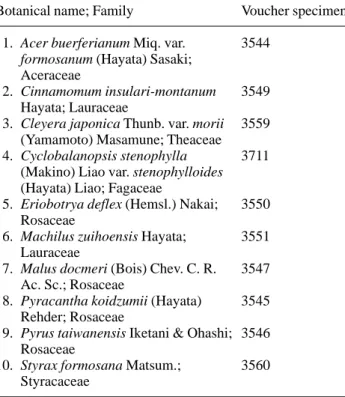
All plant materials were collected from the Taiwan En-demic Species Research Institute (TESRI) garden, in Nantou County, central Taiwan (Table 1). Herbarium voucher specimens were deposited at the Graduate In-stitute of Pharmacognosy Science, Taipei Medical Uni-versity, Taiwan, and identified by Chih-Hui Chen at the TESRI garden.
Preparation of plant extracts
Dried leaves of plants were pulverized and extracted with 70% acetone twice. After filtering, the combined filtrates were concentrated under reduced pressure. The final residues were freeze-dried and stored in a closed container until use. The yields of plant extracts were calculated by the following formula:
Yield (%) = (mass of the extract/mass of the dried raw plant material) × 100%.
Chemicals
1,1-Diphenyl-2-picrylhydrazyl (DPPH), deoxyribose, thiobarbituric acid (TBA), trichloroacetic acid (TCA), FeCl2, FeCl3, potassium ferricyanide (K3FeCN6), and Folin-Ciocalteu reagent were purchased from Sigma Chemical (St. Louis, MO). All other chemicals were of analytic grade.
1,1-Diphenyl-2-picrylhydrazyl (DPPH) free radical scavenging activity
The DPPH radical-scavenging effect was measured ac-cording to the method of Kang and Saltveit (2002). This method measures hydrogen atom- or electron-do-nating activity. DPPH is a stable free radical of a purple color which is reduced to yellow-colored diphenyl-picrylhydrazine. Each tested sample was mixed with 160 µM DPPH radical in a methanol solution. After a 20-min incubation period at room temperature in the dark, the absorbance was read at 517 nm. The inhibito-ry percentage of DPPH was calculated according to the following equation:
Scavenging activity (%) = [(absorbance of the trol absorbance of the sample)/absorbance of the con-trol] ×100%.
Reducing power activity
Reducing powers were measured by K3Fe(CN)6-FeCl3 (Yen and Chen, 1995). The test sample was mixed with an equal volume of 0.2 M phosphate buffer (pH 6.6) and 1% potassium ferricyanide (K3FeCN6). The mix-ture was incubated at 37 °C for 20 min. An equal vol-ume of 10% trichloroacetic acid was added to the mix-ture, then it was centrifuged at 3000 rpm for 10 min. The supernatant was mixed with distilled water and 0.1% FeCl3 at a ratio of 1:1:2. After standing for 10 min, the absorbance was measured at 700 nm. Deoxyribose (DR) assay
The deoxyribose method for determining the rate of re-action of the hydroxyl radical with an antioxidant was performed as described by Halliwell et al. (1987). The reaction mixtures contained the following reagents at their final concentrations: 2.8 mM deoxyribose, 20 mM potassium phosphate buffer (pH 7.4), 100 µM FeCl3, 780 µM EDTA, 1 mM H2O2, and 100 µM ascor-bic acid. Solutions of FeCl3, H2O2, and ascorbic acid were prepared immediately before use. After incubat-ing at 37 °C for 1 h, equal volumes of 1%
2-thiobarbi-Table 1. Ethnobotanical data of Taiwanese native plants studied.
Botanical name; Family Voucher specimen
1. Acer buerferianum Miq. var. 3544
formosanum (Hayata) Sasaki;
Aceraceae
2. Cinnamomum insulari-montanum 3549
Hayata; Lauraceae
3. Cleyera japonica Thunb. var. morii 3559 (Yamamoto) Masamune; Theaceae
4. Cyclobalanopsis stenophylla 3711
(Makino) Liao var. stenophylloides (Hayata) Liao; Fagaceae
5. Eriobotrya deflex (Hemsl.) Nakai; 3550 Rosaceae
6. Machilus zuihoensis Hayata; 3551
Lauraceae
7. Malus docmeri (Bois) Chev. C. R. 3547 Ac. Sc.; Rosaceae
8. Pyracantha koidzumii (Hayata) 3545 Rehder; Rosaceae
9. Pyrus taiwanensis Iketani & Ohashi; 3546 Rosaceae
10. Styrax formosana Matsum.; 3560
turic acid (TBA) and 10% trichloroacetic acid (TCA) were added to the reactants and boiled for 5 min. Then the reactants were cooled and centrifuged at 13,000 × g
for 5 min, and the absorbance was determined spec-trophotometrically at 532 nm.
Determination of total phenolics
The amount of total phenolics in extracts was deter-mined according to a modified Folin-Ciocalteu method (Kujala et al., 2000). A 250-µl aliquot of sample solu-tion (2.5 mg/ml) was mixed with 250 µl of 1 N Folin-Ciocalteu reagent, 500 µl of a 20% sodium carbonate (Na2CO3) solution, and 4 ml water. After a 25-min in-cubation at room temperature, the reaction mixture was centrifuged at 5000 rpm for 10 min. The supernatant
was measured at 730 nm using a spectrophotometer. The amount of total phenolics was expressed as gallic acid equivalent (GAE) in milligrams per gram dry plant extract.
Statistical analysis
Data are presented as the mean ± standard deviation (SD) of each triplicate test.
j
Results and Discussion
Ten Taiwanese native plants were extracted with 70% aqueous acetone, and their yields ranged from 7.3% to 32.1% (Table 2). The antioxidant activities of these
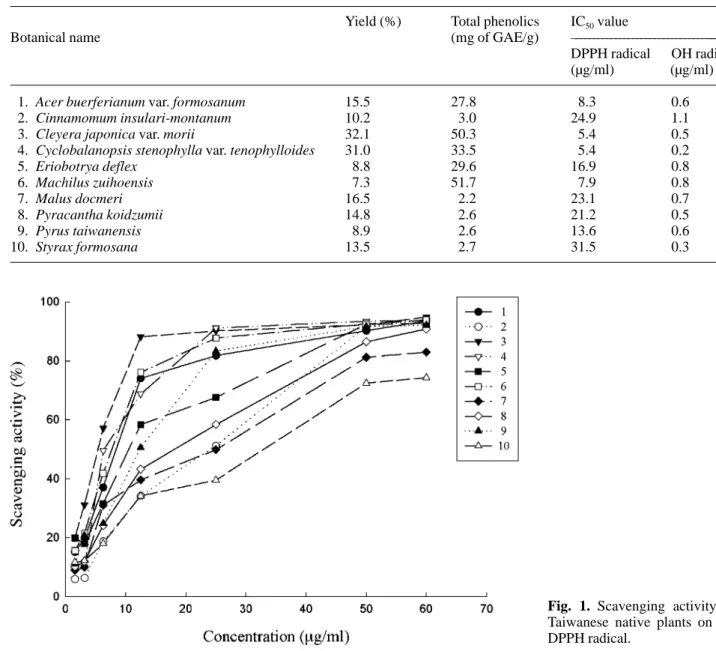
ex-Fig. 1. Scavenging activity of Taiwanese native plants on the DPPH radical.
Table 2. The phenolics and IC50values of Taiwanese native plants against DPPH and OH free radicals.
Yield (%) Total phenolics IC50value
Botanical name (mg of GAE/g) ––––––––––––––––––––––––––––––––––––––
DPPH radical OH radical
(µg/ml) (µg/ml)
1. Acer buerferianum var. formosanum 15.5 27.8 8.3 0.6
2. Cinnamomum insulari-montanum 10.2 3.0 24.9 1.1
3. Cleyera japonica var. morii 32.1 50.3 5.4 0.5
4. Cyclobalanopsis stenophylla var. tenophylloides 31.0 33.5 5.4 0.2
5. Eriobotrya deflex 8.8 29.6 16.9 0.8 6. Machilus zuihoensis 7.3 51.7 7.9 0.8 7. Malus docmeri 16.5 2.2 23.1 0.7 8. Pyracantha koidzumii 14.8 2.6 21.2 0.5 9. Pyrus taiwanensis 8.9 2.6 13.6 0.6 10. Styrax formosana 13.5 2.7 31.5 0.3
tracts were investigated by DPPH, hydroxyl radical-scavenging activities, and reducing power activity in this study.
DPPH reactivity is one popular method for screening the free radical-scavenging ability of compounds or the antioxidant activity of plant extracts. Figure 1 shows the dose-response curve for DPPH radical-scavenging activity of the extracts of ten Taiwanese native plants,
and the IC50values were calculated and are presented in Table 2. Four out of ten plants, including Acer
buer-ferianum var. formosanum, Cleyera japonica var. morii, Cyclobalanopsis stenophylla var. stenophyl-loides, and Machilus zuihoensis, were exhibited
stronger activities and their IC50values ranged from 5.4 to 8.3 µg/ml. The results imply that the radical scav-enging activities of the four plants may be attributed to
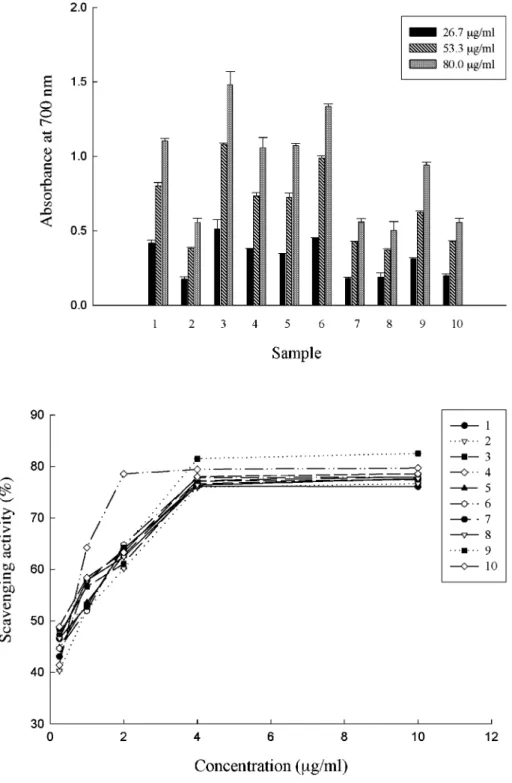
Fig. 3. Deoxyribose assay of Tai-wanese native plants.
Fig. 2. Reducing power activi-ty of Taiwanese native plants.
morii, C. stenophylla var. stenophylloides, and M. zui-hoensis showed excellent in vitro antioxidant activity
in this study. By using the Folin-Ciocalteu method to determine the total phenolics, it was shown that the four extracts contain abundant phenolics (Table 2). The total phenolic contents were expressed as gallic acid equivalents (GAEs) per gram of dried plant extract; the amount of four plant extracts ranged from 27.8 to 51.7 mg GAE/g dry material. Thus, the total phenolics may play a role in the antioxidant activity. In current epi-demiological studies, phenolic compounds of the plant kingdom have been reported to have multiple biologi-cal effects, including antioxidant (Duthie and Crozier, 2000; Eastwood, 2001), antiviral (De Clercq, 2000), and antibacterial activities (Alcaraz et al., 2000) as well as tumor cell growth inhibition (Ito et al., 2000; Rafi et al., 2000). Free radicals are one of the causes of several diseases, such as aging diseases, cardiovascular dis-eases, atherosclerosis (Kendler, 1995), and cancers (Meydani, 2001; Rice-Evans, 2001; Feiz and Mo-barhan, 2002). In addition to the four active extracts of
A. buerferianum var. formosanum, C. japonica var. morii, C. stenophylla var. stenophylloides, and M. zui-hoensis, E. deflex was also containing rich phenolics
and effective in the reducing power test but not so ef-fective in the DPPH system. This may be attributed to the compounds of plant extracts possessing small dif-ferences in their proton- and electron-donating abili-ties. However, C. insulari-montanum, M. docmeri, P.
koidzumii, P. taiwanensis, and S. formosana did not
show significant correlations between the deoxyribose assay and other assay systems. Thus, the hydroxyl radi-cal scavenging activity of these four plant extracts could not be predicted on the basis of phenolic com-pounds.
In the present study, we demonstrate that Taiwanese native plants contain phenolic compounds which can serve as natural sources to develop free radical scav-engers. Natural antioxidants may by responsible for the protective effects against the risk of many physiologi-cal and pathologiphysiologi-cal processes. Because there are few reports about Taiwanese native plants, we are interest-ed in the antioxidant properties of these native plants. Therefore, it is suggested that further work should focus on the isolation and identification of the radical-scavenging components using bio-organic chemical methods to study these active extracts.
Acknowledgements
This study was supported by a grant from the National Sci-ence Council of the Republic of China (grant no. NSC90-2320-B-038-024). We also express thanks for the financial support for this study from the Juridical Person of Yen’s Foundation, Taiwan.
their stronger proton-donating abilities. In addition to their H-donating ability (Hou et al., 2001), the DPPH scavenging activity was also related to the structure of the active substances in plant extracts (Sawai and Moon, 2000).
In the reducing power assay, the antioxidant activity of samples was measured by their ability to reduce the Fe3+/ferricyanide complex by formimg ferrous prod-ucts. Fe2+can be monitored by measuring the formation of Perl’s Prussian blue at 700 nm. Increased ab-sorbance at 700 nm indicates a stronger reducing power. When these tested extracts (with a concentra-tion of 80 µg/ml) were respectively added to the reac-tion mixture, A. buerferianum var. formosanum, C.
japonica var. morii, C. stenophylla var. stenophyl-loides, E. deflex, and M. zuihoensis showed greater
re-ducing powers relative to the other plant extracts (Fig. 2), and the absorbances at 700 nm were found to be greater than 1. They also showed a dose-dependent effect. The five extracts may contain more active mate-rials which can donate electrons and react with free radicals, and then convert them into more-stable metabolites and terminate the radical chain reaction (Yen and Chen, 1995).
The protection of lipids against free radical reactions can be evaluated by the Fenton reaction using the de-oxyribose assay (Hu and Kitts, 2001; Lai et al., 2001). In this system, a mixture of Fe3+-EDTA, hydrogen per-oxide (H2O2), and ascorbic acid were used to generate hydroxyl radicals (•OH). The response degrades the sugar deoxyribose into fragments which under heating with thiobarbituric acid at a low pH, are detected be-cause they generate a pink chromogen. This capability to reduce Fe3+ and stimulate deoxyribose degradation was also adopted as one of the pro-oxidant properties of actual or proposed antioxidants (Hsieh and Yen, 2000; Matsingou, 2001). The data in Fig. 3 show that the ten extracts could effectively inhibit the formation of •OH generated in a concentration-dependent manner. The IC50values were calculated and are presented in Table 2; they ranged from 0.3 to 1.1 µg/ml. In this assay, the tested samples inhibit color formation may be not only by reacting with hydroxyl radical but also by chelating iron (Li and Xie, 2000). Although the maximum scav-enging activity of hydroxyl radicals in this system was about 80% for the ten extracts, they possessed a concen-tration-dependent effect at lower concentrations (0.25 to 4 µg/ml) as shown in Fig. 3. This phenomenon might be because the tested extracts contain compounds which can chelate iron in high concentrations. Whatev-er, the deoxyribose assay is a convenient method to de-termine the reaction of water-soluble compounds with the hydroxyl radical (Li and Xie, 2000).
According to the above results, the crude extracts of
j
References
Alcaraz LE, Blanco SE, Puig ON, Tomas F, Ferretti FH (2000) Antibacterial activity of flavonoids against methi-cillin-resistant Staphylococcus aureus strains. J Theor Biol 205: 231–240
De Clercq E (2000) Current lead natural products for the chemotherapy of human immunodeficiency virus (HIV) infection. Med Res Rev 20: 323–349
Duthie G, Crozier A (2000) Plant-derived phenolic antioxi-dants. Curr Opin Clin Nutr Metab Care 3: 447–451 Eastwood MA (2001) A molecular biological basis for the
nu-tritional and pharmacological benefits of dietary plants. QJM 94: 45–48
Feiz HR, Mobarhan S (2002) Does vitamin C intake slow the progression of gastric cancer in Helicobacter pylori-in-fected populations? Nutr Res 60: 34–36
Formica JV, Regelson W (1995) Review of the biology of quercetin and related bioflavonoids. Food Chem Toxicol 33: 1061–1080
Halliwell B, Gutteridge JM, Aruoma OI (1987) The deoxyri-bose method: a simple “test-tube” assay for determination of rate constants for reactions of hydroxyl radicals. Anal Biochem 165: 215–219
Halliwell B, Gutteridge JM (1990) Role of free radicals and catalytic metal ions in human disease: an overview. Meth-ods Enzymol 186: 1–85
Hou WC, Lee MH, Chen HJ, Liang WL, Han CH, Liu YW, Lin YH (2001) Antioxidant activities of dioscorin, the stor-age protein of yam (Dioscorea batatas Decne) tuber. J Agric Food Chem 49: 4956–4960
Hsieh CL, Yen GC (2000) Antioxidant actions of du-zhong (Eucommia ulmoides Oliv.) toward oxidative damage in biomolecules. Life Sciences 66: 1387–1400
Hu C, Kitts DD (2001) Evaluation of antioxidant activity of epigallocatechin gallate in biphasic model systems in vitro. Mol Cell Biochem 218: 147–155
Ito H, Kobayashi E, Takamatsu Y, Li SH, Hatano T, Sakaga-mi H, Kusama K, Satoh K, Sugita D, Shimura S, Itoh Y, Yoshida T (2000) Polyphenols from Eriobotrya japonica and their cytotoxicity against human oral tumor cell lines. Chem Pharm Bull 48: 687–963
Kang HM, Saltveit ME (2002) Antioxidant enzymes and DPPH-radical scavenging activity in chilled and heat-shocked rice (Oryza sativa L.) seedlings radicles. J Agric Food Chem 50: 513–518
Kawanishi S, Hiraku Y, Oikawa S (2001) Mechanism of guanine-specific DNA damage by oxidative stress and
its role in carcinogenesis and aging. Mutat Res 488: 65–76
Kendle BS (1995) Free radicals in health and disease: impli-cations for primary health care providers. Nurse Pract 20: 29–36, 43
Kujala TS, Loponen JM, Klika KD, Pihlaja K (2000) Pheno-lics and betacyanins in red beetroot (Beta vulgaris) root: distribution and effect of cold storage on the content of total phenolics and three individual compounds. J Agric Food Chem 48: 5338–5342
Lai LS, Chou ST, Chao WW (2001) Studies on the antioxida-tive activities of Hsian-tsao (Mesona procumbens Hemsl) leaf gum. J Agric Food Chem 49: 963–968
Li C, Xie B (2000) Evaluation of the antioxidant and pro-oxi-dant effects of tea catechin oxypolymers. J Agric Food Chem 48: 6362–6366
Matsingou TC, Kapsokefalou M, Salifoglou A (2001) Aque-ous infusions of Mediterranean herbs exhibit antioxidant activity towards iron promoted oxidation of phospholipids, linoleic acid, and deoxyribose. Free Radic Res 35: 593–605
Meydani M (2001) Nutrition interventions in aging and age-associated disease. Ann NY Acad Sci 928: 226–235 Rafi MM, Rosen RT, Vassil A, Ho CT, Zhang H, Ghai G,
Lambert G, DiPaola RS (2000) Modulation of bcl-2 and cytotoxicity by licochalcone-A, a novel estrogenic flavonoid. Anticancer Res 20: 2653–2658
Rice-Evans C (2001) Flavonoid antioxidants. Curr Med Chem 8: 797–807
Xie B, Shi H, Chen Q, Ho CT (1993) Antioxidant properties of fractions and polyphenol constituents from green, oo-long and black teas. Life Sci 17: 77–84
Sawai Y, Moon JH (2000) NMR analytical approach to clari-fy the molecular mechanisms of the antioxidative and radi-cal-scavenging activities of antioxidants in tea using 1,1-diphenyl-2-picrylhydrazyl. J Agric Food Chem 48: 6247–6245
Yen GC, Chen HY (1995) Antioxidant activity of various tea extracts in relation to their antimutagenicity. J Agric Food Chem 43: 27–32
j
Address
Mei-Hsien Lee, Graduate Institute of Pharmacognosy Science, Taipei Medical University, Taipei 110, Taiwan Tel.: ++886-2-2736-1661 ext. 6151;