國立交通大學
外國語文學系外國文學與語言學碩士班
碩士論文
漢語動詞後「一點」的語法化
The Grammaticalization of Post-verbal yidian „一點‟ in
Mandarin Chinese
研究生:洪舶堯
指導教授:葉美利博士
劉辰生博士
The Grammaticalization of Post-verbal yidian „一點‟ in Mandarin Chinese
研 究 生:洪舶堯 Student: Po-Yao Hung
指導教授:葉美利 Advisor: Mei-Li Ye
劉辰生 Chen-Sheng Liu
國立交通大學
外國語文學系外國文學與語言學碩士班
碩士論文
A Thesis
Submitted to Department of Foreign Languages and Literatures
Graduate Institute of Foreign Literatures and Linguistics
National Chiao Tung University
in partial Fulfillment of the Requirements
for the Degree of Master
in
Graduate Institute of Foreign Literatures and Linguistics
July 2011
Hsinchu, Taiwan, Republic of China
漢語動詞後「一點」的語法化 學生:洪舶堯 指導教授:葉美利 劉辰生 外國語文學系外國文學與語言學碩士班 摘要 本文主要以語法化的角度為出發點探討漢語動詞後「一點」的語法化現象。本文認 為以共時角度來看,「一點」最開始的用法是作為不定量詞,說明名詞的量。之後再演 變為動詞和形容詞的補語。本文也用歷時的語料加以佐證這個主張。 由於語用功能在語法化中扮演讓意思改變的角色,本文探討「一點」的緩和功能。 本文將討論內容設定在「A 一點」的結構並主要討論兩大內容。其一,本文整理出在語 料中觀察到「一點」會出現且具有緩和作用的結構。依照說話者的觀點主要有五種結構: 「A 一點」、「比較 A 一點」、「A 了一點」、「太 A 了一點」。其二,本文探討在什麼情況下 聽者會知道說話者使用「一點」是為了緩和作用,什麼時候「一點」又維持原意而不具 有緩和作用。本文認為,「一點」會被解讀為緩和的詞語的條件是主觀性 (subjectivity)、相互主觀性(intersubjectivity)和四個說話者必須緩和其話語的原 因共同造成的。 本文也探討是否說話者表達命令時,「一點」一定可以緩和說話者的話語強度。本 文藉由 Lin(1981)和 Lee-Wong(1998)討論說話者表達直接要求的文章和問卷調查的結果 來說明說話者使用「一點」不一定是為了緩和語氣,有時候是要表達某個不理想的狀況 需要馬上獲得至少「一點」的改善。 關鍵字:一點、語法化、主觀性、緩和作用
The Grammaticalization of Post-verbal yidian ‘一點’ in Mandarin Chinese
Student: Po-Yao Hung Advisor: Dr. Mei-Li Ye
Dr. Chen-Sheng Liu
Graduate Institute of Foreign literatures and Linguistics
National Chiao Tung University
Abstract
The thesis focuses the discussion on the grammaticalization of the post-verbal yidian. In terms of the development of grammaticalization, from the synchronic data, it is suggested that
yidian is originally used as a quantifier denoting the amount of the head noun, and then
develops into the use of the complement of verbs and adjectives. The hypothesis of the development of the grammaticalization of yidian can be supported with diachronic data.
Since meaning change caused by pragamatic usage usually goes along with
grammaticalization, the thesis also discusses the pragmatic functions of yidian. Yidian in Mandarin Chinese is usually seen as a mitigator which displays hedging function. Limiting the discussion of the hedging function of yidian to the „A yidian‟construction, this thesis further discusses this issue from two main points. First, the constructions in which yidian appears as a mitigator are spelled out. Through the observation from the collected data, it is found that standing on different point of views, the speakers may employ yidian as a mitigator with four constructions –„ A yidian‟, „bijiao A yidian‟, „A le yidian‟ and „tai A le yidian‟. Second, it is discussed under what condition yidian displays its hedging function, i.e. how the hearers know that he speakers are hedging their utterances in one situation but not in another. It is suggested that yidian tends to be interpreted as a mitigator when subjectivity or
intersubjectivity is involved in the utterances and there is one of the four reasons proposed in the thesis that the speaker needs to hedge his/her utterances.
There is also a brief discussion on whether yidian is meant to be used to hedge the illocutionary force of a speaker when s/he is making orders. With the support of Lin‟s (1981) and Lee-Wong‟s (1998) papers on direct requests and the result of the survey, it is argued in the thesis that whether yidian is meant to be used as a mitigator is quite context-based and that
yidian may not be a mitigator at all when a speaker is making an order to ask the addressee to
make at least a bit of improvement to make some change in an undesirable situation.
致謝 攻讀碩士學位以來,我要特別感謝我的指導教授葉美利老師和劉辰生老師,在一次 一次的挑戰與激辯中,紮實訓練我語言分析的能力及語言學人的思維。老師的鼓勵與教 誨,不只使我在學術領域上更精進,也培養我積極正面的迎向人生。我尤其要感謝葉美 利老師,雖然是跨校指導卻花許多心血在我身上。謝謝老師如此嚴格的要求每一個環 節,讓我在每一個步驟的思考都更加紮實。謝謝劉美君老師與高雄師範大學的王萸芳老 師。因為你們寶貴的意見,使這篇論文能更加完善。此外,我也要感謝就讀期間所有教 導過我的老師們,以及在各研討會中給予我意見的教授學者們。謝謝你們豐富了我的語 言學生活。 感謝我的爸媽,感謝你們從小到大的栽培。尤其對英文上面對我的培養,讓我可以 在英文的使用上有信心。
Last but not least, I have to pay gratitude to my beloved friend, Wilson Lu, who has always been my support and kept me in a good mood through out this tough year.
Table of Contents
Chinese Abstract ………i
English Abstract ………ii
Acknowledgements ………...iv
Table of Contents ………...v
Chapter 1 Introduction ………...……….1
1.1 Introduction ………...………1
1.2 Literature review ………..……….2
1.3 The purpose and the structure of the thesis ………..……….5
1.4 Methodology ……….…………9
Chapter 2 The grammaticalization of yidian ……….………11
2.1 Theoretical background ………..……….12
2.1.1 Earlier studies on grammaticalization ……….…………...12
2.1.2 Traugott‟s study on the grammaticalization of degree modifiers in English …….15
2.2 The grammaticalization of yidian from a synchronic perspective ………..18
2.2.1 The development of yidian from denoting amount to denotinge degree ………...20
2.2.2 The development of yidian from „yidian N‟ to „ V yidian‟ ………....22
2.2.3 The extension to „A yidian‟ ……….…...27
2.3 Supporting evidence from diachronic perspective ………..32
2.4 Summary ……….……39
Chapter 3 The pragmatic function of yidian ………...40
3.1 Literature review ……….44
3.1.1 Chen (2010), cooperative principle and politeness principle ………44
3.1.2 Zou‟s study (1999) on the construction „A yidian‟ ………48
3.2 Constructions in which yidian appears and displays hedging function ………..50
3.2.1 „bijiao A yidian‟, „A le yidian‟, and „tai A le yidian‟ ………...…………..50
3.2.2 A yidian ……….……….52
3.2.3 The comparison between the two kinds of situation ………..56
3.3 The triggers that cause yidian to display its hedging function …………...………….58
3.3.1 Politeness principle ………....58
3.3.2 Constructions ……….62
3.4 Subjectivity and intersubjectivity ………63
3.4.1 The subjectivity of adjectives and adjectival evaluations in Mandarin Chinese ...64
3.4.2 Subjectivity and reasons to use yidian as a mitigator for speakers ………66
3.5 Summary and further discussion ……….79
3.5.2 The continuum of the propositional meaning and the speaker meaning of yidian.80 Chapter 4 Grammaticalization and subjectification of yidian ………..84 4.1 Subjectification and intersubjectification ………...84 4.2 Subjectification and intersubjectification in the grammaticalization of yidian……...88 Chapter 5 Summary ……….……….93 References ………...……….96
Chapter 1 Introduction
1.1 Introduction
The word dian „點‟ in Mandarin Chinese displays diverse functions. For example, it can be used as a verb, meaning „to light up‟ as in dian lazhu „to light up candles‟, or „to order meals‟ as in dian cai „to order dishes‟. Besides, dian is also used as a
quantifier to denote the quantity of something and is equivalent to „some‟ or „a little‟. It is observed that dian is frequently collocated with the numeral yi „one‟. There are several usages in the combination of yi and dian. First, yidian, like dian, can function as a quantifier, as in (1.1):
(1.1) (Academia Sinica)
… 做家務時,身上擦一點香水…
… zuo jiawu shi, shen shang ca yidian xiangshui… do housework when body on wipe a little / some perfume „…when doing housework, apply some perfume on the body…‟
Additionally, yidian can be used as a complement of a verb or adjective as in (1.2) and in (1.3) respectively:
(1.2) (Academia Sinica)
看一本不懂,看十本懂一點…
kan yi ben bu dong, kan shi ben dong yidian … look one CL NEG understand look ten CL understand a little
reading ten copies…‟
(1.3) (Academia Sinica)
如果你不舒服,就喝少一點。
Ruguo ni bu shufu, jiu he shao yidian. If 2S NEG comfortable then drink little a little „If you don‟t feel good, drink less.‟
It is worthy to note that as a quantifier, yidian is originally in the position of the specifier of an NP. However, it is posed after a verb or an adjective when used as a complement. Since yidian displays such interesting phenomenon, it is worthwhile to find out whether there is any relation of development in the usages of yidian.
1.2 Literature review
There are several studies on the discussion of yidian and most of them focus on the syntactic functions and the pragmatic functions of yidian. In terms of the syntactic perspective of yidian, most studies only focus on syntactic behaviors and meanings of
yidian. Zheng (2007) mostly discusses the syntactic behaviors of yidian and finds that
there are some syntatic functions of yidian such as being a quantifier in „yidian N‟ and being a complement in „V yidian‟ and „A yidian‟. In addition to discussing the
syntactic behaviors of yidian, Xiu (2002) observes that the meanings of yidian change with different syntactic behaviors. For example, when used as a quantifier, yidian denotes the amount of the noun; when used as the complement of a verb, yidian denotes the degree of chage made by the verb, and in the use of the complement of an adjective, yidian puts a limit to the degree of the adjective. Although the two studies
provide thorough observation from the data, neither of the studies discuss the relation between the different syntactic behaviors and meanings of yidian and whether its development is related to the various usages of yidian.
Compared to Zheng (2007) and Xiu (2002), Chen (2011) not only provides observation but analysis of the issue. Chen attempts to explain the syntactic behaviors of yidian by means of syntactic and cognitive approaches. In her analysis, Chen considers „V yidian‟ the result of the ellipsis of „V yidian N‟. Besides, through her analysis, „A yidian N‟ can be ellipsized into „A yidian‟ and since there is similarity between adjectives and verbs in Mandarin Chinese, yidian can also be used as the complement of verbs. Chen (2011) claims that when used as a complement of a verb or an adjective, yidian denotes the degree of change of the verb or the adjective and thus can be seen as a result. Therefore, yidian can be put on after a verb or an adjective.
Although Chen‟s (2011) analysis is insightful, there are still some problems unsolved. First, Chen (2011) only focuses on the development in the syntactic behaviors of yidian but not on the development in the meanings with respect to the syntactic behaviors. Second, Chen (2011) fails to observe that there is semantic difference between yidian in „V yidian‟ and „A yidian‟. The one in „A yidian‟ actually denotes the differential between two compared objects (Liu 2007). Besides, as for the syntactic development, Chen fails to explain why she thinks the use of „A yidian‟ develops to the use of „V yidian‟ but not in the opposite direction. Furthermore, Chen claims that through her observation, there are cases in which „A yidian N‟ is ellipsized into „A yidian‟, which leads to the use of „V yidian‟. However, Chen (2011) should have provided the cases in which „A yidian N‟ is ellipsized into „A yidian‟ because normally, when an adjective is used transitively, its objects should be introduced wity
(1.4) (Huang 2009: 21)
他對這個結局很不滿。
Ta dui zhe ge jieju hen buman. he on this CL outcome very discontent „He is discontent with this outcome.‟
Finally, Chen‟s (2011) claim on the development of the syntactic use of yidian would be more persuasive if she provided diachronic evidence.
In terms of the pragmatic perspective of yidian, it has been pointed out by some studies such as Zou (1999), Shuai (1999) and Chen (2011) that yidian displays the function of mitigating. Zou (1999) and Shuai (1999) focuses on the pragmatic
function of the „A yidian‟ and „tai A le yidian‟ constructions respectively. Chen (2011) further discusses that sometimes, people flout cooperative principle (Grice 1975) and use yidian as a mitigator in order to follow politeness principle (Leech 1983). All of the studies are insightful. However, none of them discuss the relation between the semantic meaning and the pragmatic meaning of yidian. That is, these studies fail to explain when the mitigating meaning of yidian will be triggered.
Additionally, Zou (1999) and Chen (2011) both agree that yidian can mitigate the speaker‟s tone when s/he is producing an imperative. However, it is claimed in this paper that not every yidian in imperatives sounds like a mitigator especially in the imperatives of making orders (Bach & Harnish 1979). Besides based on the result of the survey conducted to native speakers in the present study, the claim can be supported by the fact that yidian in imperatives of making orders is not the main role in downtoning the speaker‟s illocutionary force. Furthermore, whether yidian displays the function of hedging in imperatives of
making orders is quite context-based.
1.3 The purpose and the structure of the thesis
The purpose of the paper is mainly in the grammaticalization and subjectification of yidian. Since subjectification is a trigger that causes an element to acquire
pragmatic meanings, the pragmatic function of yidian is discussed. In Chapter 2, how
yidian is developed from a quantifier to a complement of verbs or adjectives is
discussed, as mentioned in (1.1) to (1.3). Besides, according to some of the data in which yidian is used as a quantifier syntactically, semantically, yidian can be seen as a degree modifier which denotes the degree of the head noun rather than the amount as in (1.5):
(1.5) (Academia Sinica) …一點憂愁也沒有…
… yidian youchou ye mei you… some / a little anxiety also NEG have „…there isn‟t a bit of anxiety…‟
In (1.5), yidian youchou „a bit of anxiety‟ is an NP and originally the internal object of the existential verb you; the NP is preposed to the front. In the NP, the head noun is
youchou „anxiety‟ and yidian functions as a quantifier. However, semantically, yidian
in (1.5) doesn‟t denote the amount of youchou; instead, it expresses the speaker‟s assessment of the degree of youchou. It is worth noting that when used as a
complement of verbs, yidian also denotes the degree. The meaning of yidian is used to denote the differential (Liu 2007) between two compared objected when used as the
complement of adjectives. Therefore, it is quite intriguing because yidian behaves quite different syntactically but it seems that there is semantic relation between the different meanings of yidian. Besides, there is a tendency that yidian, originally a grammatical item, develops new grammatical functions. For example, severl studies such as Zou (1999) and Chen (2011) discuss that yidian can function as a mitigator. As a result, from this perspective, yidian follows the definition of grammaticalization by Hopper and Traugott (2003):
As a term referring to a research framework, grammaticalization refers to that part of the study of langage change that is concerned with such questions as how lexical items and constructions come in certain linguistic contexts to serve grammatical fucntions or how grammatical items develop new grammatical functions.
(Hopper & Traugott 2003: 1)
It is discussed in Chapter 2 whether there is grammaticalization between the different usages of yidian. The hypothesis for the development of grammaticalization can be supported with diachronic evidences.
In Chapter 3, the discussion is on the pragmatic functions of yidian. As mentioned earlier, yidian is seen as a mitigator pragmatically. In Chapter 3, The discussion covers two main issues. The first discussion is on the constructions in which yidian often appears and is interpreted as a mitigator especially in the situation in which the speaker makes criticism to express the dissatisfaction against current states. Through the observation, it is found that the speaker may stand on two
different points of view when making criticism. First, the speaker may criticise on the perspective of the current state as in (1.6):
(1.6) A: 茶好喝嗎?
Chai hao he ma? tea good drink SPF? „Is the tea good?‟
B: 淡了一點。 Dan le yidian. weak PFT a little „It‟s a bit weak.‟
In (1.6), dan „weak‟ is the current state that the speaker is dissatisfied with. The speaker stands on the perspective of reality and employs the construction „A le yidian‟ with yidian being a mitigator to make the criticism.
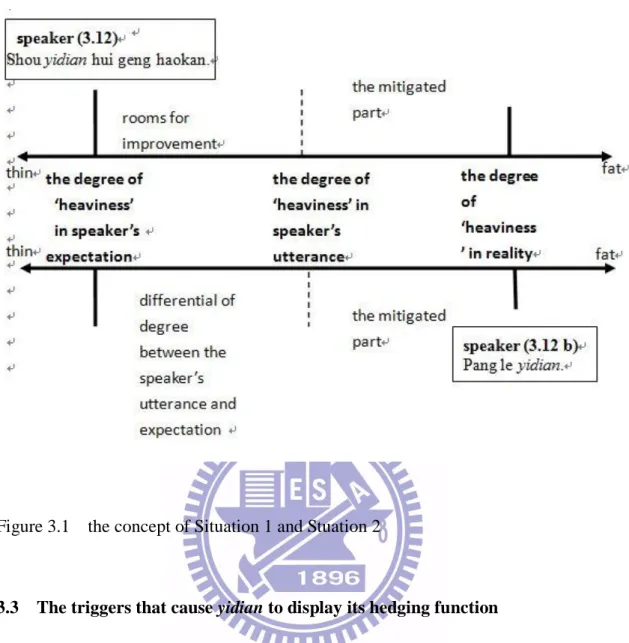
In some cases, it is observed that instead of making comments on the current situation directly, the speaker stands on the perspective of his or her expected situation which the speaker believes to be better than the current state, as in (1.7):
(1.7) 他瘦一點會更好看。
Ta shou yidian hui geng hao kan. 3S thin a little can more good-looking „He will look better if he is thinner.‟
In (1.7), the speaker uses the construction „A yidian‟ to make a comment, in which the adjective stands for the more desirable state in the speaker‟s mind. With yidian as a mitigator, the speaker is commenting that it would be better if the person that the
speaker refers to can make a bit improvement toward his or her expected state. In addition to „A le yidian‟ and „A yidian‟, there are also constructions that are found as forms for criticism with yidian being a mitigator. The constructions include „tai A le yidian‟ and „bijiao A yidian‟.
In Chapter 3, it is also discussed that what causes the mitigating meaning of
yidian to be „on-record‟, i.e. when hearers will interpret yidian as a mitigator and
when they will understand yidian as its semantic meaning. It is suggested in this thesis that subjectivity and intersubjectivity can be considered as the main factors.
In Chapter 4, the discussion is focused on the interaction between
grammaticalization and subjectification. In the sematic extention of yidian, metaphor and metonymy are the main triggers for the extension. When it comes to pragmatic function, it is subjectification that trigger yidian to display its pragmatic functions. The thesis ends at Chpater 5 with an overall conclusion.
It is necessary to note that through out the paper, the emphasis is put on yidian, a unit that denotes the amount of something. Although some studies such as Zheng (2007) consider dian to be the same as yidian in the quantifier use, this conclusion still requires further discussion and support. In addition, the homonyms won‟t be involved in the discussion such as yidian, which means „one o‟clock‟, as in (1.8):
(1.8) 已經一點鐘了。
Yijing yidian zhong le. already one o‟clock PFT „It‟s one o‟clock already.‟
Besides, the adverb youyidian „a little bit‟ won‟t be included in the discussion since it is youyidian, not yidian, that is seen as a unit, as in (1.9):
(1.9) 這題目有一點困難。
Zhe timu youyidian kunnan. this question a little bit difficult „This question is a little bit difficult.‟
1.4 Methodology
Through out the paper, the data provided are drawn from Academia Sinica Balanced Corpus of Modern Chinese (現代漢語平衡語料庫), the NCCU Corpus of Spoken Chinese (政大漢語口語語料庫). There are both written data and spoken data in Academia Balanced Corpus. Since pragmatic issue is touched in the thesis, more spoken data are needed from the NCCU corpus of Spoken Chinese. In addition to the corpus, a survey is conducted to check the judgement of native speakers of modern Chinese. Recall that diachronic evidence is used to support the hypothesis of the development of yidian in the paper, the diachronic data are drawn from Scripta Sinica database (漢籍電子文獻資料庫) and Academic Research and Information Center of
THE DREAM OF THE RED CHAMBER On line (紅樓夢網路教學研究資料中心).
Two surveys are conducted in the paper. For the first survey, there are one hundred informants who are all between twenty to forty years old. Some of them are university students while the others have already got their diploma of university. All the informants in the survey speak Mandarin Chinese as their mother tongue, and so do their parents. In the survey, there are two questions. The first question is „Tai can le
yidian‟ han „tai can le‟ na yi ge qing kuang bijiao can? (Which situation is more
terrible, „Tai can le yidian‟ or „tai can le‟?) Three choices are provided for this question and the informants are asked to put the mark „ˇ‟ on the choice they choose.
The choices are „tai can le yidian’, „tai can le‟ and „mei you chabie (no difference between the two)‟. The result shows that ninety two informants consider the situation expressed with „tai can le‟ is more terrible while there are eight informants putting the marks on the choice „mei you chabie‟. The second question is „Qing anjing‟ han „anjing yidian‟ na ju hua tingqilai bijiao weiwan? (Which sounds softer, „qing anjing‟ or „anjing yidian‟?) Just like the first question, there are three choices provided, which are „qing anjing‟, „anjing yidian‟ and „mei you chabie‟ respectively. Again, the
informants are asked to put the mark „ˇ‟ on the choice they choose. The result shows that seventy six informants consider „qing anjing‟ sounds softer than „anjing yidian‟, while there are twenty and five informants marking on the choice „anjing yidian‟ and „mei you chabie‟ respectively.
The second survey is aimed at junior high school students who are all in the eighth grade. All the informants in the survey speak Mandarin Chinese as their mother tongue, and so do their parents. There is only one question on the survey. The
question is Dang laoshi shuo „anjing yidian‟ han „anjing‟ de shihou, na ju hua
tingqilai bijiao weiwan? (When the teacher says „„anjing yidian‟ or „anjing‟, which
utterance sounds softer?) Just like the first survey, there are three choices for the question, which are „anjing yidian‟, „anjing‟ and „mei you chabie‟ respectively. The students are asked to put the mark „ˇ‟ on the choice they choose. The result shows that eighty eight students think that there is no difference between the two utterances by the teacher. Only twelve condier „anjing yidian‟ softer.
Chapter 2 The grammaticalization of yidian
In this chapter, the emphasis is put on the semantic extension of yidian from the view point of grammaticalization. Synchronically, there are three usages of yidian as shown in (2.1) to (2.3):
(2.1) (Academia Sinica)
… 做家務時,身上擦一點香水…
… zuo jiawu shi, shen shang ca yidian xiangshui… do housework when body on wipe a little perfume „…when doing housework, apply some perfume on the body…‟
(2.2) (Academia Sinica)
看一本不懂,看十本懂一點…
kan yi ben bu dong, kan shi ben dong yidian … look one CL NEG understand look ten CL understand a little
„One can‟t understand by reading only a copy. One can understand a bit by reading ten copies…‟
(2.3) (Acamedia Sinica) 小妹也比我矮一點。
Xiao mei ye bi wo ai yidian. little sister also compare 1S short a bit „My little sister is also a bit shorter than me.‟
(2.2), yidian functions as the complement of the verb phrase dong „understand‟ and denotes the degree of dong. In (2.3), yidian functions as the complement of ai „short‟.
In the following sections, it will be discussed what the relation between the usages is and what the ordering between the usages is. In addition, diachronic evidences are also used as support evidence to the path of extension proposed on the base of grammaticalization in the paper.
2.1 Theoretical background
2.1.1 Earlier studies on grammaticalization
Many linguists have different claims about grammaticalization. Millet, thought to be the first person using the term, thinks that lexical items are one of the source of grammaticalization. Some linguists, such as Lehmann, think that in addition to lexical items, certain contexts or linguistic conditions can also lead to grammaticalization:
Grammaticalization does not merely seize a word or morpheme… but the whole construction formed by the syntagmatic relations of the elements in question. (Lehmann 1992:406)
In Lehmann‟s term, the word „construction‟ mentioned is the so-called specific contexts or linguistic conditions. Some linguists claim that construction is both the source and outcome of grammaticalization. Linguists such as Bybee, Perkins and Pagliuca (1994), and Heine (2003) are the representatives of the perspective, and Himmelmann (2004) is also one of them:
It is the grammaticizing element in its syntagmatic context which is
grammaticized. That is, the unit to which grammaticization properly applies are constructions, not isolated lexical items.
(Himmelmann 2004: 31)
Additionally, it is claimed that the changes in grammaticalization is multilayered; that is, many changes are correlated and involved in this process. Lehmann (1995) mentions that when morphemes and constructions undergo grammaticalization, there is interaction among a number of semantic, syntactic and phonological processes. Bybee, Perkins and Pagliuca (1994) finds the interaction so tightly correlated that they hypothesize that the development of grammatical material is characterized by the dynamic coevolution of meaning and form. Besides, Himmelmann (2004) suggests that three types of expansion contributes the multi-layeredness of
grammaticalization – host-class expansion, syntactic context expansion, and
semantic-pragmatic context expansion. Host-class expansion means that the members of the relevant syntactic category which the grammaticalized elements co-occur with can increase. Syntactic context expansion refers to the change of a syntactic context that a construction is in. For example, a construction originally occurs in an argument position but appears in an adposition after it undergoes grammaticalization. Finally, Himmelmann (2004) considers semantic-pragmatic context expansion the most important expansion of the three. With the expansion of semantic-pragmatic expansion, the usage of a grammticalizing form can become broader and new meanings can be developed from the new context.
The pragmatic and semantic context is so crucial to a grammaticalizing form that not only Himmelmann but also other linguists mark its importance. As Heine (2003) has put:
Since linguisc items require specific contexts and constructions to undergo grammaticalization, grammaticalization theory is also concerned with the pragmatic and morphosyntactic environment in which this process occurs. (Heine 2003: 575)
Since grammaticalization means that syntactic change will occur, many linguists have made discussion on this issue. Initially, Meillet (1958) regards
grammaticalization as reanalysis – changes in the underlying structure, and discusses the association and the independence of grammaticalization and reanalysis. Millet contrasts reanalysis with analolgy, which he considers to be an expansion of an existent structure. Harris and Campbell (1995) make the claim that reanalysis and extension – changes in the surface form, are the only two basic internal mechanisms involved in grammaticalization. Traugott (2010: 16) argues that the distinction between reanalysis and extension may cause problems since “any extension that becomes institutionalized and acquires the status of a change rather than merely an innovation, entails at least some minimal reanalysis of the underlying specification.” Traugott (2010) also suggests that grammaticalization involves part of reanalysis in structure but not overall reanalysis. In many cases, the changes triggered by reanalysis are „fine-grained and local‟. Andersen (2006) points out that such local reanalysis shouldn‟t be viewed as error or mis-analysis, but „a demonstration of an
overperformance of human minds‟ and an ability of developing new symbols from existent patterns.
A fundemental discussion that may arise after the introduction above is what may motivate grammaticalization, or what are the factors that cause grammaticalization. No matter what the factors are, they seem to result from speaker production strategies
(Traugott 2010: 241). Among all the factors triggering grammaticalization, the two most discussed factors are 'Be clear' (Traugott 2010) and 'Be quick and easy' (Zipf 1929). In terms of grammaticalization, the first factor comes into play because speakers bear in mind that listeners want to make their words as explicit as possible. In addition to explicitness, economy is also an important principle in communication. Therefore, speakers may produce a new usage with old materials and analogize it. This is what Zipf (1929) means 'Be quick and easy'. Furthermore, Haspelmath (1998) also touches on the issue of how grammaticalization might be motivated. He suggests a number of "ecological” factors, among them unconscious processing, routinization, maxims of action and invisible hand processes. Haspelmath suggests that
grammaticalization arises out of speakers' desire to "be extravagant", i.e. "Talk in such as way that you are noticed" (p.1055).
2.1.2 Traugott’s study on the grammaticalization of degree modifiers in English
Traugott (2010) discusses the development of degree modifier constructions, such as a piece of, a sort of, and a lot of. They are commonly used as partitives, but they develop the degree modifier use. Some of them develop further into free degree adjuncts. The example a sort of is reviewed here.
Before being used as a partitive, a sort of has undergone pre-partitive use because sort is a word borrowed from French meaning „group‟ or „set‟, as in (2.4), a data drawn from Traugott (2010):
(2.4) Well may [h]e be called valyaunte and full of proues that hath such a sorte of
noble knyghtes unto hys kynee
knights among his kin.‟
(a1470 Malory, Works 526/21 [MED, sort 1a])
A sort of was used as a partitive in the sixteenth century, denoting member of a set.
Although there isn‟t a change in the NP of NP structure in these two periods, it is crucial to note that there has been a semantic reversal from the term for a
superordinate set to that for a member of a set (Traugott 2010:228). When the NP after a sort of cooccurs with an indefinite article, it motivates a sort of to become a degree modifier:
In this kind of context NP2 came to be reanalyzed as the head and a sort of became a degree modifier conveying the speaker‟s assessment that the entity referred to is not an adequate or prototypical exemplar of NP2.
(Traugott 2010:229)
The NP2 in Traugott‟s term is the NP after a sort of, and just as pointed out by Traugott, reanalysis is involved when a sort of functions as a degree modifier, i.e. rebracketing and head-modifier shift take place. In a partitive structure, sort is the head and of NP is a modifier, as in (2.5); on the contrary, when a sort of functions as a degree modifier, sort of is a modifier and the NP is the head, as in (2.6).
(2.5) the partitive structure [a sort [of NP]]
(2.6) a sort of used as a degree modifier [[a sort of] NP]
Over time, (a) sort of develops further and extends its use to modify a verb or an adjective and acquires the status of an adverb, as in (2.7):
(2.7)
a. I beesa sorter courted, and a sorter not
(1839 Marryat Diary Amer. Ser. I. II. 218 [Tabor 1993])
b. One is sort of bewildered in attempting to discover….
(1858 Pirie, Inq. Hum. Mind i. 10 [Ibid])
Traugott (2010) points out that as (2.7) illustrates, the article a is dropped before sort, and of loses its prepositional function. Traugott finds that in some cases, of becomes cliticized to sorta. Eventually, a sort of develops further in to a free degree adjunct which can be used as an independent response, as in (2.8):
(2.8) „Friend of this hombre?‟ „Yes; sort of‟
(1918 Mulford Man fr. Bar-20 vii. 79 [OED, hombre])
Similar development seems to be attested in yidian. Yidian in its
grammaticalization seems to correspond to some of the changes discussed in the former papers. For example, as what will be discussed in the following section, it is found that although yidian doesn‟t occur in an argument position, it changes from a pre-nominal position to a pos- verbal or post-adjectival position and from a
determiner to the complement of verbs or adjectives such as (2.1) and (2.3), repeated below:
(2.1) (Academia Sinica)
… 做家務時,身上擦一點香水…
… zuo jiawu shi, shen shang ca yidian xiangshui… do housework when body on wipe a little perfume „…when doing housework, apply some perfume on the body…‟
(2.3) (Academia Sinica) 小妹也比我矮一點。
Xiao mei ye bi wo ai yidian. little sister also compare 1S short a bit „My little sister is also a bit shorter than me.‟
2.2 The grammaticalization of yidian from a synchronic perspective
As above, synchronically, there are three main usages of yidian – quantifier, the complement of verbs and the complement of adjectives, as in (2.1), (2.2), and (2.3) respectively. The frequency of these usages of yidian in written and spoken corpus are shown in Table (2.1) and (2.2) respectively:
Table (2.1) yidian in written corpus
yidian N V yidian (V)A yidian (total)
number 379 58 366 803
Table (2.2) yidian in spoken corpus
yidian N V yidian (V)A yidian (total)
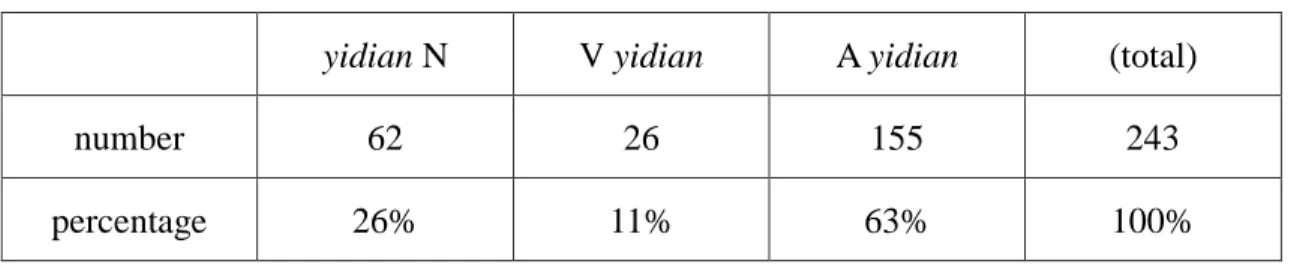
number 62 26 155 243
percentage 26% 11% 63% 100%
In Table (2.1), it is shown that yidian displays much tendency to be used both as a quantifier and as a complement of adjectives in written corpus. There isn‟t large distance between the numbers of the „yidian N‟ and „A yidian‟ usages with ten more examples found in the former usage. In Table (2.2), it is shown that the usage of
yidian as a complement of adjectives outnumbers the other two usages greatly. „A yidian‟ takes up 63% of the data, while „yidian N‟ and „V yidian‟ take up 26% and
11% of the data respectively. It is important to note that in this thesis, the „VA yidian‟ construction, in which the adjective is the complement of the verb, is considered the same as the „A yidian‟ construction. The reason is that in the „VA yidian‟ construction,
yidian functions as the complement of the adjective just as the yidian in the „A yidian‟
construction, as in (2.9):
(2.9) (Academia Sinica)
自己的要求不要訂那麼高,你可以訂低一點。
Ziji de yaoqiu bu yao ding name gao, ni keyi ding di yidian. self Poss require NEG want set so h igh 2S can set low a little „Don‟t lay down such a high criteria for yourself. You can lay down a lower one.‟
In (2.9), the adjective di „low‟ is the complement of the verb ding „set‟ and yidian denotes functions as the complement of di.
semantic extension and grammaticalization. It is also proposed that the grammaticalization of yidian is in the following order:
quantifier the complement of verbs the complement of adjectives
According to the order, the development of yidian originates from its quantifier use. The reason for the suggestion comes from metaphorical perspectives. Hopper and Traugott (2003) suggest that metaphorical innovation is one of the most widely recognized processes in meaning change (Hopper & Traugott 2003: 84). Given this suggestion, there are metaphorical processes involved in the grammaticalization of
yidian. The yidian in „yidian N‟ is a quantifier and denotes the amount of the noun,
while the yidian in „A yidian‟ denotes the degree of the adjective. Therefore, the meaning of yidian in „yidian N‟ is concrete, while the meaning of yidian in „A yidian‟ is abstract.
In the following sections, the discussion is made on the underlying factors for the order of the grammaticalization.
2.2.1 The development of yidian from denoting amount to denoting degree
When used as a quantifier, according to Iljic (1994), dian (dianr, in Iljic‟s paper) is restrictricted to mass or abstract nouns as in (2.10), repeated here:
(2.10) …而就算募了一點錢想蓋個小房子…
…er jiusuan mu le yidian qian xiang gai ge xiao and even if fund PFT a little money want build CL small fangzi…
house
„…and even if you fund a little money and want to build a small house…‟
In the corpus, it is found that in some cases, the mass noun after the quantifier yidian is rather abstract, as in (2.11):
(2.11) …我們只有這一點智慧。
…women zhi you zhe yidian zhihui. …1P only have this a little wisdom „..we only got this bit of wisdom.‟
Syntactically, zhe yidian zhihui „this bit of wisdom‟ in (2.10) is a noun, with yidian as a quantifier denoting the amount of zhihui. However, semantically, yidian zhihui can be interpreted as denoting the degree of zhihui since zhihui is an abstract noun and can‟t be measured in amount. Therefore, (2.10) can be viewed as an expanded quantifier use of yidian, in which yidian is still a quantifier but denotes the degree of the following abstract noun.
As a result, there is a development of yidian from the quantifier use to the expanded quantifier use. This chage can be viewd as what Himmelmann (2004) calls host-class expansion since the features of the nouns after yidian expand from
concreteness to abstractness.
This step of development can be explained in two ways. First, we tend to pay more attention to things we can feel and see. Therefore, it is quite logical that yidian is originally used to describe the quantity of concrete nouns. Additionally, the
metaphoric extension from concrete domains to abstract domains is common. We project the concept of concrete nouns to abstract nouns and conceptualize abstract
concepts as things of which the quality we can measure. Second, the use of yidian expanded from measuring the quantity of nouns to modifying the quality of nouns can follow the metaphor that QUANTITY is QUALITY. In the book Metaphors We Live By by Lakoff and Johnson (2008), some examples are provided to support the use of the metaphor, and one of them is provided here:
(2.12) Your argument doesn‟t cover the subject matter in enough depth.
In this sentence, the concept of quantity (depth) is mapped to the quality of argument. Another example found in Lakoff and Johnson (2008) is:
(2.13) Thats not much of an argument.
In general, the word “much” is usually used to describe the quantity of a mass noun. However, in the example, “much” can be understood as describing the quality of an argument. The same logic can be applied to the development of yidian – from describing quantity, as in yidian jiu „a little wine‟ to describing quality, as in yidian
zhihui „a bit of wisdom‟.
Although the change in the step is minor, this is a crucial step for yidian to develop its sense of degree.
2.2.2 The development of yidian from ‘yidian N’ to ‘ V yidian’
It is assumed in this study that the second step of the grammaticalization of
yidian is yidian being used as a complement of verbs in „V yidian‟. The reason for this
used as the obeject of a verb in „V yidian N‟ as in (2.14) and (2.15):
(2.14) (Academia Sinica)
我多給你一點生活費吧!
Wo duo gei ni yidian shenghuo fei ba! 1S more give 2S a little living money ITJ „Let me give you more allowance!‟
(2.15) (Academia Sinica)
每個人早上起來吃一點東西…
Mei ge ren zaoshang qilai chi yidian dongxi… every CL person morning get-up eat a little thing „Everyone gets up in the morning and eat a little food…‟
In (2.14), yidian shenghuofei „a little allowance‟ functions as the object of the verb gei „give‟ while in (2.15), yidian dongxi „a little thing‟ functions as the object of the verb
dongxi „thing‟. As a result, it is possible that the use of yidian in „V yidian‟ is
developed from „V yidian N‟
In the corpus, it seems that the data of „V yidian‟ can be divided into two groups. In one group, „V yidian‟ is actually the ellipsis of „V yidian N‟ as in (2.16), while the other group is not, i.e. „V yidian‟ is a construction and yidian is the object of the verb as in (2.17):
(2.16) (Academia Sinica)
… 聲音太低,前幾排的人還能聽到一點....
voice too low front few row DE person still can hear a little „…the voice was too low. People in the front rows may still heard a bit‟
(2.17) (Academia Sinica)
…運氣較佳時多賺一點…
… yunqi jiao jia shi duo zhuan yidian… luck compare good when much earn a little „…earn a bit more when I am lucky…‟
In (2.16), the „V yidian‟ tingdao yidian „hear a bit‟ is actually the ellipsis of tingdao
yidian shengyin „hear a bit of the voice‟. In (2.17), there is no ellipsis in „V yidian‟ zhuan yidian „understand a bit‟. Therefore, yidian in (2.16) is actually a quantifier
while yidian in (2.17) is the complement of the verb zhuan „earn‟.
As a result, the assumption can be made that there is a bridging stage before
yidian develops into its use in „V yidian‟. In the bridging stage, „V yidian‟ is the
ellipsis of „V yidian N‟ and yidian is still a quantifier. After the host expansion which is discussed in the last section, yidian can denote the sense of degree, and thus, the use of „V yidian‟ is formed and yidian denotes the degree of the extent to which the verb is done.
The assumption that VP ellipsis comes into play at this stage is similar to the example of the grammaticalization of a lot of (Traugott 2010). According to Traugott (2010), before developing into a free degree adjunct, there is time when „a lot‟ undergoes the step of ellipsis.
Like sort/kind of, a lot (without of) came to be used as a free adjunct, at first through ellipsis. This adjunct came to be used as an independent response.
(Traugott 2010: 14)
(2.18) is an example provided in Traugott (2010). In (2.15), a lot of the hillside is ellipsized into a lot:
(2.18) My house faces east and is built up against a side-hill, or should I say hillside? Anyway, they had to excavate quite a lot.
(1847, Stewart, Letters of a Woman Homesteader [UVa])
In addition, the fact that the step of ellipsis is an important process in the grammaticalization of yidian and a lot is motivated by economy (Zipf 1929) – be quick and easy. Since economy is one of the most important principles in
communication, in most of the time, speakers would avoid repeating on elements after the first mention of it. Over time, economy in speaker production leads to reuse of old material for new means (see Traugott 2010: 23). In the case of yidian, at the beginning, the construction „V. yidian‟ arises out of speakers‟ principle of economy in
communication. Then, just as what Traugott (2010) puts in her paper, the construction is used for new meanings – yidian being used to refer to the degree of the extent the verb is done.
It is important to note that all of the „V yidian‟ data, which aren‟t the result of the ellipsis of „V yidian N‟ can be divided into two groups: in one group, the verb is a transitive verb as in (2.19), and in the other, the verb is an intransitive verb as in (2.20).
(2.19) 你想省一點就吃夜市吧。
Ni xiang sheng yidian jiu chi yeshi ba. 2S want save a little then eat night market SPF „If you want to save more money, just eat at the night market.‟
(2.20) (Academia Sinica)
今天吃虧一點,明天吃虧一點,合起來就多啦。
Jintian chikui yidian, mingtian chikui yidian, he qilai jiu duo today chikui a little tomorrow chikui a little add together then much la.
SPF
„If I get my fingers burned a bit today and get my finguers burned a bit tomorrow, it will be a lot after adding these experiences together.‟
In (2.19), the verb in „V yidian‟ is a transitive verb while in (2.20), the verb in „V
yidian‟ is an intransitive one. Yidian in (2.19) functions as the object of the verb and
the construction still results from ellipsis. However, the ellipsized noun in (2.20) is hard to retrieve through the context. Over time, through generalization, yidian is seen as the complement of the verb and denote the degree of the extent the verb is done. Besides, the VC (verb and complement) as a verb phrase is very common in Mandarin Chinese such as dapo „break‟. Therefore, the grammaticalization develops into a stage where the verb in „V yidian‟ is an intransitive verb which takes yidian as its
complement. As a result, the assumption is that „V yidian‟ with a transitive verb (Vt)
develop into „V yidian‟ with an intransitive verb (Vi). Since the development is from a
kind of verb to another, this development can be seen as analogy, involving attraction of extant forms to already exisiting structures (Traugott 2010: 6).
To sum up, the discussion of the development of „V yidian‟ in this section is as followed:
V yidian (result of ellipsis) Vt yidian Vi yidian
In this development, both reanalysis and analogy comes into play. In terms of
reanalysis, at first, the verb and yidian doesn‟t form a unit as in [Vt [yidian N]]. After
rebracketing, the verb and yidian become a unit as in [Vt yidian]. Through analogy,
yidian can further be used in [Vi yidian].
2.2.3 The extension to ‘A yidian’
From synchronic perspective, it is assumed in this paper that the use of yidian in „A yidian‟ is developed from that in „V yidian‟. Analogy can account for the
assumption. In Mandarin Chinese, verbs and adjectives bear much similarity.
Sackmann (1996) mentions that neither adjectives nor verbs allow the use of a copula verb, such as shi „be‟, when they are predicates. Moreover, Sackmann (1996)
observes that some verbs, such as xihuan „like‟, ai „love‟, and zhuyi „pay attention to‟, can be modified by degree adverbs like hen „very‟ and feichang „extremely‟. In addition to Sackmann, Huang et al.(2009), in his book The Syntax of Chinese, suggests that adjectives in Mandarin Chinese easily undergo a categorical shift and some adjectives tend to change into verbs. Huang et al. (2009) provides two reasons for the change:
… Such a categorical shift is likely to happen more easily in Chinese than in, say, English for two reasons. First, Chinese has no morphological markers for
categories found in European languages. Secondly, Chinese adjectives function as predicates without a copula, making them appear verb-like.
(Huang et al. 2009: 21)
In addition, the „A yidian‟ develops from „V yidian‟ and in the last step of „V yidian‟, the verb is an intransitive verb. Intransitive verbs is more similar to adjectives because objects are not necessary for intransitive verbs and adjectives. Due to the similarity between verbs and adjectives, it is reasonable that the construction can develop from „V yidian‟ to „A yidian‟. In „A yidian‟, Since this development arises out of the similar features of Chinese verbs and adjectives, it can be viewed as analogy.
Although the use of „A yidian‟ occupies a large percentage in both written and spoken corpus, 46% and 63% respectively, all of the adjectives used in „A yidian‟ are adjectives of gradability such as hao „good‟ and rongyi „easy‟. In other words, there are no adjectives of non-gradability such as zhen „true‟ and dui „right‟ appearing in „A
yidian‟. This phenomenon can be explained by the fact that since the meaning of
gradable adjectives can be scaled by degree, yidian can collocate with gradable adjectives because it denotes degree. Paradis (1997) explains why degree modifiers collocate with adjectives:
I argue that the concepts are built up by domains that are of two kinds. There is a content domain and a schematic domain (or mode of construal)… Gradability belongs in the schematic domain. The interpretation of degree modifiers is dominated by the schematic domain… Adjectives, on the other hand, are mainly content words. Their content domain is in the foreground, but they are also configurated according to schematic domains, which are in the background.
Paradis‟ claim can also account for the reason why the use of „A yidian‟ found in the corpus occupies much larger percentage than the percentage of the „V yidian‟ use, 7% in the written corpus and 11% in the spoken corpus.
Although verbs and adjectives in Mandarin bear some similarity, the meaning of yidian in „A yidian‟ is different from that in „V yidian‟, i.e. the yidian in „A yidian‟ doesn‟t denote the degree as the yidian in „V yidian‟. Liu (2007) discusses the structure X A-le D, where X stands for an obejcet or person, A for adjective, -le for the aspectual inflection, and D the differential between two compared objects. (2.21) is one of the examples in Liu (2007):
(2.21) 這朵花紅了一點。
Zhe duo hua hong le yidian. This CL flower red ASP a little
a. „The flower becomes a little redder than the standard value of redness assumed by people for the flower.‟
b. This flower becomes a little redder than before.
In (2.21), the subject hua is X; hong is the adjective; yidian is the differential. According to Liu (2007), there are at least two interpretations in (2.21), a stative one and a dynamic one. In Liu‟s (2007) terms, there is pro in the X A-le D structure, in which pro functions as an individual-denoting compared object or a kind of standard value. If pro is not coindexed with the subject, the stative reading occurs. On the contrary, if pro is coindexed with the subject, the dynamic reading occurs.
Therefore, the meaning of yidian changes in the „A (le) yidian‟ use, developing from „V yidian‟. In „V yidian‟, yidian refers to the extent to which the subject does a certain action. In the „A (le) yidian‟ use, if the „A (le) yidian‟ construction yields
dynamic reading, it means that the subject has made some change in the state denoted through the adjective. Therefore, the meaning of yidian denotes the differential of the degree to which the subject changes to become more in the situation that the adjective denotes through a period of time as in (2.22):
(2.22) 經過了這次的經驗,大家都成熟了一點。
Jingguo le zhe ci de jingyan, dajia dou chengshou le through ASP this CL DE experience everyone all mature ASP yidian
a little
„After going through this experience, everyone all becomes more mature.‟
In (2.22), the „A le yidian‟ construction , chengshou le yidian, yields a dynamic reading. In this example, yidian denotes the differential between the degree of the maturity that the people own before and after they go through the experience.
Since adjective usually denotes a stative condition, when being interpreted as a stative reading, the subject in „A (le) yidian‟ is being compared to another object at the same time. Thus, yidian in the „A (le) yidian‟ construction denotes that the subject has more property of the adjective than the compared object by the differential of yidian. When producing the construction with a stative reading, there is an inference that the speaker is comparing the subject to other objects. If the compared objects can‟t be retrieved in the context, the hearer can infer that the compared objects are unspecified or there is some kind of a norm in the speaker‟s mind or the standard value assumed by people as in (2.23):
(2.23) (NCCU)
…我覺得客人當然都比較喜歡厚重一點的東西
…Wo juede keren dangran dou bijiao xihuan houzhong yidian 1S feel guest of-course all compare like thick-heavy a little de dongxi
ASSC thing
„…I think that customers, of course, they like thicker ones more.‟
In (2.23), the „A yidian‟ construction, houzhong yidian, yields a stative reading. In this example, yidian denotes the differential between the degree of heaviness of the things most customers prefer and of the standard value assumed by people.
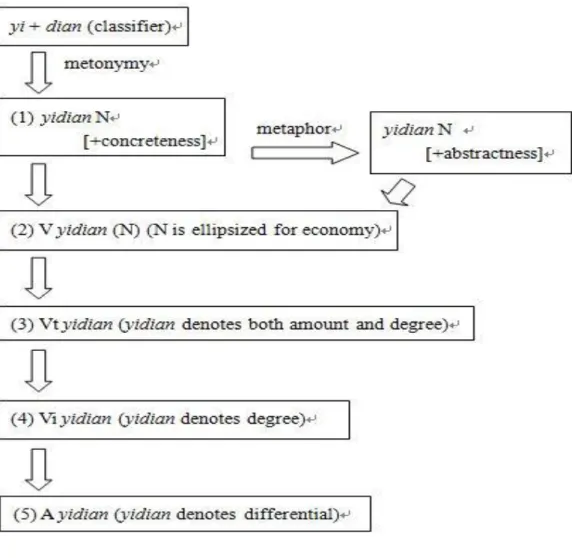
In this section, it is proposed that the grammaticalization of yidian is from „yidian N‟ to „‟V yidian‟ and finally to „A yidian‟. The hypothesis in the section is shown in Figure (2.1):
Figure (2.1) the grammaticalization of yidian from a synchronic perspective
2.3 Supporting evidence from diachronic perspective
In this section, the proposed path of development will be examined from diachronic perspective resorting to historical data.
Step I: from classifier to quantifier
Based on synchronic data, it is proposed that the grammaticalization of yidian originates from the quantifier use. Based on diachronic data, it is further found that
yidian is originally composed of a numeral yi „one‟ and dian, which refers to a black,
small dot. Over time, dian is widely used as a classifier. According to Hopper (1986), classifiers „echoes‟ the semantic features of the head nouns. In Tang Dynasty, dian can be used to denote things in the shape of grain (Lin 1996) as in (2.24):
(2.24) 一點水墨,兩處成龍。
Yi dian shui mo, liang chu cheng long. one CL water ink two place become dragon
„A drop of ink extends into a line and its two ends meet and become the shape of a dragon.‟
(五燈會元)
In the data collected, it is in Song Dynasty that yidian is used as a quantifier to denote a small amount of something as shown in (2.25). Until Yuan Dynasty, the use of yidian as a quantifier becomes more common as shown in (2.26):
(2.25)天色美晴,空色青碧,無一點翳。
Tianse mei qing, kongse qing bi, wu yidian yi. sky beautiful sunny sky blue green NEG a little haziness „The sky is beautiful, sunny, and clear.‟
(入唐求法巡禮記)
(2.26) 我若喫一點酒…
Wo ruo qi yidian jiu… 1S if drink a little wine „If I drink a little wine…‟
(關漢卿戲曲集/ 望江亭中秋切鱠旦/ 第三折)
In this step of development, dian is originally used as a classifier to denote a noun small in size and of a shape like a dot or a grain; over time, with metonymic extension, the concept of small in size is extended to denote the small amount in quantity. In Mandarin Chinese, there are some cases in which the collocation of yi and classifiers becomes frozen as an quantifier to denote quantity. In one of the examples, pian „piece‟ is a classifier denoting a noun in the shape of thin slice such as yipian yezi „a leaf‟. When yi collcates with pian, the combination yipian can be used as a quantifier such as yipian youchou „a sense of anxiety‟. In this case, yi doesn‟t mean one and pian can‟t be viewd as a classifier because it doesn‟t denote a noun in the shape of thin slice. With the case of pian, it is more persuasive that dian is originally used as a classifier and then functions as a quantifier after its collocation with yi.
Step II: from denoting amount to denoting degree
It seems that Yuan Dynasty is a crucial period in the development of yidian. First, not only does the use of quantifier become more common, but the quantifier use of
yidian also gets expanded. In the expanded use, the noun after yidian can be an
abstract concept as in (2.27). Therefore, syntactically, yidian is still a quantifier; semantically, it denotes the degree of the following noun more rather than the amount:
(2.27)
a. 一點相思幾時絕。
Yidian xiangsi jishi jue. a little miss when stop „When will I stop missing you a bit?‟
(關漢卿戲曲集/ 附錄/ 關漢卿散曲輯存/ 小令/ 南呂四塊玉一首/ 別情)
b. 我想這世上這一點情緣…
Wo xiang zhe shi shang zhe yidian qingyuan… 1S think this world on this a little predestination „I think such a little predestination in the world…….‟
(元刋雜劇三十種/ 諸宮調風月紫雲亭雜劇/ 第三折)
Step III: from ‘yidian N’ to ‘V yidian’
In Qing dynasty, the use of „V yidian‟ appears. Just as the assumption made in the paper, the use of „V yidian‟ originates from the ellipsis of „V yidian N‟ as in (2.28 a,b):
(2.28)
a. 你說的話,我牢牢的記著,要違背一點兒(你的話)…
Ni shuo de hua, wo laolaode ji zhe, yao weibei yidianer 2S say Poss. word 1S firmly remember ASP want disobey a little
(ni de hua)… (you Poss. word)
„I will remember your words firmly. If I disobey a bit (of your words)…‟ (醒世姻緣/ 第五十三回 欺絕戶本婦盜財 逞英雄遭人綑打)
b. 家事產業都是我的,誰敢分我一點兒(家事產業)。
Jiashi chanye dou shi wo de, shei gan fen wo yidianer housework business all be 1S Poss., who dare share 1S a little (jiashi chanye).
(housework business)
„Family business all belongs to me. Who dare share a bit (of family business).‟ (醒世姻緣/ 第七十六回 狄希陳兩頭娶大 薛素姐獨股吞財)
In Qing dynasty, the „Vt yidian‟ use is found, as in (2.29):
(2.29) 外頭這們亂哄,我家裏一點兒也不曉得。
Waitou zhemen luanhong, wo jia li yidianer ye bu xiaode. outside so noisy, 1S home inside a little also NEG know „It‟s so noisy outside. I don‟t know even a bit at home.
(醒世姻緣/ 第三十二回 女菩薩賤糶賑飢 眾鄉宦愧心慕義)
In (2.29), yidian is originally the object of xiaode „know‟. With the focus marker ye,
yidian is preposed to the left of the verb. In (2.30), although there is still ellipsis,
however, just as what has been mentioned, the ellipsized noun is hard to retrive and thus, the use of „Vt yidian‟ is analogized to „Vi yidian‟. The use of „Vi yidian‟ is found
(2.30) …恐怕他的墳又站不住…我背著眾人走去瞧了一瞧,果然又動了 一點子
…kongpa ta de fen you zhan bu zhu… wo bei zhe zhongren for fear 3S Poss. tomb again stand NEG still 1S back others zou qu qiao le yi qiao, guoran you dong le yidianzi walk go look PFT one look certain again move PFT a little „…for fear that his tomb can‟t stand still, I went over and took a look without others‟ notice. I found that it has been moved a bit a gain.‟
(紅樓夢 / 第四十七回 / 呆霸王調情遭苦打 冷郎君懼禍走他鄉)
Step IV: from ‘V yidian’ to ‘A yidian’
In the last step of the grammaticalization of yidian, the „A yidian‟ use appears as in (2.31a, b):
(2.31)
a. 這孩子命裡不該早娶,等大一點兒再定罷。
Zhe haizi ming li bu gai zao qu, deng da yidianer zai ding ba this child life in NEG should early marry wait big a little again decide ITJ „This kid is destined not to get married early. Let‟s wait and decide his
marriage until he gets older.‟
b. 大太太是苛刻一點的
Da taitai shi keke yidian de big wife be hardness a little CLFT „The first wife is a bit harsh.‟
(紅樓夢 / 第一百十四回 / 王熙鳳曆幻返金陵 甄應嘉蒙恩還玉闕)
In conclusion, the diachronic data can support the hypothesis of the
development of yidian and also shows that there is a pre-quantifier stage at which
dian functions as a classifier at first and then becomes a quantifier after its frequent
collocation with yi. The grammaticalization of yidian from a diachronic view is shown in Figure (2.2):
(2.2)
Figure (2.2) the grammaticalization of yidian from a diachronic view
In summary, yidian develops from a quantifier, after host-class expansion, into an extended quantifier that denotes the degree of the following noun semantically. Through a bridging stage, the ellipsis of „V yidian N‟, and reanalysis, yidian can be used as the complement of the verb. In the „V yidian‟ stage, the use of „Vt yidian‟
appears first and the the use of „Vi yidian‟ occurs. Following the use of „V yidian‟,
with the similarity between verbs and adjectives, yidian develops its use in „A
Chapter 3 The pragmatic functions of yidian
After the discussion on the grammaticalizaion from synchronic and diachronic perspectives, this chapter discusses the pragmatic functions of yidian. Recall that in the last chapter, the final development of the grammaticalization of yidian comes to the „A yidian‟ usage. In this construction, it is known that yidian denotes the
differential between the compared objects (Liu 2007). However, yidian in (3.1) may not be understood as denoting the differential for most native speakers:
(3.1) (Academia Sinica)
A: 就是她那個歲數…稍微大了一點。
Jiushi ta na ge suishu… shaowei da le yidian. just 3S that CL age sightly big ITJ a little „It‟s just that she is… slightly a bit old.‟
B: 哦,歲數… O, suishu… ITJ age
„Oh, her age…‟
A: 其實沒關係啦…
Qishi meiguanxi la… actually no big deal ITJ „Actually, it‟s no big deal.‟