Cross-Layer Design for Multi-Channel Wireless Mesh Networks Based
on a Graph-Theoretic Approach
Ching-Ju Lin
Graduate Institute of Networking and Multimedia National Taiwan University, Taipei, Taiwan
Cheng-Fu Chou
Dept. of Computer Science and Information Engineering National Taiwan University, Taipei, Taiwan
Abstract— Multi-channel wireless mesh networks (WMNs) aim
to perform the ubiquitous wireless broadband network access. In WMNs, the problem of how to efficiently utilize multiple orthogonal channels and multiple communication interfaces to enhance the network capacity and the aggregate throughput has attracted much attention. Moreover, the interference problem in the wireless channels has made such problem more difficult. Since the routing and channel assignment in WMNs are highly correlated and significantly determine the performance of the system, in this paper we propose a cross-layer framework, which uses a linear programming approach to jointly solve the traffic-aware routing and interference-minimized channel assignment problems based on the traffic characteristics of different layers. Given the traffic demand of each mesh router, the linear programming approach constructs the flow-based routing to optimally distribute the traffic demand. Next, based on the flow scheduled on the routes, we assign the channel and schedule the traffic load for each interface card to balance the workload and minimize the interference effect among channels. The simulation results show that, exploring the traffic-aware routing and interference-minimized channel assignment, our cross-layer framework can achieve higher aggregate throughput compared with the WMNs using the non-traffic-aware channel assignment.
I. INTRODUCTION
Due to the advance of the wireless technology, many interesting applications, such as wireless video streaming, neighboring gaming and VoIP, have the urgent requirement on broadband access over the ubiquitous wireless environment. Recently, the multi-hop city-wide wireless mesh networks (WMNs) have been developed for providing the last-mile ubiq-uitous broadband Internet access over the extensive coverage range [1]-[3]. The ubiquitous wireless environment helps to provide the Internet access for the area out of the coverage of the cable and DSL, and avoid the cost on deploying the cabal and DSL. Even with the capability of accessing the wired network, the devices have been increasingly equipped with multiple communication interfaces to efficiently uti-lize alternative wireless bandwidth and robustly access the seamless services. Moreover, the mesh topology allows the users to locally communicate with each other in the peer-to-peer manner without going through a service provider and the Internet, and thus relieves the traffic load of the wired networks.
In WMNs, there are three components, i.e. gateways, mesh routers, and end mobile devices. The gateways connect to the wired networks and provide the conduit to the external
networks for the mobile nodes in WMNs. The mesh routers act like the fixed routers used to relay packets for other mesh routers or end devices, but the connection between two mesh routers is the wireless link. The end devices, which are not able to relay data for others, can associate with one of the mesh routers to communicate with the nodes in WMNs or access the Internet through the gateways by multi-hop forwarding. Since the nodes in WMNs usually behave like ones in the wired networks, the topology of WMNs and the traffic load of each router do not change frequently. Therefore, the channel resources are expected to be efficiently managed and utilized to optimize the system performance.
The WMNs aim to efficiently use the aggregate bandwidth of multiple orthogonal channels to enhance the network ca-pacity and throughput. However, the problem of the channel assignment in the multi-radio multi-channel WMNs is proved a NP-hard problem in [9]. In addition, it becomes more difficult to solve the channel assignment problem when we further consider the interference effect, which is one of the major factors that degrade the system throughput in the wireless networks. We note that, in WMNs, the channel assignment correlates closely with the traffic load on each communication link, which can be determined by the routing of data trans-mission. Hence, the intuition of our approach is to figure out the traffic flow on each link, and assign the proper channel for each link based on the flow information to minimize the interference effect of close-by transmissions.
In this paper, we present a cross-layer framework includ-ing two procedures: traffic-aware routinclud-ing and interference-minimized channel assignment. The goal of this work is to improve the aggregate throughput of WMNs and balance the load among orthogonal channels. In the traffic-aware routing scheme, we use the linear programming (LP) approach to figure out the best routing for maximally delivering the traffic demand subject to the capacity of each interface card. Next, interference-minimized channel assignment scheme associates each group of channel-depend interfaces with a wireless chan-nel to satisfy the Chanchan-nel Dependency Constraint and Chanchan-nel
Number Constraint, and meanwhile minimize the maximal
interference per channel. Therefore, based on the LP model, our cross-layer framework is able to maximally transmit the traffic demand due to the optimal traffic routing and minimum performance degradation caused by the interference effect.
we briefly introduce several works which also investigate the channel assignment and the routing problems in the wireless mesh networks. The explicit description of our cross-layer routing and channel assignment algorithm is presented in section III. The performance evaluation via simulations is shown in section IV. Finally, section V gives a conclusion and refers to our future works.
II. RELATEDWORKS
Recently, there have been many works [8][6][13] adapting the IEEE 802.11 standard for the multi-channel ad hoc net-works. These works exploit multiple orthogonal channels to increase the capacity of ad hoc networks. However, consid-ering the mesh network environment, the system should also take the routing into account, since the channel assignment and routing are heavily interdependent and jointly determine the interference effect and system performance.
Other research [5][7][12][14] separately considers the rout-ing and channel assignment problems. Tang et al. in [7] greedily allocate the least used channel for each mobile node, and propose a Bandwidth-Aware Routing (BAR) algorithm to indicate the QoS-guaranteed routing. Draves et al. in [12] propose a Multi-Radio Link-Quality Source Routing protocol, which is similar to the DSR but uses a new metric called Weighted Cumulative Expected Transmission Time (WCETT). In the multi-channel environment, the traffic between two successive hops will not interfere with each other as two links use orthogonal channels. Hence, the WCETT metric explicitly accounts for the impact of both the path length and the channel diversity, and thus figures out the better route.
Some works [9][10][11] jointly solve the routing and chan-nel assignment problems. Raniwala et al. [9][10] did the initial study on jointly considering these problems. They construct a multiple spanning tree-based structure to balance the traffic load dynamically, and also design a greedy algorithm to iteratively re-configure the channel assignment and routing that can improve the aggregate throughput. Alicherry et al. in [11] also jointly solve the channel assignment and routing problems based on the linear programming model. Their work conservatively finds an interference-free routing under the assumption that each node has infinite number of interface cards (NICs), and then uses a heuristic algorithm to fix the channel assignment for satisfying the NIC constraint of each node and the connectivity constraint. Nevertheless, our work, assuming there is infinite number of channels, finds the best routing and channel assignment subject to the NIC constraint and connectivity constraint, and next combines some groups of interfaces using different channels until the configuration satisfies the channel constraint. Another distinction between their works and ours is that all these works [9][10][11] assume that most of the WMNs nodes primarily communicate with the gateways to access the wired networks, while our approach considers a more realistic scenario, where allows not only the traffic going through the gateways but also the peer-to-peer communication without wired nodes involved. Hence, our framework is able to be applied to wide range of applications.
III. PROBLEMFORMULATION ANDSYSTEMMODEL A. Problem Formulation and System Overview
We consider the WMNs environment with finite number of orthogonal channels and with several mesh routers equipped with multiple interface cards. In this work, we assume there are K channels in the WMNs and the traffic demands of each router are given1. Thus, we are able to model this WMN
as a directed graph Gm(Vm, Em). In the graph Gm, each mesh router u∈Vm equips multiple interface cards (NICs), denoted as Nu = {nu
i : 1≤i≤|Nu|}, and each NIC nui has the bandwidth capacity cu
i. We let Vg denote the set of the gateways, and hence Vg⊆Vm. A directed link eu,v∈Emif the distance between node u and node v is less than the maximal transmission range Rt. In our work, the communication can take place either between the router and the gateway or between two routers in the peer-to-peer manner. Our work aims to maximally route the aggregate traffic demand and take the fairness into account as well for each mesh router in the context of the NIC constraint and the channel constraint. For achieving this goal, we propose a cross-layer algorithm, composed of the traffic-aware routing and the interference-minimized channel assignment, to interdependently consider the problems of the routing and channel assignment.
We model the traffic-aware routing as a multi-commodity flow problem, and then use the linear programming model to construct a flow-based routing structure and schedule the network flow for each e∈Em. Taking the fairness into con-sideration, the LP model solves the maximal π so that all of traffic sources can route the proportion π of their aggregate demands. The interference-minimized channel assignment as-sociates each wireless link eu,vwith some of given K channels based on the flow scheduled on each link. The objective of the interference-minimized channel assignment is to guarantee the connectivity of the routes, balance the load among channels and minimize the interference effect per channel under two constraints, Channel Dependency Constraint and Channel
Number Constraint, which will be specifically defined latter.
In the following, we describe the traffic-aware routing and interference-minimized channel assignment in our cross-layer framework, respectively.
B. Linear Programming Based Traffic-Aware Routing
We consider the flow-based routing structure as a di-rected graph Gm with the traffic flow carried by each
eu,v∈Em. Each router u∈Vm can simultaneously have mul-tiple traffic demands, including the Internet traffic demand to the gateways and the peer-to-peer traffic demand to other routers v∈Vm. The problem of finding the max flow for several concurrent transmissions between different pairs of nodes can be described as the Multi-commodity Flow
Prob-lem. We collect all pairs of traffic demands as the set
1Since the traffic pattern in WMNs does not change frequently, the traffic
demand of each router could be obtained through online monitoring the traffic load or tracing the log file. However, the issues of how to get the traffic pattern and how to dynamically re-configure under a dynamic environment are out of the scope of this paper and will be our ongoing efforts.
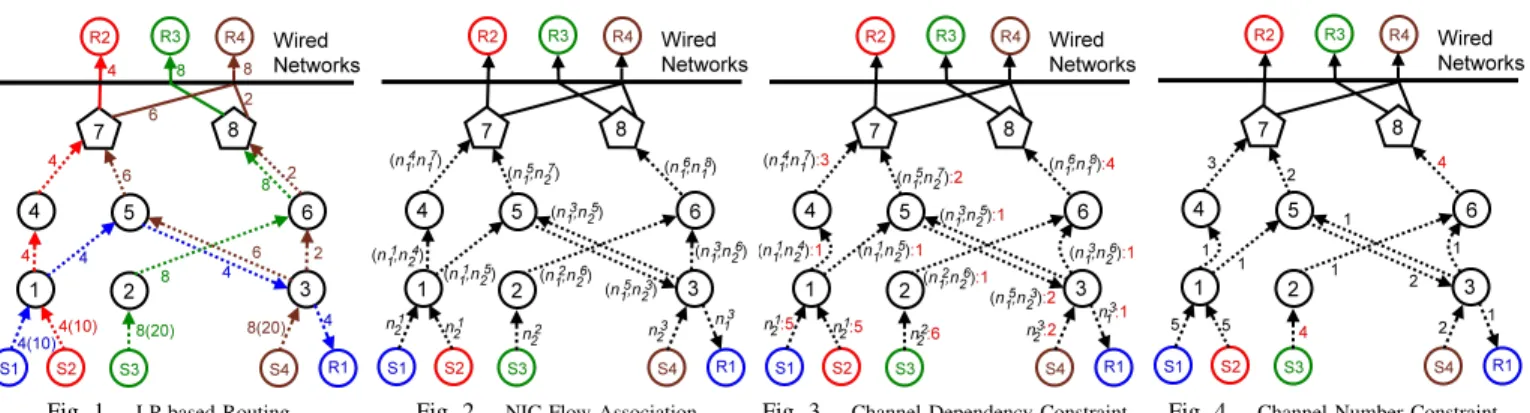
Fig. 1. LP-based Routing Fig. 2. NIC-Flow Association Fig. 3. Channel Dependency Constraint Fig. 4. Channel Number Constraint T = {(s1, r1, d1), · · ·, (sk, rk, dk), · · ·, (s|T |, r|T |, d|T |)} for
1≤k≤|T |. For each traffic demand between the source and the destination, sk in (sk, rk, dk)∈T acts as a sending agent to generate the traffic demand dk for the source node, and rk is a receiving agent to receive the traffic sent to the destination. To involve these agent nodes in the linear programming model, we form a graph G = (V, E) with
V = Vm∪{s1, · · ·, sk, · · ·, s|T |, r1, · · ·, rk, · · ·, r|T |} and E initialized to Em. For the traffic demand (sk, rk, dk)∈T , if it is a peer-to-peer traffic from the source u to the destination
v, u, v∈Vm, we add two edges esk,uand ev,rkto E. However,
if it is an Internet traffic from the source u to the gateways, we add the edges esk,u and ev,rk∀v∈Vg to E to allow the
traffic demand to be flexibly routed to any (or some) of all available gateways. We use fk
u,v to denote the flow traversing the edge eu,v∈E for kth traffic demand in T , and the total flow fu,v carried by eu,v is the sum of all fk
u,v for 1≤k≤|T |. Concerning the fairness, our model-based routing aims to route
π ∗ dk traffic for each demand (sk, rk, dk)∈T . Therefore, for
kth demand (sk, rk, dk), fskk,u means the actual traffic load,
i.e. π ∗ dk, forwarded by the source node u, and P
∀v∈V fv,rk k
means the total flow received by the destinations. Note that the router v∈V will be the only destination if (sk, rk, dk) is a peer-to-peer traffic demand from the node u to the node
v, while all gateways v∈Vg are the possible destinations if (sk, rk, dk) is an Internet traffic demand. Therefore, we use the summation of fk
v,rkfor all destinations v to denote the total
received flow of traffic demand (sk, rk, dk). We now formulate a linear programming model to solve π and find the optimal routing for each traffic demand (sk, rk, dk)∈T .
maximize π (1) Subject to : Capacity Constraint : X ∀v∈V,1≤k≤|T | (fu,vk + fv,uk )≤ X 1≤i≤|Nu| cui , ∀u∈V (2) Flow Constraint : X ∀v∈V fk u,v= X ∀v∈V fk v,u ∀u∈V, 1≤k≤|T | (3)
Fairness Forwarding Constraint :
fk
sk,u= π ∗ dk ∀(sk, rk, dk)∈T, ∀esk,u∈E (4)
Capacity Constraint (2) guarantees the total traffic going through the router will not exceed the total capacity provided by multiple interfaces. In Capacity Constraint, we ignore the interference problem and assume the capacity of interface cards can be fully utilized. We will discuss the interference problem in the channel assignment. Flow Constraint (3) makes sure that total incoming flow equals to total outgoing flow. Fairness Forwarding Constraint (4) promises all traffic de-mands to route the same proportion π of their requests dk for 1≤k≤|T |. Finally, the objective (1) is to maximize the π to ensure each node can optimally forward its traffic demand. Figure 1 illustrates an example of our traffic-aware routing. There are 8 mesh routers, and the router 7 and 8 are designated as the gateways. Each router is equipped with 2 NICs with the bandwidth capacity 10. Router 1 has a peer-to-peer traffic demand 10 to the router 3 and an Internet traffic demand 10 to the gateways, respectively. Both of router 2 and 3 have traffic demand 20 to the gateways. Therefore, we create a traffic set T = {(s1, r1, 10), (s2, r2, 10), (s3, r3, 20), (s4, r4, 20)},
where first and second elements are the peer-to-peer traffic and the Internet traffic demands for router 1 and third and fourth elements are the Internet traffic demands for router 2 and router 3. For the Internet traffic demand (s4, r4, 20) from
the source node 3, we create a sending agent s4and a receiving
agent r4. Then, we add edge e(s4, 3) to generate the traffic for
the source 3, and add edges e(7, r4) and e(8, r4) to receive
the traffic sent to the gateways. The value of each flow in Figure 1 is calculated by the linear programming model. All of routers can forward 40% of their traffic demands. In our model-based routing, there may be multiple routes for a pair of traffic demand, and, hence, the traffic load can be shared by two gateways, i.e. 7 and 8. Figure 1 shows that the source node 3 can actually forward traffic load fs4,3 = 8 for its demand
d4 = 20 to the gateways, and the gateways 7 and 8 receive traffic load 6 and 2 from the source node 3, respectively.
Before associating each NIC with a channel, we aggregate all flows fk
u,v for 1≤k≤|T | over edge eu,v to fu,v, shown in Figure 2. Next, the flows associated with a node u are balancedly allocated to its interfaces Nu= {nu
i : 1≤i≤|Nu|}. Figure 2 shows the flow-interface association in the example mentioned above. To avoid the collision between two succes-sive hops, we separate the incoming flow from the outgoing flow on different interfaces using non-overlapped channels. In
id GroupN ici Channel Dependency 1 n4 2, n11, n52, n24←f1,4→n11←f1,5→n52←f3,5→ n3 1, n62, n21 n13←f3,6→n62←f2,6→n21 2 n3 2, n51, n72 n23←f5,3→n51←f5,7→n72 3 n4 1, n71 n41←f4,7→n71 4 n6 1, n81 n61←f6,8→n81 5 n1 2 fs2,1→n12←fs1,1 6 n2 2 n22←fs3,2 TABLE I
CHANNEL-DEPENDENT INTERFACES
Figure 2, the notation (nu
i, nvj) on fu,vmeans the node u and
v associate with fu,vby ithNIC and jthNIC to communicate with each other. In Figure 2, we use the pair (n1
1, n42) on f1,4
to denote that the traffic travelling on e1,4 is handled by first
NIC of node 1, n1
1, and second NIC of node 4, n42. C. Interference-minimized Channel Assignment
If there are infinite number of channels and NICs, each flow can greedily associate with an unique orthogonal channel to perfectly avoid the interference with other communication links. However, the channel assignment will be restricted by the Channel Dependency Constraint and Channel Number
Constraint. Therefore, we propose a two-phase
interference-minimized channel assignment to satisfy two constraints in order, and to minimize the increasing interference effect per channel.
Channel Dependency Constraint: Channel dependency
means that the flows associated with the same interface should be assigned the identical channel. For example shown in Figure 2, f1,4 and f1,5 should use the same channel, since
both of them associate with NIC n1
1. That is, the interfaces n4
2, n11 and n52 associated with f1,4 and f1,5 should use
the identical channel. Also, both of flows f1,5 and f3,5
associating with n5
2 should use the identical channel. Due to
the channel dependency constraint, the interfaces, including
{n4
2, n11, n52, n31}, associated with f1,4, f1,5 and f3,5are called
the channel-dependent interfaces and have to associate with the same channel. Table I presents six groups of channel-dependent interfaces for the example shown in Figure 1. We use Kg = 6 to denote the number of groups, and use GroupN ici to denotes the group of channel-dependent interfaces for 1≤i≤Kg. To satisfy the Channel Dependency
Constraint, in the first phase of the channel assignment we
assign an unique orthogonal channel i to all interfaces in the group GroupN ici for 1≤i≤Kg. Figure 3 shows the NICs associated with each flow and what channel they use.
Channel Number Constraint: Channel Number Constraint
means that the number of allocated channels Kg can not be greater than the total number of channels K in WMNs. When the channel assignment still violates the Channel Number
Constraint after the first phase, we attempt to iteratively
merge two groups until the number of groups equals to K. For each NIC n∈GroupN ici, we use the Intf Loadn
i to denote the total traffic load within the interference range Ri of interface n over channel i. M axIntf Loadi is defined as M ax∀n∈GroupN ici(Intf Load
n
i) to indicate the maximal
interference effect of GroupN ici over channel i. To re-duce the number of groups, we greedily merge two groups
GroupN ici and GroupN icj to minimize M axIntf Load of the merged group. Next, we re-assign the channel i to each interface n∈GroupN icj and let GroupN ici =
GroupN ici∪GroupN icj be the merged group, and delete the GroupN icj. Figure 4 shows the result of first merging from Figure 3 as the number of available channels is less than 6. GroupN ic4 and GroupN ic6 are merged because of the
minimal M axIntf Load of the merged group. Therefore, NIC
n2
2∈GroupN ic6, associated with fs3,2, changes the channel
assignment from 6 to 4. The procedure of merging will continue until satisfying the Channel Number Constraint, i.e.
Kg = K. Merging two groups every iteration allows each channel to keep maximal interference effect minimized, and, hence, balances the load among all channels.
IV. PERFORMANCEEVALUATION
The performance of our cross-layer algorithm is evaluated by the simulation implemented in NS2 modified by Raniwala
et al. [9] for the multi-radio multi-channel 802.11-based
wireless networks. The linear programming model is solved by CPLEX [4]. In the following, we introduce the simulation environment and metrics, and finally show the simulation results.
Simulation Setup and Performance Metrics: The base-rate of a wireless channel is 2M bps, and there are 12 non-overlapped channels in the simulation environment. The trans-mission range of all mobile nodes is set to 250m, and the ratio of the interference range to the transmission range is 2. 70 routers are uniformly distributed over a 1000m by 1000m square field, and 5 of 70 nodes are randomly designated as the gateways. Each node equips 2 IEEE 802.11b radios. For each topology, 30 nodes are chosen at random to generate traffic flow. We assume each source node has maximal aggregate traffic demand 4M bps, which equals to total capacity of interfaces, i.e. 2 ∗ 2M bps. For 30 source nodes, 25 of them have the total traffic demand 4M bps to the gateways, while the rest 5 of them have two demands: 2M bps to the gateways and 2M bps to a sink router randomly selected from all other routers. The evaluation metrics are (1) aggregate throughput, which is defined as the sum of the throughput of all flows, and (2) Jain’s Fairness Index [15].
Comparison algorithms: We compare the performance of our cross-layer algorithm with three different algorithms and the upper bound solved by LP model as follows.
• Single-radio single-channel scheme (SRSC): SRSC is similar to the traditional ad hoc networks. Each node equips only one NIC and all nodes share the single channel.
• Multi-radio multi-channel scheme (MRMC): Each node has the same number of interface cards. MRMC just naively assigns first channel to first interface and assigns second channel to second interface.
• Non-traffic-aware greedy scheme (NON-TRAF): We compare our traffic-aware algorithm with the scheme
0 1 2 3 4 5 6 7 8 9 10 12 11 10 9 8 7 6 5 4 3 2 Aggregate Throughput (Mbps) Number of Channels Upper bound Cross-layer NON-TRAF MRMC SRSC
Fig. 5. Comparison among all schemes
also used as the baseline in [9]. In NON-TRAF, each interface greedily selects the least-used channel, but does not take the traffic load of the channel into account. • Model-based upper bound (Upper bound): We use the
expected aggregate forwarded traffic load, i.e. π ∗ P
∀(sk,rk,dk)∈Tdk, solved by LP model as the upper
bound to compare with the actual aggregate throughput that our algorithm can achieve.
A. Improvements due to cross-layer design
Figure 5 shows the aggregate throughput of all schemes under various number of channels. Because the algorithms including SRSC, MRMC and Upper bound are independent of the number of channels, we extend the results of these schemes as straight lines. The results in Figure 5 shows that, even with more available channels in WMNs, the naive MRMC performs only twice better than the traditional single-channel environment (SRSC), because the channel utilization is re-stricted by the number of interfaces. However, our cross-layer algorithm and NON-TRAF scheme can have the increasing improvement with the number of the channels. In addition, our cross-layer algorithm can even outperform NON-TRAF by a factor of 2. The NON-TRAF greedily selects the least-used channel for each interface, but, however, the number of interfaces associated the channel can not exactly reflect the traffic load of this channel. Due to the benefit of the flow-based routing solved by LP model, our cross-layer algorithm can perceptively calculate the interference effect during the channel assignment, and optimally utilize the available orthog-onal channels. Compared with the upper bound, SRSC only has about 350Kbps aggregate throughput because of the poor channel utilization caused by the severe interference effect in the single channel, while our algorithm can achieve 70% of the upper bound as there are 12 channels. The upper bound solved by the model is only restricted by the capacity of the interfaces, but, however, the actual aggregate throughput will be less than upper bound due to the interference problem. Therefore, as there are more channels, the increasing improvement on the aggregate throughput shows our algorithm can intelligently
0.1 0.2 0.3 0.4 0.5 0.6 0.7 0.8 0.9 1 5 10 15 20 25 30 35
Jain’s Fairness Index
Number of Sources
Cross-layer NON-TRAF MRMC SRSC
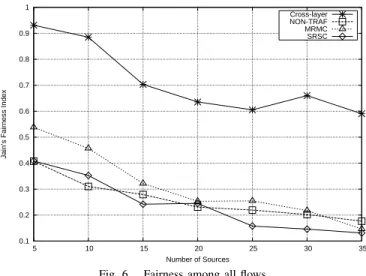
Fig. 6. Fairness among all flows
balance the load among channels and significantly alleviate the interference problem.
B. Fairness among all flows
We use Jain’s Fairness Index [15], which is defined as
(P0<i<nfi)2
nP0<i<nfi2, to evaluate the fairness among all flows fi. Jain’s
Fairness Index gives a normalized number between 0 and 1, where 0 indicates the absolute unfairness and 1 indicates the absolute fairness. We vary the number of sources from 5 to 35 to observe the fairness under various traffic loads. Figure 6 shows that because the inherent contention problem in IEEE 802.11, all schemes have worse fairness when there are heavy traffic load. In SRSC, only one pair of the transmission wins the contention within the interference range. In addition, due to the backoff mechanism in IEEE 802.11, the node lost the contention should double its backoff interval and has lower probability to win the next contention. That is, the unfairness takes place because the node won the contention may get better chance to win the following contentions. Since MRMC just distributes the traffic load of each node on two interfaces over two channels, it performs slightly better than SRSC in terms of the fairness. In NON-TRAF, the channel assignment without considering the traffic load of channels results in the load-imbalanced problem among all channels. The interfaces using the light-loaded channel have less contention and thus perform higher throughput, but, however, the interfaces using heavy-loaded channel can not get satisfied QoS. Therefore, NON-TRAF sometimes has worse fairness than SRSC does. Our model-based algorithm optimally schedules the traffic load on each wireless link to fairly forward the traffic demand for all source nodes, so provides fairness among all flows. In addition, our channel assignment takes the interference effect into account so that the load among channels can be balanced.
C. Impact of system parameters on the aggregate throughput
To focus on the effect of the number of interfaces and the number of gateways on the performance, we ignore the peer-to-peer traffic demand and let all source nodes only have 4M bps Internet traffic demand. We vary the number
1 2 3 4 5 6 7 8 9 10 11 2 4 6 8 10 12 14 16 Aggregate Throughput (Mbps) Number of Channels NIC 1 NIC 2 NIC 3 NIC 4 NIC 5
Fig. 7. Number of Interfaces vs. Aggregate Throughput of orthogonal channels from 2 to 16 and change the num-ber of interfaces equipped in each node from 1 to 5 to evaluate the benefit of multiple interfaces. Figure 7 shows that, in general, the aggregate throughput increases with the number of channels. There is a significant improvement on the aggregate throughput from one radio environment to two radios environment. The throughput almost saturates when each node has 3 NICs. When there are more than 8 channels, the throughput still slightly increases as each node equips one more interface. This simulation shows that the WMNs can benefit from multiple interfaces even if each node only has 2 NICs.
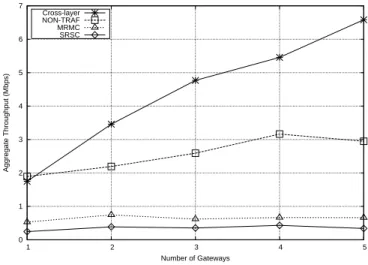
The gateways connected with the wired Internet are in charge of relaying the data for the mesh routers, and usually have heavier traffic load. The results are shown in Figure 8 under varying the number of the gateways from 1 to 5. In the multi-channel environment, i.e. our algorithm and NON-TRAF, the network performs higher throughput because the gateways can use non-overlapped channels to share the traffic load. Moreover, with one more gateway using different channels, the network can increase the capacity to relay the data to the Internet. Our algorithm can outperform NON-TRAF because the model-based method optimally schedules the traffic load on multiple available gateways and assigns appropriate channels to their interfaces for balancing the load among gateways.
V. CONCLUSIONS ANDFUTUREWORKS
In this paper, we investigated the issues of routing and channel assignment in the wireless mesh networks. The cross-layer framework mutually considers the routing and chan-nel assignment problems to minimize the interference effect among channels and enhance the aggregate throughput. The traffic-aware routing finds the paths for optimally delivering the traffic demand. Based on the flow on each link, the system assigns the channel for each NIC to minimize the interference effect and, meanwhile, subject to the Channel Dependency
Constraint and Channel Number Constraint. The performance
evaluation shows that our cross-layer algorithm can have sig-nificant improvement on the aggregate throughout and promise
0 1 2 3 4 5 6 7 5 4 3 2 1 Aggregate Throughput (Mbps) Number of Gateways Cross-layer NON-TRAF MRMC SRSC
Fig. 8. Number of Gateways vs. Aggregate Throughput
the fairness for each mesh router. Finally, our future work will focus on the distributed dynamic configuration, i.e. re-routing and channel re-assignment, to confront the transient traffic load fluctuation or the performance degradation.
REFERENCES
[1] Radiant Networks. http://www.radiantnetworks.com. [2] Defacto Wireless. http://www.defactowireless.com. [3] Chaska wireless solutions. http://www.chaska.net.
[4] ILOG CPLEX methmetical programming optimizers. http://www.ilog. com/products/cplex.
[5] A. Adya, P. Bahl, J. Padhye, A. Wolman, and L. Zhou, “A Multiradio Unification Protocol for IEEE 802.11 Wireless Networks,” Microsoft
Technical Report, vol. MSR-TR-2003-44, July 2003.
[6] P. Bahl, R. Chandra, and J. Dunagan, “SSCH: Slotted Seeded Channel Hopping for Capacity Improvement in IEEE 802.11 Ad-hoc Wireless Networks,” in MobiCom ’04, 2004.
[7] R. Draves, J. Padhye, and B. Zill, “Routing in Multi-radio, Multi-hop Wireless Mesh Networks,” in MobiCom ’04, 2004.
[8] J. So and N. H. Vaidya, “Multi-Channel Mac for Ad Hoc Networks: Handling Multi-Channel Hidden Terminals Using a Single Transceiver,” in MobiHoc ’04, 2004.
[9] A. Raniwala, K. Gopalan, and T. Chiueh, “Centralized Algorithms for Multi-channel Wireless Mesh Networks,” in ACM Mobile Computing
and Communications Review (MC2R), 2004.
[10] A. Raniwala and T. Chiueh, “Architecture and Algorithms for an IEEE 802.11-based Multi-Channel Wireless Mesh Network,” in Proc. of IEEE
Infocom, 2005.
[11] M. Alicherry, R. Bhatia, and L. Li, “Joint Channel Assignment and Routing for Throughput Optimization in Multi-radio Wireless Mesh Networks,” in MobiCom ’05, 2005.
[12] J. Tang, G. Xue, and W. Zhang, “Interference-Aware Topology Con-trol and QoS Routing in Multi-Channel Wireless Mesh Networks,” in
MobiHoc ’05, 2005.
[13] L. Loyola, T. Kumagai, K. Nagata, S. Otsuki, and S. Aikawa, “Multi-Channel Wireless LAN Mesh Architecture with DCF-based Inter-AP Communication and Idle Channel Search Packet Forwarding,” in IEEE
Globecom2005, 2005.
[14] A. K. Das, H. M. K. Alazemi, R. Vijayakumar, and S. Roy, “Optimiza-tion Models for Fixed Channel Assignment in Wireless Mesh Networks with Multiple Radios,” in Second Annual IEEE Communications Society
Conference on Sensor and Ad Hoc Communications and Networks (SECON 05), 2005.
[15] R. Jain, The Art of Computer Systems Performance Analysis: Techniques
for Experimental Design, Measurement, Simulation, and Modeling.