J Plant Growth Regul (1996) 15:197-200 J o u r n a l o f
1 mt
G wth
5 ,op *ulation
9 1996 Springer-Verlag New York Inc.
An Increase in Ethylene Sensitivity Is Associated with Jasmonate-Promoted
Senescence of Detached Rice Leaves
F.-Y. Tsai, K. T. Hung, and C. H. Kao
Department of Agronomy, National Taiwan University, Taipei, Taiwan, Republic of China
Received March 11, 1996; accepted October 24, 1996
Abstract. The role of ethylene in jasmonate-promoted
senescence of detached rice leaves was investigated. Eth-
ylene production in methyl jasmonate-treated leaf seg-
ments of rice was lower than in the control leaves. Treat-
ment of leaf segments with silver nitrate or/and silver
thiosulfate, inhibitors of ethylene action, inhibited meth-
yl jasmonate-, jasmonic acid-, linolenic acid-, and absci-
sic acid-promoted senescence of detached leaves. We
suggest that an increase in ethylene sensitivity, but not
ethylene level, is the initial event triggering the enhanced
senescence by jasmonates of detached rice leaves.
Key Words.
Ethylene--Jasmonates--Oryza sativa--
Senescene
Jasmonic acid (JA) and its methyl ester, methyl jas-
monate (M J), are naturally occurring growth regulators
found in higher plants (Meyer et al. 1984, Sembdner and
Parthier 1993). Jasmonates have been shown to be pow-
erful promoters of leaf senescence (Chou and Kao 1992,
Cuello et al. 1990, Sembdner and Parthier 1993, Ueda
and Kato 1981, Weidhase et al. 1987). However, the
mechanism whereby jasmonates promote leaf senes-
cence remains unclear. Ethylene was found to play a
significant role in promoting senescence of leaves (Mat-
too and Aharoni 1988). Using cucumber cotyledons,
Abeles et al. (1989) found that MJ was as effective as
ethylene in inducing senescence. In addition to this ob-
servation, silver thiosulfate (STS) had no effect on the
ability of MJ to promote senescence. Based on these
results they suggested that the action of MJ was inde-
A b b r e v i a t i o n s : JA, jasmonic acid; MJ, methyl jasmonate; STS, silver thiosulfate; ABA, abscisic acid.
* Author for correspondence.
pendent of ethylene. Cuello et al. (1990) also reported
that MJ and ethylene had different mechanisms in pro-
moting the senescence of detached barley leaves. In this
study the possible involvement of ethylene in the regu-
lation of jasmonate-promoted senescence of detached
rice leaves was investigated.
Materials and Methods
Rice (Oryza sativa L. cv. Taichung Native 1) was cultured as described previously (Kao 1980). The apical 3-cm segments excised from the third leaves of 12-day-old seedlings were used. A group of 10 segments was floated in a Petri dish containing 10 mL of test solutions. Incuba- tion was carried out at 27~ in darkness.
Chlorophyll was determined according to Wintermans and De Mots (1965) after extraction in 96% (v/v) ethanol. For protein extraction, leaf segments were homogenized in 50 m m sodium phosphate buffer (pH 6.8). The extracts were centrifugated at 17,600 xg for 20 min, and the supernatants were used for determination of protein by the method of Bradford (1976).
For determination of ethylene, leaf segments were placed vertically in test tubes that were plugged with rubber stoppers and incubated in darkness at 27~ for 1 h. The ethylene in the gas phase of the plugged tubes was determined by analysis of a 1-mL sample withdrawn with a hypodermic syringe as described elsewhere (Kao and Yang 1983).
In experiments with Ag § treatments, leaf segments were pretreated with 10 mg/mL silver nitrate for 30 min and then transferred to a Petri dish containing test solution. When STS was used as a source of Ag § leaf segments were treated with STS and test solution. A stock solution of STS was prepared by mixing equal volumes of 0.01 M AgNO 3 and 0.04 M Na2S203 (Liu et al. 1990).
All experiments were repeated at least twice. Data are presented as the results of a single experiment typical of the trends seen in the repeated experiments.
Results and Discussion
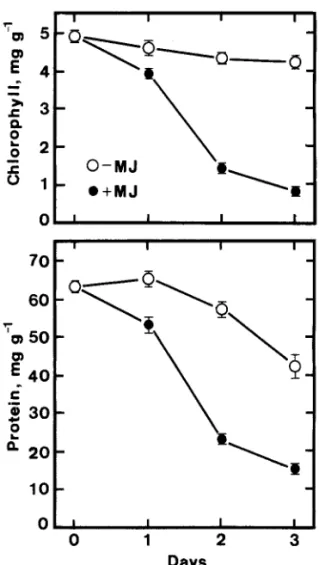
The senescence of detached rice leaves was followed by
measuring the decrease of chlorophyll and protein. Fig. 1
shows the time courses of protein and chlorophyll levels
of detached rice leaves floating on water or MJ (45 p,M)
in the dark. It is clear that the MJ significantly promotes
198 F.-Y. Tsai et al.
7 0
f I I i5 o
0 .o
~n 4 -
i
e-
3 -
2
0 L. 2 - 0 "; O - M J U 1 - O + M J I I6O
'7 m 5 0 01 E 4 0 r,~.
3o
0o. 2O
1 0
i0
I I I I ! I_ O ~
~ ) ~
-0
I
I
I
I
0
1
2
3
D a y sFig. l. Time course of chlorophyll and protein levels in detached rice leaves floating on water or MJ (45 IxM) in darkness. Bars indicate S.E.
(n = 4).
1 5 '7.c 10
'7 01 C I11"
5 W I I i I O - M J e + M J0
I
I
I
I
0
1
2
3
D a y sFig. 2. Time course of ethylene production in detached rice leaves floating on water or MJ (45 IxM) in darkness. Bars indicate S.E.
(n = 4).
T 01 01E
m r D. 0 iJ 0U
7
01
E
E
o. _ B1 -
0
6 0 - 4 0 - 2 0 - 0 "1" H 2 0F
MJ ""I'- MJ § A g N 0 3Fig. 3. Effect of silver nitrate pretreatment on the MJ-promoted senes- cence of detached rice leaves. Leaf segments were pretreated with silver nitrate (10 mg/mL) for 30 min in darkness and then transferred to distilled water or MJ (45 p~M) for 3 days. Bars indicate S.E. (n = 4).
the senescence of detached rice leaves. These results are
in agreement with earlier reports of other investigators
(Chou and Kao 1992, Cuello et al. 1990, Ueda and Kato
1981, Weidhase et al. 1987).
Ethylene production in water-treated leaf segments in-
creased significantly during the first 24 h and decreased
subsequently (Fig. 2). This result is consistent with our
early finding that ethylene production precedes the se-
nescence of detached rice leaves (Kao and Yang 1983),
indicating that ethylene production participates in the
regulation of rice leaf senescence. If MJ-promoted se-
nescence of detached rice leaves is mediated through
ethylene production, then ethylene production in M J-
treated leaf segments is expected to be higher than that in
water-treated leaf segments. However, as indicated in
Fig. 2, this does not seem to be the case.
If a change in ethylene production is excluded as an
explanation for the MJ-promoted senescence of detached
rice leaves, a change in sensitivity to ethylene is an al-
ternate possibility. This possibility was tested by using
Ethylene Sensitivity and Jasmonate-Promoted Senescence 7 o~ o}
E
P o o JZ 7 o~E
o o D 1 - 0 6 0 4 0 2 0 " 0l
I-I- MJ
~ + M J
0
0
5 0 2 0 0 8 0 0
STS, .uM
Fig. 4. Effect of STS on the MJ-promoted senescence of detached rice leaves. The concentration of MJ was 55 p,M. Chlorophyll and protein levels were determined after 3 days in darkness. Bars indicate S.E. (n
= 4).
the inhibitor of ethylene action, Ag § (Beyer 1976). Leaf
segments were pretreated with silver nitrate for 30 min
and then transferred to distilled water or MJ for 3 days in
the dark. As indicated in Fig. 3, silver nitrate pretreat-
ment resulted in an inhibition of MJ-promoted senes-
cence of detached rice leaves. Toxic effects of silver
nitrate have been reported (Lis et al. 1984, Liu et al.
1990). The advantages of using STS have been described
by others and are related to lower free Ag § in STS so-
lutions and a lower phytotoxicity of this compound (Liu
et al. 1990). Thus, a change in ethylene sensitivity in
MJ-treated leaf segments was tested further by using
STS. STS was also found to be effective in inhibit-
ing MJ-promoted senescence of detached rice leaves
Fig. 4).
JA was also observed to be effective, although to a
l e s s e r e x t e n t , in p r o m o t i n g t h e s e n e s c e n c e o f d e t a c h e d r i c e l e a v e s (Fig. 5). S i m i l a r to M J , t h e r e s p o n s e o f J A w a s also i n h i b i t e d b y S T S (Fig. 5). L i n o l e n i c a c i d (18:3) is k n o w n to b e t h e p r e c u r s o r in the p r o p o s e d b i o s y n t h e t i c p a t h w a y o f J A ( S e m b d n e r a n d P a r t h i e r 1993) a n d h a s b e e n s h o w n to b e a s e n e s c e n c e - 199I-I-JA ~I+JA
5
E
,~
':r
..:.~N
3
e - ,o
1
~
~
~:?'~
-....:.,o
=6 0
'7E 4 0
.r -r2
a. 2 0
o
0
0
50
2 0 0 8 0 0
S T S , .gl MFig. 5. Effect of STS on the JA-promoted senescence of detached rice leaves. The concentration of JA was 45 IXM. Chlorophyll and protein levels were determined after 3 days in darkness. Bars indicate S.E. (n
= 4). O } E >=
|
Z o 3 2 1 0 I-1-18:3 ~+18:3,lllm
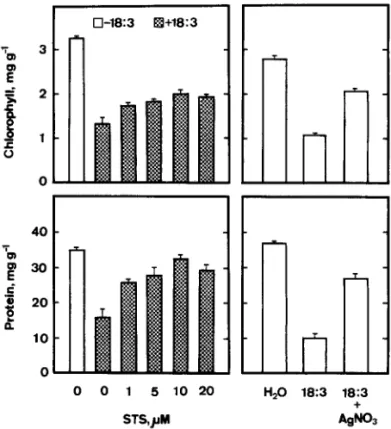
4O t o 0 0 1 5 10 20 H=O 18:3 18:3 + STS,pM AgNO3Fig. 6. Effect of STS and silver nitrate on linolenic acid-promoted senescence of detached rice leaves. Linolenic acid (18:3, 5 mm) was dissolved in 0.1% Tween 20. Water treatment included 0.1% Tween 20. For silver nitrate experiments, leaf segments were pretreated with silver nitrate (10 mg/mL) for 30 min in darkness. Chlorophyll and protein levels were determined after 3 days in darkness. Bars indicate S.E. (n = 4).
5
[ ] - A B A
I~I+ABA
"1"0
0
6 0
o~ o~E 40
t - O L .a. 20
5 0
2 0 0 8 0 0
E
9 -/ 3 ..c D . o 0 o1
i
0
0
200 F.-Y. Tsai et al.
STS, ju M
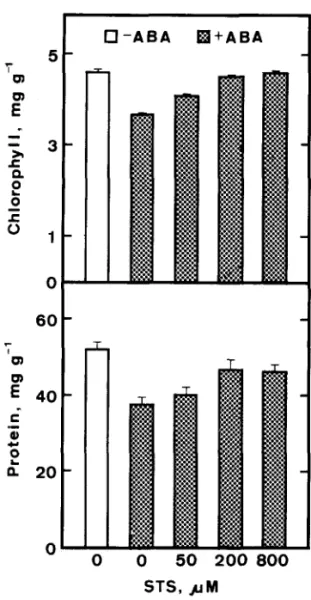
Fig. 7. Effect of STS on ABA-promoted senescence of detached rice leaves. The concentration of ABA was 45 I~M. Chlorophyll and protein levels were determined after 3 days in darkness. Bars indicate S.E. (n
= 4).
promoting substance (Ueda and Kato 1982). Our unpub-
lished data also show that the promotive effect of linole-
nic acid on the senescence of detached rice leaves may be
the result of an effect of JA. Thus, it is of great interest
to know whether the promotive response of linolenic
acid on the senescence of detached rice leaves is medi-
ated through a change in ethylene sensitivity. As indi-
cated in Fig. 6, linolenic acid indeed changes the sensi-
tivity of ethylene, as judged by the effect of silver nitrate
and STS.
In our earlier work we found that ABA promoted the
senescence of detached rice leaves but inhibited ethylene
production (Kao and Yang 1983). We proposed, but did
not prove, that ABA increases tissue sensitivity to eth-
ylene. Since jasmonates and ABA have both chemical
and physiological similarity (Anderson et al. 1989), we
investigated the effect of STS on ABA-promoted senes-
cence of detached rice leaves. The results in Fig. 7 indi-
cate that our early proposal appears to be correct.
Although it has been shown that the action of JAs was
independent of ethylene in other cases (Abeles et al.
1989, Cuello et al. 1990), our results strongly support the
notion that ethylene plays a regulatory role in the JA-
promoted senescence of detached rice leaves. It is eth-
ylene sensitivity rather than ethylene level which JAs
affect during the course of the senescence of detached
rice leaves.
Acknowledgments. This work was supported by National Science Council of Republic of China Grant (NSC 85-2321-B002-091). This paper is part 24 of the series Senescence of Rice Leaves.
References
Abeles FB, Hershberg L, Dunn LL (1989) Hormonal regulation and intracellular localization of a 33-kDa cationic peroxidase in excised cucumber cotyledons. Plant Physiol 89:664-668 Anderson JM, Spilatro SR, Klauer SF, Franceschi VR (1989) Jasmonic
acid-dependent increase in the level of vegetative storage pro- teins in soybean. Plant Sci 62:45-52
Beyer EM Jr (1976) A potent inhibitor of ethylene action in plants. Plant Physiol 58:268-271
Bradford MM (1976) A rapid and sensitive method for the quantitation of microgram quantities of protein utilizing the principle of protein-dye binding. Anal Biochem 72:248-254
Chou CM, Kao CH (1992) Methyl jasmonate, calcium, and leaf senes- cence in rice. Plant Physiol 99:1693-1694
Cuello J, Quiles MJ, Garcia C, Sabater B (1990) Effect of light and growth substances on senescence of barley leaf segments at different developmental stages. Bot Bull Acad Sin 31:107-112 Kao C H (1980) Senescence of rice leaves. IV. Influence of benzylad-
enine on chlorophyll degradation. Plant Cell Physiol 21:1255- 1262
Kao CH, Yang SF (1983) Role of ethylene in the senescence of de- tached rice leaves. Plant Physiol 73:881-885
Lis KK, Kwakkenbos AAM, Veen H (1984) Differential effects of silver salts in apple tissue. Plant Sci Lett 33:1-6
Liu J, Mukherjee I, Reid DM (1990) Adventitious rooting in hypoco- tyls of sunflower (Helianthus annus L.) seedlings. III. The role of ethylene. Physiol Plant 78:268-276
Mattoo AK, Aharoni N (1988) Ethylene and plant senescence. In: Nooden LD, Leopold AC (eds) Senescence and aging in plants. Academic Press, San Diego, pp 242-280
Meyer A, Mierch C, Buttner C, Dathe W, Sembdner G (1984) Occur- rence of the plant growth regulator jasmonic acid in plants. J Plant Growth Regul 3:1-8
Sembdner G, Parthier B (1993) The biochemistry and physiological and molecular actions of jasmonates. Annu Rev Plant Physiol Plant Mol Biol 44:569-589
Ueda J, Kato J (1981) Promotive effect of methyl jasmonate on oat leaf senescence in the light. Z Pflanzenphysiol 103:357-359 Ueda J, Kato J (1982) Abscisic acid and C]s-unsaturated fatty acids as
senescence-promoting substances from oat plants. J Plant Growth Regul 1:195-203
Weidhase RA, Lehmann J, Kramell HM, Sembdner G, Parthier B (1987) Degradation of ribulose-l,5-bisphosphate carboxylase and chlorophyll in senescing barley leaf segments triggered by jasmonic acid methylester, and counteraction by cytokinin. Physiol Plant 69:161-166
Wintermans JFGM, De Mots A (1965) Spectrophotometric character- istics of chlorophyll a, and b, and their pheophytins in ethanol. Biochim Biophys Acta 109:448~.53