Making intercultural friends: How
social and individual factors affect the
Mainland-Hong Kong friendship network
LEUNG Yick Wah, YU Baohua
Department of English Language Education, The Education University of
Hong Kong
Abstract
In recent years, there has been a rapid growth of Mainland students in higher education institutions in Hong Kong. However, it is frequently reported that Mainland students have difficulties in developing friendship with local peers. To facilitate the Mainland-HK integration, this study examines the relationship that mediates social and individual factors and Mainland-HK friendship. 159 students completed an online survey, which was followed by semi-structured interviews with 24 students. Results showed that mainland students rated their intercultural friendship higher in terms of quality and the number of friends and that willingness to communicate (WTC) in second language (L2) was correlated with the satisfaction in friendship between the two groups. Perceived language proficiency was correlated with L2 WTC although it is not totally correlated with the level of friendship, while prior intercultural experience was correlated with L2 WTC and the number of mainland friends among local students. The finding also sheds light on implications to university support and future research.Keywords
intercultural friendship, non-local students, intercultural communication, willingness to communicate, language proficiencyIntroduction
In the past decade, the internationalization of higher education section has become a major trend worldwide (Cheng, Cheung, & Ng, 2015; University Grants Committee, 2010). As part of the trend, there is increasing attention on recruiting overseas students globally and in Hong Kong. According to official statistics, the number of non-local students enrolled in UGC-funded programmes in 2015/16 in Hong Kong increased by 115% since 2010/11 from 8,392 to 18,060 in 2018/19, where 68.2% of them (or 12,322 students) are from Mainland China (University Grants Committee, 2019). Undoubtedly, Mainland student has already become a significant and indispensable population group on the university campus. The majority of mainland students expected and desired friendship with local peers during their course of study (Chiu, 2014). However, it remains challenging due to lack of opportunities to interact with Hong Kong students (Yu & Zhang, 2016). Instead, they tended to seek social support from other co-national or international friends instead (van de Vijver, Helms-Lorenz, & Feltzer, 1999; Lin, Kim, & LaRose, 2012). Even for Mainland students with local friends, their friendship is often shallow, short-term and task-oriented. (Chiu, 2014; Lu & Hsu, 2008; Yu & Wright, 2016). Building intercultural friendship with host-nationals is however important for non-local students. Benefits could include better sociocultural adaptation (Berry, 2005; Ward & Masgoret, 2006; Yu & Zhang, 2016); a stronger sense of belonging to the host community (Klomegah, 2006); more opportunities to learn about worldview and values in other cultures (Li, 2006) and greater chances of social-emotional needs being fulfilled (MacIntyre, 2007; Yeh & Inose, 2003; Ying & Liese, 1991). At the societal level, Intercultural friendship could be valuable because closer intercultural relationships would likely increase the possibility of non-local graduates’ willingness to stay and contribution to the host community. Even if they return home, they may be able to fill positions of influence and become more apathetic with their host society. As a result of these above benefits, better integration of non-local students (including their friendship with host nationals) has become a priority worldwide (Ward & Masgoret, 2006). With respect to the formation of intercultural friendship formation, existing literature suggests that there are some common contributing factors, such as language proficiency, a desire to stay behind after graduation, prior experience and frequency of contact, and L2 WTC (Gareis, Merkin, & Goldman, 2011; Kudo & Simkin, 2003; Ward & Kennedy, 1996). The influence of these factors on friendship is however highly elastic, as one’s expectation for friendship can easily vary over time in response to individual and relational situations. The correlation among different variables and satisfaction levels has to be studied in depth. Further exploration is needed for instance about whether factors such ashost language proficiency are the causes or effects of intercultural friendship (Ma, Wong, & Lam, 2014; Zeng, 2006). To sharpen the research focus, the intercultural friendship in this study will be limited to the friendship between Mainland and Hong Kong students, who have grown up and received at least 6-year secondary education in Mainland and Hong Kong separately.
Literature Review
Impact of L2 WTC on intercultural friendship
At first glance, friendship in East and West is sharing similar sets of value traits, such as emotional support or trustworthiness (Gareis, 2000). However, these traits and their importance are expressed differently across cultures. This study aims to explore the L2 WTC, which is generally agreed to be the most influential communication-based variable in the development of intercultural friendship (Gareis et al., 2011). The concept of willingness to communicate (WTC) originated in the field of second language (L2) acquisition, which is defined as “the intention to initiate communication, given a choice” (MacIntyre, 2007, p.369). It is often involved in the discussion of friendship formation because friendship typically starts with good communication, and develops according to individuals' willingness to engage with and share across different cultures. The relationship between WTC and intercultural friendship has been confirmed in different studies. For example, Barraclough and his colleagues found that WTC was directly proportional to the depth of relationship (at the level of a stranger, acquaintance or friend for instance), while WTC at different friendship levels could vary significantly across student groups (Barraclough, Christophel, & McCroskey,1988). It is reported that WTC was positively related to the frequency, breadth and depth of communication.
WTC and the frequency of intercultural communication
Communication serves as a process of psychological preparation and reduces the anxiety and uncertainties for the development of friendship. For example, Park and his colleagues' study (2009) about the use of the Internet revealed that higher levels of WTC could lead to more frequent intercultural interactions, no matter in the physical or the digital environment. This finding was consistent with Allport’s Intergroup Contact Theory (ICT), which proposed that a higher frequency of intercultural communication could increase mutual understanding and diminish prejudice and bias (Allport, 1954; Binder et al., 2009). In their view, intercultural communication is a data collection process which can help individuals better understand others (Berger & Calabrese, 1975). It is also linked with the uncertainty reduction theory, which suggests that people always need information to reduce their senses of uncertainty in predicting how others would behave (Berger & Calabrese, 1975; West & Turner, 2010).
WTC and the quality of intercultural communication WTC is also considered as a predictor of the quality of intercultural communication. For example, Pawlak, Mystkowska-Wiertelak and Bielak (2015) found that the breadth of conversation was positively correlated with the level of WTC. In Hong Kong, Gao (2010) also reported that a wider range of dimensions of self-disclosure was associated with a higher level of WTC. Some researchers, however, suggested that orientations toward language learning and social support would affect students’ L2 WTC strongly (MacIntyre, Dornyei, Clément & Noels, 1998; MacIntyre, 2007). The linkage between WTC and intercultural communication is often explained by Tajfel’s social identification theory (1981), which suggested that the development of intercultural friendship is a process of forging a new integrated identity in a multicultural context and that social identification is a cognitive process in which people categorise and culturally relate themselves with others not in their own group. Individuals with a strong sense of home-cultural identity often tend to initiate relationships with those with a similar background in values, attitudes, beliefs, age, ethnicity or religion, according to what is known as the principle of homophily (McPherson, Smith-Lovin, Cook, 2001). In this context, WTC is a useful predictor of the frequency and quality of intercultural communication, while it depends on the perceived cultural similarity with others. Whether WTC and host-language proficiency are the causes or effects of intercultural friendship is an issue which needs further investigation.
Linkage between WTC, language proficiency and other demographic variables
The role of WTC in the development of intercultural friendship, its nature and its linkage with other variables can be discussed in different directions. Some researchers are used to considering WTC as a personality-based, trait-like attribute which is consistent in different communication contexts (Pawlak et al., 2015). Clément, Baker, & MacIntyre (2003) proposed a WTC framework linked with linguistic proficiency, confidence as well as perceived ethnic identity. The importance of language competence and linguistic confidence has also been reconfirmed in a large number of studies (Yu, 2010). One of these for instance reported that individuals with stronger interest in international affairs and making friends with foreigners were more likely to initiate intercultural communication (Ulu, Fan, & Yu, 2015). In addition, demographic background factors such as age, gender and level of study were also found to be correlated with the level of WTC (MacIntyre, 2007). However, no matter how it has developed, WTC is still considered as an individual attribute which is context-independent. On the other hand, some researchers shared a more comprehensive view of WTC and took it as a context-dependent variable. For example, MacIntyre et al. (1998) are in favour of a pyramid model for WTC whereby it is considered as a behavioural intention
that is dependent on the variables at the bottom layers, such as situated antecedents (state and specific partner of communication), motivational propensities (self-confidence, interpersonal and inter-group motivation) and affective-cognitive context (inter-group attitudes, social situation and language competence). Echoing MacIntyre et al’s work, Lu and Hsu’s study (2008) of Chinese students in United States found that both the “immersion time” and “language competence” could affect the level of WTC among students of different racial backgrounds and noted that students living abroad often reported higher levels of WTC than students from host countries. Similar findings have also been reported in Europe (Arends-Tóth & Van De Vijver, 2003), Australia (Barraclough et al., 1988), Japan (Yashima, 2002; Yashima, MacIntyre, & Ikeda, 2016) and China (Errington, 2009), suggesting that students would express different levels of WTC in different contexts. In Hong Kong, however, the formation of a WTC between mainland and local students has not been fully explored. In contrast to the US or other western countries, Hong Kong is a region where the majority of population does not have overriding political rights, economic power or higher cultural prestige over its overseas students (from the mainland in this case). The invulnerable self-perception of mainland students may make the WTC between them and local students a more complicated issue for investigation. So far there is little consensus about the role of WTC in the development of friendship. On one hand, friendship and local social support are considered as useful predictors of WTC (Ulu et al., 2015; Yashima, 2002). On the other hand, some researchers suggest that intercultural friendship is an accumulated outcome of WTC and other influential factors like linguistic proficiency or communication anxiety (Gareis et al., 2011; Lu & Hsu, 2008; Yashima et al., 2016). Whether WTC and host-language proficiency are the causes or effects of intercultural friendship is an issue which needs further investigation. The present study is an investigation into the links between the development of the WTC and intercultural friendship in the Hong Kong context. The correlations among WTC, language proficiency and the extent they would influence the development of friendship were examined. The following gives the guiding questions for research in this study.
1. Is there any difference in the satisfaction level of mainland-HK friendship between mainland and local students?
2. What is the relationship between L2 WTC with the satisfaction level and depth of friendship between the two groups?
3. What is the relationship between the perceived language proficiency in the interlocutor's language with the satisfaction level and depth of mainland-HK friendship?
4. How would demographic factors (gender, future plan after graduate and prior intercultural experience) affect WTC, satisfaction level and depth of mainland-HK friendship?
Research methodology
Research Design A mixed-method design was used to collect data and information for the purpose of having a deeper understanding of the research problem and questions (Creswell, 2009; Yin, 2003). The study began by inviting students to complete an online questionnaire about their current friendship status, WTC and self-perceived language proficiency. Demographic information including age, gender, prior intercultural experience and desire of whether to stay after graduation (for mainland students only) was also collected. After this survey, 24 of the questionnaire respondents were randomly selected and invited to participate in a 20-minute semi-structured interview. Mainland students were asked to recall their experiences of friendship with local students and share their views about how L2 WTC would facilitate its development. The interviews were conducted in Cantonese or Putonghua according to the native language of participants and were audio-recorded with their consent. Sampling 159 undergraduate and postgraduate students who were having some forms of intercultural relationship (at the acquaintance level or above) were recruited from a Hong Kong university. With a mean age of 21.6 years (SD = 3.12, range from 18 to 35), the sampling included both the mainland students (n = 53, 33.1%) and local students (n = 106, 66.7%), and consisted of 16.7% male (n = 26) and 81.3% female (n = 130). The proportions of these students in terms of cultural origins and gender were similar to the respective ratios of students as a whole in the university.Data Collection and instrument
The questionnaire was concerned with the number of cross-border friends students had, how far they were satisfied with this number and the overall quality and depth of relationship. In the first three items, students were asked about the formation of relationships on a 5-point Likert scale, recalled about their best cross-cultural friends and selected the statement which best described the links between them and their cross-cultural friends. Their responses were analysed according to the staircase relationship model of Knapp, Vangelisti and Caughlin (2014) because it was one of the most widely adopted models in the literature (Chen, 2016; Peng, 2011). Under this model, friendship is classified into four levels; each of which has its specific cognitive, affective and behavioural components (Avtgis, West, & Anderson, 1998; Webb & Thompson-Hayes, 2002) (Table 1).
Cognitive, affective and behavioural components at each stage of development of friendship between students from two cultural groups
Initiating stage Students from one group often feel hesitant and nervous when meeting peers from the other group. They try to present themselves as pleasant, likable, understanding and socially adept persons, and carefully observe the others to reduce any uncertainty about personal mood, interest, orientations and personality.
Most of the conversations are about general information exchange (e.g. name, hometown or majoring subject) and superficial topics, such as weather, environment, entertainment, travel or other means of recreation. Experimenting stage Students from one group feel uncertain but curious about students from
the other groups. They often spend time searching for commonalities in habits, family conditions, hobbies, interests and life experiences.
Intensifying stage They feel closer when meeting the others. The amount of self-disclosure increases, covering aspects such as previously withheld secrets, fears, frustrations, failures, imperfections, prejudices or individual moral values. Relationships however can be at risk if there are sharp differences in personal views.
Integrating stage Students from both groups feel all at ease when meeting each other, and begin to integrate among themselves. Their attitudes, opinions, interests and tastes now clearly distinguish them from the others. They begin to share routines, identity and jargon that are unique only among themselves. Conversations may involve some sensitive issues (such as political propensity) as well as reflections about common experiences. Personal secrets, sex matters and future plans may also be discussed.
Table 1 Cognitive, affective and behaviour components at different friendship levels (adapted from Knapp, Vangelisti & Caughlin, 2014, p.46)
In this study, L2 WTC (Putonghua for Hong Kong students, and Cantonese for Mainland students) will be explored with the “Willingness to Communicate Outside the Classroom Scale” (MacIntyre, Baker, Clément, & Conrod, 2001). It includes 12 items about WTC in task-like situations and general social situations. MacIntyre’s WTC scale is adopted in this study for two reasons. First, it is widely used across different intercultural friendship studies with high reliability in all language skills (from .89 to .96) (Lu & Hsu, 2008; MacIntyre, 2007; MacIntyre et al., 2001). Second, it is generally agreed to be the most popular WTC scale which focuses on situations in which participants have the most volitional control over their L2 usage during social interaction, which is often diminished in classroom settings (MacIntyre, 2007). Meanwhile, self-evaluated language proficiency
was measured with a 4-item self-rating scale for L2 proficiency (in speaking, listening, writing and reading) which was designed by Ying and Liese (1991) and adopted by Yu and Shen (2012) in linguistic and adaptation studies in Hong Kong. Students' satisfaction with cross-cultural friendship would vary according to the levels of WTC, language proficiency and different demographic factors. Given this understanding, this study used a between-group design to compare the WTC and language proficiency level between the two groups of students concerned. Descriptive statistics were obtained for each scale and the sub-scale scores on all measures. Data were screened for outliers and analysed with an independent t-test to compare the two groups on selected continuous variables including satisfaction with the quality of friendship and the number of cross-border friends. For mainland students, independent t-tests were particularly useful to examine if some demographic variables, such as gender, desire of whether to stay after graduation and prior intercultural experience, would affect their current feelings about making friends with local people. Additional analyses included bivariate correlations among Likert-type ratings of WTC, language proficiency and satisfaction levels of friendship. Results from the semi-structured interviews were used to augment and further explain the findings obtained from the questionnaire survey.
Finding and discussion
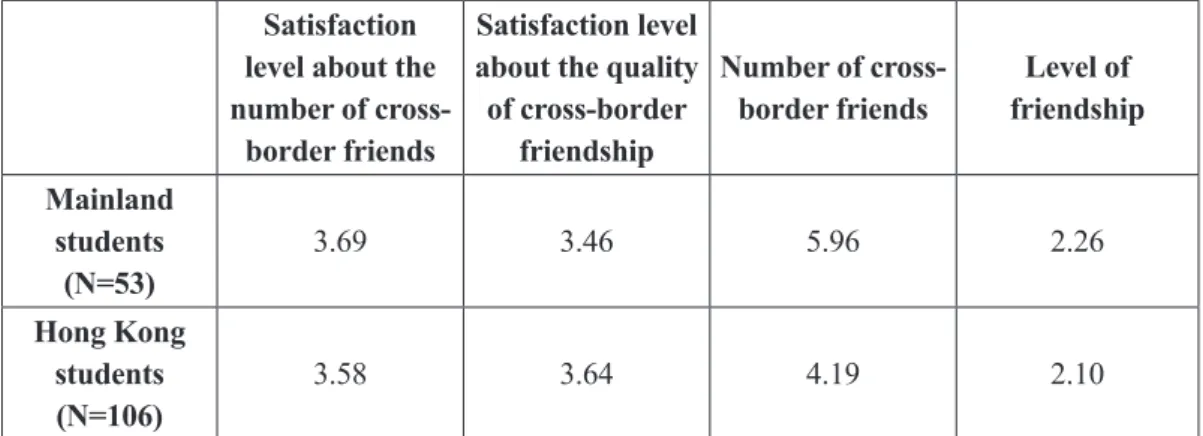
Participants were asked to express their satisfaction levels about the number of intercultural friends and the quality and quantity of friendship. The results are shown in the below table:
Satisfaction level about the number of
cross-border friends
Satisfaction level about the quality of cross-border
friendship
Number of
cross-border friends friendshipLevel of Mainland students (N=53) 3.69 3.46 5.96 2.26 Hong Kong students (N=106) 3.58 3.64 4.19 2.10
Table 2 Level of satisfaction with friendship quality, quantity and number of cross-border friends Table 2 shows that mainland students had a larger mean number of cross-border friends (5.96) than Hong Kong students (4.19). They also had a slightly higher satisfaction
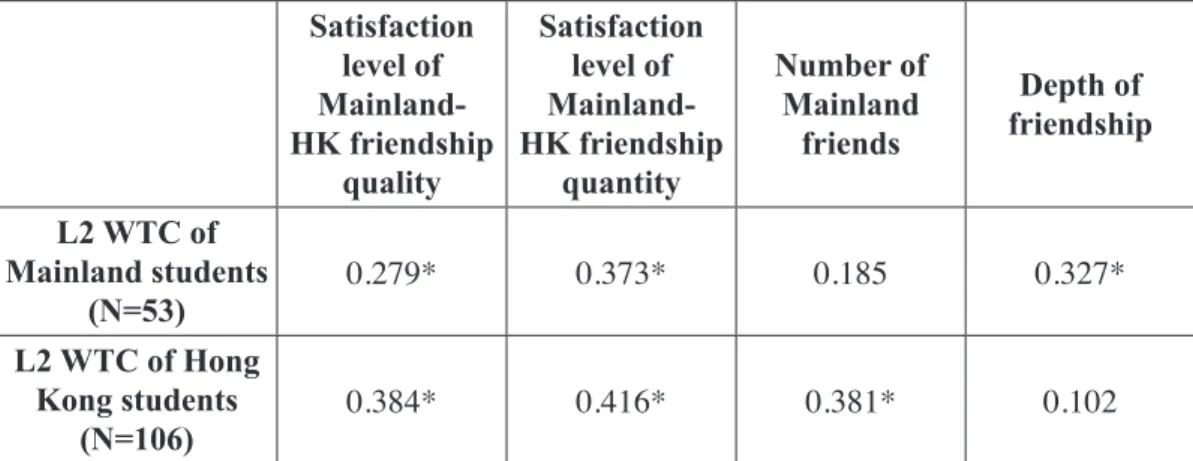
level with the friendship quality (3.69 vs. 3.58). In contrast, Hong Kong students reported a higher satisfaction level (average score = 3.64 vs. 3.46) with the quality of Mainland-HK friendship. T-tests were also performed to determine whether the two groups of students did show differences across the four variables. No statistically significant differences were found except with respect to the number of intercultural friends. The number of local friends (N=5.96) reported by mainland students was significantly more than that reported by Hong Kong students (N = 4.19), t (137) = 2.23, p < 0.05. This finding indicates that they did have a wider network of cross-border friends than local students. Meanwhile, it is worth noting that mainland students were less satisfied with the number of cross-border friends that they had made, though their reported number was more than that of their local counterparts. The trend that they were more willing to make local friends could be due to their needs for reducing acculturation stress and adjusting to the local socio-cultural environment more successfully (Yeh & Inose, 2003). Research question 2 examined the relationship between WTC and the friendship outcomes (satisfaction with friendship quality, quantity, number of intercultural friends and depth of friendship). The results are outlined below: Satisfaction level of Mainland-HK friendship quality Satisfaction level of Mainland-HK friendship quantity Number of Mainland friends Depth of friendship L2 WTC of Mainland students (N=53) 0.279* 0.373* 0.185 0.327* L2 WTC of Hong Kong students (N=106) 0.384* 0.416* 0.381* 0.102
Table 3 Correlations between WTC and friendship outcomes
As shown in Table 3, significant correlations exist between L2 WTC and satisfaction with intercultural friendship in terms of quantity and quality. This finding is consistent with previous studies that WTC is positively correlated with intercultural friendship outcomes and perceived satisfaction (Gareis et al., 2011; Gudykunst & Mody, 2002; Lu & Hsu, 2008; Ulu et al., 2015; Yashima, 2002). L2 WTC was correlated with the depth of friendship among mainland students (r = 0.327, p <0.05) only and the number of mainland
friends among local students (r = 0.381, p < 0.05). This indicates that the L2 WTC of mainland students is more related to the depth of intercultural friendship, while the L2 WTC of local students is more about the breadth of social networks. Research question 3 examined the relationships between WTC, friendship variables and self-perceived L2 proficiency (see Table 4 below). Perceived Cantonese proficiency of mainland students (N=53) Perceived Putonghua proficiency of Hong Kong
students (N=106) L2 WTC 0.723** 0.612**
Number of intercultural friends 0.276 0.334**
Satisfaction with the number of
cross-border friends 0.632* 0.417** Satisfaction with the quality of
cross-border friendship 0.087 0.364** Level of cross-border friendship 0.292* 0.167
Table 4 Correlations between WTC, satisfaction level of cross-border friendship and the perceived Cantonese proficiency of mainland and Hong Kong students
Results showed that there was strong positive correlation between perceived L2 proficiency and WTC, and between L2 proficiency and the satisfaction level of cross-border friendship. These trends are consistent with the previous findings that language proficiency serves as the foundation of developing L2 WTC and intercultural friendship (Clément et al., 2003; MacIntyre, 2007). However, the perceived Cantonese proficiency of mainland students is not correlated with the number of local friends and the quality of friendship due to the fact that local students were more willing to speak Putonghua in the beginning stage of friendship development. This view is supported by students in the interviews:
Even I have local friends, I seldom have a chance to practise my Cantonese as all of them speak Putonghua to me. (ML-05)
First, you have to speak Putonghua. If you want to make friends with them, you should not expect that they will speak your language… They are our guests, and we should show our respect to them by speaking Putonghua, though my Putonghua is not quite fluent.(HK-14)
Putonghua is more often used in cross-border student conversations, and so less emphasized in the development of friendship. This trend was supported by the response
of Hong Kong students. Their Putonghua proficiency was correlated with the number of mainland friends (r = 0.334, p < 0.01) as well as their level of satisfaction with the quantity (r = 0.417, p < 0.05) and quality of friendship (r = 0.364, p < 0.05). In spite of the trend, it would be too assertive to claim that Cantonese proficiency is not important for mainland students as it is correlated with the level of satisfaction with the quality of friendship. The level of friendship was correlated with their perceived level of Cantonese proficiency (r = .292, p < 0.05), meaning that mainland students who were fluent in Cantonese would be more likely to develop deeper relationships with their local peers. The interviews sought to find out whether L2 proficiency was the cause of the L2 WTC. The following replies were revealing about the viewpoints of mainland students:
When I am invited to local activities, I would first ask if they could speak Putonghua. If yes, then I would go. If it is all in English, I would be hesitate but I could still attend. If all Cantonese, I would surely not join (ML-06)
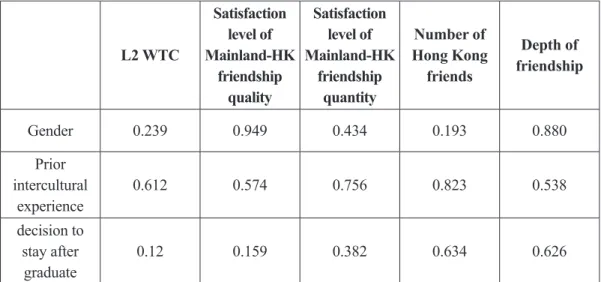
If they insist to use Cantonese… I will rather keep silent or leave. First, my Cantonese is so poor. Second, it would be fairer to use English, the second language for both of us. If you know that nobody knows what you are talking about, but you still insist, you should not expect others to follow (ML-04). L2 proficiency obviously offered students more linguistic confidence in intercultural conversations and activities. This finding is consistent with that of Kudo and Simkin (2003) that people with higher L2 proficiency and L2 WTC can communicate more often and more effectively with people from other cultures. Not only could they find intercultural interactions more rewarding; but it was helpful for the development of positive views among people from different groups as well. As L2 WTC is dependent on the student's perceived L2 proficiency (MacIntyre, 2007; Yashima & Tanaka, 2001), schools should provide support to L2 learning directly rather than improving L2 WTC indirectly. Research question 4 focused on the effect of demographic factors (gender, decision to stay after graduation and prior intercultural experience) on the WTC and the degree of satisfaction with cross-cultural friendship. The decision to stay after graduate was the item only applicable to mainland students. Results are shown in Table 5.1 and 5.2.
L2 WTC Satisfaction level of Mainland-HK friendship quality Satisfaction level of Mainland-HK friendship quantity Number of Hong Kong friends Depth of friendship Gender 0.239 0.949 0.434 0.193 0.880 Prior intercultural experience 0.612 0.574 0.756 0.823 0.538 decision to stay after graduate 0.12 0.159 0.382 0.634 0.626
Table 5.1 T-test between gender, prior intercultural experience and decision to stay after graduate on WTC and satisfaction level of mainland-HK friendship (Mainland students, N=53)
L2 WTC Satisfaction level of Mainland-HK friendship quality Satisfaction level of Mainland-HK friendship quantity Number of Hong Kong friends Depth of friendship Gender 0.408 0.592 0.131 0.730 0.536 Prior intercultural experience 0.032* 0.660 0.795 0.014* 0.321 decision to stay after
graduate Nil Nil Nil Nil Nil
Table 5.2 T-test between gender, prior intercultural experience and decision to stay after graduate on WTC and satisfaction level of mainland-HK friendship (Hong Kong students, N=106)
Table 5.1 and 5.2 show that there was no significant correlation between the demographics (gender, prior intercultural experience and “decision to stay after graduation”), WTC and satisfaction level of intercultural friendship among mainland students. Among local students, however, having prior intercultural experience was found correlated with L2 WTC (t(100) = 2.17, p < 0.05), and number of mainland friends (t(100) = 0.14, p < 0.05).
The finding is consistent with MacIntyre’s (2001) and Sias’s (2008) study, which identified “prior intercultural experience” as the key to WTC development. The quantitative survey of MacIntyre (2007) showed that “prior intercultural experience” could give more opportunities for L2 interactions and lead to better L2 proficiency, so people would be more likely to initiate communication with native-language speakers in the future. Such experience also tends to increase the students’ willingness to make friends with others from other cultures eagerness to build up friendship with the culture of the other groups (Sias et al., 2008). Consistent with their findings, students with prior intercultural experience were found in this study to have higher L2 WTC. Obviously, prior exchange could help them do better in the making of new intercultural friends although not necessarily raised their degree of satisfaction with the current quality of friendship. In the interviews, some students further reported that how their prior experience encouraged their openness to other cultures and gained more understanding about themselves:
I like to explore new cultures and try to understand viewpoints or comments which may not be compatible with mine. The nationality is not my concern. I believe that we could explore interesting differences and lead to fruitful discussions due to different cultural or language backgrounds from non-local students. I like to find out and learn more about unexplored areas. It is always good for us. (HK-12)
I know more about my attractiveness during the exchange. Before this programme, I always think that my appearance was not attractive to foreigners. After visiting different countries, however, I realise that I am considered beautiful. This really brought me advantages in daily life… I am more tolerant towards other cultures than I expect. (ML-03)
The above comments show that prior intercultural experience could serve as the cognitive and affective foundation for development of friendship. It could lead to a more positive attitude towards other cultures because the intercultural interaction is more considered as an opportunity to learn rather than a risk to their own culture. It could also help students gain more understanding about how they are perceived by others. However, it is worth noting that the significant impact of prior intercultural experience was only found among local students. The majority of mainland students involved in this study were eager to learn other cultures. As one mainland student expressed:
In general, those do want to study overseas would be more open-minded and with more tolerance for diverse opinions. Otherwise, they could just stay at home. (ML-07)
Another unexpected finding is that, there was no significant difference between L2 WTC, satisfaction with cross-border friendship and “decision to stay after graduation” among mainland students. In previous literature, it was frequently reported that non-locals would have a higher motivation to learn and use L2 WTC, and be more aggressive in making local friends if they decided to stay in the host-community after graduation (MacIntyre et al., 2001; MacIntyre et al., 1998). This trend may be due to the large population of mainland students in Hong Kong , which allows Mainland students to obtain enough emotional or information support from their co-national peers. In other words, they do no need to get information and less likely to take initiative to communicate with local peers.
Conclusion
This study explored the relationships among students’ satisfaction with mainland-HK friendship, L2 WTC, self-perceived language proficiency and different demographic factors. It was found that mainland students reported having more local friends. Consistent with previous research, the L2 WTC of students was correlated with their satisfaction about cross-cultural friendship. For mainland students, L2 WTC took a more important role in deepening friendship. For local students, L2 WTC mainly helped them to make more friends. Because Putonghua was often used in communication, WTC in Cantonese was not considered important by mainland students when making local friends. Cantonese was still important for the development of friendship however: a greater L2 WTC and a higher degree of proficiency in Cantonese were reported as capable of leading to stronger links with local peers and deeper mutual understanding. Proficiency in Putonghua meanwhile would help Hong Kong students make friends with mainland students but not much in the deepening of friendship. Prior intercultural experience was found as important for developing L2 WTC and building more satisfying links. Interview data showed that intercultural experience could help students become more open to other cultures and gain a deeper understanding about their own strength in intercultural relationship. In contrast to previous research, mainland students reported little difficulty in developing friendship with local students. However, making local friends did not ensure meaningful contacts.Implications
Many universities in Hong Kong do provide Cantonese learning courses. However, the effectiveness of these courses in enhancing intercultural friendship is doubtful. One of the reasons is that mainland students often underestimate the importance of Cantonese in communicating with local people as most of their conversations with others are conducted in Putonghua (Chiu, 2014). In response to this situation, besides helping them attain a sufficient level of proficiency, Cantonese tutor in language courses should place more emphasis on the importance of Cantonese for enhancing relationships. They should also encouarge meaningful contact with their peers in Hong Kong through more school-led intercultural activities. Courses in social, multicultural and cross-cultural psychology, for example, should include activities which can enrich their experiences in the local community and require the use of Cantonese in the discussion of current social and personal issues. Experienced local students can be matched with mainland students for this purpose. Pairing up could help mainland students adjust to university life and provide positive intercultural experience for both local and mainland students. It can also serve as the foundation for building long-lasting relationships.Limitations
Although the present study has yielded findings that have both practical and research implications, its design was not without flaws. First, only students who reported having local or mainland friends were recruited. Students who had difficulties in making cross-cultural friends were simply left out in the enquiry. Further studies of these difficulties are needed. Second, all participants in this study were recruited from one university through convenience sampling so the sample might not represent the general populations of mainland and Hong Kong students. While the findings of this study could provide a more comprehensive basis for further discussion, they might not be fully transferable to the case in another institution. Students should be recruited from a wider variety of universities in order to obtain more generalisable findings in future studies.Reference
Allport, G. W. (1954). The nature of prejudice. Cambridge, MA: Perseus Books.
Arends-Tóth, J., & Van De Vijver, F. J. R. (2003). Multiculturalism and acculturation: Views of Dutch and Turkish-Dutch. European Journal of Social Psychology, 33(2), 249-266.
Avtgis, T. A., West, D. V., & Anderson, T. L. (1998). Relationship stages: An inductive analysis identifying cognitive, affective, and behavioral dimensions of Knapp’s relational stages model. Communication Research Reports, 15(3), 280-287.
Barraclough, R. A., Christophel, D. M., & McCroskey, J. C. (1988). Willingness to communicate: A cross-cultural investigation. Communication Research Reports, 5(2), 187-192.
Berger, C. R., & Calabrese, R. J. (1975). Some explorations in initial interaction and beyond: Toward a developmental theory of interpersonal communication. Human communication research, 1(2), 99-112.
Berry, J. W. (2005). Acculturation: Living successfully in two cultures. International Journal of Intercultural Relations, 29, 697-712. doi:10.1016/j.ijintrel.2005.07.013 Binder, J., Zagefka, H., Brown, R., Funke, F., Kessler, T., Mummendey, A., & Leyens,
J. P. (2009). Does contact reduce prejudice or does prejudice reduce contact? A longitudinal test of the contact hypothesis in three European countries. Journal of Personality and Social Psychology, 96, 843-856.
Chen, L. (2016). Learning the culture of a people: Chinese communication as an example. Intercultural Communication Studies, 25(1), 53-65.
Cheng, Y. C., Cheung, A. C. K., & Ng, S. W. (2015). Internationalization of higher education: The case of Hong Kong. Singapore: Springer.
Chiu, W. K. (2014). Mainland students in Hong Kong. Hong Kong: Hong Kong Institute of Asia-Pacific Studies.
Clément, R., Baker, S. C., & MacIntyre, P. D. (2003). Willingness to communicate in a second language: The effects of context, norms, and vitality. Journal of Language and Social Psychology, 22, 190-211.
Creswell, J. W. (2009). Research design: Qualitative, quantitative, and mixed methods approaches. Thousand Oak, CA: SAGE.
Errington, J. M. (2009). Motivation, international posture and China core cultural values: Toward a theory of motivation in Chinese ESL (Unpublished Master’s thesis), University of London, London.
Gao, X. (2010). Strategic language learning: The roles of agency and context. Bristol: Multilingual Matters.
Gareis, E. (2000). Intercultural fricndship: Five case studies of German students in the USA. Journal of’ Intercultural Studies, 21(1), 67-91.
Gareis, E., Merkin, R., & Goldman, J. (2011). Intercultural friendship: Linking communication variables and friendship success. Journal of Intercultural Communication Research, 40(1), 153-171.
Gudykunst, W. B., & Mody, B. (2002). Handbook of international and intercultural communication. Thousand Oaks, CA: SAGE.
Klomegah, R. Y. (2006). Social factors relating to alienation experienced by international students in the United States. College Student Journal, 40(2), 303-315.
Knapp, M. L., Vangelisti, A. L., & Caughlin, J. P. (2014). Interpersonal communication and human relationships (7th ed.). Boston, MA: Pearson.
Kudo, K., & Simkin, K. A. (2003). Intercultural friendship formation: The case of Japanese students at an Australian university. Journal of Intercultural Studies, 24(2), 91-114.
Li, M. (2006). Cross-border flows of students for higher education: Push-pull factors and motivations of mainland Chinese students in Hong Kong and Macau. (Unpublished PhD Thesis), University of Hong Kong, Hong Kong.
Lin, J. H., Peng, W., Kim, M., Kim, S. Y., & LaRose, R. (2012). Social networking and adjustments among international students. New Media & Society, 14, 421-440. Lu, Y., & Hsu, C. F. (2008). Willingness to communicate in intercultural interactions
between Chinese and Americans. Journal of Intercultural Communication Research, 37, 75-88.
Ma, A., Wong, R., & Lam, W. Y. K. (2014). Profiling language and culture strategy use patterns of ESL student teachers in study abroad by using self-reported data. Pedagogy, Culture & Society, 1-25.
MacIntyre, P. D. (2007). Willingness to communicate in the second language: understanding the decision to speak as a volitional process. Modern Language Journal, 91, 564-576.
MacIntyre, P. D., Baker, S. C., Clément, R., & Conrod, S. (2001). Willingness to communicate, social support, and language learning orientations of immersion students. Studies in Second Language Acquisition, 23(3), 369-388.
MacIntyre, P. D., Dornyei, Z., Clément, R., & Noels, K. A. (1998). Conceptualizing willingness to communicate in a L2: A situational model of L2 confidence and affiliation. Modern Language Journal, 82(4), 545-562.
McPherson, M., Smith-Lovin, L., & Cook, J. M. (2001). Birds of a feather: Homophily in social networks. Annual Review of Sociology, 27(1), 415-444.
Park, N., Jin, B., & Jin, S. (2009). Motivations, impression management, and self-disclosure in social network sites. Paper presented at the Annual meeting of the International Communication Association, Chicago, IL. Retrieved on November 23, 2019, from http://citation.allacademic.com//meta/p_mla_apa_research_ citation/3/0/0/8/0/pages300804/p300804-1.php Pawlak, M., Mystkowska-Wiertelak, A., & Bielak, J. (2015). Investigating the nature of classroom willingness to communicate (WTC): A micro-perspective. Language Teaching Research. doi:10.1177/1362168815609615
Peng, F. (2011). Intercultural friendship development between Finnish and international students. (Unpublished Master’s thesis, University of Jyväskylä, Jyväskylä, Finland) . Retrieved on November 23, 2019, from https://jyx.jyu.fi/bitstream/ handle/123456789/27287/URN:NBN:fi:jyu-2011071211147.pdf?sequence=1
Roccas, S., Horenczyk, G., & Schwartz, S. H. (2000). Acculturation discrepancies and well-being: the moderating role of conformity. European Journal of Social Psychology, 30, 323-334.
Sias, P. M., Drzewiecka, J. A., Meares, M., Bent, R., Konomi, Y., Ortega, M., & White, C. (2008). Intercultural friendship development. Communication Reports, 20(1-2), 1-13. Tajfel, H. (1981). Human groups and social categories. British Journal of Social
Psychology, 21, 189-201. Ulu, G., Fan, W., & Yu, S. (2015). Study of the relationship between Chinese college students' international posture and their intercultural willingness to communicate. Chinese Studies, 4(3), 77-82. University Grants Committee. (2010). Aspirations for the higher education system in Hong Kong: Report of the University Grants Committee. Hong Kong: University Grants Committee.
University Grants Committee. (2019). Facts and figures 2018. Retrieved on November 23, 2019, from http://cdcf.ugc.edu.hk/cdcf/searchStatisticReport.do
van de Vijver, F. J. R., Helms-Lorenz, M., & Feltzer, M. J. A. (1999). Acculturation and cognitive performance of migrant children in the Netherlands. International Journal of Psychology, 34(3), 149-162.
Ward, C., & Kennedy, A. (1996). Crossing cultures: The relationship between psychological and sociocultural dimensions of cross-cultural adjustment. In J. Pandey, D. Sinha, & D. P. S. Bhawuk (Eds.), Asian contributions to cross-cultural psychology (pp. 289-306). New Delhi: SAGE.
Ward, C., & Masgoret, A. M. (2006). An integrated model of attitudes toward immigrants. International Journal of Intercultural Relations, 30, 671-682.
Webb, L. M., & Thompson-Hayes, M. E. (2002). Do popular collegiate textbooks in interpersonal communication reflect a common theory base? A telling content analysis. Communication Education, 51(2), 210-224.
West, R., & Turner, L. H. (2010). Understanding interpersonal communication: Making choices in changing times (2nd ed.). Belmont, CA: Thomson/Wadsworth.
Yashima, T. (2002). Willingness to communicate in a second language: The Japanese EFL context. Modern Language Journal, 86(1), 54-66. doi:10.1111/1540-4781.00136 Yashima, T., MacIntyre, P. D., & Ikeda, M. (2016). Situated willingness to communicate in an L2: Interplay of individual characteristics and context. Language Teaching Research. doi:10.1177/1362168816657851 Yashima, T., & Tanaka, T. (2001). Roles of social support and social skills in the intercultural adjustment of Japanese adolescent sojourners in the USA. Psychological Reports, 88(3), 1201-1210. doi:Doi 10.2466/Pr0.88.4.1201-1210 Yeh, C. J., & Inose, M. (2003). International students' reported English fluency, social support satisfaction, and social connectedness as predictors of acculturative stress. Counselling Psychology Quarterly, 16(1), 15-28.
Yin, K. (2003). Case study research: Design and methods (3rd ed.). London: SAGE. Ying, Y., & Liese, L. (1991). Emotional well-being of Taiwan students in the United
States: An examination of pre- to post-arrival differential. International Journal of Intercultural Relations, 15(3), 345-366.
Yu, B. (2010). Learning Chinese abroad: the role of language attitudes and motivation in the adaptation of international students in China. Journal of Multilingual and Multicultural Development, 31(3), 301-321. doi:Pii 92294922610.1080/0143463100 3735483
Yu, B., & Shen, H. Z. (2012). Predicting roles of linguistic confidence, integrative motivation and second language proficiency on cross-cultural adaptation. International Journal of Intercultural Relations, 36(1), 72-82. doi:10.1016/ j.ijintrel.2010.12.002
Yu, B., & Wright, E. (2016). Socio-cultural adaptation, academic adaptation and satisfaction of international higher degree research students in Australia. Tertiary Education and Management, 22(1), 1-22.
Yu, B., & Zhang, K. (2016). ‘It’s more foreign than a foreign country’: Adaptation and experience of mainland Chinese students in Hong Kong. Tertiary Education and Management, 22(4), 300-315.
Zeng, M. (2006). The adaptation of mainland Chinese research postgraduates to the universities of Hong Kong (Unpublished PhD thesis), The University of Hong Kong, Hong Kong, China.
Attachment
Survey about the willingness to communicate, self-perceived language proficiency and Mainland-HK friendship
關於溝通意願、自我感知語言能力及中港友誼的問卷調查 個人資料 Personal Information 電郵 Email : ______________________________ 年齡 Age : ______________________________ 性別 Gender : ______________________________ 出生地 ( 城市 / 國家 )
Place of residence (Home Town / Country) ︰ ______________________________
閣下完成學位後,會否計劃留在香港工作或升學 ?
After graduation, do you plan to stay in Hong Kong for employment or further study? 會,計劃留在香港工作 Yes, I plan to stay in Hong Kong for employment. 會,計劃留在香港升學 Yes, I plan to stay in Hong Kong for further study. 不會 No.
1. 自我感知語文水平
Self-perceived language proficienc
請根據您目前的粵、普、英的語文水平,圈出適當的數字︰
Please select your level of proficiency with the Cantonese, Putonghua and English by circling the corresponding number.
完全不懂 No proficiency 差 Poor 一般 Average 好 Good 優秀 Excellent Cantonese 粵語 Reading 讀 ( 繁體字 ) 1 2 3 4 5 Writing 寫 ( 繁體字 ) 1 2 3 4 5 Listening 聽 1 2 3 4 5 Speaking 說 1 2 3 4 5 Putonghua 普通話 Reading 讀 ( 簡體字 ) 1 2 3 4 5 Writing 寫 ( 簡體字 ) 1 2 3 4 5 Listening 聽 1 2 3 4 5 Speaking 說 1 2 3 4 5 English 英語 Reading 讀 1 2 3 4 5 Writing 寫 1 2 3 4 5 Listening 聽 1 2 3 4 5 Speaking 說 1 2 3 4 5
2. 第二語言溝通意願 [ 香港學生版本
Willingness to communicate (2nd language) [Hong Kong student's Version]
請根據您的狀況,選出最能您的跨文化溝通習慣的選項︰
Please select the most appropriate item which can best describe your current intercultural communication situation:
普通話作為第二語言 L2 as Putonghua
項目 Task
完全不重要
Not important Less important 較不重要 Neutral 一般 Important 重要 Very important 十分重要
跟隨簡體中文指示,完成任務
Listen to instructions in Simplified Chinese and complete a task 1 2 3 4 5 按簡體中文食譜焗製蛋糕
Bake a cake if instructions were only in Simplified Chinese. 1 2 3 4 5 用普通話進行遊戲( 如大富翁 )
Play a game in Putonghua, for example Monopoly. 1 2 3 4 5 試想像您對一項任務要求不清晰,您有多大程度希望得到
普通話指引?
Imagine that you are confused about a task you must complete. How willing are you to ask for instructions or clarification in Putonghua?
1 2 3 4 5
在課後與教師以普通話討論課業
Speak Putonghua to your teacher or professor after class about
an assignment. 1 2 3 4 5
以簡體中文填寫申請表
Fill out an application form in Simplified Chinese. 1 2 3 4 5 候車時與普通話朋友聊天
Talk to an Putonghua-speaking friend while waiting in line. 1 2 3 4 5 接受普通話使用者的指示
Take directions from an Putonghua speaker. 1 2 3 4 5
在最近一次假期中與朋友以普通話聊天
Speak in Putonghua in a group about a recent vacation that you
took. 1 2 3 4 5
以普通話描述您最喜歡的遊戲的規則
試想像陌生人進入您所在的房間,並與您交談,您會多大 程度上選擇以普通話回應?
Imagine that a stranger enters the room that you are in. How willing would you be to have a conversation in Putonghua if he talked to you first?
1 2 3 4 5
嘗試了解普通話電影
2. 第二語言溝通意願 [ 內地學生版本 ]
Willingness to communicate (2nd language) [Mainland student’s Version]
請根據您的狀况,選出最能您的跨文化溝通習慣的選項︰
Please select the most appropriate item which can best describe your current intercultural communication situation:
粵語作為第二語言 L2 as Cantonese
項目 Task
完全不重要
Not important Less important 較不重要 Neutral 一般 Important 重要 Very important 十分重要
跟隨繁體中文指示,完成任務
Listen to instructions in Traditional Chinese and complete a
task 1 2 3 4 5
按繁體中文食譜焗制蛋糕
Bake a cake if instructions were only in Traditional Chinese. 1 2 3 4 5 用粵語進行遊戲( 如大富翁 )
Play a game in Cantonese, for example Monopoly. 1 2 3 4 5 試想像您不清晰一項任務的要求,您有多大程度希望得到
粵語指引?
Imagine that you are confused about a task you must complete. How willing are you to ask for instructions or clarification in Cantonese?
1 2 3 4 5
在課後與教師以粵語討論課業
Speak Cantonese to your teacher or professor after class about
an assignment. 1 2 3 4 5
以繁體中文填寫申請表
Fill out an application form in Traditional Chinese. 1 2 3 4 5 候車時與粵語朋友聊天
Talk to an Cantonese-speaking friend while waiting in line. 1 2 3 4 5 接受粵語使用者的指示
Take directions from an Cantonese speaker. 1 2 3 4 5
在最近一次假期中與朋友以粵語聊天
Speak in Cantonese in a group about a recent vacation that you
took. 1 2 3 4 5
以粵語描述您最喜歡的遊戲的規則
試想像陌生人進入您所在的房間,並與您交談,您會多 大程度上選擇以粵語回應? Imagine that a stranger enters the room that you are in. How willing would you be to have a conversation in Cantonese if he talked to you first?
1 2 3 4 5
嘗試瞭解粵語電影 Try to understand a Cantonese movie. 1 2 3 4 5
3. Self-report survey
自我陳述問卷
請回想您最好的一段跨文化友誼的狀況,在最能代表您目前跨文化友誼關係的 欄目內加上「」︰
Please recall the memory of your best Intercultural friendship, and put a “” in the statement which can best describe your current intercultural friendship status:
對目前友誼的描述
Description of your current intercultural friendship
□ 相處時,我感到猶豫和緊張。我會嘗試表現自己最理想、討人歡喜、能被理 解和被社會接受的一面。我們會仔細觀察對方以減少不確定性,並希望了解 對方的個性、心情、興趣和對我們的觀感。話題一般包含背景資料 ( 如 ( 名字、 就讀學科、家鄉等 )、天氣、環境、娛樂旅行等表面或輕鬆的話題。
I feel hesitant and nervous when meeting each other, and we try to display ourselves as a person who is pleasant, likable, understanding and socially adept. We are carefully observing the other to reduce any uncertainty - hoping to gain clarification of mood, interest, orientation toward us, and aspects of the other's public personality. Most conversation is about general information exchange (e.g. name, hometown or majoring subject) and superficial topics, such as weather, environment or relaxing things (like entertainment or travelling).
□ 相處時,我會對對方感到好奇,也會努力尋找共同話題,如家庭狀況、共同 愛好和興趣、或共同經驗,以整合話題。
I feel uncertain, but curious about each other, and try to search commonalities, and primarily interested in searching for an integrating topic (e.g. family, hobbies, common interest) or past experience.
□ 相處時,我感到溫暖和親密感。我們自我訊息披露量會增加,並會分享一些 會曝露自行弱點的事,包括過去隱藏的秘密、恐懼、挫折、失敗、個人缺點、 偏見、個人道德價值等。
I feel warm and close when meeting each other. The amount of self-disclosure increases, and may involve some previously withheld secrets, fears, frustrations, failures, imperfections, prejudices or individual moral value, which may make ourselves vulnerable.
□ 我感到我們就像融為一體,我們的態度、意見、興趣和品味能讓我們與其他 朋友區分出來。一些共同習慣、身份和隱語,也讓我們的友誼顯得獨一無二。 我們的話題涉及敏感題目,如政治立場或對共同經常的反思,也涉及最深入 的自我披露,如秘密、性、未來計劃等。
I feel like one person when meeting him/her. Our attitudes, opinions, interests and tastes could clearly distinguish us from others. Some shared routines, identity and jargon are developed that make us unique. Our conversation involves some sensitive issues, such as the political propensity personal reflection about common experience. My deepest self-disclosure may also be involved, such as secrets, sex, and discussion of future plan.
4. 您目前中港友誼的狀況
The current condition of your Mainland-HK friendship
請根據您目前的跨文化友誼狀況,回答下列問題︰
Please answer the questions according to your current intercultural friendship:
4.1 您目前有多少位香港朋友 ( 於香港出生及長大 ) ? ( 如您是香港學生,請跳過 本題 )
How many Hong Kong friends (who were born and raised in Hong Kong) do you have currently? (Please skip this if you are a Hong Kong student)
____________________________________________________________________ 4.2 您目前有多少位內地朋友 ( 於內地出生及長大 ) ? ( 如您是內地學生,請跳過
本題 )
How many Mainland friends (who were born and raised in Mainland) do you have currently? (Skip this if you are Mainland student) (Please skip this if you are a Mainland student)
4.3 請在下表中選出最能代表您對現在跨文化友誼看法的數字
On the scale below, please select the number which represents your feeling about the statement about your current intercultural friendship status:
項目 Task
完全不重要
Not important Less important 較不重要 Neutral 一般 Important 重要 Very important 十分重要
總體而言,我滿意目前中港友誼的數目
In general, I am satisfied with the number of my Mainland-HK
friendship. 1 2 3 4 5
總體而言,我滿意目前中港友誼的質量
In general, I am satisfied with the quality of my Mainland-HK