
基於耐延遲網路之移動式信任者與獎勵機制設計 - 政大學術集成
53
0
0
全文
(2) 基於耐延遲網路之移動式信任者與獎勵機制設計 Mobile Trusted Bank and Incentive Strategy Design . in Delay Tolerant Networks 研 究 生:林昶瑞 Student: Chan-Juei Lin 指導教授:蔡子傑 Advisor:Tzu-Chieh Tsai. 國立政治大學 資訊科學系 碩士論文. A Thesis submitted to Department of Computer Science National Chengchi University in partial fulfillment of the Requirements for the degree of Master in Computer Science. 中華民國一百零一年七月 July 2012.
(3) 基於耐延遲網路之移動式信任者與獎勵機制設計 . 摘要. DTN(Delay Tolerant Networks)是一種缺乏網路基礎設備的網路架構,在這類的網路架構下, 無線節點之間的通訊連線並非同時存在,而是間歇式建立的。因為節點的移動、或是裝置省 電模式運作與環境因素的影響,造成連線可能不定時的失效。有不保證連線特性的網路,在 DTN網路中節點間相遇的機會很少,節點間利用 Store-Carry-Forward 的方式傳遞訊息,且有 相當長的傳遞延遲(Propagation Delay)。在這樣的網路特性下,傳統的文獻中,都是假設所 有節點都會幫忙傳遞。但不幸的,在現實生活中有自私節點(Selfish Nodes)的存在,因自己本 身設備資源有限,如電力資源、網路資源...等,節點不願意幫忙傳送訊息,這些自私節點的 存在,會對DTN網路架構造成破壞,導致無法傳送訊息到目的地。為了解決自私節點的問 題,我們提出了MTBIS(Mobile Trusted Bank of Incentive Strategies),當發送節點(Source Node)要求傳送訊息時,給予回饋給幫忙轉傳訊息的節點,來鼓勵節點間互相幫忙傳送訊 息,我們稱這些回饋為Incentive Credit。而節點也可利用Incentive Credit來要求別的節點幫忙 轉傳訊息。另外也加入SI(Social Incentive)機制,與DGT(Dynamic Grudger Threshold) ,吸引 自私節點願意幫忙轉傳訊息,改進了 MTBIS 在自私節點環境下的不足, 利用經濟學的角度 來解決節點運用Credit的問題,借此提高訊息的傳遞率(Delivery Ratio)。 . 本篇研究也注重於自私節點的模擬,利用四種不同特性的節點: Sucker(傻瓜)、. Cheater (騙子)、Grudger(小氣鬼)、Ecci(投機者), 這些自私節點會照成DTN在設計上無法使 用,甚至降低訊息的傳達率,因此我們模擬了這些自私節點的行為,並且使用我們所提出的 獎勵機制,來解決這些自私節點的問題,實驗結果也證明,Grudger可以有效的抑制自私節 點對效能大幅降低的問題,與傳統的演算法相較,效能高出34%。 關鍵字:耐延遲網路、獎勵機制、自私節點. i.
(4) Mobile Trusted Bank and Incentive Strategy Design in Delay Tolerant Networks. Abstract DTN (Delay Tolerant Networks) is a network structure without need to use any infrastructure. In DTNs, wireless connections between nodes do not always exist, i.e., nodes are connected intermittently.. Due to the mobility, power issues, or surrounding environment of nodes,. connections between nodes may be disruptive occasionally or randomly. In a DTN, nodes usually transfer the message to the encountering nodes. By this way, the messages are stored, carried, and forwarded to the next nodes, possibly the destination. However, in reality, nodes may not be willing to help each other for the message forwarding. More specifically, there are “Selfish nodes” which refuse to forward messages due to issues such as energy and network bandwidth. Thus it will prevent messages from being forwarded to its destination. In order to solve the problem of message forwarding failure caused by selfish nodes, we proposed an Incentive Strategy called “MTBIS (Mobile Trusted Bank and Incentive Strategies)”.. We. construct a rewarding scheme called “Incentive Credit” for nodes who forward the messages for the source node. In addition, to increase the intention of the selfish nodes for forwarding messages, we add two more mechanism called SI(Social Incentive) and DGT(Dynamic Grudger Threshold). The DGT uses credits to solve selfish node problems from an economics point of view to enhance MTBIS to work with existence of selfish nodes. In this thesis, we emphasis on the simulation of the behaviors of selfish nodes, using four different types of nodes: the “Sucker”, the “Cheater”, the “Grudger”, and the “Ecci”. These selfish nodes will decrease the success rate of message forwarding, and even make the DTN unusable. We simulated the behaviors of these selfish nodes, using the rewarding scheme we proposed. From the results of our experiment, we see that the Grudger can effectively deal with performance issues caused by selfish nodes, and the system can gain 34% in performance compared to the traditional algorithms. Keyword:DTN、Incentive、Selfish. ii.
(5) 致謝辭 學習的道路上從五專一路走到了研究所,這一路上歷經了很多波折和考驗,一路上遇 到了不少人的幫助與提拔,才能讓我有機會在政治大學取得碩士學位。 謝謝指導教授蔡子傑老師給我不少研究的建議,一步一步細心地指導,給予我正確的 研究與學習方向,並且每週定期的meeting,討論論文的方向,才能順利得完成論文。謝謝 口試委員吳曉光教授、周承復教授、陳伶志教授與林靖茹教授,在口試期間提出了相當多的 建議與改進,使得本論文更加完善與周詳;謝謝同學欣諦與英明,在研究的路上互相打氣幫 忙,一起學習成長;謝謝學弟建淳給予我英文寫作的諸多建議;謝謝MCLab1的各位同學, 一起研究、一起教學相長;謝謝政治大學教學發展中心,給予我工作的機會,讓我研究之餘 還有磨練自己的機會;謝謝學長彥嵩、凱貞、偉敦、勇麟與志宏,給予我不少研究的建議, 帶領我適應碩士的生活;謝謝我的家人,給予我求學路上最大的後盾,特別是父母支持我念 研究所,讓我在研究生涯沒有後顧之憂。 . 謝謝所有幫助過我的人,讓我在研究所的路上,增添更多的色彩。. iii.
(6) TABLE OF CONTENTS CHAPTER 1!. 1. Introduction!. 1. 1.1 Background!. 1. 1.2 Motivation!. 2. 1.3 Organization!. 3. CHAPTER 2!. 4. Related Work!. 4. 2.1 DTN Routing Protocol!. 4. 2.1.1 Opportunistic Protocol!. 4. 2.1.1.1 Epidemic Routing Protocol!. 4. 2.1.1.2 Spray and Wait Routing Protocol!. 5. 2.1.2 Prediction-based Protocol!. 5. 2.1.2.1 PROPHET Routing Protocol!. 5. 2.2 Incentive Techniques!. 6. 2.2.1 Pi A Practical Incentive Protocol for Delay Tolerant Networks!. 6. 2.2.2 SMART A Secure Multilayer Credit-Based Incentive Scheme for DelayTolerant Networks!. 7. 2.2.3 SORI A Secure and Objective Reputation-based Incentive Scheme for Ad-hoc Networks! 8 2.3 Design Goal!. 8. CHAPTER 3!. 9. Research Methods!. 9. 3.1 Challenges!. 9. 3.2 Mobile Trusted Bank (MTB)!. 9. 3.3 Selfish Nodes Simulation Environment!. 11. 3.3.1 Selfish Nodes Species!. 11. 3.3.2 Nodes Behavior!. 13. 3.3.3 The Discrimination between Selfish Nodes and Unselfish Nodes!. 16. iv.
(7) 3.4 Receipt Data!. 17. 3.5 Credit Clearance!. 19. 3.6 Dynamic Grudger Threshold (DGT)!. 20. 3.7 Social Incentive (SI)!. 21. 3.8 MTBIS(Mobile Trusted Bank Incentive Strategy)!. 22. CHAPTER 4!. 26. Simulation and Results!. 26. 4.1 Performance Evaluation!. 26. 4.2 Assumptions!. 27. 4.3 Simulation Setup !. 27. 4.4 Simulation Results!. 28. 4.4.1 The Selection of Grudger Threshold and ESC Threshold!. 28. 4.4.2 Selfish Nodes Density!. 30. 4.4.3 Grudger Nodes Density!. 34. 4.4.4 Delivery Ratio in each Nodes!. 36. 4.4.5 MTB Density !. 38. 5. Conclusion and Future Work!. 41. References!. 43. v.
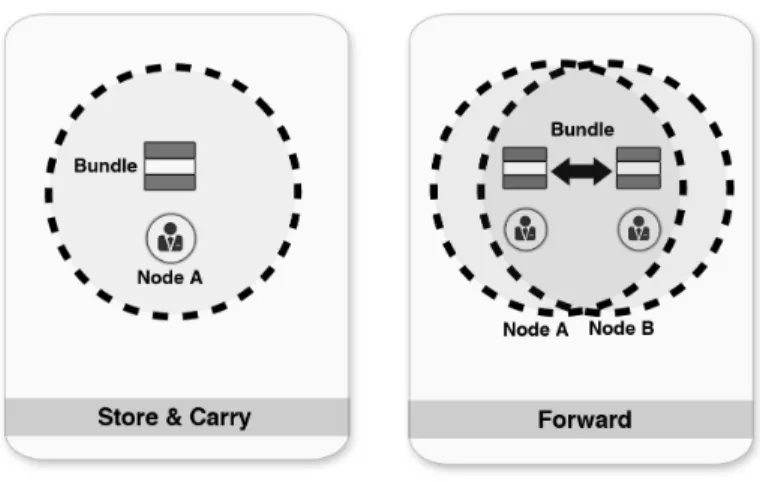
(8) LIST OF FIGURES Fig. 1.1 Store-Carry-Forward Mechanism. ....................................................................................3 Fig. 2.1 Layered Coin Model. .......................................................................................................7 Fig. 3.1 Cheater and Ecci’s Behavior. .........................................................................................14 Fig. 3.2 Sucker and Grudger’s Behavior. ...................................................................................15 Fig. 3.3 The Discrimination between Selfish Nodes and Unselfish Nodes............................16 Fig. 3.4 Receipt Data I. ..................................................................................................................17 Fig. 3.5 Receipt Data II. ................................................................................................................18 Fig. 3.6 Credit Clearance. .............................................................................................................19 Fig. 3.7 MTBIS Algorithm (Grudger-liked based). .....................................................................24 Fig. 3.8 Cheater ‘s Behavior in MTBIS. ......................................................................................24 Fig. 3.9 Sucker ‘s Behavior in MTBIS. ........................................................................................25 Fig. 3.10 Ecci ‘s Behavior in MTBIS. ..........................................................................................25 Fig. 4.1 The Map of Simulator in “ONE”. ....................................................................................28 Fig. 4.2 The Relationship between ESC Threshold and Delivery Ratio. ...............................29 Fig. 4.3 The Relationship between Grudger Threshold and Delivery Ratio. ........................30 Fig. 4.4 The Delivery Ratio results of Algorithms - The Amount of Cheaters. ......................30 Fig. 4.5 The Delivery Ratio results of Unselfish and Selfish Environment. ..........................32 Fig. 4.6 The Delivery Ratio compare with different Algorithms in selfish environment. ......33 Fig. 4.7 The Transmission Overhead results of Algorithms - The Amount of Cheaters......33 Fig. 4.8 The Latency Time results of Algorithms - The Amount of Cheaters. ......................34 Fig. 4.9 The Delivery Ratio results of MTBIS - The Amount of Grudger Nodes. .................34 Fig. 4.10 The percentage of Delivery Ratio in each Nodes. ....................................................36 Fig. 4.11 The Delivered Packets results of each Nodes. .........................................................37 Fig. 4.12 The Delivery Ratio results of Algorithms - The Amount of MTB. ...........................38 Fig. 4.13 The Transmission Overhead results of Algorithms -The Amount of MTB. ...........39 Fig. 4.14 The Latency Time results of Algorithms - The Amount of MTB. ......................... ...39 Fig. 4.15 The Delivery Ratio results of Algorithms (with MTB and without MTB)- The Amount of MTB....................................................................................................................40. vi.
(9) LIST OF TABLES Table 2 Related Work Characteristics. .........................................................................................8 Table 3.1 Nodes Characteristics. ................................................................................................10 Table 3.2 Selfish node and Unselfish node Category. ..............................................................13 Table 3.3 Node Behavior Parameter. ..........................................................................................13 Table 3.4 Nodes Forwarding behavior with Priority. .................................................................22 Table 4.1 The Parameters of Simulation. ...................................................................................27. vii.
(10) CHAPTER 1 Introduction. 1.1 Background. DTN(Delay Tolerant Networks) is a network structure without using infrastructure networks. In a DTN, wireless connections between nodes do not always exist; nodes are connected intermittently. Due to the mobility of nodes, every issues, and environmental factors, connection between nodes may be lost periodically. In DTN, opportunity that the nodes will meet are low, and no guarantee end-to-end path from source to destination, therefore resulting in a long propagation delay. Different from the traditional networks, the newly emerging DTNs are characterized by the lack of guaranteed connectivity, the typically low frequency of encounters by DTN nodes and long propagation delays within the network. Under such scenario, in traditional works, nodes are expected to always help forwarding messages when requested. However, that hypothesis is not always true in the real world. There are “Selfish nodes” which refuse to forward messages due to issues such as energy and. network. bandwidth, thus preventing messages from being forwarded to it's destination. Under the hypothesis that each individual DTN node is willing to help with forwarding. Unfortunately, there may exist some selfish nodes, especially in a cooperative network like DTN, and the presence of selfish DTN nodes could cause catastrophic damage to any well designed opportunistic routing scheme and jeopardize the whole network. In order to solve the problem of messages forwarding failure caused by selfish nodes, we proposed a Incentive Strategy called “MTBIS(Mobile Trusted Bank and Incentive Strategies)”. We construct a rewarding scheme called “Incentive Credit” for nodes who forwards the messages from the source node. With the fair incentive, the selfish DTN nodes could be stimulated to help with forwarding messages to achieve better performance in terms of delivery ratio. 1.
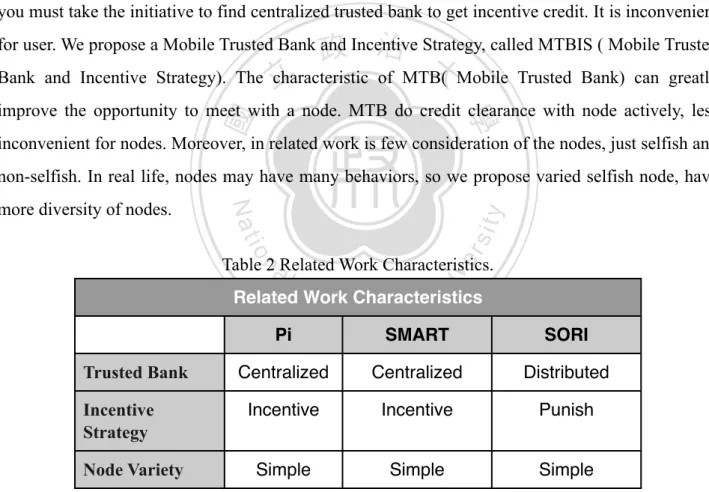
(11) 1.2 Motivation DTN is extensive researched in the environment of network infrastructure lacking, such as vehicular ad hoc networks ,disaster area rescue, outer space communication,and underwater networks. In DTN uses “Store-Carry-Forward” mechanisms (Fig. 1.1), when two DTN nodes (NA ,NB ) forward messages we called as bundles in each other’s transmission range and contact with each other during a period of time.[1] There are no other nodes nearby in transmission range, node NA will store the bundles in buffer untile other nodes nearby in transmission range, called “store and carry”. The bundles are opportunistically routed toward the destinations by intermittent connections. Under the hypothesis that each individual DTN node is willing to help with forwarding. Unfortunately, there may exist some selfish nodes, especially in a cooperative network like DTN, and the presence of selfish DTN nodes could cause catastrophic damage to any well designed opportunistic routing scheme and jeopardize the whole network. In order to solve the problem of messages forwarding failure caused by selfish nodes, we proposed a Incentive Strategy called “MTBIS(Mobile Trusted Bank and Incentive Strategies)”.There is a organization called TB(Trusted Bank), is responsible for managing Incentive Information such as Incentive Credit and Credit Clearance . In most of Incentive Strategy researches , Trusted Bank , most of them are centralized or distributed. We proposed Mobile Trusted Bank (MTB) in order to implement Incentive Strategy in cooperative network such as DTN. We used bus characteristics, selected bus as Mobile Trusted Bank. Finally, we simulated the selfish node environment, and implement MTBIS we proposed to degrade selfish nodes jeopardize.. 2.
(12) Fig. 1.1 Store-Carry-Forward Mechanism.. 1.3 Organization The remainder of this paper is organized as follows. In Section II, we review the related work of DTN routing protocol and Incentive techniques, and identify the design goal. Then, we present the MTBIS in Section III. In Section V, we show simulation results to demonstrate the effectiveness of our scheme. Finally, we draw our conclusions in Section V.. 3.
(13) CHAPTER 2 Related Work 2.1 DTN Routing Protocol In DTN researches in recent years, an increasing number of Routing Protocol was proposed. Due to the DTN are a class of networks characterized by lack of guaranteed connectivity, encounters between nodes are few opportunities, and there is a considerable amount of propagation delay. Many scholars. designs different Routing Protocol for a variety of different scenarios. In this. section, We will address a variety of Routing Protocol for discussion and research. In DTN Routing Protocol, can be divided into two types : Opportunistic Prediction-based Protocol and Protocol respectively, as follows:. 2.1.1 Opportunistic Protocol Opportunistic Protocol does not predict future path of the node when they encountered and do not to calculate which node will be the best node, but when the nodes encountered opportunely, will forward the messages to other node. This type of routing protocol design does not need to know the topology of the whole network. The common Opportunistic Protocol are as follows:. 2.1.1.1 Epidemic Routing Protocol The most common example of a Opportunistic Protocol is Epidemic[8][9] (addressed by Vahdat and Becker). In this case, a node continuously replicates messages, and relay to the nearby nodes. Under the hypothesis , if don’t consider buffer size, this algorithm has the highest delivery ratio. As can easily predicted , since a large number of replication messages unlimitedly, this algorithm wastes a lot of resources, such as bandwidth, storage space and power. Because the resources will soon be exhausted, in the limited resource such as DTN, Epidemic is not a best choice of algorithm.. 4.
(14) 2.1.1.2 Spray and Wait Routing Protocol In order to improve the shortcomings of the Epidemic, it is necessary to limit the number of messages copied, and reduce as much as possible the use of network resources, Spray and Wait limits the number of copies and setting Strict Upper Bound to limit the amount of delivery of each message [10], reducing the chance of wasting resource. The algorithm as follows: Spray and Wait is divided into two cycles, Spray cycle and Wait period, when a new message has been generated , digital “L” will attach to messages. Digital “L” represents the maximum amount is allowed to messages copy. This period called the Spray cycle, when node transfers the messages. When a node receives a message enter the Wait period, the node will maintain this information until to encounter the destination node.. 2.1.2 Prediction-based Protocol Prediction-based algorithm try to reduced transmission overhead and messages buffer contention through node history records to predict future path. To calculate probability whether node has higher of transfer rate sent to destinations node. Generally speaking, forward messages to the highest chance encountered destinations node if possible, such can improve message delivery ratio . Moreover, in a real world, since exists selfish nodes, selfish node drop messages at any time, make this algorithm will become more difficult to predict. Common Prediction-based Protocol are as follows :. 2.1.2.1 PROPHET Routing Protocol PROPHET stand for prediction-based Protocol using history of encounters and transitivity and maintaining a list of probabilities for the successful delivery for each node[11]. The prediction for successful delivery is based on three elements: number of previous encounters between each host (where frequently encounters means more chances to deliver the message), aging (where the time passed from the last encounter between nodes is factored in the delivery probability) and transitivity (where a node A is considered a relay between two nodes that meet rarely with each other, but they do meet A more frequently).. 5.
(15) 2.2 Incentive Techniques There are many papers on incentive techniques for different kinds of networks. In many proposed protocol, when the source DTN node sends a message, it attaches some incentive on the bundles. Then, the selfish nodes on the road could be stimulated to help with forwarding the bundles to improve the delivery ratio. These reported techniques basically fall into three categories, ie, Creditbased, Game-Theory-based, and Security-Protocol-Based are as follows :. •Credit-based Schemes:The basic strategy is to provide incentives for intermediate forwarding DTN nodes to faithfully forward messages. Generally, the intermediate nodes will get reward for bundles forwarding from the source nodes, and will take the same payment mechanism to pay for their bundles forwarding requests.[1 , 2]. •Game-Theory-based. Schemes :Using Game-Theory Model to explore the case of cooperative. communication , and prove that the method each node will achieve the best of Payoff, which is Nash Equilibrium.[4]. •Security-Protocol-Based Schemes:It focus on the security part of malicious nodes do not want to transmit the messages ,and also possible to attack the Trusted Bank.[2] In this paper ,we focuses on Credit-based Schemes, related work are as follows:. 2.2.1 Pi A Practical Incentive Protocol for Delay Tolerant Networks Due to the DTN are a class of networks characterized by lack of guaranteed connectivity, encounters between nodes are few opportunities, and there is a considerable amount of propagation delay. The nodes must help other to forward messages. However, the nodes may not be willing to help other to forward messages without benefit. Pi [1] addressed a incentive protocol not only attract to nodes help to forward messages, but also considered fairness. There exists a Trusted Authority(TA) in the system of Pi. Although it does not participate in bundles forwarding in DTN, TA performs trusted fair credit and reputation clearance for DTN nodes. Therefore, before joining the DTN, each DTN node should register itself to the TA and obtain its personal credit account (PCA) and personal reputation account (PRA) in the initialization 6.
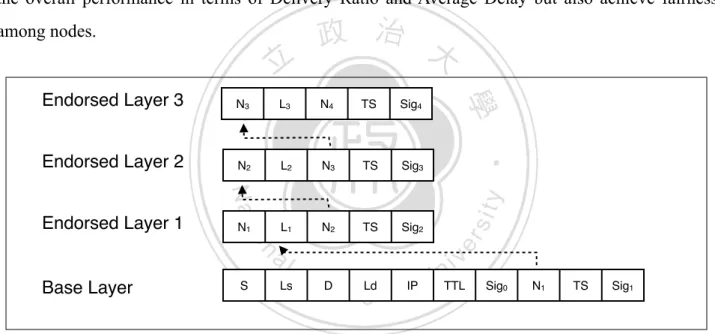
(16) phase. Later, when a DTN node has an available fast connection to the TA, it can report to the TA for credit and/or reputation clearance. To guarantee the incentive strategy working well, the incentive must be secure. Therefore, in the implementation, Pi use the layered coin to stimulate the bundles delivery (Fig. 2.1). A typical Layered Coin Model usually consists of a base layer formed by the source node and multiple endorsed layers formed by the intermediate nodes. Each layer containing incentive information. TA uses those Layered Coin inside the messages, assigning credit to those nodes involved in the transmission, when forward to destination node successfully. The results show that if incentive rewards high enough, although many selfish nodes in system, due to the incentive are high, attract them help to forward messages, will not only improve the overall performance in terms of Delivery Ratio and Average Delay but also achieve fairness among nodes.. Endorsed Layer 3. N3. L3. N4. TS. Sig4. Endorsed Layer 2. N2. L2. N3. TS. Sig3. Endorsed Layer 1. N1. L1. N2. TS. Sig2. Base Layer. S. Ls. D. Ld. IP. TTL. Sig0. N1. TS. Sig1. Fig. 2.1 Layered Coin Model.. 2.2.2 SMART A Secure Multilayer Credit-Based Incentive Scheme for Delay-Tolerant Networks This paper using same concept of Layered Coin Model in Pi[1], but the difference is SMART[2] more focused on security issues. SMART has two parts, Offline Security Manager (OSM): responsible for key distribution. Virtual Bank (VB): responsible for Credit Clearance. When a node joining DTN network, each DTN node should register itself to the OSM and get a identity. OSM is responsible for verify the legality . VB uses those Layered Coin inside the messages, assigning credit to those nodes involved in the transmission, when forward to destination node successfully.. 7.
(17) 2.2.3 SORI A Secure and Objective Reputation-based Incentive Scheme for Ad-hoc Networks All Incentive information managed by a Centralized Trusted Bank above. SORI [3] is distinct from the above, there has no Trusted Bank . The incentive information of a node is only propagated to its neighbors but not entire network since the reputation of a node is only used by its neighbors in our scheme, which reduces communication overhead.. 2.3 Design Goal The Trusted Bank in related work are almost centralized or distributed (Table 2). In DTN, since no guarantee end-to-end path from source to destination, it is difficult to find the node that is disconnect, and unable to do credit clearance. In real world, if there was Centralized Trusted Bank, you must take the initiative to find centralized trusted bank to get incentive credit. It is inconvenient for user. We propose a Mobile Trusted Bank and Incentive Strategy, called MTBIS ( Mobile Trusted Bank and Incentive Strategy). The characteristic of MTB( Mobile Trusted Bank) can greatly improve the opportunity to meet with a node. MTB do credit clearance with node actively, less inconvenient for nodes. Moreover, in related work is few consideration of the nodes, just selfish and non-selfish. In real life, nodes may have many behaviors, so we propose varied selfish node, have more diversity of nodes. Table 2 Related Work Characteristics. Related Work Characteristics. Trusted Bank Incentive Strategy Node Variety. Pi. SMART. SORI. Centralized. Centralized. Distributed. Incentive. Incentive. Punish. Simple. Simple. Simple. 8.
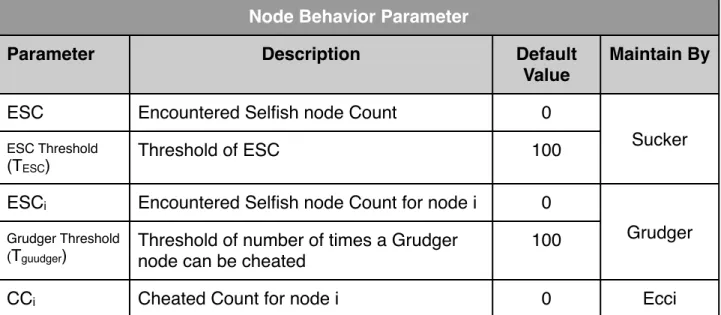
(18) CHAPTER 3 Research Methods. 3.1 Challenges In incentive strategy of DTN, Trusted Bank plays a very important role, responsible for managing incentive information, credit clearance and help to forward messages. In the related work, most Trusted Bank are centralized(or distributed) .We propose a new incentive strategy focused on Mobile Trusted Bank in selfish node environment. By the different characteristics of the node (moving velocity, transmission range, moving paths ... etc.) to find the appropriate Mobile Trusted Bank. Moreover, in traditional algorithm(like Epidemic,PROPHET and Spray and Wait ...) does not take into account the selfish nodes. These original algorithm in selfish nodes environment could cause damage to any well designed opportunistic routing protocol. We consider issues in selfish nodes environment, and add DGT(Dynamic Grudger Threshold) and SI(Social Incentive) to improve performance of original MTBIS. In addition, MTBIS also consider the simulation in selfish node environment. We consider node not only bus and pedestrian , but more varied node behavior. Different nodes based on various different acts are divided into four types (Grudger, and Sucker, and Cheater and Ecci), when a node requested to help forwarding messages when it comes to other nodes, other nodes will make a different behavior, not only selfish node and unselfish node. Hoping this way to achieve reality and diversity of selfish nodes environment in simulation.. 3.2 Mobile Trusted Bank (MTB) In traditional incentive techniques, there is a centralized (or distributed) Trusted Bank in system. Trusted Bank is responsible for managing all nodes Incentive Credit, when a node requested to other node help forwarding, after more than one node to help successfully forwarded the message to the destination node, all of the intermediate nodes will get the reward called “Incentive Credit”. We 9.
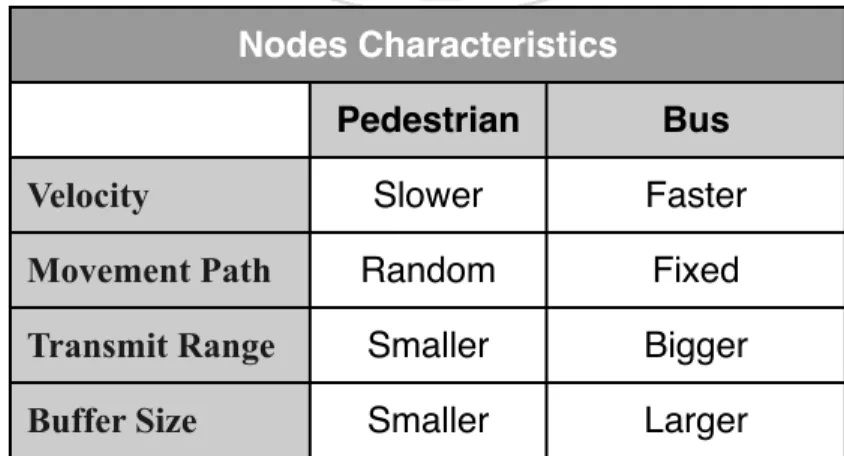
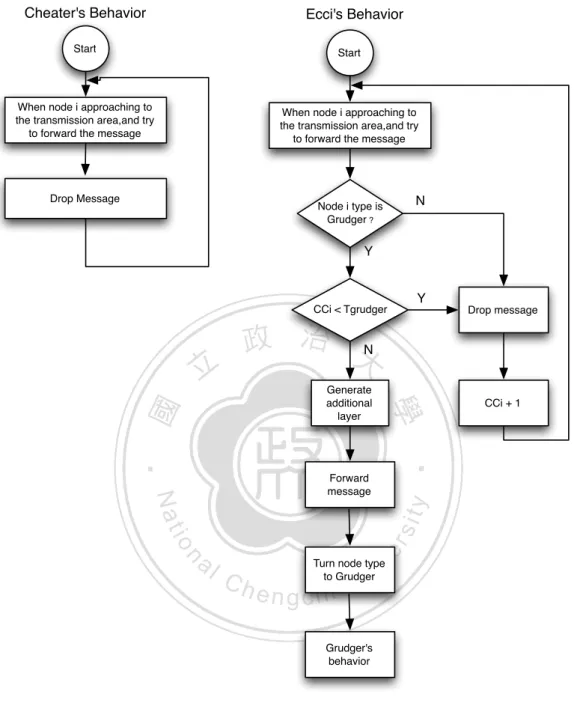
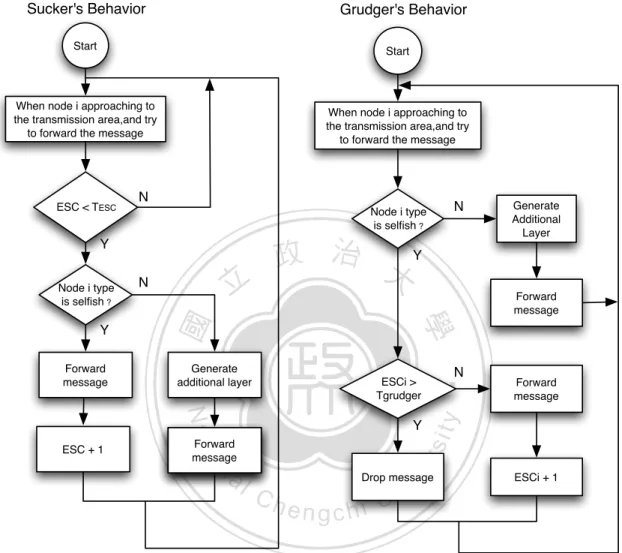
(19) construct a rewarding scheme called “Incentive Credit” for nodes who forwards the message from the source node. Trusted Bank will deduct from the source node’s incentive credit, and assigned incentive credit to nodes who participate in forwarding. In this paper, we focused on Mobile Trusted Bank. Assumed in a city, all nodes can be divided into two major categories the bus and pedestrian. Bus nodes have a fixed moving path, moving faster and larger transmission range, and larger buffer size characteristics of bus (Table 3.1). General node which is pedestrian with a handheld device (such as a PDA or smart phone), moving slower, smaller transmission range, and smaller buffer size characteristics of pedestrian, most of the nodes are moved within a certain range, so we take advantage of these features to the design system. Based on above characteristics, we choose bus node as MTB(Mobile Trusted Bank). MTB just like a bank responsible for managing all nodes incentive credit and credit clearance and help forwarding messages. The nodes will get the qualifications after forwarding messages. When nodes encountered MTB in the future, nodes can use the qualifications we called “Receipt Data” to get the reward we called “Incentive Credit” from MTB, above process called “Credit Clearance”. Nodes can use these incentive credit to request other node to forward messages. If node s help more times, nodes will get more incentive credit. Selfish nodes are stimulated to help forward messages with credit-based incentive strategy. The strategy can further stimulate DTN nodes to improve the DTN’s performance in terns of delivery ratio. Table 3.1 Nodes Characteristics. Nodes Characteristics Pedestrian. Bus. Slower. Faster. Movement Path. Random. Fixed. Transmit Range. Smaller. Bigger. Buffer Size. Smaller. Larger. Velocity. 10.
(20) 3.3 Selfish Nodes Simulation Environment 3.3.1 Selfish Nodes Species The so-called selfish nodes are the nodes request other nodes help forwarding messages, but discard others request. The presence of selfish DTN nodes could cause damage to any well designed opportunistic routing scheme. In order. to simulate the selfish node environment, we proposed. varied selfish nodes behaviors, and implement the incentive strategy we proposed called MTBIS(Mobile Trusted Bank and Incentive Strategy), to solve the selfish node issue and increase the delivery ratio in selfish node environment. We referred to [5] , Richard Dawkins to cite an instance, in order to rid of parasites the birds groom each other. The birds can be divided into two types by different behavior: “Sucker” and “Cheater”. Suckers groom anybody who needs it, indiscriminately. Cheats accept altruism from suckers, but they never groom anybody else, not even somebody who has previously groomed them. In this system, cheater always get benefits from sucker help grooming. Cheat genes will therefore start to spread through the population. Sucker genes will soon be driven to extinction. This is because, no matter what the ratio in the population, cheats will always do better than suckers.Therefore, as long as we consider only these two strategies, nothing can stop the extinction of the suckers. After a period, the extinction of the whole population too. So there is third type called “Grudger”. Grudgers groom strangers and individuals who have previously groomed them. If any individual cheats them, they remember the incident, then they refuse to groom that individual in the future. In the initial period, Sucker will soon be extinct, since cheated so many times by Cheated. After while, there are only two genes : Grudger and Cheater. When Cheater cheated Grudger too many times, Grudger will refuse to help Cheater. In this period, the number of Cheater will soon be decreased, since nobody to help them. Grudger will help each other and in the meantime, Cheater will nearly to be extinct. Next, we considered another type called Ecci(means “behold” in Latin). Ecci is a smart type, cheat everyone and don’t help other at beginning. Now the node realized another will not help if Ecci continue to cheat. Ecci is owning up to owns mistake, when cheated the some node too many times, they begin to help. Ecci is gimmicky node, they cheat other nodes until they discover.. 11.
(21) There are four type nodes, we will use those different behaviors in our simulation environment, and use the incentive strategy we proposed called MTBIS to stimulate selfish nodes to help forwarding.. 12.
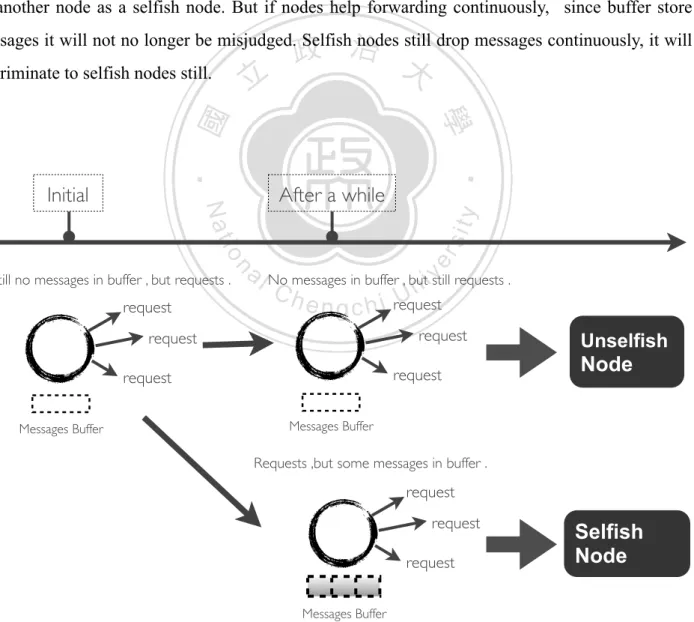
(22) 3.3.2 Nodes Behavior Different nodes based on various different acts are divided into two categories:Cheater and Ecci are selfish node, and Grudger and Sucker are unselfish nodes.(Table 3.2) Table 3.2 Selfish node and Unselfish node Category. Selfish node and Unselfish node Category Species Selfish Node. Cheater and Ecci. Unselfish Node. Grudger and Sucker. In order to implement selfish nodes environment in simulator, we used following arguments. !. in Table 3.3. ESC denote as a node encountered selfish node count, when a node encountered a selfish node, ESC will add one. Nodes will be died when ESC over ESC Threshold, it means nodes has been cheated too much times, and don’t help forwarding for every nodes anymore. Grudger Threshold represents threshold of number of times a Grudger node can be cheated, when ESCi (encountered selfish node count for node i) is over Grudger Threshold , then Grudger don’t help node i forwarding in the future. CCi represents Ecci cheated count for node i, when CCi over Grudger Threshold, Grudger wouldn’t help Ecci, so Ecci ‘s behavior turn to Grudger’ behavior to avoid Grudger discover. And each type of nodes behavior as following :(Fig. 3.1、 Fig. 3.2) Table 3.3 Node Behavior Parameter. Node Behavior Parameter Parameter. Description. ESC. Encountered Selfish node Count. ESC Threshold. Threshold of ESC. (TESC). Default Value 0 100. ESCi. Encountered Selfish node Count for node i. Grudger Threshold (Tguudger). Threshold of number of times a Grudger node can be cheated. CCi. Cheated Count for node i. 13. Maintain By. Sucker. 0 100. Grudger. 0. Ecci.
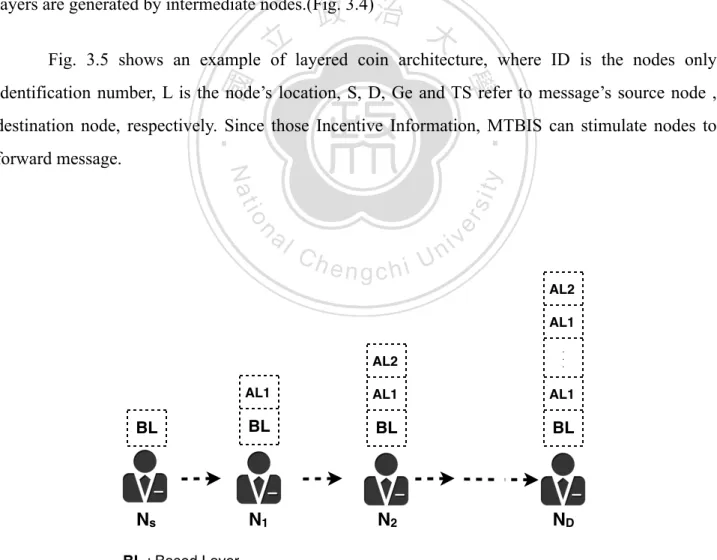
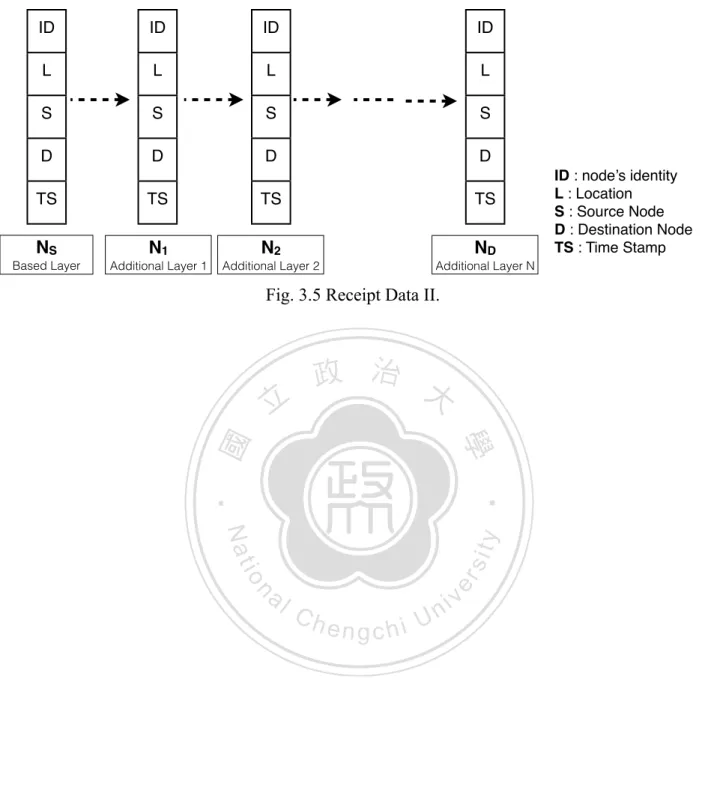
(23) Cheater's Behavior. Ecci's Behavior. Start. Start. When node i approaching to the transmission area,and try to forward the message. When node i approaching to the transmission area,and try to forward the message. Drop Message. Node i type is Grudger ?. N. Y. CCi < Tgrudger. Y. Drop message. N Generate additional layer. Forward message. Turn node type to Grudger. Grudger's behavior. Fig. 3.1 Cheater and Ecci’s Behavior.. 14. CCi + 1.
(24) Sucker's Behavior. Grudger's Behavior. Start. Start. When node i approaching to the transmission area,and try to forward the message. ESC < TESC. When node i approaching to the transmission area,and try to forward the message. N Node i type is selfish ?. Y Node i type is selfish ?. N. Generate Additional Layer. Y N Forward message. Y Forward message. Generate additional layer. ESC + 1. Forward message. ESCi > Tgrudger. N. Forward message. Y. Drop message. Fig. 3.2 Sucker and Grudger’s Behavior.. 15. ESCi + 1.
(25) 3.3.3 The Discrimination between Selfish Nodes and Unselfish Nodes In related work[1] mentioned:”due to the unique features of DTNs, such as the lack of contemporaneous path and high variation in network conditions, it is hard to detect DTN nodes’ selfish behaviors or predetermine a routing path. Therefore, these challenges in DTNs make the existing incentive protocols, which usually rely on a contemporaneous routing, not applicable to DTNs.” In this issue, we proposed a way to discriminate selfish nodes. We can discover selfish nodes characteristics as following : Selfish node has no willing to help forwarding messages, so will drop packets received from others, but request others to forward the messages. So the selfish nodes’s message buffer is empty frequently. In initial stage (Fig. 3.3), node’s buffer is empty when join DTN, it may be mis-discriminate by another node as a selfish node. But if nodes help forwarding continuously, since buffer store messages it will not no longer be misjudged. Selfish nodes still drop messages continuously, it will discriminate to selfish nodes still.. Initial. After a while. Still no messages in buffer , but requests .. No messages in buffer , but still requests .. request. request. request. request. request. request Messages Buffer. Unselfish. Node. Messages Buffer. Requests ,but some messages in buffer .. request request request. Selfish Node. Messages Buffer. Fig. 3.3 The Discrimination between Selfish Nodes and Unselfish Nodes. 16.
(26) 3.4 Receipt Data We assume there are nodes N={Ns,N1 ,N2 ,...... ND} in DTN, and transmission path is Ns -> N1 -> N2 ->.... -> ND. In order to manage the incentive information and to guarantee the incentive strategy working well, each node will maintain this information after forwarding message, we called this incentive information as Receipt Data (Fig. 3.4) similar to layered coin [2]. Each node maintain Receipt Data when forwarding message. The node will get Receipt Data when help forwarding message. Receipt Data like a certificate to prove a node had been helped forwarding message. Node will generate Receipt Data after a node help forwarding. When nodes encountered MTB in the future, nodes can use this Receipt Data to get the reward “Incentive Credit” from MTB. Receipt Data consists of a base layer formed by the source node and multiple additional layers formed by the intermediate nodes. Based layer is generated by source nod, and additional layers are generated by intermediate nodes.(Fig. 3.4) Fig. 3.5 shows an example of layered coin architecture, where ID is the nodes only identification number, L is the node’s location, S, D, Ge and TS refer to message’s source node , destination node, respectively. Since those Incentive Information, MTBIS can stimulate nodes to forward message.. AL2 AL1 AL2. . . .. AL1. AL1. AL1. BL. BL. BL. BL. Ns. N1. N2. ND. BL : Based Layer AL : Additional Layer. Fig. 3.4 Receipt Data I.. 17.
(27) ID. ID. ID. ID. L. L. L. L. S. S. S. S. D. D. D. D. TS. TS. TS. TS. NS Based Layer. N1 Additional Layer 1. N2 Additional Layer 2. ND Additional Layer N. Fig. 3.5 Receipt Data II.. 18. ID : node’s identity L : Location S : Source Node D : Destination Node TS : Time Stamp.
(28) 3.5 Credit Clearance In MTBIS, Mobile Trusted Bank(MTB) is responsible for managing all nodes incentive credit, when a node requested to other node help forwarding, after more than one node to help successfully forwarded the message to the destination node. We construct a rewarding scheme called “Incentive Credit” for nodes who forwards the message from the source node. MTB will deduct from the Source Node Incentive Credit, and assigned Incentive Credit to nodes participate in forwarding in the future when a node encountered MTB. There are several available rewarding models that can be adopted in MTBIS. For example, a popular charging method is paying per message, which means that, for each forwarded packet, each of N intermediate nodes should receive 1 credits, whereas the source needs to pay 1*N in total. When a node encountered MTB, MTB will check Receipt Data ensure the node has qualifications to get incentive credit. If MTB verify successfully, source node will be disbursed credit to pay intermediate nodes, and intermediate nodes will get incentive credit from source node. The algorithm of Credit Clearance is Fig. 3.6.. Nodes After Forwarding. No Relevant Recept Data. Verify Receipt Data. Verify Successfully. Clearance Processing. Source Nodes. Intermediate Nodes. Nodes Disburse Credit. Nodes Receive Credit. End of Clearance. Fig. 3.6 Credit Clearance. 19.
(29) 3.6 Dynamic Grudger Threshold (DGT) The characteristics of Grudger is, if any individual cheats them, they remember the incident and then they refuse to groom that individual in the future. In order to implement, we maintain the parameter called Grudger Threshold. In the real world, Grudger was refused help after being cheated twice . The performance would degrade if. Grudger only help Cheater twice (Grudger. Threshold is 2), since the frequency of node encounter other node may reach thousands times. In order to determine Grudger Threshold, there are two issues while tuning the parameter of Grudger Threshold. First, if the value is set too high, the characteristic of Grudger would be lost, because a node can be cheated many times but is still willing to forward messages, and become a Sucker. Second, if the value is set too low, an Ecci can barely cheat a Grudger, thus loosing the means of using Ecci. In the beginning of the simulation, Grudger Threshold is set to 100, and soon the number of times a Grudger being cheated by selfish nodes are greater than Grudger Threshold, therefore no longer accepts forwarding message for selfish nodes. At last, only Grudger are willing to forward messages for each other, so deliver ratio declines very quickly. Considering this scenario, the value of the parameter is set dynamically, according to the number of selfish node met by a Grudger. The detail is described as follows: First, Grudger will use History List to record every node it has met. Recent history of nodes met by Grudger is used to count the number of selfish nodes. When a Grudger discovers that it encounters too many selfish nodes, it sets its Grudger Threshold to a lower value to reduce the chance of being cheated by a selfish node. On the other hand, when the number of selfish nodes encountered is relatively lower, Grudger raises the value of its Grudger Threshold, meanwhile earning more credit. Our approach is similar different policies for good and bad economy times. From the view of Economics, when the economy is bad (abundant selfish nodes), fiscal austerity should be enforced to regulate expenses (lower Grudger Threshold to avoid being cheated by selfish nodes, but meanwhile earn less incentive credit). When the economy is good (fewer selfish nodes), surplus policy should be enforced, raising the value of Grudger Threshold in order to earn more incentive credit. The algorithm of Grudger Threshold is described in Formula.1, λ is the number of selfish nodes encountered so far, Λ is the total number of nodes encountered. The number of selfish nodes is inversely proportional to. , and Grudger Threshold Upper Bound is the upper bound of. Grudger Threshold. According to our experimental results, when Grudger Threshold is higher than 15000, the performance varies slightly. When a higher Grudger Threshold is chosen, Grudger will 20.
(30) be more likely to be cheated by a selfish node, so we set grudgerThresholdUpperBound to 15000, grudgerThresHoldLowerBound to 50, the results are shown in section 4.3.1.. Grudger Threshold=. { GTU=grudgerThresholdUpperbound GTL=grudgerThresholdLowerbound λ = number of selfish nodes encountered Λ = total number of nodes encountered. Formula.1 Dynamic Grudger Threshold.. 3.7 Social Incentive (SI) In real world, a host will not have the same behavior towards all the other hosts it meets, when we meets friends we could not require any reasons to help forwarding messages. It is expected to have a set of social relationships(friends, family, co-workers, etc) for which it will not require a material incentive in terns of Incentive Credit and willing to help each other. In order to implement, every node maintain History List, record a node who the node meets, and friend list, who the node is friend. The nodes will help forwarding whatever the node is selfish node or unselfish node, when a node is in friend list. Further, we attach priority to all messages, nodes forwarding behavior with priority such as Table 3.4. When the messages are no pay(priority is 0), only unselfish node(Grudger and Sucker) will help forwarding, when the messages are paid(priority is 1), Ecci will help forwarding. When nodes are friends(in friend list, priority is 2), all nodes will help forwarding message include Cheater. When the selfish node percentage is low, the nodes treat priority messages the same as the messages with no priority, as they have no incentive to do otherwise. As the number of selfish nodes increases, selfish nodes will only accept priority messages. Thus, they will transport and exchange 21.
(31) only priority messages increasing accordingly the delivery ratio. Of course, the delivery ratio is also dependent on the ratio of priority vs. no-priority messages, since if all messages will be of high priority than they will also be treated in a non-discriminatory manner. Since the message has attached priority, the nodes will select higher priority to forward. Especially selfish nodes does not help any node to forward message, but after adding SI , selfish nodes will help when other nodes are friends (in friend list). Not only improve the reality of simulation, but also stimulate selfish nodes to begin forwarding messages, and increase the overall performance. Table 3.4 Nodes Forwarding behavior with Priority. Nodes Forwarding behavior with Priority Node Types \ Priority. Cheater. Grudger. Ecci. Sucker. 0(No Pay). ╳. √ / ╳ (be cheated over Grudger Threshold). ╳. √. 1(Paid). ╳. √. √. √. 2 (In Friend List). √. √. √. √. 3.8 MTBIS(Mobile Trusted Bank Incentive Strategy) As above mentioned in section 3.3.2, Grudger can effectively restrain destruction of the selfish nodes. So we design MTBIS based on Grudger’s behavior, include characteristics of Grudger : Grudger will not help a node forwarding if has been cheated over Grudger Threshold , and also include SI and DGT. In forward period when a node in transmission range , MTBIS determine whether a node is friend first (part of SI), then determine the messages are paid or not. When the conditions is positive, node will help forwarding message, if is negative, then determine a node has been cheated over Grudger Threshold, if negative then help forwarding, and don’t help forwarding if positive. During the moving period, nodes will be based on the nodes that have been encountered selfish nodes in the past statistics (maintained in History List) to calculate Grudger Threshold dynamically after forwarding (part of DGT). Nodes will get incentive credit from MTB (called Credit Clearance ) after forwarding. Since adding SI(Social Incentive), Cheater are not like before that don’t help forwarding for every nodes, they begin to help forwarding message when they are friend, otherwise, drop message when they are not friend such as before. And since begin to help forwarding message, they have qualifications to get incentive credit from MTB. The new behavior in MTBIS is shown in Fig. 3.8. 22.
(32) Sucker always help every nodes, it’s the same behavior after adding SI. They will help forwarding before they extinct (has been cheated over ESC Threshold). The behavior of Sucker in MTBIS is shown Fig. 3.9. When Ecci cheated over Grudger Threshold, Grudger wouldn’t help Ecci, so Ecci ‘s behavior turn to Grudger’s behavior to avoid Grudger discover. The behavior of Ecci in MTBIS is shown Fig. 3.10. MTB have a fixed moving path, moving faster and larger transmission range of characteristics, the delivery ratio more higher than other nodes. Since those reasons, MTB will help to all nodes forwarding message as possible.. 23.
(33) Grudger in MTBIS When node i approaching to the transmission area,and try to forward the message. Is a Selfish Node ?. N. Y Is Friends ?. Social Incentive. Dynamic Grudger Threshold. Y. If node encounters MTB?. Forward Message. N. Don't Forward Message to Anyone. N Is Message Paid ?. Y. N Cheated over Grudger Threshold. N. Y. Fig. 3.7 MTBIS Algorithm (Grudger-liked based).. Cheater in MTBIS When node i approaching to the transmission area,and try to forward the message. Is Friends ?. Y. If node encounters MTB?. Forward Message. Y. Credit Clearance. N. N Don't Forward Message to Anyone. Fig. 3.8 Cheater ‘s Behavior in MTBIS.. 24. Y. Credit Clearance.
(34) Sucker in MTBIS When node i approaching to the transmission area,and try to forward the message. Is Alive ?. Y. If node encounters MTB?. Forward Message. Y. Credit Clearance. N. N Don't Forward Message to Anyone. Fig. 3.9 Sucker ‘s Behavior in MTBIS.. Ecci in MTBIS When node i approaching to the transmission area,and try to forward the message. Cheated Node i Tgrudger times. N. Cheater's Behavior. Y. Grudger's Behavior. Fig. 3.10 Ecci ‘s Behavior in MTBIS.. 25.
(35) CHAPTER 4 Simulation and Results. In this chapter, we explain the various parameters and simulation processes, and use ONE (Opportunistic Network Environment) as a simulation environment. We show simulation results to demonstrate the effectiveness of our scheme.. 4.1 Performance Evaluation. In DTN, the main purpose is to achieve the maximum Message Delivery Ratio, lower Latency TIme and less Transmission Overhead. We take the following three arguments to measure network efficiency:. •Message Delivery Ratio = • Latency Time. • Transmission Overhead = In the simulation, we assumed unselfish nodes dose not refuse to help forwarding message, except selfish nodes. We compared with Epidemic Routing、PROPHET Routing、SprayAndWait Routing, we called three of them as traditional routing protocol, since all of them dose not consider selfish node in routing. Epidemic Routing used flooding mechanisms to forward message and relay to all the nearby nodes. It ‘s cause more network overhead than other traditional routing protocol. In order to solve the problem mentioned above, SprayAndWait Routing restrict the number of message copies into the network, it achieve saving network resource. PROPHET Routing calculates each node’s transmission probability using GPS or history of encounter and transitivity.. 26.
(36) 4.2 Assumptions In this paper, we make the following assumptions: Selfish but not malicious. The nodes may be selfish (don’t help other node to forward message) since conservation of power and computing resources. Nodes dose not attack MTB such layer removing and layer adding in [1]. Every nodes can get each other information such as buffer size when starting communication, and can’t be forge also.. 4.3 Simulation Setup In this paper, we used ONE(Opportunistic Network Environment) as simulation software. ONE is based on java program language, MTBIS used ONE as a extension to simulate selfish node environment. The selfish nodes environment used built-in maps the capital Helsinki in Finland (Fig. 4.1), size is 4500m x 3500m, simulation time is 43200Sec (24 Hours). Nodes are divided into two categories: pedestrian and bus. Pedestrian nodes contains Grudger, Ecci, Sucker and Cheater; the bus nodes is MTB. Bus nodes have higher velocity (25~36 Km/h), larger Buffer Size (500 MB) and wider Transmission Range (100m), Pedestrian nodes have slower velocity (1.8~5.4 Km/h), smaller Buffer Size (25 MB) and shorter Transmission Range (10m). There are 85 MTBs and 7 lines, and the total number of Pedestrian nodes are 160 (each type of nodes amount are 40). Every message size is 256KB, data rate is 1 Mbps. Since PROPHET Routing needs warm up time for calculating probability of every nodes. In fairness, the warm up time is 1000 Sec. In this time, all node are not allow forwarding, but moving. Simulation parameters is following table (Table 4.1). Table 4.1 The Parameters of Simulation. The Parameters of Simulation Area. 4500m x 3400m. Interval of message creation. 25-35 Sec. Simulation Times. 43200 Sec (24 Hr). Pedestrian Transmission Range. 10m (Bluetooth interface). Warm up Time. 1000 Sec. MTB Transmission Range. 100m. Number of Nodes. 160 (each node : 40). Pedestrian Buffer SIze. 25MB. Number of MTBs. 85. MTB Buffer Size. 500MB. Data Rate. 1Mbps. Pedestrian Velocity. 1.8~5.4 Km/h. Message Size. 256KB. MTB Velocity. 25~36 Km/h. Interval of message creation. 25-35 Sec. TTL (Time to Live). 300 min. 27.
(37) Bus Line Line 1 Line 2 Line 3 Line 4 Line 5 Line 6 Line 7. Fig. 4.1 The Map of Simulator in “ONE”.. 4.4 Simulation Results We organize this section as below. In Sections 4.3.1,we show the Selection of Grudger Threshold and ESC Threshold we chosen. In Sections 4.3.2 through 4.3.5, we investigate how our incentive strategy performs under various number of selfish nodes, grudger nodes density, delivery ratio in each nodes, respectively.. 4.4.1 The Selection of Grudger Threshold and ESC Threshold In MTBIS, Grudger Threshold (Table 3.3) represent “threshold of number of times a Grudger node can be cheated”. Grudger will not help forwarding message when over Grudger Threshold. ESC Threshold represent “threshold of ESC”. Sucker would be died (in practical it means nodes leave the system) when over ESC Threshold. Two of them are the important parameter to improve the whole network in MTBIS. Therefore, in order to implement Dynamic Grudger Threshold(Section 3.6), we based on those result in this section to decide grudgerThresholdUpperbound and grudgerThresholdLowerbound . In later section, we achieved higher performance significantly after adding Dynamic Grudger Threshold in MTBIS.. 28.
(38) Delivery Ratio. 0.54 Selfish Environment. 0.52 0.50 0.47 0.45. 2. 5. 10. 50. 100. Sucker. 40. Grudger. 40. Cheater. 40. Ecci. 40. MTB. 85. 5000 10000. ESC Threshold Fig. 4.2 The Relationship between ESC Threshold and Delivery Ratio.. Sucker would be died (in practical it means nodes leave the system) when over ESC Threshold. As represented in Figure 4.2, our measurements show that ESC Threshold, delivery ratio is increasing when ESC Threshold is 2 to 5.(for this simulation, the number of nodes is fixed) There are no significant in 50-100, and degrade after ESC Threshold bigger than 50. The reason for this result is the following : as the ESC Threshold is lower(around 2-5), Sucker will soon be died since be cheated by selfish node, so less contribution with Sucker in whole network. As the ESC Threshold is 50, it is reasonable value, since Sucker wouldn’t be cheater excessively, and more contribution in MTBIS. Performance degraded when ESC Threshold bigger than 50, since Sucker be cheated too much excess system can bare; the performance degraded significantly. For these reasons, we choose ESC Threshold fix to 50. Grudger Threshold represent “threshold of number of times a Grudger node can be cheated”. Grudger will not help forwarding message when over Grudger Threshold. As represented in Figure 4.3, Grudger Threshold higher is better for delivery ratio. But for system, in terns of overhead will increase, since cheater can be cheated other nodes more times. For fairness, it’s not fair for those unselfish node that help forwarding, but Cheater drop messages. The value of Grudger Threshold a r o u n d 5 0 0 0 t o 1 5 0 0 0 i n c r e a s e s i g n i f i c a n t l y. F o r t h e s e r e a s o n s , w e s e t grudgerThresholdUpperbound is 15000 and grudgerThresholdLowerbound is 5000.. 29.
(39) 0.50 Delivery Ratio. Selfish Environment. 0.49 0.49 0.48 0.47. 100. 5000. 10000. 15000. 20000. Sucker. 40. Grudger. 40. Cheater. 40. Ecci. 40. MTB. 85. 25000. Grudger Threshold Fig. 4.3 The Relationship between Grudger Threshold and Delivery Ratio.. 4.4.2 Selfish Nodes Density The selfish nodes is most critical role in this paper. Selfish node is defined as, to accept other people's help, but they refuse to forward messages. The presence of selfish nodes could cause catastrophic damage to any well designed opportunistic routing scheme and jeopardize the whole network. In order to increase the intention of the selfish nodes for forwarding messages, we add two more mechanism called SI(Social Incentive) and DGT(Dynamic Grudger Threshold). As the results show, the performance loss is not as severe in MTBIS than other routing protocol in selfish nodes. MTBIS Epidemic. MTBIS(with SI) PROPHET. MTBIS(with DGT,SI). SprayAndWait. 0.60. Delivery Ratio. 0.45. 0.30. Selfish Environment. 0.15. 0. 0. Sucker. 40. Grudger. 40. Cheater. variable. Ecci. 40. MTB. 85. 40. 80. 120. 160. 200. 240. The Amount of Cheaters Fig. 4.4 The Delivery Ratio results of Algorithms - The Amount of Cheaters. 30. 280.
(40) This experiment is to show the performance of protocol under various number of Cheater. In terms of impact of selfishness, the simulation results show, as expected, that the number of the successful message delivery ratio decreases directly proportional with the number of selfish nodes. (for this simulation, the number of Ecci, Grudger and Sucker nodes are fixed, Cheater is variable) After adding Dynamic Grudger Threshold, Grudger adjust Grudger Threshold dynamically. As represented in Fig. 4.4, MTBIS always has higher delivery ratio than traditional protocol (Epidemic, PROPHET and Spray and Wait), this is important shown incentive strategy that stimulate nodes to help forwarding. When the number of Cheater nodes reaches 160 ( the number of Cheater is 4 times than Grudger), Grudger is difficult to restrain Cheater, so delivery ratio begin to degrade. In traditional protocol, Epidemic has higher delivery ratio than other protocol, because Epidemic use flooding manner to forward, a node continuously replicates the messages it has and sends all of them to all the nodes it encounters, if they don’t already have it. In hypothesis, Epidemic has most performance, but not in selfish node environment, since the selfish nodes could jeopardize the performance severely. On the contrary, the delivery ratio of Spray and Wait is the best in traditional protocol, it limited the number of messages copied, reduce the chance that selfish nodes jeopardized. PROPHET use history to predict probabilities for the successful delivery for each node, but in selfish node environment, it’s more difficult to predict, therefore, it has worst delivery ratio. The result also shows that when MTBIS encounters a large number of selfish nodes (number of Cheater 160 to 280), it can resist to being cheated by selfish nodes effectively, and unlike other protocols, its performance do not degrade dramatically in such environment. Another interesting finding is that when a DTN has a small number of selfish nodes (around 40 to 80), its performance actually seems to increase in contrast. This is because, in a completely non-selfish nodes configuration, the number of message exchanges is high, so the node’s buffers tend to overload more quickly and thus more messages are dropped and never reach their destination. Small number of selfish nodes can relieve the situation a node’s buffer size is full that can not store more message. In order to mesure the impact of selfishness, as represented in Fig. 4.5, all of protocol has lose least 29% delivery ratio compare with unselfish node environment. In original MTBIS (without SI and DGT), has most impact of delivery ratio loss from selfish nodes (-41%). After adding SI the delivery ratio are improved reaching -36%, since it stimulate selfish node to forwarding message. 31.
(41) After adding DGT are improved reaching -29% further compare with unselfish node environment, since DTG can calculate Grudger Threshold dynamically according to the number of selfish node from history list. The results represented the delivery ratio of traditional protocol degrade dramatically (more than -46%), this is why the reason we must consider the selfish node in order to implement in real world. In order to observe the improvement after adding DGT (Dynamic Grudger Threshold) and SI (Social Incentive), we shown in Fig. 4.6, the delivery ratio of MTBIS (without SI and DGT) is 0.41, after adding SI is 0.48 (improved 14%), and after adding DGT is 0.53 (improved 9% than before). As the varied selfish node environment, SI can stimulate selfish node to forward, and DGT also adopt to selfish nodes environment. In the analysis of the transmission overhead (Fig. 4.7), since has more chance to reward more message in MTB with SI and DGT, overhead is higher than traditional protocol (Transmission Overhead =. ). In traditional protocol, Epidemic continuously replicates. the messages , therefore, there are highest transmission overhead. PROPHET can’t predict the selfish node from history, it also has higher transmission overhead. In the analysis of the Latency Time (Fig. 4.8), MTBIS use SI and DG effectively, and fully utilized the characteristic of MTB :higher velocity, more quickly delivery message to destination. UnSelfish Environment. Selfish Environment. Delivery Ratio. 0.8 0.6 0.4 0.2 0. Selfish Environ ment. (-41%). MTBIS. (-36%). (-29%). (-46%). MTBIS(with SI) MTBIS(with DGT,SI). SprayAndWait. (-51%). Epidemic. (-47%). Prophet. DTN Routing Algorithms Fig. 4.5 The Delivery Ratio results of Unselfish and Selfish Environment.. 32. Sucke r Grudg er Cheat er Ecci. 40. MTB. Unselfish Environm ent. 160. 40. 0. 40. 0. 40. 0. 85. 85.
(42) 0.6. Delivery Ratio. 0.45 9% 0.3. Selfish Environment. (-26%). 14%. (-30%) 0.15. (-34%). 0. MTBIS. MTBIS(with SI) MTBIS(withDGT,SI) SprayAndWait. Epidemic. Sucker. 40. Grudge r Cheate r Ecci. 40. MTB. 85. 40 40. Prophet. Fig. 4.6 The Delivery Ratio compare with different Algorithms in selfish environment.. MTBIS Epidemic. Transmission Overhead. 40.00. MTBIS(with SI) PROPHET. MTBIS(with DGT,SI). SprayAndWait. Selfish Environment. 30.00. 20.00. Sucker. 40. Grudger. 40. Cheater. variable. Ecci. 40. MTB. 85. 10.00. 0. 40. 80. 120. 160. 200. 240. The Amount of Cheaters Fig. 4.7 The Transmission Overhead results of Algorithms - The Amount of Cheaters.. 33. 280.
(43) MTBIS Epidemic. MTBIS(with SI) PROPHET. Latency Time (sec). 8000.00. MTBIS(with DGT,SI). SprayAndWait. Selfish Environment. 6500.00. Sucker. 40. Grudger. 40. Cheater. variable. Ecci. 40. MTB. 85. 5000.00. 3500.00. 2000.00. 40. 80. 120. 160. 200. 240. 280. The Amount of Cheaters Fig. 4.8 The Latency Time results of Algorithms - The Amount of Cheaters.. 4.4.3 Grudger Nodes Density Grudger plays major role in selfish nodes environment, and Grudger can also restrain the Cheater ‘s destruction in whole network, it can also improve the performance. In this section, we analyzed the number of Grudger various delivery ratio. MITBIS. Delivery Ratio. 0.60 0.48. Selfish Environment. ↑50% 0.35 0.23 0.10. 0. 40. 80. 120. 160. 200. 240. Sucker. 40. Grudger. variable. Cheater. 40. Ecci. 40. MTB. 85. 280. The Amount of Grudger Fig. 4.9 The Delivery Ratio results of MTBIS - The Amount of Grudger Nodes. 34.
(44) As represented in Figure 4.9, if the number of Grudger less than Cheater, opportunity of selfish nodes encountered Grudger are relatively low, so Grudger can’t restrain effectively. (for this simulation, the number of Ecci , Cheater and SUcker nodes are fixed, Grudger is variable) There are number of Grudger increasing from 0 to 40, improved 50% delivery ratio, as we can see Grudger really can restrain selfish node and improve delivery ratio. If grudgers are rare comparison with cheats, the grudger gene will go extinct. Once the grudgers manage to build up in numbers so that they reach a critical proportion, however, their chance of meeting each other becomes higher. When this critical proportion is reached they will start to restrain Cheater’s destruction, and the cheats will be driven at an accelerating rate towards extinction. Another unexpected results, more Grudger can’t improve more delivery ratio. The reason is the density of Grudger relative high, Cheater will be discovered in relatively shorter time, and Cheater has been refused to help forwarding(means Cheater was extinct), then only Grudger help forwarding each other, the delivery ratio is accounted for only Grudger.. 35.
(45) 4.4.4 Delivery Ratio in each Nodes In this section we evaluate the proportion of delivery ratio. Through selfish nodes tend to take advantage of unselfish nodes, but Grudger can effectively deal with performance issues caused by selfish nodes. Cheater. Grudger. Sucker. Ecci. MTB. With MTB Without MTB. Cheater 12% MTB 62%. Cheater 30% Grudger 48%. Grudger 18% Ecci 13%. Sucker Ecci3% 5%. Sucker 9%. Selfish Environment. Sucker. 40. Grudger. 40. Cheater. 40. Ecci. 40. MTB. 85. Fig. 4.10 The percentage of Delivery Ratio in each Nodes.. As represented in Figure 4.10(left pie chart), MTB delivered more message (mostly of proportion of delivery ratio (62%) than other pedestrian nodes (Grudger, Ecci, Sucker, Cheater) in MTBIS, since the characteristics of MTB such as moving faster and larger transmission range, and larger buffer size. (for this simulation, the number of nodes is fixed) In order to evaluate pedestrian nodes individually, the results without MTB shown as Fig. 4.10 (right pie chart), the best of percentage of delivery ratio is Grudger we excepted. It’s shown Grudger’s behavior fit in selfish nodes environment effectively. The percentage of delivery ratio of Sucker is the worst, since Sucker had been taken advantage of selfish nodes, that’s why Cheater’s delivery ratio still 30% through take advantage of Sucker.. 36.
(46) Cheater. Grudger. Sucker. Ecci. Delivered Packets. 1000.00. 750.00. 500.00. Selfish Environment. 250.00. 0. 40. 80. 120. 160. 200. 240. Sucker. 40. Grudger. variable. Cheater. 40. Ecci. 40. MTB. 85. 280. The Amount of Grudger (MTB with DGT,SI) Fig. 4.11 The Delivered Packets results of each Nodes.. As represented in Figure 4.11, a discovery is that the performance of Cheater loss as expected. If grudgers are rare in comparison with cheats, the grudger gene will not work well. Once the grudgers manage to build up in numbers so that they reach a critical proportion (Cheater : Grudger is 1 : 2), however, their chance of meeting each other becomes higher. When this critical proportion reached ,they will start to restrain Cheater’s destruction, and the cheats will be driven at an accelerating rate towards extinction.. 37.
(47) 4.4.5 MTB Density In MTBIS, MTB have a fixed moving path, moving faster and larger transmission range,and larger buffer size of characteristic. In General, MTB play a major role to improve performance in whole network. In selfish node environment, MTB not only responsible for credit clearance, also forwarding message. In this section, we evaluate performance of MTB in selfish node environment. MTBIS Epidemic. MTBIS(with SI) PROPHET. MTBIS(with DGT,SI). SprayAndWait. 0.60. Delivery Ratio. 0.50. Selfish Environment. 0.40. 0.30. 0.20. 0. 5. 25. 50. 70. Sucker. 40. Grudger. 40. Cheater. 40. Ecci. 40. MTB. variable. 85. The Amount of MTB Fig. 4.12 The Delivery Ratio results of Algorithms - The Amount of MTB.. Delivery ratio of PROPHET is lowest than others ,but overhead is relatively low (Fig.4.13) . Since PROPHET chose forwards message to higher delivery probability nodes such as MTB. But still suffer from selfish nodes. Delivery ratio of Spray and Wait is higher compared to the other three traditional algorithms, using MTB’s attributes such as larger buffer size, you can send more packets to MTB to improve Delivery Ratio. When there are more MTB (70 ~ 85), delivery ratio is decreasing due to message duplication. The results of Latency Times (Fig. 4.14) also shown, when there are no MTB ,the Latency Times are higher than after joining MTB, since a node can forward to MTB help relay messages (moving velocity faster than the General node), the Latency Times are significantly reduced.. 38.
(48) The results of Fig. 4.15, MTB can be shown more clearly improvement on systems, after joining MTB will increase efficiency as high as 53% in MTBIS, SI and DGT also improve performance significantly in MTBS. In traditional algorithms, Epidemic is the highest effectiveness of elevation (22%), since MTB can deliver more message. Spray And Wait because limits the number of duplicate packets, the performance also limited. MTBIS Epidemic. MTBIS(with SI) Prophet. MTBIS(with DGT,SI). SprayAndWait. Transmission Overhead. 30.00 22.50 Selfish Environment. 15.00 7.50 0. 0. 5. 25. 50. 70. Sucker. 40. Grudger. 40. Cheater. 40. Ecci. 40. MTB. variable. 85. Number of MTB Fig. 4.13 The Transmission Overhead results of Algorithms -The Amount of MTB. MTBIS Epidemic. MTBIS(with SI) Prophet. MTBIS(with DGT,SI). SprayAndWait. Latency Time (sec). 8000.00 7000.00 Selfish Environment. 6000.00 5000.00 4000.00. 0. 5. 25. 50. 70. 85. Number of MTB Fig. 4.14 The Latency Time results of Algorithms - The Amount of MTB. 39. Sucker. 40. Grudger. 40. Cheater. 40. Ecci. 40. MTB. variable.
(49) Without MTB (0 MTB). With MTB (85 MTB). 0.6 With MTB. Delivery Ratio. 0.475. Without MTB. Sucker. 40. 160. Grudger. 40. 0. Cheater. 40. 0. Ecci. 40. 0. MTB. 85. 85. 0.35. 0.225. 0.1. 30%. MTBIS. 38%. MTBIS(with SI). 53%. MTBIS(with DT,SI). 10%. SprayAndWait. 22%. Epidemic. 19%. PROPHET. DTN Routing Algorithms Fig. 4.15 The Delivery Ratio results of Algorithms (with MTB and without MTB)- The Amount of MTB.. 40.
(50) 5. Conclusion and Future Work. According to the result of our experiment, if we use traditional protocol in the selfish node environment, performance declines very quickly. Therefore, if DTN is applied to the real world without considering the existence of selfish nodes, its performance could be degraded. We propose MITBIS, not only raising the performance under the selfish node environment, but also 34% higher than traditional protocols. In addition, adding SI and DGT also refined the original MTBIS, and performance gained 23%. The result also shows that MITBIS need to take care of selfish nodes, so its overhead is higher than the other three, but better than traditional protocols in any other aspects. The result also shows that when MTBIS encounters a large number of selfish nodes, it can resist to being cheated by selfish nodes effectively, and unlike other protocols, its performance do not degrade dramatically in such environment. In a group mainly formed by cheaters, too few Grudgers is no use, because they have to record all the Cheated that cheated so that they do not forward messages for the second time, and that process takes time. On the other hand, Cheaters won't help Grudger to forward messages, so if the number of Grudger is much fewer than Cheater, Grudger could die very quickly. However, if the percentage of Grudger raises to a critical point, then the chances that a Grudger meet another Grudger and help each other raises. Once the number of Grudger raises, the chances that a Grudger meet a Cheater also raises, avoiding being cheated by the same Cheater, and Cheaters would die quickly because Grudgers refuse to help them forward messages. When the Cheaters are rare, the declining rate of Cheaters will also slow down, leaving very few Cheaters which can survive for a long time. That is because as a minority, it's unlikely to meet a same Grudger twice, so they can still benefit from Grudgers that have not met before. It is unrealistic to hope that nodes are all Sucker(Always help), so the decline of Suckers do not affect the system too much. Nodes that threats the system are Cheater and Ecci, Grudger are used to deal with these selfish nodes, and they are very realistic.. 41.
(51) On the other hand, the environment without any selfish nodes do not have the highest Delivery Ratio, appropriate number of selfish nodes can actually raise the Delivery Ratio, because the buffer in nodes are very limited, and a node can no longer forward messages after its buffer is full, thus decreases the Delivery Ratio. However, with a minority of selfish nodes can solve this problem, because if the buffer in a node is full, forwarding messages to selfish nodes(selfish nodes would drop message at the same time), the space in buffer is freed and is available again for new messages. Although selfish nodes are harmful for the DTN environment, a minority of selfish nodes are still better than none.. 42.
(52) References 【1】Rongxing Lu; Xiaodong Lin; Haojin Zhu; Xuemin Shen; Preiss, B.; , "Pi: A practical incentive protocol for delay tolerant networks," Wireless Communications, IEEE Transactions on , vol.9, no.4, pp.1483-1493, April 2010 【2】Haojin Zhu; Xiaodong Lin; Rongxing Lu; Yanfei Fan; Xuemin Shen; , "SMART: A Secure Multilayer Credit-Based Incentive Scheme for Delay-Tolerant Networks,"Vehicular Technology, IEEE Transactions on , vol.58, no.8, pp.4628-4639, Oct. 2009 【3】Qi He; Dapeng Wu; Khosla, P.; , "SORI: a secure and objective reputationbased incentive scheme for ad-hoc networks," Wireless Communications and Networking Conference, 2004. WCNC. 2004 IEEE , vol.2, no., pp. 825- 830 Vol.2, 21-25 March 2004 【4】Richard T. B. Ma, Sam C. M. Lee, John C. S. Lui, and David K. Y. Yau. 2004. A game theoretic approach to provide incentive and service differentiation in P2P networks. In Proceedings of the joint international conference on Measurement and modeling of computer systems(SIGMETRICS '04/Performance '04). ACM, New York, NY, USA, 189-198. 【5】Richard Dawkins. The Selfish Gene. Oxford University Press, 1989 edition, 1976. 【6】Rongxing Lu; Xiaodong Lin; Haojin Zhu; Chenxi Zhang; Pin-Han Ho; Xuemin Shen; , "A Novel Fair Incentive Protocol for Mobile Ad Hoc Networks," Wireless Communications and Networking Conference, 2008. WCNC 2008. IEEE , vol., no., pp.3237-3242, March 31 2008-April 3 2008 【7】Tanase, M.; Cristea, V.; , "Quality of Service in Large Scale Mobile Distributed Systems Based on Opportunistic Networks," Advanced Information Networking and Applications (WAINA), 2011 IEEE Workshops of International Conference on , vol., no., pp.849-854, 22-25 March 2011 【8】 Alan Demers, Carl Hauser, Dan Greene, John Larson, and Wes Irish, “Epidemic algorithms for replicated database maintenance,” Proceedings of the sixth annual ACM Symposium on Principles of distributed computing, pp. 1-12, August 1987. 【9】Vahdat A and Becker D, “Epidemic routing for partially connected ad hoc networks,” Technical report, Duke University, 2000. 43.
(53) 【10】Cauligi S. Raghavendra, Konstantinos Psounis, and Thrasyvoulos Spyropoulos, “Spray and Wait: an efficient routing scheme for intermittently connected mobile networks,” Proceeding of the 2005 ACM SIGCOMM workshop on Delay-tolerant networking, pp. 252–259, August 2005. 【11】 Silvia Giordano, Alessandro Puiatti, and Hoang Anh Nguyen, “Probabilistic routing in intermittently connected networks,” A World of Wireless, Mobile and Multimedia Networks, International Symposium, pp. 1-6, June 2007. 【12】Mihai Tanase and Valentin Cristea. 2011. Quality of Service in Large Scale Mobile Distributed Systems Based on Opportunistic Networks. In Proceedings of the 2011 IEEE Workshops of International Conference on Advanced Information Networking and Applications (WAINA '11). IEEE Computer Society, Washington, DC, USA, 849-854. 【13】Shevade, U.; Han Hee Song; Lili Qiu; Yin Zhang; , "Incentive-aware routing in DTNs," Network Protocols, 2008. ICNP 2008. IEEE International Conference on , vol., no., pp.238-247, 19-22 Oct. 2008. 【14】Philippe Golle, Kevin Leyton-Brown, Ilya Mironov, and Mark Lillibridge. 2001. Incentives for Sharing in Peer-to-Peer Networks. In Proceedings of the Second International Workshop on Electronic Commerce (WELCOM '01), Ludger Fiege, Gero M\&\#252;hl, and Uwe G. Wilhelm (Eds.). Springer-Verlag, London, UK, 75-87. 【15】Sonja Buchegger and Jean-Yves Le Boudec. 2002. Performance analysis of the CONFIDANT protocol. In Proceedings of the 3rd ACM international symposium on Mobile ad hoc networking \& computing (MobiHoc '02). ACM, New York, NY, USA, 226-236. DOI=10.1145/513800.513828. 【16】Elgan Huang, Jon Crowcroft, and Ian Wassell. 2004. Rethinking incentives for mobile ad hoc networks. In Proceedings of the ACM SIGCOMM workshop on Practice and theory of incentives in networked systems (PINS '04). ACM, New York, NY, USA, 191-196. 【17】Michal Feldman, Kevin Lai, Ion Stoica, and John Chuang. 2004. Robust incentive techniques for peer-to-peer networks. In Proceedings of the 5th ACM conference on Electronic commerce (EC '04). ACM, New York, NY, USA, 102-111. DOI=10.1145/988772.988788 【18】Ari Keränen, Jörg Ott, and Teemu Kärkkäinen. 2009. The ONE simulator for DTN protocol evaluation. In Proceedings of the 2nd International Conference on Simulation Tools and Techniques (Simutools '09). ICST (Institute for Computer Sciences, Social-Informatics and Telecommunications Engineering), ICST, Brussels, Belgium, Belgium, , Article 55 , 10 pages. DOI=10.4108/ ICST.SIMUTOOLS2009.5674.. 44.
(54)
數據
+7
Outline
相關文件
Let us consider the numbers of sectors read and written over flash memory when n records are inserted: Because BFTL adopts the node translation table to collect index units of a
Most existing machine learning algorithms are designed by assuming that data can be easily accessed.. Therefore, the same data may be accessed
MR CLEAN: A Randomized Trial of Intra-arterial Treatment for Acute Ischemic Stroke. • Multicenter Randomized Clinical trial of Endovascular treatment for Acute ischemic stroke in
• When light is refracted into two rays each polarized with the vibration directions.. oriented at right angles to one another, and traveling at
Students are able to use different learning strategies such as inquiry, reasoning, and problem solving skills in various learning activities. Teachers will employ a variety
Co-teaching has great potential when defined as a form of collaboration that involves equal partners contributing different types of expertise to the process of planning,
1.8 Teachers should take every opportunity to attend seminars and training courses on special education to get a better understanding of the students’ special needs and
The booklet is divided into four chapters, which cover the spirit and governance framework of school-based management, scope of school- based management, roles
