Route Throughput Analysis with Spectral Reuse
for Multi-Rate Mobile Ad Hoc Networks
* LIEN-WU CHEN1, WEIKUO CHU1, YU-CHEE TSENG1,2AND JAN-JAN WU31Department of Computer Science National Chiao Tung University
Hsinchu, 300 Taiwan
E-mail: {lwchen; wkchu; yctseng}@cs.nctu.edu.tw 2Department of Information and Computer Engineering
Chung Yuan Christian University Chungli, 320 Taiwan 3Institute of Information Science
Academia Sinica Taipei, 115 Taiwan E-mail: [email protected]
The mobile ad hoc networks (MANETs) have received a lot of attention for its flexible network architecture. While many routing protocols have been proposed for MANETs based on different criteria, few have considered the impact of multi-rate com-munication capability that is supported by many current WLAN products. Given a rout-ing path, this paper provides an analytic tool to evaluate the expected throughput of the route with spectral reuse, assuming that hosts move following the discrete-time, random- walk model. The derived result can be added as another metric for route selection. Simu- lation results show that the proposed formulation can be used to evaluate path throughput accurately.
Keywords: ad hoc networks, mobile computing, mobile networks, routing, wireless
communication, spectral reuse
1. INTRODUCTION
The mobile ad hoc network (MANET) is a flexible and dynamic architecture that is attractive due to its ease in network deployment. Routing is perhaps one of the most in-tensively addressed issues in MANET. Many different criteria have been used in route selection, including hop count [5], signal strength [11], route lifetime [3], and energy con-straint [12]. Among these metrics, hop count may be the most widely used metric in choosing routes. When a hop-count based routing protocol is given multiple paths, the shortest path is normally selected and a random path is selected when there is a tie. This metric has the advantage of simplicity, requiring no additional measurements and incur-ring the least number of transmissions. The primary disadvantage of this metric is that it Received October 22, 2007; revised January 30, 2008; accepted March 6, 2008.
Communicated by Ten-Hwang Lai.
* Y. C. Tseng’s research was co-sponsored by Taiwan MoE ATU Program, by NSC grants No. 93-2752-E-007-001-PAE, 95-2221-E-009-058-MY3, 95-2221-E-009-060-MY3, 2219-E-009-007, 2218-E-009-004, 96-2622-E-009-004-CC3, and 96-2219-E-007-008, by MOEA under grant No. 94-EC-17-A-04-S1-044, by ITRI, Taiwan, by Microsoft under grant FY08-RES-THEME-092, and by Intel Corp.
does not take packet loss or available bandwidth into account, especially when network interfaces can transmit at multiple rates [10]. It has been shown in [4] that a route which minimizes the hop count does not necessarily maximize the throughput of a flow.
While it is true that there is no single route selection metric that is able to best fit all possible routing scenarios in MANET, few works have considered the impact of multi- rate communication capability that is widely supported by many current wireless LAN products. For example, IEEE 802.11b supports rates of 11, 5.5, 2, and 1 Mbps, while IEEE 802.11a supports rates of 6, 9, 12, 18, …, and 54 Mbps. Route selection is more complicated in a multi-rate MANET than in a single-rate environment. Also, there exists an inherent tradeoff between transmission rates and their effective transmission ranges [2]. To support reliable data transmissions, longer-range communications must use lower rates, and vice versa. Auto-rate selection protocols [1, 6] do exist at the link level. Refer-ence [13] proposes a multi-rate-aware topology control algorithm to enhance the network throughput in multi-hop ad hoc networks, and [14] uses fast links (with high nominal bit rate) to improve the system throughput in wireless mesh networks. However, they only focus on static network environment without taking mobility into account. Reference [17] proposes a multi-rate-aware sub-layer between the MAC and the network layers to im-prove resource utilization and to minimize power consumption, but the effect of multi-rate communications at the routing level is not yet fully addressed.
In this paper, we consider a MANET where each wireless link can support multiple rates and has the auto-rate selection capability. Given a routing path, this paper provides an analytic tool to evaluate the expected throughput of the route with spectral reuse, as-suming that hosts move following the discrete-time, random-walk model. The result can be added as a new metric for route selection in MANET. (We comment that we do not intend to propose a new routing protocol here. But the proposed results may be used in many current protocols to compute a new route selection metric.)
The rest of this paper is organized as follows. Section 2 presents our system model. Section 3 shows our analysis results. Simulation results are presented in section 4. Sec-tion 5 concludes this paper.
2. SYSTEM MODEL
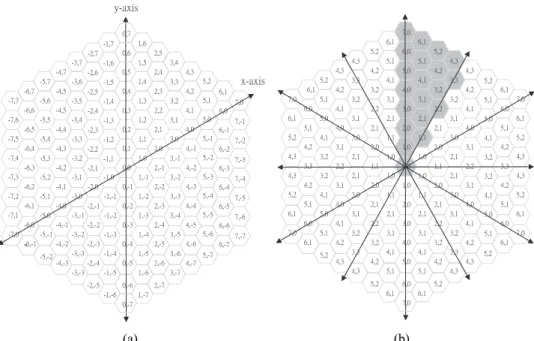
In this paper, we assume that each mobile host roams around in the network area following the discrete-time, random-walk mobility model, which has been widely used in several works [7-9]. In this model, the network area is partitioned into a number of hex-agonal cells, each with radius R and each with a coordinate (x, y), as shown in Fig. 1 (a). Cells on the x-axis are numbered (x, 0), and those on the y-axis (0, y). The coordinates of other cells are obtained by mapping them onto these two axes, as is normally done in the Cartesian coordinate system.
Although hosts actually roam around in continuous time domain, we will work in discrete time domain by dividing time into fixed-length units. We assume that mobile hosts roam around in a cell-to-cell basis following the random walk model. Given a mo-bile host at any cell, it will move into any one of its six neighboring cells in the next time unit with an equal probability of 1/6.
(a) (b)
Fig. 1. (a) A cellular system to model station mobility, and (b) the “folding” of link states.
layer-0. The six neighboring cells of cell (0, 0) are the layer-1 cells, and the outer cells surrounding layer-i cells are said to be on layer (i + 1). The number of cells included in an
n-layer network is 3n2 + 3n + 1. In this paper, we will model the transmission range of a mobile host by a certain number of layers, by assuming its current location at layer 0.
Following [16], we use a vector to represent the state of a wireless link. Specifically, given a wireless link between two hosts located at cells (x, y) and (x′, y′), we represent the link’s state as a vector 〈x′ − x, y′ − y〉. A routing path thus may contain a sequence of vec-tors, each representing a wireless link. For example, a routing path containing hosts in cells (0, 1), (3, 1), and (7, − 3) in the order can be written as [〈3, 0〉, 〈4, − 4〉].
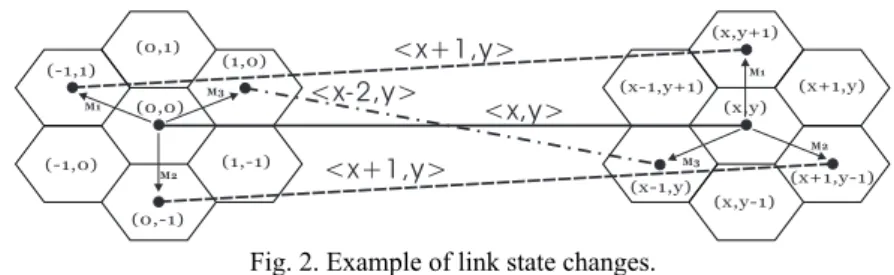
Based on the random walk model, we can derive a probability model for the state change of a wireless link. Let 〈x, y〉 be the state of a wireless link connecting two neighboring hosts at time t, At time t + 1, each of the hosts may move into one of its six neighboring cells with probability of 1/6. This gives 36 combinations of the two hosts' next locations (as shown in Fig. 2), which can be reduced to 19 link states with different probabilities (as shown in Table 1) [16].
Table 1. The probability distribution for a wireless link to switch from state 〈x, y〉 to state 〈x′, y′〉 after one time unit.
〈x′, y′〉 〈x, y〉 〈x−1, y〉 〈x−1, y−1〉 〈x, y−2〉 〈x+1, y−2〉 〈x+1, y−1〉 〈x+1, y〉 〈x, y−1〉 〈x+2, y−2〉 〈x+2, y−1〉
Probability 6/36 2/36 2/36 1/36 2/36 2/36 2/36 2/36 1/36 2/36
〈x′, y′〉 〈x+1, y+1〉 〈x, y+1〉 〈x+2, y〉 〈x, y+2〉 〈x−1, y+2) 〈x−1, y+1〉 〈x−2, y+2〉 〈x−2, y+1〉 〈x−2, y〉
(0,0) (0,1) (-1,1) (-1,0) (1,-1) (1,0) (0,-1) (x,y) (x,y+1) (x-1,y+1) (x-1,y) (x+1,y-1) (x+1,y) (x,y-1) <x,y> <x+1,y> <x-2,y> <x+1,y> M1 M1 M2 M2 M3 M3
Fig. 2. Example of link state changes.
Suppose that the transmission distance of a host is n layers. Then the number of states for a wireless link will be as large as 3n2 + 3n + 1. To prevent the problem of state explosion that so many states need to be taken into consideration, [15] proposes to merge equivalent cells by “folding” the 12 sectors in Fig. 1 (b) into one (cells of the same indi-ces are equivalent). This reduindi-ces the number of states by around 1/12. Detailed deriva-tions can be found in [15]. We will adopt the state reduction in this paper.
Most current wireless LAN cards support automatic rate selection depending on channel conditions. For example, IEEE 802.11b standard supports four transmission rates: 11, 5.5, 2, and 1 Mbps. When the MAC layer overheads are taken into account (control overheads, contention overheads, collision costs, etc.), the effective link rates may be reduced from 11, 5.5, 2, and 1 Mbps to 4.55, 3.17, 1.54, and 0.85 Mbps, respectively [2]. We assume that the rate of a wireless link will depend on the distance between the two hosts of the link. Reference [2] provides a general theoretical model of the attainable throughput in multi-rate ad hoc wireless networks.
3. ROUTE THROUGHPUT ANALYSIS
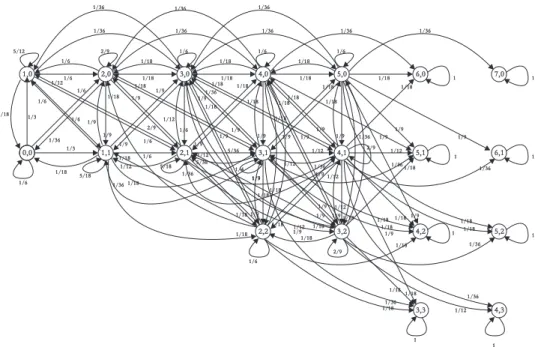
A route consists of a number of wireless links. Given a routing path, our goal is to determine the expected route throughput based on the random walk model. In the previ-ous section, we have derived how a wireless link changes states. Suppose that each mo-bile host has a transmission range of n layers. Then we can model a wireless link by con-sidering an (n + 2)-layer network. For example, Fig. 3 shows the state transition diagram of a wireless link when n = 5. Note that states 〈6, 0〉, 〈5, 1〉, 〈4, 2〉, 〈3, 3〉, 〈7, 0〉, 〈6, 1〉, 〈5, 2〉, and 〈4, 3〉 are “absorbing” states such that x + y > n for state 〈x, y〉, which means the distance between mobile hosts is larger than the transmission range and once a wireless link changes to any of these states, the link is considered broken.
The state transition probability of a wireless link in Fig. 3 can be modeled by a ma-trix M in Fig. 4, where each element Mi,j represents the probability for a link to transit from state i to state j. M k is the kth power of M, which represents the state transition probabilities after k time units. That is,Mi jk, is the probability that a link at state i transits to state j after k time units. Therefore, M is a C(n + 2) × C(n + 2) matrix. The formal derivation of C(n) can be found in [16]:
1 0 ( 1)( 3) 0 and is odd ( ) 4 . ( 4) 1 0 and is even 4 n n n n n C n n n n n = ⎧ ⎪ + + ⎪ > = ⎨ ⎪ + + > ⎪⎩
1,0 0,0 2,0 1,1 3,0 2,1 4,0 3,1 5,0 4,1 6,0 5,1 7,0 6,1 2,2 3,2 4,2 5,2 3,3 4,3 1/3 1/6 1/6 1/3 1 1 1 1 1 1 1 1 1/18 1/36 1/6 1/6 1/6 5/12 1/36 1/6 2/9 1/9 1/18 2/9 1/36 1/9 1/18 1/6 1/9 5/18 1/9 1/6 1/18 1/18 1/36 1/18 1/9 1/6 1/6 1/18 1/9 1/9 1/36 1/9 1/18 1/12 1/9 1/12 1/12 5/18 1/18 5/36 1/18 1/36 1/12 1/36 1/18 1/9 1/6 1/9 1/18 1/18 1/9 1/9 1/36 1/9 1/18 1/18 1/36 1/18 5/36 1/18 1/4 1/18 1/18 1/12 1/9 1/36 1/18 1/36 1/18 1/18 1/9 1/18 1/9 1/6 1/9 1/9 1/18 1/18 1/36 1/18 1/9 1/6 1/9 1/18 1/18 1/9 1/9 1/36 1/9 1/18 1/18 1/36 1/18 1/12 1/18 1/18 2/9 1/12 1/18 1/12 1/18 1/18 1/36 1/18 1/36 1/9 1/36 1/12 1/18 1/9 1/18 1/36 1/12 2/9 1/18 1/9 1/18 1/36 1/12
Fig. 3. State transition diagram of a wireless link when n = 5.
ú ú ú ú ú ú ú ú ú ú ú ú ú ú ú ú ú û ù ê ê ê ê ê ê ê ê ê ê ê ê ê ê ê ê ê ë é = 36 36 36 0 36 0 36 0 36 0 36 0 36 0 36 36 36 0 36 0 36 0 36 0 36 0 36 0 36 10 36 4 36 6 36 2 36 0 36 0 36 4 36 8 36 6 36 1 36 0 36 0 36 6 36 6 36 15 36 2 36 0 36 0 36 12 36 6 36 12 36 6 3 , 4 2 , 5 1 , 1 0 , 2 0 , 1 0 , 0 3 , 4 2 , 5 1 , 1 0 , 2 0 , 1 0 , 0 L L M M O M M M M L L L L M L M
Fig. 4. A state transition matrix of a wireless link when n = 5.
Suppose that a wireless link is in state i at time 0. The probability that the link will become broken at time t is
1 , layer 1, 2 ( , ) t . i j j n n P i t M ∈ + + =
∑
The probability that the wireless link is alive at time t − 1 but becomes broken at time t is 1 2 1 1 ( , ) if 1 ( , ) . ( , ) ( , 1) if 1 P i t t P i t P i t P i t t = ⎧ = ⎨ − − > ⎩
Now consider an α-hop route R = [s1, s2, …, sα], where si, i = 1 … α, is the state of the ith wireless link in R. The probability that R is still alive after t time units is
3 1 1 ( , ) (1 ( , )).i i P R t α P s t = =
∏
−A path breaks when one or more of its links break. So the probability that R becomes broken after t time units is
P4(R, t) = 1 − P3(R, t)
and the probability that R is alive at time t − 1 but becomes broken at time t is 4 5 4 4 ( , ) if 1 ( , ) . ( , ) ( , 1) if 1 P R t t P R t P R t P R t t = ⎧ = ⎨ − − > ⎩
Let each wireless LAN card support m rates, R1, R2, …, Rm, such that rate Ri, i = 1 …
m, will be used if the destination host falls between (including) layers ni-1 + 1 and ni from the source, where n0 = − 1 and nm = n. For example, reference [2] models an IEEE 802.11b card by R1 = 11, R2 = 5.5, R3 = 2, R4 = 1, n0 = − 1, n1=⎢ ⎥⎣ ⎦2n ,n2 =⎢⎣23n⎥⎦,n3=⎢⎣56n⎥⎦ , and n4 = n. Given the initial state of link si, i = 1 … α, the probability that the link’s rate falling in Rj (i.e., the link’s distance is between layers nj-1 + 1 and nj) at time t is
1 6 , layer( 1).. ( , , ) . j j t i j i k k n n P s R t M − ∈ + =
∑
Therefore, the bandwidth of R at time t can be modeled by summing the expected transmission rate of the route over all possible rate combination of links in R at time t as follows 1 1 2 6 1 1 1 1 ( , ) m m m ( , i, ) i i i B R t P s R t α = = = =
∑ ∑ ∑
K × P6(s2, Ri2, t) × … × P6(sα, Riα, t) × f(Ri1, Ri2, …, Riα),where the function f is the transmission rate of the route. It will be estimated in next sub-section. Finally, the expected throughput of route R, denoted by E(R), can be derived by summing the expected route throughput over all possible route lifetime of R as follows
1 1 2 2 5 1 1 1 1 ( , ) ( ) ( , ) . t t t B R t E R P R t t ∞ = = ⎛ ⎞ ⎜ ⎟ = × ⎜ ⎟ ⎝ ⎠
∑
∑
(1)A. Estimation of the Function f(⋅)
In this subsection, we will propose a method to estimate the throughput of a given α-hop route R = [s1, s2, …, sα], where si, i = 1, 2, …, α, is the state of the ith wireless link.
Recall that we represent link state as a vector in a 2-dimensional space. So from each si, we can derive the distance between the two endpoints of the link and the most appropri-ate rappropri-ate ri that should be used by this link. Given such a route R, our goal is to derive its transmission rate f(r1, r2, …, rα). An ideal channel condition is assumed in the estimation such that a transmission fails only when collisions occur.
The hosts in routing path R are numbered from 0 to α such that host 0 is the traffic source and host α the sink of the path. Therefore, si is the state of the link between host i − 1 and host i. Except the sink host, we can assign each host i in R an interference group
Gi, which contains host i and each host j in front of i (i.e., i > j) that can sense the signal of i when i is transmitting. Intuitively, hosts in the same group will not transmit at the same time, but hosts in different groups may be allowed to transmit simultaneously. Note that the interference group Gi is defined to make hosts in Gi can not transmit at the same time. If hosts behind host i are included in Gi, hosts in front of host i and hosts behind host i may be allowed to transmit simultaneously. In our estimation, we model the func-tion f(⋅) by 1 2 1~( 1) ( 1) 1 ( , , , ) , 1 1 max { } i i j G i j f r r r r r α α = − ∈ + = +
∑
K where ( 1) 1~( 1) 1 1 max { } i j ii= α− r+ +
∑
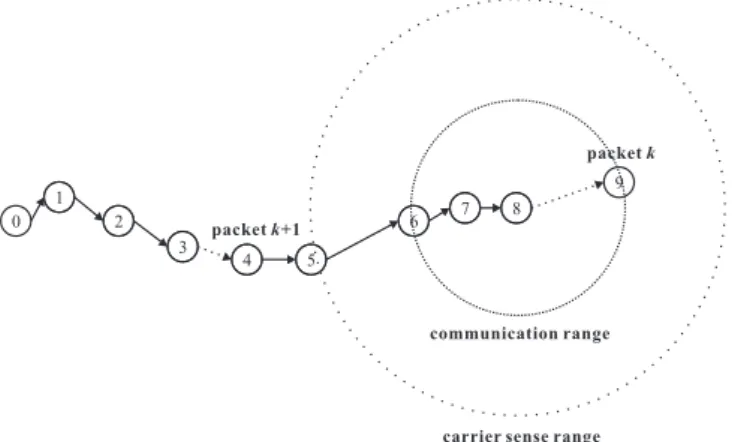
j G∈ r is the time required to transmit a bit along R in the most interfered region.The basic concept of our modulation is that host a receiving packet k + 1 can not be in the carrier sense range of host b sending packet k. In other words, these two packets can be transmitted simultaneously if host a is not in the carrier sense range of host b. From the view of pipelining, when packet k arrived at host b, packet k + 1 has arrived at the host near but out of the carrier sense range of host a. Since the slowest stage of a pipeline dominates its throughput, we take the time T of travelling through the most in-terfered region as the transmission time for packets in R. So every packet except the first one in R only takes T to arrive at sink host α after its previous packet arrived at the sink host. Therefore, the expected transmission time for each packet of size S being trans- mitted in R is ( 1) 1~( 1) max { }, i j i i rS j G rS T α + = − ∈
= +
∑
and the transmission rate of R is TS = 1/( 1)
1~( 1) 1 1
(max { }).
i j i
i= α− r+ +
∑
j G∈ r For example, Fig. 5 shows the 9-hop route with its mostinterfered region including host 5 ~ 9.The links that can transmit concurrently are indi-cated by dashes. We can find that when packet k arrived at sink host 9, packet k + 1 has arrived at host 4. It is because that when host 3 is sending packet k + 1 to host 4, host 8 can send packet k to sink host 9 at the same time without interfering the receiving of host 4. Therefore, packet k + 1 in the 9-hop route only takes the time of travelling through hosts 5 ~ 8 to arrive at sink host 9 after packet k arrived at the sink host. Accordingly, the transmission rate of the 9-hop route is
8 5 7 9 6 8 9 1 1 1 1 1 11 1 1 . j j G r ∈ r r r r r r = +
∑
+ + + +Fig. 5. The 9-hop route with its most interfered region including host 5 ~ 9.
4. SIMULATION RESULTS
In this section, we present our simulation results. Most current products of IEEE 802.11b have a transmission distance of 150 ~ 300 meters. We set the radius of each hex-agonal cell to 10 meters, so hosts’ transmission range is around n = 15 ~ 30 layers. The carrier sense range is set to be the same with the transmission range, and the mobile host is set to randomly select its roaming direction per time unit. Each time unit is set to 10 seconds, so as to model the roaming speed of pedestrians (around 1 m/s). The saturated traffic and unlimited buffer are used in our simulation, and the roaming speed of each mobile host is set to 1 m/s.
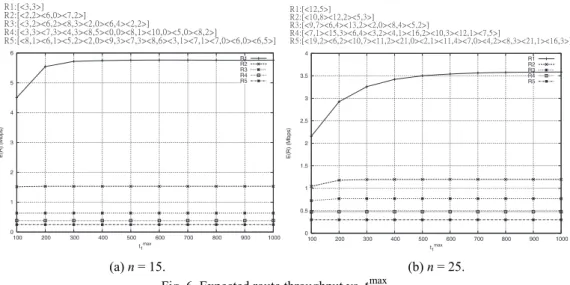
First, we try to determine the level of accuracy. Observe that index t1 in Eq. (1) ranges from 1 to infinity. This is computationally infeasible. So we need to determine an upper bound for t1 (calledt1maxbelow). We randomly generate five routing paths with 1, 3, 6, 9, and 12 hops, respectively. We calculate their expected throughputs by varying t1max
from 100 to 1000. The results are in Fig. 6 for n = 15 and 25, respectively. Since E(R) stablizes at t1max≈ 300, we will set max
1
t = 1000 in the rest of the simulations.
Our results can be used to help route selection in a MANET. Hop count is probably the most widely used route selection criterion. Our result may provide an alternative choice if throughput is the main concern, especially under a multi-rate environment. We pick a source cell and a destination cell, and place some relay hosts between them which are separated uniformly. We evaluate the expected route throughput by varying the num-ber of relay hosts (and thus path length that is the numnum-ber of links in the path). Fig. 7 shows our results for n = 15 and 25, respectively.
In both cases, we see that the throughput increases with the path length initially, but decreases afterwards after certain thresholds. In fact, there are two contradicting factors here. A very small path length implies a low transmission rate in each hop, thus leading to low path throughput. On the contrary, a longer path implies potentially higher rates and the higher degree of spectral reuse, but may risk a higher probability of existence of low-rate links in the path (thus becoming a bottleneck). Our result may be used here to make a smart choice.
(a) n = 15. (b) n = 25. Fig. 6. Expected route throughput vs.t1max.
(a) n = 15. (b) n = 25. Fig. 7. Expected route throughput vs. path length.
Fig. 7 also contains comparisons of simulation and analytical results. In each simu-lation, we evaluate the throughput of the path every time unit until it is broken and then calculate the average throughput. Each simulation is repeated 20,000 times to capture the random roaming of mobile hosts, and then we take the average throughput. As can be seen, the simulated and analytical results are quite close, which justifies the correctness of our derivation.
5. CONCLUSIONS
In this paper, we have shown how to formulate the throughput given a path in which hosts roam around in a random walk model and the communication interfaces have the rate adaptive capability. As far as we know, this issue has not been carefully studied yet.
Simulation results show that the proposed formulation can be used to evaluate path throughput accurately. We believe that the path throughput is a better metric than the tra-ditional metrics, such as the hop count, for route selection in multi-rate ad hoc networks and that the proposed mechanism can be easily embedded into most of the current routing protocols for mobile ad hoc networks.
REFERENCES
1. A. Kamerman and L. Monteban, “WaveLAN II: A high-performance wireless lan for the unlicensed band,” Bell Labs Technical Journal, Vol. 2, 1997, pp. 118-133. 2. B. Awerbuch, D. Holmer, and H. Rubens, “High throughput route selection in multi-
rate ad hoc wireless networks,” Wireless On-Demand Network Systems, 2004, pp. 251-268.
3. C. K. Toh, “Associativity-based routing for ad hoc mobile networks,” Wireless
Per-sonal Communications Journal, Vol. 4, 1997, pp. 103-139.
4. D. De Couto, D. Aguayo, J. Bicket, and R. Morris, “A high-throughput path metric for multi-hop wireless routing,” in Proceedings of ACM/IEEE Mobile Computing
and Networking, 2003, pp. 134-146.
5. D. Johnson, D. Maltz, and J. Broch, “DSR: The dynamic source routing protocol for multihop wireless ad hoc networks,” Ad Hoc Networking, Chapter 5, Addison-Wes- ley, Boston, 2001, pp. 139-172.
6. G. Holland, N. Vaidya, and P. Bahl, “A rate-adaptive mac protocol for multi-hop wireless networks,” in Proceedings of ACM/IEEE Mobile Computing and
Network-ing, 2001, pp. 236-251.
7. I. Akyildiz, J. Ho, and Y. Lin, “Movement-based location update and selective pag-ing for PCS networks,” IEEE/ACM Transactions on Networkpag-ing, Vol. 4, 1996, pp. 629-638.
8. I. F. Akyildiz and J. S. M. Ho, “Dynamic mobile user location update for wireless PCS networks,” ACM Wireless Networks, Vol. 1, 1995, pp. 187-196.
9. J. S. M. Ho and I. F. Akyildiz, “Mobile user location update and paging under delay constraints,” ACM Wireless Networks, Vol. 1, 1995, pp. 413-426.
10. R. Draves, J. Padhye, and B. Zill, “Comparison of routing metrics for static multi-hop wireless networks,” in Proceedings of Special Interest Group on Data
Communica-tions, 2004, pp. 133-144.
11. R. Dube, C. Rais, K. Wang, and S. Tripathi, “Signal stability based adaptive routing (SSA) for ad-hoc mobile networks,” IEEE Personal Communications, Vol. 4, 1997, pp. 36-45.
12. S. Singh, M. Woo, and C. S. Raghavendra, “Power-aware routing in mobile ad hoc networks,” in Proceedings of ACM/IEEE Mobile Computing and Networking, 1998, pp. 181-190.
13. S. Zou, S. Cheng, and Y. Lin, “Multi-rate aware topology control in multi-hop ad hoc networks,” in Proceedings of Wireless Communications and Networking Conference, 2005, pp. 2207-2212.
14. V. P. Mhatre, H. Lundgren, and C. Diot, “Mac-aware routing in wireless mesh net-works.” in Proceedings of Wireless on Demand Network Systems and Services, 2007,
pp. 46-49.
15. Y. C. Tseng and W. N. Hung, “An improved cell type classification for random walk modeling in cellular networks,” IEEE Communication Letters, Vol. 5, 2001, pp. 337- 339.
16. Y. C. Tseng, Y. F. Li, and Y. C. Chang, “On the lifetime of routing paths in multi-hop mobile ad hoc networks,” IEEE Transactions on Mobile Computing, Vol. 2, 2003, pp. 366-376.
17. Y. Seok, J. Park, and Y. Choi, “Multi-rate aware routing protocol for mobile ad hoc networks,” in Proceedings of IEEE Vehicular Technology Conference, 2003, pp. 1749-1752.
Lien-Wu Chen (陳烈武) received his B.S. and M.S. degrees in Computer Science and Information Engineering from the Fu Jen Catholic University and the National Central University in 1998 and 2000, respectively. He has worked for Academia Sinica as an engineer since 2001. He is currently working toward the Ph.D. degree at the National Chiao Tung University. His research interests include resource management in wireless networks, link- layer protocols, and WMAN technologies.
WeiKuo Chu (朱緯國) is currently a Ph.D. student at the
Department of Computer Science, National Chiao Tung Univer-sity, Taiwan. He is also an instructor at the Department of Infor-mation Management, St. John’s University, Taiwan. His research interests include mobile computing, wireless communication, and network security.
Yu-Chee Tseng (曾煜棋) obtained his Ph.D. in Computer
and Information Science from the Ohio State University in Janu-ary of 1994. He is Professor (2000-present), Chairman (2005- present), and Associate Dean (2007-present) at the Department of Computer Science, National Chiao Tung University, Taiwan. From 2006 to present, he is Adjunct Chair Professor at the Chung Yuan Christian University. Dr. Tseng received the Outstanding Research Award, by National Science Council, R.O.C., in both 2001-2002 and 2003-2005, the Best Paper Award, by International Confer-ence on Parallel Processing, in 2003, the Elite I. T. Award in 2004,
and the Distinguished Alumnus Award, by the Ohio State University, in 2005. His re-search interests include mobile computing, wireless communication, network security, and parallel and distributed computing. Dr. Tseng served as an Associate Editor for Tele-communication Systems (2005-present), as an Associate Editor for IEEE Transactions on Vehicular Technology (2005-present), and as an Associate Editor for IEEE Transactions on Mobile Computing (2006-present).
Jan-Jan Wu (吳真貞) received the B.S. degree in Computer Science from National Taiwan University in 1985. She received the M.S. degree and the Ph.D. in Computer Science from Yale University in 1991 and 1995 respectively. She is an associate re-search fellow in the Institute of Information Science, Academia Sinica. Her research interests include parallel and distributed computing, cluster computing and grid computing.