Spontaneous vortex state and ferromagnetic behavior of type-II p-wave superconductors
A. Knigavko
Physics Department, National Taiwan University, Taipei 10764, Taiwan, Republic of China B. Rosenstein
Electrophysics Department, National Chiao Tung University, Hsinchu 30043, Taiwan, Republic of China ~Received 20 January 1998!
The mixed phase in type-II superconductors with equal spin p-wave pairing is considered using the Ginzburg-Landau approach. Due to direct spin coupling of the condensate to magnetic field the mixed state acquires ferromagnetic properties. For sufficiently large Zeeman coupling a spontaneous vortex phase appears at H50 and exists and for an arbitrarily large magnetic field. The Meissner phase therefore completely disappears. Vortices become thinner when H grows. There exists a value of Zeeman coupling above which, in the presence of external magnetic field, a mixed phase might occur even for temperatures above Tc. The
structure of the vortex core is markedly different from the usual one.@S0163-1829~98!06137-2#
I. INTRODUCTION
In the majority of conventional low-Tc superconductors pairing occurs in the s channel. In this case the Cooper pair does not have total spin and an external magnetic field influ-ences superconductors via coupling to orbital motion of the pairs only. Although high-Tc cuprites are most probably d-wave superconductors, direct magnetic coupling to the spin of the Cooper pair should be still insignificant.1The situation might be different in certain cases of p-wave paring. The magnetic field violates time-reversal invariance and is an ex-tremely effective pair breaker for s-, d-, and certain p-wave states,2but it does not break pairs with parallel spins of con-stituent fermions.
The p-wave pairing is suspected to occur in a recently discovered new class of Ru-based superconductors Sr2YRu12xCuxO6.
3
At the same temperature of about 60 K, at which superconductivity sets in, these materials begin to exhibit basic ferromagnetic properties like hysteresis loop. Experimental observation of a positive remanence suggests the existence of spontaneous magnetization in the absence of an external magnetic field. Various conventional sources of ferromagnetism, independent from but coexisting with superconductivity,4,5 cannot be ruled out. However, exact overlap of superconductivity and ferromagnetism naturally suggests that in these particular materials Cooper pairs might in fact be magnetic moments and that they themselves are responsible, at least partially, for overcoming the usual dia-magnetic response of the superconductor. Of course, in prin-ciple, the critical temperatures of transition to ferromagnetic and superconducting states can simply accidentally coincide, but the ‘‘same-mechanism’’ scenario is nevertheless worth taking a look at.
In this paper we explore in some detail this possibility in the case of type-II superconductors using the phenomeno-logical Ginzburg-Landau ~GL! approach. Superconductors obtained by Wu and collaborators3are believed to be of type II, similar to high-Tccopper oxides, although at present their unusual magnetic properties introduce ambiguities in
stan-dard direct methods of measurement of coherence length and penetration depth. Our study turned out to be interesting in its own right ~even with no direct relation to the above ex-periment!, since the vortex-matter physics happens to be quite nonstandard. The same GL equations might describe other physical systems. Microscopic derivation of GL equa-tions for p-wave pairing has been recently performed by Xu
et al.6in connection to Sr2RuO4.
Within the framework of the phenomenological GL theory nonzero spin of the Cooper pair is taken into account by introducing an order parameter of the vector type. It is directly coupled to an internal magnetic field through a Zeeman-like term in the free energy. An external magnetic field penetrates a type-II superconductor via creation of vor-tices in the bulk of the sample. Formation of each vortex is accompanied by both the energy loss due to vortex line for-mation, and the energy gain due to the energy of the pen-etrating field itself. Now, however, it is also accompanied by an additional energy gain due to direct interaction of the penetrating field with the spin of the condensate. If this in-teraction is sufficiently strong, the total line energy of a vor-tex can become negative and consequently instability devel-ops. The usual hexagonal lattice vortex structure will form even for the system at zero external magnetic field. This state can be characterized as a spontaneous vortex state.7 At the same time there appears a ferromagnetic moment of the su-perconductor associated with the bulk of the condensate that prevails over the conventional diamagnetic moment due to screening by supercurrents.
In Sec. II we formulate the model and investigate its main features. As in heavy-fermion systems,8there are two quartic terms in the GL free energy and there exist two qualitatively different superconducting states. One has rather conventional magnetic behavior and we concentrate on the more interest-ing state allowinterest-ing ferromagnetism. Different types of H-T phase diagrams are possible for different strengths of Zee-man coupling. Anticipating the derivation, we present the diagrams in Fig. 1. When the direct spin coupling increases, the magnetic behavior of the superconductor changes
dra-PRB 58
matically: from essentially diamagnetic, even perfectly dia-magnetic in the Meissner phase @Fig. 1~a!#, to essentially ferromagnetic@Fig. 1~c!#. At nonzero magnetic field a mixed state can exist even beyond Tc because Zeeman coupling facilitates creation of the Cooper pairs along with the usual destruction of the condensate@Figs. 1~b! and 1~c!#. For large, but still of a quite realistic order of magnitude of the cou-pling, the Meissner phase disappears completely@Fig. 1~c!#. Below Tc, a spontaneous vortex phase appears at H50 and exists for an arbitrarily large magnetic field.
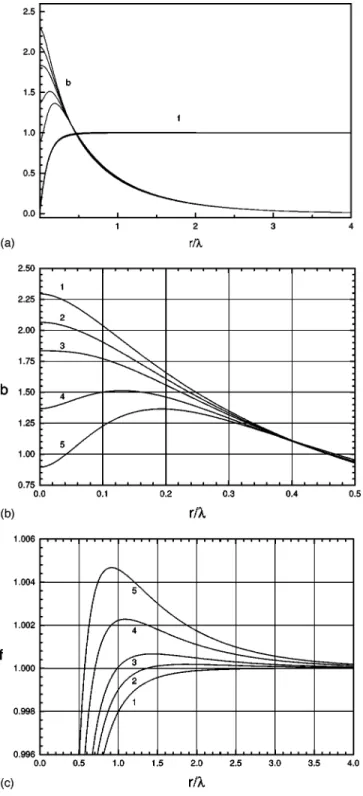
In Sec. III the model is studied using a London approxi-mation. Transition to the normal state is studied in Sec. IV. In Sec. V we find the single-vortex solution numerically. The vortex core structure is quite different from that of an usual Abrikosov vortex in the s-wave superconductors. The phase diagram and the magnetization curve are also qualitatively calculated and discussed beyond London approximation. Vortices become thinner when H grows making room for
more vortices to squeeze in. Conclusions and some generali-zations are discussed in Sec. VI.
II. GENERAL PHENOMENOLOGICAL FORMULATION
Within the general framework of the Ginzburg-Landau approach in unconventional superconductors,9 the p-wave pairing in an isotropic material is described by the order parameter ci that has three complex components: i51,2,3. In the absence of magnetic field the free-energy density is
F5 \ 2 2m*~]jci!~]jci!*1Fpot, ~1! Fpot52acici*1 b1 2 ~cici*! 21b2 2 uciciu 2.
It has the following independent symmetries. The spin rota-tions, forming group SOs pin(3) act on the index of the order-parameter field, so that it transforms as a vector. Three-dimensional ~orbital! space rotations forming different SOorbit(3) group, act on spatial coordinates and the electric-charge transformations, forming the U(1) group, rotate the complex phase of the order parameter. Note two independent quartic terms. This is similar to that of heavy fermions ~where order parameter usually has two components! or liq-uid 3He for which the order parameter is more complicated. The vacuum structure can be studied using methods devel-oped in these fields.8,10
This free energy has been already considered by Burlach-kov and Kopnin in connection with p-wave organic superconductors.11 It is not, strictly speaking, the most gen-eral possible free energy for the p wave. Recently, an attempt has been made to derive the GL energy from reasonable microscopical models describing Sr2RuO4.6In principle, for strong spin-orbit coupling there is no separate spin rotation symmetry, just overall rotations. In this case one can add an additional two terms even for an isotropic superconductor.13 It is sufficient, however, for the purposes of the present paper to consider free-energy ~1! even not assuming weak spin-orbit coupling. Our results essentially depend only on the existence of Zeeman coupling in GL-free energy expansion. The Zeeman-like term that will be introduced below@see Eq. ~6!# is also allowed by the symmetry considerations in the case of strong spin-orbit coupling as well as for weak break-ing of full rotational symmetry by the crystal field. It is only necessary to have a nonunitary ~broken time-reversal sym-metry! superconducting phase with an order parameter that has at least two components. This generalization can be eas-ily made.
We use the following convenient parametrization of the order parameter:
c5 f~n cosf1im sinf!, ~2!
FIG. 1. Phase diagrams of equal spin p-wave superconductor with different strength of Zeeman coupling g:~a! g,gc2, ~b! gc2 ,g,gc1, ~c! g.gc1. The solid lines present lines of transition to
the Meissner state and the normal state. The dashed line is vortex lattice melting line ~not calculated in the present paper!. Dotted lines are boundaries of validity of different approximations used.
where f.0, n and m are arbitrary unit vectors and 0<f <p/2. Using this parametrization the homogeneous part of the free-energy density takes the form
Fpot52af21 b1 2 f 41b2 2 f 4~cos22f1~mn!2sin22f!, ~3! which can be easily minimized to give the two phases. In phase I,b2.0, c5 fn1im
A
2 , n'm,f5p/4, f 25a b1 , ~4!while in phase II,b2,0, various vacua are given by
c5 f eifn, n56m; f25 a
b11b2
. ~5!
In phase I both the spin-rotation SOs pin(3) symmetry and the superconducting phase U(1) symmetry are broken, but a diagonal subgroup U(1) survives. It consists of rotations by angle u around the axis n3m[l that are accompanied by gauge transformations eiu. The vacuum manifold in this phase is isomorphic to SO(3). In phase II the superconduct-ing U(1) symmetry is also broken, however the spin rotation SOs pin(3) is only partially broken down to its SO(2) sub-group. There is an additional unbroken discrete symmetry that consists of a simultaneous change of the gauge phase by
p and change of the sign for n. The vacuum manifold in phase II is therefore isomorphic to S2^U(1)/Z2. From Eqs. ~4! and ~5! it is seen that stability of phases is achieved for
b1.0 in phase I and for b11b2.0 in phase II. Energy densities of the condensate are 2a2/2b1 and 2a2/2(b
11b2) correspondingly.
Gibbs free-energy density in the presence of electromag-netic interactions is
F5Fpot1Fgrad1Fmagn2
BiHi 4p 1 Hi 2 8p, ~6! Fgrad5 \2 2m*~Djci!~Djci!*, Fmagn5 Bi2 8p2mSiBi,
where Di[]i2i(e*/c\)Ai, rot A5B. The second term in
Fmagn is the direct magnetic coupling to spin Si [2i«i j kc*jck carried by the order-parameter field. Of course, due to this Zeeman-like term~even in the absence of external magnetic field!, separate spin- and orbital-rotation symmetry groups are broken down to an overall rotation group: SOs pin^SOorbit→SOrot. In principle, one more in-dependent gradient invariant is possible:8
~Djci!~Dicj!*1~Dici!~Djcj!*.
We will not introduce it and instead assume a larger symme-try even in the presence of external magnetic field. It is as-sumed that an external magnetic field is always oriented along the third (z) direction: H15H250. In this case the free energy, Eq.~6! is still invariant under two-dimensional spin rotations SOs pin(2) in the x y plane, in addition to the orbital SOorbit(2). The additional derivative term does not respect this symmetry. We assume its coefficient to be small and thus avoid severe complications of considering noncy-lindrically symmetric vortices created by such a term. Its influence has been thoroughly studied in the context of heavy-fermion superconductors8 and in the present context can be considered later perturbatively, similar to the recent treatment of the anisotropic d-wave situation.14
Using the parametrization of Eq. ~2! allows us to make several interesting observations. We see that S5 f2sin 2fn 3m[ f2sin 2fl. In phase I the projection of the spin of a Cooper pair S on the quantization axis determined by the vector l is equal to either11 or 21, reflecting spontaneous time-reversal symmetry breaking. In phase II this projection is equal to 0.
The gradient and magnetic parts of the free-energy den-sity take form
Fgrad5 \2 2m*~]if! 21 \ 2 2m*f 2
F
~] if!21cos2f~]in!21sin2f~]im!2 22e\c*AiS
~nm!]if1sin 2f n]im2m]in 2D
1S
e* \cD
2 Ai2G
, ~7! Fmagn5 1 8pB 22mf2sin 2flB, ~8!from which the following equation for the field A can be obtained: e*\ m*cf 2
S
~nm!] if1sin 2f n]im2m]in 2 2 e* \cAiD
5S
1 4p¹3~¹3A!2m¹3~ f 2sin 2fl!D
i . ~9!The ‘‘supercurrent’’ Eq. ~9! shows that superconducting ve-locity is given~in units of \/m*) by n]im in phase I, while it is]if in phase II. Next we deduce, after integration along a closed contour, that the flux is quantized in units of F0 [hc/e* ~for definiteness we assume that e*.0). At this
point it is convenient to introduce magnetic penetration depthl[ (c/e*f0)
A
m*/4p, where f0 should be taken from Eq. ~4! for phase I or from Eq. ~5! for phase II, and also coherence length j[\/A
2am* and dimensionless Ginsburg-Landau~GL! parameterk[l/j.The equation for the order-parameter field creads 2aci1b1~cjc*j!ci1b2~cjcj!ci* 2 \ 2 2m*Dj 2c i1im«i j kcjBk50. ~10! It is very bulky to be presented here in the parametrization of Eq. ~2!.
Being interested in the magnetic properties of a p-wave superconductor that arise because of direct Cooper-pair spin coupling to magnetic field, in the following sections we will concentrate on phase I only. Phase II is quite similar to usual
s-wave superconductors in a sense that the condensate does
not carry spin.
Equations~9! and ~10! are difficult to solve analytically in the general case and we therefore have to resort to approxi-mations. We will consider situations that possess transla-tional symmetry along z axis, the direction of the magnetic field, and from now on spatial index i will take only two
values: i51,2. This, in general, by no means precludes n or m to be oriented out of the 1-2 plane.
Two standard approaches are used in the following sec-tions. The first~Sec. III! is for almost isolated vortices when distance between them a5
A
F0/B is larger than the mag-netic penetration lengthl ~region 1 of H-T diagram in Fig. 2!. Here an analytic solution for an isolated vortex in the London approximation is used to show that a spontaneous vortex state can appear and to construct the magnetization curve. Then~Sec. IV! the opposite limit in which the super-conductivity is very weak, i.e., f!1, allows linearization of the equations and can also be solved ~region 3 in Fig. 1!. Finally in Sec. V, a more complicated, but more important, intermediate regime is considered ~region 2 in Fig. 1!. Here different approximations and numerical methods are neces-sary.III. LONDON APPROXIMATION: DISAPPEARANCE OF MEISSNER PHASE
The London approximation assumes that the vacuum has the form that is determined by the homogeneous part of the free energy ~3! almost everywhere except in some singular points. The approximation is applicable mainly in the case of the large GL parameter k. In the presence of singularities, a vacuum state can gradually vary into another such state~still belonging the vacuum manifold defined earlier! and in this way a vortex is formed. The structure of the vortex core is outside of range of validity of this approach and will be investigated in Sec. V.
To derive the London equations we take the general vec-tor equation for the superconducting current, Eq. ~9!, and substitute cin the form given by Eq.~4!. This leads to
e*\ m*cf0 2
S
n] im2 e* \cAiD
5S
1 4p¹3~¹3A!2mf0 2¹3lD
i , ~11! where f025a/b1.To find the single-vortex solution, we impose, as usual, cylindrical symmetry and require appropriate behavior as r →`, namely,c5(ex1iey)exp(ivw), or
n5excosvw1eysin vw, m52exsin vw1eycosvw,
wherewis azimuthal angle and integerv stands for vorticity.
l[n3m always points upwards in the direction of external magnetic field so as to minimize the Zeeman term in the energy~8!. This yields the equation for azimuthal component of the vector potential A(r):
\e* m*cf0 2
S
v r2 e* \cAD
1 1 4pS
A¨1 A˙ r2 A r2D
50. ~12!We observe that this equation that governs the behavior of a vortex in the p-wave superconductor is essentially the same as that for an s-wave superconductor. The solution is well known to be A~r!5vF0 2pl
F
l r2K1S
r lDG
.Multiple vortices are unstable and we therefore setv51.
Let us now estimate the line tension of the vortex«V in the present case. Although Eq.~12! does not reflect the pres-ence of Zeeman coupling 2mSiBi of the spin to the mag-netic field at all, the free energy does depend, of course, on
m. Thus, the energetics changes considerably as compared to the s-wave vortex. Provided m.0, the Zeeman term makes an additional negative ‘‘bulk’’ contribution «Z to the usual value of vortex line tension«L.
15
Summing up the two, one obtains
«V[«L1«Z'«0lnk2mF0f0 25«
0~lnk2g!, ~13! where the notation «05(F0/4pl)2 was used and a conve-nient dimensionless parameter g was introduced by last equality. Since the relation
m5 e*\
2m*cg ~14!
holds, g can also be viewed as an effective Lande factor. However, in the present context, it is just a phenomenologi-cal parameter, in the spirit of the Ginzburg-Landau approach. From Eq. ~13! we see that lower critical field becomes renormalized and diminishes:
Hc1~g!5 F0
4pl2~lnk2g!. ~15! Linear dependence of the lower critical field on g in Eq.~15! coincides with conclusions of earlier work by Tokuyasu
et al.12Ultimately, in the case of
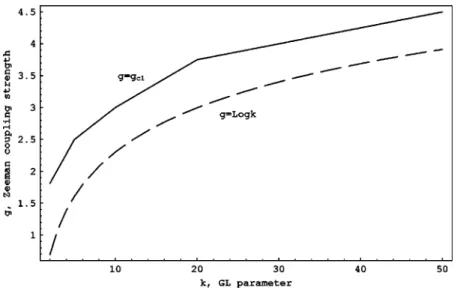
g>gc15ln k, ~16! the line tension «V becomes negative and vortices will be created copiously until repulsive interaction between them overpowers the energy gain due to Zeeman coupling. This is
the most unusual situation in which the ground state of a superconductor at zero magnetic field spontaneously be-comes inhomogeneous. Another situation of inhomogeneous ground state in the superconducting phase with spontane-ously broken time-reversal symmetry was considered in con-nection to heavy-fermion systems by Palumbo et al.,16while inhomogeneous ground states of a superconductor described by a one-component order parameter in the presence of an external magnetic field were extensively studied by Vos
et al.17
Peculiarity of the London approximation in our case re-sults in the interesting fact that vortex interaction does not change at all as compared to the usual s-wave case15 up to the values of external field where this approximation ceases to be valid. To show this we consider the free energy of collection of vortices separated by distances much larger than vortex core size. Additional contribution comes from the term 2mL*SBd2x52mL* f2lBd2x. It is equal to the
total flux through the sample since, within the London ap-proximation, the vortex core’s contribution to the integral is ignored. Flux is an additive function of the number of vorti-ces and thus the above term does not influence the interac-tion between vortices.
As a straightforward consequence of such a lack of the interaction renormalization, we can get the B-H curve of the vortex structure considered in weak fields B'F0/4pl2from that of the usual vortex structure simply by shifting the or-dinate axis on the B-H plot to the right by some amount proportional tom ~see Fig. 2!. A standard calculation18 sum-ming up z nearest neighbors (z56 for triangular lattice! in-teractions and neglecting contributions of the cores gives
B5 2F0
A
3l2F
ln 4pl2 3F0 @H2Hc1~g!#G
22 .In the case g.gc1 the line, as expected, crosses the B50 axis. This means that the Meissner phase completely disap-pears and the spontaneous vortex state is formed instead@see Figs. 1~b! and 1~c!#. The spontaneously created field, the remanence, is Br5 2F0
A
3l2F
ln g2lnk 3G
22 . ~17!This field rather then Hc1 has a physical meaning under present circumstances. Now we turn to the opposite limit of situations in which the order parameter is small compared to its vacuum value.
IV. TRANSITION TO NORMAL STATE: ABSENCE OF Hc2FOR T<Tc
The presence of strong Zeeman coupling should signifi-cantly modify also the transition to the normal state. When the order parameter becomes small, the quartic terms in the free-energy equations~1! and ~6! are negligible compared to the quadratic ones. Simultaneously the magnetization be-comes small and therefore one can replace B by H in the linearized equations. If the direction of the magnetic field is
xˆ3, the dependence of the order-parameter field on x3has the form of a plane wave. It is also clear that the equation forc3 decouples and is the same as the usual s-wave equation. Its
eigenvalues arean35H (\e*/m*c) (1/21n), where n is a natural number. Dependence of c1,c2 on x1,x2 is to be found from the following system of equations:
\2 2m*~D1 21D 2 2!c i1aci2imH«i jcj50, ~18! where Dj5]j2i (e*H/2\c) «j ixj, «i j being the antisym-metric tensor and j,i51,2. This coincides with the nonrela-tivistic Schro¨dinger equation for a spin 1/2 particle in mag-netic field. It can be disentangled by changing variables to
c65c16ic2 and writing covariant derivative operators via D65D16iD2. The eigenvalues are
an65H \e*
2m*c~16g12n!, ~19!
where definition~14! of g was used. If there are only positive eigenvalues for all components of the order parameter, the phase transition from a superconducting state to a normal one occurs at the value of an external magnetic field that corresponds to the lowest eigenvalue amongan6,an3. This argument gives usc35c150, while thec2component de-termines the upper critical field
Hc2~g!52m*c
\e*
a
12g. ~20!
If, however, the spectrum started from a negative eigen-value, then linearization procedure that led us to Eq. ~18! would have been inconsistent and the quartic terms in the free-energy equation ~6! would have to be retained. Physi-cally such a situation means that the phase transition to the normal state ceases to be of the second order~even neglect-ing fluctuations, as we do throughout this work!. Either the transition becomes of the first order or, more probably, the vacuum rearranges and the transition disappears altogether for any value of magnetic field, no matter how large. The second possibility takes place in our idealized model.
To find the transition line, we therefore look for regions on the H-T plane where the linearization of GL equation is still consistent and the second-order phase transition to the normal state takes place. Coefficients of the GL equations depend on temperature. Let us assume, for simplicity, that the dependence ofais linear:a5a
8
(Tc2T), a8
.0 @recall that in our definitions a is positive in the superconducting state; see Eqs. ~1! and ~4!#, while the other coefficients are temperature independent. In reality this is true only near Tc, but necessary modifications for nonlinear behavior can be easily accommodated within the same framework of Ginzburg-Landau approach. Usually the transition line starts at (Tc,0) and ends at (0,Hc2); see solid line in Fig. 1~a!. We find that the phase transition line starts naturally at (Tc,0) and continues to higher fields, but in the case ofg.gc251 ~21!
turns to higher temperatures instead of lower ones@solid line in Figs. 1~b! and 1~c!#.
Thus superconductivity at nonzero magnetic field can take place at T.Tc. This conclusion, although strange from the
traditional s-wave point of view, is rather natural under present circumstances. Indeed, from the beginning we as-sumed the ferromagnetic coupling of the magnetic field to the condensate that means that the field stimulates formation of Cooper pairs. For the particular pairing considered, pair-ing of p-wave type, the magnetic field is not actpair-ing as a pair-breaking agent. This by no means indicates that the re-sistive transition in highly fluctuating materials ~Ginzburg number not very small! occurs at T.Tc. As is well known,20the resistive transition is associated with the vortex melting line@dashed line in Figs. 1~a!, 1~b!, and 1~c!#, which is much lower then the classical line, especially for tempera-tures close to Tc.
At temperatures higher than Tc @see Figs. 1~b! and 1~c!# superconductivity appears at some finite field, which can be viewed as an analog of conventional Hc2and is given by the same formula~20! with negativea. At fields slightly higher than this threshold value, magnetization of the sample due to developing superconducting state can be calculated by stan-dard methods15 taking into account nonlinear terms in the GL equations perturbatively. The result reads
M5 ~12g! 2 4pbA@2k22~12g!2#
S
H12m*ca 8 \e* T2Tc g21D
, ~22! where k5 (m*c/\e*)A
b1/2p and bA5^
(cici*)2&
/^
cici*&
2. Note that the magnetization is positive at T.T c. The result~22! is valid in the region 3 on the H-T diagram ~see Fig. 1! and, of course, not in the vicinity of the point
g5gc251 itself. Similarly, one can analytically obtain mag-netization in the case of g,1 and H&Hc2(g), T,Tc. It is again given by the same formula~22! and it is negative.
The unusual shape of the normal to mixed-state transition line in particular means that for T,Tcthere is no Hc2at all @Fig. 1~b!#. The vortex density therefore is rising indefinitely with H. How could this happen? It turns out that vortices become thinner. If one defines~square of! coherence length as a ratio of the coefficient of the derivative term in free energy to that of the quadratic in the order-parameter term, it would be given by
j2~T,H