
以資料探勘法鏈結顧客知識管理於創新性產品開發專案之研究
112
0
0
全文
(2) ͽྤफ़ଣછڱᙥඕᜪۢމᙊგநٺ౹າّயݡฟ൴९̝ࡁտ LINKING INNOVATIVE PRODUCT DEVELOPMENT WITHCUSTOMER KNOWLEDGE: A DATA-MINING APPROACH ࡁ!!տ!!Ϡ!Ĉౘ!ϖ! !!!!!!!!!!!ܫStudentĈYung-Hsin Chen !ጱ!ି!Ĉᛂ!ഈ!ᆫ!౾̀!!!!!!AdvisorĈ Dr. Chao-Ton Su Ւ!ϖ!!౾̀!!!!!!!!!!!!!!!Dr. Yung-Jye Sha. ઼ϲϹ఼̂ጯ ̍ຽ̍ᄃგநጯր ౾̀ኢ͛ A Dissertation Submitted to Industrial Engineering and Management College of Management National Chiao Tung University In Partial Fulfillment of the Requirement For the degree of Doctor of Philosophy In Industrial Engineering July 2005 Hsinchhu, Taiwan, Replic of China 中華民國九十四年七月二十七日.
(3) 致. 謝. 承蒙指導教授 蘇朝墩博士及沙永傑博士悉心指導與鼓勵,並對本文 逐字斧正,使本文得以完成。受教多年,其嚴謹治學與謙恭處事之態度 和樂觀、積極的精神,一直為筆者學習之典範。因為有指導教授持續的 鼓勵與殷切的督促,本文方得以順利完成。口試期間承蒙盧淵源教授、 楊千教授、范書凱教授、駱景堯教授之不吝指正,並提供寶貴意見,使 本文更趨完備,僅此深致謝忱。 就學期間,蒙中華汽車公司前任總經理蘇慶陽先生、副總經理吳海 博士、副總經理黃重洲先生支持筆者深造,多所鼓勵與協助,皆令筆者 銘謝難忘。也感謝工業技術研究院機械所研究所副所長蘇評揮博士於筆 者共同參與經濟部「先進車輛技術科專(93-EC-17-A-16-R7-0295)」期間 的指導鼓勵。 最後僅以本文獻給我最敬愛的家人,感謝他們的支持,讓我無後 顧之憂以奮力向學,使得本文得以順利完成,願與他們分享所有努力的 成果。.
(4) 摘. 要. 當今知識經濟中,知識被視為組織內的資產,推行知識管理有助 於公司開發創新性產品及制定關鍵性的策略決策。產品的創新必須鏈 結顧客知識到產品設計及製程上的技術能量,使上市的產品滿足顧客 需求,以在市場上獲致成功。儘管知識管理在技術創新上的重要性長 久以來已被認知,然而對於顧客知識上所能發揮的效益卻尚未廣為研 究,所以本論文提出一個整合性知識管理模型之概念架構以及實施應 用時之方法論,來論述創新性產品開發中同步管理產品知識和顧客知 識,有助於降低產品風險並獲得市場成功。 在知識管理領域中,最重要的任務就是將隱性知識轉換成顯性知 識。此時可借重資訊科技如網際網路市場調查法和資料探勘法(如多 變量分析,類神經網路)先進行市場區隔作業,再來萃取各市場區隔 內的顧客知識。在本研究中,此整合性知識管理模型已實際應用於一 項和行動商務相關的產品開發專案,資料探勘的結果滿足了多項評鑑 準則,因而讓開發團隊作出重要的產品型態規劃決策。本論文的貢獻 在於原創出一個鏈結顧客知識於創新性產品開發專案的新方法論,兼 顧 KM 理論架構和產品開發實務,並在顧客 KM 流程中導入計量方 法,既有原創性的學術貢獻,也能夠在產業界實際應用。 關鍵詞 :顧客知識管理,資料探勘,創新性產品開發,行動商務, 網際網路市場調查. ⅰ.
(5) ABSTRACT In today’s digital economy, knowledge is regarded as an asset in organization, and the implementation of knowledge management supports a company in developing innovative products and making critical management strategic decisions. Product innovation must link technological competence such as engineering and process knowhow with customer knowledge, so that the product will meet the customers’ needs, in order to secure market reception. Even though the importance of knowledge management in the technological product innovation has long been recognized, its potential for customer knowledge has not been widely studied. To address the need of customer knowledge in innovative product development, this dissertation proposes an integrated knowledge-management model with a methodology to precisely delineate the process of congruently managing product knowledge and customer knowledge for innovative product development. In the knowledge management domain, an important task is the conversion of tacit knowledge into explicit knowledge, allowing information technology application such as web-based surveys and data mining approach to extract customer knowledge from different market segments. An empirical study applying the proposed integrated knowledge-management model has been carried out in a Mobile-commerce oriented Telematics product development project. The result meets the evaluation criteria in a multiple-assessment scheme for showing a satisfactory justification. This study makes a contribution toward the creation of a new methodology by linking innovative product development with customer knowledge, in order to reduce project risk and ensure market success.. Keywords: Customer knowledge management, Data mining, Innovative product development, Mobile-commerce, Web-based market survey. ⅱ.
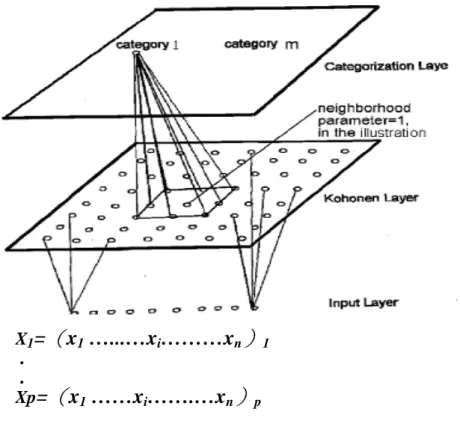
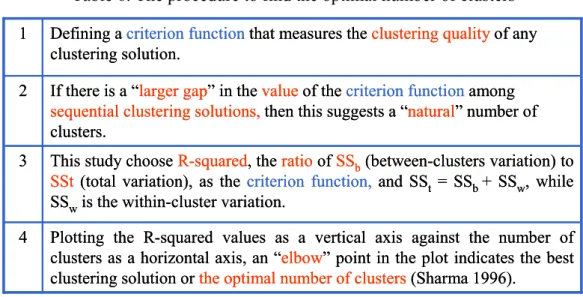
(6) TABLE OF CONTENTS Pages Abstract………………………………………………..…….……….….…...ⅱ List of Tables……………………………………………..……….………….ⅵ List of Figures……………………………………………..……….…………ⅶ Chapters 1. Introduction………………………………………..….……………………………... 1 1.1 Research Background…………………………………………….……….………1 1.2 Research Motivation…………………………………………….……………….. 2 1.3 Research Objective………………………………………………….…..….……. 4 1.4 Organization of this dissertation…………………………………………………. 5 2. Literature Review………………………………………………………...………….. 7 2.1 The Evolution of New Product Development Studies…………………………… 7 2.2 Knowledge Management………………………………………………………… 11 2.2.1 Technological Innovation and Knowledge……………………….………….. 11 2.2.2 Knowledge Management on New Product Development…………………….13 2.2.3 Knowledge Management on The Customers in Marketplace………………... 15 2.3 Data Mining For Customer Knowledge Management…………………………… 17 2.3.1 Market Segmentation to Support NPD………………………………………. 17 2.3.2 Market Segmentation to Form Customer Clusters……………………………18 2.3.3 Data Mining for Market Cluster Analysis…………………………………… 20 2.3.4 Neural Network Application in Market Segmentation ……….……….…….. 22 2.4 The findings……………………………………………………………………… 24 3. An Integrated KM Model For Managing Product and Customer Knowledge…….…26. ⅲ.
(7) 3.1 The Activities of Product Knowledge Management…………………………. 29 3.1.1 Organizational Learning ………………………………………….…………30 3.1.2 Value Chain Collaboration ………………………………………………….31 3.1.3 Technology Transfer ……………………………………………………….. 32 3.1.4 Product Features Realization ………………………………………………..33 3.2 The Activities of Customer Knowledge Management…..………………………34 3.2.1 Product Benefits Identification………………………………………………36 3.2.2 Customers’ Needs Categorization…………………………………………... 37 3.2.3 Market Segmenting: Use Data Mining to Convert Tacit Customer Knowledge into Codified Knowledge …………………………………….. 38 3.2.4 Segment Needs Pattern Extraction…………………………………..……… 39 3.3 Data Mining Technique to Implement Market Segmentation…………….…….. 40 3.3.1 The Self-Organizing Feature Map Network for data mining …………….. 40 3.3.2 The FuzzyART Network as One of The Clustering Methods……………... 43 .. 3.3.3 K-means Clustering Method………………………………………..……… 46 3.4 Evaluation Criteria In A Multiple-Assessment Scheme for Data-Mining………. 47 4. Implementation of The Integrated KM Model……………………………………… 52 4.1 The Background About The Case Study………………………….………………52 4.1.1 Wireless Internet as The Technological Innovation to Support Telematics and Mobile-Commerce…… ……………………………………. 52 4.1.2 The Backbone of M-Commerce–the ‘Ubiquitous networking’ Technology… 54 4.1.3 Building An M-Commerce Platform Demands Innovative Technology and Innovative Knowledge ……………………….…………… 55 4.2 Research Methodology for Model Implementation….………..………………. 56 4.2.1 Product Knowledge Management for Telematics NPD project..….………... 56. ⅳ.
(8) 4.2.1.1 Organizational Learning………………………………………….……… 57 4.2.1.2 Value Chain Collaboration……………………………….……………… 57 4.2.1.3 Technology Transfer…………………………………………………….. 59 4.2.1.4 Product Features Realization-The Outcome of Product Knowledge Application………………………..………………………… 59 4.2.2 Customer Knowledge Management for Telematics Platform NPD………….60 4.2.2.1 Product Benefits Identification………………………….……………….. 60 4.2.2.2 Customers’ Needs Categorization…………………..…………………….63 4.2.2.3 Data Mining for Market Segmenting to Convert Tacit Customer Knowledge into Codified Knowledge…………………….………………64 4.2.2.4 The Results of Research-Tested by The Multiple-Assessment Scheme.…65 4.2.2.5 Segment Needs Pattern Extraction………………………………………..70 4.2.2.6 The Outcome of Customer Knowledge Application…………………….. 74 5. Discussion…………………………………………………………………………… 75 5.1 The General Discussion About This Study………………………………………. 75 5.2 The Comparison on Results of Three Data Mining Methods……………………. 77 5.2.1 The Determination of The Best Clustering Solution……..………………….. 77 5.2.2. The Refinement In Data Mining Steps for Better Clustering Result….…….. 78 5.2.3. The Challenge of Forming Uniform-Siz Market Segments…….…………… 78 5.3 The Contribution and Constraint of This Study……………..…………………… 79 6. Conclusion……………………………………………………………….………….. 81 References………………………………………………………..……………………… 83 Appendix A. The Contents of Web-based Survey Questionnaire….………………….. 95 Appendix B. The Aggregate Needs Categoriztion……………………………………. 100 .. Appendix C. The Analysis of Segment Characteristics……………….………….……102. ⅴ.
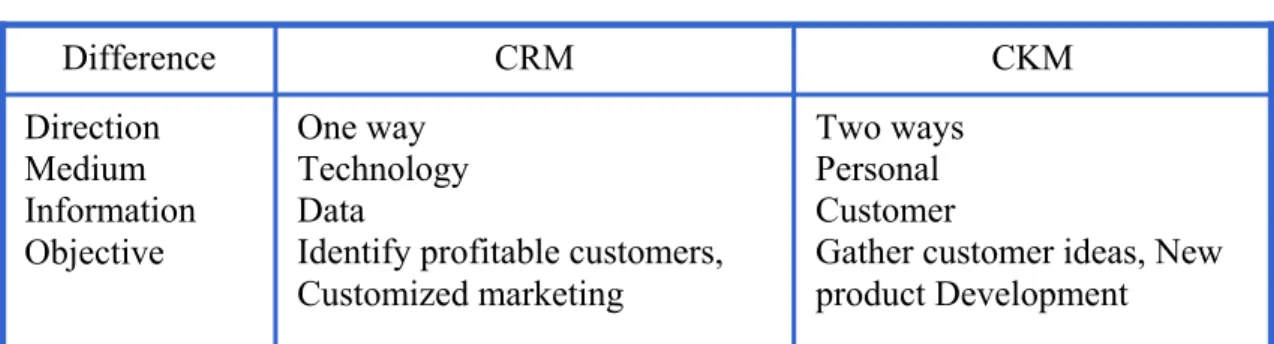
(9) LIST OF TABLES Table 1. The Difference between CRM and CKM ……………………………………. 3 Table 2. The Categories of Customer Knowledge…………………………………….. 16 Table 3. The Categories of CRM systems…………………………………………….. 16 Table 4. Functionalities of data mining …………………………………………...….. 22 Table 5. The Three Evaluation Criteria in The Multiple-Assessment Scheme………… 47 Table 6. The Procedure to Find the Optimal Number of Clusters………………………49 Table 7. Recommended Reliability Levels for Rating Scale SurveyInstrument……….50 Table 8 Telematics platform’s Features, Benefits Offered and Technologies Involved.61 Table 9. Parameters and R-squared Values for Different Clustering Solutions Using Self-Organizing Feature Map Network……………………………………… 65 Table 10.Parameters and R-squared Value for Different Clustering Solutions Using FuzzyART network………………………………………………….. …..…. 65 Table 11.Parameters and R-squared Value for Different Clustering Solutions Using K-means Algorithm ………………………………………………….….……66 Table 12. Cronbach’s Alpha for Clustering Solutions Done by SOM network….….… 68 Table 13. Clustering Solutions for FuzzyART………………………………………….68 Table 14. Cronbach’s Alpha Coefficient for Clustering Solutions Done by K-means… 69 Table 15. The Needs Pattern in Each Segment as The Explicit Customer Knowledge...71 Table 16. The Main Part of The Questionnaire: Multiple Rating List Scale for Web-Based Survey on Customer Needs about Telematics Features………… 85. ⅵ.
(10) LIST OF FIGURES Figure 1. The SECI Model………………………………………………………………12 Figure 2. Product Variants for Various Segments………………………………………18 Figure 3. A Taxonomy of Data Mining Tasks…………………………………………. 21 Figure 4. Integrated KM Model for Managing Both The Product Knowledge and The Customer Knowledge………………………………………………. 27 Figure 5. In Both Product KM and Customer KM dimensions, NPD Activities Go through KM Process to Result in The KM Outcomes………………………. 28 Figure 6. The Customer Knowledge Management Process Supported by Information Technology………………………………………………………36 Figure 7. The Architecture of SOM Network………………………………………….. 42 Figure 8. The Architecture of FuzzyART Network……………………………………. 45 Figure 9. The Procedure of The Multiple-Assessment Scheme……………………….. 51 Figure 10.The Business Model and Architecture of Telematics System ……………… 54 Figure 11. Clustering Solutions for SOM Network……………………………………. 66 Figure 12. Clustering Solutions for FuzzyART Network……………………………… 66 Figure 13. Clustering Solutions for K-means Algorithm………………………………. 67. ⅶ.
(11) CHAPTER 1 INTRODUCTION Technological innovation allows us to cope with increasingly intensive competition when facing challenges from a rapidly changing market situation. Most companies make an effort in knowledge management (KM) to enhance their competitive advantage in product innovation in order to ensure market success. An important component in knowledge management is ‘knowledge creation’. This knowledge creation is supported by two key factors:. (1) converting tacit knowledge into explicit knowledge, and (2). translating this tacit knowledge of experts or customers into a comprehensible form (Nonaka 1998). Elaborating on knowledge work can have innovative outcomes, such as the discovery of new technologies for the development of new products and new processes. For an innovative product to be successful, the product innovation for a company must link technological competence such as engineering and process know-how with customer competence such as knowledge of customer needs and communication channels (Danneels 2002).. 1.1 RESEARCH BACKGROUND The importance of knowledge management in the product technology innovation has been duly recognized (Corso 2001); however, the potential for customer knowledge management has not been studied in any great depth (Grover 2001, Soo 2002), and little discussion has been devoted to the outcomes of knowledge application (Gold 2001, Plessis 2004). Thus, among many types of knowledge in a company, product knowledge and customer knowledge fall into the ‘crucial’ category, because they directly contribute to the product’s acceptance in the market, the competitive advantage and the financial performance of the company. Therefore, any study on knowledge work improvement. 1.
(12) should focus on making products/services more attractive in order to increase value and to prevent project failure (Davenport 1996). This is especially important for innovative new product development (NPD) project, which demands huge amount of investment and complex technological input, as the business excellence relies on not only technology breakthrough but also the success of market outcome.. 1.2 RESEARCH MOTIVATION For organizations working at developing innovative product to facilitate early stage market acceptance and satisfactory return in investment, there is a demand on studying how to congruently manage both product knowledge and customer knowledge to create product value and to reduce market risk. In the digital economy, customer relationship management (CRM) is a contemporary management tool. It manages the relationship with customers by employing up-to-date information technology to understand, to communicate with, and to attract them. Its objective is to satisfy and retain customers (Dyche 2002). Increasing the productivity of knowledge work and managing customer knowledge so as to understand their needs and wants, enables a company to gain a competitive advantage in the market. Recently the ‘customer knowledge management’ (CKM) model has drawn much attention by the combining of both the technology-driven approach in CRM and the people-oriented approach in KM, with a view to exploit their synergy potential (Davenport 2001). The expectation from this endeavor is to more effectively create knowledge ‘for’ customers, knowledge ‘about’ customers, and knowledge ‘from’ customers, so that an attractive product can be delivered to the right group of customers to ensure business success. The difference between CRM and CKM is shown in Table 1 (Garcia-Murillo 2002).. 2.
(13) Table 1. The difference between CRM and CKM Difference Direction Medium Information Objective. CRM. CKM. One way Technology Data Identify profitable customers, Customized marketing. Two ways Personal Customer Gather customer ideas, New product Development. Gerbert (2003) and his associates provided a well-structured “Customer knowledge management model” that describes the interaction between customers and a company’s marketing activities. However, their work lacked the implementation details and methodology. Shaw (2001) presented an “Integrated knowledge management system for marketing model” involving shared marketing knowledge, supply chain partners and marketing decision support application. In the article he indicated the challenges in marketing KM as (1) knowledge discovery through data mining, (2) cross-organizational boundaries, and (3) customers classification, but provided no solution how to practically tackle the challenging issues. Corso’s paper offered a “Knowledge management in product innovation model” to emphasize the interaction stages between KM process and KM sources/uses, both internal and external (Corso 2001). It pointed out the need for the development of empirically tested supportive models to foster the KM applications. Even though researchers have made efforts to address the importance of KM on product development or for customers in marketplace, their studies not yet congruently took product and customer into consideration, and also had lack of procedure for implementation, not to mention the introduction of up-to-date methodology such as the application of information technology (IT). Herby it arouses the motivation to propose an conceptual framework entitiled as the integrated knowledge management model to (1) link customer knowledge with product development, (2) delineate the methodology and the procedure for implementation and also (3) by the intervention of IT application to conduct. 3.
(14) an empirical study. The knowledge derived from the implementation of this integrated KM model in an industry level empirical study, can be applied to an innovative NPD project. The outcome of knowledge application demonstrates that technological innovation NPD requires not only the sophistication of knowledge, but also the fusion from knowledge influx of other sort.. 1.3 RESEACH OBJECTIVE With the background and the motivation of addressing the essentiality of customer knowledge in innovative NPD, this dissertation presents a methodology to support the argument that in order to ensure business excellence, a product’s features must meet the needs of specific customer groups in the market. An conceptual-framework-based integrated KM model implemented with the application of information technology is used to accomplish it. In this model, aside from product knowledge management, there is also the introduction of a web-based survey approach and data mining techniques to accomplish the outcome of customer knowledge management. The customer knowledge management process is as follows. First, the features of a product are transformed into ‘benefits’ that customers need, paving the way to understand the response of the customer toward the benefits those features bring out. Next, a customer’s needs toward the perceived product benefits are taken as the base to form market segments. By this approach it is possible to convert tacit customer knowledge into explicit knowledge, so as to support the company in developing different product variants for various customer groups having a similar attraction. Because market segmentation, market targeting, and market positioning are the three major tasks to be carried out in target marketing (Kotler 2003). To be successful in marketing, market segmentation is certainly a very important task.. 4.
(15) In order to justify this integrated model as applicable in the field, a multi-assessment scheme consists of three criteria is employed for evaluation: (1) does the customers accept the web-based survey approach and does he/she render a sufficient response for data mining? (2) Can the data mining technique successfully extract the customers’ needs pattern in order to facilitate NPD? (3) If multiple data mining methods are all qualified to cluster customers into segments, then which one is the most appropriate method? Therefore, the research objectives of this study are: (1) Addressing the imperativeness of managing product knowledge and customer knowledge in an innovative NPD project, by proposing an integrated KM model. (2) Setting up the methodology for extracting knowledge of the customers in market to facilitate the NPD project, by web-based survey and data mining technique. (3) Justifying the robustness of this integrated KM model by an empirical study, if the result meets three evaluation criteria in a multiple-assessment scheme.. 1.4 ORGANIZATION OF THIS DISSERTATION The remaining part of this dissertation is arranged as follows. In chapter 2 we review the literature on knowledge management regarding innovation, new product development and the customer in the market place, as well as data mining application in market segmentation. Then in chapter 3 we propose an integrated KM model to link CKM with an innovative NPD project, details of the implementation process are also described. In chapter 4 we report the application of the integrated KM model in a Telematics NPD project, and then present an empirical study and the result. The outcome that meets the evaluation criteria will confirm the feasibility of this model in the real world business environment. It enables the application of customer knowledge in making product variants for different target market segments, in reducing. 5.
(16) project risk, and in meeting custimers’ satisfaction, so as to make the business a success. In chapter 5 we will present the discussion and compare the results of these three data mining methods, and finally in chapter 6 we draw our conclusion and indicate the direction for further research.. 6.
(17) CHAPTER 2 LITERATURE REVIEW 2.1 THE EVOLUTION OF NEW PRODUCT DEVELOPMENT STUDIES It is well recognized that to substantiate a company’s success the market offerings whatever products or services must meet customers’ requirement or even more, to exceed their expectation. So the importance of new product development cannot be underestimated. To explore the best practice how to bring out successful products, industry and academic community have made efforts to study the theoretical foundation and real world case by means of domestic investigation and international survey. In U.S.A. a systematic study for product development management practice has been done to report that the basic product development processes should be: new product strategy,. exploration,. screening,. business. analysis,. development,. testing. and. commercialization (Booz 1982). Brown organized the within-ten-years empirical research literatures on product development into three main streams: the ‘rational plan approach’ emphasized determinants of financial performance of the product, the ‘communication web approach’ dealt with communication effect on project result, and the ‘disciplined problem solving approach’ concentrated on factors that bring product into being – team, suppliers, project leader (Brown 1995). He also proposed an ‘integrative model for product development’ by taking product effectiveness and process performance as the most influential points for the financial success of the product developed. Eleven large-scale surveys sponsored by Product Development and Management Association, U.S.A., have been conducted from 1990 to 1996. The results were summarized to conclude a consistent clue that multi-functional team, rational process/resources and considerate strategy are crucial part for success; however, best practices may be context-specific (Griffin 1997).. 7.
(18) Another article evaluated product development literatures in the past ten years to assess the relationships between project performance and several specific product development characteristics: product development process, product definitions, organization context and cross-function. teaming.. The. positive. impact. factors. found. are:. the. use. of. overlapping/interaction activities by cross-function teaming, employment of integrated tools and formal methods, and the organizational influence of team leaders (Gerwin 2002). Other school of study was focused to the successful practices in specific industry of certain countries. Teams of scholars at Massachusetts Institute of Technology, Harvard University and the University of Michigan have identified a number of strengths in Japanese automobile industry (Lynn 2002). For instance, technology fusion by convergence of different technologies from separate disciplines (Kodama 1992), integrating of suppliers’ technology capability in development stage (Kamath 1994), setbased concurrent engineering (Ward 1995, Liker 1996), technology integration by incremental improvement (Iansiti 1997), and organizational mechanism (Sobeck 1998). The taxonomy and evolution of technology strategies of Taiwan’s high technology-based firms was reported too (Hung 2003). However, methodology down to the product structure level is relatively seldom to be studied, except researches about product modularization by several scholars (Baldwin 1997, Diaz 1998, Sanchez 1999, Schilling 2000, Mikkola 2003) to emphasize the design strategies aiming at less lead time and less cost for introducing new product variants for multiple market segments. Recent studies in the NPD literatures look into new issues such as sustainable development, innovative problem solving theory, and knowledge management. The Earth Summit held in Rio de Janeiro, Brazil in 1992, produced a conference document: Agenda 21, which is regarded as “a blueprint for action for global sustainable development into 21st century”. From then on, sustainable development become a new concept for environment. 8.
(19) protection by collaboration among governments, industries and education institutes. Therefore, many environment assessment tools were developed to measure the impact on environment by industrial products, for instance, life cycle analysis (LCA), cumulative energy expenditure (KEA), material input per service input (MIPS) and so on. However, some firms may see the approach of sustainable development as a constraint undermining their economic interest, they indicates that financial resources assigned by firms for environment sustainability must be rewarded by market success for the sustainability of firms. Innovative technology development and management is a key success factor in sustainability of both environment and firm. Through technological collaboration and value chain management in 3R (reduce, reuse and recycle) countermeasures for product and process design, a competitive advantage can be gained in an innovative new product development project. WBCSD (World business council for sustainable development) has identified seven major eco-efficiency elements to guide companies in developing eco-friendly products for reducing environment impacts (Desimone 1997): (1) reduce the material intensity of its goods and services, (2) reduce the energy intensity of its goods and services, (3) reduce the dispersion of any toxic materials, (4) enhance the re-cyclability of its materials, (5) maximize the sustainable use of renewable resources, (6) extend the durability of its products, (7) increase the service intensity of its goods and services. In February of 2003, European Community announced the proposal for two directives: (1) WEEE, a directive on Waste Electrical and Electronic Equipment, (2) RoHS, a directive on ‘the Restriction of the use of certain Hazardous Substance’ in electrical and electronic equipment. The registration of environment protection measure will certainly influence the future NPD program.. 9.
(20) On the other hand, innovation in NPD has already been well studied, however, merely in the level of conceptual frame (Lynn 1996, Goel 1998, Thomke 2002, Rice 2002, McDermott 2002, and Chapman 2004). A tool to help engineers to tackle systematic incompatibility and technical contradiction problem in an innovative NPD project has drawn attention in recent years. It is TRIZ (an acronym in Russian: Theory of Inventive Problem Solving), a methodology developed in 1946 by Genrich Altshuller by investigating the intellectual property contained in 200,000 patents (Smith 2003) . The core of TRIZ are the 40 principles and a matrix of contradictions with 39 parameters to reduce creativity to an exact science. It has been proven to be a very powerful method for creating new NPD solution by providing a new and more problem-solving-oriented way of creation of innovative conceptual design solution (Orloff 2003, Bariani 2004). The TRIZ function analysis helps in coping with design problems involves some kinds of conflict condition such as: (1) a product should be stronger but lighter—the technical contradiction, (2) a product should be of higher quality but lower cost—the management contradiction. Therefore, researcher has tried using TRIZ to deal with eco-innovative NPD problems: achieving material reduction, energy reduction, toxicity reduction in a more durable, better service product (Chang 2004). The most significant contribution of TRIZ is the conversion of tacit knowledge (Polanyi 1966) hoarded in the world’s finest inventive and innovative minds into a codified and comprehensive form, and becomes the explicit product knowledge to facilitate the innovative new product development.. 10.
(21) 2.2 KNOWLEDGE MANAGEMENT 2.2.1 Technological Innovation and Knowledge Peter Drucker defined innovation as “The effort to create purposeful, focused change in an enterprise’s economical or social potential”. He indicated that most successful innovation stemmed from seven areas of opportunities and ‘industry and market change’, ‘changes in perception’ as well as ‘new knowledge’ are three among those seven areas. Knowledge-based innovation requires not only one kind of knowledge but many, and the innovation that creates new users and new markets should be carefully aimed at the specific application (Drucker 1998). Betz (2003) defined technological innovation as: “Technological innovation is both the invention of a new technology and its introduction into the marketplace as a new high-technology product, process, or service.” Technological innovation allows us to cope with increasingly intensive competition in a rapidly changing marketplace. Most companies should use their knowledge to promote their competitive advantage in product innovation, by enhancing their capability in managing that knowledge so as to convert it into useful products and services. In the past decade, knowledge has been recognized as one of the most valuable asset in organization as indicated by Peter Drucker: “The most important contribution management needs to make in the 21st century is to increase the productivity of knowledge work and knowledge worker” (Drucker 1999). Among many examples on definition about knowledge given by researchers, Davenport’s pragmatic one is “The most valuable form of contents in a continuum starting at data, encompassing information, and ending at knowledge” (Davenport 1996). Researchers, a long time ago, defined the knowledge category using the concept of explicit knowledge and tacit knowledge (Polanyi 1966). Then, Nonaka used a SECI model shown in Figure 1 to identify knowledge creation as a spiral process of interaction between. 11.
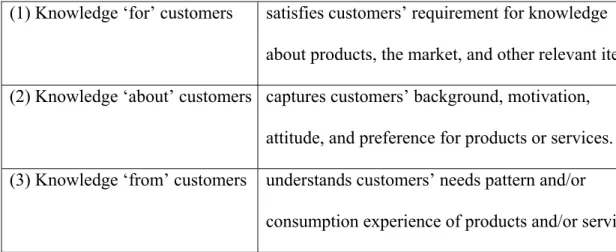
(22) explicit knowledge and tacit knowledge. The ‘externalization’ step which takes place at ‘interaction ba’ plays an important role in knowledge creation, it is supported by two key factors: (1) converting tacit knowledge into explicit knowledge and (2) translating the tacit knowledge of experts or customers into comprehensible forms (Nonaka 1998).. Figure 1. The SECI Model (Nonaka 1998). Investment in knowledge work can lead to innovation efforts such as the discovery and the development of new technologies, new products, and new production processes according to Carneiro (2000). Danneels (2002) offered an important insight when he argued that product innovation for a company must link technological competence such as engineering and process know-how with customer competence such as knowledge of customer needs and communication channels.. 12.
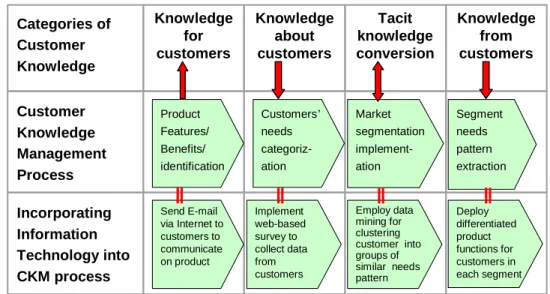
(23) Therefore, it is worthwhile to manage the knowledge a company desires to have and it is also imperative to institutionalize the knowledge management process for transforming knowledge into company’s competitive advantage. Different, however similar approaches have been proposed by researchers in this field: Davenport again pointed out that the knowledge process lies somewhere between information and a company’s products and services, and the knowledge process consists of three sub-processes: knowledge generation, knowledge codification, and knowledge transfer / realization (Davenport 2001). Bhatt (2000) defined the knowledge development cycle as four phases: (1) knowledge creation, (2) knowledge adoption, (3) knowledge distribution and (4) knowledge review and revision, and addressed that appropriate strategies should be required for each phase to organize knowledge into the development cycle. His viewpoint is largely concurred with Kakabadse’s four distinct stages of knowledge institutionalization: (1) knowledge creation, (2) knowledge sharing, (3) knowledge application, and (4) knowledge acquisition from outside (Kakabadse 2001).. 2.2.2 Knowledge Management on New Product Development The importance of knowledge work for a company has been well recognized. However, justifying this knowledge as being valuable is a must for a company in order to qualify the knowledge as an intangible asset. “Knowledge assets underpin competence, and the competence in turn underpins the company’s products and services offering in the market.” (Styre 2002). Indeed, the success of a knowledge-conscious company relies on its efficiency in creating knowledge, and its effectiveness in applying that knowledge to products and services that offer a deliverable value to customers thereby generating a profit for the company. Researchers argued that the challenge for a new product development task is to design and create organizational context for the knowledge work. Therefore, they. 13.
(24) proposed a conceptual model of the NPD organization as a knowledge enterprise, the model constitutes four high-level constructs that shapes up the knowledge system: (1) contextual organizational elements such as information quality, participants from boundary spanning structure, and etc., (2) knowledge work behaviors such as linking knowledge sources and knowledge users, creating opportunities for producing new knowledge, and etc., (3) knowledge outcomes such as effective knowledge use and new knowledge generation, (4) knowledge effectiveness such as organizational performance in quality, innovation, customer focus, knowledge and productivity (Mohrman 2003). A crossfunctional collaborative KM model in NPD teams is also proposed to create internal knowledge repositories by developing IT-based KM tools to store NPD process knowledge, as a successful company should be able to continuously create new knowledge, quickly disseminate knowledge and embody knowledge in new products (Ramesh 1999). Other researchers have emphasized the use of KM for reducing the risk in NPD, by collecting data from internal and external sources and then extracting relevant information in order to prevent product failure. The internal problems affecting product failure are: being unable to meet performance, reliability, or cost requirement, while the external problems are: unsuccessful reception in the market, changing regulations, and so on (Cooper 2003). Today the role that KM plays in the NPD activities is better understood. However, it only makes a contribution to within-organization NPD outcomes such as product/service quality, cost, and deliverables-to-market. In fact these NPD outcomes should link with market outcomes like products sales, customer satisfaction, and return on investment, and to be jointly assessed in order to evaluate the business success. Therefore, customer knowledge is an important attribute of any NPD project.. 14.
(25) 2.2.3. Knowledge Management on The Customers in Marketplace Li (1998) suggested that market knowledge competence in NPD is composed of three. processes: (1) a customer knowledge process; (2) a competitor knowledge process; and (3) the interface between marketing research and R&D. Based on his work, Campell (2003) proposed a conceptual framework of “customer knowledge competence” to create and integrate customer knowledge within an organization. It is composed of four processes: (1) a customer information process, (2) a market-IT interface, (3) senior management involvement, and (4) employing evaluation and reward system. He explained that a customer information process is a set of activities that generate customer knowledge about customers’ current and potential needs for products and services. As far as market-IT interface is concerned, data about customers can be available through a customer relationship management (CRM) database. However, data needs to be converted into information and the company can then integrate the information to develop customer knowledge. Another researcher further opined that CRM cannot take place without KM, because in order to deliver products and services to delight customers, knowledge from customer must be well managed to make sure that the deliverables a company offers meet customers’ satisfaction (Plessis 2004). CRM, with the support of IT, has already been recognized as a contemporary management tool in the digital economy for managing the relationship with customers. It does so by taking advantage of on-line data analysis, data mining and a database management system to assist a company in its management decisions. In order to maintain a good relationship with customers, it is crucial that a company communicates and interacts with its customers in a satisfactory manner, and provides market offerings that the customers want. This requires the deliberate management of different categories of. 15.
(26) ‘customer knowledge’ shown in Table 2 (Davenport 2001, Garcia-Murillo 2002, Gebert 2003). Table 2. The categories of customer knowledge (1) Knowledge ‘for’ customers. satisfies customers’ requirement for knowledge about products, the market, and other relevant items.. (2) Knowledge ‘about’ customers captures customers’ background, motivation, attitude, and preference for products or services. (3) Knowledge ‘from’ customers. understands customers’ needs pattern and/or consumption experience of products and/or services.. In this regard, customer knowledge obtained via a CRM system is a valuable intellectual asset for a company to develop or improve products and services in order to meet or even exceed customers’ expectations. CRM systems that collect information for customer knowledge are classified into three main categories shown in Table 3 (Dyche 2002, Gebert 2003). Table 3. The categories of CRM systems (1) Operational CRM systems. enhances the efficiency of a CRM process through service-center management and marketing-automation like database marketing.. (2) Analytical CRM systems. evaluates knowledge of an individual customer’s attitude, needs, and values for cluster analysis. Data mining is a typical technique in this category.. (3) Collaborative CRM systems synchronizes customer communication time through channels such as e-mail, the Internet, and/or the telephone.. 16.
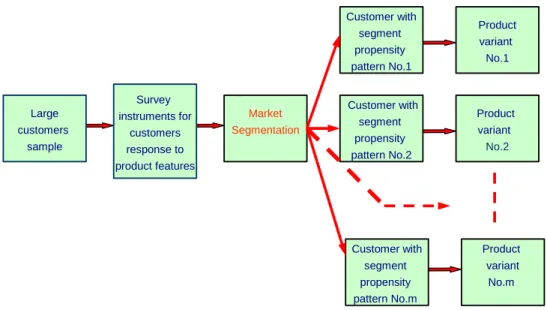
(27) In the literature most studies on KM and CRM are treated in separate research domains. However, lately their mutual synergy potential has drawn the attention of researchers in the field by employing KM in an effort to help CRM to transcend from its original technology-driven and data-oriented approach into a more people-oriented ‘customer knowledge management’ model or CKM model, it has already invoked a convergence of the two (Davenport 2001, Garcia-Murillo 2002). The CKM model emphasizes a bi-directional communication channel. This interaction with customers, and customer knowledge management set up strategies for how a company can develop attractive innovative products, or improve its service to win customers satisfaction.. 2.3 DATA MINING FOR GENERATING CUSTOMER KNOWLEDGE 2.3.1 Market Segmentation to Support NPD To secure market acceptance, customer knowledge on customer group of the same propensity is very important for a company in deciding which product variant to develop, to satisfy or delight customers in that market segment. Extracting knowledge of customers behavior in various segments for making decisions in product variants development is critical to the success of marketing efforts, as shown in Figure 2. Heinrichs (2003) stipulated prerequisites for company to sustain competitive advantage, one of them is the use of leading edge information technology tools for effective knowledge management, for example, web-based data mining tools to build up specific capacities in information presentation, knowledge discovery and analytical capabilities.. 17.
(28) Customer with segment propensity pattern No.1. Large customers sample. Survey instruments for customers response to product features. Market Segmentation. Customer with segment propensity pattern No.2. Product variant No.1. Product variant No.2. Customer with. Product. segment propensity pattern No.m. variant No.m. Figure 2. Product variants for various segments. 2.3.2 Market Segmentation to Form Customer Clusters The concept of market segmentation was presented along with the concept of product differentiation by Wendell R. Smith to describe the demand-supply condition in imperfect competition market (Smith 1956). Since then, segmentation concept dominated marketing research literature and practice. Major considerations involved in segmentation research studies are the selection of the bases of segmentation -- a set of variables to allocate potential customers into homogeneous groups. Variables employed as bases (the dependable variable) or descriptors (the independent variable) can be divided into two categories: ‘general’ customer characteristics and ‘situation specific (product specific)’ customer characteristics (Wind 1978). Kamakura (2000) further classified variables into ‘observable’ ones (i.e., be measured directly) and ‘unobservable’ ones (i.e., inferred). For example, geographic and demographic variables are ‘general-observable’, situations and usage frequency variables are ‘product specific-observable’, psychographics and life-style variables are ‘general-unobservable’, and benefits, preferences variables are ‘product specific-unobservable’.. 18.
(29) ‘Benefits’ has been regarded as a preferred segmentation base for understanding a market and for making decision about market positioning and new product development (Wind 1978). Haley (1985) argued that ‘causal segmentation schemes’ (segments based on benefits, experiences, beliefs) are more likely to discover potential responsive subgroups and more attractive targets, when compared with ‘descriptive segmentation schemes’ (segments based on demographic and volumetric characteristics). Because demographic segmentation only describes customers behavior without explaining it, and the change in the perception of benefits delivered by brand/product can alter customers’ attitude – the tacit customer knowledge. Today, concerning the base for segmenting consumer market, customer characteristics such as geographic, demographic, and psychographic variables, are one of two broad groups of variables for segmenting the market. The other group is the response customers towards benefits/needs, situation and brand. Six criteria are employed to evaluate the effectiveness of different segmentation bases: identifiability, substantiality, accessibility, stability, actionability and responsiveness (Kotler 2003). ‘Benefit-based’ or ‘needs-based’ segmentation scheme is ranked as the most appropriate one if taking into account the overall performance (Kamakura 2000). Using market survey instrument to collect data that represent customers’ response towards product benefits or product features enables data mining technique to contribute in performing cluster analysis to form several target customer segments. Generating customer knowledge in each segment requires a precedent segmentation task. There are two principal segmentation frameworks for segmentation studies (Green 1977, Wind 1978) and a hybrid two-stage segmentation method (Punj 1983): (1) A priori segmentation Management decides in advance some variables as segmentation bases such as customers’ gender, age, and etc., then classifies them into predetermined number of. 19.
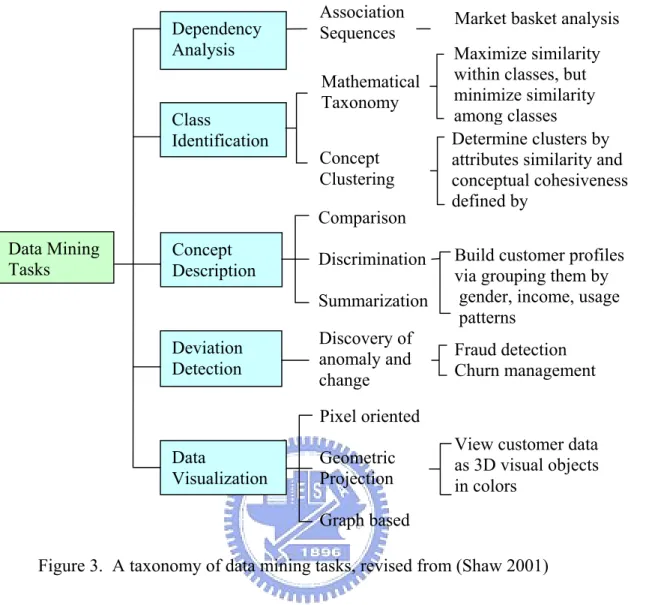
(30) segments to show each segment’s size and demographic, socioeconomic status. (2) Post hoc segmentation. Management may chooseas segmentation base a set of variables responsive to some marketing stimuli, e.g. benefits, needs and preferences. The aggregate individual customer’s response score or rating then be clustered into groups with the best within-group homogeneity as well as the highest between-group heterogeneity, to result in the number and the type of clusters for further investigation. It is also referred as ‘cluster-based’ segmentation.. (3) Hybrid segmentation. It is called ‘two-stage’ method by combining both a priori and post hoc segmentation procedures in consequence.. 2.3.3 Data Mining Techniques for Market Cluster Analysis Today, with the rapid advancement of computing power, data mining plays an important role in knowing customers’ wants and needs toward benefits that products offered (Amstel 2000). In an article, Shaw (2001) presented a well-illustrated taxonomy of data mining tasks for creating customer knowledge (Figure 3), so as to support his argument that effective CRM only be validated by the actual understanding of customers and their needs, preferences, manifested itself in the form of pattern extraction. 20.
(31) Association Sequences. Dependency Analysis. Mathematical Taxonomy. Class Identification. Concept Clustering Comparison. Data Mining Tasks. Concept Description. Discrimination Summarization Discovery of anomaly and change. Deviation Detection. Market basket analysis Maximize similarity within classes, but minimize similarity among classes Determine clusters by attributes similarity and conceptual cohesiveness defined by Build customer profiles via grouping them by gender, income, usage patterns Fraud detection Churn management. Pixel oriented Data Visualization. Geometric Projection. View customer data as 3D visual objects in colors. Graph based Figure 3. A taxonomy of data mining tasks, revised from (Shaw 2001) Han (2001) referred ‘data mining’ to extracting knowledge from large amounts of data, by the following steps: (1) data cleaning, (2) data integration, (3) data selection, (4) data transformation, (5) data mining, (6) pattern evaluation, and (7) knowledge representation. Some functionalities of data mining technique are shown in Table 4.. 21.
(32) Table 4. Functionalities of data mining (1) Cluster analysis. analyzes data objects without knowing in advance the known category labels, so as to generate such labels.. (2) Classification. builds a model to distinguish data set into various classes with labels.. (3) Association analysis. discovers association rules for data attributes that frequently take place together.. (4) Prediction. builds up a model to predict data value.. Han (2001) again classified clustering techniques by categories such as: partitioning methods (K-means, K-medoids and variations), hierarchical methods (AGENS, DIANA, BIRCH, CURE and Cameleon), density-based methods (DBSCAN, OPTICS, DENCLUE), grid-based methods (STING, WaveCluster, CLIQUE) and model-based methods (statistical approach and neural network approach). In this study, neural network model and K-means algorithm are employed for cluster analysis.. 2.3.4 Neural Network Application in Market Segmentation An overview of neural network application history in business has been done (Smith 2000) to report that multilayered perceptron (MLP) neural network, Hopfield neural network and self-organizing feature map (SOM) neural network as the three main models used in business. Another review (Wong 2000) on 302 research articles related to the neural network application in business during the period of 1994-1998, indicated that 4 articles among the 302 articles were associated with market segmentation. In another article, the MLP neural network outperformed traditional statistical approaches, namely the discriminant analysis and the logistic regression model in segmenting customers by purchase intentions (Dasgupta 1994). The MLP neural network also obtains higher hit ratio. 22.
(33) in an industrial segmentation problem, compared with discriminant analysis and logistic regression methods (Fish 1995). Another study reported that neural network with frequency-sensitive competitive learning algorithm didn’t outperform K-means clustering technique, however, in case that the result of network is used as the seeds to be input into K-means algorithm, a better segmentation outcome appears (Balakrishnan 1996). However, an article reported that a supervised MLP neural network didn’t do better than logistic regression in segmentation for target marketing (Zahavi 1997). In another comprehensive survey on 95 articles by describing artificial neural network in different dimensions: network architecture, learning rule, algorithm and performance comparison with traditional statistical method (Krycha 1999), 4 articles of neural network application in marketing segmentation, overwhelmingly employing MLP networks, reported better outcomes than traditional statistical approaches. Krysha identified that although artificial neural network can be applied to many marketing decision situations which could only be dealt previously with multivariate statistical analysis, its two typical contribution areas are: market segmentation tasks (statistical methods in this application are discriminant analysis for classification and other clustering techniques) as well as market response modeling (statistical method in this application are is multiple regression analysis). He also pointed out that the most crucial point for marketing research activities is lacking applications on the individual level data (Krysha 1999). To focus on more broad area such as management, marketing and decision making, 93 papers has been surveyed and found that 74 out of 93 papers, made use of MLP network trained by the backpropagation learning rule, the others employed unsupervised approach, mainly SOM network. Among them, 6 articles were for market segmentation. The MLP network has successfully tackled the problems. After recognizing the fact that the MLP. 23.
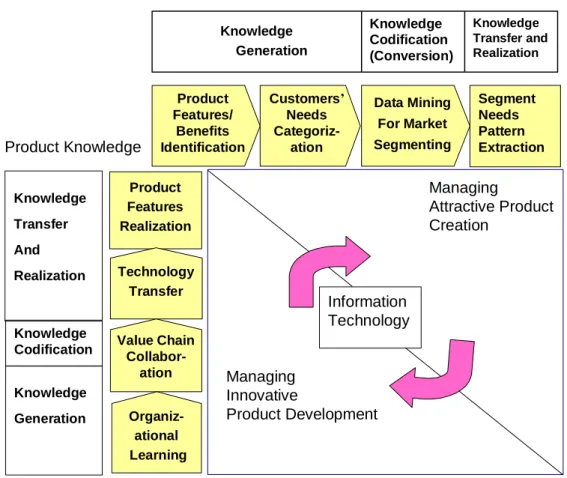
(34) network is basically a supervised network architecture for classification rather than for clustering, the researcher urged on more segmentation studies by means of unsupervised neural network (Vellido 1999a). SOM has made much presence in segmentation research studies, for example, the segmentation of the on-line shopping market (Vellio 1999b), and the mining procedure to support on-line recommendation (Changchien 2001). On the other hand, K-means algorithm has been regarded as the benchmarking tool in evaluating the performance of artificial neural network, because K-means is the most popular and most widely used post hoc procedure for market segmentation (Kamakura 2000). When the performance of these three methods are compared one another, it can be found that an earlier article described a unfavorable performance of SOM network against K-means clustering algorithm (Balakrishnan 1994), and another research article on the clustering of binary market research data reported that SOM was inferior to the performance of K-means (Larkin 1999). However, K-means algorithm failed to discover cluster structure compared to a special designed MLP network (Hrushka 1999). It is interesting to note that the artificial neural network based on Adaptive Resonance Theory (ART), which is also an unsupervised neural network, also appears in the literature to form customer cluster (Chen 2002). Therefore, the FuzzyART network is also applicable in the market segmentation study.. 2.4 THE FINDINGS From the literature review, we found that although researchers hade made efforts to address the importance of KM on product development and that on customers in marketplace, their studies treated product KM and customer KM in separate domain, and there was seldom any article to congruently took product and customer into consideration.. 24.
(35) A susbstantial volume of research articles dealt with KM conceptual framework, however; there were in the lack of procedure for implementation, not to mention the introduction of up-to-date methodology such as the application of information technology and quantitative method such as data mining. Herby there is a need to explore the possibility of proposing a conceptual framework entitled ‘integrated KM model’ to link customer knowledge with innovative product development, and also delineate the methodology and the procedure for implementation. It will be preferable that an empirical study to be done to support the validality of this integrated KM model.. 25.
(36) CHAPTER 3 AN INTEGRATED KM MODEL FOR MANAGING PRODUCT AND CUSTOMER KNOWLEDGE Innovative products often stemmed from radical innovation that is defined as: “A basic technology innovation that establishes a new functionality”. Radical innovation differs from incremental innovation that is defined as: “A change in an existing technology system that does not alter functionality but improve performance” (Betz 2003). Radical innovative product weighs heavily on enhancing company’s competitive advantage for business success. However, the adverse side effects happen on user’s side shouldn’t be underestimated. The reason is that advanced features delivered by high technologies indeed offer certain benefits to customer though, the accompanying complexities of application and cost mark-up inevitably offset customers’ perceived value against the innovative product. Radical innovation features three dimensions: (1) product benefits, (2) technology capabilities and (3) customer use pattern (Veryzer 1998). Therefore, it is important to elaborate the generation of customer knowledge on how they evaluate from these dimensions the radical innovative product, because without attractive quality, a radical innovative product will hardly find a strong position for market viability. To achieve market success, company has to deal with many sorts of knowledge including suppliers knowledge, product knowledge, customer knowledge, industry knowledge, competitor knowledge, employee knowledge and operations knowledge (Garcia-Murillo 2002). Among them, product knowledge and customer knowledge fall into the category of priority concern, for they directly contribute to the company’s competitive advantage and financial performance.. 26.
(37) Based on the findings of many studies in the above-mentioned literatures, either the importance of KM on NPD project or the requirement of KM on the customers in the market has been separately addressed. Therefore, it is imperative to explore the interaction of both product knowledge and customer knowledge as a whole, as well as the procedure for KM implementation in an innovative NPD project. Therefore, this study from the perspective of implementation proposes an integrated KM model as a new approach for managing both product knowledge and customer knowledge. The structure of this integrated model is shown in Figure 4. Customer Knowledge. Knowledge Generation. Product Knowledge Knowledge Transfer. Product Features/ Benefits Identification. Customers’ Needs Categorization. Knowledge Codification (Conversion). Knowledge Transfer and Realization. Data Mining. Segment Needs Pattern Extraction. For Market Segmenting. Managing Attractive Product Creation. Product Features Realization. And Technology Transfer. Realization. Knowledge Codification. Value Chain Collaboration. Knowledge Generation. Organizational Learning. Information Technology. Managing Innovative Product Development. Figure 4. Integrated KM model for managing both product knowledge and customer knowledge. 27.
(38) KM Process. Knowledge generation Knowledge codification Knowledge transfer Knowledge realization. NPD activities. Organizational learning Value chain collaboration Technology transfer Product features realization. Product KM. Knowledge generation Knowledge codification Knowledge transfer Knowledge realization. KM Process Customer KM. Product benefits identification Customer needs categorization Data mining for market segmentation Segment needs pattern extraction. NPD activities. Figure 5. In both product KM and customer KM dimensions, NPD activities go through KM process to result in the KM outcomes The integrated KM model features two dimensions: the product knowledge dimension and the customer knowledge dimension (Figure 5). In both dimensions, NPD activities go through KM process to result in KM outcomes, by interwoven knowledge flows via IT application. The product KM NPD activities stem from the outcomes of research literatures and industry practices, and the customer KM NPD actitivies are the original work of this dissertation. Both embrace, as indicated by Davenport (2001), the knowledge process represented by several sub-processes: ‘knowledge generation (creation)’ involves the acquisition and development of knowledge, ‘knowledge codification’ involves the conversion of knowledge into an accessible and applicable format, ‘knowledge transfer’ includes the movement of knowledge from its point of generation or codified form to the point of use, and ‘knowledge realization’ which refers to the process involved in creating value. In the product knowledge dimension, the focus is on organizational networks aiming at knowledge creation and application, while in the. 28.
(39) customer knowledge dimension, the focus is on information technology application targeted at knowledge extraction. The value of this model is that it provides a practical solution to overcome the complexities of value chain collaboration by heterogeneous industries, and also offer a feasible solution to extract customers’ needs, so as to culminate the success of an innovative NPD project. The integrated KM model makes contribution to both academic community and industry level application.. 3.1 THE ACTIVITIES OF PRODUCT KNOWLEDGE MANAGEMENT Managing product knowledge in an innovative NPD project requires both the crossfunctional team within an organization to share interdisciplinary knowledge and the collaboration from heterogeneous industry partners to acquire and to develop the complementary knowledge, so as to inspire creativity for bringing the product of innovation into being. The integrated KM model articulates the product knowledge process by dealing with four product development activities: (1) knowledge generation takes place at the stages of organizational learning and value chain collaboration, (2) collaboration across organizational boundaries creates new knowledge for products or processes, and NPD project teams then codifies the newly created knowledge into documents or database, (3) knowledge embodied in the form of technology is further transferred to collaboration the partners via meetings, Intranet, Internet, and experiments in order to result in (4) knowledge realization by coming up with the physical prototype of attractive product. In this study, an innovative NPD project such as the Mobile-commerce related product involves wireless communication, mobile Internet connectivity, multimedia computing, and in-vehicle application. The input of financial investment and human talent. 29.
(40) is too much to afford a premature market outcome. Under the circumstance, customer knowledge pertinent to whether the products are perceived as attractive or beneficial turns into a crucial part of knowledge in this innovative NPD project.. 3.1.1 Organizational Learning In an innovative NPD project, boundary-spanning organization comprising internal and external teams becomes necessary. Organizational learning consists of five disciplines: system thinking, personal mastery, mental models, shared vision, and team learning, they can accelerate the pace that team members develop the required knowledge (Senge1994). Sharing control with those who have competence and those who implement tasks, and avoiding defensive interpersonal and group relationships are very important factors to encourage organizational learning. Many studies in the literature address the issue how to enhance organizational learning for knowledge generation. The ‘situated organizational learning’ approach moves the focus from individuals to the activity systems within organization, as organizational learning depends on the ability to generate and adopt knowledge from horizontal and vertical sources (Nidumolu 2001, Bhatt 2000). These studies all provide an excellent foundation for inspiration in how to design an appropriate organizational learning structure, however, there is a short supply of articulate guidelines in how to actually fulfill the task. An exception is the research article of Sanchez, which proposed a “modular organization” that continuously changes and solves problems through interlinking coordinated selforganizing processes (Sanchez, 1996). In which incremental learning, modular learning, architectural learning, and radical learning take place to access advanced architectural knowledge about product components and their interactions.. 30.
(41) Based on Sanchez’s work, this study proposes a ‘hierarchical interface learning’ scheme to tackle the demand that learning occurs at the interface between marketing and product design, the interface among value chain stakeholders, the interface among heterogeneous technologies, and etc. An innovative NPD project needs not only the sharing of existing interdisciplinary knowledge, but also the generation of new knowledge to integrate different types of knowledge for product innovation.. 3.1.2 Value Chain Collaboration In the realm of E-commerce, telecommunication companies, computer hardware manufacturers, software design houses, contents providers, logistics enterprises and finance institutions make their presence as stakeholders in the value chain. Advancing to Mobile-commerce, which takes mobile Internet connectivity as the prerequisite, additional more elements of advanced technology and communication media have to join in the existing E-commerce infrastructure. The complexity of innovative product is located in two areas: the complexity of the product’s internal architecture and the complexity of product-user interface. The more complex the product is, the more the NPD teams demand cross-functional “concurrent engineering” to cope with the complex situation. When taking into account of value chain partners and support by information technology, a wider context entitled “collaborative engineering” comes into being (Willaert 1998). The contribution IT makes to NPD collaboration is in interpersonal communication, efficiency, and effectiveness by offering (1) design tools such as CAD/CAE and simulations, (2) collaboration tools such as product data management systems and groupware like video conferencing and web-mail, and (3) tailor-made KM software packages for decision support and knowledge codification.. 31.
(42) Integrating value chain partners into an NPD collaboration network often induces issues of conflict and cooperation (Coles 2003) and brings in variables like organization culture, job sharing responsibility, time to participate, methods for communication, intellectual property issues, and so on. Thus, in addition to make efforts that foster organizational learning, it is also imperative to diminish the organizational barrier so as to generate collaborative knowledge, by overcoming the complication encountered among various disciplines and team units that are heterogeneous in specialization and objective. Because it is the value chain collaborative activities that determine the success or failure of an innovative NPD program, every effort should be made to enhance the spirit of teamwork and in the meantime to eliminate negative factors that may impede the NPD progress. Tacit knowledge sharing among parties in value chain is not so difficult, codification of generated knowledge still be possible if presented in a mutual-agreed format. However, when comes to the transfer of knowledge-embedded technology, it becomes an invincible barricade.. 3.1.3 Technology Transfer The ultimate form of knowledge transfer among NPD project partners is the transfer in terms of technology for product realization. In the process of collaboration, useful new knowledge can be generated and then be codified into the repositories of each organization as the intellectual capital. The problem arises as to what extent partners one another are willing to transfer the codified knowledge and the associated knowledge-embedded technology. Organizational level knowledge or technology flow takes place as intracompany flows, cross-company flow among heterogeneous industries, and cross-company flow among homogeneous industries. The small-scale knowledge or technology exchange via IT groupware, seminar and regular meeting for the necessary project coordination is. 32.
數據
+7


Outline
Research Motivation
Organization of this dissertation
Knowledge Management on The Customers in Marketplace
Market Segmentation to Form Customer Clusters
The findings
The Activities of Customer Knowledge Management…
Evaluation Criteria In A Multiple-Assessment Scheme for Data-Mining
Product Knowledge Management for Telematics NPD project
Data Mining for Market Segmenting to Convert Tacit Customer
The Contribution and Constraint of This Study
相關文件
Then we can draw a right triangle with angle θ as in Figure 3 and deduce from the Pythagorean Theorem that the third side has length.. This enables us to read from the
This discovery is not only to provide a precious resource for the research of Wenxuan that has a long and excellent tradition in Chinese literature studies, but also to stress
It has been well-known that, if △ABC is a plane triangle, then there exists a unique point P (known as the Fermat point of the triangle △ABC) in the same plane such that it
In this paper, we evaluate whether adaptive penalty selection procedure proposed in Shen and Ye (2002) leads to a consistent model selector or just reduce the overfitting of
To proceed, we construct a t-motive M S for this purpose, so that it has the GP property and its “periods”Ψ S (θ) from rigid analytic trivialization generate also the field K S ,
Enrich the poem with a line that appeals to this missing sense.. __________________imagery that appeals to the sense of____________has not been used in the description
Once a NET’s normal place of residence is established to be outside Hong Kong and his/her eligibility for the fringe benefits under the Enhanced NET Scheme in Secondary Schools or
These programmes are operated by 11 degree-awarding self-financing institutions registered under the Post Secondary Colleges Ordinance (Cap. 320) or statutory
