334 OPTICS LETTERS / Vol. 17, No. 5 / March 1, 1992
Pulse-forming dynamics
of a cw passively mode-locked Ti:sapphire/DDI laser
Jahn-Chung Kuo, Jia-Min Shieh, Chin-Der Hwang, C.-S. Chang, and Ci-Ling PanInstitute of Electro-optical Engineering, National Chiao Tung University, Hsinchu, Taiwan 300, China
Kaung-Hsiung Wu
Department of Electrophysics, National Chioo Tung University, Hsinchu, Taiwan 300, China
Received October 21, 1991
The dynamics of pulse formation in a cw passively mode-locked Ti:sapphire/DDI laser has been investigated. It is found that the time required for the circulating energy in the cavity to build up and bleach the dye absorber
is approximately 140 As. A further 230 Axs is required for the buildup of steady-state picosecond pulses.
Con-currently the laser output spectrum initially narrows in the cw regime, begins to broaden as the laser becomes modulated, and finally establishes the steady-state spectral distribution.
The solid-state nature, high saturation power, and broad bandwidth of Ti:sapphire have allowed it to become one of the most important laser crystals for the generation and amplification of ultrashort opti-cal pulses. Much effort has been devoted to mode lock the Ti:sapphire laser using various schemes. These include additive-pulse mode locking,' active mode locking,2'3 coupled-cavity resonant passive mode locking,4 and self-mode locking5'6 or Kerr-lens mode locking.7 Passive mode locking has also
been demonstrated by using organic dyes or
semiconductor-doped glass as the saturable
ab-sorber. Pulses as short as 4 and 2.7 ps, respectively, have been obtained with a DDI dye absorber' and
a semiconductor-doped glass absorber.
9Using
another absorber dye, HITCI, Sarukura et al."
0achieved 15.4-ps chirped pulses and 2.4-ps com-pressed pulses with a grating-prism pair outside the cavity. A dispersion-compensating prism pair in-corporated inside the same cavity has allowed them to produce 150-fs pulses directly. Subsequent pulse compression yielded 50-fs pulses." Furthermore a colliding-pulse mode-locked Ti:sapphire/HITCI laser that uses an antiresonant ring configuration has generated 50-fs pulses.'2 These studies have con-centrated on the steady-state characteristics, and relatively less attention has been paid to the
pulse-forming dynamics of mode-locked Ti:sapphire
lasers. Goodberlet et al.'3 showed that their
self-starting additive-pulse mode-locking Ti:sapphire
laser evolved from mode-beating fluctuations to mode-locked operation in n200 ,us, or 17,000 round trips. For a cw passively mode-locked Ti:sapphire/ HITCI laser system, Ishida et al.'4 reported that the
pulse train rapidly built up with a time constant of n200 As and reached the steady state on a time scale of milliseconds to seconds. Chen and Wang'5 recently proposed a new model to describe the evolu-tion of Ishida's laser. They showed that the time
required to shorten the pulses from 5 ns to 100 fs
FWHM was -200-300 As. The excited-state life-times of DDI and HITCI are quite different: 17 ps and 1.2 ns, respectively.'6 It is interesting to com-pare the buildup time for steady-state short pulses of
these two passively mode-locked lasers. In this
Letter we report for the first time, to our knowledge, results on the temporal evolution of a cw passively mode-locked Ti:sapphirelDDI laser from cw opera-tion to steady-state picosecond pulses. The evolu-tion of the corresponding spectra of the laser output is also presented.
A block diagram of the experimental setup is shown in Fig. 1. The configuration of our passively mode-locked Ti:sapphire/DDI laser is shown in the inset of Fig. 1. The laser employs a 20-mm-long Brewster-angle-cut Ti:A1203 crystal (0.05% doping) as the gain medium and an organic dye (DDI) as the saturable absorber. The cavity consists of six mir-rors, with a round-trip time of 10 ns, and a 1% trans-mission output coupler. No bandwidth-limiting or tuning elements were employed inside the cavity. The gain and absorber folding sections of the reso-nator had focusing mirrors of 15- and 5-cm radii of
curvature, respectively. The saturable absorber
DDI was dissolved in ethylene glycol with a concen-tration of 4 x 10-i M. A standard nozzle obtained
from Coherent was used for the absorber jet.
Pumped by an all-line 4.8-W cw argon-ion laser, our mode-locked Ti:sapphire laser has routinely gener-ated optical pulses with average power of 70 mW and pulse durations of 3-5 ps (assuming a sech2 pulse shape). For investigating the dynamics of pulse formation in this laser, we used both a fast
photodetector with an oscilloscope and the
time-gating technique previously described."7 The cw argon-ion laser was mechanically chopped to obtain 600-Hz square pulses with a FWHM of 800 ts and a rise time of 30 As. The Ti:sapphire laser output was fed to a noncollinear autocorrelator or a mono-chromator and detected by a gatable photomultiplier
March 1, 1992 / Vol. 17, No. 5 / OPTICS LETTERS 335
r---
Ti sapphire taser I pump LM i_ _ _ _ __ Ti: Ms, L-M~12 3]Fig. 1. Block diagram of the experimental arrangement. MC, mechanical chopper; BS's, beam splitters; PD's photodetectors; PMT, photomultiplier tube. The inset shows the configuration of the passively mode-locked Ti:sapphire laser: L, focal lens; SA, saturable absorber; Ml-M6, mirrors.
Fig. 2. Real-time display of the dynamics of pulse forma-tion. The upper trace is the chopped argon-ion laser pump pulse with a FWHM of 800 As and a rise time of
300 As. The lower trace shows the pulse train buildup in the Ti:sapphire laser measured with a fast photodetector.
The horizontal scale is 100 As/division.
tube (PMT). To sample the pulse evolution process, we controlled the PMT with a 50-ns gate to select five pulses. A boxcar integrator with a 100-ns gate has been used for signal averaging. By delaying
these two synchronous gates with respect to the
chopped pumping signal, we can sample the temporal and spectral characteristics of the Ti:sapphire laser as it evolves to the steady state. By feeding the out-put of the Ti:sapphire laser directly to the gatable PMT, we have also observed the evolution of its
av-erage output power.
A real-time oscilloscope display of the dynamics of pulse formation of the mode-locked Ti:sapphire/DDI
laser as detected by a fast photodetector is shown in Fig. 2. Initially the saturable absorber just played the role of a loss element in the cavity. The laser output built up from spontaneous emission and op-erated in the cw stage in =140 Us. During the first
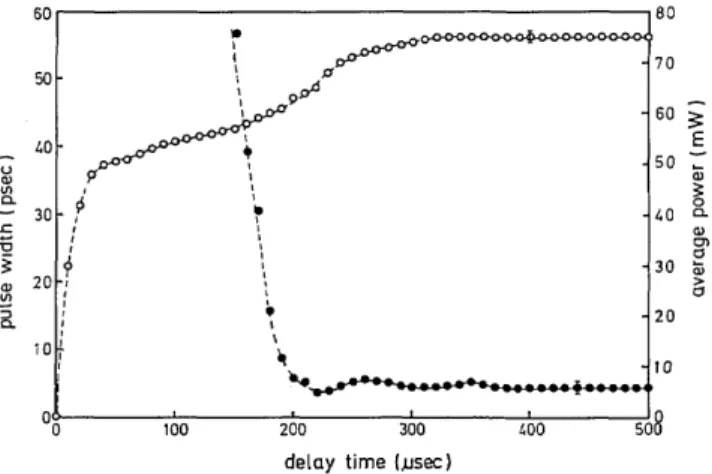
15 Aus of the cw regime, the laser exhibited relaxa-tion oscillarelaxa-tion at 200 kHz. As the circulating en-ergy inside the cavity increased and saturated the DDI dye absorber, the output of the Ti:sapphire laser became modulated, and a pulse train appeared. In Fig. 3 we display the widths of the mode-locked
pulses as a function of the delay time. This was measured by the time-gating method. Zero delay time was at the onset of Ti:sapphire laser action. The pulse width can be seen to shorten quickly dur-ing a period of =60 gs after the laser output became
modulated. In comparison, the shortening took
=200 gs in a mode-locked Ti:sapphire/HITCI laser
with an intracavity compensating prism pair.
14This is explained as follows: At the starting stage of pulse development, the pulse width was longer and the chirping effect had not manifested itself. The additional prism pair would contribute an (as yet) uncompensated amount of group-velocity dis-persion and be responsible for a longer buildup time than that of our Ti:sapphire/DDI laser without the
compensating prism pair. Furthermore the system
with the prism sequence eventually generated
steady-state subpicosecond pulses and thus would require a longer buildup time than our picosecond
laser without the compensating prism pair. The
Ti:sapphire/DDI laser also exhibited an oscillatory behavior as it approached a steady-state value of 4.2 ps in =370 gs. Excluding the initial cw opera-tion regime, the buildup time to the steady state took -230 As. The oscillatory behavior was not caused by the electronic artifacts (i.e., ringing), and similar behavior has previously been observed for a colliding-pulse mode-locked Rhodamine 6G/DODCI ring dye laser without the compensating prism se-quence.'7 Based on the similarities, we interpret the oscillation to be the result of combined action of the pulse-shortening forces and the pulse-broadening forces that are primarily due to group-velocity dis-persion and to a lesser extent to self-phase modula-tion effects in the cavity. Also shown in Fig. 3 is the buildup of the average output power
PI,
of theTi:sapphire laser. During the initial 30 As, the rate
of change of Pay was limited by the chopper. As Pay increased, this rate of change became faster once the laser pulse train was formed. Lower effective loss in the cavity owing to bleaching of the absorber was throught to be responsible for the faster rate. The steady-state value of Pay was reached in approxi-mately the same time as that taken by the evolution of the pulse width.
a, 30 30 E: 0. 0)M E0 IV 0 0 100 200 300 400 soD
deMay time (jusec)
Fig. 3. Pulse width (filled circles) and average power (open circles) as a function of the delay time. Zero delay time corresponds to the onset of Ti:sapphire laser action.
40 ,r 4~~~~~~~~~~~~~~~~~~~~~~~~~~~~~~~~~~~~~~, 30- W , I I I I I I p0MVJ100MVJ I
I L
I I II
iM -% I L A I I - I 0 us 7 0 5 0 i 20 D336 OPTICS LETTERS / Vol. 17, No. 5 / March 1, 1992 260 130 50 770 780 790 800 wavelength ( nm )
Fig. 4. Spectra of the output of the Ti:sapphire/DDI laser as a function of the delay time.
By increasing the pumping power of the argon-ion
laser from 4.6 to 5.4 W with steps of 0.2 W, we found
that the duration in which the laser operated cw was shortened to =200, 140, 100, 80, and 60 4s, respec-tively. The pulse buildup times, starting from the time that the laser became modulated to the first minimum of oscillation of the pulse width, also shortened to =100, 60, 40, 35, and 30 as, respec-tively. The shortening of these two characteristic times is attributed to the increase in the intracavity energy at higher pumping powers. The steady-state pulse widths, however, were nearly the same when the pumping power was varied in this range. It is not yet clear from our data and previous studies how the steady-state properties of passively mode-locked Ti:sapphire lasers are affected by the characteristics of a saturable absorber.
The evolution of the spectra of the laser output is shown in Fig. 4. Spectral narrowing was observed in the cw regime. This is reasonable, since the lon-gitudinal modes would then be unlocked and random in phase, yielding a broad output spectrum. As the photon energy built up inside the cavity, the side modes ceased lasing and the bandwidth of the spec-trum narrowed owing to gain competition among the longitudinal modes in a homogeneously broad-ened medium. This process took -110 As. Once
the laser began to operate in the mode-locked
regime, the blue side of the spectrum gradually
in-creased and the output spectrum broadened. A
much longer pulse width was observed than was ex-pected from the spectral width in the steady state (Fig. 4). This implies that the pulses show large chirping caused by the dispersion and self-phase modulation inside the Ti:sapphire rod. The gain saturation process will enhance the trailing-edge
spectral component. As a result the observed
spectrum exhibited a blue shift. A dramatically
changed spectrum was also observed at the first minimum of oscillation of the pulse width. This
be-havior also resembled that of the colliding-pulse
mode-locked Rhodamine 6G/DODCI ring dye laser without the compensating prism
sequence.'
7In summary, we have presented detailed
experi-mental data on the dynamics of pulse formation in a cw passively mode-locked Ti:sapphire/DDI laser. This laser initially operates in a cw regime, becomes mode locked, and generates steady-state picosecond pulses in n370 us. Excluding the cw stage, the pulse width rapidly shortens in 60 gs, and the en-tire pulse buildup process takes -230 gs. This
cor-responds to 23,000 round trips. An interesting
oscillatory behavior during the evolution of the pulse width, attributed to the competition between the
shortening forces and the broadening forces in
the cavity, was also observed. Concurrently the
bandwidth of the laser output spectrum initially
narrowed owing to the competition among the longi-tudinal modes of the homogeneously broadened gain medium and broadened as the mode-locked pulse train evolved.
This research was partially supported by the
National Science Council of the Republic of China under grants NSC79-0417-E009-04,
NSC80-0417-E009-05, and NSC80-0417-E009-17. The
au-thors thank the reviewers for valuable comments, W-D. Hwang and M.-H. Lu for the loan of equip-ment, and J. Wang for a preprint of his paper. Help-ful discussions with Y Lai are also acknowledged.
References
1. J. Goodberlet, J. Wang, J. G. Fujimoto, and P. A.
Schulz, Opt. Lett. 14, 1125 (1989).
2. P. F. Curley and A. I. Ferguson, Opt. Lett. 16, 1016
(1991).
3. J. D. Kafka, M. L. Watts, D. J. Roach, M. S. Keirstead,
H. W Schaaf, and T. Baer, in Digest of Conference on
Lasers and Electro-Optics (Optical Society of Amer-ica, Washington, D.C., 1990), paper CPDP8.
4. U. Keller, W H. Knox, and H. Roskos, Opt. Lett. 15, 1377 (1990).
5. D. E. Spence, P. N. Kean, and W Sibbett, Opt. Lett.
16, 42 (1991).
6. J. P. Likforman, G. Grillon, M. Joffre, C. L. Blanc,
A. Migus, and A. Antonetti, Appl. Phys. Lett. 58,
2061 (1991).
7. L. Spinelli, B. Couillaud, N. Goldblatt, and D. K. Negus,
in Digest of Conference on Lasers and Electro-Optics
(Optical Society of America, Washington, D.C., 1991), paper CPDP7.
8. N. Sarukura, Y. Ishida, H. Nakano, and Y. Yamamoto,
Appl. Phys. Lett. 56, 814 (1990).
9. N. Sarukura, Y Ishida, T. Yanagawa, and H. Nakano,
Appl. Phys. Lett. 57, 229 (1990).
10. N. Sarukura, Y. Ishida, and H. Nakano, Opt. Commun.
77, 49 (1990).
11. N. Sarukura, Y. Ishida, and H. Nakano, Opt. Lett. 16,
153 (1991).
12. K. Naganuma and K. Mogi, Opt. Lett. 16, 738 (1991).
13. J. Goodberlet, J. Wang, J. G. Fujimoto, and P. A.
Schulz, Opt. Lett. 15, 1300 (1990).
14. Y Ishida, N. Sarukura, and H. Nakano, in Digest of
Conference on Lasers and Electro-Optics (Optical Society of America, Washington, D.C., 1991),
paper JMB2.
15. S. Chen and J. Wang, Opt. Lett. 16, 1689 (1991). 16. Exciton, Inc., laser dye catalog (Dayton, Ohio,
1989-1991), p. 33.