On: 27 April 2014, At: 17:13 Publisher: Taylor & Francis
Informa Ltd Registered in England and Wales Registered Number: 1072954 Registered office: Mortimer House, 37-41 Mortimer Street, London W1T 3JH, UK
Liquid Crystals
Publication details, including instructions for authors and subscription information: http://www.tandfonline.com/loi/tlct20
Effect of polar substituents on the properties of
1,3,4-oxadiazole-based liquid crystalline materials
containing asymmetric cores
Hsiao-Hsien Sung a & Hong-Cheu Lin Corresponding author a
a
Department of Materials Science and Engineering , National Chiao Tung University , Hsinchu, Taiwan, ROC
Published online: 25 May 2010.
To cite this article: Hsiao-Hsien Sung & Hong-Cheu Lin Corresponding author (2004) Effect of polar substituents on the properties of 1,3,4-oxadiazole-based liquid crystalline materials containing asymmetric cores , Liquid Crystals, 31:6, 831-840, DOI: 10.1080/02678290410001703109
To link to this article: http://dx.doi.org/10.1080/02678290410001703109
PLEASE SCROLL DOWN FOR ARTICLE
Taylor & Francis makes every effort to ensure the accuracy of all the information (the “Content”) contained in the publications on our platform. However, Taylor & Francis, our agents, and our licensors make no
representations or warranties whatsoever as to the accuracy, completeness, or suitability for any purpose of the Content. Any opinions and views expressed in this publication are the opinions and views of the authors, and are not the views of or endorsed by Taylor & Francis. The accuracy of the Content should not be relied upon and should be independently verified with primary sources of information. Taylor and Francis shall not be liable for any losses, actions, claims, proceedings, demands, costs, expenses, damages, and other liabilities whatsoever or howsoever caused arising directly or indirectly in connection with, in relation to or arising out of the use of the Content.
This article may be used for research, teaching, and private study purposes. Any substantial or systematic reproduction, redistribution, reselling, loan, sub-licensing, systematic supply, or distribution in any
form to anyone is expressly forbidden. Terms & Conditions of access and use can be found at http:// www.tandfonline.com/page/terms-and-conditions
Liquid Crystals ISSN 0267-8292 print/ISSN 1366-5855 online#2004 Taylor & Francis Ltd
http://www.tandf.co.uk/journals DOI: 10.1080/02678290410001703109
Effect of polar substituents on the properties of
1,3,4-oxadiazole-based liquid crystalline materials containing
asymmetric cores
HSIAO-HSIEN SUNG and HONG-CHEU LIN*
Department of Materials Science and Engineering, National Chiao Tung University, Hsinchu, Taiwan, ROC
(Received 10 October 2003; in final form 4 February 2004; accepted 4 February 2004 )
A series of 1,3,4-oxadiazole-based liquid crystals bearing different polar substituents (n-NPO-X, where X~Me, OMe, Cl, F, CN, and NO2) at the phenyl 4-position have been synthesized and characterized. These angular oxadiazole-based liquid crystals, which are composed of asymmetric cores containing naphthalene units, exhibit stable mesogenic properties including the nematic and smectic A phases. With analogous structural design, the transition temperatures, mesomorphic phases, optical properties, and internal quantum efficiencies show strong dependence on the terminal substitution. In general, by increasing the terminal dipoles, the temperature ranges of the mesophases are enhanced, and both the absorption and photoluminescence spectra are shifted to longer wavelengths.
1. Introduction
The design and synthesis of liquid crystals (LCs) containing heterocyclic units have been the subject of much research in recent years [1–6]. Due to greater choices in the design of new mesogenic molecules containing heterocyclic rings, the polarity and geometry of the molecules may be varied by the introduction of hetero-atoms [7, 8]. These factors lead to dramatic changes in the types of mesophase and the phase transition temperatures in heterocyclic liquid crystalline materials.
Dipole–dipole interactions and structural shapes are fundamental elements in the design of liquid crystals [9]. However, the role of polar units in the generation of liquid crystalline phases still needs to be explored in novel heterocyclic systems, because polar substituents are highly variable, and their attaching sites are also adjustable. These benefits allow us to access a wide variety of mesophases simply by changing the polar moieties or their attaching positions.
1,3,4-Oxadiazole-based LC derivatives, which possess asymmetric structures containing the oxadiazole ring in the central position of the mesogenic core, were first proposed by Dimitrowa et al. [10]. The introduction of oxadiazole rings can provide not only the lateral dipole from the oxygen and nitrogen atoms, but also the bent shape of the rigid cores. This large lateral dipole leads to the possibility of hexagonal columnar phases when
oxadiazole rings are used as central cores [11]. In addition, star-shaped molecules containing 2,5-diphenyloxadiazole units as rigid arms possess a discotic nematic phase [12]. Compounds having both oxadiazole and pyridinium groups may exhibit liquid crystalline properties as well as thermochromic beha-viour, with a colour change from yellow at room temperature to bright red in the mesophase [13].
The choice of terminal moieties is crucial in the generation of specific types of liquid crystalline phases. In this study, a series of 1,3,4-oxadiazole-based liquid crystals with different terminal polar units have been synthesized; their liquid crystalline and photolumines-cent properties with respect to various terminal polarities have been investigated.
2. Results and discussion 2.1. Mesophases and thermal properties
The series of 1,3,4-oxadiazole-based liquid crystals containing different polar substituents are depicted in figure 1. From previous studies, it is known that 2,5-diphenyl-1,3,4-oxadiazole has an exocylic bond angle (y134‡) with a 3.86 D dipole moment pointed to the oxygen atom of the oxadiazole [14]. These new oxadiazole-based materials therefore also have large exocylic bond angles and lateral dipole moments.
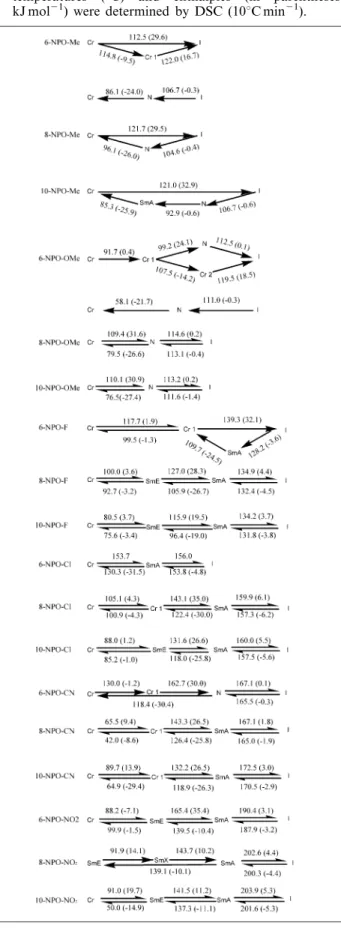
The phase behaviour of these materials is shown in table 1. The temperature ranges (3.1–62.4‡C) of the mesophases are probably influenced by the bent structure of the rigid core, which originates from the
*Author for correspondence; e-mail: [email protected]
non-linear 1,3,4-oxadiazole ring, as well as by the flexible chain lengths and polar terminal groups. All the compounds with electron-donating terminal groups, i.e. n-NPO-Me and n-NPO-OMe, exhibit the nematic (N) phase characterized by schlieren textures. Methoxy-substituted compounds (NPO-OMe) possess enantiotropic mesophase behaviour; however, methyl-substituted compounds (NPO-Me) display a monotropic nematic phases. Surprisingly, 10-NPO-Me has a focal-conic texture indicating a smectic A (SmA) phase, but 10-NPO-OMe has no SmA phase. This might be explained by cancellation of the opposing dipole moments of the methoxy group and oxadiazole unit. This effect is also evident in that the isotropization temperatures of n-NPO-Me are higher than those of analogous n-NPO-OMe. As it can be seen in figure 2, 6-NPO-Me and 6-NPO-O6-NPO-Me both recrystallize before reaching their isotropic points. In particular, 6-NPO-OMe enters the N phase at 99.2‡C, then part of the domain begins to recrystallize. The N phase becomes isotropic at 112.5‡C, and the recrystallized domain melts at 119.5‡C. This unusual behaviour has also been observed in glass-forming liquid crystals [15].
These LC materials, incorporating the strongly polar electron-withdrawing terminal groups F, Cl, CN and NO2, exhibit the SmA phase (except 6-NPO-CN). During cooling in the polarizing optical microscope, 10-NPO-NO2 shows a typical focal-conic texture of the SmA phase at 150‡C, figure 3 (a); at 130‡C the mesophase then transfers to a paramorphotic arced focal-conic fan texture which is tentatively assigned as the smectic E phase, figure 3 (b). In a literature search it was found that an oxadiazole-based material (2,5-diphenyl-1,3,4-oxadiazole, see figure 4) containing a symmetric core, which is similar to 6-NPO-CN of this report, possesses only a crystalline phase [10]. In comparison with the analogous structure containing the symmetric diphenyl core, 6-NPO-CN shows meso-morphic properties owing to the replacement of one phenyl group by a naphthalene unit to generate an asymmetric core. Therefore, our molecular design of
Figure 1. Chemical structures of the synthesized molecules.
Table 1. Phase behavior of n-NPO-X derivatives. Transition temperatures (‡C) and enthalpies (in parentheses, kJ mol21) were determined by DSC (10‡C min21).
asymmetric cores containing naphthalene units do enhance the occurrence of liquid crystallinity in this study.
Although fluorine has larger electronegativity than chlorine, from the literature [16] the chloro-substituted system (NPO-Cl) actually generates a larger dipole than the fluoro-substituted system (NPO-F) because of the longer bond distance from chlorine to carbon. The angular mesogens carrying different terminal groups indeed influence the mesogenic phases and the transi-tion temperatures in 8-NPO-X analogues (see figure 5). Both the melting and liquid crystallization temperatures (on cooling) increase with the increasing terminal dipoles. The clearing temperature and crystallization temperature have a similar tendency, except for the methyl-substituted compound (8-NPO-Me). Another interesting trend is that the mesogenic phase range also
increases with increasing terminal dipoles (see figure 6), especially during heating; the mesomorphic temperature ranges from 3.1‡C with the methoxy group (8-NPO-OMe)
(a) (b)
Figure 3. Optical textures of compound 10-NPO-NO2. (a) Focal-conic texture at 150‡C (cooling); (b) transfers to a paramorphotic arced focal–conic fan texture at 130‡C (cooling).
Figure 4. Structure containing a diphenyl symmetric core [10].
Figure 2. DSC thermograms of 6-NPO-OMe and 6-NPO-Me during first cooling and second heating.
Figure 5. The effect of polar substituents on the transition temperatures (dipole increases from left to right). (A) clearing point, (B) melting point, (C) liquid crystallization temperature (on cooling), (D) crystallization temperature.
up to 62.4‡C with the nitro group (8-NPO-NO2). From this result, it can be seen that the mesogenic phase ranges of these oxadiazole-based structures can be enlarged by increasing the terminal dipoles, and that both the melting and clearing temperatures can also be raised.
The optical texture of nematic liquid crystals is an important diagnostic for the presence of a biaxial phase. It has been proposed that the elastic constants of a biaxial nematic should produce only two-brush (|S|~1/2) patterns [17]. In our system, when nematic samples of n-NPO-Me and n-NPO-OMe are placed between two untreated glass plates, a schlieren texture consisting only of two-brush disclinations is observed; four-brush disclinations (|S|~1) are absent (see figure 7). It is reported that bent-shaped or boomerang-shaped materials may be candidates for a biaxial nematic phase (Nb) [18, 19], hence, the mesogenic unit containing 1,3,4-oxadiazole which provides a large exocylic bond angle, may possibly lead to Nb materials.
2.2. Photoluminescent properties
The absorption spectra of the synthesized materials n-NPO-X in solution (chloroform) are depicted in figure 8. Similar absorption patterns between 300 and 400 nm are observed in various substituted derivatives of 8-NPO-X (X~Me, OMe, F, and Cl). Nevertheless, both the cyano- and nitro-substituted compounds have longer absorption wavelengths. Except for the
fluoro-substituted compounds (n-NPO-F), a general polar substituent effect is observed; i.e. substituted groups with a stronger dipole result in larger red shifts of absorption (NO2wCNwClwOMewMe). Moreover, the strongest polar substituent effect, resulting in the largest red shift (w30 nm), is observed in the nitro-substituted compound 8-NPO-NO2. This shift may be due to the electronic effect, which lowers the LUMO level (as in p-doped semiconductors) and reduces the energy gap [20].
Normalized photoluminescence (PL) spectra are shown in figure 9, and peak positions are summarized in table 2. The emission colours of these 8-NPO-X derivatives are all in the purple region. The
Figure 7. Schlieren texture exhibited by the nematic phase of compound 6-NPO-OMe (sandwiched between two untreated glass plates). Note that only two-brush disclina-tions, |S|~1/2, are observed.
Figure 6. The effect of polar substituents on the mesophase range during heating and cooling cycles (dipole increases from left to right).
Figure 8. Normalized absorption spectra of 8-NPO-X deri-vatives in solution (chloroform).
methyl-substituted compound 8-NPO-Me has the shortest (PL) wavelength, whereas the stronger dipole substituted compounds have longer PL emission wavelengths. The cyano-substituted compound 8-NPO-CN has the longest emission wavelength, which may be due to the elongated conjugation length of the cyano group in conjuction with the mesogenic core. The relative PL quantum yields of these materials are measured in contrast to 8-NPO-Me. The chloro-substituted compound 8-NPO-Cl has the highest quantum yield, while the nitro-substituted compound 8-NPO-NO2 has the lowest quantum yield. The quenching effect induced by nitro-substitution has also been observed by Wong et al. [21], and is due to the photocurrent generated by the nitro-substituent.
The PL dichroic (DPL) behaviour of these materials was also examined. The emission intensity is highest when the polarizer is parallel to the rubbing direction of the aligned cell, and lowest in the direction perpendi-cular to it. This property yields a PL dichroic ratio DPL~I||/I\, where I|| and I\ are values of the PL
intensities parallel and perpendicular to the rubbing direction, respectively [22]. The values of DPLhave been estimated from 1.4 to 3.4 at the temperatures where the highest DPLvalues are seen (table 3). These results indi-cate that the conjugated cores are aligned predominantly along the rubbing direction. 10-NPO-Me possesses the largest DPL~3.4 at 100‡C, which means that this material has the highest order parameter among these oxadiazole derivatives.
3. Summary
A new class of mesomorphic molecules containing 1,3,4-oxadiazole-based mesogenic cores has been pre-pared. These bent-shaped molecules exhibit nematic and smectic A phases. In general, the mesogenic phases and optical properties of these oxadiazole-based LC materials are strongly influenced by their terminal functional groups. By increasing the terminal dipoles, the mesophase ranges are enhanced, and both the absorption and photoluminescence spectra are shifted toward longer wavelengths.
4. Experimental 4.1. Characterization
Chemicals and solvents were reagent grades and purchased from Aldrich, ARCROS, TCI and Lancaster Chemical Co. Pyridine and N-methyl-2-pyrrolidone (NMP) were distilled before use to remove water. Other chemicals were used without further purification.
1
H NMR spectra were recorded on a Varian unity 300 MHz spectrometer using CDCl3and DMSO-d6 as solvents. Elemental analyses were performed on a Heraeus CHN-OS RAPID elemental analyzer. High resolution electron impact mass data were obtained on a Finnigan-MAT-95XL. Mesophase textures were studied using a polarizing optical microscope (Leica
Table 2. Absorption and photoluminescence spectra of 8-NPO derivatives. Compound Absorption peak/nm Emission PL peak/nm Relative quantum yield 8-NPO-Me 323 374 1 8-NPO-OMe 325 377 1.05 8-NPO-F 323 375 0.95 8-NPO-Cl 329 383 1.3 8-NPO-CN 338 417 1.05 8-NPO-NO2 346 390 0.05
Table 3. PL dichroic ratio (DPL) and order parameter of n-NPO-X in various conditions.
Compound Temperature/‡C Maximum PL dichroic ratioa Order parameterb 10-NPO-Me 100 3.4 0.44 6-NPO-OMe 85 1.8 0.21 10-NPO-F 110 1.9 0.23 10-NPO-Cl 150 1.4 0.11 10-NPO-CN 130 1.7 0.19 10-NPO-NO2 150 1.6 0.17
aThe PL dichroic ratio (D
PL~I||/I\) is obtained from the photoluminescence spectra (using the highest intensities of I|| and I\) at the temperature which gives the highest value.
bOrder parameter~(I
||2I\)/(I||z2I\). Figure 9. Normalized PL spectra of 8-NPO-X derivatives in
solution (chloroform).
DMLP) equipped with a hot stage. Transition tem-peratures were determined by differential scanning calorimetry (Perkin Elmer Pyris 7) with heating and cooling rates of 10‡C min21.
4.2. Synthesis
The synthetic route to the 1,3,4-oxadiazole-based liquid crystalline materials of this study is shown in the scheme. 6-Hydroxynaphthalene-2-carboxylic acid methyl ester (1) was prepared using a modification of the procedure described by Gu¨ller et al. [23]. Compounds 2a–c were obtained by o-alkylation of compound 1 with appropriate n-alkyl bromides, according to a procedure reported previously [24]. The synthetic procedures and chemical analyses of each product are described sequentially below.
4.2.1. 6-Hexyloxynaphthalene-2-carboxylic acid hydrazide (3a)
A mixture of 2.23 g (7.78 mmol) of compound 1 and 3.90 g (77.8 mmol) of hydrazine monohydrate was dissolved in methanol, and the solution heated under reflux for 24 h. After cooling, the reaction mixture was poured into water and the separated solid recrystallized from methanol. yield: 83%. 1H NMR (ppm, DMSO-d6): 0.88 (t, –CH3, 3H), 1.22–1.79 (m, –CH2, 8H), 4.09 (t, –OCH2, 2H), 4.50 (s, –NH2, 2H), 7.18 (d, J~9 Hz, –C10H6, 1H), 7.34 (s, –C10H6, 1H), 7.80–7.90 (m, –C10H6, 3H), 8.33 (s, –C10H6, 1H), 9.81 (s, –NH, 1H). 4.2.2. 6-Octyloxynaphthalene-2-carboxylic acid hydrazide (3b) Yield: 79%.1H NMR (ppm, DMSO-d6): 0.85 (t, –CH3, 3H), 1.25–1.79 (m, –CH2, 12H), 4.08 (t, –OCH2, 2H), 4.52 (s, –NH2, 2H), 7.17 (d, J~9 Hz, –C10H6, 1H), 7.33 (s, –C10H6, 1H), 7.79–7.90 (m, –C10H6, 3H), 8.33 (s, –C10H6, 1H), 9.80 (s, –NH, 1H). 4.2.3. 6-Decyloxynaphthalene-2-carboxylic acid hydrazide (3c) Yield: 82%.1H NMR (ppm, DMSO-d6): 0.84 (t, –CH3, 3H), 1.24–1.79 (m, –CH2, 16H), 4.08 (t, –OCH2, 2H), 4.51 (s, –NH2, 2H), 7.18 (d, J~9 Hz, –C10H6, 1H), 7.34 (s, –C10H6, 1H), 7.83–7.90 (m, –C10H6, 3H), 8.33 (s, –C10H6, 1H), 9.82 (s, –NH, 1H).
4.2.4. 4-Methylbenzoic acid N’-(6-hexyloxynaphthalene-2-carbonyl)hydrazide (4a-CH3)
4-Methylbenzoyl chloride (0.5 g, 3.23 mmol) was added to a solution containing 0.93 g (3.23 mmol) of compound 3a and 0.26 g (3.23 mmol) of pyridine in 10 ml of NMP. The reaction mixture was stirred for 12 h and then poured into water. The solid product was filtered and crystallized from methanol. Yield: 70%.1H NMR (ppm, DMSO-d6): 0.83 (t, –CH3, 3H), 1.21–1.80 (m, –CH2, 8H), 2.38 (s, –CH3, 3H), 4.10 (t, –OCH2, 2H), 7.21 (d, J~9 Hz, –C10H6, 1H), 7.31 (d, J~8.1 Hz, –C6H4, 2H), 7.39 (s, –C10H6, 1H), 7.83–7.95 (m, –C10H6
Scheme. The synthetic route to 1,3,4-oxadiazole-based materials.
and –C6H4, 5H), 8.45 (s, –C10H6, 1H), 10.45 (s, –NH, 1H), 10.52 (s, –NH, 1H).
4.2.5. 4-Methylbenzoic acid N’-(6-octyloxynaphthalene-2-carbonyl)hydrazide (4b-CH3) Yield: 69%.1H NMR (ppm, DMSO-d6): 0.83 (t, –CH3, 3H), 1.21–1.80 (m, –CH2, 12H), 3.38 (s, –CH3, 3H), 4.11 (t, –OCH2, 2H), 7.22 (d, J~9 Hz, –C10H6, 1H), 7.31 (d, J~8.4 Hz, –C6H4, 2H), 7.39 (s, –C10H6, 1H), 7.83–7.96(m, –C10H6and –C6H4, 5H), 8.46 (s, –C10H6, 1H), 10.46 (s, –NH, 1H), 10.52 (s, –NH, 1H).
4.2.6. 4-Methylbenzoic acid N’-(6-decyloxynaphthalene-2-carbonyl)hydrazide (4c-CH3) Yield: 79%.1H NMR (ppm, DMSO-d6): 0.84 (t, –CH3, 3H), 1.24–1.78 (m, –CH2, 16H), 2.38 (s, –CH3, 3H), 4.11 (t, –OCH2, 2H), 7.22 (d, J~9 Hz, –C10H6, 1H), 7.31 (d, J~7.8 Hz, –C6H4, 2H), 7.39 (s, –C10H6, 1H), 7.83–7.97 (m, –C10H6and –C6H4, 5H), 8.46 (s, –C10H6, 1H), 10.47 (s, –NH, 1H), 10.52 (s, –NH, 1H).
4.2.7. 4-Methoxybenzoic acid N’-(6-hexyloxynaphthalene-2-carbonyl)hydrazide (4a-OMe) Yield: 90%.1H NMR (ppm, DMSO-d6): 0.88 (t, –CH3, 3H), 1.21–1.81 (m, –CH2, 8H), 3.87 (s, –OCH3, 3H), 4.11 (t, –OCH2, 2H), 7.17 (d, J~8.7 Hz, –C6H4, 2H), 7.25 (d, J~8.7 Hz, –C10H6, 1H), 7.42 (s, –C10H6, 1H), 7.79–8.11 (m, –C10H6and –C6H4, 5H), 8.63 (s, –C10H6, 1H), 10.39 (d, –NH, 2H).
4.2.8. 4-Methoxybenzoic acid N’-(6-octyloxynaphthalene-2-carbonyl)hydrazide (4b-OMe) Yield: 85%.1H NMR (ppm, DMSO-d6): 0.86 (t, –CH3, 3H), 1.22–1.81 (m, –CH2, 12H), 3.83 (s, –OCH3, 3H), 4.11 (t, –OCH2, 2H), 7.04 (d, J~8.7 Hz, –C6H4, 2H), 7.21 (d, J~9 Hz, –C10H6, 1H), 7.39 (s, –C10H6, 1H), 7.90–7.96 (m, –C10H6and –C6H4, 5H), 8.46 (s, –C10H6, 1H), 10.39 (d, –NH, 2H).
4.2.9. 4-Methoxybenzoic acid N’-(6-decyloxynaphthalene-2-carbonyl)hydrazide (4c-OMe) Yield: 82%.1H NMR (ppm, DMSO-d6): 0.86 (t, –CH3, 3H), 1.24–1.77 (m, –CH2, 16H), 3.82 (s, –OCH3, 3H), 4.10 (t, –OCH2, 2H), 7.04 (d, J~8.7 Hz, –C6H4, 2H), 7.21 (d, J~9.3 Hz, –C10H6, 1H), 7.39 (s, –C10H6, 1H), 7.90–7.93 (m, –C10H6and –C6H4, 5H), 8.45 (s, –C10H6, 1H), 10.39 (d, –NH, 2H).
4.2.10. 4-Fluorobenzoic acid N’-(6-hexyloxynaphthalene-2-carbonyl)hydrazide (4a-F) Yield: 77%.1H NMR (ppm, DMSO-d6): 0.88 (t, –CH3, 3H), 1.23–1.81 (m, –CH2, 8H), 4.11 (t, –OCH2, 2H), 7.22 (d, J~9 Hz, –C10H6, 1H), 7.34 (s, –C10H6, 1H), 7.37 (d, J~8.7 Hz, –C6H4, 2H), 7.87–8.03 (m, –C10H6 and –C6H4, 5H), 8.46 (s, –C10H6, 1H), 10.58 (s, –NH, 2H).
4.2.11. 4-Fluorobenzoic acid N’-(6-octyloxynaphthalene-2-carbonyl)hydrazide (4b-F) Yield: 72%.1H NMR (ppm, DMSO-d6): 0.85 (t, –CH3, 3H), 1.26–1.80 (m, –CH2, 12H), 4.11 (t, –OCH2, 2H), 7.22 (d, J~9 Hz, –C10H6, 1H), 7.34 (s, –C10H6, 1H), 7.37 (d, J~8.7 Hz, –C6H4, 2H), 7.88–8.04 (m, –C10H6 and –C6H4, 5H), 8.46 (s, –C10H6, 1H), 10.58 (s, –NH, 2H).
4.2.12. 4-Fluorobenzoic acid N’-(6-decyloxynaphthalene-2-carbonyl)hydrazide (4c-F) Yield: 72%.1H NMR (ppm, DMSO-d6): 0.85 (t, –CH3, 3H), 1.24–1.80 (m, –CH2, 16H), 4.11 (t, –OCH2, 2H), 7.22 (d, J~9 Hz, –C10H6, 1H), 7.34 (s, –C10H6, 1H), 7.37 (d, J~9 Hz, –C6H4, 2H), 7.87–8.04 (m, –C10H6 and –C6H4, 5H), 8.46 (s, –C10H6, 1H), 10.55 (s, –NH, 2H).
4.2.13. 4-Chlorobenzoic acid N’-(6-hexyloxynaphthalene-2-carbonyl)hydrazide (4a-Cl) Yield: 80%.1H NMR (ppm, DMSO-d6): 0.88 (t, –CH3, 3H), 1.23–1.81 (m, –CH2, 8H), 4.11 (t, –OCH2, 2H), 7.22 (d, J~9 Hz, –C10H6, 1H), 7.39 (s, –C10H6, 1H), 7.60 (d, J~8.7 Hz, –C6H4, 2H), 7.88–7.97 (m, –C10H6 and –C6H4, 5H), 8.46 (s, –C10H6, 1H), 10.60 (s, –NH, 1H), 10.64 (s, –NH, 1H).
4.2.14. 4-Chlorobenzoic acid N’-(6-octyloxynaphthalene-2-carbonyl)hydrazide (4b-Cl) Yield: 83%.1H NMR (ppm, DMSO-d6): 0.86 (t, –CH3, 3H), 1.26–1.81 (m, –CH2, 12H), 4.11 (t, –OCH2, 2H), 7.22 (d, J~9 Hz, –C10H6, 1H), 7.39 (s, –C10H6, 1H), 7.60 (d, J~8.7 Hz, –C6H4, 2H), 7.88–7.97 (m, –C10H6 and –C6H4, 5H), 8.46 (s, –C10H6, 1H), 10.62 (s, –NH, 1H), 10.64 (s, –NH, 1H).
4.2.15. 4-Chlorobenzoic acid N’-(6-decyloxynaphthalene-2-carbonyl)hydrazide (4c-Cl) Yield: 79%.1H NMR (ppm, DMSO-d6): 0.84 (t, –CH3, 3H), 1.24–1.80 (m, –CH2, 16H), 4.11 (t, –OCH2, 2H), 7.21 (d, J~9 Hz, –C10H6, 1H), 7.38 (s, –C10H6, 1H), 7.60 (d, J~8.4 Hz, –C6H4, 2H), 7.87–7.97 (m, –C10H6 and –C6H4, 5H), 8.46 (s, –C10H6, 1H), 10.58 (s, –NH, 1H), 10.62 (s, –NH, 1H).
4.2.16. 4-Cyanobenzoic acid N’-(6-hexyloxynaphthalene-2-carbonyl)hydrazide (4a-CN) Yield: 77%.1H NMR (ppm, DMSO-d6): 0.86 (t, –CH3, 3H), 1.26–1.81 (m, –CH2, 8H), 4.11 (t, –OCH2, 2H), 7.22 (d, J~9 Hz, –C10H6, 1H), 7.40 (s, –C10H, 1H), 7.88–7.97 (m, –C10H6 and –C6H4, 3H), 8.02–8.10 (m, –C10H6 and –C6H4, 4H), 8.46 (s, –C10H6, 1H), 10.67 (s, –NH, 1H), 10.82 (s, –NH, 1H).
4.2.17. 4-Cyanobenzoic acid N’-(6-octlyoxynaphthalene-2-carbonyl)hydrazide (4b-CN) Yield: 68%.1H NMR (ppm, DMSO-d6): 0.84 (t, –CH3, 3H), 1.26–1.81 (m, –CH2, 12H), 4.11 (t, –OCH2, 2H), 7.22 (d, J~9 Hz, –C10H6, 1H), 7.39 (s, –C10H, 1H), 7.91–7.97 (m, –C10H6 and –C6H4, 3H), 8.02–8.10 (m, –C10H6 and –C6H4, 4H), 8.46 (s, –C10H6, 1H), 10.67 (s, –NH, 1H), 10.82 (s, –NH, 1H).
4.2.18. 4-Cyanobenzoic acid N’-(6-decyloxynaphthalene-2-carbonyl)hydrazide (4c-CN) Yield: 68%.1H NMR (ppm, DMSO-d6): 0.82 (t, –CH3, 3H), 1.24–1.80 (m, –CH2, 16H), 4.11 (t, –OCH2, 2H), 7.22 (d, J~9 Hz, –C10H6, 1H), 7.39 (s, –C10H, 1H), 7.88–7.97 (m, –C10H6 and –C6H4, 3H), 8.02–8.10 (m, –C10H6 and –C6H4, 4H), 8.46 (s, –C10H6, 1H), 10.68 (d, –NH, 2H).
4.2.19. 4-Nitrobenzoic acid N’-(6-hexyloxynaphthalene-2-carbonyl)hydrazide (4a-NO2) Yield: 77%.1H NMR (ppm, DMSO-d6): 0.88 (t, –CH3, 3H), 1.22–1.81 (m, –CH2, 8H), 4.11 (t, –OCH2, 2H), 7.22 (d, J~9 Hz, –C10H6, 1H), 7.41 (d, –C10H, 1H), 7.88–7.97 (m, –C10H6, 3H), 8.15 (d, J~9 Hz, –C6H4, 2H), 8.39 (d, J~9 Hz, –C6H4, 2H), 8.47 (s, –C10H6, 1H), 10.70 (s, –NH, 1H), 10.90 (s, –NH, 1H).
4.2.20. 4-Nitrobenzoic acid N’-(6-octyloxynaphthalene-2-carbonyl)hydrazide (4b-NO2) Yield: 83%.1H NMR (ppm, DMSO-d6): 0.85 (t, –CH3, 3H), 1.22–1.81 (m, –CH2, 12H), 4.11 (t, –OCH2, 2H), 7.22 (d, J~8.7 Hz, –C10H6, 1H), 7.40 (d, –C10H, 1H), 7.88–7.97 (m, –C10H6, 3H), 8.15 (d, J~9 Hz, –C6H4, 2H), 8.37 (d, J~9 Hz, –C6H4, 2H), 8.47 (s, –C10H6, 1H), 10.70 (s, –NH, 1H), 10.91 (s, –NH, 1H).
4.2.21. 4-Nitrobenzoic acid N’-(6-decyloxynaphthalene-2-carbonyl)hydrazide (4c-NO2) Yield: 83%.1H NMR (ppm, DMSO-d6): 0.84 (t, –CH3, 3H), 1.24–1.81 (m, –CH2, 16H), 4.11 (t, –OCH2, 2H), 7.22 (d, J~9 Hz, –C10H6, 1H), 7.40 (d, –C10H, 1H), 7.88–7.97 (m, –C10H6, 3H), 8.15 (d, J~8.7 Hz, –C6H4, 2H), 8.37 (d, J~9.0 Hz, –C6H4, 2H), 8.47 (s, –C10H6, 1H), 10.69 (s, –NH, 1H), 10.89 (s, –NH, 1H). 4.2.22. 2-(6-Hexyloxynaphthalen-2-yl)-5-p-tolyl-[1,3,4]oxadiazole (6-NPO-CH3)
Compound 4a-CH3 (0.8 g, 2.07 mmol) was dissolved in 10 ml of POCl3; the mixture was heated at 130‡C overnight, and then cooled to room temperature. Excess POCl3 was removed at reduced pressure and the remaining mixture poured into water. The product was filtered and crystallized from methanol and chloroform to give a white solid; yield 42%. 1H NMR (ppm, CDCl3): 0.93 (t, –CH3, 3H), 1.26–1.90 (m, –CH2, 8H), 2.46 (s, –CH3, 3H), 4.11 (t, –OCH2, 2H), 7.17 (s, –C10H6, 1H), 7.21 (d, J~8.7 Hz, –C10H6, 1H), 7.34 (d, J~7.8 Hz, –C6H4, 2H), 7.83(d, J~8.4 Hz, –C10H6, 2H), 7.85(d, J~8.4 Hz, –C10H6, 1H), 8.05 (d, J~8.4 Hz, –C6H4, 2H), 8.14 (d, J~8.4 Hz, –C10H6, 1H), 8.53 (s, –C10H6, 1H). Anal: calc. for C25H26N2O2 C 77.69, H 6.78, N 7.25; found C 77.98, H 6.80, N 6.85%. HRMS (EI) calc. 386.1994; found 386.1986. 4.2.23.
2-(6-Octyloxynaphthalen-2-yl)-5-p-tolyl-[1,3,4]oxadiazole (8-NPO-CH3)
White solid; yield 36%.1H NMR (ppm, CDCl3): 0.93 (t, –CH3, 3H), 1.26–1.90 (m, –CH2, 12H), 2.46 (s, –CH3, 3H), 4.11 (t, –OCH2, 2H), 7.17 (s, –C10H6, 1H), 7.21 (d, J~8.7 Hz, –C10H6, 1H), 7.34 (d, J~7.8 Hz, –C6H4, 2H), 7.83 (d, J~8.4 Hz, –C10H6, 1H), 7.85 (d, J~8.4 Hz, –C10H6, 1H), 8.06 (d, J~8.4 Hz, –C6H4, 2H), 8.14 (d, J~8.4 Hz, –C10H6, 1H), 8.53 (s, –C10H6, 1H). Anal: calc. for C27H30N2O2 C 78.23, H 7.29, N 6.76; found C 78.46, H 7.41, N 6.65%. HRMS (EI) calc. 414.2307; found 414.2312.
4.2.24. 2-(6-Decyloxy-naphthalen-2-yl)-5-p-tolyl-[1,3,4]oxadiazole (10-NPO-CH3)
White solid; yield 53%.1H NMR (ppm, CDCl3): 0.86 (t, –CH3, 3H), 1.29–1.90 (m, –CH2, 16H), 2.46 (s, –CH3, 3H), 4.11 (t, –OCH2, 2H), 7.17 (s, –C10H6, 1H), 7.21 (d, J~9.3 Hz, –C10H6, 1H), 7.34 (d, J~8.4 Hz, –C6H4, 2H), 7.82 (d, J~8.7 Hz, –C10H6, 1H), 7.85 (d, J~8.4 Hz, –C10H6, 1H), 8.06 (d, J~8.4 Hz, –C6H4, 2H), 8.14 (d, J~9 Hz, –C10H6, 1H), 8.53 (s, –C10H6, 1H). Anal: calc. for C29H34N2O2 C 78.70, H 7.74, N 6.33; found C 78.64, H 7.64, N 6.51%. HRMS (EI) calc. 442.2620; found 442.2617.
4.2.25. 2-(6-Hexyloxynaphthalen-2-yl)-5-(4-methoxy-phenyl)-[1,3,4]oxadiazole (6-NPO-OMe) White solid; yield 45%.1H NMR (ppm, CDCl3): 0.90 (t, –CH3, 3H), 1.30–1.90 (m, –CH2, 8H), 3.91 (s, –OCH3,
3H), 4.11 (t, –OCH2, 2H), 7.04 (d, J~9 Hz, –C6H4, 2H), 7.17 (s, –C10H6, 1H), 7.21 (d, J~9 Hz, –C10H6, 1H), 7.82 (d, J~8.4 Hz, –C10H6, 1H), 7.85 (d, J~8.4 Hz, –C10H6, 1H), 8.10–8.17 (m, –C6H4 and –C10H6, 3H), 8.52 (s, –C10H6, 1H). Anal: calc. for C25H26N2O3C 74.60, H 6.51, N 6.96; found C 74.27, H 6.55, N 6.80%. HRMS (EI) calc. 402.1943; found 402.1946.
4.2.26. 2-(6-Methoxyphenyl)-5-(6-octyloxynaphthalen-2-yl)-[1,3,4]oxadiazole (8-NPO-OMe)
White solid; yield 51%.1H NMR (ppm, CDCl3): 0.90 (t, –CH3, 3H), 1.30–1.90 (m, –CH2, 12H), 3.91 (s, –OCH3, 3H), 4.11 (t, –OCH2, 2H), 7.03 (d, J~9 Hz, –C6H4, 2H), 7.16 (s, –C10H6, 1H), 7.21 (d, J~8.7 Hz, –C6H4, 2H), 7.82 (d, J~8.1 Hz, –C10H6, 1H), 7.85 (d, J~8.1 Hz, –C10H6, 1H), 8.10–8.17 (m, –C6H4 and –C10H6, 3H), 8.51 (s, –C10H6, 1H). Anal: calc. for C27H30N2O3 C 75.32, H 7.02, N 6.51; found C 75.15, H 6.45, N 7.16%. HRMS (EI) calc. 430.2256; found 430.2248.
4.2.27. 2-(6-Decyloxynaphthalen-2-yl)-5-(4-methoxy-phenyl)-[1,3,4]oxadiazole (10-NPO-OMe) White solid; yield 52%.1H NMR (ppm, CDCl3): 0.89 (t, –CH3, 3H), 1.28–1.90 (m, –CH2, 16H), 3.91 (s, –OCH3, 3H), 4.11 (t, –OCH2, 2H), 7.04 (d, J~9.3 Hz, –C6H4, 2H), 7.16 (s, –C10H6, 1H), 7.21 (d, J~9 Hz, –C6H4, 2H), 7.82 (d, J~8.4 Hz, –C10H6, 1H), 7.85 (d, J~8.4 Hz, –C10H6, 1H), 8.11–8.17 (m, –C6H4 and –C10H6, 3H), 8.52 (s, –C10H6, 1H). Anal: calc. for C29H34N2O3C 75.95, H 7.47, N 6.11; found C 76.10, H 7.22, N 5.89%. HRMS (EI) calc. 458.2569; found 458.2574.
4.2.28. 2-(4-Fluorophenyl)-5-(6-hexyloxynaphthalen-2-yl)-[1,3,4]oxadiazole (6-NPO-F)
White solid; yield 87%.1H NMR (ppm, CDCl3): 0.93 (t, –CH3, 3H), 1.24–1.90 (m, –CH2, 8H), 4.11 (t, –OCH2, 2H), 7.18–7.28 (m, –C10H6 and –C6H4, 4H), 7.83 (d, J~8.7 Hz, –C10H6, 1H), 7.85 (d, J~9 Hz, –C10H6, 1H), 8.13–8.22 (m, –C6H4 and –C10H6, 3H), 8.53 (s, –C10H6, 1H). Anal: calc. for C24H23FN2O2 C 73.83, H 5.94, N 7.17; found C 73.78, H 6.23, N 7.50%. HRMS (EI) calc. 390.1744; found 390.1740.
4.2.29. 2-(4-Fluorophenyl)-5-(6-octyloxynaphthalen-2-yl)-[1,3,4]oxadiazole (8-NPO-F)
White solid; yield 81%.1H NMR (ppm, CDCl3): 0.90 (t, –CH3, 3H), 1.31–1.90 (m, –CH2, 12H), 4.11 (t, –OCH2, 2H), 7.17–7.28 (m, –C10H6 and –C6H4, 4H), 7.83 (d, J~8.7 Hz, –C10H6, 1H), 7.85 (d, J~8.7 Hz,
–C10H6, 1H), 8.13–8.22 (m, –C6H4 and –C10H6, 3H), 8.52 (s, –C10H6, 1H). Anal: calc. for C26H27FN2O2 C 74.62, H 6.50, N 6.69%; found C 74.22, H 6.57, N 6.55%. HRMS (EI) calc. 418.2057; found 418.2055. 4.2.30.
2-(6-Decyloxy-naphthalen-2-yl)-5-(4-fluoro-phenyl)-[1,3,4]oxadiazole (10-NPO-F)
White solid; yield 87%.1H NMR (ppm, CDCl3): 0.88 (t, –CH3, 3H), 1.26–1.87 (m, –CH2, 16H), 4.11 (t, –OCH2, 2H), 7.17–7.28 (m, –C10H6 and –C6H4, 4H), 7.84 (d, J~8.4 Hz, –C10H6, 1H), 7.85 (d, J~9 Hz, –C10H6, 1H), 8.14–8.23 (m, –C6H4 and –C10H6, 3H), 8.52 (s, –C10H6, 1H). Anal: calc. for C28H31FN2O2 C 75.31, H 7.00, N 6.27; found C 75.58, H 7.18, N 6.09%. HRMS (EI) calc. 446.2370; found 446.2377.
4.2.31. 2-(4-Chloro-phenyl)-5-(6-hexyloxy-naphthalen-2-yl)-[1,3,4]oxadiazole (6-NPO-Cl)
White solid; yield 68%.1H NMR (ppm, CDCl3): 0.88 (t, –CH3, 3H), 1.25–1.90 (m, –CH2, 8H), 4.07 (t, –OCH2, 2H), 7.12 (s, –C10H6, 1H), 7.18 (d, J~9 Hz, –C10H6, 1H), 7.49 (d, J~8.4 Hz, –C6H4, 2H), 7.78 (d, J~8.1 Hz, –C10H6, 1H), 7.84 (d, J~8.4 Hz, –C10H6, 1H), 8.06–8.11 (m, –C10H6 and –C6H4, 3H), 8.46 (s, –C10H6, 1H). Anal: calc. for C24H23ClN2O2C 70.84, H 5.70, N 6.88; found C 70.97, H 5.74, N 6.77%. HRMS (EI) calc. 406.1448; found 406.1441.
4.2.32. 2-(4-Chlorophenyl)-5-(6-octyloxy-naphthalen-2-yl)-[1,3,4]oxadiazole (8-NPO-Cl)
White solid; yield 72%.1H NMR (ppm, CDCl3): 0.90 (t, –CH3, 3H), 1.33–1.91 (m, –CH2, 12H), 4.09 (t, –OCH2, 2H), 7.15 (s, –C10H6, 1H), 7.21 (d, J~8.7 Hz, –C10H6, 1H), 7.51 (d, J~8.1 Hz, –C6H4, 2H), 7.81 (d, J~8.1 Hz, –C10H6, 1H), 7.84 (d, J~8.4 Hz, –C10H6, 1H), 8.09–8.14 (m, –C10H6 and –C6H4, 3H), 8.50 (s, –C10H6, 1H). Anal: calc. for C26H27ClN2O2C 71.80, H 6.26, N 6.44; found C 71.46, H 6.33, N 6.29%. HRMS (EI) calc. 434.1761; found 434.1767.
4.2.33. 2-(4-Chlorophenyl)-5-(6-decyloxynaphthalen-2-yl)-[1,3,4]oxadiazole (10-NPO-Cl)
White solid; yield 60%.1H NMR (ppm, CDCl3): 0.89 (t, –CH3, 3H), 1.25–1.89 (m, –CH2, 16H), 4.10 (t, –OCH2, 2H), 7.15 (s, –C10H6, 1H), 7.21 (d, J~8.7 Hz, –C10H6, 1H), 7.51 (d, J~8.7 Hz, –C6H4, 2H), 7.81 (d, J~8.1 Hz, –C10H6, 1H), 7.84 (d, J~8.4 Hz, –C10H6, 1H), 8.09–8.15 (m, –C10H6 and –C6H4, 3H), 8.51 (s, –C10H6, 1H). Anal: calc. for C28H31ClN2O2C 72.63, H 6.75, N 6.05; found C 72.76, H 6.87, N 5.90%. HRMS (EI) calc. 462.2074; found 462.2073.
4.2.34. 4-[5-(6-Hexyloxynaphthalen-2-yl)-[1,3,4]oxa-diazol-2-yl]benzonitrile (6-NPO-CN)
White solid; yield 52%.1H NMR (ppm, CDCl3): 0.93 (t, –CH3, 3H), 1.22–1.90 (m, –CH2, 8H), 4.11 (t, –OCH2, 2H), 7.18 (s, –C10H6, 1H), 7.23 (d, J~8.7 Hz, –C10H6, 1H), 7.84–7.88 (m, –C10H6 and –C6H4, 4H), 8.13 (d, J~8.4 Hz, –C10H6, 1H), 8.29 (d, J~9 Hz, –C6H4, 2H), 8.54 (s, –C10H6, 1H). Anal: calc. for C25H23N3O2C 75.54, H 5.83, N 10.57; found C 75.29, H 6.05, N 10.55%. HRMS (EI) calc. 397.1790; found 397.1792.
4.2.35. 4-[5-(6-Octyloxynaphthalen-2-yl)-[1,3,4]oxa-diazol-2-yl]benzonitrile (8-NPO-CN)
White solid; yield 46%.1H NMR (ppm, CDCl3): 0.90 (t, –CH3, 3H), 1.25–1.89 (m, –CH2, 12H), 4.09 (t, –OCH2, 2H), 7.15 (s, –C10H6, 1H), 7.21 (d, J~9 Hz, –C10H6, 1H), 7.81–7.86 (m, –C10H6 and –C6H4, 4H), 8.12 (d, J~8.7 Hz, –C10H6, 1H), 8.25 (d, J~8.1 Hz, –C6H4, 2H), 8.50 (s, –C10H6, 1H). Anal: calc. for C27H27N3O2C 76.21, H 6.40, N 9.87; found C 76.21, H 6.46, N 9.70%. HRMS (EI) calc. 425.2103; found 425.2108.
4.2.36. 4-[5-(6-Decyloxynaphthalen-2-yl)-[1,3,4]oxa-diazol-2-yl]benzonitrile (10-NPO-CN)
Light yellow solid; yield 60%.1H NMR (ppm, CDCl3): 0.89 (t, –CH3, 3H), 1.28–1.90 (m, –CH2, 16H), 4.11 (t, –OCH2, 2H), 7.18 (s, –C10H6, 1H), 7.23 (d, –C10H6, 1H), 7.84–7.88 (m, –C10H6and –C6H4, 4H), 8.13 (d, J~8.7 Hz, –C10H6, 1H), 8.28 (d, J~8.7 Hz, –C6H4, 2H), 8.54 (s, –C10H6, 1H). Anal: calc. for C29H31N3O2C 76.79, H 6.89, N 93.26; found C 76.70, H 7.03, N 9.29%. HRMS (EI) calc. 453.2416; found 453.2409.
4.2.37. 2-(6-Hexyloxynaphthalen-2-yl)-5-(4-nitrophe-nyl)-[1,3,4]oxadiazole (6-NPO-NO2)
Yellow solid; yield 70%. 1H NMR (ppm, CDCl3): 0.90 (t, –CH3, 3H), 1.25–1.90 (m, –CH2, 8H), 4.11 (t, –OCH2, 2H), 7.18 (s, –C10H6, 1H), 7.23 (d, J~9 Hz, –C10H6, 1H), 7.85 (d, J~8.7 Hz, –C10H6, 1H), 7.86 (d, J~8.9 Hz, –C10H6, 1H), 8.14 (d, J~8.7 Hz, –C10H6, 1H), 8.35–8.44 (m, –C6H4, 4H), 8.56 (s, –C10H6, 1H). Anal: calc. for C24H23N3O4 C 69.05, H 5.55, N 10.07; found C 68.99, H 5.78, N 10.05. HRMS (EI) calc. 417.1689; found 417.1690.
4.2.38. 2-(4-Nitrophenyl)-5-(6-octyloxynaphthalen-2-yl)-[1,3,4]oxadiazole (8-NPO-NO2)
Yellow solid; yield 73%. 1H NMR (ppm, CDCl3): 0.90 (t, –CH3, 3H), 1.25–1.92 (m, –CH2, 12H), 4.12 (t, –OCH2, 2H), 7.18 (s, –C10H6, 1H), 7.24 (d, J~8.7 Hz,
–C10H6, 1H), 7.85 (d, J~8.4 Hz, –C10H6, 1H), 7.87 (d, J~8.7 Hz, –C10H6, 1H), 8.14 (d, J~8.7 Hz, –C10H6, 1H), 8.36–8.45 (m, –C6H4, 4H), 8.57 (s, –C10H6, 1H). Anal: calc. for C26H27N3O4 C 70.09, H 6.11, N 9.43; found C 70.38, H 6.20, N 9.05. HRMS (EI) calc. 445.2002; found 445.2004
4.2.39. 2-(6-Decyloxynaphthalen-2-yl)-5-(4-nitrophe-nyl)-[1,3,4]oxadiazole (10-NPO-NO2)
Yellow solid; yield 73%.1H NMR (ppm, CDCl3): 0.88 (t, –CH3, 3H), 1.28–1.90 (m, –CH2, 16H), 4.12 (t, –OCH2, 2H), 7.19 (s, –C10H6, 1H), 7.24 (d, –C10H6, 1H), 7.85 (d, J~8.7 Hz, –C10H6, 1H), 7.87 (d, J~9 Hz, –C10H6, 1H), 8.15 (d, J~8.7 Hz, –C10H6, 1H), 8.36–8.45 (m, –C6H4, 4H), 8.57 (s, –C10H6, 1H). Anal: calc. for C28H31N3O4C 71.01, H 6.60, N 8.87; found C 70.98, H 6.58, N 8.50. HRMS (EI) calc. 473.2315; found 473.2310.
References
[ 1 ] LIN, H. C., LAI, L. L., HSIEH, W. P., and HUANG, W. Y., 1997, Liq. Cryst., 22, 661.
[ 2 ] SEMMLER, K. J. K., DINGEMANS, and SAMULSKI, E. T.,
1998, Liq. Cryst., 258, 85.
[ 3 ] TOKUHISA, H., ERA, M., and TSUTSUI, T., 1998, Appl.
Phys. Lett., 72, 2639.
[ 4 ] TOKUHISA, H., ERA, M., and TSUTSUI, T., 1998, Adv. Mater., 10, 404.
[ 5 ] SATO, M., OHTA, R., HANDA, M., and KASUGA, K., 2002, Liq. Cryst., 29, 1441.
[ 6 ] KARAMYSHEVA, L. A., TORGOVA, S. I., and AGAFONOVA, I. F., 2000, Liq. Cryst., 27, 393.
[ 7 ] CAI, R., and SAMULSKI, E. T., 1991, Liq. Cryst., 9, 617. [ 8 ] PARRA, M., ALDERETE, J., ZUNIGA, C., HIDALGO, P., VERGARA, J., and FUENTES, G., 2002, Liq. Cryst., 29, 1375.
[ 9 ] EICHHORN, S. H., PARASKOS, A. J., KISHIKAWA, E., and SWAGER, T. M., 2002, J. Am. chem. Soc., 124, 12 742. [ 10 ] DIMITROWA, K., HAUSCHILD, J., ZASCHKE, H., and
SCHUBERT, H., 1980, J. prakt. Chem., 331, 631. [ 11 ] LAI, C., KE, Y. C., SU, J. C., SHEN, C., and LI, W. R.,
2002, Liq. Cryst., 29, 915.
[ 12 ] KIM, B. G., KIM, S., and PARK, S. Y., 2001,
Tetrahedron Lett., 42, 2697.
[ 13 ] HARISTOY, D., and TSIOURVAS, D., 2003, Chem. Mater., 15, 2079.
[ 14 ] DINGEMANS, T. J., MURTHY, N. S., and SAMULSKI, E. T., 2001, J. phys. Chem. B., 105, 8845.
[ 15 ] FAN, F. Y., CULLIGAN, S. W., MASTRANGELO, J. C., KATSIS, D., and CHEN, S. H., 2001, Chem. Mater., 13, 4584.
[ 16 ] COLLINGS, P. J., and HIRD, M., 1997, Introduction to Liquid Crystals (London: Taylor and Francis), p.71. [ 17 ] CHANDRASEKHAR, S., NAIR, G. G., RAO, D. S. S.,
PRAEFCKE, K., and BLUNK, D., 1998, Liq. Cryst., 24, 67.
[ 18 ] KISHIKAWA, K., HARRIS, M. C., and SWAGER, T. M., 1999, Chem. Mater., 11, 867.
[ 19 ] DINGEMANS, T. J., and SAMULSKI, E. T., 2000, Liq.
Cryst., 27, 131.
[ 20 ] TAO, Y. T., BALASUBRAMANIAM, E., DANEL, A., JAROSZ, B., and TOMASIK, P., 2001, Chem. Mater., 13, 1207.
[ 21 ] WONG, M. S., LI, Z. H., TAO, Y., and D’IORO, M., 2003, Chem. Mater., 15, 1198.
[ 22 ] WAWAMOTO, M., MOCHIZUKI, H., SHISHIDO, A., TSUTSUMI, O., IKEDA, T., LEE, B., and SHIROTA, Y.,
2003, J. phys. Chem. B., 21, 4887.
[ 23 ] GU¨ LLER, R., BINGGELI, A., BREU, V., BUR, D.,
FISCHLI, W., HIRTH, G., JENNY, C., KANSY, M., MONTAVON, F., MU¨ LLER, M., OEFNER, C., STADLER, H., VIEIRA, E., WILHELM, M., WOSTL, W., and MA˘ TKI, H. P., 1999, Bioorg. med. Chem. Lett., 9, 1403. [ 24 ] DEBONO, M., TURNER, W. W., LAGRANDEUR, L.,
BURKHARDT, F. J., NISSEN, J. S., NICHOLS, K. K., RODRIGUEZ, M. J., ZWEIFEL, M. J., ZECKNER, D. J.,
GORDEE, R. S., TANG, J., and PARR, T. R., 1995,
J. med. Chem., 38, 3271.