Efficient Routability Check Algorithms for
Segmented Channel Routing
CHENG-HSING YANG
Kung Shan Institute of Technology SAO-JIE CHEN
National Taiwan University JAN-MING HO
Academia Sinica and
CHIA-CHUN TSAI
National Taipei University of Technology
The segmented channel-routing problem arises in the context of row-based field programma-ble gate arrays (FPGAs). Since theK-segment channel-routing problem is NP-complete for K $ 2, an efficient algorithm using the weighted bipartite-matching approach is developed for this problem. Connections that form a maximum clique are chosen first to be routed to the segmented channel. Then, another maximum clique of the remained connections is routed until all connections have been processed. In addition, a powerful “unroutability check” algorithm is uniquely proposed to tell whether the horizontal switches in an interval of the segmented channel are sufficient for routing or not. Hence, we can precisely discriminate the routable and the unroutable ones from all the test cases. As shown in the experiments, average discrimination ratios of 98.8% and 99.4% are obtained for the 2-segmentation and 3-segmentation models, respectively. Moreover, when applying our routing algorithm to the analyzed nonunroutable cases, a routing failure ratio of 1.5% is reported for the 2-segmenta-tion model, compared to Zhu and Wong’s 5.9%; also, a routing failure ratio of 0.8% (less than their 4.7%) is obtained for the 3-segmentation model. In total, the routing failure ratio of our routing algorithm is less than 21% of Zhu and Wong’s.
Categories and Subject Descriptors: B.7.1 [Integrated Circuits]: Types and Design Styles— Gate arrays; B.7.2 [Integrated Circuits]: Design Aids—Placement and routing; J.6
[Com-puter Applications]: Com[Com-puter-Aided Engineering—Com[Com-puter-aided design (CAD)
This work was supported by the National Science Council R.O.C under grant NSC 86-2221-E002-066 and NSC 86-2221-E027-003.
Authors’ addresses: C.-H. Yang, Department of Information Management, Kung Shan Insti-tute of Technology, Tainan, Taiwan; S.-J. Chen, Department of Electrical Engineering, National Taiwan University, Taipei, Taiwan; J.-M. Ho, Institute of Information Science, Academia Sinica, Taipei, Taiwan; C.-C. Tsai, Department of Electronic Engineering, National Taipei University of Technology, Taipei, Taiwan.
Permission to make digital / hard copy of part or all of this work for personal or classroom use is granted without fee provided that the copies are not made or distributed for profit or commercial advantage, the copyright notice, the title of the publication, and its date appear, and notice is given that copying is by permission of the ACM, Inc. To copy otherwise, to republish, to post on servers, or to redistribute to lists, requires prior specific permission and / or a fee.
General Terms: Algorithms, Design
Additional Key Words and Phrases: Field programmable gate arrays (FPGAs), routing, segmented channel
1. INTRODUCTION
The segmented-routing channels, or simply the segmented channels, in a row-based FPGA [El Gamal et al. 1989] consist of vertical and horizontal routing segments. Each input or output of the logic modules connects to a dedicated vertical segment; programmable switches are located at each crossing of the vertical and horizontal segments (cross switches) and also between pairs of adjacent horizontal segments on the same track
(horizon-tal switches), such that the routing in a row-based FPGA can be performed
by programming these switch elements [Greene et al. 1990; El Gamal et al. 1991]. Researches on how to design a segmented channel that maximizes the routability and satisfies performance requirements have been reported [Zhu and Wong 1992; Burman et al. 1992; Pedram et al. 1994], and this is denoted as a segmentation design problem.
A K-segment channel routing is a routing that assigns each connection to a track such that no segment is occupied by more than one connection and each connection occupies at most K segments. Greene et al. [1990] state
that theK-segment ~K . 1! channel-routing problem is equivalent to the
problem of numerical matching with target sums [Garey and Johnson 1979], and hence strongly NP-complete for K $ 2. Exhaustive search
[Greene et al. 1990; Roychowdhury et al. 1993]; bounded search [Roy 1993]; and heuristic algorithms [Zhu and Wong 1992] have been proposed to solve the K-segment channel-routing problem.
In this paper we develop a weighted bipartite-matching algorithm for the segmented channel-routing problem. We do not choose and assign connec-tions one by one but clique by clique. The set of connecconnec-tions forming a maximum clique is chosen first. The routing of each clique of connections is done by finding a minimum weighted matching. If some connections cannot be assigned by the above step, postprocessing is used to reroute these connections. Also, in order to pick out the cases that are unroutable, we propose some criteria to check the unroutability of a case. Generally, given a set of connections to be routed over a range of columns, the number of tracks must be large enough such that each of the overlapping connections can be assigned to a different track, and the number of switches must also be sufficient such that as many nonoverlapped connections as possible can be assigned to the same track. Accordingly, a simple but powerful un-routability check method is proposed to tell whether the tracks and the switches between a range of columns are sufficient to complete the connec-tions in this range.
The remainder of this paper is organized as follows: Section 2 describes some preliminary concepts and basic definitions. The routing and
postpro-cessing algorithms are presented in Section 3. The unroutability check algorithm is stated in Section 4. Results on a set of benchmarks are reported in Section 5. Finally, a conclusion is drawn in Section 6.
2. PRELIMINARIES AND DEFINITIONS
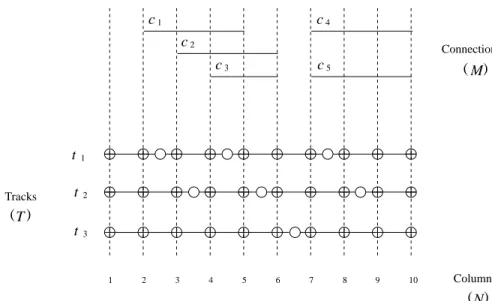
In this paper we refer to Roychowdhury [1993] for the following definitions. The input to a segmented channel-routing problem, as depicted in Figure 1, is a segmented channel consisting of a set T ofT tracks and a set C of M
connections. A symbol E represents a horizontal switch and! represents a cross switch. Each track extending from column 1 to column N is divided
into a set of adjacent segments separated by horizontal switches.
For a segment s, left~s! and right~s! denote the leftmost and rightmost
columns in which this segment is present. Similarly, a connection c is
uniquely characterized by the span of its leftmost and rightmost columns,
left~c! and right~c!. When a connection c is assigned to a track t, the one
or more segments in trackt that are present in the columns spanned by c
are considered occupied. More precisely, a segments in track t is occupied
by the connection c if right~s! $ left~c! and left~s! # right~c!. For a K-segment channel routing, c can be assigned to t only if c occupies at most K segments. A connection c is assignable (to a track t) if there exists such a
trackt to which c may be assigned and if the segments in track t that are
present in the columns spanned by c are not occupied by another
connec-tion. Connections ci and cj overlap if their spans overlap. Connection ci
collides with cj on a track t if, when they are assigned to t, some of their occupied segments will overlap. For the segmented channel-routing prob-lem, we restrict each connection that may be assigned to a single track only. The main objective of a K-segment channel routing is to find a full assignment of connections to tracks, i.e., to complete the assignment of
connections to tracks such that each of the connections occupies at most K
segments. Another objective is to reduce the number of switches used in the routing.
Given a set C of M connections with density D, which is the maximum
number of connections over a column, a clique is a subset of C such that any ci and cj in it overlap each other. A maximal clique Q is a clique, in which there is no ci [y Q such that $ci% ø Q forms a new clique. A
maximum clique is a maximal clique Q with the maximum cardinality, i.e.,
?Q? 5 D. Note that any two connections in a clique cannot be assigned to the same track for they will occupy some same segments. A clique and the set of tracks form the two sets of nodes of a bipartite graphG. To find a full
assignment of the clique Q is to find a maximum matching of the bipartite graph such that the cardinality of the maximum matching is equal to ?Q?.
3. THE ROUTING ALGORITHM
To solve the segmented channel-routing problem efficiently, we apply the weighted bipartite matching algorithm to route and remove cliques of connections one by one. The weighted matching problem can be solved in time complexity O~n3! for a complete bipartite graph with 2n nodes
[Papadimitriou and Steiglitz 1982]. The routing algorithm is as follows:
Algorithm. C_route(C, T)
{ Do until C is empty:
{ Q5 Remove_Max_Clique(C);
G5 Construct_Bipartite_Graph(Q, T);
(Routed, Unrouted)5 Weighted_Bipartite_Matching~G!; Total_Routed5 Total_Routed ø Routed;
Total_Unrouted5 Total_Unrouted ø Unrouted; } if (Total_Unrouted is empty) return(feasible); else return(Postprocessing(Total_Unrouted)); }
Every time a maximum clique Q of the remaining connections is picked out, a weighted bipartite graph for Q is constructed. The weight of edgeeij is defined as follows:
weight~eij! 5
H
a z w11b z w21g z w3 if ciis assignable to tj` otherwise, (1) where c1 1 t t2 t3 c2 c3 c4 c5 1 2 3 4 5 6 7 8 9 10 ( )T ( )N ( )M Tracks Columns Connections
w15
collision_number~ci, tj!
remained_connection~C!, w25
segment_length~ci, tj! 2 connection_length~ci!
segment_length~ci, tj! , and
w35
switch_number~ci, tj!
K2 1 .
In the above equations, collision_number~ci, tj! is the number of remaining connections that collide with ci on track tj;
remained_connection~C! is the total number of remaining connections in C; segment_length~ci, tj! is the total length of segments occupied by ci when ci is assigned to tj; and connection_length~ci! is the length of ci;
switch_number~ci, tj! is the number of switches that need to be pro-grammed when ci is assigned to tj. a, b, and g are ratio parameters; w1
denotes the degree of popularity on tracktj for the remaining connections; andw2 andw3 denote the segment-length waste and switch usage,
respec-tively. In order to save resources of segments and switches, a connection should be assigned to a track such that segment-length waste and switch usage are lower. Also, a connection should be assigned to a track with lower cost ofw1 such that fewer remaining connections will be affected. Weighted_
Bipartite_Matching finds a minimum weighted match. If connection ci is matched with tracktj andweight~eij! Þ `, ci can be assigned to tj and is put into the Routed set. Otherwise,ci cannot be assigned and has to be put into the Unrouted set. The Total_Unrouted set is used to save all the connections not yet assigned. If Total_Unrouted is empty, this case is routable. Otherwise, a Postprocessing procedure is called to reroute the connections in Total_Unrouted again.
Postprocessing
When the routing of some connections cannot be completed in the routing step, we have to reroute them one-by-one using the Postprocessing step. But first we need some definitions. If a connection has been assigned to a track but is also assignable to another track, we say this connection is
movable. When a connectionci is rerouted, it has to squeeze one connection
cj assigned to a trackt; that is, we have to remove cjfromt when assigning
ci tot. Of course, this would only be done if the removal of cjimplies thatci becomes assignable to t. If cj is movable, the rerouting of ci is done. Otherwise, cj has to squeeze another connection again. We do not consider the case where a connection would squeeze more than one connection on a
track at a time, because this is too complex. The idea of squeezing can be implemented by the following algorithm.
Algorithm. Postprocessing(Total_Unrouted)
{ Do until Total_Unrouted is empty:
{ c 5 remove a connection from Total_Unrouted; Queue5 À;
Put all movable connections into Queue and mark these connections as roots;
Do while Queue is not empty andc is not yet in Queue: { cq5 remove a connection from Queue;
A 5 the connections that have never been in Queue and can squeeze cq;
link all connections inA to cq;
put all connections inA into Queue; }
ifc is not in Queue return(infeasible); else
reassign the connections in the squeeze path forc; }
return(feasible); }
To reroute an unrouted connection c, all movable connections that
become the roots of the squeeze paths are put into a Queue first. The connections, which have not been in Queue but can squeeze one connection
cq in Queue, are linked tocqand put into Queue. If the unrouted connection
c is in Queue, the squeezing path for c is found. Otherwise, c cannot be
rerouted by this approach.
Time Complexity
Procedures Construct_Bipartite_Graph, Weighted_Bipartite_Matching, and
Postprocessing are the main parts of Algorithm C_route. Let q1, q2, · · ·,
qm be the cardinalities of cliques that are processed step by step in C_route. For each step, say qk, each weight~eij! in Construct_Bipartite_Graph can
be calculated at O~M ! time. There are O~T2! edges in a bipartite graph.
Thus, Construct_Bipartite_Graph takes O~MT2! time. Also, Weighted_
Bipartite_Matching takes O~T3! time. So to process m steps it takes
O~mMT2 1 mT3! time, which is less than O~M2T2 1 MT3!.
Suppose n connections need to be rerouted in Postprocessing. Each
connection takes O~MT ! time to find the movable connections and to
construct a squeeze path. Hence, Postprocessing takes O~nMT ! time,
which is less than O~M2T!. Thus the time complexity for Algorithm
Critical Path
Our algorithm is designed for the K-segment channel routing problem. It
does not consider the problem of critical path in a routing case. There are two possible methods of adjusting our algorithm to handle the problem of critical path. The first one is to route the connections in a critical path by first setting theg value to be much larger than the a and b values. Then
C_route is used to route the remaining connections if they are routable. The
second method uses C_route to route all connections as before, but the weight of each edge created by the connections in a critical path is set as follows: itsg value must be larger than the a and b values.
4. UNROUTABILITY CHECK
In the C_route algorithm introduced in Section 3, if the returned signal in
C_route is feasible then, of course, this case is routable. But if C_route
cannot find a feasible routing, it is not sufficient to say that it is routable. In this section we present the sufficient conditions for an un-routable case and develop an algorithm to check whether the case is really unroutable.
To describe the following lemmas, we assume that aK-segment
channel-routing problem includes a set C ofM connections, a set T of T tracks, and
the density of C isD. Let Q be a clique of C and G be the bipartite graph
built from Q and T. If the cardinality of the maximum matching for G is
equal to ?Q?, Q can be completely assigned. We call such a G fully
matchable.
LEMMA 1. Given a clique Q of C, if its bipartite graph G is not fully
matchable, C is unroutable.
PROOF. G not being fully matchable means that Q is unroutable. Be-causeQ # C, C is unroutable. e
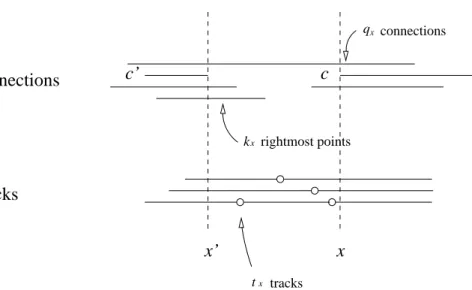
Let x 5 left~c! and Qx be the clique that consists of the connections spanning over column x, and qx 5 ?Qx?. As shown in Figure 2, when we scan the connections from column x to the left until a certain column x9,
which is the rightmost column of a certain connection c9, we find kx
rightmost points appearing betweenx 2 1 and x9, and these kxconnections form a cliqueQx9. Suppose there exists a setTxoftxtracks having switches betweenx and x9, we then have the following lemma.
LEMMA2. If C is routable, thenT 2 qx 1 tx $ kx.
PROOF. First, if each track in T has no switch between x 2 1 and x9,
any two connections chosen fromQxandQx9 will collide with each other on
this track. In this case, if ?Qx? 1 ?Qx9? . T, then C is unroutable. Second, since a track in Tx allows at most two connections, one from Qx and the
other fromQx9, to be assigned, if?Qx? 1 ?Qx9? 2 ?Tx? . T, C is unroutable.
Hence we have proven this lemma. e
More precisely, let mx be the cardinality of the maximum matching for the bipartite graph built fromkxconnections andtxtracks. If C is routable, thenT 2 qx1 mx $ kx. Lemma 2 is also applicable to the case of column
x 5 right~c!, and the difference is that it scans the connections from
column x to the right and counts the connections whose leftmost points
have been scanned.
Lemma 2 only considers the case where thekx-counted connections form a clique. If some complete connections were to appear between x 2 1 and x9, it may be the case that two counted connections were assigned to the
same track. To deal with this case, we have to change Lemma 2 by considering the following two conditions. Condition (1): there is no complete segment that appears between x 2 1 and x9. Condition (2): there exist
complete segments that appear betweenx 2 1 and x9. Considering
Condi-tion (1), since all counted connecCondi-tions cannot be assigned to the same track in Tx, Lemma 2 is still suitable. Considering Condition (2), we have to partition kx connections into two parts: one consisting of kx1 connections that do not appear complete betweenx 2 1 and x9; the other consists of kx2 connections that appear complete between x 2 1 and x9. Let sx be the number of segments that appear complete betweenx 2 1 and x9. In order
to check unroutability, we need to know that how manykx2connections can be assinged to the sx segments. This problem is similar to the K-segment channel-routing problem, and thus is NP-complete. However, we can calcu-late the maximum number of connections to be assigned to each track, which is formed by these sx segments independently. Then, we obtain an upper bound of the above problem by totalizing these maximum numbers.
kx rightmost points x t tracks x q connections
x
x’
c
c’
Connections
Tracks
The maximum number can be calculated easily if we sort in increasing order thekx2connections by their rightmost columns, and then assign them to a track according to the sorting order. Let the total be s9x and
k9x25
H
kx22 s9x if kx2. s9x 0 if kx2# s9x.
(2)
Thus, there are at least kx1 1 k9x2 counted connections that cannot be assigned to the same track inTx. Note that Condition (1) is a special case of Condition (2) forsx 5 0. Now we have the following lemma:
LEMMA3. If C is routable, thenT 2 qx 1 tx $ kx11 k9x2.
Given connections C and tracks T, the Unroutability_check algorithm uses Lemma 3 to check whether C is unroutable. The cardinalities of each clique of connectionsQx can be calculated column by column in linear time if connections in C are sorted [Rheinboldt 1980]. In order to save time, only the columns whose ?Qx? is larger than (D 2 CLIQUE_CONSTANT) are processed. In our experiments, almost no unroutable cases are found when CLIQUE_CONSTANT is set to 8. Scanning from column x to the left,
whenever a connectionc9 and its rightmost column x9 is found, Lemma 3 is
used to check the unroutability. If there exist x and x9 such that T 2 qx 1 tx , kx1 1 k9x2, C is unroutable. Otherwise, Algorithm Unroutability_
check fails to check whether C is unroutable.
Algorithm. Unroutability_check(C, T)
{ To calculate?Qx? of each column x for C;
For each columnx such that?Qx? . ~D 2 CLIQUE_CONSTANT! do:
{ if (Qx is a maximal clique and x is the leftmost column of a certain
connection)
scan fromx to the left to find x9 columns and use Lemma 3 to check unroutability;
if (Qx is a maximal clique and x is the rightmost column of a certain
connection)
scan fromx to the right to find x9 columns and use Lemma 3 to check unroutability;
}
if (one of above checks does not satisfy Lemma 3) return(unroutable);
else
return(fail to check); }
For each columnx and maximal clique Qx, it takesO~MT ! time to assign
kx2 connections to each of tx tracks after a column x9 is found. Since there are at most O~M ! of maximal cliques and the number of x9 columns that
each maximal clique Qx needs to scan is O~M !, the time complexity of Algorithm Unroutability check isO~M3T!.
5. EXPERIMENTAL RESULTS
Our C_route and Unroutability_check algorithms were implemented in the C language and tested on the 300 set connections created by Zhu and Wong [1992]. All experiments ran on a SUN Sparc 10 workstation with 32 MB main memory. The parameters of the channel model, N 5 100 and T 5
36, are close to the Actel’s ACT2 family A1280 FPGA [Actel Corporation 1991]. The ratio parameters a, b, and g in our experiments are 0.5, 0.4, and 0.1, respectively. Zhu and Wong’s 2-segmentation models and 3-seg-mentation models were used; ten types of connection distributions, D1 through D7, geometric, normal, and Poisson, were tested. Table I shows the 2-segment and 3-segment channel-routability analysis results using
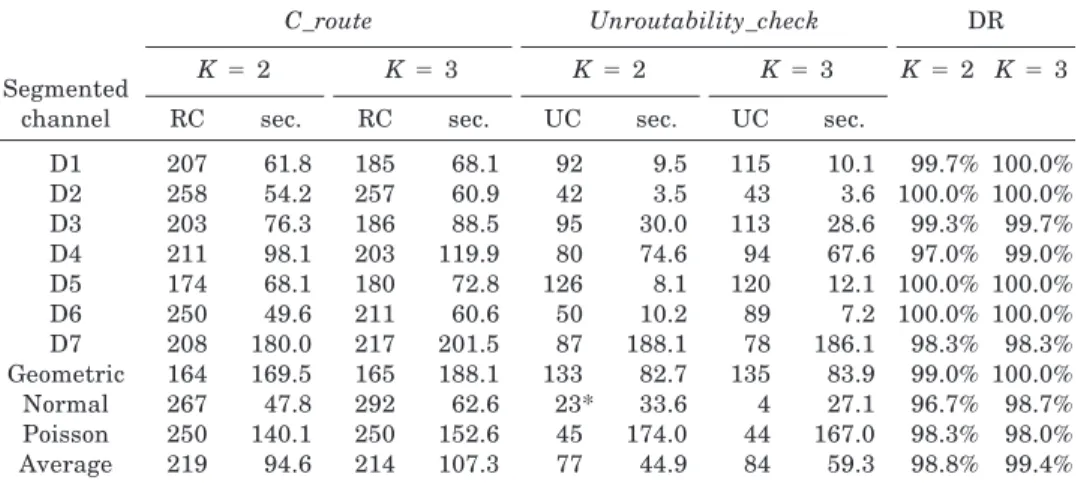
C_route and Unroutability_check on each distribution of 300 test cases. RC
is the number of cases that can feasibly be routed by C_route. UC is the number of cases that can be checked as unroutable by Unroutability_check. The total time to run the 300 cases for each distribution is also shown in the table. The last two columns show the discrimination ratios obtained from the results of these two algorithms, i.e., the ratio of RC 1 UC cases over 300 cases for each distribution. The discrimination ratio is denoted as DR. The average discrimination ratios are 98.8% and 99.4% for 2-segment and 3-segment channel routing, respectively.
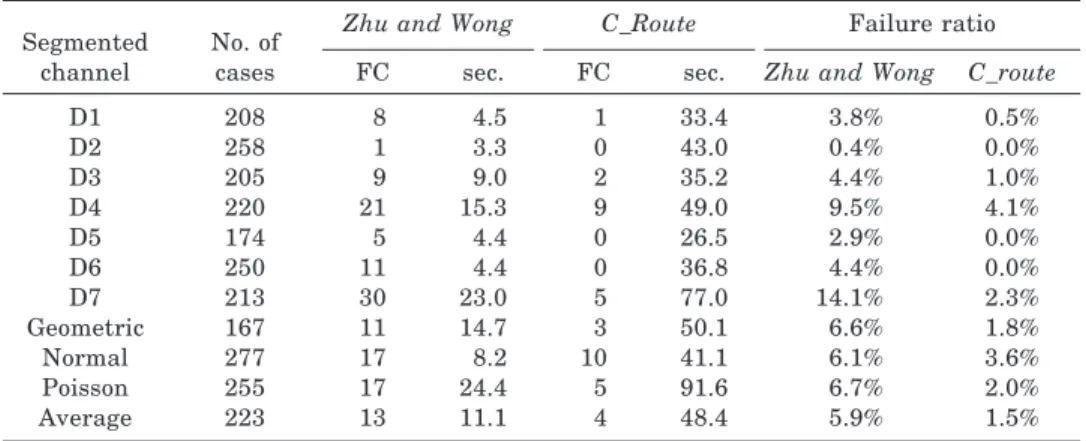
Table II and Table III compare the 2-segment channel-routing and 3-segment channel-routing results, respectively, of Zhu and Wong’s routing algorithm with our C_route algorithm. Column 2 shows the number of test cases, excluding the UC cases for each distribution. FC is the number of cases that fail to be routed. The failure ratios of our routing algorithm are all less than or equal to those of Zhu and Wong’s. For the 2-segment channel routing, ours is less than 25% of theirs on the average. For the 3-segment channel routing, ours is less than 17% of theirs on the average. The disadvantage of our approach is that our runtime is longer than theirs.
Table I. Routability Analysis Results for theK-Segmentation Models
Segmented channel
C_route Unroutability_check DR
K5 2 K5 3 K 5 2 K 5 3 K5 2 K 5 3
RC sec. RC sec. UC sec. UC sec.
D1 207 61.8 185 68.1 92 9.5 115 10.1 99.7% 100.0% D2 258 54.2 257 60.9 42 3.5 43 3.6 100.0% 100.0% D3 203 76.3 186 88.5 95 30.0 113 28.6 99.3% 99.7% D4 211 98.1 203 119.9 80 74.6 94 67.6 97.0% 99.0% D5 174 68.1 180 72.8 126 8.1 120 12.1 100.0% 100.0% D6 250 49.6 211 60.6 50 10.2 89 7.2 100.0% 100.0% D7 208 180.0 217 201.5 87 188.1 78 186.1 98.3% 98.3% Geometric 164 169.5 165 188.1 133 82.7 135 83.9 99.0% 100.0% Normal 267 47.8 292 62.6 23* 33.6 4 27.1 96.7% 98.7% Poisson 250 140.1 250 152.6 45 174.0 44 167.0 98.3% 98.0% Average 219 94.6 214 107.3 77 44.9 84 59.3 98.8% 99.4%
The results of postprocessing are shown in Table IV. Columns 3 to 6 show the number of cases routed with the help of postprocessing for Zhu and Wong’s and our algorithms. The ratios are the numbers of routed cases over the cases numbers shown in Table II and Table III. Although the benefit obtained by postprocessing is small, it is helpful when the failure ratio of the main routing algorithm is quite small also. This also means that our weighted bipartite matching approach is efficient.
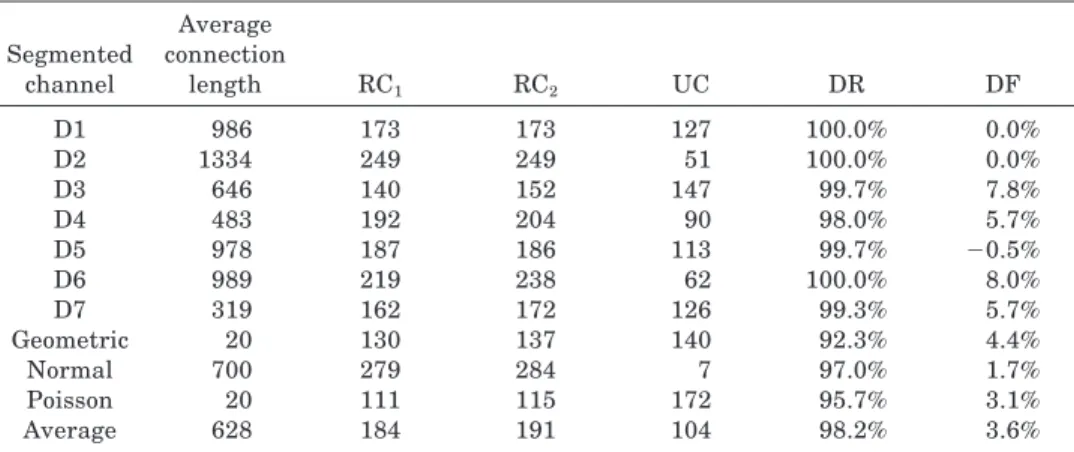
We speculated that our routing algorithm would work badly if N were larger than the average length of the connections. So we tested our algorithm for the channel models using different N values. First, we used Zhu and Wong’s program to generate 3-segmentation models for N5 100, 200, · · ·, 2000. The results for N 5 2000 are shown in Table V. RC1 and
RC2are the numbers of cases which can feasibly be routed by, respectively,
Zhu and Wong’s algorithm and our C_route. UC is the number of cases that can be checked unroutable by Unroutability_check. DR is the discrimina-tion ratio. DF is the difference for the failure ratio, which is the value of Zhu and Wong’s failure ratio minus our failure ratio. Our C_route is still
Table II. Comparing Zhu and Wong’s 2-Segment Channel Routing Algorithm with Others
Segmented channel
No. of cases
Zhu and Wong C_Route Failure ratio FC sec. FC sec. Zhu and Wong C_route
D1 208 8 4.5 1 33.4 3.8% 0.5% D2 258 1 3.3 0 43.0 0.4% 0.0% D3 205 9 9.0 2 35.2 4.4% 1.0% D4 220 21 15.3 9 49.0 9.5% 4.1% D5 174 5 4.4 0 26.5 2.9% 0.0% D6 250 11 4.4 0 36.8 4.4% 0.0% D7 213 30 23.0 5 77.0 14.1% 2.3% Geometric 167 11 14.7 3 50.1 6.6% 1.8% Normal 277 17 8.2 10 41.1 6.1% 3.6% Poisson 255 17 24.4 5 91.6 6.7% 2.0% Average 223 13 11.1 4 48.4 5.9% 1.5%
Table III. Comparing Zhu and Wong’s Algorithm on 3-Segment Channel Routing
Segmented channel
No. of cases
Zhu and Wong C_Route Failure ratio FC sec. FC sec. Zhu and Wong C_route
D1 185 0 5.3 0 30.7 0.0% 0.0% D2 257 0 4.5 0 47.3 0.0% 0.0% D3 187 21 12.9 1 35.3 11.2% 0.5% D4 206 7 17.7 3 50.9 3.4% 1.5% D5 180 0 5.5 0 30.2 0.0% 0.0% D6 211 10 5.2 0 34.9 4.7% 0.0% D7 222 28 34.4 5 93.3 12.6% 2.3% Geometric 165 12 20.4 4 50.4 7.3% 0.0% Normal 296 9 10.6 4 60.7 3.0% 1.4% Poisson 256 13 28.6 6 101.1 5.1% 2.3% Average 217 10 14.5 2 53.5 4.7% 0.8%
efficient and generates better results than Zhu and Wong’s for this large N value. Some of results with different N values are shown in Table VI. The averages of DF are always at least 3% larger than Zhu and Wong’s. And the averages of DR are all larger than 97%.
6. CONCLUSIONS
We presented a weighted bipartite-matching algorithm for the segmented channel-routing problem. Our approach routes the connections clique by clique, where the connections in each clique are routed using the weighted bipartite-matching method. An approach to successfully judging un-routability is also presented. The average discrimination ratios of the 300 routing cases are 98.8% and 99.4% for the 2-segmentation and 3-segmenta-tion models, respectively. Applying our segmented channel-routing algo-rithm to the nonunroutable cases, the average of our failure ratios is less than 21% of Zhu and Wong’s algorithm.
Table IV. Results of Postprocessing on theK-Segmentation Models
Segmented channel
Routed by postprocessing Ratio
Zhu and Wong C_route Zhu and Wong C_route
K5 2 K 5 3 K5 2 K 5 3 K5 2 K5 3 K5 2 K5 3 D1 0 0 0 0 0.0% 0.0% 0.0% 0.0% D2 0 0 0 0 0.0% 0.0% 0.0% 0.0% D3 0 0 0 0 0.0% 0.0% 0.0% 0.0% D4 1 1 8 1 0.5% 0.5% 3.6% 0.5% D5 0 0 0 0 0.0% 0.0% 0.0% 0.0% D6 0 0 0 0 0.0% 0.0% 0.0% 0.0% D7 12 3 12 8 5.6% 1.4% 5.6% 3.6% Geometric 0 0 2 4 0.0% 0.0% 1.2% 2.4% Normal 3 1 6 0 1.1% 0.3% 2.2% 0.0% Poisson 0 0 2 2 0.0% 0.0% 0.8% 0.8% Average 1.6 0.5 3.0 1.5 0.7% 0.2% 1.3% 0.7%
Table V. Routability Analysis for the 3-Segmentation Models with N5 2000
Segmented channel Average connection length RC1 RC2 UC DR DF D1 986 173 173 127 100.0% 0.0% D2 1334 249 249 51 100.0% 0.0% D3 646 140 152 147 99.7% 7.8% D4 483 192 204 90 98.0% 5.7% D5 978 187 186 113 99.7% 20.5% D6 989 219 238 62 100.0% 8.0% D7 319 162 172 126 99.3% 5.7% Geometric 20 130 137 140 92.3% 4.4% Normal 700 279 284 7 97.0% 1.7% Poisson 20 111 115 172 95.7% 3.1% Average 628 184 191 104 98.2% 3.6%
REFERENCES
ACTELCORP. 1991. ACT Family FPGA Databook.
BURMAN, S., KAMALANATHAN, C.,ANDSHERWANI, N. 1992. New channel segmentation model and associated routing algorithm for high performance FPGAs. In Proceedings of the 1992 IEEE/ACM International Conference on Computer-Aided Design (ICCAD ’92, Santa Clara, CA, Nov. 8 –12), L. Trevillyan, Ed. IEEE Computer Society Press, Los Alamitos, CA, 22–25. ELGAMAL, A., GREENE, J.,ANDROYCHOWDHURY, V. 1991. Segmented channel routing in nearly as efficient as channel routing (and just as hard). In Proceedings of the 1991 University of California/Santa Cruz Conference on Advanced Research in VLSI (Edimburgh, Scotland), C. H. Séquin, Ed. MIT Press, Cambridge, MA, 192–211.
ELGAMAL, A., GREENE, J., REYNARI, J., ROGOYSKI, E., ELAYAT, K. A.,ANDMOHSEN, A. 1989. An architecture for electrically configurable gate arrays. IEEE J. Solid-State Circuits 24, 2 (Apr.), 394 –398.
GAREY, M.AND JOHNSON, D. 1979. Computers and Intractability: A Guide to the Theory of NP-Completeness. W. H. Freeman and Co., New York, NY.
GREENE, J., ROYCHOWDHURY, V., KAPTANOGLU, S.,ANDGAMAL, A. E. 1990. Segmented channel routing. In Proceedings of the ACM/IEEE Conference on Design Automation (DAC ’90, Orlando, FL, June 24-28), R. C. Smith, Ed. ACM Press, New York, NY, 567–572.
PAPADIMITRIOU, C. H.AND STEIGLITZ, K. 1982. Combinatorial Optimization: Algorithms and Complexity. Prentice-Hall, Inc., Upper Saddle River, NJ.
PEDRAM, M., NOBANDEGANI, B. S.,ANDPREAS, B. T. 1994. Design and analysis of segmented routing channels for row-based FPGA’s. IEEE Trans. Comput.-Aided Des. 13, 12 (Dec.), 1470 –1479.
RHEINBOLDT, W. 1980. Algorithmic Graph Theory and Perfect Graphs. Academic Press, Inc., New York, NY.
ROY, K. 1993. A bounded search algorithm for segmented channel routing for FPGA’s and associated channel architecture issues. IEEE Trans. Comput.-Aided Des. 12, 11, 1695–1705. ROYCHOWDHURY, V. P., GREENE, J., AND EL GAMAL, A. 1993. Segmented channel
routing. IEEE Trans. Comput.-Aided Des. 12, 1, 79 –95.
ZHU, K.ANDWONG, D. F. 1992. On channel segmentation design for row-based FPGAs. In Proceedings of the 1992 IEEE/ACM International Conference on Computer-Aided Design (ICCAD ’92, Santa Clara, CA, Nov. 8 –12), L. Trevillyan, Ed. IEEE Computer Society Press, Los Alamitos, CA, 26 –29.
Received: July 1997; accepted: March 1999
Table VI. Routability Analysis for the 3-Segmentation with Different N Values
Segmented channel N5 400 N5 800 N5 1200 N5 1600 DR DF DR DF DR DF DR DF D1 100.0% 0.0% 100.0% 0.0% 100.0% 0.0% 100.0% 0.0% D2 100.0% 0.0% 100.0% 0.0% 100.0% 0.4% 100.0% 0.0% D3 100.0% 3.2% 100.0% 6.3% 99.7% 4.2% 99.3% 3.5% D4 99.3% 2.5% 99.3% 2.5% 99.3% 1.2% 99.7% 3.3% D5 100.0% 0.5% 100.0% 0.5% 99.7% 0.0% 100.0% 0.0% D6 99.0% 21.4% 99.3% 11.7% 99.7% 13.3% 99.0% 17.3% D7 98.3% 8.5% 98.7% 7.2% 97.7% 8.9% 98.7% 2.7% Geometric 97.7% 5.9% 99.3% 2.7% 91.3% 5.6% 94.0% 5.1% Normal 99.3% 3.1% 98.0% 3.8% 97.0% 4.4% 96.7% 2.4% Poisson 97.3% 7.2% 93.0% 3.2% 95.0% 20.6% 94.7% 4.2% Average 99.1% 5.3% 98.8% 3.8% 97.9% 3.7% 98.2% 3.8%