國立交通大學
電機資訊國際學位學程
碩
士 論 文
電子書閱讀器的效能評估及使用者經驗
Performance Evaluation and User Experience of E-Book Reader
研 究 生:任之皓
指導教授:林一平 博士
電子書閱讀器的效能評估及使用者經驗
Performance Evaluation and User Experience of E-Book Reader
研究生:任之皓
Student:Zhihao Julie Ren
指導教授:林一平博士
Advisor:Dr. Yi-Bing Lin
國 立 交 通 大 學
電機資訊國際學位學程
碩 士 論 文
A Thesis
Submitted to EECS International Graduate Program National Chiao Tung University
in Partial Fulfillment of the Requirements for the Degree of
Master
April 2011
Hsinchu, Taiwan, Republic of China
電子書閱讀器的效能評估及使用者經驗
學生:任之皓
指導教授:林一平 博士
國立交通大學
電機資訊國際學位學程
摘 要
電子書是行動網路上一個快速發展的服務,使用者可以利用專用的電子書閱讀器或 智慧手機上的電子書閱讀軟體來閱讀電子書。多元化的功能和快速的反應是電子書 閱讀器必備的條件。本論文探討基於使用者體驗的電子書閱讀器效能評估方法。這 個方法包含特性和功能面的分析以及電子書閱讀器分階段的效能評估。此外我們在 交通大學進行意見調查,收集學生們對於電子書閱讀器的使用心得。我們發現,電 子書的載入時間是一個關鍵的考量,尤其是對於擁有數位版權管理(Digital Right Management ; DRM)保護的電子書。為了減少載入時間,我們提出一個預載方法, 它會在緩衝器內預載少量章節。這個方法可以改善使用者體驗並且仍然確保電子書 的必要保護。 關鍵詞:電子書,電子書閱讀器, 效能評估, 使用者體驗Performance Evaluation and User Experience of E-Book Reader
Student: Zhihao Julie Ren
Advisor: Dr. Yi-Bing Lin
EECS International Graduate Program
National Chiao Tung University
Abstract
Electronic-book, e-book, is a fast growing service for mobile Internet. A user reads e-books through an e-book reader, e-reader, which can be a dedicated reading device or an application on a smart-phone. A key criterion for e-reader design is to provide good user experience, which means rich features and fast access time. This thesis presents an evaluation method of e-readers regarding the user experience. This method includes a feature and functionality analysis and a detailed performance evaluation of tested e-readers. Moreover, surveys are conducted among NCTU students to collect their opinions and feedback about their e-reading experience. One of the main findings is that the loading time is a critical issue especially for Digital Right Management (DRM) protected e-books. To reduce the waiting time, we propose a preloading mechanism that preloads a small number of chapters into the buffer. The mechanism can improve the user experience and still assure the required protection level for the e-book.
Acknowledgements
Above all, I would like to thank my principal advisor, Prof. Yi-Bing Lin, for his guidance, support and patience during my Master study in NCTU. He taught me how to do research and gave me valuable advices about my work. I want to thank also Mr. Chen-Yuan Chuang, for his precious help and technical support for the last year and half.
This thesis would not be possible without the support of Prof. Noël Crespi and Prof. John K. Zao, coordinators for this Dual Degree program between Telecom SudParis in France and National Chiao Tung University in Taiwan. And I have to mention Prof. Charles T.M. Choi, director of this EECS International Graduate Program. I also want to thank Angel Yu, for her support and assistance in any academic or personal needs or issues I have been through.
I am grateful to all my labmates and all my Taiwanese and international friends. They made my life more enjoyable and helped me to feel Taiwan like home. Last but not least, I want hank my family. They have always trusted in me and given me encouragement.
Table of Content
摘 要 i Abstract ii Acknowledgements iii Table of Content iv List of Tables viList of Figures vii
Notations viii
Introduction 1
1.1 E-Book and E-Reader...1
1.2 Overview of the E-Book Technology...2
Evaluation of E-Readers on Mobile Devices 6 2.1 Lexcycle Stanza...6
2.2 X-Reader...7
2.3 Functionality Comparison ...8
2.4 Performance Evaluation ...11
User Experience of E-Readers for NCTU Students 18 3.1 Context of the Studies...18
3.2 Behaviors Regarding Electronic Resources and E-Books...19
Chapter Preloading Mechanism for E-Reader 23 4.1. Chapter Loading Performance Issues ...23 4.2. Chapter Preloading Mechanism...25 4.3. Performance Evaluation ...31
Conclusion and Future Works 37
5.1. Contribution...37 5.2. Future Works ...38
Biography 39
Appendix: E-reader Survey at NCTU Library 42
List of Tables
Table 2.1. Overall Features Comparison...9
Table 2.2. Fonctionality Comparison ...10
Table 2.3. Customizability Comparison...11
List of Figures
Figure 1.1 OCF 1.0 Example...3
Figure 2.1 Screenshot of Stanza Library ...7
Figure 2.2 Screenshot of X-Reader Bookshelf...9
Figure 2.3 Testing Environment...12
Figure 2.4 X-Reader Application Loading...13
Figure 2.5 Comparison of Application Loading...14
Figure 2.6 Comparison of E-Book Loading ...15
Figure 2.7 Comparison of Chapter Loading...16
Figure 3.1 Often Used and Reliable Electronic References ...19
Figure 3.2 Time Devoted to e-Book Reading ...20
Figure 3.3 Devices Used for e-Book Reading...21
Figure 4.1 Most Likely Reading Order (MLRO) ...25
Figure 4.2 Reload Probability for N=20 ...34
Figure 4.3 Reload Probability for s=2 ...35
Figure 4.4 Loading Cost for N=20 ...35
Notations
The notations used in this thesis are listed below.
• α: factor that weights the importance of CL against p
• B: buffer size • C: net cost • CL: loading cost
• j: number of chapters the user jumps forwardly or backwardly • kn(i): MLRO rank of any chapter i with respect to n
• l: number of non-replaced chapters on the right-hand side in the buffer • p: reload probability
• PZ: Zipf’s probability law
• n: current reading chapter (1 ≤ n ≤ N)
• n*: next reading chapter (can be the same as n) • N: total number of chapters of a given e-book • NL: number of replaced chapters in the buffer
• r: number of non-replaced chapters on the right-hand side in the buffer • s: reading behavior or the locality of the read chapters.
• S: chapters in the buffer before the jump • S*: chapters in the buffer after the jump
Chapter 1
Introduction
This chapter defines the concept of electronic-book readers, e-readers, and describes the general background of e-book format and its content delivery mechanism.
1.1 E-Book and E-Reader
Electronic-book, has gained increasing attention in recent years, especially after Amazon provided Kindle [10] and Apple announced iPad. Some manufactories in Taiwan have developed electronic-ink (e-ink) solutions and Linux-based reading devices. From the viewpoint of mobile operators, selling e-books is straightforward and similar to other digital content services for wallpapers, ringtones, or Java games.
Hand-held e-readers, can be distinguished into two main categories:
Dedicated reading devices, such as Amazon Kindle, Sony Reader, and iRex iLiad. Springer staff members had tested these devices [22]. Instead of conventional printed-books, these lightweight devices may provide large screen, use e-ink display technology to reduce power consumption, and import e-books via 3G/WiFi, memory card, or USB connection.
E-reader applications on smart-phones, such as Lexcycle Stanza, Chunghwa Telecom’s Hamibook, and Amazon’s Kindle for iPhone app. Although smart-phones have relatively smaller screens, the number of end users is growing rapidly. Therefore, some e-book service providers also distribute their e-readers as freeware on App store or Android Market [5]. A troublesome problem might be that the reading process may consume too much power and therefore affects the original purpose of the mobile phones.
1.2 Overview of the E-Book Technology
In past years, many e-book formats were proposed. These e-book formats have different features and different Digital Rights Management (DRM) protection mechanisms [9]. Therefore, the e-book publishers have to spend much effort to transform and validate their e-books to fit to the right formats. Currently many e-readers support a common standard, the EPUB format, produced by the International Digital Publishing Forum (IDPF) [11].
1.2.1 EPUB Format
The EPUB format is a combination of three IDPF open standards: the Open Publication Structure (OPS) 2.0, Open Packaging Format (OPF) 2.0 and Open Container Format (OCF) 1.0 [12].
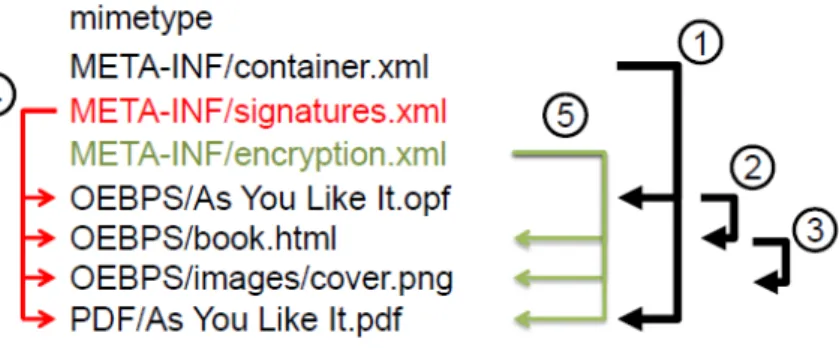
Figure 1.1. OCF 1.0 Example
An EPUB (.epub) file basically is a ZIP archive. Figure 1.1 depicts the extracted files in a sample .epub file. The mimetype file specifies the MIME media type as application/epub+zip. The META-INF/container.xml indicates one or more root files, which are the top-level files and a rendition of this e-book.
As shown in Figure 1.1(1), both the OPF (.opf) file and Portable Document Format (PDF) are the root files. Usually, the root file is an .opf file rather than a PDF file. Contrary to traditional PDF documents, a main advantage of EPUB format is that it is reflowable. Therefore an .epub file can be compatible with various e-readers with different hardware configurations and screen sizes. The users can change the displayed style according to their preferences.
The .opf file contains an XML document and describes the e-book’s metadata, e.g. book title, authors. It also provides an exhaustive list of files and the linear reading-order of these files. A Navigation Center extended (NCX) file can furthermore declare the table of contents of the e-book. The OPS describes the content of e-book as either XHTML or Daisy DTBook. In Figure 1.1(2), the .opf file points to the OEBPS/book.html, which can be a cover page, an index, and a book chapter. In addition to referencing an image file, Figure 1.1(3), the XHTML file can also reference to a CSS-based style sheet for rendering
purpose. Digital signatures and encryption are optional features. The e-reader can check digital signatures to ensure that the file contents are not modified. The META-INF/signatures.xml presents the signature methods and parameters for the reference files, Figure 1.1(4). The content files can be encrypted into binary code, and the META-INF/encryption.xml records how these files are encrypted, Figure 1.1(5). The OCF also recommends optionally DRM support. However, the service models and document details are not defined in the specification. Until now, DRM mechanisms on EPUB contents are proprietary.
1.2.2 Content Delivery
Free and paid e-books are both available in the Internet mainly through online bookstores. They provide e-books in different formats, of among which EPUB is a very popular one. For example, Google Books provides both PDF and EPUB e-books [7]. Users can purchase e-books through e-reader’s built-in online bookstores. Another way to access extra e-books is to import e-books through PC hosts.
The general process of content delivery from the online bookstore to the e-reader is described as follows. When a user purchases an e-book from a bookstore, the e-reader simply downloads the .epub file. When the user clicks to open the e-book on the bookshelf, the e-reader extracts the .epub file to a folder and then loads the data to read book index or chapters. Usually, the content of an e-book is saved separately into individual data files by chapters, therefore, the reader loads them one by one. If the e-book is DRM protected, that data file is encrypted and needs decryption method and key. Note that the e-reader should not save the decrypted data into any folder on the
smart-phone, because the file system can be accessed on jail-broken smart-phone [4]. Loading DRM protected data may increase the computing time and complexity of e-readers; however, copyright issues are critical for many publishers. Thus, online bookstores and e-reader providers have to ensure both the quality and the protection of the e-book contents.
Finally, to provide good user experience of reading, many e-readers add new functionalities such as embedded dictionary and bookmarks support.
Chapter 2
Evaluation of E-Readers on Mobile Devices
This chapter aims at figuring out an evaluation method of e-book readers on iPhone. In this study, we chose an e-reader, say X-Reader (a commercial product in Taiwan) and compared it with Lexcycle Stanza, one of the most popular e-readers on iPhone. Both of them support the e-book format standard, EPUB, which will be promoted for Chinese-language e-book markets in China and Taiwan [19].
2.1 Lexcycle Stanza
Lexcycle Stanza [13] is one of the most popular e-readers on iPhone, which supports multi-language, including English, French and Chinese. Stanza also provides PC software, named Stanza Desktop, to convert and manage e-books, digital newspapers, and other digital publications.
Amazon owns Lexcycle since April 2009 [14], but Stanza still supports many built-in third-party online bookstores and imported e-books from Stanza Desktop on PC or via a URL. The third-party bookstores provide free and paid e-books. The purchasing process is not controlled by Stanza itself. To acquire an e-book from a chosen bookstore, the user needs an account of this specific bookstore, which is also used for the billing of e-books.
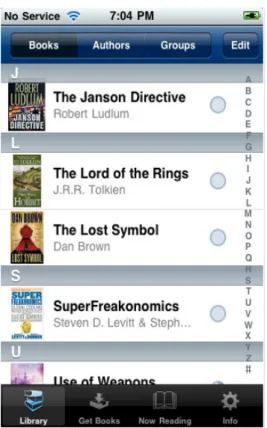
On iPhone, all downloaded e-books are saved into the local file system of the application, which tracks the download history and the reading status of each e-book. Similar to bookshelves on most other e-readers, Stanza provides a “Library” to list e-books ordered by book names, author names, and groups. Figure 2.1 shows a screenshot of Stanza Library.
Figure 2.1 Screenshot of Stanza Library
2.2 X-Reader
We chose X-Reader (fake name) from a local e-book service provider to compare with Stanza. X-Reader is a freeware released on both iPhone and Android platforms. This study focused on the iPhone version. X-Reader is designed for its subscribers exclusively. Each time X-Reader is launched, the login and the bookshelf synchronization procedures are triggered. If the login or the synchronization fails, the application runs on its off-line mode. In any case, the bookshelf, as shown in Figure 2.2, lists the existing e-books on iPhone.
X-Reader only supports EPUB format books and only allows the user to purchase e-books from its associated online e-bookstore. To acquire a new e-book, the application guides the user to visit the online bookstore and choose an e-book. The service provider itself manages the billing of e-books. The Web-based bookstore lists available e-books grouped by categories and publishers. It also provides free preview versions of many e-books. All e-books purchased from the online bookstore have a proprietary DRM protection. Even though file transferring from iPhones is restricted, a jail-broken iPhone might induce some loopholes. The online bookstore provides EPUB files with encrypted content files. Only authorized X-Readers can decrypt the content files of the e-books.
X-Reader performs the downloading process, and all transactions have a backup on the server side simultaneously. Therefore, X-Reader has a bookshelf synchronization feature since all their purchases are recorded. The mobile subscribers can keep their e-books if one day they change their smart-phone. The only DRM-free EPUB file on the bookshelf is a built-in “user manual”. This is the reference e-book of our performance evaluation. It seems that e-books for X-Reader must follow an extension of the EPUB format. Pages layouts, image sizes, and file organization must follow rules specific to X-Reader. The cover page and index page in each EPUB file also act as book chapters.
2.3 Functionality Comparison
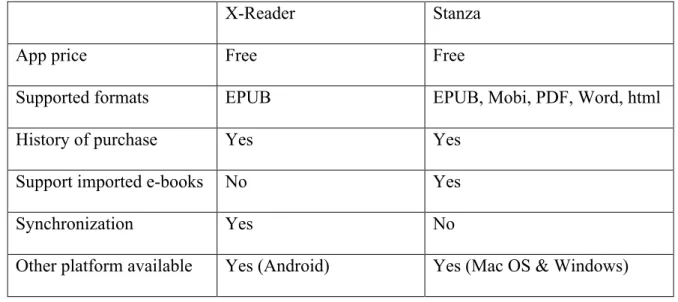
Table 2.1 summarizes the general features of both applications. The main characteristic of X-Reader is its synchronization feature thanks to its online server. Stanza’s main characteristic is its support to imported e-books from various sources.
TABLE 2.1. OVERALL FEATURES COMPARISON
X-Reader Stanza
App price Free Free
Supported formats EPUB EPUB, Mobi, PDF, Word, html
History of purchase Yes Yes
Support imported e-books No Yes
Synchronization Yes No
Other platform available Yes (Android) Yes (Mac OS & Windows)
In X-Reader, the bookshelf is the homepage of the application. The e-books are classified by categories, from the latest readings on the top, to a classification by category bellow (Figure 2.2).
Lexcycle Stanza’s homepage is the latest visited page, which can be a page of an e-book or the bookshelf. Stanza has more than one way to organize its bookshelf; an e-book is classified either by its author, title or category as shown in Figure 2.1. The user can even create his/her own collection. For each book, a pie chart shows how far you are in the e-book. Studies show that the navigability in an e-book is a key concern for the readers [3]. Therefore, e-readers provide many tools for the users to navigate at ease in the e-book. Some tools, such as table of contents or bookmarks, are inspired by conventional printed-books. Others use specific functionalities of the iPhone such as the search function or the dictionary (Table 2.2).
TABLE 2.2. FONCTIONALITY COMPARISON
X-Reader Stanza
Book information Yes Yes (editable)
Table of contents Yes Yes
Navigability By chapter
(page number in a chapter) % into the e-book
By chapter
(page number in a chapter) % into the e-book
Bookmark Yes Yes (namable)
Annotation Yes Yes
Search by word/ by phrase No Yes
Built-in dictionary No Yes
Since the EPUB e-books format is reflowable, the user can customize the e-book layout. There are some built-in functions that help the user to adjust his/her preferences. Table 2.3 shows some of them. However, changing the font size or the line spacing may affect the
number of words in a screen. Therefore, rather than a page number, a user-inserted bookmark is positioned by the percentage of the e-book.
TABLE 2.3. CUSTOMIZABILITY COMPARISON
X-Reader Stanza
Built-in themes Yes (5) Yes (5)
Day/Night change Yes Yes
Font change No Yes
Font size Yes Yes
Background/Text/Link Color Yes Yes
Background image No Yes
Paragraph/Line/Text spacing Yes Yes
Alignment Yes Yes
We perhaps regret that on neither of the two e-readers, the reading direction can be customized. Indeed Chinese e-book can be read from left to right or right to left. Moreover inside the e-book, the reading way is either from left to right or from top to bottom.
2.4 Performance Evaluation
Performance evaluation of this study stresses on the time responsiveness and the CPU usage of tested e-readers. Response time is the main concern of a user since it affects directly his/her reading experience. CPU utilization is also a key evaluation parameter due to its immediate impact on power consumption and on the smart-phone condition.
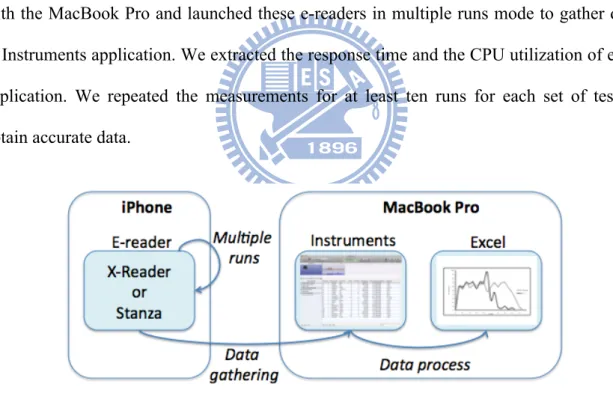
To measure the performance, we used an iPhone3G [2] (8GB model) with latest OS version 3.1.3 and a performance analysis tool, called Instruments [1], from the iPhone SDK. In our testing environment, as shown in Figure 2.3, Instruments runs on a MacBook Pro with MacOS version 10.5.8. We use the “Activity Monitor” instrument to record a sequence of user actions and collect data over multiple runs.
“User manual” is the tested e-book for this study. This e-book is in EPUB format without DRM protection. The size of the e-book is 760 kB and the language is traditional Chinese. To be fair in the comparison, we exported the “user manual” in advance and then imported it into Stanza e-reader via the Stanza Desktop application. Then we connected the iPhone with the MacBook Pro and launched these e-readers in multiple runs mode to gather data in Instruments application. We extracted the response time and the CPU utilization of each application. We repeated the measurements for at least ten runs for each set of test to obtain accurate data.
Figure 2.3 Testing Environment
The measured raw data provided by Instrument were exported into excel tables. Finally they are processed to get the comparison charts and results. In this study, we lead examination on four aspects of the e-reader applications.
2.4.1 Application Loading Results
As described in Section 2.1 and 2.2 the application loading process of Stanza and X-Reader is different. X-X-Reader application needs to login and synchronize with the application server each time the user launches the application. Stanza does not have this registration phase.
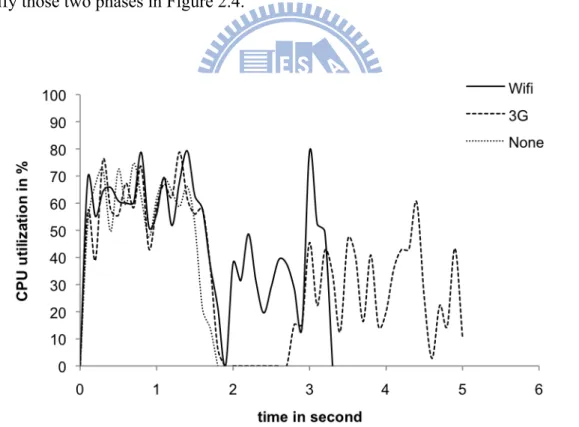
To compare fairly the application loading step, we distinguish X-Reader’s application loading phase and registration phase in order to ignore the latter one. To do that, we run tests under different network connections: WiFi, 3G and none (airplane mode). We clearly identify those two phases in Figure 2.4.
Figure 2.4 X-Reader Application Loading
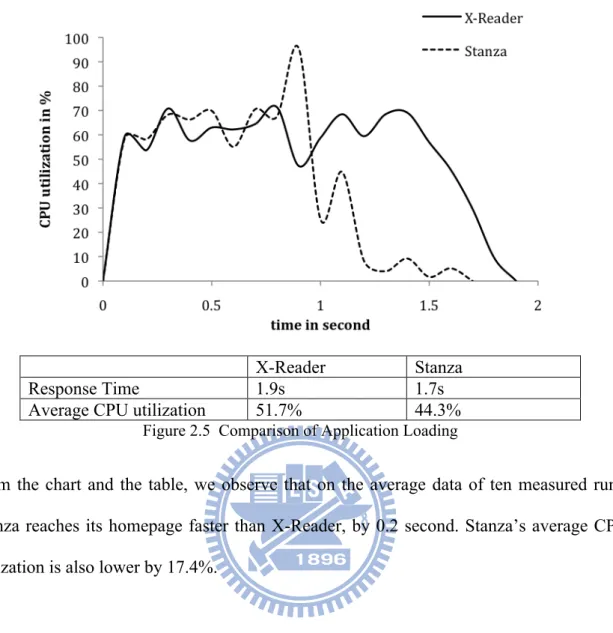
By extracting phase one, the application loading phase, we can compare it with Stanza application loading. Figure 2.5 shows the test results.
X-Reader Stanza
Response Time 1.9s 1.7s
Average CPU utilization 51.7% 44.3%
Figure 2.5 Comparison of Application Loading
From the chart and the table, we observe that on the average data of ten measured runs, Stanza reaches its homepage faster than X-Reader, by 0.2 second. Stanza’s average CPU utilization is also lower by 17.4%.
2.4.2 E-Book Loading Results
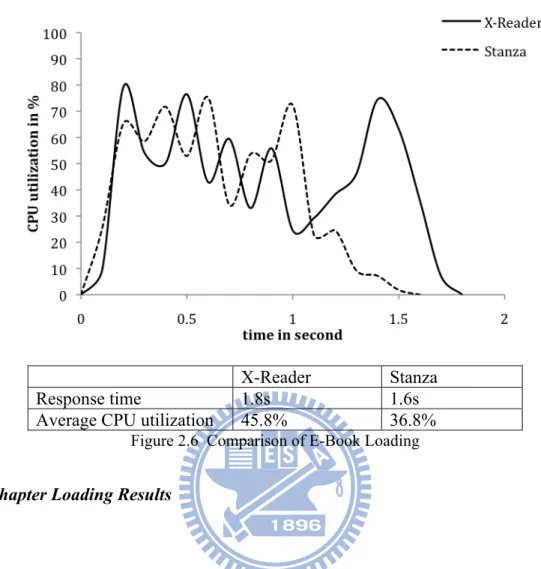
When the user clicks an e-book on the bookshelf or Library, the e-book loading starts. During the e-book loading step, the e-readers have to extract the same EPUB file and load the related files as described in Section 1.2.1.
Figure 2.6 shows the differences in response time and CPU utilization between the two e-readers under comparison. Note that as the application loading, Stanza still has better average performance of e-book loading than X-Reader by around 20%.
X-Reader Stanza
Response time 1.8s 1.6s
Average CPU utilization 45.8% 36.8%
Figure 2.6 Comparison of E-Book Loading
2.4.3 Chapter Loading Results
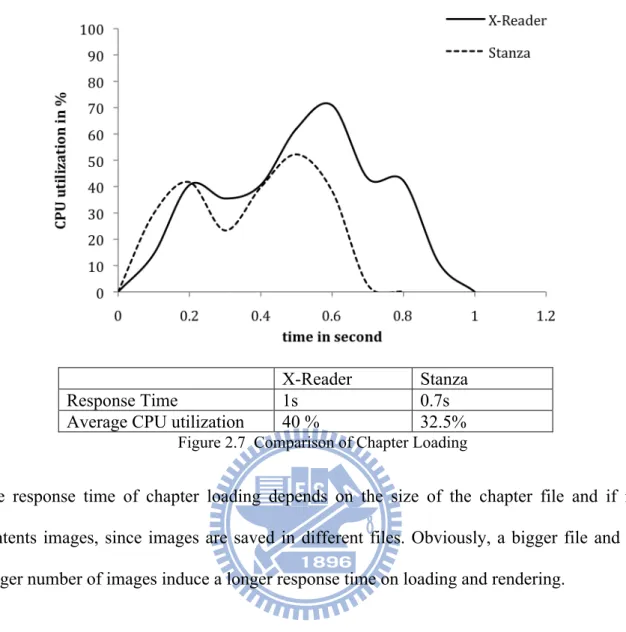
In an EPUB file, book chapters are separated into different .html files, as mentioned in Section 1.2.1. Figure 2.7 depicts the comparison of e-book chapter loading. For this test, the e-readers render the first chapter of the “User manual”. The results of loading other chapters are similar. Stanza seems to have once more better performance than X-reader on both time responsiveness and CPU utilization.
X-Reader Stanza
Response Time 1s 0.7s
Average CPU utilization 40 % 32.5%
Figure 2.7 Comparison of Chapter Loading
The response time of chapter loading depends on the size of the chapter file and if it contents images, since images are saved in different files. Obviously, a bigger file and a bigger number of images induce a longer response time on loading and rendering.
2.4.4 Page Loading Results
Table 2.4 shows that the page loading time on both e-readers is less than 0.2 second. Since, the data is loaded chapter by chapter, the page loading step does not involve any other file loading. This explains how short the response time can be even though both e-readers perform page-turning animations.
TABLE 2.4. PAGE LOADING COMPARISON
X-Reader Stanza
Response time 0.2s < 0.2s
Another observation from Table 2.4 is that, contrary to the other testing steps, X-Reader has a far less CPU consumption than that Stanza on the page loading.
Generally speaking, the tests running on application, e-book and chapter loading steps show that Stanza have better performance than X-Reader. The time response of X-Reader is about 20% longer than Stanza’s. In the same way, the CPU utilization of X-Reader is higher than Stanza by around 20%. On page loading, the response time is about the same for both e-readers. However, X-Reader has a much lower CPU utilization.
This study aimed to compare e-book readers from both functionality and performance points of view. The two e-readers under comparison, Stanza and X-reader, show that they have only little functionality differences. The key feature of Stanza application is its capability to support many ways of importing e-books. X-Reader’s main strengths are its synchronization feature and its proprietary DRM protection. From the performance point of view, the two e-readers are comparable. In this study, we focused on the reading experience of an end-user. The result shows that reading a common e-book on the same iPhone, the global performance of Stanza is better than X-Reader.
We did not address the performance issue on mobility, because most e-readers can access the downloaded e-books without any network connection. The proposed paper highlights what has to be improved in e-readers. The evaluation method is also applicable to other mobile devices, e.g. Android. An e-reader developer should make a trade-off between performance and user-interface design. Furthermore, if the e-reader needs to support DRM protection, evaluating the induced delay is essential to prevent from impacts on the reading experience.
Chapter 3
User Experience of E-Readers for NCTU Students
User experiences and opinions are valuable elements to evaluate e-readers. Many studies about the usefulness of e-readers among university students have been conducted in recent years [16, 24]. This chapter collects the results of two survey studies about the e-reader user experience among NCTU students. Those studies concern users’ reading behavior of e-books as well as their opinions about e-readers.
3.1 Context of the Studies
The first and the more thorough study is done thanks to the participation of the students of the undergraduate course “Mobile Application and Services” taught by Prof. Lin in the spring semester 2010. During this course, 27 students answered a survey about their reading experience and behavior towards e-books and electronic resources in general. Moreover, students had to experience the use of different kind of e-readers either on smart-phone and on dedicated devices. This chapter collects their feedbacks and user experiences. The expected results focus mainly on if e-readers are easy and convenient to use. The conclusion suggests solutions and gave ideas about what can be done to make e-readers better.
The second study is done thanks to the collaboration of NCTU library. Indeed, the library provided smart-phones for loan in order for NCTU students to experience reading e-books through smart-phone applications. We collected their opinions and user experiences through a survey. For that purpose, an event was created with the support of NCTU library to target more NCTU students to answer the survey. The agenda of the event and the survey can be found in the appendix of this thesis. Finally, 46 students took part in the event.
3.2 Behaviors Regarding Electronic Resources and E-Books
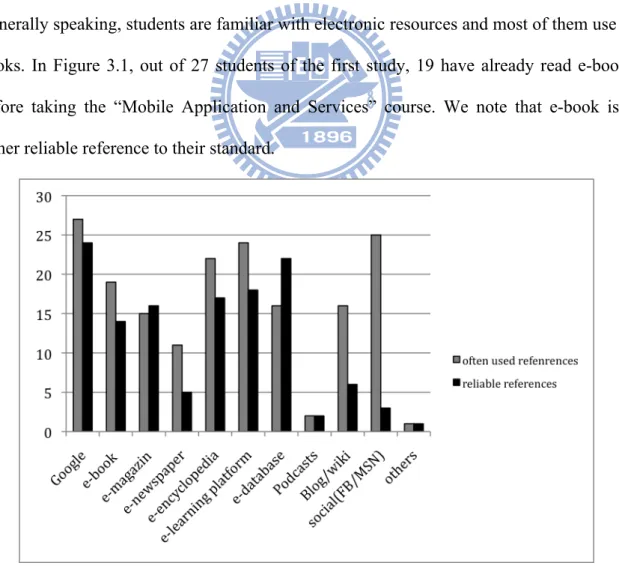
Generally speaking, students are familiar with electronic resources and most of them use e-books. In Figure 3.1, out of 27 students of the first study, 19 have already read e-books before taking the “Mobile Application and Services” course. We note that e-book is a rather reliable reference to their standard.
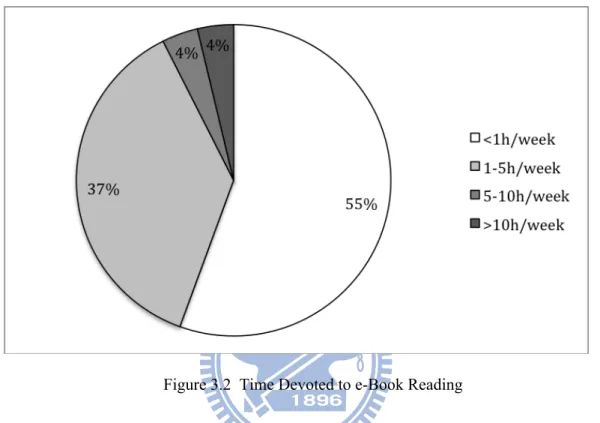
Among the students who have already read e-book, Figure 3.2 shows the average time they spend. The result reveals that they only devote really little time on this activity (92% read less than 5 hours a week).
Figure 3.2 Time Devoted to e-Book Reading
In Figure 3.3, we observe that desktop/laptop (55%) is the most used device for students to read e-books on. However, hand held e-readers, including smart-phones and dedicated devices, are also becoming quite popular (39%).
Figure 3.3 Devices Used for e-Book-Reading
3.3 Opinions and Feedbacks about E-Readers
The first impression of an e-reader is very important to the user. An easy-to-use interface and a friendly home page are essential. For now, being lightweight and having a big storage capacity are the main advantages of e-readers. Moreover, most e-readers are web based; it is very convenient to download e-books anytime and anywhere. A user can also easily access to the feedbacks and reviews about a particular e-book from other users. Usually, the user likes to have other readers’ opinions to guide him/her to choose. On the contrary, many students have raised the problem that most of the online libraries only have few e-books and most of them are too specific.
The suggested improvements in term of features and functionalities are annotations and an easier way to navigate in the e-books. Many students also point out the fact that they choose e-reader to benefit from the fact that e-books can have links, embedded dictionary,
search tools that don’t exist in paper books. From the performance point of view, connectivity is very important. That is, to be able to find the right e-book to read anywhere, anytime, fast Internet connection is a must. Moreover, the general responsiveness of the e-reader is a key issue. Many users complain about the waiting time of chapter and image loading while reading. Sometime we may need to wait several minutes to read a DRM protected e-book due to data decryption. To summarize, the user experience of e-reader still can be improved. For the features and functionalities, e-reader needs to make the most of its electronic support. The performance issue is even more important, especially for DRM protected e-books. The last chapters of this these will deal with the particular issue of chapter loading.
Chapter 4
Chapter Preloading Mechanism for E-Reader
In e-reader applications, the content files (chapters) of an e-book are downloaded/decrypted to the buffer of an reader for reading. For DRM protected e-books, to prevent the content from illegally copied, only the current chapter for reading is decrypted and loaded into the buffer of the e-reader. When the user jumps to another chapter, he/she has to wait until the new chapter is loaded. To reduce the waiting time, we propose in this chapter a preloading mechanism that preloads a small number of chapters to significantly improve the user experience and still assure the required protection level for the e-book.
4.1. Chapter Loading Performance Issues
In Chapters 2 and 3, our studies on e-readers focused on their features and functionalities. Performance of e-reader is seldom investigated in the literature, which can be measured by two indices: the content loading time and the device resource consumption [20].
The loading time influences the user experience directly. With long loading time, the user cannot read smoothly through the e-book. The resource consumption includes the CPU usage of the device and the memory buffer that holds the e-book content in the device. We
have studied the CPU usage issue in chapter 2, and will not elaborate on it here. In this chapter, we consider the loading time and the buffer size issues. E-book reading can be implemented in two alternatives:
Offline reading is the most common implementation in readers [13, 10], where an e-book is downloaded offline into the e-reader as a zipped file. To read the e-e-book, it has to be unzipped and the content files are loaded into the buffer individually. Each content file typically represents one chapter of the e-book.
Online reading is typically implemented for comics and journals reading [21, 18]. The e-book chapters are stored in the server of a dedicated website or online library, instead of downloading them into the file directory of the e-reader. The chapters to be read are delivered directly from the server to the buffer of the e-reader through, e.g., mobile Internet.
In both alternatives, chapter loading is the most time and resource consuming procedure. The easiest way to resolve this issue is to preload the whole book into the buffer of the e-reader [6]. However, this method is not applicable for DRM protected e-books, where the content files are encrypted to prevent the whole e-book from being illegally copied [8, 15]. That is, to deliver DRM protected e-book content, either from the server or the zipped-file directory of the device, only the current chapter for reading is loaded into the buffer. Therefore, a malicious user can potentially copy at most one chapter of the e-book. However, it means that each time the user jumps to another chapter, he/she has to wait until the new chapter is loaded.
Based on the reading behavior and the e-book characteristics, this chapter presents a method to improve chapter loading by optimizing the e-reader buffer allocation. We apply on DRM protected e-books a chapter preloading mechanism that loads a limited number of unzipped chapters into the buffer of an e-reader. We will carefully select the number of loaded chapters to limit the damage caused by a malicious user, while significantly improve the reading experience.
The next section presents the chapter preloading mechanism that loads a limited number of unzipped/decrypted chapters into the buffer. The last section evaluates the performances of this mechanism and concludes chapter.
4.2. Chapter Preloading Mechanism
This section proposes a preloading mechanism for e-book. We use a multi element ring buffer for chapter loading [23], where each buffer element holds one chapter of the e-book. Our method preloads into the buffer a small number of chapters having the highest probabilities to be read.
Let N be the number of chapters of a given e-book. We first rank all chapters according to its Most Likely Reading Order (MLRO) as shown in Figure 4.1
Figure 4.1 Most Likely Reading Order (MLRO)
Chapter number i 1 … n - j … n - 1 n n +1 … n + j … N
MLRO is established based on common reading habits, i.e. the reading order is sequential and chapters close to the current reading one have higher probabilities to be read. Let n be the current chapter (1 ≤ n ≤ N), and kn(i) be the rank of any chapter i with respect to n. In
Figure 4.1, the gray-colored box indicates chapter n, which has the rank kn(n)=1. Rank 2 is
assigned to the next chapter in the sequential order: kn(n
+
1)=2, rank 3 is assigned to theprevious one, i.e. kn(n-1)=3, and so on. We note that user’s “backward” reading may not
exactly follow the above ranking. However this ranking does capture the trend in our experiments at university library. For the description purpose, we define two operators
⊕
and as follows:n
⊕
j = (n + j mod N) and n j = (n - j mod N)Note that if (n + j)>N, then n
⊕
j = n + j - N; and if (n - j)<1, then n j = n – j + N.To accommodate the
⊕
and the operators on the range [1,N]={1,2,…,N}, we define a notation to represent a positive integer range:In (4.1) and (4.2), we call a the left-hand side of a,b , and b the right-hand side of a,b .
While reading an e-book, the user can jump from chapter n to another chapter n*. If the jump is to the right of chapter n within half of the e-book (i.e. ⎢⎣N / 2⎥⎦ chapters), then it is
a forward jump. Similarly, if the jump is to the left of chapter n within half of the e-book (i.e. N / 2
(
⎡⎢ ⎤⎥ −1)
chapters), then it is a backward jump. That is, a forward jump impliesn*∈ n + 1,n ⊕ N / 2⎢⎣ ⎥⎦ , and a backward jump implies n*∈ n N / 2
(
⎡⎢ ⎤⎥ −1)
, n .a,b =
[ ]
a,b if a≤ b a, N[ ]
∪ 1,b[ ]
if a> b ⎧ ⎨ ⎪ ⎩⎪ (4.1) (4.2)From the above description, the MLRO ranking can be mathematically defined as follows.
Definition 1. Let n* be the next chapter and j=|n*-n| be the number of chapters the user
jumps forward or backward. For an e-book of size N, the MLRO ranking of chapter n* with respect to n is
kn(n*)= kn(n⊕ j) = 2 j for a forward jump (j ≥ 1)
kn(nj)= 2 j + 1 for a backward jump (j ≥ 0) ⎧
⎨ ⎩
When j=0, n*=n and kn(n*)=1, which is considered as a backward jump.
Directly from Definition 1, we have the following fact.
Fact 1: If j=|n*-n| is the number of chapters the user jumps, then
Note that MLRO can be adjusted based on other reading habits. In this chapter, we evaluate the reader performance based on MLRO in Definition 1. Performance of e-reader with other chapter rankings can be similarly investigated and will not be presented.
If the current chapter is changed, MLRO re-ranking is triggered, where the re-established ranking is centered on the new chapter using Definition 1. Note that the user may jump to a page in the same chapter. In this case, MRLO remains the same. In the preloading mechanism, we always load the chapters with the smallest MLRO ranks into the buffer as described in the following definition.
Definition 2. Let B be the buffer size and n the current chapter. Then chapter i is stored in
the buffer if 1 ≤ kn(i) ≤ B.
j= kn(n*) 2 ⎢ ⎣⎢ ⎥ ⎦⎥ (4.3)
Based on Definition 2, chapter i is in the buffer if
Note that if B ≥ N, the whole e-book is held in the buffer and there is no chapter loading issue. If B < N, when the user jumps to a new chapter, some or all of the loaded chapters in the buffer must be replaced. The number of chapters to be replaced is derived in the following Theorem.
Theorem 1. Suppose that B<N. For a jump from chapter n to chapter n*, let j =|n*-n|. Let
NL(j) be the number of chapters to be replaced in the buffer. Then
NL( j)= j if j< min(B, N − B) N− B if N − B ≤ j < B B if B≤ j ≤ N − B ⎧ ⎨ ⎪ ⎩⎪
Proof: Note that for every jump, j ≤ N/2, and in the hypothesis, we do not need to consider
the case when j > N/2. Suppose that B is odd (For B is even, the proof is similar and will not be presented). From (4.4), chapter is in the buffer where
S= n B− 1 2 ⎛ ⎝⎜ ⎞⎠⎟, n⊕ B− 1 2 ⎛ ⎝⎜ ⎞⎠⎟ For the demonstration purpose, we assume that S satisfies (1), i.e.
1≤ n − B− 1 2 ⎛ ⎝⎜ ⎞⎠⎟ ≤ n + B− 1 2 ⎛ ⎝⎜ ⎞⎠⎟ ≤ N
The above inequality implies i∈ n B− 1 2 ⎛ ⎝⎜ ⎞⎠⎟, n⊕ B− 1 2 ⎛ ⎝⎜ ⎞⎠⎟ if B is odd n B 2 − 1 ⎛ ⎝⎜ ⎞⎠⎟, n⊕ B 2 ⎛ ⎝⎜ ⎞⎠⎟ if B is even ⎧ ⎨ ⎪ ⎪ ⎩ ⎪ ⎪ (4.4) S= n − B− 1 2 ⎛ ⎝⎜ ⎞⎠⎟, n+ B− 1 2 ⎛ ⎝⎜ ⎞⎠⎟ ⎡ ⎣⎢ ⎤ ⎦⎥ (4.5)
Since we use a symmetrical ring buffer, assumption (4.5) does not compromise the generality of the proof. Assume that the user jumps j chapters forward. After the jump, chapter is in the buffer where
Let r and l be the numbers of non-replaced chapters on the right-hand side and the left-hand side in the buffer, respectively. Therefore, the number of overlapped chapters in S and S* is r+l and the number of chapters to be replaced is NL=B-(r+l). Note that
depending on the relations between j, B and N, l and r may or may not be 0. Now, we prove the hypothesis in two scenarios: j < B (r ≠ 0) and j ≥ B (r =0).
Scenario 1: j <B. We first consider the right-hand side of S. Since j <B, the left-hand side
of S* in (4.6) is equal or smaller than the right-hand side of S in (4.5), and chapters i in the
r portion of S satisfy (n+ j) − B− 1 2 ⎛ ⎝⎜ ⎞⎠⎟ ≤ i ≤ n + B− 1 2 ⎛ ⎝⎜ ⎞⎠⎟ (4.7) From (4.7), S*= n * B− 1 2 ⎛ ⎝⎜ ⎞⎠⎟, n *⊕ B− 1 2 ⎛ ⎝⎜ ⎞⎠⎟ = (n + j) B− 1 2 ⎛ ⎝⎜ ⎞⎠⎟,(n+ j) ⊕ B− 1 2 ⎛ ⎝⎜ ⎞⎠⎟ (4.6) r= n + B− 1 2 ⎛ ⎝⎜ ⎞⎠⎟ ⎡ ⎣⎢ ⎤ ⎦⎥− (n + j) − B− 1 2 ⎛ ⎝⎜ ⎞⎠⎟ ⎡ ⎣⎢ ⎤ ⎦⎥+ 1 = n
[
− (n + j)]
+ B− 1 2 ⎛ ⎝⎜ ⎞⎠⎟+ B− 1 2 ⎛ ⎝⎜ ⎞⎠⎟ ⎡ ⎣⎢ ⎤ ⎦⎥+ 1 = B− j (4.8)Now, we consider the left-hand side of S. If l ≠ 0, it implies that and
NL( j)= N − B (4.9)
Since l ≠ 0, (4.6) must satisfies (4.2); in other words,
(n+ j) B− 1 2 ⎛ ⎝⎜ ⎞⎠⎟ > (n + j) ⊕ B− 1 2 ⎛ ⎝⎜ ⎞⎠⎟ = (n + j) − N + B− 1 2 ⎛ ⎝⎜ ⎞⎠⎟
Furthermore, the right-hand side of S* in (4.6) is equal or larger than the left-hand side of S in (4.5). That is, (n+ j) − N + B− 1 2 ⎛ ⎝⎜ ⎞⎠⎟ ≥ n − B− 1 2 ⎛ ⎝⎜ ⎞⎠⎟ ⇔ j + B − 1 ≥ N ⇔ j > N − B (4.10)
Therefore, l ≠ 0 if and only if j> N − B . When j ≤ N − B , l=0 and from (4.8), NL is
NL( j)= B − (r + l) = B − ((B − j) + 0) = j (4.11) From (4.9) and (4.11), NL( j)= j if j≤ N − B N − B if j > N − B ⎧ ⎨ ⎩ (4.12)
Scenario 2: j ≥ B. This scenario implies r = 0. Now we show l = 0 by contradiction.
Suppose l ≠ 0, then (4.10) must be satisfied. That is j >N-B. Since j ≤ N/2 (definition of a forward jump), we have
N− B < N
2 ⇒ B >
N
2 (4.13)
Therefore, Scenario 2 holds if and only if B ≤ j ≤ N–B and l=0,
NL( j)= B (4.14)
From (4.12) and (4.14), the hypothesis is proved. Note that for a backward jump, the proofs for both Scenarios 1 and 2 are similar except that n +j is replaced by n – j.
Q.E.D.
4.3. Performance Evaluation
Two output measures are considered for the performance evaluation of the chapter preloading:
The reload probability p is the probability that the next chapter n* is not in the buffer. That is, with probability p, the user needs to wait for the loading of chapter n* and cannot read smoothly through the e-book.
The loading cost CL is the expected number of chapters that are replaced in the buffer
at each MRLO re-ranking due to a chapter jump.
Note that in a practical e-book application, the buffer size cannot be too large, and for the practical exercise, it suffices to consider B<N/2. In this case, the loading cost also reflects the “security cost”. If more chapters are loaded into the buffer, the penalty of being illegally copied is higher.
This section shows how to select appropriate B values to yield good p and CL performance.
We derive p and CL assuming that the probability distribution of e-book chapter reading
follows Zipf’s law. This law was initially used to predict the frequency of appearance of words in a corpus in English language. It is an empirical law stating that the frequency of
any word is inversely proportional to its rank in the order of frequency [17]. More generally, Zipf's law predicts, out of a population of N elements, the frequency of the element of rank k to appear. The parameter s describes the behavior of the population (to be elaborate). The Zipf’s probability of the element of rank k is
(4.15)
In this study, the e-book chapters are the population under consideration, where N is the number of chapters of a given e-book. The parameter s describes the reading behavior, and more specifically, the locality of the read chapters. A larger s means that the user is more inclined to stay in the same chapter; on the contrary, a small s means that there is a higher probability to jump to chapters further away from the current one. Zipf’s law gives the probability of any chapter to be read depending on its MLRO rank given in Definition 1. For a jump from chapter n to chapter n*, n* needs to be loaded in the buffer for immediate reading if kn(n*)>B. Therefore, from (4.15), the reload probability p is expressed as
(4.16)
A low reload probability p means that most of the time, the user can read through the e-book without waiting.
Let C1 be the loading cost corresponding to forward jumps. In this case, j≤ N / 2⎢⎣ ⎥⎦. From Definition 1, kn(n*) = 2j, and C1 = NL( j)Pz(2 j) 1≤ j ≤ N 2 ⎢ ⎣⎢ ⎥ ⎦⎥
∑
= jPz(2 j)+ B Pz(2 j) B< j ≤ N 2 ⎢ ⎣⎢ ⎥ ⎦⎥∑
⎛ ⎝ ⎜ ⎜ ⎜ ⎞ ⎠ ⎟ ⎟ ⎟ 1≤ j ≤ B∑
(4.17)Let C2 be the loading cost corresponding to backward jumps. In this case, j ≤ N / 2⎡⎢ ⎤⎥ − 1 . From Definition 1, kn(n*) = 2j+1, and
C2 = NL( j)Pz(2 j+ 1) 1≤ j ≤ N 2 ⎡ ⎢⎢ ⎤⎥⎥−1
∑
= jPz(2 j+ 1) + B Pz(2 j+ 1) B< j ≤ N 2 ⎡ ⎢⎢ ⎤ ⎥⎥−1∑
⎛ ⎝ ⎜ ⎜ ⎜ ⎞ ⎠ ⎟ ⎟ ⎟ 0≤ j ≤ B∑
(4.18)From (4.15), (4.17), (4.18) and (4.3), the loading cost CL is
CL = C1+ C2 = l 2 ⎢ ⎣⎢ ⎥ ⎦⎥Pz(l)+ B Pz(l) 2 B<l ≤ N
∑
⎛ ⎝⎜ ⎞ ⎠⎟ 1≤l ≤2B∑
= l 2 ⎢ ⎣⎢ ⎥ ⎦⎥ l s 1 is i=1 N∑
⎛ ⎝⎜ ⎞ ⎠⎟ ⎡ ⎣ ⎢ ⎤ ⎦ ⎥ −1 + B ls 1 is i=1 N∑
⎛ ⎝⎜ ⎞ ⎠⎟ ⎡ ⎣ ⎢ ⎤ ⎦ ⎥ −1 2 B<k ≤ N∑
⎛ ⎝ ⎜ ⎞ ⎠ ⎟ 1≤l ≤2B∑
(4.19)Note that from (4.16), we observe that a larger buffer size B implies a lower reload probability p. On the contrary, from (4.19), a larger buffer size B implies a higher loading cost CL. The goal of this study is to select an appropriate buffer size B to balance against p
and CL. In doing so, we define a net cost C that considers the effect of both p and CL as
follows:
C= p +αCL
Figure 4.2 shows the reload probability p as a function of B/N and s, where N=20. The figure indicates the intuition that p decreases as B/N increases. We observe a non-trivial result that there is a knee point (the bullets in Figure 4.2) such that before this point, p significantly decreases as B/N increases. This phenomenon implies that after this knee point, selecting a larger buffer size does not improve p performance. Such knee effect is more significant for a larger s. Figure 4.2 also indicates that to achieve the same p performance, B/N deceases as s increases.
Figure 4.2 Reload Probability for N=20
Figure 4.3 illustrates that to achieve the same p performance, a larger B/N is required for a smaller N. That is, a larger portion of e-book needs to be stored in the buffer for an e-book of small volume. Similar to Figure 4.2, a knee point can be determined on every p curve.
Figure 4.3 Reload Probability for s=2
Figure 4.4 shows the loading cost for N=20 under various s values. We observe that CL
increases as the locality parameter s or the e-book size B/N increases; this effect becomes less significant with large s values.
The net cost for s=2 is illustrated in Figure 4.5. For α=0.6, we observe a minimum value on each C curve for N=50 and N=100 respectively. In both cases, this minimum occurs when B=3 (B/N=0.06 for N=50 and B/N=0.03 for N=100). By increasing the factor α, the protection of the e-book is higher and the minimum occurs for a smaller B value (for
α=0.8, B=2). We note that the B/N value of the minimum is always smaller than that of the
knee point for p.
Figure 4.5 Net Cost for s=2
The above performance study indicates that by slightly increasing the buffer size (i.e. slightly compromising the protection of the e-book), the user experience is significantly improved. In the example in Figure 4.5, by buffering two more chapters (i.e., B/N increases from 0.02 to 0.06 for N=50 and α=0.6), we can reduce the reload probability p from 0.38 to 0.17 (Figure 4.3), which is a 56% improvement. Our chapter preloading mechanism provides a method for e-reader designers to select the appropriate buffer size according to the requirements in term of user experience and e-book protection.
Chapter 5
Conclusion and Future Works
This chapter concludes our work about the performance evaluation and user experience of e-readers and presents briefly the future directions of this study.
5.1. Contribution
E-reader has introduced a brand new experience of reading compared to the traditional paper book. The development of e-readers is still in its growing phase. The users need to know and to familiarize with this new technology; at the same time, e-reader designers try their best to fulfill the users’ needs. Generally speaking, e-reader features and functionalities are designed to imitate the reading experience of paper books. Moreover, additional features are added to make the most of the electronic support, such as connectivity, links and storage capability. Our studies showed that for university students, these features are the ones that make them prefer e-books to paper books.
The performance of e-reader is a key issue under consideration to improve user experience. It is obvious that with long response time and high resource consumption, no one will use e-readers. From the performance evaluation in this thesis, we observe that for now, e-book and chapter loading performances are rather poor. Moreover, for DRM protected e-books
these loading performances are even worth caused by data decryption. Then, we described a chapter preloading mechanism to improve performance. In the presented mechanism, we showed that by preloading a small number of chapters, we could significantly improve the user experience and still assure the required level of e-book protection.
5.2. Future Works
This thesis has pointed out the weaknesses and the possible improvements for e-readers regarding the user experience. In terms of features, we found out that the e-reader should benefit more from its electronic support. We will focus our future work on the design of additional features such as internal links, embedded dictionary or search tools to bring to the user an innovative and easier way of reading and learning.
Moreover, in the chapter preloading mechanism, strong assumptions on the reading behavior were made to define the MLRO. However, we note that user’s reading may not exactly follow this ranking. This ranking depends on the user’s own reading behavior as well as the type of the e-book content. Our future work will also consider the design of reading models suitable for specific type of e-books. The final goal is to implement this mechanism on actual e-readers.
Biography
[1] Apple - Instruments User Guide - Performance Analysis Tools, Apple Inc. 2009. Available: http://developer.apple.com/iPhone/library/documentation/Developer Tools/ Conceptual/InstrumentsUserGuide/Introduction/Introduction.html
[2] Apple - iPhone - Technical Specifications, 2010. Available: http://www.apple.com/iphone/specs- 3g.html.
[3] Chong, P.F., Lim, Y.P. and Ling, S. W. “E-Book Design Preferences: A Case Study”, International Symposium on Information Technology, 2008.
[4] Chuang, C.Y., Wang, Y.C. and Lin, Y.B. “Digital Right Management and Software Protection on Android Phones”, IEEE 71st Vehicular Technology Conference (VTC2010-Spring), 2010.
[5] Cripps, T. “If iPhones and Androids: Redefining the Smartphone and Other Devices,” Ovum Report, March 2009.
[6] Freda: the Free Ebook Reader. Available: http://www.turnip.demon.co.uk/jim/freda/ [7] Google - Google Books. Available http://books.google.com/
[8] He, G. “Analysis of E-Book Security”, Article in T-110.501 Seminar on Network Security, 2001. Available: http://www.tml.tkk.fi/Studies/Tik110.501/2001/papers/ he.pdf
[9] Hillesund, T. and Jon, E. Noring “Digital Libraries and the Need for a Universal Digital Publication Format,” the Journal of Electronic Publishing, vol. 9, no. 2, summer 2006.
[10] Kindle-Amazon: Wireless Reading Device. Available: http://www.amazon.com/Kindle-Wireless-Reading-Device-Display/dp/B00154JDAI
[11] International Digital Publishing Forum (formerly Open eBook Forum). Available:
http://www.idpf.org/
[12] International Digital Publishing Forum Specifications. Available: http://www.idpf.org/specs.htm
[13] Lexcycle Stanza: a Revolution in Reading. Available: http://www.lexcycle.com/ [14] Lexcycle - Lexcycle Has Been Acquired by Amazon.com! Lexcycle, April 27 2009.
Available: http://www.lexcycle.com/lexcycle_acquired_by_amazon
[15] Liu, Q., Safavi-Naini, R. and Sheppaed N.P. “Digital Rights Management for Content Distribution”, Proceedings for the Australasian Information Security Workshop Conference on ACSW Frontiers 2003.
[16] Moore, L.M. “At Your Leisure: Assessing Ebook Reader Functionality and Interactivity”. Available: http://www.uclic.ucl.ac.uk/distinction-projects/2009-Moore.pdf
[17] Newman, M. E. J. “Power Laws, Pareto Distributions and Zipf’s Law” Contemporary Physics, vol 46, pp. 323-351, 2005.
[18] Questia: Trusted Online Research. Available: http://www.questia.com/
[19] Rave, P. “How to Approach the “Base of the Pyramid”: A Business-Strategy and Country Based Analysis for an Ebook Reader,” Master Thesis, 2009.
[20] Ren, Z.J., Lin, Y.B. and Crespi, N. “Evaluation of E-Book Reader on Mobile Devices”, Proceedings of the 15th Mobile Computing Workshop, Taichung, Taiwan, June 2010.
[21] Spectrum Nexus: Manga Scans. Available:
[22] Springer – “Ebook Readers Tested: Amazon’s Kindler, the Sony Reader and the iRex iLiad”, 2010. Available: http://www.springer.com/librarians/e-content/ebooks? SGWID=0-40791-6-801317-0
[23] Tse, P. K. C. “Multimedia Information Storage and Retrieval: Techniques and Technologies”, IGI Publishing, 2008.
[24] Wilson, R. “Ebook Readers in Higher Education”, Educational Technology & Society, 6 (4), 8-17, 2003.
Appendix: E-reader Survey at NCTU Library
[
體驗電子書,拿禮券!]活動說明
2010/11/03-2010/12/03 使用智慧手機或電子閱讀器,試讀電子書,體驗電子書的閱讀功能,並填寫問卷,就可 以抽好禮! 主辦單位: 國立交通大學電機資訊國際學位學程 指導教授: 林一平 教授 研究生: 任之皓活動對象:
國立交通大學全校師生活動獎項:
頭獎:RT Baker House 禮券 500元 (一名) 二獎:RT Baker House 禮券 100元 (十名)活動時間:
活動期限:2010/11/3 -2010/12/3 得奬名單:2010/12/10 (公佈於圖書館網頁上) 領獎時間:2010/12/13-2010/12/17 (得奬者若未於期限內領取奬品,視同放棄得奬資格。) 領獎地點:請帶證件,至圖書館讀者服務台領取。活動辦法 :
1. 在圖書館二樓(Ask me)讀者服務台借用公用手機,使用任意一個已安裝的電子書 閱讀應用程式,並且填寫問卷。 2. 利用個人的智慧手機,下載任意一個電子書閱讀應用程式使用,並且填寫問卷。 3. 使用個人的電子閱讀器設備,並且填寫問卷。 問卷可以上網在這裡或在圖書館二樓(Ask me)讀者服務台填寫。 注意:每位參加者可以對於不同的電子書閱讀器,填多份問卷。試讀電子書的步驟 說明
Step 1: 安裝電子書閱讀應用程式
智慧手機用者:
如果手機內已安裝了電子書閱讀應用程式可以忽略這個步驟。
如果沒有,可以參考以下電子書閱讀應用程式(這並不是所有選擇): iPhone 平台:Hami-書城, e書城, Stanza, eReader, 等等。
應用程式請由 App-Store 下載安裝。
Android 平台:Hami-書城,,e書城, Aldiko, FBReader,等等。 應用程式請由 Android Market 下載安裝。 安裝細節請參考官方網站* 。 電子閱讀器設備用者: 可以忽略這個步驟。 Step 2: 下載電子書 下載任意幾本電子書。 不同的電子書閱讀器擁有不同的下載方式,請參考它們的官方網站* 或以下連接。 Hami-書城: http://www.youtube.com/watch?v=gHT-fYxz0aw Step 3: 試讀電子書 試讀下載的電子書。 嘗試電子書閱讀器的各種功能。 使用方法可以參考以下連接。 Hami-書城: http://www.youtube.com/watch?v=axXpNnh2ofM Stanza: http://www.youtube.com/watch?v=SZmm8-8n3Tw Aldoko: http://www.youtube.com/watch?v=Iratn-Vu8HU&p=6966F0AE247B5F38 Step 4: 填寫問卷 在這裡或在圖書館二樓(Ask me)讀者服務台。 Online survey: https://spreadsheets.google.com/viewform?formkey=dC1uc2dQWmxMZzJPNTd0VlllMlF3anc6MA Step 5: 等候得獎名單 得奬名單會在12月10日公佈於圖書館網頁上。 * 一些電子書閱讀程式的官方網站: Hami-書城: hamiweb.emome.net/categories/view/19 e書城: www.ebooktown.com.tw Stanza: www.lexcycle.com eReader:www.ereader.com/ereader/software/browse.htm Aldiko: www.aldiko.com FBReader: www.fbreader.org
電子書閱讀器的功能和效能問卷
親愛的受訪者,您好 非常感謝您撥冗填寫此份問卷! 本問卷調查目的為探討「 體驗電子書,拿禮券!」活動網站使用者之使用電子書閱讀器 經驗。希望您可以提出對於電子書閱讀器功能和效能的寶貴意見和建議。 問卷內容僅供學術研究 之用,您所填的資料不做個別探究,只做整體分析,一切資料均予以保密,敬請依據實際狀況安 心作答。 最後,為您的協助與分享致上最誠摯的謝意。 敬祝 平安喜樂! 主辦單位: 國立交通大學電機資訊國際學位學程 指導教授: 林一平 教授 研究生: 任之皓 中華民國 99 年 11 月 第一部分:基本資料 1. 性別: 男 女 2. 身份: 大學部 碩士班 博士班 教職員 3. 學院: 電機學院 生物科技學院 人文社會學院 客家文化學院 資訊學院 理學院 管理學院 工學院 光電學院 4. 姓名 :_____ 學號:______ Email:_______________ 第二部分:電子書的使用經驗 5. 您如何獲得您使用的電子書閱讀器? 向圖書館借用 專門為了讀書而購買 自用手機附有的功能 6. 您使用的電子書閱讀器是: 智慧手機上的應用程式 專用的電子閱讀器設備 7. 請您寫出您使用的電子書閱讀器名稱:______________________ 8. 請問您閱讀電子書的頻率? 每天數次 每2-3天一次 每週一次 偶爾 9. 請問您每次閱讀的時間? 30分鐘以下 0.5-1小時 1-2小時 2 小時以上 10. 請問您較常閱讀那類電子書? (可複選) 文學小說 課本 漫畫 語言學習 休閒娛樂 工具書 其他 請說明:_____________ 11. 請問您個人的讀書習慣 (讀書速度,是否會作筆記, 用書籤,等等):第三部分:此部份是關於電子書閱讀器功能,請勾選您使用後的感想。 很好用 好用 普通 不好用 無此功 能 12. 書籤 13. 筆記 14. 內建字典 15. 單字/詞組搜索 16. 目錄 17. 跳頁/導覽 18. 讀者評論 19. 我的最愛 20. 書櫃組織 21. 請您列出一些您希望在電子書閱讀器裡出現的功能: 22. 請說明關於電子書閱讀器功能之個人意見: 第四部分:此部份是關於電子書閱讀器的效能,請提供您的意見: 很快 快 普通 慢 很慢 23. 打開閱讀器 24. 打開一本電子書 25. 載入一個章節 26. 載入一幅圖像 27. 翻頁 28. 整體反應 29. 請說明對於電子書閱讀器效能的個人意見(那一個方面對你比較重要, 有什麼可改善的, 等 等):