行政院國家科學委員會專題研究計畫 成果報告
對苯二甲酸二丙酯與對苯二甲酸二乙酯無規共聚物的共結
晶機構、熔融行為與結晶結構之形成
計畫類別: 個別型計畫 計畫編號: NSC92-2216-E-110-011- 執行期間: 92 年 08 月 01 日至 93 年 07 月 31 日 執行單位: 國立中山大學材料科學研究所 計畫主持人: 陳明 計畫參與人員: 張芷維、柯季昀 報告類型: 精簡報告 處理方式: 本計畫涉及專利或其他智慧財產權,1 年後可公開查詢中 華 民 國 93 年 10 月 2 日
行政院國家科學委員會專題研究計畫成果報告
對苯二甲酸二丙酯與對苯二甲酸二乙酯無規共聚酯的共結晶機
構、熔融行為與結晶結構之形成
Cocrystallization mechanism, melting behavior and structure
formation of poly(trimethylene terephthalate-co-ethylene
terephthalate) random copolymers
計畫編號:NSC 92-2216-E-110-011
執行期限:92 年 8 月 1 日至 93 年 7 月 31 日
主持人:陳明 國立中山大學材料科學研究所
計畫參與人員:張芷維、柯季昀 國立中山大學材料科學研究所
一、中文摘要 以調幅式微差掃瞄卡儀和 X-ray 繞射 儀探討與證明一系列對苯二甲酸二乙酯與 對苯二甲酸二丙酯無規共聚酯之共結晶行 為,其整體的結晶速率與繞射峰的強度均 隨次量共聚單體之增加而減少;此外,兩 單體含量相同的共聚酯之 X-ray 繞射光譜 和兩單聚酯的明顯不同。非等溫結晶後之 可逆熔融行為觀察到三個熔融峰,分別為 主晶體峰與加熱過程中形成的兩個再結 晶—再熔融峰,其中最高溫的峰是由區域 I 形成的晶體熔融所得,以上結果支持多 重熔融峰是經由熔融—再結晶—再熔融的 機制。藉由高分子—稀釋劑之熔融溫度下 降與 Flory 方程式可求取高分子的熔融 焓,選擇鄰苯二甲酸二丁酯作為溶劑得到 對苯二甲酸二乙酯莫耳含量28、38 和 50% 共聚酯之百分百結晶的熔融焓(ΔHf)分別 是4.48、3.43 和 3.07 kcal/mole。 關鍵詞:共聚酯、結晶、熔融、熔融焓 AbstractA series of random copolyesters of ethylene- and trimethylene- terephthalate were investigated using temperature modu- lated differential scanning calorimeter (TMDSC) and wide angle X-ray diffracto- meter (WAXD). The co-crystallization beha-
vior was evidenced from the non-isothermal DSC thermograms and WAXD. The overall crystallization rate and the intensity of diffraction peaks decreased with increasing the minor co-monomer content. In addition, WAXD pattern of the copolyester with equal amounts of monomers is quite different from those of homopolymers. In the melting study, three distinct peaks of reversing melting were observed in three of these copolyesters. The lowest one corresponds to the melting of primary crystals. The higher two peaks are due to re-melting of the re-crystallized crystals formed during the heating scan, whereas the highest one is attributed to the melting of the crystals that are formed in regime I. The results of WAXD and TMDSC support the mechanism of melting-recry- stallization-remelting for the multiple melting behaviors. The heat of fusion of polymer is customarily evaluated through the melting point depression measurements with the thermodynamic melting points. Application of the Flory equation to the random copoly- esters diluted with di-n-butyl phthalate gave the values of the heat of fusion to be 4.48, 3.43 and 3.07 kcal/mole, respectively, for the random copolyesters containing 28, 38 and 50 mole % of ethylene terephthalate unit. Keywords: copolyester, crystallization,
二、緣由與目的
In recent years there has been renewed interest in crystallization and the resulting solid-state structure of random copolymers. In most of the copolyesters where both A/B components are crystallizable, the incompa- tibility in crystal lattices of two components leads often to fully amorphous materials. Only a few systems show the compatibility in crystal lattice, i.e. some crystallinity over entire copolymer composition. In this project, the goal is to study the nonisothermal cry- stallization kinetics and the subsequent melt- ing behavior of poly(ethylene terephthalate-
co-trimethylene terephthalate) random co-
polyesters (PET/PTT) by TMDSC. The values of the enthalpy of fusion of crystals were determined from the melting point de- pression in a polymer-diluent system.
三、結果與討論
Non-isothermal Crystallization. Fig.
1 shows the heating and cooling thermo- grams of the melt-quenched samples at 5 °C/min. For all PET/PTT copolyesters, a clear endothermic melting peak and an exo- thermic peak are detected. Furthermore, the change of melting temperatures with the ET compositions revealed a typical eutectic be- havior, indicating that the PET/PTT copoly- esters exhibited an isodimorphic co-crystal- lization. The minimum melting temperature is observed at PT50/ET50, a random copoly- ester with equal amounts of PT and ET. As can be seen in the cooling thermograms of Fig. 1(B), the peak and the peak temperature gradually become broader and lower as the content of minor co-monomer increases. It means that the crystallization rates of the copolymers decrease with increasing the minor co-monomer content, which is due to the lower rates of nucleation and crystal growth.
Wide Angle X-ray Diffraction. The
results of WAXD measurements of homo- and co-polyesters are shown in Fig. 2. The WAXD patterns are divided into three groups according to the PT content in the
copolymer. For PT content above 72 mol%, the crystal structure of the copolymer is a triclinic system in the same manner as is PTT. The intensity of diffraction peaks decreased with increasing content of ET moieties. PET triclinic crystals mainly develop below 28 mol% PT content. On the other hand, the WAXD pattern of PT50/ET50 is quite different from those of PET and PTT, and that of PT62/ET38 shows the mixed dif- fraction peaks of PT72/ET28 and PT50 /ET50. In addition, it was found that there was no positional change of the diffraction peaks through the WAXD measurement for the individual polyester crystallized at va- rious temperatures isothermally (Tc). It indi- cates that only one
crystal structure exists regardless of Tc for
the individual polyester.
Melting Behavior. Fig. 1(B) shows
that the detectable signal of non-isothermal crystallization of PT91/ET9 disappears at ~173.5°C, and its enthalpy of melt crystalli- zation is the highest one among these co- polyesters. There should be no cold crystalli- zation. In curve b of Fig. 3, the reversible melting process starts at 173°C. The amount of endotherm for melting the secondary cry- stals slowly increases, and finally reaches a distinct peak at 206.6°C that corresponds to the melting of primary crystals. There are three distinct peaks of reversing melting in the case of PT91/ET9. Three broad and overlapping peaks are also observed in the reversing melting curves of PT72/ET28 and PT62/ET38 (see Fig. 3). The last two peaks are due to re-melting of the re-crystallized crystals formed during the heating scan, whereas the highest one is attributed to the melting of the crystals that are formed in regime I. The results of WAXD and TMDSC support the mechanism of melting-recry- stallization-remelting for the multiple melting behaviors of these copolyesters.
Heat of Fusion. The specimens of
PT72/ET28 copolyester were heated from room temperature to 210°C, hold for 5 min and then cooled down rapidly to a TC for iso-
thermal crystallization ranging from 122 to 150°C in an interval of 4°C. These melt- crystallized samples were heated at a heating rate of 30 °C/min. The DSC thermograms exhibit multiple melting peaks, as shown in Fig.4. These melting endotherms are labeled as Tm1, Tm2 and Tm3. The peak temperature
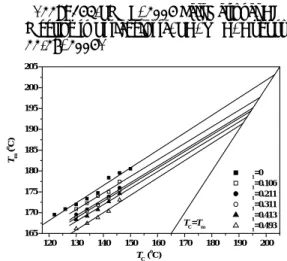
(Tm2) of primary crystals is plotted versus TC
in Fig. 5 (filled squares) to determine the equilibrium melting temperature, o
m
T ' . Hoffman-Weeks plot yields a value of
203.1°C for the PT72/ET28 copolyester.
The homogeneous PT72/ET28 copoly- ester-diluent mixtures were treated in the
same way except TC ranging from 130 to
146 °C. Fig. 6 shows the melting behavior of
PT72/ET28-dibutyl phthalate mixtures with diluent volume fraction of 0.106. The con- centrated mixtures exhibit a behavior similar to the bulk copolymer, but discrepancies de- velop as the diluent concentration is in-
creased. The relative intensity of peaks Tm3
/Tm2 decreases with an increasing in Tc, and
also decreases with the volume fraction of the diluent. This is a consequence of compo- sitional changes in the melt and of the in- fluence of diffusion with the concomitant decrease in the re-crystallization rate. The
peak temperatures (Tm2) are plotted versus
TC in Fig. 5. Hoffman-Weeks plots yield the
equilibrium melting temperature (T’m) with
values of 197.6°C for φ1=0.106, 195.1°C for
φ1=0.211, 194.4°C for φ1=0.311, 193.0°C for
φ1=0.413, and 191.4°C for φ1=0.493. They
are listed in the 4th column of Table 1. The
weight and the estimated density at in-
dividual T’m for diluent and copolyester are
tabulated in columns 2, 3, 5 and 6 of Table 1.
The calculated values of φ1, (1/T’m-1/T ' )/om φ1,
φ1/T’m are listed in columns 1, 7 and 8 of
Table 1. Plotting (1/T’m-1/T ' )/om φ1 vs. φ1/T’m
yields a linear line with a correlation co- efficient of 0.9405, as shown in Fig. 7. From the intercept of this plot, it gives a heat of
fu- sion of ∆Hf = 4.48 kcal/mol (18.76
kJ/mol).
The values of the 100% heat of fusion
were 3.43 and 3.07 kcal/mole, respectively, for the random copolyesters containing 38% and 50% of ethylene terephthalate unit. 四、成果自評
兩年期計畫書中獲核准的第一年部分 已完成研究目標。
五、References
[1] C.-W. Chang, C.-Y. Ko and M. Chen, Program & Abstracts of the 27th R.O.C. Polymer Symposium in Tamsui, Taipei County, February 21-22, 2004, pp.216. 40 80 120 160 200 240 280 0.2 mW (A) (i) (f) (h) (g) (e) (d) (c) (b) (a) En do Temperature (oC) 40 80 120 160 200 240 280 0.5 mW (e) (b) (i) (h) (g) (f) (d) (c) (a) (B) Ex o Temperature (o C)
Fig. 1 Non-isothermal DSC thermograms at heating
(A) and cooling (B) rates of 5°C/min for melt-
quenched homo- and co-polyesters of: (a) PTT, (b) PT91/ET9, (c) PT72/ET28, (d) PT62/ET38, (e) PT50/ET50, (f) PT28/ET72, (g) PT22/ET78, (h) PT9/ET91, (i) PET.
60 80 100 120 140 160 180 200 220 240 260 Re ve rs ing h ea t f low , E n d o Temperature (oC) b c d f g h 0.05 W/g
Fig. 3 Reversing heat flow of TMDSC curves for the specimens after non-isothermal crystallization: (b-h) see the caption of Fig. 1.
[2] C.-W. Chang, Master Thesis, National Sun Yat-sen University, 2004.
[3] M. Chen and C.-Y. Ko, Abstr. Pap. Am. Chem.
8 12 16 20 24 28 32 36 (111) (110) (100) (111) (021) (010) (011) (110) (112) (120) (110) (012) (012)(100)* (103)* (113) (103) (020)* (102)* (010) (b) (h) (i) (c) (d) (e) (f) (g) (a) I n te ns ity (a rb itr a ry u n it ) 2θ (degree)
Fig. 2 X-ray diffraction patterns for isothermally melt-crystallized copolyesters of: (a-i) see the caption of Fig. 1. The asterisk indicates the major reflection.
80 100 120 140 160 180 200 220 T m3 Tm2 Tm1 4 mW 150o C 146o C 142oC 138o C 134o C 130o C 126o C 122o C E ndo Temperature (oC)
Fig. 4 DSC thermograms at a heating rate of 30
S. 228: 143-PMSE, 2004 Fall National ACS Meeting in Philadelphia, PA, USA, August 22-26, 2004. 120 130 140 150 160 170 180 190 200 165 170 175 180 185 190 195 200 205 TC=Tm Tm ( oC) TC (oC) φ1=0 φ1=0.106 φ1=0.211 φ1=0.311 φ1=0.413 φ1=0.493
Fig. 5 Hoffmann-Weeks plots of pure PT72/ET28 and its mixtures with dibutyl phthalate with different compositions at a heating rate of 30 °C/min.
80 100 120 140 160 180 200 220 Tm1 Tm2 Tm3 4 mW 146o C 142o C 138o C 134o C 130o C E ndo Temperature (oC)
Fig. 6 DSC thermograms at a rate of 30 °C/min for PT72/ET28-diluent mixtures, φ = 0.106. 0.2 0.4 0.6 0.8 1.0 1.2 0.08 0.10 0.12 0.14 0.16 0.18 0.20 0.22 0.24 0.26 y=0.2458-0.1478x R=0.9405 [1 / φ1 (1/ Tm -1/ Tm o)] *10 3 (φ1/Tm)*103
Fig. 7 (1/T’m – 1/T’mo)/Ф1) versus Ф1/T’m for PT72
/ET28 copolyester-dibutyl phthalate.
Table 1 The diluent volume fraction, the sample weight, the equilibrium dissolution temperature (T’m), the
density, and the calculated parameters for PT72/ET28 copolyester-dibutyl phthalate.
φ1 w(mg) solvent w(mg) polymer T’m (oC) (g/cmdsolvent3) (g/cmdpolymer3) [1/T’φ1 (1/T’m-
mo)]×103 (φ1/T’m)×10 3 0.106 1.37 15.18 197.6 0.912 1.193 0.23 0.22 0.211 2.61 12.74 195.1 0.914 1.195 0.17 0.45 0.311 4.09 11.83 194.4 0.914 1.195 0.13 0.67 0.413 5.23 9.72 193.0 0.915 1.196 0.11 0.89 0.493 6.76 9.08 191.4 0.916 1.197 0.11 1.06