Brief Research Communication
Association of 5HT2A Receptor Gene Polymorphism
and Alcohol Abuse With Behavior Problems
Hai-Gwo Hwu1* and Chia-Hsiang Chen2
1Department of Psychiatry, College of Medicine, National Taiwan University, Taipei, Taiwan 2Department of Psychiatry, Tzu Chi College of Medicine, Hualien, Taiwan
This study investigated the association be-tween T/C polymorphism, at position 102, of the 5-hydroxytryptamine 2A receptor gene and alcoholism with and without behavior problems. Eighty-five subjects (45 men, 40 women) with alcohol abuse, 75 subjects (51 men, 24 women) with alcohol dependence, and 70 normal control subjects (21 men, 49 women) participated in the study. The re-sults show that the frequency of the homo-zygous T102 genotype was significantly lower in the group of male alcohol abuse with behavior problems than in the female group (2 = 4.072, df = 1, P < 0.05) and the
allele frequency of T102 was also lower in the male group than in the female group (2
= 4.187, df = 1, P < 0.05). Of the male alcohol abuse subjects, the group with behavior problems was found to have lower frequen-cies of the T102 allele than the group with-out behavior problems (2= 4.328, df = 1, P <
0.05). In conclusion, this study demonstrates that alcoholism is heterogeneous and male alcohol abuse with behavioral problems was associated with T/C 102 polymorphism of the 5HT2A receptor gene. Am. J. Med. Genet. (Neuropsychiatr. Genet.) 96:797–800, 2000. © 2000 Wiley-Liss, Inc.
KEY WORDS: alcoholism; heterogeneity; serotonin receptor gene; be-havior problem
INTRODUCTION
Genetic factors are found to be important in the etio-logical complex of alcoholism [Cloninger et al., 1981; Sigvardsson et al., 1996]. Type 1 alcoholism, defined by Cloninger et al. [1981], was found to have both envi-ronmental and genetic risk factors, and Type 2 alcohol-ism, the severe form of alcoholalcohol-ism, was found to have a more emphasized genetic etiological factor [Sigvard-sson et al., 1996]. Serotonin was found to play impor-tant roles in mediating drinking behavior through vari-ous mechanisms [Meltzer, 1990; Le Marquand et al., 1994; Virkkunen and Linnoila, 1997; Maurel et al., 1999]. Activation of various subtypes of serotonin re-ceptors, such as 5HT2A, 5-HT2C, and 5-HT1B reduce
ethanol consumption [Maurel et al., 1999]. Clinical pharmacological agents increasing serotonergic activi-ties were found to have a modest degree, but not con-sistent across studies, of action in reducing alcohol in-take [Lejoyeux, 1996; Garbutt et al., 1999].
Low serotonergic function was responsible for poor impulse control, such as aggressiveness and self-in-jurious behaviors [Roy, 1990]. Alcohol-dependent indi-viduals often show poor impulse control behavior [Lin-nolia et al., 1989]. There is a consistent finding that a proportion of alcoholism patients have association with behavior symptoms assigned as Type 2 alcoholism [Cloninger et al., 1981], Type B alcoholism [Barbor et al., 1992], and deviant-behavior type alcoholism [Hwu et al., 1992]. This behavior-disordered subtype of alco-holism is possibly based on the pathophysiological mechanism of reduced serotonergic functions.
Based on this background, a promising area of study is the search for genes related to serotonin transmis-sion, responsible for vulnerability to alcoholism [Hill et al., 1999]. Serotonin transporter gene (HTT) polymor-phism (HTTLPR) was not found to be associated with alcohol dependence [Edenberg et al., 1998]. The LL ge-notype of the HTT was found to be associated with a low level of alcohol response which was a vulnerability marker of alcoholism [Schuckit et al., 1999]. Nakamura et al. [1999] reported a positive association of alcohol dependence with a (A/G) polymorphism of the promoter region of 5HT2A receptor gene located at chromosome 13q14-21 [Hsieh et al., 1990]. The present study was designed with the hypothesis that there is an associa-tion between alcoholism with behavior problems and
Contract grant sponsor: the Department of Health, Taiwan; Contract grant number: DOH-85-TD-109; Contract grant spon-sor: the National Health Research Institute, Taiwan; Contract grant numbers: DOH 87-HR-306, NHRI-GT-EX89P825P; tract grant sponsor: National Taiwan University Hospital; Con-tract grant number: NTUH-88-A0015.
*Correspondence to: Hai-Gwo Hwu, M.D., Department of Psy-chiatry, National Taiwan University Hospital, No. 7 Chung-Shan S. Rd., Taipei, 100, Taiwan. E-mail: [email protected]
Received 29 November 1999; Accepted 26 April 2000
American Journal of Medical Genetics (Neuropsychiatric Genetics) 96:797–800 (2000)
receptor gene T/C polymorphism, at position 102, of the serotonin receptor subtype 2A (HTR2A) [Hsieh et al., 1990; Warren et al., 1993].
METHODS AND SAMPLES
The sample of this study consisted of 85 subjects (45 men, 40 women) with alcohol abuse (AA), 75 subjects (51 men, 24 women) with alcohol dependence (AD), and 70 normal control subjects (21 men, 49 women), after obtaining informed consent. The diagnoses of alcohol abuse and alcohol dependence by DSM-III criteria [APA, 1980], were assessed using the alcoholism sec-tion of the Chinese modified version of the Diagnostic Interview Schedule (DIS-CM) [Hwu et al., 1984, 1986; Lin et al., 1995] with satisfactory interrater reliability. Eleven items of childhood–adolescent behavioral symp-toms included in this study were repeated truancy, re-peated fighting with fists, ever fighting with arms, run-ning away from home, lying, stealing, damaging other’s property, being cruel to animals, attacking others with-out notice, setting fires, and robbery. In this study, those subjects who had three or more items of behav-ioral symptoms were coded as “with a behavior prob-lem.”
RESULTS
Data were obtained by using personal interviews performed by well-trained research interviewers. Pe-ripheral blood samples were drawn and the DNA of white blood cells was extracted using the method of Sambrook et al. [1989] with modifications. Genotyping of the T/C polymorphism at position 102 of HTR2A was done by polymerase chain reaction (PCR) [Warren et al., 1993; Arranz et al., 1995] using the sense primer of 5⬘-TCT GCT ACA AGT TCT GGC TT-3⬘, and the anti-sense primer of 5⬘-CTG CAG CTT TTT CTA GGG-3⬘. The 102T allele (T102) showed a PCR product fragment of 342 bp and the 102C allele (C102) showed two PCR product fragments of 126 bp and 216 bp after digestion with restriction enzyme of MspI.
The allele frequencies T102 and C102 in the AA, AD, and normal control groups were 72.9%, 69.3%, and 69.3%, and 27.1%, 30.7%, and 30.7%, respectively. The homozygous genotypes of T102/T102 and C102/C102 had frequencies of 50.6%, 44.0%, and 44.3%, and 4.7%, 5.3%, and 5.7% in the AA, AD, and normal control groups, respectively. No significant differences in ge-notype or allele distributions between study groups were found.
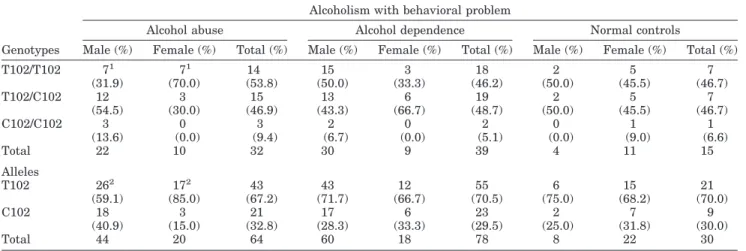
Table I shows the frequencies of genotypes and al-leles in the three study groups with behavioral prob-lems. The group of male alcohol abuse subjects with behavior problems was found to have lower frequencies of the genotype of homozygous T102 and to have higher frequencies of the genotype of homozygous C102 in con-trast with the male groups of both alcohol dependence and normal control. The difference in frequencies of homozygous T102 genotype between the other two genotypes (T/C and C/C) between the male and female alcohol abuse subjects was statistically significant (2
⳱ 4.072, df ⳱ 1, P < 0.05). The frequency of T102 was significantly lower in the male alcohol abuse subjects than in the female subjects with behavior problems (2
⳱ 4.187, df ⳱ 1, P < 0.05).
Table II shows that the frequency of T102 in the male alcohol abuse group without behavioral problems was 79.5% and this was significantly higher (2⳱ 4.328, df
⳱ 1, P < 0.05) than that of the group with behavioral problems (59.1%). In the female alcohol abuse subjects, the frequencies of allele T102 in the groups with and without behavioral problems were similar (85.0% vs. 73.3%).
DISCUSSION AND CONCLUSION
This study used 11 behavior problem symptoms to evaluate the behavior problems in childhood and ado-lescence. The presence of a behavior problem was de-fined as having at least three symptom items. This is an arbitrary criterion for definition of having behavior-al problems to indicate the tendency of having poor
TABLE I. Genotypes and Allele Frequencies of T/C 102 Polymorphism of the Receptor Gene of Serotonin Receptor 2A in Study Groups of Alcohol Abuse, Alcohol Dependence, and Normal Controls With Behavioral Problem
Alcoholism with behavioral problem
Genotypes
Alcohol abuse Alcohol dependence Normal controls
Male (%) Female (%) Total (%) Male (%) Female (%) Total (%) Male (%) Female (%) Total (%)
T102/T102 71 71 14 15 3 18 2 5 7 (31.9) (70.0) (53.8) (50.0) (33.3) (46.2) (50.0) (45.5) (46.7) T102/C102 12 3 15 13 6 19 2 5 7 (54.5) (30.0) (46.9) (43.3) (66.7) (48.7) (50.0) (45.5) (46.7) C102/C102 3 0 3 2 0 2 0 1 1 (13.6) (0.0) (9.4) (6.7) (0.0) (5.1) (0.0) (9.0) (6.6) Total 22 10 32 30 9 39 4 11 15 Alleles T102 262 172 43 43 12 55 6 15 21 (59.1) (85.0) (67.2) (71.7) (66.7) (70.5) (75.0) (68.2) (70.0) C102 18 3 21 17 6 23 2 7 9 (40.9) (15.0) (32.8) (28.3) (33.3) (29.5) (25.0) (31.8) (30.0) Total 44 20 64 60 18 78 8 22 30 1T102/T102 vs. (T102/C102 and C102/C102) by sex:2⳱ 4.072, df ⳱ 1, P < 0.05. 2(T102 vs. C102) by sex:2⳱ 4.187, df ⳱ 1, P < 0.05.
impulse control which might be related to serotonin dysregulation [Roy et al., 1990]. This study shows that there is a significant difference in the allele frequencies of T102 and C102 between male alcohol abuse subjects with and without behavioral problems. The polymor-phism of T/C 102 does not involve change in the amino acids of the protein. The best speculation for the sig-nificance of T/C polymorphism at the molecular biologi-cal level in male alcohol abuse may involve the affected translation through the secondary structure and the stability of the mRNA which, in turn, may decrease the functional activity of this receptor in male subjects and cause impulsive behaviors associated with alcohol abuse.
The study results emphasize that alcohol abuse de-fined by DSM-III is heterogeneous in nature and can be differentiated by gender and by the presence or ab-sence of behavior problems. Moreover, the significance of behavior problems in alcohol abuse and alcohol de-pendence was also different. The polymorphism of MAOA gene [Sullivan et al., 1990] was found to be associated with Type 2 alcoholism, mainly of alcohol dependence cases, defined by Cloninger et al. [1981]. These data support the idea that the diagnostic catego-ries of alcohol abuse and dependence are heteroge-neous nosologically. The location of the HTR2A is near the gene for esterase D [Hsieh et al., 1990], and it was found to be associated with alcoholism [Tanna et al., 1998]. However, this finding was not replicated in an-other study [Wesner et al., 1991]. This inconsistent finding might be due to different study samples. More-over, the inconsistent findings of the therapeutic effect of serotonergic medications [Lejoyeux, 1996; Garbutt et al., 1999] in alcoholism could also be explained by the heterogeneity of alcoholism. Future studies of this kind may have to consider the presence of behavior prob-lems and the different diagnostic categories of alcohol abuse and dependence.
REFERENCES
APA (American Psychiatric Association). 1980. Diagnostic and statistical manual, 3rd ed. Washington, DC: American Psychiatric Press. Arranz M, Collier D, Sodhi M, Ball D, Roberts G, Price J, Sham P, Kerwin
R. 1995. Association between clozapine response and allelic variation 5-HT2A receptor gene. Lancet 346:281–282.
Barbor TF, Hofmann M, Delboca FK, Hesselbrock V, Meyer RE, Dolinsky ZS, Rounsaville B. 1992. Types of alcoholism. I. Evidence for an em-pirically derived typology based on indicators of vulnerability and se-verity. Arch Gen Psychiatr 49:599–608.
Chen K, Yang W, Grimsby J, Shib JC. 1992. The human 5-HT2 receptor is encoded by a multiple intron-exon gene. Mol Brain Res 14:20–22. Cloninger CR, Bohman M, Sigvardsson S. 1981. Inheritance of alcohol
abuse: cross-fostering analysis of adopted men. Arch Gen Psychiatr 38:861–868.
Garbutt JC, West SL, Carey TS, Lohr KN, Crews FT. 1999. Pharmacologi-cal treatment of alcohol dependence: a review of the evidence. JAMA 281:1318–1325.
Hill EM, Stoltenberg SF, Burmeister M, Closser M, Zucker RA. 1999. Po-tential associations among genetic markers in the serotonergic system and the antisocial alcoholism subtype. Exp Clin Psychopharmacol 7: 103–121.
Hsieh CL, Bowcock AM, Farrer LA, Hebert JM, Huang KN, Cavalli-Storza LL, Julius D, Francke U. 1990. The serotonin receptor subtype 2 locus HTR2 is on human chromosome 13 near genes for esterase D and retinoblastoma-1 and on mouse chromosome 14. Somat Cell Mol Genet 16:567–574.
Hwu HG, Yeh EK, Chang LY, Chen CT, Chen CC, Chen TY. 1984. The Chinese modification of NIMH-Diagnostic Interview Schedule-reliability study on assessment of psychiatric symptoms. Psychol Test 31:15–26.
Hwu HG, Yeh EK, Chang LY. 1986. Chinese diagnostic interview schedule. I. Agreement with psychiatrist’s diagnosis. Acta Psychiatr Scand 73: 225–233.
Hwu HG, Chen CC, Yeh LL. 1992. A typology of alcoholism in Taiwan aborigines: a study on evolving process of community cases. Psychopa-thology 25:311–318.
Le Marquand D, Pihl RO, Benkelfat C. 1994. Serotonin and alcohol intake, abuse, and dependence: findings of animal studies. Biol Psychiatr 36: 395–421.
Lejoyeux M. 1996. Use of serotonin reuptake inhibitors in the treatment of alcoholism. Alcohol Alcohol 31(Suppl 1):69–75.
Lin LS, Hwu HG, Soong WT, Yeh LL, Chang C, Chang SH, Lin ST, Wang JD, Hsu MT, Chen CC. 1995. The establishment of an interview sched-ule for psychopathology of alcoholism: inter-rater reliability and pro-cedure validity. Chin Psychiatr 9:111–121.
Linnolia M, De Jong J, Virkkunen M. 1989. Family history of alcoholism in violent offenders and impulsive fire setters. Arch Gen Psychiatr 46: 613–616.
Maurel S, De Vry J, De Beun R, Schreiber R. 1999. 5-HT2Aand 5-HT2C/
5-HT1Breceptors are differentially involved in alcohol preference and
consummatory behavior in cAA rats. Psychopharm Biochem Behav 62: 89–96.
Meltzer HY. 1990. Role of serotonin in depression. Ann NY Acad Sci 600: 486–500.
Nakamura T, Matsushita S, Nishiguchi N, Kimura M, Yoshino A, Higuchi S. 1999. Association of a polymorphism of the 5HT2A receptor gene promoter region with alcohol dependence. Mol Psychiatr 4:85–88. Roy A, Virkkunen M, Linnoila M. 1990. Serotonin in suicide, violence and
alcoholism. In: Coccaro EF, Murphy DL, editors. Serotonin in major psychiatric disorders. Washington, DC: American Psychiatric Press. p 187–208.
Sambrook J, Fritsch EF, Maniatis T. 1989. Molecular cloning: a laboratory manual, 2nd ed. New York: Cold Spring Harbor Laboratory Press. p 914–919.
Schuckit MA, Mazzanti C, Smith TL, Ahmed U, Radel M, Iwata N, Gold-man D. 1999. Selective genotyping for the role of 5-HT2A, 5-HT2C, and GABAa6 receptors and the serotonin transporter in the level of re-sponse to alcohol: a pilot study. Biol Psychiatr 45:647–651.
TABLE II. Comparison of Genotype and Allele Frequencies of T/C 102 Polymorphism of the Receptor Gene of Serotonin Receptor 2A Between Study Groups With Behavior Problem (GWB) and Without Behavioral Problems (WOB) in Male and
Female Alcohol Abuse Cases Alcohol abuse Genotypes Males Females GWB(%) GOB(%) GWB(%) GOB(%) T102/T102 7 13 7 15 (31.9) (59.1) (70.0) (50.0) T102/C102 12 9 3 14 (54.5) (40.9) (30.3) (46.7) C102/C102 3 0 0 1 (13.6) (0.0) (0.0) (3.3) Total 22 22 10 30 Alleles T102 26 35 17 44 (59.1) (79.5) (85.0) (73.3) C102 18 9 3 16 (40.9)* (20.5)* (15.0) (26.7) Total 44 44 20 60 *2⳱ 4.328, df ⳱ 1, P < 0.05.
Sigvardsson S, Bohman M, Cloninger CR. 1996. Replication of the Stock-holm adoption study of alcoholism. Arch Gen Psychiatr 53:681– 687.
Sullivan JL, Baenziger JC, Wagner DL, Rauscher FP, Nurnberger JI Jr, Holmes JS. 1990. Platelet MAO in subtypes of alcoholism. Biol Psychi-atr 27:911–922.
Tanna VL, Wilson AF, Winokur G, Elston RC. 1988. Possible linkage be-tween alcoholism and esterase D. J Study Alcohol 4:472–476.
Virkkunen M, Linnoila M. 1997. Serotonin in early-onset alcoholism. Re-cent Dev Alcohol 13:173–189.
Warren JT Jr, Peacock ML, Rodriguez LC, Fink JK. 1993. An MspI poly-morphism in the human serotonin receptor gene (HTR2A): detection by DGGE and RFLP analysis. Hum Mol Genet 2:338.
Wesner RB, Tanna VL, Palmer PJ, Thompson RJ, Growe RR, Wonokor G. 1991. Close linkage of esterase-D to unipolar depression and alcoholism is ruled out in eight pedigree. J Study Alcohol 52:609–612.