Characterization of Zr-Doped TiO
2Nanocrystals Prepared by a Nonhydrolytic
Sol-Gel Method at High Temperatures
Sue-min Chang*,†and Ruey-an Doong‡Institute of EnVironmental Engineering, National Chiao Tung UniVersity, 75, Po Ai Street, Hsinchu, 30068, Taiwan, and Department of Biomedical Engineering and EnVironmental Sciences, National Tsing Hua UniVersity, 101, Sec 2, Kuang Fu Road, Hsinchu, 30013, Taiwan
ReceiVed: May 1, 2006; In Final Form: August 11, 2006
Highly crystalline and surface-modified Zr-doped TiO2 nanorods were successfully prepared using a
nonhydrolytic sol-gel method that involves the condensation of metal halides with alkoxides in anhydrous trioctylphosphine oxide (TOPO) at either 320 or 400°C. In addition, the interaction of the cross-condensation between the Ti and Zr species was studied by characterizing the morphologies, crystalline structures, chemical compositions, surface properties, and band gaps of the nanocrystals obtained at different reaction temperatures and Zr-to-Ti stoichiometric ratios. Increases in the concentration of Zr4+and in the reaction temperature led
to large nanorods and regular shapes, respectively. In addition, only the anatase form was observed in the Zr-doped TiO2nanorods. The Zr-to-Ti ratios obtained ranged from 0.01 to 2.05, all of which were far below
the stoichiometric ratios used during the preparation of the samples (0.25-4). Moreover, the Zr4+ units
accumulated mainly at the surface of the TiO2nanocrystals. The band gaps of the Zr-doped TiO2nanorods
ranged from 2.8 to 3.8 eV, which are smaller than those of pure TiO2(3.7 eV) or ZrO2(5.2 eV). The
Zr-doped anatase TiO2nanorods prepared at 400°C at an initial stoichiometric Zr-to-Ti ratio of 2:3 exhibited
the highest photoactivities for the decomposition of rhodamine B because of the presence of trace amounts of Zr4+(Zr/Ti ) 0.03) in the TiO
2and the regular shapes of these particles. DSC analysis indicated that the
temperatures for forming nanocrystalline TiO2and ZrO2were 207 and 340°C, respectively. Moreover, the
reactivities of condensation between the Ti species were reduced when Zr species were involved in the NHSG reactions. The results obtained in this study clearly demonstrate that the faster kinetics for the generation of TiO2 controls the material properties as well as the photoactivities of the nonhydrolytic sol-gel-derived
nanocrystals.
Introduction
Titanium dioxide (TiO2) is one of the most widely used
photocatalysts because of its suitable band gap (ca. 3.2 eV), chemical stability, and nontoxicity.1 In addition, zirconium
dioxide (ZrO2), which has a wide band gap (ca. 5.0 eV) and
more-negative (-1.0 V vs NHE) and more-positive (4.0 V vs NHE) reducing potentials in its conduction and valence bands, respectively, relative to those of TiO2, is considered as a
promising alternative photocatalyst for the degradation of a greater variety of pollutants.2-5It has been demonstrated that
incorporating Zr4+into TiO
2to form ZrxTi1-xO2can introduce
lattice defects and lead to higher photoactivities than those of the pure oxides. The introduced defects not only reduce the band gaps, i.e., increase the wavelength of the activation light, but also play a role as charge-trapping centers in inhibiting charge recombination.6 Although the presence of a few defects
improves the photoactivities of ZrxTi1-xO2systems, an excess
of defects promotes charge recombination and decreases cata-lytic efficiency. The number of defects is dependent on the size, crystalline structure, and Zr-to-Ti ratio of the photocatalyst.7-9
Nanosize photocatalysts have large surface areas and sufficient numbers of surface defects to exhibit high catalytic efficiencies.
In addition, anatase TiO2and tetragonal ZrO2contain oxygen
vacancies and exhibit higher catalytic performances than their other crystalline forms.7,10-12Therefore, the preparation and
characterization of nanosize, highly crystalline anatase and tetragonal ZrxTi1-xO2photocatalysts continues to attract a high
degree of attention.
The sol-gel method is a simple and feasible process for the fabrication of nanocomposite oxides with tailored sizes. Con-ventionally, the sol-gel method uses a hydrolytic route that involves initial hydrolysis of the precursors and subsequent continuous condensation between the hydrolyzed precursors to form oxide gels. The hydrolytic sol-gel (HSG) route to metal oxides proceeds very efficiently at room temperature. In addi-tion, nanoparticulates can be prepared through a combination of water-in-oil emulsion and sol-gel processing. Because the as-prepared oxides are usually amorphous, they must be calcined at high temperature for crystallization. Unfortunately, calcination results in the coalescence of particles, which increases the size and decreases the surface area of the photocatalysts.13
The nonhydrolytic sol-gel (NHSG) route is an alternative pathway for the preparation of metal oxides. In contrast to the HSG route, the NHSG route involves the reaction of metal halides with oxygen donors, such as metal alkoxides, alcohols, or ethers, under nonaqueous conditions.14Several studies have
investigated the nonhydrolytic sol-gel route to pure oxides and binary oxides including TiO2, ZrTiO4, SiTiO4, and SiZrO4.15-17 * Corresponding author. E-mail: [email protected]. Tel.:
+886-3-5712121 ext. 55506.
†National Chiao Tung University. ‡National Tsing Hua University.
10.1021/jp0626566 CCC: $33.50 © 2006 American Chemical Society Published on Web 09/07/2006
Because the NHSG process is relatively slower than the HSG approach, it usually requires temperatures exceeding 80 °C. Moreover, the lower reactivity makes the morphologies and microstructures of NHSG-derived metal oxides more control-lable. Trentler et al.18 prepared anatase TiO
2 nanocrystals
through the injection of titanium alkoxides into titanium iso-propoxide/heptadecane solutions in the presence of trioctylphos-phine oxide (TOPO) at 300°C. These TiO2crystals had average
sizes of 3.8-9.2 nm, depending on the type of the metal halide and the concentration of TOPO. Moreover, these TiO2
nano-particles exhibited no surface hydroxyl groups because of the coordination of the surface titanium atom to TOPO. Subse-quently, Joo et al.19 reported that condensation between
zir-conium halides and zirzir-conium isopropoxide at 340°C in pure TOPO results in monodisperse, uniformly sized tetragonal ZrO2
nanoparticles (ca. 4 nm). In addition to pure metal oxides, binary metal oxides can also be prepared through cross-condensation between different metal halide and alkoxides. Tang et al.20
adapted a process similar to that of Joo et al. to prepare monodisperse HfxZr1-xO2 nanocrystals. Solid solutions with
various concentrations were obtained after nonhydrolytic cross-condensations using different stoichiometric amounts of hafnium halides and zirconium alkoxides had been performed. In addition, the morphologies and crystalline phases within these solid solutions were controllable by modifying the reaction temperature and the combination of metal halide and alkoxide. Unfortunately, ZrTiO4solid solutions could not be formed using
this method. This phenomenon is different from that of ZrTiO4,
for which the desired Zr-to-Ti ratios can be controlled by the initial metallic ratios in the solutions when the similar elimina-tion of alkyl halides is conducted at low temperatures (110°C).17
In any event, the interaction between the Zr/Ti halides and alkoxides in the presence of TOPO at high temperatures has yet to be addressed adequately. In addition, the detailed quanti-fication of the Zr-to-Ti ratios, microstructures, electronic struc-tures, surface properties, and photoactivities of the ZrxTi1-xO2
nanocrystals resulting from various combinations of Zr and Ti species remain unclear.
In this study, we synthesized and characterized Zr-doped TiO2
nanocrystals using an NHSG method conducted at 320 or 400 °C in liquid TOPO. Titanium chloride (TiCl4) and zirconium
chloride (ZrCl4) were used as the precursors for TiO2and ZrO2,
respectively, and titanium isopropoxide and zirconium iso-propoxide were used as the oxygen donors. To understand explicitly the chemistry of the cross-condensation leading to the Zr-doped TiO2 nanocrystals, we examined the material
propertiessincluding particle sizes, shapes, crystalline phases, surface compositions, surface properties, and optical propertiess of the products prepared at various stoichiometric Zr-to-Ti ratios and reaction temperatures. Moreover, we investigated the photocatalytic activities of the Zr-doped TiO2samples toward
the degradation of rhodamine B (RhB) and elucidated how they relate to the material properties.
Experimental Section
NHSG-Derived Nanocrystals. Titanium dioxide (TiO2)
nanocrystals were prepared by condensation between titanium chloride (TiCl4, Fluka, 99%) and Ti(OC3H7)4(Aldrich, 99.9%),
whereas zirconium dioxide (ZrO2) nanocrystals were fabricated
by zirconium chloride (ZrCl4, Strem Chemicals, 99.5%) and
zirconium isopropoxide propanol complex [Zr(OC3H7)4-(CH3)2
-CHOH, Aldrich, 99.9%]. Titanium chloride (0.5 g, 2.5 mmol) and Ti(OC3H7)4(0.6 g, 2.0 mmol) were first dissolved in TOPO
(5.2 g, 13.5 mmol) at 150°C under N2atmosphere. This
well-mixed solution was then heated to 320°C and underwent the condensation reaction at this temperature for 3 h with vigorous stirring at 500 rpm. Afterward, the solution was cooled to 60 °C, and acetone was added to precipitate TiO2 nanocrystals.
The precipitate was harvested by centrifugation at 11000 rpm and washed with acetone several times to remove excess TOPO. For ZrO2preparation, 0.6 g of ZrCl4(2.5 mmol) and 0.8 g of
Zr(OC3H7)4-(CH3)2CHOH (2.0 mmol) were dissolved in 8.0 g
of TOPO (21 mmol). The ratio of metal chloride to alkoxide is similar to that used by Joo et al.,19which means that the metal
chloride was in excess. In contrast to TiO2, ZrO2particles were
produced only when the temperature rose to 400 °C. For the synthesis of Zr-doped TiO2nanocrystals, various molar ratios
of M(OiPr)
4and M′Cl4(M and M′represent Ti and/or Zr) were
used. The samples are denoted as ZrxTi1-xO2-t, where x
represents the reactants in the ratio of Zr/(Zr + Ti) and t denotes the reaction temperature. The nonhydrolytic reaction was carried out at 320 or 400°C when x was smaller than 0.5 and 400°C for x larger than 0.5. All recipes and reaction conditions are summarized in Table 1. Unless otherwise mentioned, all of the NHSG reactions were conducted in hot trioctylphosphine oxide (TOPO, Strem Chemicals, 99%) liquid and under N2
atmo-sphere.
Characterization. The thermal behaviors of the NHSG reac-tions were investigated by differential scanning calorimetry (DSC, Setaram Labsys DSC 131) under a N2flow of 20 mL/
min and at a heating rate of 10°C/min from 25 to 550°C. The samples for DSC were prepared by dissolving the reactants in TOPO at 150 °C and then cooling the mixture to room tem-perature under N2atmosphere. The TiCl4/Ti(OiPr)4/TOPO
mix-ture was a viscous yellow liquid, and the ZrCl4/Zr(OiPr)4/TOPO
mixture was an opaque white solid. The particle sizes and shapes of the NHSG-derived nanocrystals were characterized by high-resolution transmission electron microscopy (HRTEM, JEOL JEM-4000EX) at an accelerating voltage of 400 kV. The crys-talline properties of the nanocrystals were identified by X-ray diffractometry (XRD, Rigaku) using Cu KR radiation (λ ) 1.5405 Å) and operating at an accelerating voltage of 30 kV and an emission current of 20 mA. The X-ray diffraction patterns TABLE 1: Metal Halides, Oxygen Donors, and Reaction Temperatures Used for the Synthesis of ZrxTi1-xO2
Nanoparticles sample
metal halide
(2.5 mmol) oxygen donor(s)
TOPO (mmol)
temp (°C) TiO2-320 TiCl4 Ti(OC3H7)4(2.0 mmol) 13.5 320 Zr0.2Ti0.8O2-320 TiCl4 Ti(OC3H7)4(1.0 mmol),
Zr(OC3H7)4‚ (CH3)2CHOH (1.0 mmol) 13.5 320 Zr0.4Ti0.6O2-320 TiCl4 Zr(OC3H7)4‚ (CH3)2CHOH (2.0 mmol) 13.5 320
Zr0.2Ti0.8O2-400 TiCl4 Ti(OC3H7)4(1.0 mmol), Zr(OC3H7)4‚ (CH3)2CHOH (1.0 mmol) 13.5 400 Zr0.4Ti0.6O2-400 TiCl4 Zr(OC3H7)4‚ (CH3)2CHOH (2.0 mmol) 13.5 400 Zr0.6Ti0.4O2-400 ZrCl4 Ti(OC3H7)4(2.0 mmol) 21 400 Zr0.8Ti0.2O2-400 ZrCl4 Ti(OC3H7)4(1.0 mmol), Zr(OC3H7)4‚ (CH3)2CHOH (1.0 mmol) 21 400 ZrO2-400 ZrCl4 Zr(OC3H7)4‚ (CH3)2CHOH (2.0 mmol) 21 400 2
were acquired over the 2θ range from 20°to 90°at a sampling width of 0.02°and a scanning speed of 4°/min. The elemental compositions (Zr/Ti) of the binary metal oxides were analyzed by inductively coupled plasma-mass spectrometry (ICP-MS, Perkin-Elmer, SCIEX ELAN 5000). The surface chemical compositions of the nanocrystals were examined by X-ray photoelectron spectroscopy (XPS, Physical Electronics, ESCA PHI 1600) using an Al KR X-ray source (1486.6 eV). The photoelectrons were collected into the analyzer with a 23.5 eV passing energy. The collection step was 1.0 eV for the wide-range scan and 0.1 eV for high-resolution analysis in selected energy intervals. All analytical processes were carried out under ultrahigh vacuum conditions with the pressure maintained below 1.4× 10⁻⁹Torr. The shifts of the photoelectron peaks in the XPS spectra resulting from charging effects were referenced to the O(1s) line taken as 530.2 eV. The surface elemental ratios were estimated from the integrated peak areas of the elements and normalized to their sensitivity factors. The functional groups of the nanoparticles were identified by Fourier transform infrared spectrometry (FTIR, Horiba) scanning from 400 to 4000 cm-1 with a resolution of 4 cm-1 for 100 scans. Samples for FTIR measurements were well-mixed with KBr and then pressed as pellets. The optical properties and band gaps of the nanoparticles were determined by UV-vis spectrophotometry (Hitachi 3010) scanning from 800 to 190 nm using the absorption of hexane as the reference. Samples for the UV-vis measurements were well-dispersed in hexane in a quartz cuvette with an optical length of 10 mm.
Photocatalytic Activities. Rhodamine B (RhB) was selected as the target compound to examine the photoactivity of the NHSG-derived ZrxTi1-xO2materials. The nanocrystalline
cata-lysts were suspended in RhB solutions (0.05 mM) to give a final concentration of 1 g/L in the dark. Prior to illumination, the solutions were purged with O2 in the dark for 30 min to
ensure equilibrium among the catalysts, RhB, and oxygen. Thereafter, the solutions were kept under constant O2equlibrium
condition during photocatalysis. Photocatalysis was carried out in a fused-silica tube irradiated by UV light at a wavelength of 305 nm. The decolored solutions were analyzed by UV-vis spectrophotometer scanning from 700 to 400 nm.
Results and Discussion
Chemical Compositions. To examine the chemical states of the Ti and Zr species after the nonhydrolytic sol-gel reaction, the NHSG-derived samples were analyzed using XPS (see Supporting Information, Figure S1). The binding energy of Zr(3d5/2) centered at 182.3 eV in the ZrO2spectrum, and that
of Ti(2p3/2) was at 459.0 eV in the TiO2spectrum. Similarly to
pure TiO2 and ZrO2, Zr(3d5/2) and Ti(2p3/2) in ZrxTi1-xO2
nanocrystals exhibited binding energies in the ranges 182.3-182.5 and 458.7-459.0 eV, respectively. These values are in good agreement with the reported values for TiO2, ZrO2, and
ZrTiO4,21which indicates the formation of TisO and ZrsO
bonds in the samples via the nonhydrolytic reactions. Table 2 lists the actual Zr-to-Ti ratios of the ZrxTi1-xO2nanocrystals as
analyzed using both ICP-MS and XPS. The Zr-to-Ti ratios of the binary oxides determined by ICP-MS ranged from 0.01 to 2.05, whereas a range of 0.02-2.29 was obtained through XPS analysis. It is noted that ICP-MS is an instrumental method that can determine the total concentrations of elements in ZrxTi1-xO2
nanocrystals suspended in solution, whereas XPS is usually employed for the analysis of chemical species on the surfaces of nanocrystals. The similar Zr-to-Ti ratios obtained in these two methods reveal that most of the Zr4+ions accumulated in
the surface layer of the nanocrystals. When the value of x was greater than 0.5, the actual Zr-to-Ti ratios in the nanocrystals increased with increasing content of Zr in the reaction mixture. No such trend occurred, however, when the value of x was below 0.5. The similar Zr-to-Ti ratios (0.01-0.05) in the Zr0.2
-Ti0.8O2and Zr0.4Ti0.6O2samples prepared at 320 and 400 °C
indicate that increasing temperature had little effect on the degree of incorporation of Zr into the TiO2lattice.
Regardless of the initial Zr-to-Ti ratio used for the synthesis of the binary oxides, the final Zr-to-Ti ratios in the products were always much smaller than the theoretical stoichiometry. This phenomenon is attributed to the different kinetics of condensation between Ti and Zr species. Actually, the formation of TiO2 through the condensation of TiCl4 with Ti(OC3H7)4
occurs at 320°C, but a higher temperature (400°C) is required for the preparation of ZrO2. Because the actual compositions
of ZrxTi1-xO2are different from the stoichiometric values, we
use the actual ratios based on ICP-MS results for further discussion.
Heat Flows during NHSG Reactions. To understand the different dynamic properties of the NHSG reactions that form TiO2, ZrO2, and ZrxTi1-xO2, we used DSC to examine the heat
flows of these reactions. Figure 1 displays the heat flows of the NHSG reactions forming TiO2, ZrO2, and Zr0.25Ti0.75O2-400 in
the presence of TOPO. The NHSG reaction leading to TiO2
exhibited two endothermic peaks in the temperature range from 180 to 270 °C. The endothermic peak centered at 207 °C is ascribed to the condensation between tTisCl and tTis (OC3H7), and the peak ranging between 218 and 270 °C is
attributed to the halide/titanyl exchange. This exchange results in the breaking and reforming of TisO bonds, which is consid-ered to be necessary for the crystallization of TiO2.18The DSC
trace for the NHSG reaction leading to ZrO2 exhibited two
Figure 1. DSC curves of the NHSG reactions leading to TiO2(solid line), ZrO2(dashed line), and Zr0.25Ti0.75O2(dashed-dotted line) in the presence of TOPO.
TABLE 2: Zr-to-Ti Molar Ratios and Actual Compositions of the Binary Oxide Nanoparticles
Zr-to-Ti molar ratioa
ZrxTi1-xO2nanocrystals ICP-MS XPS actual composition
Zr0.2Ti0.8O2-320 0.03 b Zr0.03Ti0.97O2-320 Zr0.4Ti0.6O2-320 0.05 0.02 Zr0.05Ti0.95O2-320 Zr0.2Ti0.8O2-400 0.01 b Zr0.01Ti0.99O2-400 Zr0.4Ti0.6O2-400 0.03 0.05 Zr0.03Ti0.97O2-400 Zr0.6Ti0.4O2-400 0.34 0.33 Zr0.25Ti0.75O2-400 Zr0.8Ti0.2O2-400 2.05 2.29 Zr0.67Ti0.33O2-400
aMolar ratios were determined by ICP-MS and XPS.bDetection of Zr was not possible.
significant endothermic peaks centered at 51 and 340°C, which are attributed to the liquefaction of the ZrCl4/Zr(OiPr)4/TOPO
complex and the condensation of tZrsCl with tZrs(OC3H7),
respectively. The DSC results clearly indicate that the temper-atures for the formation of TiO2nanocrystals (207°C) are lower
than those required for the generation of NHSG-derived ZrO2
(340 °C), which means the the condensation reactivity of Ti species is higher than that of Zr species.
To understand the interaction between the Ti and Zr species, the DSC curve of Zr0.25Ti0.75O2was further examined. Similarly
to ZrO2, Zr0.25Ti0.75O2 exhibited endothermic melting of the
TOPO complex at 65 °C. However, the endothermic melting process was not obvious in the DSC curve of TiO2. This is
mainly attributed to the fact that TiCl4/Ti(OiPr)4/TOPO mixture
is a viscous liquid, whereas the ZrCl4/Zr(OiPr)4/TOPO and
ZrCl4/Ti(OiPr)4/TOPO mixtures are solids at room temperature.
The Zr0.25Ti0.75O2 sample exhibited an endothermic peak of
condensation centered at 300°C. Because the elemental analysis showed that TiO2is the dominant component in Zr0.25Ti0.75O2,
this condensation mainly occurs between tTisCl and tTis (OiPr), which result from ligand exchange between tTis(Oi
-Pr) and tZrsCl at low temperatures. Ligand exchange between metal chlorides and metal alkoxides has been demonstrated to produce metal chloroalkoxides, and thus homogeneous as well as heterogeneous condensations can occur.17It is noted that the
temperature for condensation between the Ti species for Zr0.25
-Ti0.75O2(300°C) was higher than that for TiO2(207°C), which
suggests that the Ti species in the Zr0.25Ti0.75O2 precursor
solution is different from that in the TiO2precursor solution.
Arnal et al.16reported that metal chloroalkoxides are present in
oligomeric structures because of the formation of alkoxo bridges. In this study, titanium zirconium chloroalkoxide oligomers could be produced in the Zr0.25Ti0.75O2precursor solution after ligand
exchange. Compared to the pure titanium chloroalkoxide isomers, the Ti species have a lower reactivity to condense with each other to form TisOsTi bonds when Zr species coexist with Ti species.
The endothermic peak for Zr0.25Ti0.75O2appearing at 334°C
in the DCS curve can be assigned to the formation of ZrsOs Ti bonds through cross-condensation. This cross-condensation is responsible for the incorporation of Zr into the TiO2lattice.
However, the low Zr-to-Ti ratios reveal that the formation of ZrxTi1-xO2 nanocrystals is kinetically controlled because the
temperature required for the formation of TiO2is lower than
that for the formation of binary oxides. The relatively rapid formation of TiO2 nanocrystals results in the inefficient
condensation of Zr species during a dynamic equilibrium. The Zr components were lost either because the reaction temperature (320°C) was too low to form ZrO2or because the ZrO2particles
that formed were too small to be recovered through centrifuga-tion at 11000 rpm at 400°C. In contrast to the ineffective incor-poration of Zr into TiO2in this study, Vioux et al.17reported
that amorphous zirconium titanate gels with Zr-to-Ti ratios equal to those of the initial solutions were obtained using a similar cross-condensation process at 110°C. In addition, the temper-ature of condensation between TisCl and TisOiPr was reported
to be 100°C,16 which is lower than the temperature for the
condensation of pure TiO2(207°C) obtained in this study. This
discrepancy is due to the fact that TOPO modifies the thermo-dynamic properties and kinetics of the nonhydrolytic sol-gel reactions by forming Lewis adducts with the precursors.
Microstructures. To identify the effect of the preparation conditions on the microstructures of Zr-doped TiO2, the
NHSG-derived ZrxTi1-xO2samples were further analyzed using
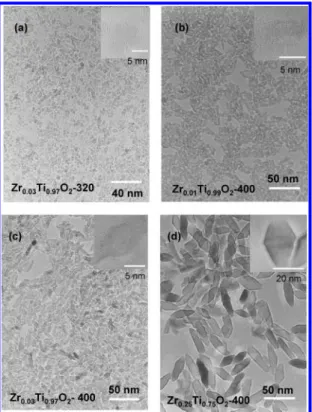
HR-TEM and XRD. Figure 2 shows HRHR-TEM images of Zr0.03
-Ti0.97O2-320, Zr0.01Ti0.99O2-400, Zr0.03Ti0.97O2-400, and Zr0.25
-Ti0.75O2-400 nanocrystals. The HRTEM images indicate that
the NHSG-derived TiO2and ZrO2nanocrystals were almost
spherical, except for a few that have irregular shapes as a result of aggregation (see Supporting Information, Figure S2). The sizes of the TiO2and ZrO2 particles, as observed from
low-magnification TEM images, were ca. 4.5 and 3.0 nm, respec-tively. Highly crystalline structures and single crystallinity were observed for both the TiO2 and ZrO2 particles in
high-magnification TEM images. Because TOPO plays the role of a capping agent that isolates the NHSG-derived nanocrystals, these relatively small ZrO2nanocrystals arose from the lower
metal-to-TOPO ratio that we used in these NHSG reactions. The Zr0.03Ti0.97O2nanocrystals prepared at 320°C exhibited
irregular shapes and a wide size distribution. A similar phenom-enon was also observed for Zr0.05Ti0.95O2-320 (see Supporting
Information, Figure S2). The sizes and shapes became more uniform when the reaction temperature rose to 400 °C. The Zr0.03Ti0.97O2-400 and Zr0.25Ti0.75O2-400 nanoparticles became
faceted nanorods at 400°C (Figure 2c,d). The lengths and widths of the Zr0.03Ti0.97O2-400 nanorods were of ca. 15.0 and 8.0 nm,
respectively, whereas the corresponding dimensions of the Zr0.25
-Ti0.75O2-400 nanorods were ca. 30.0 and 14.0 nm, respectively.
The high-magnification HRTEM images showed that the nanorods existed in a single crystalline domain but contained a considerable number of defects on their edges. In addition, the Zr0.25Ti0.75O2-400 nanorods were covered with a thin layer of
amorphous material. A similar amorphous structure was domi-nant in the Zr0.67Ti0.33O2-400 sample.
Figure 3 displays the XRD patterns of TiO2, ZrO2, and
ZrxTi1-xO2samples with various values of x. The TiO2and ZrO2
particles obtained crystallized in the anatase and tetragonal forms, respectively, without further calcination. In addition, the Zr0.03Ti0.97O2-320, Zr0.05Ti0.95O2-320, Zr0.01Ti0.99O2-400, Zr0.03
-Ti0.97O2-400, and Zr0.25Ti0.75O2-400 samples exhibited only
Figure 2. HRTEM images of NHSG-derived nanocrystals: (a) Zr 0.03-Ti0.97O2-320, (b) Zr0.01Ti0.99O2-400, (c) Zr0.03Ti0.97O2-400, (d) Zr0.25-Ti0.75O2-400.
anatase structures, and no ZrO2or ZrTiO4diffraction peaks were
identified, even though substantial amounts of Zr reactants had been added to participate in the nonhydrolytic reactions. This result is mainly due to the fact that the Zr4+ions serve only as
dopants in the TiO2matrix. Moreover, the diffraction peak of
the (101)aprofile of Zr0.25Ti0.75O2-400 shifted slightly to a lower
value of 2θ when compared to that of the pure TiO2
nanocrys-tals, revealing that the Zr4+ions, with a larger ionic radius (0.79
Å) than Ti4+(0.68 Å), were incorporated into the TiO 2lattice
to form dilute ZrxTi1-xO2solid solutions. The XRD results show
the poor crystallinity of the Zr0.67Ti0.33O2-400 sample, which is
in agreement with the observation of the amorphous structure in its HRTEM image. The Zr-to-Ti ratio of 2.05 in the Zr0.67
-Ti0.33O2-400 sample clearly indicates that substantial amounts
of TiO2are present in the ZrO2matrix. These results suggest
that higher temperatures are required for crystallization of the binary oxide solutions than for crystallization of pure TiO2and
ZrO2in the nonhydrolytic sol-gel reactions. Vioux et al.17found
that an NHSG-derived ZrTiO4sample crystallized at 700°C.
The high temperatures required for crystallized ZrxTi1-xO2solid
solutions at high Zr concentrations probably arise because the anatase TiO2and tetragonal ZrO2structures are not compatible
with each other. The anatase Zr0.25Ti0.75O2-400 nanocrystals
contained amorphous structures at their edges. It has been previously demonstrated that the solubility of Zr4+units in
sol-gel-derived anatase TiO2is below the Zr-to-Ti ratio of 0.075.22
The excess Zr4+ions (i.e., 0.34 > 0.075) in the Zr
0.25Ti0.75O2
-400 sample would primarily accumulate at the surface of the anatase TiO2nanocrystals because of slow condensation
involv-ing the Zr species and segregation of the Zr4+ions to maintain
phase stability. Therefore, the amorphous material at the edges of the Zr0.25Ti0.75O2-400 nanorods presumably comprises
cross-linked Zr and Ti binary oxides that are unable to crystallize in this nonhydrolytic sol-gel reaction.
The average crystallite sizes of anatase TiO2and tetragonal
ZrO2, calculated using Scherrer’s equation from the broadening
of diffraction peaks of the (101)aand (101)tprofiles, were 4.6
and 3.0 nm, respectively. These values are close to the particle sizes observed in the TEM images. Because of the single crystallinity of the NHSG-derived nanocrystals, the size distri-butions and variations were examined from the TEM images. The TiO2and ZrO2nanoparticle sizes have uncertainties of (1.0
and (0.9 nm, respectively. The crystallite sizes of the Zr0.03
-Ti0.97O2-320 and Zr0.05Ti0.95O2-320 samples were 5.2 ( 1.4 and
6.7 ( 2.5 nm, respectively; i.e., an increased Zr-to-Ti ratio increased the crystallite sizes. In addition, both the crystallite sizes and the size distributions of the Zr0.01Ti0.99O2-400 (5.6 (
1.0 nm) and Zr0.03Ti0.97O2-400 (7.7 ( 1.9 nm) samples were
larger than those obtained at 320°C, indicating that increasing
reaction temperature makes the crystallite sizes larger and more uniform. The Zr0.25Ti0.75O2-400 sample exhibited the largest
crystallite size of 12.6 ( 2.5 nm because it was prepared at a high Zr-to-Ti ratio and reaction temperature.
The TEM observations and XRD results reveal that the initial Zr-to-Ti ratio and reaction temperature affect the sizes and shapes of the NHSG-derived ZrxTi1-xO2nanocrystals. The initial
Zr-to-Ti ratio affects the morphology of the ZrxTi1-xO2samples
by affecting the condensation rate. It has been suggested that the rate of alkyl halide elimination governs the nucleation and growth of nanocrystals.18In this study, because the presence of
Zr species retarded the formation of TiO2, the sizes of the
nanocrystals increased as the Zr-to-Ti ratio increased. In addition to the crystallite sizes, the different reactivities between Ti and Zr species also play the crucial role in the shapes and size distributions of the NHSG-derived nanocrystals. At 320°C, the growth of TiO2nanocrystals is inhibited at the end where the
Ti species are hybridized with less-reactive Zr species, thus resulting in the irregular shape of Zr-doped TiO2. However, this
low reactivity can be kinetically promoted by increasing the reaction temperature. Trentler et al.18suggested that the
forma-tion and breaking of TisO bonds at elevated temperatures helps to erase the defects and, hence, result in more-crystalline structures. In this study, increasing temperature encourages the rearrangement of Ti and O atoms, leading to the elimination of the defects caused by Zr4+and the formation of regularly shaped
nanocrystals. This phenomenon was not observed when a similar reaction protocol was used for the preparation of HfxZr1-xO2
nanoparticles.20This discrepancy might be due to the fact that
Zr and Hf species have similar reactivities, whereas the Ti species have a higher reactivity than the Zr species in the nonhydrolytic sol-gel reactions.
Surface Properties. In contrast to the hydrophilic surfaces of the metal oxides obtained using the conventional HSG method, the surfaces of the metal oxides obtained in this study were hydrophobic. The nanocrystals were readily soluble in hexane, but they were difficult to suspend in water. The XPS results indicate the existence of substantial amounts of carbon and small amounts of phosphorus on the surfaces of the nanocrystals, suggesting that some TOPO residues existed on the surface of the metal oxides (see Supporting Information, Figure S3). The C-to-P molar ratio ranged between 18 and 20, which is lower than that expected for TOPO (C/P ) 24). In addition, the O*-to-P ratios (where O*denotes oxygen atoms
other than MsO atoms) were in the range 2-3, which is larger than the intrinsic value (O/P ) 1) expected for TOPO (see Supporting Information, Table 1S). These results imply that the TOPO molecules were decomposed during the high-temperature reactions. To investigate the interactions between TOPO and the nanocrystals, we used FTIR spectroscopy to further char-acterize the functional groups present on the surfaces of the nanocrystals. Figure 4 displays the FTIR spectra of TOPO, the as-prepared nanocrystals, and the nanocrystals obtained after photocatalysis. The spectrum of TOPO exhibited a significant absorption at 1146 cm-1that was due to PdO stretching. The corresponding most intense absorptions for the TiO2and ZrO2
nanocrystals appeared at 1065 cm-1. The shift from 1146 to 1065 cm-1indicates that the PdO groups were chelated to the surface Zr4+or Ti4+centers. Figure 5 presents a cartoon
illus-tration of the surface structure of an NHSG-derived nanocrystal based on the XPS and FTIR spectroscopic data. The surfaces of the nanocrystals are covered by TOPO units, which are chem-ically bonded to the surface through chelation of the PdO oxygen atoms or through defunctionalization of the PdO groups Figure 3. XRD patterns of TiO2, ZrO2, and ZrxTi1-xO2nanocrystals.
to form new PsOsM bonds. After photocatalysis, the intensity of the signal for TOPO decreased, implying that a certain amount of TOPO decomposed during photocatalysis. The P-to-Ti and C-to-P elemental ratios of the NHSG-derived P-to-TiO2before
and after photocatalysis were further analyzed by XPS. The P-to-Ti ratio remained at a similar value (2.01), whereas the C-to-P ratio decreased from 19.1 to 11.1 after photocatalysis. These XPS and IR results reveal that photocatalysis causes the decomposition of the surface TOPO through the removal of organic parts and the transformation of PdO functional groups to other phosphorus species.
Optical Properties. The band gaps and quantum effects on the optical properties of the nanocrystals were determined by UV-vis spectrophotometry. Figure 6 presents the UV-vis spectra of the TiO2, ZO2, and ZrxTi1-xO2nanocrystals suspended
in hexane. The TiO2nanocrystals showed a steep increase in
their absorptions at wavelengths below 333 nm, and the ZrO2
nanocrystals exhibited significant absorptions at wavelengths below 234 nm. The band gaps of the pure TiO2 and ZrO2
nanocrystals, derived from the onsets of these significant absorptions, were 3.7 and 5.3 eV, respectively, which are larger than those of bulk TiO2(3.2 eV) and ZrO2(5.0 eV).1,23This
phenomenon indicates that quantum effects occurred and that the nanocrystals obtained were quantum-sized. The anatase Zr-doped TiO2 crystals exhibited absorptions that extended to
longer wavelengths. The band gaps of the Zr-doped TiO2
crystals ranged between 2.8 and 3.6 eV, i.e., they were smaller than those of pure TiO2or ZrO2nanocrystals. Presumably, these
red shifts and reduced band gaps resulted either from defects caused by trace amounts of Zr4+ in the TiO
2 lattice or from
increased crystal domains. We note that the Zr0.25Ti0.75O2-400
sample exhibited marked absorptions up to 600 nm. This extrinsic band gap absorption of Zr0.25Ti0.75O2-400 is attributed
to the accumulation of substantial amounts of Zr4+at the surface
of the TiO2 anatase crystals. A similar effect occurred for
amorphous Zr0.67Ti0.33O2-400, which contained mainly ZrO2
with TiO2in a comparative amount (Zr/Ti ) 2.1) and exhibited
a band gap of 3.8 eV. Large amounts of Ti4+in the ZrO 2matrix
not only inhibited the crystallization of ZrO2but also greatly
reduced the band gap of ZrO2from 5.3 to 3.8 eV.
Photoactivities of the NHSG-Derived Nanocrystals. We examined the photoactivities of the NHSG-derived nanocrystals by considering the decoloration of RhB monitored at 554 nm. Figure 7 shows the change in RhB concentration as a function of irradiation time. In the absence of a photocatalyst, RhB was stable when illuminated with UV light at 305 nm. The rapid degradation of RhB in the presence of the prepared nanocrystals indicates that each of the TOPO-capped photocatalysts exhibited photoactivity. Although the band transitions of ZrO2
nanocrys-tals occur below 234 nm, electron transitions between the defect levels and bands result in the ZrO2nanocrystals having
photo-catalytic functions at 305 nm. The photodecomposition of RhB Figure 4. FTIR spectra of pure TOPO and TOPO-capped ZrO2and
TiO2nanocrystals, the latter recorded before and after photocatalysis.
Figure 5. Surface chemical structures of NHSG-derived nanocrystals.
Figure 6. UV-vis spectra of NHSG-derived nanocrystals.
Figure 7. Photodegradation of RhB in the presence of NHSG-derived
nanocrystals. 2
followed pseudo-first-order kinetics. The Zr0.03Ti0.97O2-400
sample (k ) 0.40 min-1) exhibited the highest rate of decom-position of RhB, followed by Zr0.25Ti0.75O2-400 (k ) 0.28
min-1), Zr0.01Ti0.99O2-400 (k ) 0.13 min-1), Zr0.05Ti0.95O2-320
(k ) 0.10 min-1), Zr0.03Ti0.97O2-320 (k ) 0.07 min-1), TiO2
-320 (k ) 0.04 min-1), Zr067Ti0.33O2-400 (k ) 0.01 min-1), and
then ZrO2(k ) 3.2× 10⁻³min-1).
The ZrxTi1-xO2 nanocrystals exhibited higher degradation
efficiencies than did the pure TiO2and ZrO2samples. Moreover,
the stoichiometry of the reactants and the reaction temperature during the synthesis of the nanoparticles affected the photo-activities of these NHSG-derived nanocrystals. The degradation efficiencies increased with increasing Zr-to-Ti ratio. For the samples prepared at 400°C, we observed the highest photo-activity when the Zr-to-Ti ratio in the ZrxTi1-xO2nanocrystals
was 0.03. In contrast, the ZrxTi1-xO2sample prepared with the
same Zr-to-Ti ratio (0.03) but at 320°C exhibited a lower rate of degradation of RhB. It has been demonstrated that the photoactivities of photocatalysts are mainly related to the amounts of defects. A few defects in a TiO2matrix, resulting
from the presence of dopants, can play the role of trapping centers to inhibit charge recombination and improve the photoactivity.24On the contrary, an excessive number of defects
can induce charge recombination and decrease the degree of effective charge. We attribute the highest photoactivity of the Zr0.03Ti0.97O2-400 samples to their moderate content of Zr4+ions
in the TiO2 lattice (Zr-to-Ti ratio of 0.03) and the poor
photoactivity of the photocatalysts prepared at low temperature to the great number of surface defects that resulted from the irregular shapes of these particles.
We also compared the photoactivity of the NHSG-derived photocatalysts with that of Degussa P25 TiO2in terms of the
decoloration of RhB (see Supporting Information, Figure S4). Similarly, the photodecomposition of RhB by Degussa P25 TiO2
followed pseudo-first-order kinetics, and the pseudo-first-order rate constant (k) was 0.58 min-1. Although Degussa P25 showed a higher apparent photoactivity than the NHSG-derived nano-crystals, the intrinsic photoactivities of the NHSG-derived TiO2
nanocrystals (k ) 0.02 g‚m-2‚min-1) were 1.7 times higher than that of Degussa P25 (k ) 1.2 × 10⁻² g‚m-2‚min-1) when normalized to the surface area, because the TOPO-capped TiO2
(2 m2/g) has a much smaller specific surface area than Degussa
P25 (50 m2/g). The high intrinsic photoactivities of the
NHSG-derived nanocrystals are presumably due to the fact that the surface TOPO enhances the adsorption of RhB onto the photocatalysts.
Conclusions
We have successfully prepared Zr-doped anatase TiO2
nanorods through the cross-condensation of Zr/TiCl4with Zr/
Ti(OiPr)
4 in anhydrous TOPO at either 320 or 400 °C. The
kinetics of the alkyl halide elimination involving the Ti and Zr species plays a crucial role in determining the morphologies, chemical compositions, and crystalline phases of the Zr-doped TiO2nanorods. Because the condensation between the Ti species
is faster than that between the Zr species, the kinetically controlled reactions cause anatase TiO2 to be the dominant
structure in the nanorods, with the Zr4+ions appearing only as
dopants accumulating at the surfaces of the nanocrystals for various initial Zr-to-Ti ratios used in preparation. The existence of less-reactive Zr species in the reaction mixtures retards the nucleation of TiO2. Therefore, increasing the concentration of
Zr species in the precursor solutions increases the sizes of the nanocrystals, and increasing reaction temperatures promote
regular shapes of the nanorods. The photoreactivities of the Zr-doped TiO2materials are associated with the amounts of dopants
and the shapes of the nanorods. The photocatalysts having the optimal Zr-to-Ti ratio of 0.03 and regular shapes exhibit the highest photoactivities. The TOPO moieties, which we used as capping agents, were chemically bound to the surface of the nanocrystals, either through direct donation of their PdO groups to the surface metal centers or through reformation. The influence of surface TOPO on the mechanisms and dynamics of photocatalysis requires further studies to better understand the photocatalytic chemistry of such surface-modified photo-catalysts.
Acknowledgment. The authors thank the MOE ATU Program and the National Science Council, Taiwan, R.O.C., for financial support under Grants NSC95-2221-E-009-110 and NSC94-2113-M-007-018.
Supporting Information Available: HRTEM images of NHSG-derived TiO2, ZrO2, Zr0.05Ti0.95O2-320, and Zr0.67Ti0.33O2
-400 nanocrystals; Ti(2p) and Zr(3d) XPS spectra of ZrxTi1-xO2
nanocrystals; O(1s), P(2p), and C(1s) XPS spectra of NHSG-derived TiO2nanocrystals; C-to-O*-to-P molar ratios estimated
from the integrated peak areas of the XPS spectra normalized by their atomic sensitivity factors; and photodecomposition of RhB in the presence of Degussa P-25 TiO2. This material is
available free of charge via the Internet at http://pubs.acs.org. References and Notes
(1) Kabra, K.; Chaudhary, R.; Sawhney, R. L. Ind. Eng. Chem. Res.
2004, 43, 7683.
(2) Emeline, A. V.; Panasuk, A. V.; Sheremetyeva, N.; Serpone, N. J.
Phys. Chem. B 2005, 109, 2785.
(3) Karunakaran, C.; Senthilvelan, S. J. Mol. Catal. A: Chem. 2005,
233, 1.
(4) Navio, J. A.; Colon, G.; Macias, M.; SanchezSoto, P. J.; Augugliaro, V.; Palmisano, L. J. Mol. Catal. A: Chem. 1996, 109, 239.
(5) Sayama, K.; Arakawa, H. J. Photochem. Photobiol. A 1996, 94, 67.
(6) Schattka, J. H.; Shchukin, D. G.; Jia, J. G.; Antonietti, M.; Caruso, R. A. Chem. Mater. 2002, 14, 5103.
(7) Chang, S. M.; Doong, R. A. Chem. Mater. 2005, 17, 4837. (8) Zhang, Z. B.; Wang, C. C.; Zakaria, R.; Ying, J. Y. J. Phys. Chem.
B 1998, 102, 10871.
(9) Dondi, M.; Matteucci, F.; Cruciani, G. J. Solid State Chem. 2006,
179, 233.
(10) Shibata, T.; Irie, H.; Ohmori, M.; Nakajima, A.; Watanabe, T.; Hashimoto, K. Phys. Chem. Chem. Phys. 2004, 6, 1359.
(11) Zhang, Q. H.; Gao, L.; Guo, J. K. Appl. Catal. B: EnViron. 2000,
26, 207.
(12) Vera, C. R.; Pieck, C. L.; Shimizu, K.; Parera, J. M. Appl. Catal.
A: Gen. 2002, 230, 137.
(13) Udompom, A.; Ananta, S. Mater. Lett. 2004, 58, 1154. (14) Vioux, A. Chem. Mater. 1997, 9, 2292.
(15) Andrianainarivelo, M.; Corriu, R.; Leclercq, D.; Mutin, P. H.; Vioux, A. J. Mater. Chem. 1996, 6, 1665.
(16) Arnal, P.; Corriu, R. J. P.; Leclercq, D.; Mutin, P. H.; Vioux, A.
Chem. Mater. 1997, 9, 694.
(17) Andrianainarivelo, M.; Corriu, R. J. P.; Leclercq, D.; Mutin, P. H.; Vioux, A. J. Mater. Chem. 1997, 7, 279.
(18) Trentler, T. J.; Denler, T. E.; Bertone, J. F.; Agrawal, A.; Colvin, V. L. J. Am. Chem. Soc. 1999, 121, 1613.
(19) Joo, J.; Yu, T.; Kim, Y. W.; Park, H. M.; Wu, F. X.; Zhang, J. Z.; Hyeon, T. J. Am. Chem. Soc. 2003, 125, 6553.
(20) Tang, J.; Fabbri, J.; Robinson, R. D.; Zhu, Y. M.; Herman, I. P.; Steigerwald, M. L.; Brus, L. E. Chem. Mater. 2004, 16, 1336.
(21) Sham, E. L.; Aranda, M. A. G.; Farfan-Torres, E. M.; Gottifredi, J. C.; Martinez-Lara, M.; Bruque, S. J. Solid State Chem. 1998, 139, 225.
(22) Yang, J.; Ferreira, J. M. F. Mater. Res. Bull. 1998, 33, 389. (23) Emeline, A.; Kataeva, G. V.; Litke, A. S.; Rudakova, A. V.; Ryabchuk, V. K.; Serpone, N. Langmuir 1998, 14, 5011.
(24) Choi, W. Y.; Termin, A.; Hoffmann, M. R. J. Phys. Chem. 1994,