6 (PA6)/Poly(phenylene ether) (PPE) Blends
KUO-CHAN CHIOU, SHOEI-CHIN WU, HEW-DER WU, FENG-CHIH CHANG Institute of Applied Chemistry, National Chiao Tung University, HsinChu, TaiwanReceived 5 October 1998; accepted 8 February 1999
ABSTRACT: In the elastomer-modified (polyamide-6/poly(phenylene ether) (PA6/PPE) 5 50/50 blends, poly(styrene-co-maleic anhydride) (SMA) was demonstrated to be an efficient reactive compatibilizer. The G1651 elastomer was shown to be an effective impact modifier to result in superior toughness and heat-deflection temperature (HDT) than is the 1901X elastomer for the SMA-compatibilized blends because G1651 parti-cles exclusively reside within the dispersed PPE phase but 1901X partiparti-cles tend to distribute in the PA6 matrix and/or along the interface. The apparent average diameter of the dispersed PPE phase is insignificantly dependent on the elastomer content in the G1651-modified blend, whereas it increases with increase of the elastomer content in the 1901X-modified blend. Moreover, there exists a critical elastomer content, 15 phr, for the ductile– brittle transition of the G1651-modified SMA-modified PA6/PPE blends.
© 1999 John Wiley & Sons, Inc. J Appl Polym Sci 74: 23–32, 1999
Key words: PA6; PPE; SMA; toughness; compatibilizer; impact modifier
INTRODUCTION
The great profit of polymer blends and alloys from different available polymers is the most effective and convenient route to create new and useful materials with greater versatility and flexibility than is the development of new polymers. How-ever, from the thermodynamics point of view, most of polymer pairs are immiscible and incom-patible at the molecule level, which results in poor interfacial strength and inferior mechanical properties. Hundreds of polymer blends have been attempted1–3; only very few of them have been successfully commercialized and the most important one is the HIPS/poly(phenylene ether) (PPE) blend.4 – 6 The common route to overcome the incompatible obstruction of a polymer blend is
to add a suitable compatibilizing agent, usually a block or graft copolymer, to lead to a great im-provement of the mechanical properties of the blend.7–12
For polymers in engineering applications, the fracture toughness of a polymer becomes crucial in the material selection. Therefore, there has been great interest in developing toughened poly-mers and polymer blends during the last two de-cades. There have been a great number of suc-cessful examples by adding elastomers to various polymers to toughen the originally brittle or notch-sensitive polymers.13–28 Many variables
can influence the degree of toughening achieved and some debate about underlying mechanisms exit.18,19,29 –34 However, there is general
agree-ment that the morphology of the blend, more spe-cifically, the particle size and the elastomer dis-tribution, is an influential factor. The optimized elastomer size distribution depends mainly upon the viscosity ratio, interfacial tension, involved deformation mechanisms, and other possible fac-tors.
Correspondence to: F.-C. Chang.
Contract grant sponsor: National Science Council of Re-public of China; contract grant number: NSC86-2216-E009-002.
Journal of Applied Polymer Science, Vol. 74, 23–32 (1999)
© 1999 John Wiley & Sons, Inc. CCC 0021-8995/99/010023-10
Both polyamide-6 (PA6) and PPE [poly(2,6-dimethyl-1,4-phenylene ether)] are important engineering plastics, each providing outstand-ing performance in various applications. Never-theless, they possess some negative aspects and PA6/PPE blends are expected to complement each other’s deficiencies while maintaining the good properties of each polymer. However, PA6 and PPE are thermodynamically immiscible and incompatible in the whole composition range. To modify this blend with potential com-mercial interest, the combination of a compati-bilizer and an impact modifier is necessary. During the last decade, extensive research has been carried out in areas of compatibilization and/or impact toughening of the nylon (PA6 and PA6,6)/PPE blends. Ghidoni et al.35 reported that the modified PPE, PPE functionalized with
N-methyl-4-nitro-phthalimide, was allowed to
react with the amine end group of PA6 to pro-duce a transimidation copolymer as the com-patibilizer and then this blend was further toughened with a suitable rubber to improve the Izod impact strength. Chiang et al.36 – 40
utilized various reactive compatibilizing agents to enhance the interfacial strength and subse-quently promote the mechanical properties of the incompatible PA6/PPE blends. Hobbs et al.41utilized a proprietary coupling agent as a compatibilizer and a styrene– butadiene–sty-rene (SBS) block copolymer as an impact mod-ifier to develop a high-impact PA6,6/PPE blend. There are several patents42– 46 reporting
poly-amide–PPE blends compatibilized by adding maleic anhydride (MA) directly or by a copoly-mer precompounded PPE with MA and tough-ened with a rubber impact modifier. This study attempted to improve the toughness of PA6/ PPE blends by incorporating both a compatibi-lizer and impact modifiers.
EXPERIMENTAL Materials
PA6, trademark 1010C2, with a relative viscosity of 2.3 was obtained from the Mitsubishi Kasei Co. Ltd. (Yokohama, Japan). PPE, trademark Blen-dex HPP-820, with intrinsic viscosity of 0.4 dL/g was purchased from the General Electrical Co. (Dallas, TX). The poly(styrene-co-maleic anhy-dride) (SMA), trademark Dylark 232, with 8% MA and an Mw 5 2 3 10
5
, was supplied by Arco Chemical Co. (Tokyo, Japan). Two different types of elastomers, G1651 and 1901X, were employed in this study as shown in Table I. Both G1651 and 1901X have styrene end-blocks and a hydroge-nated butadiene midblock resembling an ethyl-ene/butylene copolymer. However, 1901X was grafted with 2% wt MA along the olefin midblock.
Sample Preparation
All the blends were prepared on a corotating 30-mm twin-screw extruder (L/D 5 36, Sino-Alloy Machinery Inc.) with a rotational speed of 250 rpm. The barrel temperatures were set from 210 to 290°C. The standard ASTM 18-in. testing specimens were prepared by an Arburg 3-oz injec-tion-molding machine. The temperatures of the injection molding were from 280 to 295°C.
Characterization
Standard tensile tests (ASTM-D638) were carried out at a crosshead speed of 5 mm/min. Standard flexural tests (ASTM-D790) were carried out at a crosshead speed of 1.2 mm/min and with a span length of 50 mm. Notched Izod impact tests were carried out at ambient conditions according to the ASTM-D256 standard method. The heat-deflec-tion temperature (HDT) was determined under a load of 66 psi for the18-in. specimens according to
Table I Summary of Different Kinds of Elastomers
Designation Material (Trademark) Composition Molecular Weight Source G1651 Styrene/ethylene–butylene/styrene (Kraton G1651) 29% Styrene Mw 5 29,000 Styrene block 5 29,000 EB block5 116,000
Shell Chemical Co. (Houston, TX)
1901X Styrene/ethylene–butylene/styrene (Kraton FG-1901X)
29% Styrene 2% MA
Mw 5 20,000 Shell Chemical Co. (Houston, TX)
the ASTM-D648 standard method. The proce-dures of the previously developed method to de-termine the impact critical strain energy release rate (Gc) were carried out at ambient conditions by varying the depth of a notch.47
Morphological studies were carried out by transmission electron microscopy (TEM). Sec-tions were microtomed using a Reichert-Jung Ul-tracut E to section molded specimens perpendic-ular to the flow direction and then stained with 0.5 wt % ruthenium tetraoxide (RuO4). The thin sections were laid on top copper grids and exam-ined using a JEM-E1200 EXII (or JEOL 200CX) TEM operating at an accelerating voltage of 90 kV. Dynamical mechanical analysis (DMA) was carried out with a single-cantilever clamp mode, on a TA Instrument DMA 2980, at a frequency of 10 Hz and a heating rate of 3°C/min. Samples were cut into a size of 403 15 3 4 mm from the molded specimens.
RESULTS AND DISCUSSION Mechanical Properties
In general, the assessments of the material’s me-chanical properties can be roughly classified into two categories: toughness and strength. The Izod
impact strength and tensile elongation are con-sidered as the material toughness, while the ten-sile strength and modulus are considered as the material strength. Modification of a polymeric material seldom results in improving both mate-rial strength and toughness simultaneously. In other words, one property is usually improved while the other suffers.
Figure 1 illustrates the effect of two different elastomers on the notched impact strengths of the uncompatibilized and compatibilized PA6/PPE 5 50/50 blends. At low elastomer content (#10 phr), there is insignificant difference between the impact strength of all the blends. The SMA-com-patibilized G1651-modified blend is the only blend in which its impact strength is drastically increased and results in ductile failure when the elastomer content is 15 phr or higher. The 1901X-modified blends, uncompatibilized or compatibi-lized, do not give high-impact ductile failure even if the elastomer content is increased to 30 phr. However, their impact strengths are always higher than those of the uncompatibilized G1651-modified blends because the MA of 1901X can react with the amine end group of PA6 to form an
in situ copolymer as a compatibilizer. Therefore,
SMA actually plays a key role as a compatibilizer to improve the interfacial adhesion and to reduce
Figure 1 Effect of two different elastomers on the notched impact strength of the uncompatibilized and compatibilized PA6/PPE5 50/50 blends.
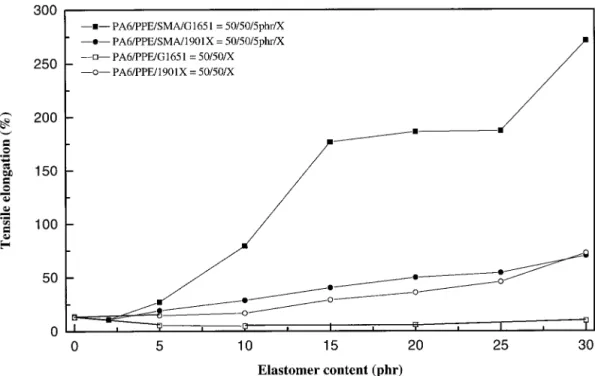
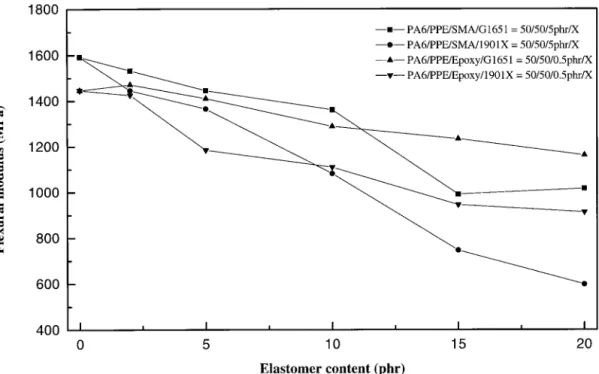
the size of the disperse phase in the G1651-mod-ified blends. The effects of two different elas-tomers on the tensile elongations of the uncom-patibilized and the comuncom-patibilized PA6/PPE 5 50/50 blends are shown in Figure 2. The trend in tensile elongation is similar to the notched impact strength as shown in Figure 1. The G1651-modified blend has a higher flexural modulus than that of the 1901X-modified blend at the same elastomer content as shown in Figure 3, because G1651 always resides in the dispersed PPE phase, whereas most 1901X reside in the PA6 matrix.
Morphologies
The effect of a compatibilizer upon the mechani-cal properties of a polymer blend can be eluci-dated by the particle-size distribution of the dis-persed phase and its interfacial strength. How-ever, the base morphology of a system and the level of interfacial bonding are dictated by the amount of compatibilizer formed and/or added and processing conditions.41In toughening a
poly-mer, the elastomer particle size and its interfacial adhesion are important factors in dictating the toughness of the resultant blend. Figure 4 gives transmission electron microscopy (TEM) micro-graphs of uncompatibilized and compatibilized
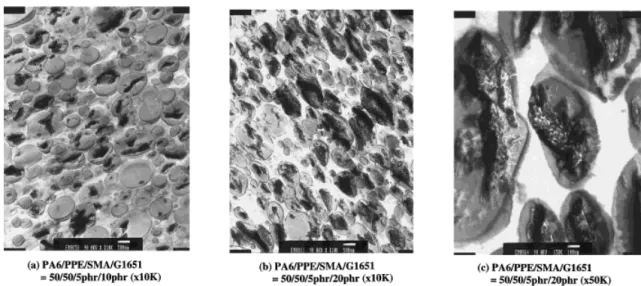
PA6/PPE5 50/50 blends. The PA6 is the matrix (light region) and the PPE is the dispersed phase (gray region) in this system due to relatively lower PA6 viscosity. The dispersed phase size of the blend becomes smaller and the interface con-trast becomes blurred after compatibilization. The in situ-formed PA6-g-SMA at the interface is an effective compatibilizer of the PA6/PPE blend. TEM micrographs of elastomer-modified compati-bilized blends are shown in Figures 5 and 6 where elastomers are stained by RuO4. Figure 5 shows that G1651 particles exclusively reside in the dis-persed PPE phase since they are more compati-ble. From the higher magnification [Fig. 5(c)], the G1651 particles are distributed within the PPE phase where the microstructures of polystyrene (PS) and poly(ethylene-co-butylene) (PEB) show phase separation between plastic PS and rubbery PEB. On the contrary, most 1901X particles re-side in the PA6 matrix and/or exist along the interface due to the reaction between the MA of 1901X and the amine end group of PA6 as shown in Figure 6. 1901X elastomers distributed along the interface compete with SMA-g-PA6 copoly-mers, but the latter is a more effective compati-bilizer than is the former. Therefore, the presence of more 1901X elastomers results in lower com-patibility of the PA6/PPE/SMA blend. The
pres-Figure 2 Effect of two different elastomers on the tensile elongations of the uncom-patibilized and comuncom-patibilized PA6/PPE5 50/50 blends.
Figure 3 Effect of two different elastomers on the flexural moduli of the SMA-compatibilized PA6/PPE5 50/50 blends.
ence of the 20 phr 1901X elastomer [Fig. 6(b)] results in a larger dispersed PPE phase domain size than that with the 10 phr 1901X elastomer [Fig. 6(a)]. Therefore, the 1901X elastomer actu-ally decreases the effectiveness of the SMA com-patibilizer in this PA6/PPE blend and results in less improvement in the toughness.
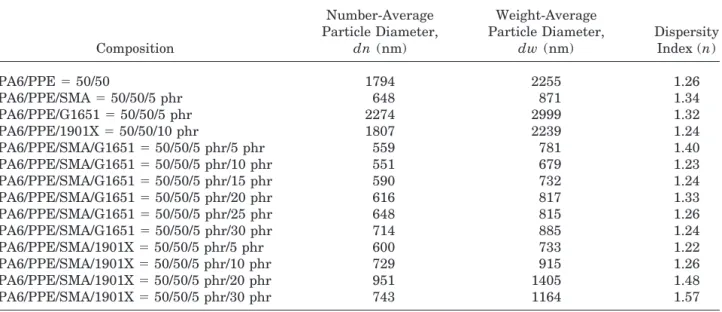
From the morphological results, the apparent average diameters of the dispersed PPE phase are summarized in Table II. The diameter of the dis-persed PPE phase in the compatibilized PA6/PPE blend is about one-third relative to the uncom-patibilized blend. Additionally, the diameter of the dispersed PPE phase is less dependent upon the elastomer content in the G1651-modified blend but increases in the 1901X-modified blend.
For the PA6/PPE/G16515 50/50/5 phr blend, the diameter of the dispersed PPE phase is larger than that of the uncompatibilized blend due to the coalescence of the dispersed PPE phase induced by G1651. The diameter of the dispersed PPE phase of the PA6/PPE/1901X 5 50/50/10 phr blend is similar to that of the uncompatibilized blend, whereas it is three times that of the PA6/ PPE/SMA/1901X 5 50/50/5 phr/5 phr blend. Therefore, SMA is a more effective compatibilizer than is 1901X in the PA6/PPE blend.
From the results of the mechanical properties and morphologies, it can be concluded that the 1901X elastomer has a certain compatibilizing ability but it will also interfere with the compati-bilizing ability of the already existing SMA. If the
Figure 5 TEM micrographs of G1651-modified compatibilized blends.
Figure 6 TEM micrographs of 1901X-modified compatibilized blends.
amount of 1901X reaches a critical value, its com-patibilizing ability precedes its interference, so that the diameter of the dispersed PPE phase becomes smaller, for example, PA6/PPE/SMA/ 1901X 5 50/50/5 phr/30 phr. Hence, G1651 dis-tributed in the dispersed PPE phase is more ef-fective than is 1901X distributed in the PA6 ma-trix to toughen the PA6/PPE blends. In our previous study,48it was also discovered that the final elastomer destination is a determinative fac-tor to toughen the PC/PET blend. A core–shell elastomer distributed in the PC phase is more effective than that distributed in the PET phase for toughening the PC/PET blend.
Dynamical Mechanical Properties and Thermal Analysis
SMA is a reactive compatibilizer for the immisci-ble and incompatiimmisci-ble PA6/PPE immisci-blend. The reac-tion and the extent of segmental mixing between SMA with PA6 and PPE will affect the glass tran-sition temperatures of PA6 and PPE. Nanasawa et al.12reported that thea, b, and g transitions of
PPE are 210, 50, and2100°C, respectively. Fig-ure 7 presents plots of tand versus temperature for the uncompatibilized and compatibilized PA6/ PPE blends. The uncompatibilized blend gives only the Tgof PA6 (37.15°C) and theg transition of PPE (291.4°C). The Tg of PPE cannot be de-tected since the glassy transition temperature of PPE (Tg5 208.79°C) and the melting point (Tm 5 210.84°C) of PA6 are too close to be
distin-guished. There are two obvious Tg peaks in the
compatibilized PA6/PPE blend where the main Tg
peak of the PA6 remains unchanged except for the appearance of a minor peak at 75°C. We sus-pect this minor peak may come from the PA6-g-SMA copolymer. The peak at 171°C is probably the miscible mixture of PPE and the unreacted SMA because it has been reported that the SMA copolymer with 8% MA is fully miscible with PPE.49 –50The effects of the elastomer content on the heat-deflection temperature (HDT) of the compatibilized blends are shown in Figure 8. The HDT of the G1651-modified blend is less depen-dent on the elastomer content because the elas-tomer particles are distributed in the dispersed PPE phase. The HDTs of the 1901X-modified blends decrease substantially since 1901X parti-cles reside mostly in the PA6 matrix and result in the reduction of the matrix modulus.
Strain-Energy Release Rate
Linear elastic fracture mechanics (LEFM) is fre-quently utilized to characterize polymer fracture behavior. The stress-intensity factor, K, or the strain-energy release rate, G, represents the frac-ture toughness of a polymer in LEFM. According to the LEFM theory, when K or G reaches its critical value (Kcor Gc), fracture of a brittle mer will occur. Even for a limited-yielding poly-mer, a modified LEFM is still applicable. How-ever, the fracture toughness of a ductile polymer characterized by LEFM becomes difficult because
Table II Summary of Various Diameters and Size Distribution of the Dispersed PPE Phase
Composition Number-Average Particle Diameter, dn (nm) Weight-Average Particle Diameter, dw (nm) Dispersity Index (n) PA6/PPE5 50/50 1794 2255 1.26 PA6/PPE/SMA5 50/50/5 phr 648 871 1.34 PA6/PPE/G16515 50/50/5 phr 2274 2999 1.32 PA6/PPE/1901X5 50/50/10 phr 1807 2239 1.24 PA6/PPE/SMA/G16515 50/50/5 phr/5 phr 559 781 1.40 PA6/PPE/SMA/G16515 50/50/5 phr/10 phr 551 679 1.23 PA6/PPE/SMA/G16515 50/50/5 phr/15 phr 590 732 1.24 PA6/PPE/SMA/G16515 50/50/5 phr/20 phr 616 817 1.33 PA6/PPE/SMA/G16515 50/50/5 phr/25 phr 648 815 1.26 PA6/PPE/SMA/G16515 50/50/5 phr/30 phr 714 885 1.24 PA6/PPE/SMA/1901X5 50/50/5 phr/5 phr 600 733 1.22 PA6/PPE/SMA/1901X5 50/50/5 phr/10 phr 729 915 1.26 PA6/PPE/SMA/1901X5 50/50/5 phr/20 phr 951 1405 1.48 PA6/PPE/SMA/1901X5 50/50/5 phr/30 phr 743 1164 1.57
Figure 7 Tan d versus temperature for the uncompatibilized and compatibilized PA6/PPE5 50/50 blends.
Figure 8 Effect of two different elastomers on the HDTs of the compatibilized PA6/ PPE5 50/50 blends under 66 psi.
the fracture toughness to yield strength ratio is high. The polymer blend with a large plastic zone prior to crack initiation violates the limitation of small-scale yielding, which ensures the validity of LEFM. Therefore, for the uncompatibilized blends or the blends with low elastomer content, they can still be characterized by LEFM in the compatibilized PA6/PPE blends.
The aim of the Izod impact test on the mechan-ical performance of plastics and polymer blends is to give a basic understanding of the behavior of such materials under impact loading and, hence, provides a reliable criterion for materials selec-tion. However, although it is easy to perform, the impact test is difficult to analyze clearly since it involves the dynamic response of structures, stress waves in the solids, and nonequilibrium situations. Besides, the impact behavior depends upon the basic properties of materials, conditions of use, processing conditions, and product design. From the practical point of view, most polymers and polymer blends are sensitive to the notch radius, temperature, and strain rate.
Figure 9 illustrates the effect of two different elastomers on the strain-energy release rates of the compatibilized PA6/PPE5 50/50 blends. The improvement of the Gc of the compatibilized blend progressively increases with increasing elastomer content. At the low elastomer content, the Gcof the 1901X-modified blend is higher than
that of the G1651-modified blend owing to that 1901X can play a dual role as an interfacial agent and an impact modifier. However, there is an inverse trend at high elastomer content since the G1651 particles distributed in the dispersed PPE phase are able to promote the fracture mecha-nisms more effectively. When the G1651 elas-tomer content is greater than 10 phr, Gc dramat-ically increases. The blends with large-scale yield-ing and correspondyield-ing fracture mechanisms, will be reported in the next article.
CONCLUSIONS
SMA was demonstrated to act as an efficient re-active compatibilizer in the elastomer-toughened PA6/PPE blends. The G1651 elastomer is a more effective impact modifier and results in superior toughness and HDT than those of the 1901X elas-tomer for the SMA-compatibilized blend since G1651 particles are exclusively distributed in the dispersed PPE phase while 1901X particles are distributed in the PA6 matrix and/or along the interface. Besides, as an impact modifier, the 1901X elastomer also acts as an interfacial agent along the interface. However, its presence tends to interfere with the effectiveness of the SMA compatibilizer and results in relatively poor per-formance. The apparent average size of the
dis-Figure 9 Effect of two different elastomers on the strain-energy release rates of the uncompatibilized and the compatibilized PA6/PPE5 50/50 blends.
persed PPE phase is less dependent upon the elastomer content in the G1651-modified blend while it increases with increase of the elastomer content in the 1901X-modified blend. Moreover, there exists a critical elastomer content, 15 phr, for the ductile– brittle transition of the G1651-modified SMA-compatibilized PA6/PPE blends. Quantitative measurements of the fracture toughness, critical elastomer diameter, and corre-sponding fracture behavior and mechanisms will be reported later.
The authors are grateful to the National Science Coun-cil of Republic of China for financial support this work through Grant NSC86-2216-E009-002.
REFERENCES
1. Rudin, A. J Macromol Sci Rev Macromol Chem C 1980, 19, 267.
2. Karam, H. J. In Polymer Compatibility of Incom-patibility; Sole, K., Ed.; Harwood: New York, 1982. 3. Shiomi, T.; Karasz, F. E.; MacKnight, W. J.
Mac-romolecules 1986, 19, 2274.
4. Nakaschio, S. U.S. Patent 3 658 945, 1972. 5. Katchman, A. U.S. Patent 4 128 602, 1978. 6. Lee, G. U.S. Patent 4 239 673, 1980.
7. Paul, D. R. In Polymer Blends; Paul, D. R.; New-man, S., Eds.; Academic: New York, 1978.
8. Sjoerdsma, S. D.; Bleijenberg, A. C. A. M.; Heikens, D. Polymer 1981, 22, 619.
9. Teyssie, R. Macromol Chem Macromol Symp 1988, 22, 83.
10. Fayt, R.; Jerome, R.; Teyssie, P. ACS Symposium Series 395; American Chemical Society, Washing-ton, DC, 1989.
11. Chang, F. C. In Handbook of Thermoplastics; Olabisi, O., Ed.; Marcel Dekker: New York, 1996; Chapter 21, pp 491–521.
12. Nanasawa, A.; Takayama, S.; Takeda, K. J Appl Polym Sci 1997, 66, 19.
13. Bucknall, B. Toughened Plastics; Applied Science: London, 1977.
14. Breuer, H.; Haaf, F.; Shabenow, J. J Macromol Sci Phys B 1977, 14, 387.
15. Bascom, W. D.; Ting, R. Y.; Moulton, R. J.; Riew, C. K.; Siebert, A. R. J Mater Sci 1981, 16, 2657. 16. Yee, A. F.; Maxwell, M. A. Polym Eng Sci 1981, 21,
205.
17. Sultan, J. N.; McGarry, F. J. Polym Eng Sci 1973, 13, 29.
18. Wu, S. Polymer 1985, 26, 1855.
19. Borggreve, R. J. M.; Gaymans, R. J.; Schuijer, J.; Ingen Housz, J. F. Polymer 1987, 28, 1489. 20. Parker, D. S.; Sue, H. J.; Huang, J.; Yee, A. F.
Polymer 1990, 31, 2267.
21. Sue, H. J.; Yee, A. F. J Mater Sci 1989, 24, 1447. 22. Oshinski, A. J.; Keskkula, H.; Paul, D. R. Polymer
1992, 33, 268.
23. Oshinski, A. J.; Keskkula, H.; Paul, D. R. Polymer 1992, 33, 284.
24. Rosch, J.; Mulhaupt, R. J Appl Polym Sci 1995, 56, 1599.
25. Gonzalez-Montiel, A.; Keskkula, H.; Paul, D. R. Polymer 1995, 36, 4621.
26. Horiuchi, S.; Matchariyakul, N.; Yase, K.; Kitano, T.; Choi, H. K.; Lee, Y. M. Polymer 1996, 37, 3065. 27. Horiuchi, S.; Matchariyakul, N.; Yase, K.; Kitano, T.; Choi, H. K.; Lee, Y. M. Polymer 1997, 38, 59. 28. Wong, S. C.; Mai, Y. W. Key Eng Mater 1998, 137, 55. 29. Hobbs, S. Y.; Bopp, R. C.; Watkins, V. H. Polym
Eng Sci 1983, 23, 380.
30. Jang, B. Z.; Uhlmann, D. R.; VanderSande, J. B. J Appl Polym Sci 1984, 29, 3409.
31. Margolina, A.; Wu, S. Polymer 1988, 29, 2170. 32. Sjoerdsma, S. D. Polymer 1989, 30, 106.
33. Gaymans, R. J.; Dijkstra, K. Polymer 1990, 31, 971. 34. Wu, S.; Marolina, A. Polymer 1990, 31, 972. 35. Ghidoni, G.; Bencini, E.; Nocci, R. J Mater Sci 1996,
31, 95.
36. Chiang, C. R.; Chang, F. C. J Appl Polym Sci 1996, 61, 2411.
37. Chiang, C. R.; Chang, F. C. Polymer 1997, 38, 4807. 38. Chiang, C. R.; Tseng, C. R.; Chang, F. C. J Polym
Res 1997, 4, 91.
39. Chiang, C. R.; Ju, M. Y.; Chang, F. Polym Eng Sci 1998, 38, 622.
40. Chiang, C. R.; Chang, F. C. J Polym Sci Polym Phys Ed 1998, 36, 1802.
41. Hobbs, S. Y.; Dekkers, M. E. J.; Watkins, V. H. J Mater Sci 1989, 24, 2925.
42. Bates, G. M.; Chambers, G. R.; Ting, S. P. U.S. Patent 4 681 915, 1987.
43. Grant, T. S.; Jalbert, R. L.; Whalen, D. U.S. Patent 4 732 938, 1988.
44. Gallucci, R. R. U.S. Patent 5 260 374, 1993. 45. Aycock, D. F.; Ting, S. P. U.S. Patent 4 600 741,
1986.
46. Nakazima, O.; Izawa, S. U.S. Patent 4 863 996, 1989. 47. Plati, E.; Williams, J. G. Polym Eng Sci 1975, 15, 470. 48. Lin, K. P.; Chang, F. C. Polym Networks Blends
1994, 4, 51.
49. Fried, J. R.; Hanna, G. A. Polym Eng Sci 1982, 22, 705.
50. Witteler, H.; Leiser, G.; Drosher, M. Makromol Chem Rapid Commun 1993, 14, 401.