Ge/Al Bilayer Thin Film for Optical Write-once Media
T. H. Wu
a, P.C. Kuo
a, Jung-Po Chen
b, Chih-Yuan Wu
c, Po-Fu Yen
b, Tzuan-Ren Jeng
b,
Der-Ray Huang
d, and Sin-Liang Ou
aa
Institute of Material Science and Engineering, National Taiwan University, Taipei 106, Taiwan.
bElectronics and OptoElectronics & Research Laboratories, Industrial Technology Research
Institute, Hsinchu, 310 Taiwan, R.O.C.
c
Department of Electrophysics, National Chiao Tung University, Hsinchu 300, Taiwan.
dHsinchu Science Park, Hsinchu, 300, Taiwan, R.O.C..
(e-mail:
[email protected]
)
Abstract:
Ge/Al bilayer thin films are prepared by magnetron sputtering. Thermal analysis shows that the phase change of the film occurs at 275 °C. Contrasts at 650 nm and 405 nm wavelength are 71.4% and 31.1% respectively.OCIS codes: (210.4770) General; (240.0310)
1. Introduction
At present, recording medium of write-once optical disc is mainly made by organic dye. Since environmental pollution issues are difficult to resolve for organic dye, the inorganic recording medium was introduced to replace the organic materials recent years. Various inorganic recording media for Blu-ray disc (BD), High definition DVD (HD DVD), and forward versatile disc (FVD) had been proposed. AgSb binary alloy[1] had been investigated that its carrier to noise ratio (CNR) was 45 dB at 657 nm. Using groove and “High to Low” recording mechanism, the jitter value of Bi-Ge nitride[2] was found only 5.7% under 36 Mbps~72 Mbps writing speed. Te-O-Pd [3] was proposed as a 4 layers recording media for 100Gb BD system. The crystallization temperature of sandwiched structure a-Si:H/Ag/a-Si:H [4] was found lower than that of a-Si/Ag/a-Si. The bilayer structure, such as a-Si/Ni[5], Si/Cu [6], Sb/Se[7] and a-Si/(Cu, Al) [8] were also been studied for the inorganic recording media recently.
In this paper, optical and thermal properties of inorganic Ge/Al bilayer recording thin films are investigated. It is shown that the Ge/Al bilayer has a phase change temperature around 275 °C by the measurement of the variation of resistance with temperature. Dynamic tests show that Ge/Al bilayer structure is suitable for high recording speed write-once optical disc.
2. Experiments
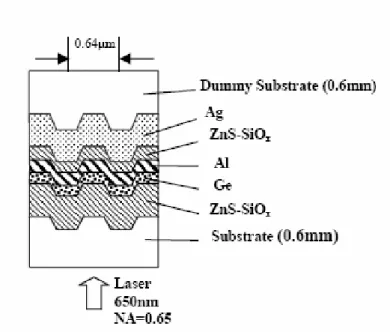
The layer structure of the Ge/Al bilayer write-once disk is shown as figure 1. A polycarbonate substrate with 0.64 µm track pitch was used, the films were sputtered in an order of lower dielectric layer(60nm), Ge/Al (10nm/10nm) recording bilayer, upper dielectric layer(20nm) and Ag reflective layer(80nm) by commercial sputtering system (Modulus, SINGULUS). After that, the 0.6mm thick polycarbonate (PC) substrate was bonded on the top. On the other hand, nature oxidized (110) silicone substrate was used for the thermal analysis sample. Relationship of reflectivity with wavelength was measured by spectrometer (ETA-RT, Optik's high sensitive spectrometer). Variation of resistance with temperature was investigated by 4-probe resistance test system in vacuum. The jitter value was evaluated by using a dynamic tester (DDU1000, PULSTEC), the testing conditions are shown in table 1. Laser beam with wavelength of 650 nm is used, the numerical aperture (NA) of the objective lens is 0.65, and linear velocity is 42m/s.
ft
Laser 650mmNA. 65
Dummy Substrate (0.6mm) Ag ZnS.SiO. A] Ge ZnS.SiO. Substrate (0.6mm)Fig.1. Ge/Al bilayer structure of the write-once disc.
Table 1. Evaluation conditions
User capacity 5.4GB Thickness of substrate 0.6mm Wavelength 650nm N.A. 0.65 Modulation code 8/16 Track pitch 0.64µm linear velocities 42 m/s
Recording format Groove only
3. Results and discussion
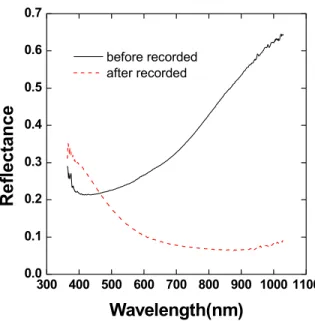
Figure 2 shows the changes of reflectivity with wavelength. Under 650 nm red laser condition, the as-deposited and recorded Ge/Al film’s reflectivity are about 28.5% and 8.5%, respectively. On the other hand, at 405 nm blue laser condition, the reflectivity of as-deposited and recorded Ge/Al films are about 20.3% and 29.5%, respectively. The corresponding contrasts at 650 nm and 405 nm are 71.4% and 31.1%, respectively.
P
hase change temperature for write-once optical medium was suggested to be in the range between 150oC and400 oC for the medium stability and sensitivity [9]. The phase change temperature of Ge/Al thin films was evaluated by
300 400 500 600 700 800 900 1000 1100 0.0 0.1 0.2 0.3 0.4 0.5 0.6 0.7
Reflectance
Wavelength(nm)
before recorded after recordedFig.2. Reflectivity changes with wavelength of as-deposited and recorded ZnS-SiOx/Ge(10nm)/Al(10nm)/ZnS-SiOx/Ag films.
Figure 3. Schematically diagram of 4-probe resistance test system.
The Ge (10nm)/Al (10nm) bilayer was sandwiched by ZnS-SiOx protective layers (each 50nm), and the edge of Al
layer was exposed to vacuum for the resistance measuring. As the temperature is increased, a sharp increasing of resistance is found at 275 °C, as shown in figure 4. The resistance is further increased slightly from 275 °C to 340 °C. After that, resistance is decreased from 340 °C to 380°C, and then the resistance keeps at constant to 420 °C. Al-Ge alloy phase was found forming at 275 °C[10]. The increase of resistance is owing to the thickness decrease of Al layer. On the other hand, the increase and decrease of resistance from 275 °C to 380 °C is owing to the reamorphization and
p.r ann
12 22 20 42 22 00 72 00 20 AtomicPercent Gernioniule Ge
segregation of Ge and Al grain, this result is the same as a-Si/Al bilayers[8]. The GeAl has a simple eutectic curve and an eutectic line at 420 °C, as shown in the GeAl phase diagram of figure 5 [11]. It can be seen that the crystallization temperature of Ge is reduced from 473 °C to 275 °C in the Ge/Al bilayer structure due to the metal induced crystallization (MIC) mechanism.[4, 8, 10, 12]
0 100 200 300 400 500
Res
ist
ance (
a.u
.)
Temperature(
oC)
Fig.4. Relationship between electric resistance and temperature.
Fig.5. The phase diagram of GeAl alloy.[11]
The recording characteristics of Ge/Al bilayer were measured at different recording powers. As shown in figure 6, the modulation of the Ge/Al bilayers is increased from 0.69 to 0.73 as the writing power is increased from 30.0 mW to 34.0 mW. The optimum jitter value is 7.69 % which is obtained at 32.0 mW, 42 m/s recording speed. This means that
the Ge/Al bilayer films can be applied to high speed write-once disc. 29.5 30.0 30.5 31.0 31.5 32.0 32.5 33.0 33.5 34.0 34.5 7.5 8.0 8.5 9.0 9.5 10.0 0.5 0.6 0.7 0.8 0.9 Ge/Al 42 m/s M od ulatio n Jitter v alu e % writing power mW
Fig.6. Characteristics of jitter value for 42 m/s recording speed (track pitch 0.64µm).
4. Conclusion
Recording properties of Ge/Al inorganic write-once optical media had been studied. From the resistance measurement, it is found that the crystallization temperature of Ge will be reduced from 473°C to 275°C by metal induced crystallization in Ge/Al bilayer. Dynamic tests show that the minimum jitter value was 7.69 % under 42 m/s recording speed.
This work was supported by the National Science Council and Ministry of Economic Affairs of Taiwan through Grant No. NSC 95-2221-E-002-115 and 95-EC-17-A-08-S1-0006.
References
[1] Y. H. Fang, P. C. Kuo, P. W. Chen, Wei-Chih Hsu, C. Y. Chou and T. H. Wu, , “Optical properties of AgSb recording thin film”, Appl. Phys. Lett., 88 , 261917 (2006).
[2] Y. Hosoda, T. Izumi, A. Mitsumori, F. Yokogawa, S.Jinno and H. Kudo, “Inorganic Recordable Disk with More Eco-Friendly Material for Blue”, Jpn. J. Appl. Phys., 42, 1040-1041 (2003)
[3] K. Kimura, E. Ohno, “Crystallization of TeOx-Pd Films for Optical Recording Materials”, Jpn. J. Appl. Phys., 28, 2223 (1989).
[4] Bo Bian, Jian Yie, Boquan Li and Ziqin Wu, “Fractal formation in a-Si:H/Ag/a-Si:H films after annealing”, J. Appl. Phys. 73, 7402 (1991).
[5] S. T. Jean and Y. C Her, “A study of a-Si/Ni bilayer recording film for write-once blue-ray disk”, Journal of Material Science and Engineering, 37, 211-217 (2005).
[6] H. Inoue, K. Mishima, M. Aoshima, H. Hirata, T. Kato and H. Utsunomiya, “Inorganic Write-Once Disc for High Speed Recording”, Jpn. J. Appl. Phys., 42, 1059-1061 (2003).
[7] N. Starbov, T. Missana, C. N. Afonso, K. Starbov, and M. A. Ollacarizqueta, “Mixing kinetics and write-once optical recording characteristics of Sb/Se bilayer films”, Appl. Phys. A., 63, 161-165 (1996).
[8] Yung-Chiun Her, Chih-Wei Chen, and Chun-Lin Wu, “Comparison of crystallization kinetics in a-Si/Cu and a-Si/Al Bilayer recording films under thermal annealing and pulsed laser irradiation”, J. Appl. Phys., 99,113512 (2006)
[9] Alan B. Marchant, Optical Recording: A Technical Overview (Addison-Wesley, 1990).
[10] Ting-Hau Wu, Jung-Po Chen, Chih-Yuan Wu, Po-Fu Yen, Ching-Yu Hsieh, Tzuan-Ren Jeng, Po-Cheng Kuo, Der-Ray Huang, Sheng-Chi Chen, ” Inorganic material for high speed write-once FVD disc”, J. Magn. and Magn. Mat., 304, e359–e361 (2006).
[10] S. W. Russell, Jian Li, and J. W. Mayer. “In situ observation of fractal growth during a-Si crystallization”, J. Appl. Phys., 70, 5153-5155 (1991).
[11] Binary Alloys Phase Diagrams, edited by B. Thaddeus, J. L. Murray, L.H. Bennett, and H. Baker (American Society for Metals, Metals Park, OH, 1986), Vol 1, p.117.
[12] Jae-Bok LEE, Chan-Jae LEE and Duck-Kyun CHO, “Influnces of various Metal elements on Field Aided Lateral Crystallization of Amorphous Silicon Films”, Jpn. J. Appl. Phys., 40, 6177-6181 (2001).