國
立
交
通
大
學
光電工程研究所
碩 士 論 文
氧化鋅量子點中不受激發功率影響之激子態研究
Invariable exciton states upon increasing
pumping in ZnO quantum dots
研 究 生:廖婉君
指導教授:謝文峰 教授
張振雄 教授
氧化鋅量子點中不受激發功率影響之激子態研究
Invariable exciton states upon increasing
pumping in ZnO quantum dots
研 究 生:廖婉君 Student: Wan-Jiun Liao
指導老師:謝文峰 教授 Advisors: Dr. Wen-Feng Hsieh
張振雄 教授 Dr. Chen-Shiung Chang
國立交通大學 光電工程研究所 碩士論文A Thesis
Submitted to Institute of Electro-Optical Engineering College of Electrical Engineering and Computer Science
National Chiao Tung University In partial Fulfillment of the Requirements
for the Degree of Master
in
Electro-Optical Engineering June 2010
Hsinchu, Taiwan, Republic of China
Invariable exciton states upon increasing pumping
in ZnO quantum dots
Student: Wan-Jiun Liao Advisor: Dr. Wen-Feng Hsieh
Dr. Chen-Shiung Chang
Department of Photonics & Institute of Electro-Optical Engineering
National Chiao Tung University
Abstract
ZnO QDs are synthesized by a simple sol-gel method and the average size of QDs can be tailored under solution concentration. Size-dependent blue shifts of photoluminescence give the evidence of the quantum confinement effect. Furthermore, the unchanged spectral profiles of near-bandedge emission (NBE) for a fixed size of ZnO quantum dots (QDs) reveal no signature of biexciton formation and exciton-exciton scattering under excitation density covering three orders of magnitude. These results quite differ from that of the micrometer-sized powder. The intensities of NBE peaks attributed to free exciton and surface bound exciton states exhibit linear dependence on the excitation power density that confirms the invariable exciton states with no effect of two-exciton interaction in ZnO QDs upon increasing the pump intensity.
氧化鋅量子點中不受激發功率影響之激子態研究
研究生:廖婉君 指導老師:謝文峰 教授
張振雄 教授
國立交通大學光電工程研究所
摘要
利用溶膠-凝膠法藉由改變溶液濃度來合成不同晶粒大小的氧化鋅量子點, 並量測其光學特性。從低溫螢光光譜隨氧化鋅量子點尺寸變小而藍移的現象可觀 察到在氧化鋅量子點中存在量子侷限效應。然而,量測變功率螢光光譜發現,當 激發光強度改變了1000倍,除了光譜強度會隨激發強度增加而變大外,NBE的光 譜形狀幾乎都不變,且觀察不到雙激子的形成與激子與激子的散射現象,此情形 與氧化鋅塊材的特性相當不一樣。另外,自由激子與表面束縛激子的發光能量幾 乎不隨激發光強度改變及線性的發光強度與激發能量關係,表示當激發功率增 加,仍沒有激子間的交互作用,因此在氧化鋅量子點中,存在穩定的激子態。誌謝
時間過得真快,一轉眼我的碩士生生活就要結束了。在這兩年的日子裡, 我學習與成長了很多,也讓我的想法與處事態度變得更成熟了。 研究所這段期間,我要謝謝我的指導教授謝文峰老師,謝謝老師在課業、 研究與待人處事上對我的指導與教誨,以及對我在生活上的關心,從老師的身上 我學習到很多。也要謝謝另外一位指導教授張振雄老師,提供我專業意見,以及 生活上的幫助。接下來要謝謝小豪帶我入門做實驗,雖然我常做出讓你啞口無言 的事,不過真的很謝謝你教了我很多事。還要謝謝小郭,當我研究上有問題時, 常常向你請教,謝謝你提供我很多想法與協助。也要謝謝楊松幫我打XRD與教我 SEM。以及謝謝鄭信民學長對我研究的關心與協助,還有歐博濟,雖然在碩二之 後才跟你比較有交集,常向你請教TRPL的問題,你也常會關心我的近況,論文或 找工作的進展如何,謝謝你。另外,智章學長、維仁學長、碧軒學長以及黃董偶 爾我有問題要請教你們,你們也都很熱心的幫我解答,謝謝你們。還有要謝謝黃 至賢,很多生活上的瑣碎事情常會去煩你,謝謝你啦,實驗室有了你讓我很不無 聊了XD 另外,謝謝蔡智雅學姐,課業上或是找工作等常找你幫忙或詢問你意見, 謝謝你;還要謝謝陳厚仁總是很大方的借我筆記與考古題,祝你跟學姐永遠甜蜜 幸福喔XD 還有黃冠智,常常會以你的經驗告訴我很多事情以及提供我建議,以 及林建輝,你真是一個奇妙的人,你的很多事情與想法常讓我們驚奇,也讓實驗 室更有趣了,還有黃棕儂,雖然你比較少來實驗室,但也很謝謝你在我還沒進實 驗室前對我的照顧,另外還有黎延垠你竟然拋棄我們提前畢業去了,剛進實驗室 時什麼都不懂,多虧你在,告訴與提醒我要做什麼,以及問你光電系的八卦,ㄎㄎ,謝謝你們,雖然跟你們只相處了一年,但碩一的那一年裡,因為有你們讓我 覺得實驗室很溫馨也讓我能更快熟悉實驗室,當然也要謝謝和我當了兩年同學的 李柏毅,謝謝你對我生活上的關心。還有許家瑋,謝謝你很熱心想教我程式語言 但我還是沒學會= = 另外,還有實驗室的學弟們,雖然跟你們還沒有很熟,不過 也祝你們在實驗室的生活都能很愉快。 最後當然要謝謝一位特別的人,謝謝你的陪伴與鼓勵,讓我在心情不好沮 喪的時候得以抒發與得到安慰,未來還有很多挑戰等著我們,我們要一起加油!! 小布丁 于 九十九年六月
Contents
Abstract (in English)………..….I Abstract (in Chinese)……….II Acknowledgement………....…III Contents………...………...……...V List of Figures………..………...…VII List of Tables………...VIII
Chapter 1 Introduction………...….1
1.1 Basic properties of ZnO and significance of ZnO related photonic devices…...…1
1.2 General review of ZnO nanostructures………...……4
1.3 Motivations……….……….6
1.4 Organization of the thesis………8
Chapter 2 Theoretical background………..…………..9
2.1 Sol-gel method………...……..………...9
2.2 Quantum effect……….…………..…………...12
2.2.1 Quantum confinement effect……….………....13
2.2.2 Density of states………...………..…..……….16 2.3 X-ray diffraction….………...…19 2.3.1 Lattice parameters……….………..…..19 2.3.2 Debye-Scherer formula……….………....21 2.4 Photoluminescence characterization……….24 2.4.1 Fundamental transitions…….………...………..25
2.4.2 Influence of high excited light intensity…….……….………..31
Chapter 3 Experiment detail and analysis techniques………...…….34
3.1 Sample preparation………34
3.2 Microstructure and optical properties analysis………...…………..….37
3.2.1 X-ray diffraction………...……….37
3.2.2 Photoluminescence system………...……….38
Chapter 4 Results and Discussion……….40
4.1 Morphology and crystal structures………...………...……..40
4.1.1 Morphology………..…….40
4.1.2 X-ray diffraction measurement……..………..….41
4.2 Photoluminescence spectra………...……….42
4.2.1 Photoluminescence spectra for different sizes of ZnO particles……..…….42
4.2.2 Temperature-dependent PL for different sizes of ZnO particles………..….44
4.2.3 Power-dependent PL for different sizes of ZnO particles……….45
4.2.4 PL peak positions as a function of excitation power……….48
4.2.5 Integrated intensity as a function of excitation power………..……49
Chapter 5 Conclusions and Prospective ………..51
5.1 Conclusions………..…………...…………..51
5.2 Prospective………..……….….52
List of Figures
Fig. 1-1 The wurtzite structure model of ZnO………...3
Fig. 1.2 Representative scanning electron microscopy images of various ZnO nanostructure morphologies………..…...6
Fig. 2-1 Schematic of the rotes that one could follow within the scope of sol-gel processing………...…12
Fig. 2-2 Geometry used to calculate density of states in three, two and one dimensions………..17
Fig. 2-3 Variation in the energy dependence of the density of states…….……..……18
Fig. 2-4 X-ray scattering from a 2-dimendion periodic crystal………20
Fig. 2-5 The hexagonal unit cell………...21
Fig. 2-6 Grating treatment of line broadening by crystallite ………...21
Fig. 2-7 A pair excitation in the scheme of valence and conduction bands………...27
Fig. 2-8 Visualization of bound excitons………...28
Fig. 2-9 Radiative transition between a band and an impurity state………31
Fig. 2-10 The general scenario for many-particle effects in semiconductors……...32
Fig. 2-11 Schematic representation of the inelastic exciton-exciton scattering processes……….33
Fig. 3-1 Experiment equipment used for fabricating ZnO QDs..……….36
Fig. 3-2 A flow chart of fabricates ZnO QDs by sol-gel method……….36
Fig. 3-3 The x-ray spectrometer………...37
Fig. 3-4 PL detection systems………..39
Fig. 4-1 HRTEM image of the ZnO QDs fabricated using 0.04M Zn(OAc)2………..40
Fig. 4-2 XRD profiles of the ZnO QDs prepared with various concentration of Zn(OAc)2.………...41
Fig. 4-3 The PL spectra of the ZnO QDs measured at low temperature…….……….43 Fig. 4-4 PL spectra of different sizes of ZnO QD at low temperature…...….……….44 Fig. 4-5 Temperature-dependent PL spectra…...….……….45 Fig. 4-6 Power-dependent PL spectra…...….………..….47 Fig. 4-7 Theoretical fit to a PL spectrum of 6 nm ZnO QDs measured at 80K…...48 Fig. 4-8 The PL peak positions as a function of excitation power measured at 80K...49 Fig. 4-9 The integrated intensity of two decomposed peaks as a function of excitation
power measured at 80K…………..………50
List of Tables
Table 1-1 Comparison of properties of ZnO with those of other wide band gap
semiconductors………...1 Table 1-2 Properties of wurtzite ZnO ………2 Table 3.1 Shows that chemical reagent was used with sol-gel experiment process …35
Chapter 1 Introduction
1.1 Basic property of ZnO and significance of ZnO related photonic
devices
Zinc oxide (ZnO) is a promising material for a variety of practical applications [1]
such as piezoelectric transducers, optical waveguides, surface acoustic wave devices,
varistors, phosphors, solar cells, chemical and gas sensors, transparent electrodes, spin
functional devices, UV-light emitters [2] and ultraviolet laser diodes. The basic
properties of ZnO can be obtained by examining Table 1-1, which compares the
material properties of other relevant semiconductors [3].
Table 1-1. Comparison of properties of ZnO with those of other wide band gap semiconductors [3].
ZnO has attracted significant scientific and technological attention due to its
wide direct band gap (3.37 eV) that is suitable for photonic applications in the
ultraviolet (UV) or blue spectrum range [4]. In this regard, a large exciton binding
ZnS (39 meV) and other wide-gap semiconductors. The large exciton binding
energy allows stable existence of excitons and efficient excitonic emission at room
temperature (thermal energy 26 meV). The basic material parameters of ZnO are
also shown in Table 1-2. To realize any type of device technology, these parameters
are important to have control over the concentration of intentionally introduced
impurities (dopants), which are responsible for the electrical properties of ZnO. The
dopants determine whether the current (and, ultimately, the information processed by
the device) is carried by electrons or holes.
The structure of ZnO crystal is shown in Fig 1-1 which has a hexagonal wurtzite
structure (space group C6mc) with lattice parameters a = 0.3249 nm and c = 0.5207
nm. The structure of ZnO can be simply described as a number of alternating planes
composed of tetrahedrally coordinated O2- and Zn2+ ions, stacked alternately along the
c-axis, in which a1, a2, and c are the unit vectors in a unit cell, the large and small
circles denote the anion and cation atoms, respectively. The tetrahedral coordination
in ZnO results in non-central symmetric structure and consequently the development
of piezoelectricity and pyroelectricity.
1.2 General review of ZnO nanostructures
ZnO nanocrystals have recently attracted broad attention in fundamental studies
and technical applications [5] because of their distinguished performance in
electronics, optics and photonics. Therefore, in the last few decades, a variety of
ZnO nanostructure morphologies, such as nanowires [6], nanorods [7, 8], tetrapods
[9], nanoribbons/belts [9], and nanoparticles [10, 11] have been reported. Recently,
novel morphologies such as hierarchical nanostructures [12], bridge-/nail-like
nanostructures [13], tubular nanostructures [14], nanosheets [15], nanopropeller
arrays [16], nanohelixes [17], and nanorings [17] have, amongst others, been
demonstrated. These diverse ZnO nanostructures have been fabricated by various
methods, such as thermal evaporation [9], metal–organic vapor phase epitaxy
(MOVPE) [8], laser ablation, hydrothermal synthesis [7], sol-gel method [10, 11] and
template-based synthesis [6]. Several recent review articles have summarized progress in the growth and applications of ZnO nanostructures [4, 18]. Some of the
possible ZnO nanostructure morphologies are shown in Fig. 1.2.
Additionally, when the dimension of semiconductors are reduced from three
(bulk material) to the quasi-zero dimensional semiconductor structures such as
quantum dots (QDs), the optical properties of QDs are much different from the bulk
structure of nanostructures, i.e., the quantum confinement effect (QCE) [19] and
surface states [20]. These two mechanisms compete with each other to influence PL
spectra. For nanodots or nanostructures in ZnO system with diameters less than 10
nm, the QCE plays a dominant role as has been much reported [21]. On the other
hand, the surface-to-volume ratio also brings much influence on the system’s
Hamiltonian when the material size is reduced to the nanometer scale [22]. The
predominance of surface states is responsible for many novel physical features of
nanomaterials. In the past decade, various groups have devoted to produce ZnO
QDs and study the properties. For instance, Guo et al. [23] exhibited significantly
enhanced UV luminescence, diminished visible luminescence and excellent
third-order nonlinear optical response with poly vinyl pyrrolidone (PVP) modified
surface of ZnO nanoparticles. Pan et al. [24] predicted a significant increase in the
intensity ratio of the deep level to the near band edge emission is observed with
ever-increasing nanorod surface-aspect ratio. Fonoberov et al. [25] have
theoretically investigated that, depending on the fabrication technique and ZnO QD
surface quality, the origin of UV photoluminescence (PL) in ZnO QDs is either
recombination of confined exciton or surface-bound ionized acceptor-exciton
complexs. Although there were many experiments to describe the behavior of ZnO
Fig. 1.2 Representative scanning electron microscopy images of various ZnO nanostructure morphologies [4].
1.3 Motivations
Recently, the power-dependent photoluminescence (PL) of ZnO bulk associated
with biexciton recombination has been investigated by several research groups
[26-29]. Zhang et al. [26], who grew ZnO rods by metalorganic chemical vapor
deposition, indicated that the biexciton intensity is proportional to the 1.7th power of
the excitation density. Besides, we have observed the intensity of biexciton emission
in ZnO powder is proportional to the 1.86th power of the excitation power at T = 80
K, but it is close to unity exponent or even sub-linear when it is measured at the lower
temperature [30]. Acoustic and optical phonon scatterings playing key roles in
biexciton at various temperatures. At low temperature the acoustic phonon
scattering is the dominant mechanism for exciton thermalization while the optical
phonon scattering will participate in when the exciton kinetic energy approaches to
the energy of the lowest optical phonon about T = 80 K. The efficient cooling of
exciton with the assistance of optical phonon scattering allows effectively bounding
exciton pairs to form biexcitons.
However, Kim et al. [31] have reported the spectra of power-dependent PL in
ZnO nanorods synthesized by standard Schlenk techniques remain nearly unchanged
spectral profile as increasing the excitation intensity as compared with 40 meV red
shift for bulk crystal with their maximum excitation intensity. They attributed this
finding to the quantum confinement effects that can alter the properties of exciton
states and claimed in this study the exciton states of the nanorods are stable even
when the excitation intensity reaches the Mott density of the bulk crystal due to a
smaller exciton size and an enhanced exciton binding energy [32]. On the other
hand, Bagnall et al. [33] have observed the red-shifted PL peak of ~50 meV in ZnO
powder that may be attributed to the exciton-exciton scattering (or P band) rather than
electron-hole plasma (EHP or N band) with > 100 meV red shift.
The characterizations of ZnO QDs are complicated problems to be investigated.
important roles in stimulated emission and gain process in real photonic device
structures.
1.4 Organization of the thesis
This thesis is organized as follows. Chapter 2 covers the theoretical
background of experiments such as sol-gel method, X-ray diffraction (XRD),
photoluminescence (PL) characterization, and a general concept of quantum effect,
fundamental optical transitions and ZnO excitons-related emissions. In Chapter 3,
we describe the experimental details including the measurement apparatus and
processes. By means of the XRD and PL spectroscopy, the crystal structures and the
optical emission properties of ZnO QDs grown by the sol-gel method will be
investigated and discussed in Chapter 4. Finally, in Chapter 5, we conclude the
studies on the ZnO QDs and propose several topics of the future works.
Chapter 2 Theoretical background
2.1 Sol-gel method
An aerosol is a colloidal suspension of particles in a gas (the suspension may be
called a fog if the particles are liquid and a smoke if they are solid) and an emulsion is
a suspension of liquid droplets in anther liquid. A sol is a colloidal suspension of
solid particles in a liquid, in which the dispersed phase is so small (~1-1000 nm) that
gravitational force is negligible and interactions are dominated by the short-range
forces, such as Van der Waals attraction and surface charge. All of these types of
colloids can be used to generate polymers or particles from which ceramic materials
can be made. A polymer is a huge molecule (also called a macromolecule) formed
from hundreds or thousands of units called monomers. If one molecule reaches
macroscopic dimensions so that it extends throughout the solution, the substance is
said to be gel.
Sol-gel synthesis has two ways to prepare solution. One way is the
metal-organic route with metal alkoxides in organic solvent; the other way is the
inorganic route with metal salts in aqueous solution. It is much cheaper and easier to
handle than metal alkoxides, but their reactions are more difficult to control. The
condensation of metal alkoxides M(OR)Z, where M = Si, Ti, Zr, Al, Sn, Ce, and OR is
an alkoxy group and Z is the valence or the oxidation state of the metal. First,
hydroxylation upon the hydrolysis of alkoxy groups:
ROH OH M O H OR M − + 2 → − + . (2-1)
The second step, polycondensation process leads to the formation of branched
oligomers and polymers with a metal oxygenation based skeleton and reactive
residual hydroxyl and alkoxy groups. There are 2 competitive mechanisms:
(1) Oxolation-- formation of oxygen bridges:
XOH M O M M XO OH M − + − → − − + . (2-2)
The hydrolysis ratio (h = H2O/M) decides X=H (h >> 2) or X = R (h < 2).
(2) Olation-- formation of hydroxyl bridges when the coordination of the metallic
center is not fully satisfied (N - Z > 0):
M OH M M HO OH M − + − → −( )2 − , (2-3)
where X = H or R. The kinetics of olation is usually faster than those of oxolation.
Figure 2-1 presents a schematic of the routes that one could follow within the
scope of sol-gel processing [34]. In the sol-gel process, the precursors (starting
compounds) for preparation of a colloid consist of a metal or metalloid element
surrounded by various ligands. The precursors were mixed together and heated at
homogeneous product is obtained. Then, the materials have to be transformed into
the desired shape. For example, an alkyl is a ligand formed by removing one
hydrogen (proton) from an alkane molecule to produce, for example, methyl (‧CH3)
or ethyl (‧C2H5). An alcohol is a molecule formed by adding a hydroxyl (OH) group
to an alkyl (or other) molecule, as in methanol (CH3OH) or ethanol (C2H5OH).
Metal alkoxides are members of the family of metalorganic compounds, which
have an organic ligand attracted to a metal or metalloid atom. Metal alkoxides are
popular precursors because they react readily with water. The reaction is called
hydrolysis, because a hydroxy ion becomes attached to the metal atom. This type of
reaction can continue to build larger and larger molecules by the process of
polymerization. The gel point is the time (or degree of reaction) when the last bound
is formed that completes this giant molecule. It is generally found that the process
begins with the formation of fractal aggregates that begin to impinge on one another,
then those clusters link together as described by the theory of percolation. The gel
point corresponds to the percolation threshold, when a single cluster (call the
spanning cluster) appears that extends throughout the sol; the spanning cluster
coexists with a sol phase containing many smaller clusters, which gradually become
attached to the network. Gelation can occur after a sol is cast into a mold, in which
Fig. 2-1 Schematic of the rotes that one could follow within the scope of sol-gel processing [8].
2.2 Quantum effect
During the last decade, the growth of low-dimensional semiconductor structures
has made it possible to reduce the dimension from three (bulk material) to the
quasi-zero dimensional semiconductor structures usually called QDs. In these
nanostructures the quantum confinement effects become predominant and give rise to
many interesting electronic and optical properties. The electron energy will be
quantized and varies with dot sizes that cause the variation of band gap energy,
binding energy, and Bohr radius. The band gap and the density of states (DOS)
associated with a quantum-structure differ from that associated with bulk material,
2.2.1 Quantum confinement effect
Models explaining the confinement of charged particles in a three-dimensional
potential well typically involve the solution of Schrödinger’s wave equation using the
Hamiltonian [35] U V m m H h e + + ∇ − ∇ − = 2 2 2 2 0 2 2 h h . (2-4)
Variation between treatments generally originates from differences in expressions
assigned to V0 for the confining potential well, which normally is accompanied by the
Coulombic interaction term U. Boundary conditions are imposed forcing the wave
functions describing the carriers to zero at the walls of the potential well.
Two regimes of quantization are usually distinguished in which the crystallite
radius R is compared with the Bohr radius of the excitons aB or the related
quantities:
(1) Weak confinement regime for R≥aB and
(2) Strong confinement regime for R<aB.
In the weak confinement regime, the motion of center of exciton mass is
quantized while the relative motion of electron and hole given by the envelope
function )φ(re −rh is hardly affected. In the strong confinement regime, however,
the Coulomb energy increases roughly with R-1, and the quantization energy with R-2,
Coulomb term can be neglected.
2.2.1.1 Weak confinement [36]
Coulomb-related correlation between the charged particles handled through the
use of variational approach involving higher-order wave function of the confined
particles, and we cannot neglect the electron hole Coulomb potential. The
Schrödinger equation may be written as
Ψ = Ψ − + + Ψ ∇ − − e h t h e E r r U V m m 2 ) [ ( )] 2 ( h2 h2 2 0 . (2-5) Taking r=re −rh and h e h h e e m m r m r m R + +
= , then the equation becomes
Ψ = Ψ + + ∇ − ∇ − R r V R U r Et M 2 ( ) ( )] 2 2 [ 2 2 2 μ h h with M =me +mh, h e h e m m m m + =
μ , and E as the total energy of the system. If we t
take Ψ=φ(R)ϕ(r) and consider Coulomb interaction first, then we get
) ( ) ( )] ( 2 [ 2 2 R E R R V M ∇R + φ = cφ − h , ) ( ) ( ) ( ) ( )] ( 2 [ 2 2 r E r E E r r U t c ex r ϕ ϕ ϕ μ∇ + = − = − h .
Here E results from the inclusion of Coulomb interaction. Then we consider the ex
confinement potential B B a R R V a R R V > ∞ = ≤ = , ) ( , 0 ) ( .
Thus, the energy is
... 3 , 2 , 1 , 2 2 2 2 2 = = n Ma n Ecn h π (2-6)
ex g ex c t E Ma E E E E = + = + + = 2 22 0 2 π ω h h (2-7)
with M =me +mh as the total mass of the electron and hole.
2.2.1.2 Strong confinement
The size quantization band states of the electron and hole dominate for the
kinetic energies of electron and hole are larger than the electron-hole Coulomb
potential, and the effect of the Coulomb attraction between the electron and hole can
be treated as a perturbation. Then the Schrödinger equation becomes
Ψ = Ψ + Ψ ∇ − − V E m me e 0 2 2 2 ) 2 2 ( h h .
The potential is defined as
B B a r r V a r r V > ∞ = ≤ = , ) ( , 0 ) (
and the energy of an electron or a hole is
... 3 , 2 , 1 , 2 2 , 2 2 2 = = n a m n E h e cn π h
The absorption energy of a photon is
μ π π ω0 2 22 222 2 ) 1 1 ( 2a m m E a E g h e g h h h = + + = + (2-8) with h e h e m m m m + =
2.2.2 Density of states (DOS)
The concept of density of states (DOS) is extremely powerful and important
physical properties such as optical absorption, transport, etc., are intimately dependent
upon this concept. The density of states is the number of available electronic states
per unit volume per unit energy around an energy E. If we denote the density of
states by N(E), the number of states in an energy interval dE around an energy E is
N(E)dE. To calculate the density of states, we need to know the dimensionality of
the system and the energy vs. wave vector relation or the dispersion relation that the
electrons obey [37].
2.2.2.1 Density of states for a three-dimensional system
In a three dimension system, the k-space volume between vector k and k + dk is
4πk2
dk (see Figure 2-2). We had shown above that the k-space volume per electron
state is(2 / )3
L
π . Therefore, the number of states of electron in the region between k
and k+ dk are V dk k V dk k 2 2 3 2 2 8 4 π π π = .
Denoting the energy and energy interval corresponding to k and dk as E and dE, we
see that the number of electron states between E and E+ dE per unit volume are
2 2 2 ) ( π dk k dE E N =
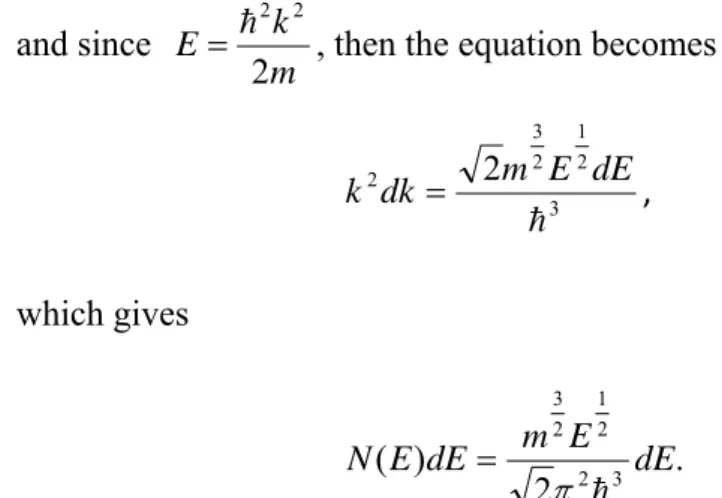
and since m k E 2 2 2 h
= , then the equation becomes
3 2 1 2 3 2 2 h dE E m dk k = , which gives . 2 ) ( 223 1 2 3 dE E m dE E N h π =
We must remember that the electron can have two states for a given k-value
since it can have a spin state of s = 1/2 or -1/2. Accounting for spin, the density of
states is . 2 ) ( 2 3 2 1 2 3 h π E m E N =
Fig. 2-2 Geometry used to calculate density of states in three, two and one dimensions.
2.2.2.2 Density of states for lower-dimensional systems
If we consider a 2-D system, a concept that has become a reality with use of
quantum wells, similar arguments tell us that the density of states for a parabolic band
2 ) ( h π m E N = .
Finally, in a 1-D system or “quantum wire”, the density of states is
h π 2 1 2 1 2 ) ( − = m E E N .
We notice that as the dimensionality of the system changes, the energy
dependence of the density of states also changes. In three-dimensional systems we
have E1/2-dependence as shown in Figure 2-3a, while in two-dimensional systems
there is no energy dependence (Figure 2-3b). In one-dimensional systems, the
density of states has E-1/2-dependence and a peak at E = 0 (Figure 2-3c), and the
density of states in zero-dimensional systems is shown in Figure 2-3d. The
variations related to dimensionality are extremely important and is a key driving force
to lower dimensional systems.
Fig. 2-3 Variation in the energy dependence of the density of states in a) three-dimensional b) two-dimensional c) one-dimensional d) zero-dimensional systems.
2.3 X-ray diffraction
2.3.1 Lattice parameters [38]
A crystal consists of orderly array of atoms, each of which can scatter
electromagnetic waves. A monochromatic beam of X-rays that falls upon a crystal
will be scattered in all directions inside it. However, owing to the regular
arrangement of the atoms, in certain directions the scattered waves will constructively
interfere with one another while in others they will destructively interfere. The peaks
of an x-ray diffraction pattern are made up of photons constructively interfere with
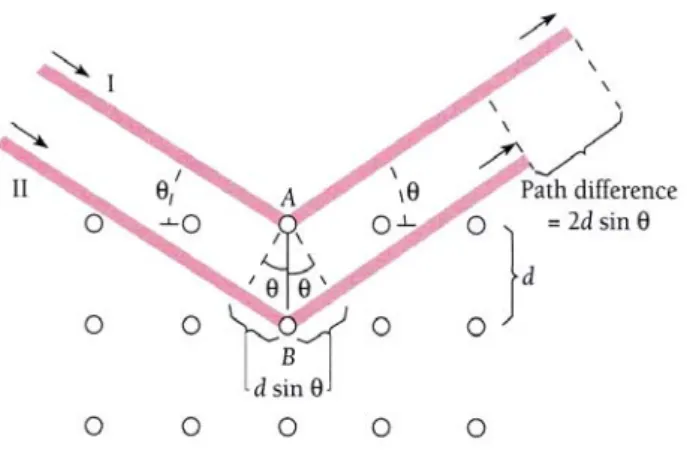
planes, this analysis was suggested in 1913 by W. L. Bragg. Consider an incident
monochromatic x-ray beam interacting with the atoms arranged in a periodic manner
as shown in 2-dimendion in Fig. 2-4. The atoms represented as circles in the graph
form different sets of plane in the crystal. To give a set of lattice planes with an
inter-plane distance of d, the condition for diffraction (peak) constructively interfere
to occur can be simply written as
λ θ n
dsin =
2 , n=1,2,3,..., (2.9) which is known as the Bragg’s law. In this equation, λ is the wavelength of the x-ray, θ is the diffraction angle, and n is an integer representing the order of the
Fig. 2-4 x-ray scattering from a 2-dimendion periodic crystal.
The lattice constant can be found by means of the diffraction pattern. For
hexagonal unit cell (Figure 2-5), which is characterized by lattice parameters a and c,
the plane spacing equation for hexagonal structure is
2 2 2 2 2 2 3 4 1 c l a k hk h d ⎟⎟⎠+ ⎞ ⎜⎜ ⎝ ⎛ + + = , (2.10) whereh,k, and l are the Mill’s indices.
Combining the Bragg’s law (λ=2dsinθ ) with (2-2), we can get:
. sin 4 3 4 1 2 2 2 2 2 2 2 2 λ θ = + ⎟⎟ ⎠ ⎞ ⎜⎜ ⎝ ⎛ + + = c l a k hk h d (2-11) Rearranging (2-3) gives } 3 4 { 4 sin2 2 2 2 2 22 c l a k hk h + ⎟⎟ ⎠ ⎞ ⎜⎜ ⎝ ⎛ + + =λ θ , (2-12) thus the lattice parameters can be estimated from Eq. (2-12).
Fig. 2-5 The hexagonal unit cell.
2.3.2 Deby-Scherer formula [39]
Considering the path difference between the successive planes when the incident
beam remains fixed at the Bragg angle θ, but with the diffracted ray leaving at an
angle θ+Δθ, corresponding to intensity I in the spectrum line an distance Δθ away
from the peak as Figure 2-6.
Fig. 2-6 Grating treatment of line broadening by crystallite.
The path difference between waves from successive planes is now
= d sinθ+ d sinθcosΔθ+d cosθsinΔθ (2.13)
where BC and CE is the path difference between incident ray of the successive planes,
and d is the interplanar distance. If Δθ is very small, we can write cosΔθ ≈ 1 and
sinΔθ ≈ Δθ, in which case
BC + CE = 2dsinθ+ d cosθΔθ. (2.14)
Combining Bragg’s law Eq. (2.1)
BC + CE = 2dsinθ+ d cosθΔθ= nλ + d cosθΔθ, (2.15) where λ is the wavelength of the incident x-ray. Therefore the phase difference δ per interplanar distance or “aperture” is
δ = θ θ λ π λ π λ 2 +2 dcos •Δ n = 2nπ + θ θ λ π •Δ cos 2 d (2.16)
Since a phase difference of 2π n produces the same effect as a zero phase, we can write the effective phase difference per aperture as
δ = θ θ λ π •Δ cos 2 d (2.17)
We obtain the result that the distribution of intensity of I in a spectrum line a
distance R from the grating is effectively
δ δ 2 1 sin 2 1 sin ) ( 2 2 2 N R I = Φ (2.18)
2 2
max ( ) N
R
I = Φ . (2.19)
where Φ is the amplitude at unit distance from the graying, and N is the total number
of grating aperture.
Diving Eq. (2.10) by Eq. (2.11), we obtain
2 2 2 max ) 1 ( 2 1 sin 2 1 sin N N I I δ δ = . (2.20) Since 2 1
Nδ will change much faster than 2 1
δ, the function will reach its first
minimum before 2 1
δ is very large. We can therefore replace δ 2 1 sin by 2 1 δ, and we will get 2 max ) 2 1 2 1 sin ( δ δ N N I I = . (2.21) The ratio max I I will fall to 2 1 when δ δ N N 2 1 2 1 sin = 2 1 . (2.22)
The solution to the equation (2.14) yields the required phase difference
corresponding to the half maximum. It may be obtained
δ
N
2 1
= 1.39, (2.23)
Since, according to equation (2.9), δ = θ θ
λ π •Δ cos 2 d , and D = Nd, we obtain θ θ λ = 2Δ cos 89 . 0 D . (2.24)
Let B be taken as the full width at half maximum from Δθ to –Δθ, hence B = 2Δθ= θ λ cos 89 . 0 D (radians), (2.25)
where λ is the wavelength of x-ray and D is the average size of the particles.
2.4 Photoluminescence characterization [35, 40]
Photoluminescence (PL) is a powerful and noninvasive optical analysis
technology for the semiconductor industry. It has high sensitivity to reveal the band
structure and the carrier transportation behaviors in a material. From PL spectrum
the defect or impurity can also be found in the compound semiconductors, which
affect material quality and device performance. A given impurity produces a set of
characteristic spectral features. The fingerprint identifies the impurity type, and
often several different impurities can be seen in a single PL spectrum. In addition,
the full width at half maximum of the PL peak is an indication of sample’s quality
[41]. So the PL could be a judgment of the material quality and be a key technology
of the development of nano-technology.
PL is the optical radiation emitted by a physical system (in excess the thermal
equilibrium blackbody radiation) resulting from excitation to a nonequilibrium state
by illuminating with light. Three processes can be distinguished: (i) creation of
electron-hole pairs, and (iii) escape of the recombination radiation from the sample.
2.4.1 Fundamental Transitions
An electron is excited from the valence band to the conduction band by
absorption of a photon. In this sense an optical excitation is a two-particle transition.
The same is true for the recombination process. An electron in the conduction band
can return radiatively or nonradiatively to the valance band only if there is a free
space, i.e., a hole available. Two quasi-particles annihilate in the recombination
process. What we need for the understanding of the optical properties of the
electronic system of a semiconductor is therefore a description of the excited states of
the N-particle problem. We will consider the fundamental transitions, those
occurring at or near the band edges.
1. Free excitons (Wannier-Mott excitons)
An electron in the conduction band and a hole in the valence band are created at
the same point in space and can attract each other through their Coulomb interaction.
Using the effective mass approximation, the Coulomb interaction between electron
and hole leads to a hydrogen-like problem with a Coulomb potential term
h e r r e − − ε πε0 2 4 .
Here we will consider the so-called Wannier-Mott excitons more specifically.
This type of excitons has a large Bohr radius (i.e., the mean distance between electron
and hole) that encompasses many atoms, and they are delocalized states that can move
freely throughout the crystal; hence the alternative name of free excitons.
Indeed excitons in semiconductors form, to a good approximation, a hydrogen-
or positronium-like series of states below the gap. For a simple parabolic band in a
direct-gap semiconductor one can separate the relative motion of electron and hole
and the motion of the center of mass. This leads to the dispersion relation of exciton
as shown in Fig. 2-7. M K n Ry E K n E B g B ph 2 1 ) , ( = − * 2 + h2 2 , (2.26) where nB=1,2,3,... is the principal number, )
1 ( 6 . 13 2 0 * ε μ m Ry = eV is exciton binding
energy, M =me +mh and K =ke+kh are translational mass and wave vector of
the exciton, respectively. The series of exciton states in (2.26) has an effective
Rydberg energy *
Ry modified by the reduced mass of electron and hole and the
dielectric constant of the medium in which these particles move. The radius of the
exciton equals the Bohr radius of H atom again modified by ε and μ. Using the
material parameters for typical semiconductors one finds that the orbits of electron
and hole around their common center of mass average over many unit cells and this in
excitons are called Wannier-Mott excitons.
Fig. 2-7 A pair excitation in the scheme of valence and conduction bands (a) in the exciton picture for a direct gap semiconductor (b).
2. Biexcitons
It is well known that two hydrogen atoms with opposite electron spins can bind
to form a hydrogen molecule. In the same sense, it has been calculated that two
positronium-like atoms can form a positronium-like molecule as a bound state. So
the idea is not far away that two excitons could bind to form a new quasiparticle, the
so-called biexciton or excitonic molecule. It has been found theoretically that the
biexciton should form a bound state for all ratios of effective electron and hole masses
and dimensionalities of the sample.
The dispersion relation is given in the simplest case by
ex b biex b ex g biex M k E E E k E 4 ) ( 2 ) ( 2 2 h + − − = , (2-27) assuming that the effective mass of the biexciton is just twice that of the exciton.
3. Bound excitons
Similar to the way that free carriers can be bound to defects, it is found that
excitons can also be bound to defects. Some of these defects can bind an exciton
resulting in a bound exciton complex (BEC). In Figure 2-8 we visualize exciton
bound to an ionized donor (D+X), a neutral donor (D0X), and a netural axxeptor (A0X).
An ionized acceptor does not usually bind an exciton since a neutral acceptor and a
free electron are energetically more favorable. The binding energy of an exciton (X)
is the highest for a neutral acceptor (A0X complex), the lower for a neutral donor
(D0X) and the lower still for an ionized donor (D+X). The binding energy b
E of
exciton to the complex usually increases according to b X A b X D b X D E E E + < 0 < 0 . The binding energy is defined as the energetic distance from the lowest free exciton state
at k = 0 to the energy of the complex. There is a rule of thumb, known as Hayne’s
rule, which relates the binding energy of the exciton to the neutral complex with the
binding of the additional carrier to the point defect.
4. Surface-bound exciton
The surface-to-volume ratio brings much influence on the system’s Hamiltonian
when the material size is reduced to the nanometer scale [22]. From the calculation
of exciton states at the QD surface, we can know the exciton is bound to the
surface-located acceptor [25]. Unlike the acceptor, the donor does not bind the
exciton. Because the hole is much heavier than the electron, which makes the
surface donor a shallow impurity, while the surface acceptor a deep impurity.
Therefore, excitons can be effectively bound only to surface acceptors.
5. Two-Electron Satellites (TES) [42]
Two-electron satellite (TES) transitions involve radiative recombination of an
exciton bound to a neutral donor, leaving the donor in the excited state. In the
effective mass approximation, the energy difference between the ground-state neutral
donor bound excitons and their excited states (TES) can be used to determine the
donor binding energies [43] (the donor excitation energy from the ground state to the
first excited state equals to 3/4 of the donor binding energy, ED) and catalog the
6. Donor-Acceptor Pairs (DAP)
Donors and acceptors can form pairs and act as stationary molecules imbedded in
the host crystal. The coulomb interaction between a donor and an acceptor results in
a lowering of their binding energies. In the donor-acceptor pair case it is convenient
to consider only the separation between the donor and the acceptor level:
r q E E E Epair g D A ε 2 ) ( + + − = , (2-28) where r is the donor-acceptor pair separation, EDandEAare the respective ionization
energies of the donor and the acceptor as isolated impurities.
7. Deep transitions
By deep transition we shall mean either the transition of an electron from the
conduction band to an acceptor state or a transition from a donor to the valence band
in Fig. 2-9. Such transition emits a photon hν =Eg −Eifor direct transition and
p i g E E
E
hν = − − if the transition is indirect and involves a phonon of energyE . p
Hence the deep transitions can be distinguished as ( ) conductionⅠ -band-to-acceptor
transition, which produces an emission peak at hν =Eg −EA , and ( ) Ⅱ
donor-to-valence-band transition which produces emission peak at the higher photon
C
V
D
A
Fig. 2-9 Radiative transition between a band and an impurity state.
2.4.2 Influence of high excited light intensity
The PL conditions as mentioned above are excited by low excitation light
intensity. At low excitation light intensity (low density regime in Fig. 2-10), the PL
properties are determined by single electron-hole pairs, either in the exciton states or
in the continuum. Higher excitation intensity (intermediate density regime in Fig.
2-10) makes more excitons; such condition would lead to the exciton inelastic
scattering processes and form the biexciton. The scattering processes may lead to a
collision-broadening of the exciton resonances and to the appearance of new
luminescence bands, to an excitation-induced increase of absorption, to bleaching or
to optical amplification, i.e., to gain or negative absorption depending on the
excitation conditions. If we pump the sample even harder, we leave the intermediate
and arrive at the high density regime in Fig. 2-10, where the excitons lose their
is known as the electron-hole plasma (EHP).
Fig. 2-10 The general scenario for many-particle effects in semiconductors. [35]
1. Electron-Hole Plasma
In this high density regime, the density of electron-hole pairs np is at least in
parts of the excited volume so high that their average distance is comparable to or
smaller than their Bohr radius, i.e., we reach a “critical density” c p
n in an EHP, given
to a first approximation by 3 c ≈1
p Bn
a . We can no longer say that a certain electron is
bound to a certain hole; instead, we have the new collective EHP phase. The
transition to an EHP is connected with very strong changes of the electronic
excitations and the optical properties of semiconductors.
2. Scattering Processes
In the inelastic scattering processes, an exciton is scattered into a higher excited
state, while another is scattered on the photon-like part of the polariton dispersion and
leaves the sample with high probability as a luminescence photon, when this
photon-like particle hits the surface of the sample. This process is shown
schematically in Fig. 2-11 and the photons emit in such a process having energies En
given by Ref. [44] kT n E E En ex bex 2 3 1 1 2 ⎟− ⎠ ⎞ ⎜ ⎝ ⎛ − − = , (2-29) where n = 2, 3, 4,…, ex b
E = 60 meV is the binding energy of the free exciton of ZnO,
and kT is the thermal energy. The resulting emission bands are usually called
P-bands with an index given by n.
energy Wave vector Eg Eexciton P2 P∞ 1 2 ∞ nB= continuum
Chapter 3 Experiment details and analysis techniques
3.1 Sample preparation
We fabricate ZnO QDs by sol-gel method. Sol-gel method was chosen due to
its simple handling, low cost, and narrow size distribution. In particular, it has the
potential to produce samples with large areas and complicated forms on various
substrates.
The ZnO colloidal spheres were produced by one-stage reaction process, and
reactions were described as the following equations:
COOH xCH COO CH OH Zn O xH COO CH Zn( 3 )2 + 2 ⎯⎯→Δ ( −)x( 3 −)2−x + 3 , (3-1) COOH CH x O H x ZnO COO CH OH Zn( −)x( 3 −)2−x ⎯⎯→Δ +( −1) 2 +(2− ) 3 . (3-2)
Equation (3-1) is the hydrolysis reaction for Zn(OAc)2 to form metal complexes. We
increased the temperature of reflux from RT to 160oC and maintained for aging. The
zinc complexes will dehydrate and remove acetic acid to form pure ZnO as Eq. (3-2)
during the aging time. Actually, the two reactions described above proceed
simultaneously while the temperature is over 110oC.
All chemicals used in this study were reagent grade and employed without
further purification. A typical reaction was listed in Table 3-1, stoichiometric zinc
diethylene glycol [99.5% DEG, ethylenediamine-tetra-acetic acid (EDTA)] to make
0.1 M, 0.05 M, 0.01 M solutions. The first thing we notice is that we can control the
QDs size with domination concentration of zinc acetate in the solvent (DEG). Then
the temperature of reaction solution was increased to 160℃, and white colloidal ZnO
was formed in the solution that was employed as the primary solution. The primary
solutions were put separately in a centrifuge operating at 3000 rpm for 30 minutes.
The supernatant was decanted off and saved, and the polydisperse powder was
discarded. Finally, the supernatant was then dropped onto Si (100) substrates and
dried at 150℃ for further characterization. The experiment equipment and a flow
chart of fabricate ZnO QDs by sol-gel method was shown in Figure 3-1&3-2.
Chemical reagent Molecular formula Degree of purity
Source
Zinc acetate dehydrate Zn(CH3COOH)2‧2H2O 99.5% Riedel-deHaen
Diethylene glycol C4H10O3 99.5% EDTA
Table 3-1 Shows that chemical reagent was used with sol-gel experiment process.
Fig. 3-1 Experiment equipment used for fabricating ZnO QDs.
Fig. 3-2 A flow chart of fabricate ZnO QDs by sol-gel method.
Zn(CH3COOH)2‧2H2O
Diethylene-glycol (DEG)
Counter flow apparatus
White colloidal formed
Centrifuge
Clear solution
drop or spin coating on SiO2/Si(001)
varying solution concentration
heating up to 160℃
3.2 Microstructure and optical properties analysis
3.2.1 X-ray diffraction
The crystal structures of the as-grown powder were inspected by using XRD
(model: MAC Sience, MXP18) at room temperature equipped with CuK X-ray source
(λ=1.5405Å) in National Synchrotron Radiation Research Center (NSRRC), Taiwan.
Data were recorded between the angle range of 20° < 2θ < 80° with steps of 0.02°and
rate of scanning is 40°/min. The operation voltage of the system is 50 kV and the
operation current is 200 mA. The essential features of x-ray spectrometer are shown
in Figure 3-3. X-rays from the tube T are incident on a crystal C which may be set at
any desired angle to the incident beam by rotation about an axis through O, the center
of the spectrometer circle. D is a detector which measures the intensity of the
diffraction x-rays.
The sizes of the nanocrystallites can be determined by X-ray diffraction using the
measurement of the full width at half maximum (FWHM) of the X-ray diffraction
lines. The average diameter is obtained by
θ λ cos 89 . 0 B
D= , where D is the average
diameter of the nanocrystallite, λ is the wavelength of the X-ray source, and B is the
FWHM of X-ray diffraction peak at the diffraction angle θ.
3.2.2 Photoluminescence system
PL provides a non-destructive technique for the determination of certain
impurities in semiconductors. The shallow-level and the deep-level of impurity
states were detected by PL system. It was provided radiative recombination events
dominate nonradiative recombination.
In the PL measurements, we used a He-Cd cw laser (325 nm) [Kimmon
IK5552R-F] as the excitation light. Light emission from the samples was collected
into the TRIAX 320 spectrometer and detected by a photomultiplier tube (PMT). As
shown in Fig. 3-4, the diagram of PL detection system includes mirror, focusing and
collecting lens, the sample holder and the cooling system. The excitation laser beam
was directed normally and focused onto the sample surface with power being varied
with an optical attenuator. The spot size on the sample is about 100 μm.
into a 0.32 cm focal-length monochromator (TRIAX 320) with a 1200 lines/mm
grating, then detected by either an electrically cooled CCD (CCD-3000) or a
photomultiplier tube (PMT-HVPS) detector. The temperature-dependent PL
measurements were carried out using a closed cycle cryogenic system. A closed
cycle refrigerator was used to set the temperature anywhere between 15 K and 300 K.
And the power-dependent PL spectra were used for monitoring the characteristic of
excitons and thermalization effect at the different excitation density.
Chapter 4 Results and Discussion
4.1 Morphology and crystal structures
4.1.1 Morphology
Shown in Fig. 4-1 is a typical high-resolution transmission electron microscope
(HRTEM) image of the ZnO nanoparticles. Nanoparticles aged at 160 °C for 1 hr
and solution concentration of 0.04 M was selected for particle size determination by
HRTEM. The shape of particles is predominantly spherical, and the nanoparticles
are clearly well separated and essentially have some aggregation. The average
diameter of the number-weighted particles obtained from a colloid aged at 160 °C for
1 hr (0.04 M) was determined to be 6.18 ± 0.3 nm.
4.1.2 X-ray diffraction measurement
The XRD profiles of the ZnO QDs with various concentrations of Zn(OAc)2 are
shown in Fig. 4-2. The diffraction pattern and interplanar spacings match nicely
with the standard diffraction pattern of wurtzite ZnO, demonstrating the formation of
wurtzite ZnO nanocrystals. All of the samples present similar XRD peaks that can
be indexed as the wurtzite ZnO crystal structure with lattice constants a = 3.253 Å and
c = 5.213 Å, which are consistent with the value in the standard card (JCPDS
89-1397).
Fig. 4-2 XRD profiles of the ZnO QDs prepared with various concentration of Zn(OAc)2. The
crystalline size can be approximately estimated to be 16 and 7 nm, respectively (top to bottom), for concentrations of 0.16 and 0.06 M.
No diffraction peaks of other species could be detected that indicates all the
formed. The full width at half maximum (FWHM) of the diffraction peaks increases,
that is, the average crystalline size decreases, as the concentration of zinc precursor
reduces. The average size is calculated from the width of diffraction peak using the
Debye-Scherer formula: [45, 46]D = 0.89λ /(wcos θ ), where D is the average
crystalline diameter of the particles, λ is the wavelength of the x-ray source, w is the
linewidth at half maximum in excess of the instrumental broadening, and θ is the
diffraction angle. The crystalline size can be estimated to be 16 nm and 7 nm, for
concentrations of 0.16 M, and 0.06 M, respectively.
4.2 Photoluminescence spectra
4.2.1 Photoluminescence spectra for different sizes of ZnO particles
The PL spectra of ZnO QDs with average crystalline sizes of 16 and 7 nm at 13
K are shown in Fig. 4-3. For the 16-nm ZnO QDs, a strong UV emission peak at
3.388 eV with FWHM of ~ 96 meV was observed accompanied with very broad weak
visible emission with the slightly strong blue emission and rather weak yellow
emission bands. And only a strong UV emission peak at 3.411 eV with FWHM of ~
174 meV was observed unaccompanied with visible emission for the 7 nm ZnO QDs.
The sharp UV emission peak is attributed to the near band edge emission (NBE) [27,
oxygen vacancy (green emission) or oxygen interstitial (red emission). The intensity
of the UV and visible peak ratio increases with decreasing the QD size. The strong
UV emission and weak visible emission in PL spectra indicates that the ZnO QDs
have a good crystal quality.
Fig. 4-3 The PL spectra of the ZnO QDs measured at low temperature.
Figure 4-4 demonstrates the PL spectra of ZnO QDs with different average
crystalline sizes measured at T = 13 K. The near band edge UV emission is
attributed to the free exciton (FX) emission [32], which shifts (solid line) to the higher
energy (from 3.386 eV to 3.42 eV) as the QD size decreases (16 nm – 6 nm) due to
the quantum confinement effect (QCE). Besides, the FWHM increases as the
average QDs size decreases that may be caused by the contribution of surface-optical
Since the Bohr radius of the exciton in bulk ZnO is about 2.34 nm [49], we must
consider the electron hole Coulomb interaction in our samples and the particles are in
the moderate to weak confinement regime.
Fig. 4-4 PL spectra of different sizes of ZnO QD at low temperature. The line indicates the shifts of FX peak energy.
4.2.2 Temperature-dependent PL for different sizes of ZnO particles
Figure 4-5 displays the temperature-dependent PL of different sizes of ZnO, it
reveals only single one band for T = 8 ~ 300 K in QDs system. Due to small binding
energy of D0X, it will be ionized as T > 100 K, so we can easily attribute the single
band to the FX emission. We also find that the peak energy difference of FX in QDs
system between 8 K and 300 K decrease with the particle size decreasing. It is
result of Coulomb interaction.
Fig. 4-5 Temperature-dependent PL spectra of (a) 16 nm, (b) 7 nm, (c) 6 nm.
4.2.3 Power-dependent PL for different sizes of ZnO particles
The power-dependent PL spectra of different sizes of ZnO QDs are shown in Fig.
4-6. These spectral shapes are almost the same except that the spectral intensity
49 kW/cm2), covering a range of three orders of magnitude, which show the exciton
states remain invariable.
The character in ZnO QDs gives a sharp contrast to the ZnO powder (~ 1 μm),
in which the relative peak intensities of biexciton (BX) and P-band (exciton-exciton
scattering) emissions increase as the excitation power increasing [30]. For
quantitative analysis, the spectral shape of NBE emission measured in 6-nm ZnO QDs
at 80 K is decomposed into two peaks and theoretical fitting results are shown in Fig.
4-7. For comparison, the inset of Fig. 4-7 shows the fit of the PL spectrum in ZnO
powder at 80 K. The dashed curves denote the various emissions and the solid curve
corresponds to the sum of the theoretical fit, which shows good agreement with the
experimental data marked as the open dots. The PL spectra of QDs and that of
powder are very diverse. The BX emission can be observed in ZnO powder,
nevertheless, in ZnO QDs only the emission of surface bound exciton (SX) [51] rather
Fig. 4-6 Power-dependent PL spectra of (a) 16 nm at 15 K, (b) 16 nm at 80 K, (c) 7 nm at 15 K, (d) 7 nm at 80 K, (e) 6 nm at 8 K, (f) 6 nm at 80 K.
Fig. 4-7 Gaussian fit to a PL spectrum of 6 nm ZnO QDs (0.04M) measured at 80K. The inset shows the spectral fitting for ZnO powder. The fitted line shapes are shown separately in dash lines. Solid lines correspond to the fit and dots represent the data.
4.2.4 PL peak positions as a function of excitation power
The peak positions of these emissions with increasing the excitation power in
6-nm ZnO QDs at 80 K are plotted in Fig. 4-8. The FX is observed at 3.418 eV and
the PL emission peak at 3.325 eV may be attributed to the emission of SX. The peak
positions of FX emission and SX emission are hardly shifted as the excitation power
Fig. 4-8 The PL peak positions as a function of excitation power measured at 80K.
4.2.5 Integrated intensity as a function of excitation power
In order to further understand the characteristic of these two peaks, the integrated
PL intensities of these peaks as a function of excitation power in 6-nm ZnO QDs at
80K are depicted in Fig. 4-9. Both of the integrated intensities exhibit nearly linear
dependence on the excitation power with both exponents close to 0.96. However,
the exponent of BX (with binding energy of ~15 meV) on the excitation power in
ZnO powder comes near the theoretical value of 2 having 1.86 at 80K. It is due to
efficient cooling via participation of optical phonons when the exciton kinetic energy
approaches to the energy of the lowest optical phonon [30]. However, reducing the
exciton-LO phonon coupling in ZnO QDs [32] causes the lack of the efficient cooling
of exciton with assistance of optical phonon scattering or the so-called phonon
bottleneck. Therefore, it is hardly to allow effectively bounding exciton pairs to
In addition, the P-band emission is hardly found in Fig. 4-6. This finding
means that the probability of exciton-exciton scattering is also very low. For that
reason, we suspect the other reason might be that there is only one exciton existing in
a QD within the exciton lifetime even with the achievable high power CW excitation,
so that neither exciton-exciton scattering nor BX can be observed in ZnO QDs.
Therefore, the increase of excitation intensity provides the larger chance of a single
exciton being excited or the larger excitation rate of single exciton. Thus the peak is
hardly shifted and the PL intensity is linear dependence with excitation intensity
corroborating the invariable exciton states upon increasing pumping in ZnO QDs.
Fig. 4-9 The integrated intensity of two decomposed TES and FX peaks as a function of excitation power measured at 80K. The inset shows the excitation power dependent emission intensity of biexciton in ZnO powder measured at 80 K. The power factor is 1.86.
Chapter 5 Conclusions and Prospective
5.1 Conclusions
In summary, we have measured XRD to inspect the crystal structures and the
average size of ZnO QDs synthesized by a simple sol-gel method. The average sizes
of ZnO QDs were verfied by TEM. The diffraction pattern and interplanar spacings
indicate the formation of wurtzite ZnO nanocrystals, and no diffraction peaks of other
species could be detected that indicates all the precursors have been completely
decomposed and no other crystal products were formed. We have measured
temperature-dependent and power-dependent PL spectra of ZnO QDs with different
sizes to investigate the optical properties. From Size-dependence of efficient UV
photoluminescence from low temperature PL gives evidence for quantum
confinement effect. The ZnO QDs exhibit strong UV emission and weak visible
emission, indicating very good crystal quality. Moreover, the biexciton and P-band
emissions in ZnO QDs are hardly observed and unchanged shapes of
power-dependent PL spectra show the exciton states remain invariable in ZnO QDs.
The intensities of emission peaks associated with these invariable free exciton and
5.2 Prospective
In order to further investigate the optical properties of ZnO QDs, we will
measure the time resolved photoluminescence (TRPL) to inspect the lifetime of ZnO
QDs. Through measuring the lifetime of ZnO QDs, we can identify the different PL
origins of physical mechanisms and the process of exciton recombination. Besides,
we will do single-photon measurement to study the optical characterizations in a
![Table 1-1. Comparison of properties of ZnO with those of other wide band gap semiconductors [3]](https://thumb-ap.123doks.com/thumbv2/9libinfo/8558099.188396/11.892.136.784.497.827/table-comparison-properties-zno-wide-band-gap-semiconductors.webp)


![Fig. 1.2 Representative scanning electron microscopy images of various ZnO nanostructure morphologies [4]](https://thumb-ap.123doks.com/thumbv2/9libinfo/8558099.188396/16.892.170.719.106.428/representative-scanning-electron-microscopy-images-various-nanostructure-morphologies.webp)
![Figure 2-1 presents a schematic of the routes that one could follow within the scope of sol-gel processing [34]](https://thumb-ap.123doks.com/thumbv2/9libinfo/8558099.188396/20.892.135.762.502.785/figure-presents-schematic-routes-follow-scope-sol-processing.webp)
![Fig. 2-1 Schematic of the rotes that one could follow within the scope of sol-gel processing [8]](https://thumb-ap.123doks.com/thumbv2/9libinfo/8558099.188396/22.892.188.705.109.484/fig-schematic-rotes-follow-scope-sol-gel-processing.webp)