行政院國家科學委員會專題研究計畫 成果報告
第三代及後三代無線通訊系統多路徑交遞控制方法研究
計畫類別: 個別型計畫
計畫編號: NSC91-2218-E-009-018-
執行期間: 91 年 12 月 01 日至 92 年 07 月 31 日
執行單位: 國立交通大學電子工程學系
計畫主持人: 黃經堯
報告類型: 精簡報告
處理方式: 本計畫涉及專利或其他智慧財產權,2 年後可公開查詢
中 華 民 國 92 年 11 月 24 日
行政院國家科學委員會補助專題研究計畫成果報告
※※※※※※※※※※※※※※※※※※※※※※※※※※※※※※※※※※※※※
※
※
※
第三代及後三代無線通訊多路徑交遞控制方法研究 ※
※
※
※※※※※※※※※※※※※※※※※※※※※※※※※※※※※※※※※※※※※
計畫類型: ╳個別型計畫 □整合型計畫
計畫編號: NSC 92-2218-E-009-018
執行期限: 91 年 12 月 1 日至 92 年 7 月 31 日
計畫主持人: 黃經堯
計畫參與人員:蔡明原、高振哲
本成果報告包括以下應繳交之附件
□ 赴國外出差或研習心得報告一份
□ 赴大陸地區出差或研習報告一份
□ 出席國際學術會議心得報告及發表之論文各一份
□ 國際合作研究計畫國外研究報告書一份
執行單位:國立交通大學電子工程學系
中 華 民 國 92 年 10 月 10 日
1
行政院國家科學委員會專題研究計畫成果報告
動態通訊品質多重斜率通訊交遞演算法則
Multi-Slope Quality based Handoff Controls in Third Generation CDMA Wireless
Systems
計畫編號: NSC 92-2218-E-009-018
執行期限: 91 年 12 月 1 日至 92 年 7 月 31 日
主持人: 黃經堯
國立交通大學電子工程所
計畫參與人員:蔡明原、高振哲 國立交通大學電子工程所
一、中文摘要
如何成功地完成移動中所產生的通訊
聯結交遞程序,並且以最有效的系統資源來
處理通訊連結交遞,是任何無線行動通訊系
統的核心重點。因此,我們針對無線通訊聯
結的交遞環境,並以通訊連結品質及系統雜
訊干擾間的非線性自然特性為基礎,在第三
代 CDMA『分碼多工接取技術』系統下,開
發『動態通訊品質多重斜率通訊交遞演算法
則』
,進行系統模擬驗證,分析新演算法的
運作效能。
關鍵字:分碼多工接取技術、第三代無
線通訊系統、通訊聯結交遞、通訊品質、多
重斜率、多路徑連結
Abstract
In this study, we will propose an advanced multi-slope quality-based handoff control algorithm to effectively manage connection quality while minimizing the required resources. In a wireless communication system, there exits a non-linear relationship among the connection quality, the overall interference level, and the required resources. To meet the handoff design challenge in 3G systems, we will demonstrate the need of having a flexible handoff control algorithm. The proposed algorithm will be evaluated again other existing handoff algorithms based on the performance of the connection quality, the forward-link power budget, the channel element usage, and the handoff frequency.
Key words: CDMA, Third Generation Wireless Communications, Handoff, Quality, Multi-Slope, Multi-connection
1. Introduction
In third generation and beyond wireless CDMA (code division multiple access) communication systems, it is critical to have optimum resource management schemes. In this study, we will focus on the handoff problem and propose an advanced handoff control algorithm to effectively manage the required resources while maintaining comparable connection quality.
Handoff problems have been studied for many years. Various approaches have been proposed in the literatures. Starting with SIR (Signal-to-Interference Ratio) based handoff algorithms and then the pilot Ec/Io based CDMA soft/softer handoff controls [1-2], those algorithms are designed to ensure a seamless migration from cell-to-cell. Recently, quality-based handoff algorithms, which take the actual connection quality (i.e., aggregate Ec/Io) into consideration [3-5], are proposed to reduce the legs that do not contribute significantly to the connection quality. Due to the saving in both the forward-link power budget and hardware resources, quality-based handoff algorithms are implemented in IS-95B and cdma2000 [6,7].
In a CDMA wireless system, all users’ connection qualities are tightly coupled. Adding a new leg (connection) to improve one user might have a negative impact on other users. As a result, the increase of the interference level might cause an unstable interference impacts. This non-linear effect is important and needs be considered for handoff controls. Unfortunately, this effect is not captured in current handoff control algorithms in neither the fixed quality-based handoff algorithm [4] nor the linear dynamic quality-based handoff algorithm used for IS-95B and cdma2000 [6,7]. To resolve this discrepancy, the multi-slope based handoff algorithm is proposed and will be evaluated in this paper.
The paper is organized as follows: In Section II, the advanced multi-slope quality based handoff algorithm is proposed. The simulation model is stated in Section III. Section IV will discuss the performance results. The final conclusions are included in Section V.
2. Advanced Multi-Slope Handoff
Algorithms
The multi-slope design concept is introduced to address the non-linear effect in a wireless communication system. It is not clear whether adding a new leg even at a poor connection can actually help to improve the connection quality. Adding a new leg might improve the connection quality but at the cost of the increase the overall interference level. If the new leg is not stable, the improvement on the connection quality might diminish. In other words, the intention of improving the individual connection quality might not stand if excessive interference is created by this connection. To avoid the problem, we will show that only the leg with a reasonable strength can contribute a positive effect on the final connection quality.
2.1. Multi-Slope Handoff Algorithm
The idea of the multi-slope quality based handoff algorithm is plotted in Figure 1 where two slopes are used to explain the design concept. In the plot, the TSLOPE_I and TSLOPE_II is used as example trigger
thresholds for the first slope and the second slope. The value of the slope can be either grater or smaller than the value of the first slope. The effect of different slop values will be evaluated in the simulation.
Figure 1.Multi-slope Quality based Handoff Algorithm
In theory, there requires infinite number of slopes to represent a non-linear performance curve. Mathematically, it is easy to express the control in
equations, as depicted in Figure 2 for TADD_MultiSlope.
} { , } ) ( | { max min ) ) ( ( ) ( ) ) ( ( _ _ set active ; T Io Ec i T Io Ec B Io Ec Io Ec A T MultiSlope ADD i i ADD i i i i i i MultiSlope ADD ∈ Ω ⎭ ⎬ ⎫ ⎩ ⎨ ⎧ = + × = Ω ∈ Ω ∈ Ω ∈ Ω ∈
∑
∑
∑
Figure 2. Multi-slope Quality based Handoff Algorithm -- TADD
In Figure 2, the slope, A( ), is a function of the aggregate Ec/Io and the intercept, B( ), can be adjusted for proper initial operating points in order to match with the add-leg threshold, TADD_MultiSlope. Even
multi-slope has considered the connection quality, we believe that the condition of adding a new leg which is stronger than all existing legs are important in real CDMA systems. For the drop-leg criterion, it is reasonable to keep the same slope values for TADD and
TDROP (A = ADROP) but introducing an offset on the
intercept point and a delay timer, TTDROP, to avoid the
ping-pong effect in wireless environment.
} { ) ) ( ( ) ( ) ) ( ( set active remaining ; Second T for Io Ec B Io Ec Io Ec A T TDROP i i DROP i i i i DROP DROP ∈ Λ + × =
∑
∑
∑
Λ ∈ Λ ∈ Λ ∈Figure 3. Multi-slope Quality based Handoff Algorithm – TDROP
The multi-slope handoff control algorithm can be viewed as a generic control algorithm. Different combination of the parameters and values can represent most existing handoff control algorithms implemented today.
3. Simulation Model and Performance
Evaluation
In this section, we will evaluate the multi-slope quality based handoff algorithm with various slope values. The cdmaOne (IS-95A) handoff algorithm is used as a baseline algorithm to benchmark the performance. All algorithms will be evaluated in terms of the connection quality, the forward-link power budget, the use of the hardware resources (channel elements), and handoff frequency.
3.1. System Model
Figure 4 shows the block diagram for this simulation. With the propagation model, the lognormal fading
3 channel, and various loadings (in terms of number of mobiles), the pilot Ec/Io of each mobile is calculated. To capture the dynamic behavior of the mobile RF condition, at every 200 msec, the number of connection paths, mobile locations, the pilot Ec/Io, transmitted power, and hardware usage will be recalculated.
Figure 4. Simulation Model
Simulation assumptions are listed as follows:
1. Propagation model: Cellular Band: Hata Model is used
2. Lognormal fading with the correlation distance of 400 meters and the variance of 8 dB are used
3. Two-tier 19 3-sector cells are considered.
9 Center cell is used to studied the performance statistics
4. Traffic loads: 4-8 user cases are used
3.2. Algorithm Parameters Assumptions
Here, the multi-slope quality based handoff algorithm is based on the two-slope design only. The assumptions used for the algorithms are listed in Table 1.
Table 1. Algorithm Assumptions
Tadd Tdrop TtdropTqualit y Tqualit y II Slope I Slope II Add Intercept Drop Intercept IS-95A -13 dB -15 dB 1sec X X X X X X
Multi-slope D D 1 sec -6 dB -10dB 1 vary D (-3) D (-5)
D: Dynamic, X: N/A (not available)
Note: The first slope is set at the value of 1. The
performance of IS-95B is very close to the slope value of 1 for both the slope one and slope two.
4. Performance Results
The proposed handoff algorithm and the baseline cdmaOne handoff algorithm are evaluated based on the performance of (1) connection quality, (2) forward-link power usage (capacity), (3) hardware resources (channel elements), and (4) processing load (handoff frequency). In order to have proper assessment of the results, we first decide a proper loading based on cdmaOne experience. In cdmaOne (IS-95A), the proper average operating aggregate pilot Ec/Io should be around of -8dB to ensure the target FER of 1% to 2%. As depicted in Figure 5, to operate at the average aggregate Ec/Io of -8dB, 6-user case (with continuous transmission) is chosen. It is important to know that the results in Figure 5 are the average performance among 100 runs with each run of 60 seconds. The intent here is to identify the average operating range instead of investigating the performance impacts.
Figure 5.Average aggregate Ec/Io vs. number of active users
4.1. Connection Quality
In any control designs, maintaining the connection quality is always the first fundamental objective. To quantify the connection quality, the aggregate pilot Ec/Io is used for evaluating the average aggregate performance and individual performance.
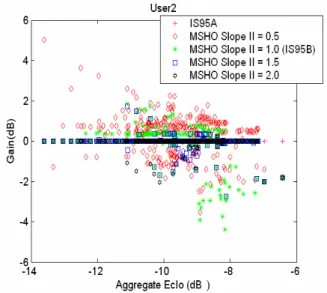
Considering the average aggregate connection quality, as shown in Figure 6, the multi-slope quality-based handoff algorithm with the second slope value of 0.5 (up tilt from the slope I) has the most improvement in the average connection quality for most Ec/Io operating ranges. But if we selectively examine user’s instant performance (at every 200 msec), plotted in Figure 7, the gain (relative to the
Handoff Decision Aggregate Ec/Io Power Budget Channel Elements Handoff Frequency
cdmaOne Handoff Algorithm
Multi-slope Handoff Algorithm
Fading Propagation Interference Mobility Pilot meas ur eme n ts
cdmaOne) are not guarantee. Even there exists a tendency of improving the connection quality at all points it is more important to point out that even implementing a conservative algorithm likes cdmaOne (by adding legs more aggressively), the algorithm does not necessary improve the connection quality. In other words, adding a leg does not necessarily improve the connection quality but instead the leg could increase the interference level which might have a negative impact on the individual quality.
Figure 6.Average aggregate Ec/Io at 6-user case
Figure 7. Instant Performance (200 msec average) – User 2
4.2. Forward-link Power Budget
In the current CDMA system designs, the forward-link power budget is limited. Any controls to reduce the total power can effectively improve for the forward-link capacity. In a CDMA system, if a user has multiple connections, it means that multiple sectors need to transmit the same power to the user (if the power synchronization is done properly). In this case, if a leg has only minor contribution to the connection quality, the leg could be eliminated to reduce the transmitted power. In Figure 8, to support the same number of users, the multi-slope handoff algorithm needs less power than the baseline algorithm. If we compared the correlation between the total transmitted power (Figure 8) and the average aggregate pilot Ec/Io (Figure 6), we found that there exists a high correlation between the average aggregate pilot Ec/Io and the total transmitted power; the reduction of the transmitted power has a positive effect on the connection quality. Among all, the multi-slope quality-based handoff algorithm with second slope value of 0.5 needs the least forward-link transmitted power with comparable connection quality.
Figure 8.Base Station Transmit Power at 6-user Case and the Associated Aggregate Pilot Ec/Io
4.3. Channel Elements (Hardware Resources)
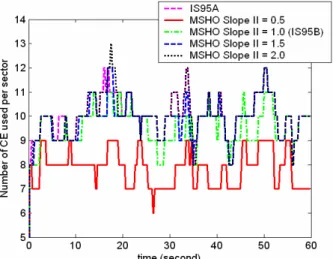
In this section, we will quantify the saving. From Figure 9, the saving in channel elements (CEs) is significant (30% to 50% reduction) at the normal traffic loading situation. Without compromising the connection quality, this reduction in CEs is very important especially the purchasing of CEs will occupy the most portion of the capital investment. Besides, the
5 provisioning on the backhaul to accommodate the CEs’ traffic is even more critical for the daily operation cost.
Figure 9. Channel Element (hardware) Usage at 6-user case 4.4. Processing Load (Handoff Frequency)
For each handoff process, there is a set of call processing messages sent back-and-forth between the base station and the user. This processing load will reduce the capacity of the processor for handling other calls (if the processors have reached the processing limit). From a design perspective, any reduction of unnecessary processing load is always important, especially, when the processing is limited or the relative power consumption is a major concern. In Figure 10, the number of handoff frequency is plotted with different algorithms. As shown, the multi-slope quality-based handoff algorithm has less handoff events in a 60-sec call duration. Among all settings, again the second slope of 0.5 provides the most saving in the handoff trigger events and the associated processing power.
Figure 10. Handoff Events per 60-sec Call
5. Conclusions
In this paper, the performance of the Multi-slope quality-based handoff algorithms is quantified in terms of the connection quality, the forward-link power budget, and the hardware resource allocation. In general, multi-slope quality-based handoff algorithms provide better resource management with comparable connection quality. The intention of having the conservative control in cdmaOne (IS-95A) to ensure the best connection quality does not stand. The resulting increase of the interference will in fact degrade individual user performance. From our studies, with comparable connection quality, the multi-slope quality-based handoff control with the second slope set at smaller-than-slope_I (up tilt from slope I) provides the best saving and reduction in the required transmitted power, the channel element usage and the number of the handoff triggers. Even the actual improvement depends on the traffic load and may vary from market-to-market, the multi-slope handoff control and the design concepts provide the flexibility to meet different design criteria in the future wireless systems.
6. Reference
[1] TIA/EIA IS-95-A, “Mobile Station-Base Station Compatibility Standard for Wideband Spread Spectrum Cellular Systems”, Feb. 1996.
[2] Ning Zhang and Jack M. Holtzman “Analysis of a CDMA soft-handoff algorithm,” Vehicular Technology, IEEE Transactions on , Volume: 47 Issue: 2 , May 1998. Page(s): 710 -714
[3] The Members of Technical Staff, Bell Labs Edited by Kyoung I1 Kim, “HANDBOOK of CDMA System Design,Engineering, and Optimization,” Prentice-Hall, Inc. 2000.
[4] Terry Si-Fong Cheng and Ching Yao Huang, “Base Stations Of Cellular Wireless Communication Systems,” granted on 05/29/2001, U.S. patent number: 6240287 [5] Sung Jin Hong and I-Tai Lu, “Effect of various threshold settings on soft handoff performance in various propagation environments,” Vehicular Technology Conference, 2000. IEEE VTS-Fall VTC 2000. 52nd , Volume: 6 , 2000. Page(s): 2945 -2949
[6] TIA/EIA IS-95-B, “Mobile Station-Base Station Compatibility Standard for Wideband Spread Spectrum Cellular Systems”, Feb. 1999.
[7] Physical Layer Standard for cdma2000 Spread Spectrum Systems, 3GPP2 C.S0002-0 Version 1.0, Version Date: July 1999