Verbal polysemy of Hakka Piong3 (放) ‘to put’: Frames and Constructions*
Huei-ling LAI
National Chengchi University
1. INTRODUCTION
Verbs describing putting, a prototypical exemplar of a caused-motion activity, have been found to be the first acquired and the most frequently used verbs in many languages. Their semantic compatibility with various syntactic structures reinforces the association between verbal meanings and the associated constructions, giving rise to a grouping of related but distinct senses (Goldberg et al. 2004).
Hakka piong3( 放 ) ‘put’, similar to the English verb put, involves a caused-motion activity and can be decomposed as an animate entity exerting its manual force upon another inanimate entity and causing its movement in a particular direction, by the use of certain means, or in a particular manner. Likewise, Hakka
piong3 (放) ‘to put’ demonstrates a case of verbal polysemy. To illustrate, consider the
following examplesi.
(1) ii 待灶下放一罐酒。
ngai5 tai3 zo3 -ha5 piong3 it2 kon3 ziu2
I LOCiii kitchen put one CL wine ‘I put a bottle of wine in the kitchen.’
(2) 甜水粄放烏糖。
Tiam5- sui2- pan2 piong3 vu1- tong5
Sweet rice-pastry put brown sugar ‘To add brown sugar to the sweet rice-pastry’
(3) 甜粄炊好,放幾隻月無問題。
Tiam5- pan2 coi5- ho2, piong3 ki5-chat4 ngiet5 mo5 mun3-ti5
Sweet rice pastry steam-COMP put several month NEG problem
‘Steamed sweet rice pastry can be put (kept) for several months.’
(4) 放厥鴨去河壩亢食水。
Piong3 kia1 ap2 hi3 ho5 pa3 kong3 siit5 sui2
put his duck go riverbank top have water ‘To release the ducks to go to the riverbank for some water’
(5) 心愛放開兜。
sim5 oi3 piong3 koi5 teu1
heart need put open bit (be relieved) ‘To put your heart at rest/to rest your heart a bit’
(6) 放火燒厥屋。
piong3 fo2 seu1 kia1 vuk2
put fire burn his house ‘To set the house on fire’
These examples demonstrate the multitude of senses latent in Hakka piong3. Example (1) illustrates the most typical use of piong3 denoting ‘to put’. Example (2) extends to mean ‘to add. Example (3) extends to mean ‘to be kept’. Each of these examples denotes a change of location. Example (4) means ‘to release’ and example (5) means ‘relieve’ where both designate a metaphorically change of state. Example (6) goes further to mean ‘to set on fire’ where both metaphor and metonymy are responsible for this meaning extension.
With regard to the phenomenon of verbal polysemy, Goldberg (1995) and Jackendoff (1997), among others, have proposed a constructionist account to explain form-meaning pairings. However, the constructionist account is revealing, it does not explicate why a lexical item (i.e., piong3) should exhibit such a wealth of delicate nuances. Hence, the notion of frame that underlies a speaker’s construal and use of language and the concept of perspective need to be reintroduced to account for such phenomena (cf. Fillmore 1985; Fillmore & Atkins, 1992, 2000; Taylor 2003; Lien, 2000). Adopting the theoretical framework of both Fillmore (1985) and of Goldberg (1995, 2006), this study aims to address two issues: to explain why a lexical item (e.g.,
piong3) is able to exhibit such a wealth of delicate nuances and to investigate the
mechanisms involved in the verbal polysemy of piong3. We will scrutinize the interaction between participant roles of piong3 and argument roles of the caused-motion construction. Specifically, we will demonstrate how the syntactical realization of participants of piong3 in phrasal constructions (i.e., [VN] and [VA] constructions, where N stands for a noun phrase, including an object noun, location or a temporal expression and A refers to a cover term for complements such as adjectives and adverbs among other) can generate a grouping of distinct but interrelated senses. In addition to the phrasal constructions denoted by piong3 in examples (1) through (6), more complicated sentential constructions will also be examined so as to provide a detailed analysis of piong3 in Hakka.
present the relevant theoretical frameworks to account for the verbal polysemy denoted by piong3. Special attention is directed to Frame Semantics (Fillmore 1985, Fillmore & Atkins 1992, 2000), Construction Grammar (Goldberg 1995, 2005, 2006), and metaphor and metonymy (Lakoff and Johnson, 1980; Sweetser, 1988, 1990; Traugott & Konig, 1991; Hopper & Traugott, 1993; Bybee & Pagliuca, 1994; Traugott & Dasher, 2002). Section 3 will propose the account, followed by a conclusion in Section 4.
2. THEORETICAL FOUNDATIONS
The traditional view of lexical concepts (i.e., verbs), which are perceptually-based constructs, is fundamentally compositional. Such an approach seeks to make a systematic representation of the internal structure of a word that constitutes its conceptual structure. However, it has been argued at length that the linking of meaning-to-form is not a one-to-one correspondence (Talmy, 1985). That is, a word is better understood with reference to its semantic components, syntactic structures, and particularly the frames it involves.
In the case of Hakka piong3, a single form (i.e., a [VN]/[VA] construction) can be associated with a myriad of interrelated but distinctive senses. Certain relevant frameworks provide a plausible account for the relatedness of the meanings latent in
piong3. Section 2.1 will introduce the basic assumption of frames and perspective.
Section 2.2 will present the main arguments in relation to constructions for an account of the form-meaning pairings of piong3. Furthermore, cognitive-based mechanisms (i.e., metaphor and metonymy) that are used by speakers in conceptual projection are presented for a better account of the verbal polysemy latent in piong3.
Frames and perspective
Frames, responsible for speaker’s construal of the world and use of language, refer to “specific unified frameworks of knowledge, or coherent schematizations of experience” (Fillmore 1985:223). Perspective, a construct, occurs frequently when some components of a frame are in focus. As an illustration of the notion of perspective, let us reconsider Lakoff’s discussion of mother. The notions of frames and perspective can be extended to describe temporal and causative situations. Talmy (1985, 1991) proposes the notion of event-frames and the windowing of attention to verify the claim that frames (or more specifically, motion event-frames), heavily context and culture dependent cognitive models, are shared by all humans.
It makes no sense to talk about event frames in the absence of semantic-syntactic relations among argument, complement, and adjunct. In his follow-up study, Talmy (2000) makes distinctions between complements and adjuncts by examining the
interaction between event frames and their complement structure. Two types of complements to a lexical item are proposed: an obligatory complement, which must co-occur with the lexical item, and an optional complement that may or may not do so. A third type of complement, a blocked complement is proposed as an associated argument which may be expressed by the use of a particular conceptual construction rather than by any particular lexical item.
Talmy’s notion of motion event-frames identifies six components including figure, ground, path, motion, manner, and cause. While the four components (i.e., figure, ground, path, and motion) are conceived of as central and so are claimed to lie within the motion event frame, the others (i.e., manner and cause) as peripheral or incidental lie outside the event frame. Temporal or spatial categories, the most peripheral categories of the motion event frame, are rendered linguistically in adverbial forms, and are conceived of as explicit specifications of the path
component of the whole motion event frame which in Talmy’s term is called the windowing of attention. This term, as suggested by its name, must take place in an event frame where the portion of an event to be profiled in a referent situation is windowed by explicit mention while the remaining portions of that situation are omitted. (Talmy 2000). The cognitive process of foregrounding/backgrounding certain portions of an event-frame can be subject to the notions of perspective and of profiling.
Constructions
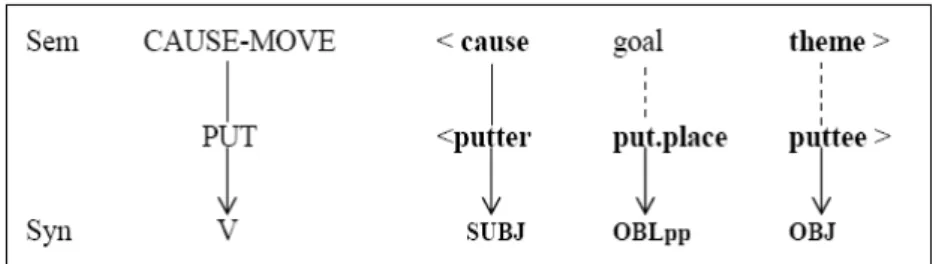
A construction, in Goldberg’s term, refers to any conventionalized pairings of syntactic (phonological and morphological) form with semantic complexity, sometimes including pragmatic inference. That is, grammatical knowledge in a speaker’s mind represents a syntax-lexicon continuum: components smaller than a single word (i.e., a morpheme) or larger than a single word (i.e., phrases, idioms, clauses, sentences, or a larger discourse) can be labeled as a construction. In her analysis of argument structure constructions, Goldberg emphasizes the nature of the constructional relations between constructions. In particular, she argues at length that the proper way to analyze argument structure construction is to investigate the interaction between the participant roles and the whole event/ situation it evokes. Two general principles, the semantic coherence principleiv and the correspondence principle, are employed to constrain the ways in which the participant roles of a verb and the argument roles of a construction can be fused. For example, the argument structure of put is represented in figure 1.
Figure 1. Composite Fused Structure: Caused-Motion+put
At the semantic level, the verb put lexically specifies three profiled participants, namely, putter, put-place, and puttee, while the caused-motion construction profiles two argument roles, namely cause and theme. The Correspondence Principle ensures that the three profiled participants of put must be fused with the profiled arguments of the Caused-Motion Construction in a one-to-one correspondence manner. The Semantic Coherence Principle guarantees that the profiled participant roles of the verb
put must be construable as one instance of their correspondent profiled argument roles
in the Caused-Motion Construction. At the syntactic level, the cause argument manifests itself as subject; the theme argument as object; and the goal argument is rendered linguistically in the oblique slot.
With regard to form-meaning pairings larger than a single word (i.e., idioms, clauses), the constructionist account maintains that all grammatical knowledge is represented as generalized constructions which have their own specific syntactic, semantic, and pragmatic properties that cannot be derived from a set of linking rules but should be rule-governed within the context of that construction. Specifically speaking, the overall interpretation of a clause is arrived at by integrating the meaning of the construction with those of the components in the construction (Kay and O’Connor 1988; Lakoff 1987; Goldberg 1995, 2006).
Metaphor and Metonymy
Most lexical items are polysemous in nature. Two mechanisms, metaphor and metonymy, have been claimed to be responsible for such a prevalent phenomenon. Metaphor, embedded in the everyday use of language and in ways of thinking about the world, involves an understanding of a more abstract concept by use of a more basic, and concrete entity, usually by analogy and iconic relationships. Human body-parts, on account of their geometric features and relative location, have been documented to be the most useful cognitive template to express spatial concepts. For example, nouns for ‘head’ have given rise to FRONT, REFLEXIVE, MIDDLE, and UP markers (O’Neil, 1935; Moravcsik, 1972: 272; Bruce 1984:85; Frajzyngier, 1989: 183). Terms for ‘belly/stomach’ are used as structural template to express the deictic
location of ‘in’ (Claudi and Heine, 1986; Svorou, 1994; Heine and Kuteva, 2002). The metaphorical process is conceptualized as abrupt and discontinuous.
In contrast to a metaphorical process, metonymic strengthening is a gradual and continuous process. Traditionally, metonymy is defined as a figure of speech where the name of one entity is used to refer to another entity. For instance, Shakespeare is
on the top shelf is a metonymic use of a producer to represent his product. In addition
to the continuity relation, a part-whole relation may also exist between two entities. For example, new faces in we need some new faces around here is metonymic since
faces is the most salient part in identifying persons who are new to one. However,
Kovecses and Radden (1998) argue at length that even discontinuous entities within the same conceptual domain (i.e., part-and-part relationsv) may give rise to metonymy. Take Action ICM as an illustration. A number of metonymic relationships can be found in the Action ICM where ACTION FOR RESULT metonymy comes into play. In the case of a deep cut, for instance, the de-verbal noun cut acts as a profile of the direct consequences of the action. The substitution of the de-verbal noun cut for any generic noun denoting a result (i.e., wound) may be more specific and more accessible to the hearers since the cutting action and its result represents a continuous relation within the same Action ICM. Ruiz de Mendoza Ibañez & Díez Velasco (2001) state explicitly as follows:
This metonymy, by highlighting a subdomain of the propositional action ICM, involves the reduction of the conceptual material which is brought to bear upon interpretation.... Processes are congruently expressed as verbs, but they may be reworded metaphorically as nouns, which designate participants in a process. 3. THE MULTITUDE OF SENSES LATENT IN PIONG3 CONSTRUCTIONS
With the theoretical foundations established in Section 2, this section will investigate the form-meaning pairings denoted by piong3. Section 3.1 discusses the verbal polysemy latent in piong3 by scrutinizing the interaction between the semantic role of theme/ location/ temporal expression and the [VN] construction. Section 3.2 examines the delicate nuances which result from the interplay between various complements and the [VA] constructions. Section 3.3 further characterizes three types of [VN] constructions lexicalized into assorted compounds in light of their syntactic elasticity and semantic idiomaticity. Section 3.4 looks into sentential constructions (such as TUNG construction, locative inversion, and etc.).
Hakka piong3 in [VN] constructions
affectedness and syntactic realization. Specifically, the participant assigned to the object position is said to be fully affected by the action whereas the participant assigned to oblique position is not. The [VN] construction as a meaning bearing unit generally denotes the effect of an action on the entity. Such a construction is semantically compatible with the caused motion construction in that the agent acts upon the theme thus causing certain effects on the theme. In addition to such a correlation, it has been widely accepted that a syntactic form may correspond to more than one interpretation since different frames are activated. In the case of piong3, the interaction between the semantic role(s) and the [VN] constructions yields to a multitude of senses. Let us take the following two examples in (7) and (8) as a point of departure to illustrate our point.
(7) 放酒。
piong3 ziu2 put wine
‘To put (place) a bottle of wine (somewhere)’
(8) 放龍銀。
piong3 liung5 ngiun5 put dragon silver
‘To put (place) some silver coins (somewhere)’
First of all, the noun in the [VN] constructions denotes the semantic role of theme. In a prototypical sense, there is physical contact between the agent (though it is temporarily omitted) and the theme as given in (7), where an implicit agent grasps another inanimate theme (i.e., ziu2 ‘wine’) and then they jointly move to a new location. Similarly, the act described in (8) also involves an agentive manual force upon a theme. Given that the object (i.e., liung5 ngiun5 ‘the silver coins’) stay somewhere until being moved, a physical contact made by the agent thus transmits a motion force upon the object and causes the object to undergo a change of location.
Aside from denoting a change of location in the [VN] constructions, the use of
piong3 in the [VN] construction may imply the effect of the relocation on the implicit
goal, as illustrated from (9) to (11).
(9) 放烏糖
piong3 vu1-tong5
put brown-sugar
‘To put (add) some brown sugar’
piong3 tuk5- iok5
put poison
‘To put (add) some poison in(to) food or drink’
(11) 放財產
piong3 coi5- san2
put property
‘To put (leave) some property with (to) someone/ to make a bequest’
Example (9) involves a cooking frame. When the agent puts (adds) the theme (i.e., vu1-tong5 ‘brown sugar’) into the implicit goal (i.e., the sweet rice pastry), the theme dissolves in the goal which enables the goal (tiam5- pan2 ‘plain rice pastry’) to become richer. Example (10) depicts a scene where the adding of poison to food or drink causes a series of chemical changes and thus turns the food or drink into a toxicant. Example (11), the episode involves a metaphorical relocation of the theme from agent to goal: A successful transfer indicates that the theme (i.e., coi5- san2 ‘property’) is no longer in the possession of the agent; instead, the goal (i.e., the implicit beneficiaryvi party) has now taken possession of the property and may grow rich overnight.
The meaning extension of piong3 in the [VN] construction is more conceptually complicated. The overall interpretation is arrived at by the metaphor of CHANGE OF STATE AS CHANGE OF LOCATION, as shown in the following examples:
(12) 放牛
piong3 ngiu5
put cow
‘To put (release) a cow (to pasture)’
(13) 放紙鷂
piong3 zii2- ieu3
put kite
‘To move (fly) a kite into the sky’
(14 ) 放火
piong3 fo2
put fire ‘To put (set) on fire’
(15) 放心
piong3 sim1
‘To put one’s heart at rest/ to be relieved’
(16) 放手
piong3 su2
put hand ‘To open one’s hand’
Example (12) describes a scene where some cows are put out to pasture. Metaphorically speaking, the change of location from a bounded area (i.e., fence) into an unbounded one (i.e., pasture land) implies a change of state from being in captivity to being free. Note further that although the cow is released from the enclosure, it is not totally set free: the owner(s) may be watching the cattle or the cowherd may be holding a long string.
Similarly, the meaning of Example (13) can be explained by consideration of the use of a CHANGE OF STATE AS CHANGE OF LOCATION metaphor. At first, the kite is spatially located at a certain location and remains motionless. Once a volitional entity flies the kite, it changes its location (from a bounded area such as a drawer to a three-dimensional space such as the sky), and the kite becomes active. There will be little surprise at the interpretation of piong3 in (13). That is, although the kite has been released and, in the wake of its relocation, become dynamic, it is still, however, kept under control. What is more interesting here is that the composite meaning is accessed by an additional cognitive mechanism: metonymy. The initial releasing of the kite from one’s palm stands for the whole of the event: the kite flies in the air while one holds onto it by a long string.
In the case of (14), a scenario must be given beforehand. Prior to the introduction of web-field rice production in Taiwan, people used dried straw to ignite a fire. In this case, a person first has to take a hold of the straw which is on fire (or perhaps some dried wood in a stove) and then move it to the target. Dried straw is inactive and harmless. However, at the point of which people move it to fire, it becomes flammable and dangerous. The meaning of this construction can be better explicated through metaphorical mapping. Specifically, it involves the metaphor of CHANGE OF STATE AS CHANGE OF LOCATION where a change of state is understood in terms of movement to a new location.
Aside from physical concrete themes denoted by the nouns (whether they are solid, liquid or gas), the nouns that refer to human body parts can also be associated with
piong3, as exemplified in (15) and (16). The semantic role of theme, namely, sim1 (心)
‘heart’ in (15) and su2 (手) ‘hand’ in (16), lose their referential properties in the [VN] construction; instead, the interplay between the sense of piong3 and that of sim1 (心) ‘heart’ or su2 (手) ‘hand’ determines the composite meaning. While the former
expresses a mental change from an uneasy state to one of greater relief, the latter identifies a shift in human cognition from continuously thinking about something upsetting to ceasing to think about it.
Previous examples have succinctly presented how the semantic role of theme interacts with [VN] constructions and generates a grouping of interrelated senses. Next, we will move on to the discussion of another semantic role in the [VN] constructions. The semantic role of location can be applied to the [VN] construction, indicating the final destination of the caused-motion activity. Three types of location can be construed in the [VN] construction: location as a flat surface, as a container, and as the space immediately next to something else. See the following examples.
(17) 放地泥亢
piong3 ti3-nai5 kong3
put floor above ‘To put on the floor’
(18) 放案桌亢
piong3 on3- zok2 kong3
put table above ‘To put on the table’
Instances (17) and (18) exemplify the most representative choice of location—location as a flat surface. In (17), the place to which the theme is put is a floor; in (18), the surface of a table serves as the location.
The second type of location refers to location as a container. In addition to a flat surface, the three dimensional regions in which all things can exist can also be a location. It is interesting that the three dimensional regions can refer to either a concrete physical container as in (19) or an abstract mental container as in (20).
(19) 放屋家
piong3 vuk2- ka1
put house ‘To put in the house’
(20) 放(佇)心肚
piong3 (du) sim1 tu2
put (DU) heart belly ‘To put (keep) in heart/ mind’
location of the putting event. On the other hand, abstract mentality, i.e.,, sim1 du2 (心 肚) ‘heart’ is metaphorically construed as a location of the movement as exemplified in (20). The final and the more peripheral cases of location, i.e., the space immediately next to something, are found with the [VN] construction as in (21) and (22).
(21) 放(到)田唇
piong3 (do3) tien5 sun5
put (DO) farm ridge
‘To put (something) on a narrow raised strip of plowed land’
(22) 門背角放
mun5 poi3 kok2 piong3
door back inside put ‘To put on the back of the door’
In (21), the location is depicted as a lineal locus located in a separate two-dimensional or three-dimensional space, i.e., the raised space between two areas of plowed land. In (22), the location refers to an enclosed area at which two lines, surfaces, or edges meet and form an angle (i.e., mun5 poi3 kok2 ‘behind the door’).
To sum up, the diversity of spatial representation complements the semantics of
piong3 in the [VN] constructions. The semantic frame with a flat surface simply
represents a change of location from one surface to another. On the other hand, the semantic frame with an enclosed area implies that the moving entity bears certain degrees of significance and, to some extent, needs to be protected. In the last case, the restriction to the shape of location is no longer the frame of reference of an object; instead, any bounded area formed by two lines/ sides may be a candidate for the choice of location.
Admittedly, our metaphorical understanding of time in terms of space has often been noted. The conceptual richness inherent in the spatial domain as a whole maps its structural elements onto time and imparts new meanings to temporal notions. Motivated by such a metaphor (i.e., the TIME-AS-SPACE metaphor) and ACTION-FOR-RESULT metonymy, the object noun indicating the length of time of the resultant state can be found in the [VN] construction. See the following examples.
(23) 放得多日
piong3 tet2 to1 ngit2
put CP many day
(24) 放幾隻月
piong3 ki5 chat2 ngiet5
put several CL month
‘To (be able to) put (be kept here) for several months’
This usage of piong3 constructions extends to mean ‘to put for a prolonged time’. Such an interpretation mainly comes from the ACTION-FOR-RESULT metonymy. Provided that an object is being put onto a location, it stays there until it is otherwise moved. That is, without a motion force exerted upon it, the state of the moved object presumably does not alter. Hence, piong3 can co-occur with a time phrase to specify the time length of the state as shown in (23) and (24).
Hakka piong3 in [VA] constructions
Not only does the [VN] construction exhibit semantic diversity, but the [VA] construction of piong3 may also allow for multiple yet interrelated senses which seem to be contributed to the meanings of the kinds of the following element with which it is associated. Unlike object nouns, modifiers such as adjectives and adverbs acting as complements are optional but predicative. The small set of Hakka data overwhelmingly indicates that certain adjectives and adverbs are predicated of the inanimate object. Let us begin with directional adverbs in the [VA] constructions, which together specify the path of every motion.
(25) 放上天
piong3 song2 tien1
put up sky ‘To put (move) upwards’
(26) 放下(來)
piong3 ha5 ( loi5)
put down (come)
‘To put (move) downwards’
(27) 放入
piong3 ngip5
put enter
‘To put into’
Example (25) specifies an upward direction of the motion; Example (26) indicates a downward motion. In Example (27), the path of the motion is from the outside to the inside. It is worth noting that a different portion of the path is windowed in these examples. In Example (25), a movement from a lower level to a higher level
is windowed. By contrast, Example (26) presents a movement from a higher position to a lower position. Unlike the former two cases, Example (27) only profiles the terminal point of the path.
Next, let us move on to a discussion of the cases where modifiers (i.e., adjectives or adverbs), which are syntactically identified as complements, denote a result. The resultative complement indicates the outcome of the whole event. It has been claimed to be predicated of the following element, indicating a completive effect of the theme posited on the location. Noticeably, not only physical concrete entities but also abstract ones can be predicated by the resultative complement. Consider the following examples. (28) 放滿 piong3 nem5 put full ‘To cover’ (29) 放開 piong3 koi1 put open ‘To let go’
(30) 放襛
piong3 nung5
put loose ‘To make loose’
(31) 放 phet4
piong3 phet4
put away
‘To get rid of’
Generally speaking, the kinds of resultative complements associated with piong3 in the [VA] construction are responsible for the composite meaning. Certain complements specify the holistic effect on the location such as nem5 (滿) in (28). Other complements highlight a resultant state of changing from tenseness to looseness such as koi1 (開) in (29) and nung5 (襛) in (30). Still others mark the momentary manual movement of the leaving of things behind such as phet4 in (31). Note that the resultative complements as in (28)-(30) not only denote a change of state but also encode a causative meaning. In Example (28), there exists a durative relation between
the complement and the main predicate: the completive result will only come into being after the action of putting is accomplished. In complementary fashion, the phasevii complement phet4 ‘away’ in (31) merely signifies a change of state in that the performance of the action immediately brings about the result of a change in stages.
The Lexicalized [VN] constructions
So far, we have discussed two types of piong3 constructions, i.e., the [VN] and the [VA] constructions, unraveling their form-meaning correspondences. Another finding reveals that piong3 can co-occur with a range of arguments/complements in some fixed collocations due to its underspecified meanings. Dong (2002) and Wang (2005) have indicated that grammatical decline in concurrence with frequency in a particular context contributes to the process of lexicalization. As time goes by, these frequently used collocations evolve into assorted compounds.viii
As claimed by Talmy (1985), every language appears to have distinctive ways to represent its semantic structure in lexical forms. Although his argument is revealing, he does not touch upon the issues of the frequency of occurrence in particular contexts or of differences in degrees of lexicalization. Our Hakka data indicate that many frequently-used [VN] constructions have become various compounds, displaying different degrees of lexicalization. Three types of compounds can be delineated based on the following tests—the introduction of complements/aspectual markers, the insertion of classifiers/modifiers, and topicalization.
(32) 放人
piong3 ngin5
put person
‘To put (cast) a spell on someone’
The first type of VN compounds is not lexically open. As in (32), a semantic interpretation of the VN compound should be restricted to the lexicon because the composite meaning of piong3 ngin5 (放人) ‘to put (cast) a spell on someone’ cannot be predicted from some aspect of its form, function, or uses. Examples in this type of VN compounds as a whole contain their syntactic and semantic information unique to one particular construction so that they display a lower degree of syntactic flexibility. Consider the following examples.
(33) a. *放 phet4 人 le。
*Piong3 phet4 ngin5 le
b. *有放過一個人
*iu5 piong3 ko3 it2 ge3 ngin5
have put ASP one GE person c. *人就同佢放 phet4 le。
*ngin5 ciu3 tung5 –ki5 piong3 phet4 le
person then TUNG put CP SFP
The phrase piong3 ngin5 (放人) is ambiguousix: it may designate a releasing event (literal meaning) or a spell-casting event (figurative meaning). The insertion of the complement taking on the phasal function, i.e., phet4 ‘away’, only makes sense in its literal usage but sounds odd in its figurative use. Since the idiomatic use of piong3
ngin5 (放人) has been lexicalized into a single word, denoting ‘to cast a spell on
somebody’, any interruption between piong3 and ngin5 leads to a decay in the meaning.
Classifiers and modifiers provide another useful tool for testing idiomaticity. When piong3 ngin5 (放人) is used to express an idiomatic (a fixed) meaning, the referential property of ngin5 (人) is missing. This loss of referential property thus prevents classifiers from denoting quantity of the object ngin5 (人), as in (33b). Finally, because the noun loses its expressivity, it cannot be modified by the patient marker TUNG (同). That is, its idiomatic interpretation cannot be captured.
Unlike Type 1, the overall interpretation of a Type 2 VN compound can be accessed partially by its components and partially by the mechanisms of metaphor or metonymy. Examples need not be particularly novel to make the point. Consider the following examples.
(34) a. 放心
piong3 sim1
put heart
‘To rest assured/to feel relieved’ b. 放槓
piong3 kong3
put bamboo pole
‘To lower down the bamboo carrier and take a rest’
In (34a), the idiomatic sense ‘to feel relieved’ hinges upon a good grasp of individual words and clever use of spatio-physical metaphors including HEART-IS-A-CONTAINER, REVEALING-IS-OPENING and CONTAINER-FOR-CONTAINED. Specifically, at first glance, the physical body part sim1 (心) is conceptualized as a container filled with feelings. Next, the opening of the physical container is mapped onto the revealing of the abstract feelings through the metaphors of REVEALING-IS-OPENINGS, and CONTAINER-FOR-CONTAINED.
Aside from metaphorical interpretation of a VN compound, the metonymic construal of a VN compound can also be detected. As shown in (34b), its semantic interpretation is calculated by an event chain where the initial act of lowering down the bamboo carrier stands for the whole event: temporarily resting from work. With respect to the syntactic elasticity, VN compounds of Type 2 are more flexible than those of Type 1. This can be exemplified in the following examples.
(35) a. 放毋落心
piong3 m5 lok5 sim1
put NEG down heart ‘To be unable to soothe an anxious heart’
b. 毋[放心]厥老弟
m5 piong3-sim1 kia2 lo2 ti3 NEG put-heart his younger brother ‘He cannot stop worrying about his younger brother.’ c. 心,愛同佢放開兜
sim5, oi3 piong3 koi5 teu1
heart need put open bit ‘Let your feelings go a little bit.’
Example (35a) illustrates the use of a negative complement (consisting of a negative marker m5 (毋) and a complement lok5 (落) ‘down’) between the verb
piong3 (放) and the object sim1 (心). Even though the negative complement separates
the V and the O, its idiomatic meaning remains intact except for the expression of a negative sense. Example (35b) depicts a situation where the speaker cannot help but worry about his brother. The whole sentence provides evidence for the line of argument that piong3 sim1 (放心) has been lexicalized into a verb and denotes a particular meaning of ‘to relieve’. Specially put, because the referring function of the noun sim1 (心) has gradually declined, the argument structure of the noun sim1 (心) ‘heart’ may be interpreted as the direct internal argument of piong3 (放). As a result, the noun sim1 (心) has further developed into a lexicalized item, syntactically behaving like a transitive verb and sanctioning an object slot for the following noun
lo2 ti3 (老弟) as shown in (35b). In Example (35c), the object sim1 (心) is topicalized;
however, its idiomatic interpretation remains intact, denoting ‘to let go of something’. Next let us move to Type 3 where the idiomatic interpretation hinges completely upon the interaction between the individual components without further operation of metaphor or metonymy.
VN compounds of Type 3 display the highest degree of syntactic elasticity and the lowest degree of semantic idiomaticity. That is, the overall interpretation of a VN compound is the composite meaning of its parts. Consider the following examples.
(36) a. 放烏糖
piong3 vu1- tong5
put brown-sugar
‘To add brown sugar (somewhere)’
b. 放鴨
piong3 ap2
put ducks
‘To release ducks (for some water)’ c. 放紙鷂
piong3 zii2- ieu3
put kite ‘To fly the kite’ d. 放風
piong3 fung1
put wind ‘To allow a release of air’
These examples demonstrate a multitude of senses latent in piong3 when it occurs in the VN compounds. To pick up an appropriate sense of piong3, speakers have to understand the sense of the following noun with which it is associated. In Example (36a), the combination of the verb piong3 (放) ‘to put’ and the noun vu1 tong5 (烏糖) ‘brown sugar’ evokes a cooking frame which also contributes to the composite meaning of this VN compound. Likewise, the releasing sense latent in piong3 (放) is picked up by the following noun ap2 (鴨) as shown in (36b). Other senses including flying a kite as in (36c) and the releasing of air as in (36d) are both activated by the semantics of piong3 and by those of the following noun phrases.
Regarding syntactic flexibility, a VN compound of Type 3 is harmonious with a range of syntactic structures. The syntactic tests utilized above can be applied to VN compounds of Type 3 without any loss of expressivity. For instance, the object nouns in most examples can be modified by quantitative classifiers/modifiers as shown in (37a-c).
(37) a. 放一匙烏糖
piong3 it2 cii5 vu1-tong5
put one spoon brown sugar ‘To add a spoonful of brown sugar (somewhere)’ b. 放一隻鴨
piong3 it2 zak2 ap2
put one CL ducks ‘To let a duck go’
c. 放一 ge 紙鷂
piong3 it2 ge zii2-ieu3
put one CL kite ‘To fly a kite’
In addition to classifiers, nouns in VN compounds of Type 3 can receive the patient marker TUNG (同) and/or move to the left side of the verb. The insertion of a patient marker TUNG (同) in concurrence with object fronting does not alter the central idea of the VN compound but furnishes other linguistic information such as the foreground-background distinction in pragmatics. See the following examples.
(38) a. 烏糖同佢放兜落去。
vu1-tong5 tung5-ki5 piong3 teu5 lok5 hi3
brown sugar TUNG put bit down go ‘Brown sugar, add some.’
b. 鴨同佢放出去。
ap2 tung5- ki5 piong3 cut2 hi3
duck TUNG put out go
‘Ducks, let them go.’ c. 紙鷂同佢放上天。
zii2- ieu3 tung5-ki5 piong3 song3 tien1
kite TUNG put up sky ‘Kite, fly it above in the sky’
To summarize, the overall interpretation denoted by a VN compound of Type 3 does not come from a fixed co-occurrence of individual lexical items. That is, the semantics of a VN compound need not be restricted to the lexicon because both the form and the meaning are in conformity with the general rules. The Semantic componentiality and syntactic predictability of the VN compound thus guarantees a higher degree of syntactic flexibility. Figure 2 summarizes the negative correlation between syntactic flexibility and degrees of idiomaticity.
Type (3) piong3 vu1-tong5 (放烏糖)
‘To add some brown sugar (to somewhere)’ Syntactic
Figure 2 The interplay between syntactic flexibility and degree of idiomaticity
The shape of the curve reveals the negative correlation between syntactic flexibility and degree of idiomaticity: the more elastic the syntax, the less the degree of idiomaticity, and vice versa.
Hakka Piong3 in sentential structure Canonical Constructions
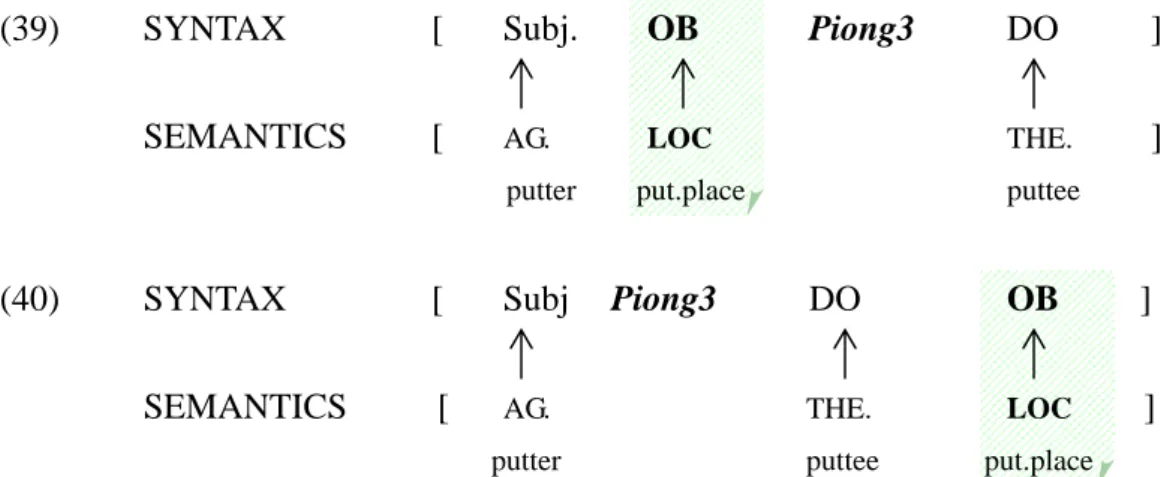
Constructions, varying in size and complexity, can be applied to the interpretation of basic sentence patterns. Canonical representations of piong3 constructions profile the most three salient participants and assign them to subject, (direct) object, and oblique, respectively. In spite of slight differences in the oblique position (i.e., preverbal or postverbal), canonical piong3 constructions capture the insight that the meaning of “an agent causes a theme to move to a location” comes to be associated with the Subj V Obj Oblpath.Loc syntactic pattern. Below are two prototypical constructions which represent the mapping between semantics and syntax.
(39) SYNTAX [ Subj. OB Piong3 DO ]
SEMANTICS [ AG. LOC THE. ]
putter put.place puttee
(40) SYNTAX [ Subj Piong3 DO OB
]
SEMANTICS [ AG. THE. LOC ] putter puttee put.place At the semantic level, the meanings in (39) and (40) are related to the same scenes, denoting a successful transfer by an agent of a theme to a location. At the syntactic level, the two alternative syntactic patterns can be fused with the general putting verb piong3. The syntactic categories in both constructions are the same, but
Type (1) piong3 ngin5 (放人)
‘To cast a spell on someone’ Type (2) piong3 sim1(放心)
‘To put one’s heart at rest/to feel relieved’
are rendered in different ways. In Pattern (39), the oblique, denoting a path or a location, occurs before the verb whereas that in (40) takes up a postverbal position. For example, both Sentence (41) and Sentence (42) describe the same scene where the agent puts a bottle of wine on the table.
(41) 佢待桌亢放一罐酒。
ki5 dai3 zo3-hong3 piong3 it2 kon3 ziu2
he LOC table top put one CL wine ‘He put a bottle of wine on the table.’
(42) 佢放一罐酒佇桌亢。
ki5 piong3 it2 kon3 ziu2 du3 zok2 kong3
he put one CL wine DUx table top ‘He put a bottle of wine on the table.’
Both sentences involve a caused motion event; however, they differ in their placement of location and their choice of locative markers. Specifically speaking, in Sentence (41), the locative phrase occurs before the main predicate while in Sentence (42), the same location takes up a postverbal position. With respect to the choice of locative markers, a preverbal locative phrase is pervasively found in line with the locative marker dai3 (待), designating the location where an action takes place. On the other hand, a sentence with a postverbal locative phrase appears to be introduced by the locative marker du3 (佇)/do3xi (到), specifying the terminative location of the motion.
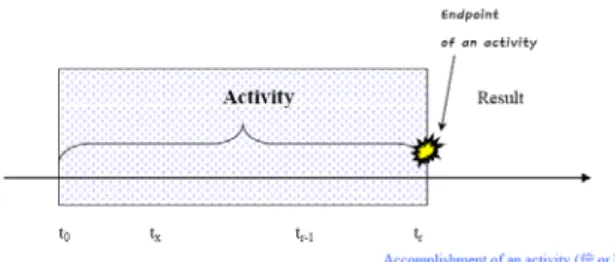
As noted above, the two constructions are identical in meaning. However, there seems to be no reason for a language to have two distinct syntactic forms denoting exactly the same meaning. The two canonical constructions denoted by piong3, in fact, represent different shades of meaning. The difference is illustrated in the following figures.
Figure 4 Time axis highlighting the end result of the event
The two figures each represent the progression of an event over a certain time span from its beginning at t0 over a subsequent series of time intervals tx and tr-1 to its end-result state at tr (Boas, 2003). Two specific perfectives are indicated by the boxes containing the exploding star. Whereas the event depicted in Example (41) places an emphasis on the starting point of the event, that in Example (42) highlights the endpoint of the event although both examples contain the information about the final stage of the event, namely, the result state of the patient participant (i.e., the bottle of wine is now on the table). In other words, the choice of the locative marker dai3 (待) in Example (41) serves to convey a specific perspective of the event, namely the starting point of a putting activity initiated by the agent participant. Alternatively, the use of du3 (佇) or do3 (到) to introduce a postverbal locative phrase as in (42) expresses a specific concern about the end point of the putting activity although the nature of the two events both entail the completion of the putting activity.
To sum up, investigation into the canonical constructions uncovers the following generalizations. To begin with, there are two formal representations of piong3 constructions: one has a preverbal locative phrase while the other has a postverbal one. Second, both constructions indicate the completion of an action, i.e., the completion of a caused-to-move activity; nevertheless, they are dissimilar in that they convey different perspectives of the event depending on the nature of the locative markers which are added. That is, when introduced by the locative marker dai3 (待), the sentence with a preverbal locative phrase specifies the importance of the starting point; on the other hand, when marked by du3 (佇) or do3 (到), the perspective shifts to the very moment at which an action is accomplished.
Non-Canonical Constructions
Constructions with argument omission are grouped into the non-canonical representation of piong3 constructions. An explanation of such phenomena can be provided by factors such as Grice’s maxim of Quantityxii and Goldberg’s pragmatic mapping generalization.xiii Compared with the canonical groups, the instances of argument omission under certain pragmatic factors are found pervasively in a range of
Hakka piong3 constructions. In what follows we concentrate on the extent to which these non-canonical constructions are represented in various forms: TUNG constructions, locative inversion, and the deprofiled object construction.
TUNG, a free variant of North Sixian Hakka LAU, is used exclusively in Dongshi Dapu and Hailu Hakka. A TUNG construction performs four grammatical functions: comitative, source/goal, benefactive, and patient functions (Lai 2003, Chiang 2006). In particular, the patient function is frequently found with the non-canonical constructions denoted by piong3 as illustrated in a [(NP1) TUNG NP2 V NP3] construction or in a [NP2 TUNG-KI V NP3] construction where NP2 is marked as the entity undertaking the result of the action. Specifically speaking, the first construction maximally provides three syntactic slots for all participant roles of piong3: NP1 for the agent, NP2 for the theme, and NP3 for the location. It is worthy of note that NP1 tends to be unexpressed in the first construction when it is construed to be non-focal or predictable in the discourse. With regard to the second construction, it can be treated as an instance of topicalization in that the agent is always made implicit. More specifically, the theme role (i.e., NP2) is moved to the front of the sentence and functions as the topic. In the second construction, the theme (i.e., NP2) precedes the patient marker, adds a resumptive pronoun ki2 (佢xiv) ‘he’ directly to TUNG followed by the main predicate. Since the TUNG construction usually involves a caused-to-move activity, almost all action verbs which can measure out an event are semantically compatible with the TUNG construction. That is, predicates that have an end point for the event and that can have a resultative complement can occur with the patient TUNG construction. The Hakka general putting verb, piong3 (放), does not inherently specify a delimited event but has been found to concur with the TUNG construction as exemplified in (43), which describes a scene where a book is put on a desk.
(43) a. ngai 同書放佇桌亢。
ngai tung2 su5 piong3 du3 zok2 kong3
I TUNG book put DU desk top ‘I put the book on the desk.’
b.書同佢放佇桌亢。
su1 tung2 -ki5 piong3 du3 zok2 kong3
book TUNG put DU desk top ‘The book was put on the desk.’
In Sentence (43a), all of the participant roles (i.e., agent, theme, location) are profiled and syntactically realized as subject, direct object, and oblique. In Sentence (43b), only the theme and the location are made explicit and are rendered in the subject and
oblique, respectively. As noted above, a TUNG construction only allows such verbs as can measure out an event to enter into the construction. The piong3 intrinsically denotes in itself an atelic unbounded activity, which activity may be excluded from the TUNG construction. Nevertheless, the attachment of certain adjuncts (signifying a terminal point for the event) to piong3 such as du3 (佇) ‘be in’ sanctions the semantics-syntax compatibility with TUNG constructions as shown in (43). Other adjuncts or adverbials such as the postverbal locative marker do3 (到) ‘to arrive’, the directional adverbial ha3 loi5 (下來) ‘downwards’, and the temporal expression ki5
chat ngiet5 (幾隻月) ‘for several months’ can be added to signify the terminal point
of the putting event as illustrated in Examples (44) through (46).
Example (44) and (45) are instances of the [(NP1) TUNG NP2 VP] construction whereas Example (46) is that of the [NP2 TUNG-KI VP] construction.
(44)同兩斗米放到篩仔頂。
Tung2 liong2 teu2 mi2 piong3 do3 ci1-e5 tang2 TUNG two CL rice put DO sieve top ‘Two scoops of rice were put (placed) on one top of the sieve.’
(45)同婦人家放下來。
Tung2 fu3- ngin5- ka5 piong3 ha3 loi5
TUNG woman put down come
‘The woman was let down onto the floor (from someone’s back). ’
(46)甜粄炊好,駛得同佢放幾隻月沒問題。
tiam5-pan2 coi1 ho2 sii2- tet2 tung2-ki5 piong3
sweet rice pastry steam CP, AUX TUNG put
ki2-chat2 ngiet5 mo5 mun3-ti5
several month NEG problem
‘The sweet rice pastry can be put (kept) for several months after it has been steamed.’
Sentence (44) describes a scene where rice is replaced in a sieve. In Example (44), the locative marker do3 (到) denoting the end point contributes to a terminative meaning. That is, the successful transfer of the rice to the end location, ci1 e5 tang2 (篩仔頂) ‘in the sieve’ indicates the completion of the whole event.
Sentence (45) is about someone performing an action which results in a woman and causing her to change her location (specifically, from a higher to a lower place). In this case, a directional complement is used to measure out the whole of the event. More particularly speaking, the relocation of the woman to a lower place simultaneously brings about the endpoint of the action denoted by the verb. Note that
in Example (45), only the theme role, i.e., fu3- ngin5- ka5 (婦人家) ‘a women’, which undergoes a change of location, is overtly expressed.
As mentioned earlier in Section 3.4.2, this phenomenon can be explained with reference to pragmatic or discourse factors: arguments are prone to be unexpressed when they are predictable and non-focal in the discourse. In this example, due to the degree to which the arguments are predictable and recoverable from the context, the end point, namely the ground, can be cast in shadow. Similarly, Example (46) specifies a delimited event by the use of a temporal expression, ki5 chat2 ngiet5 (幾隻 月) ‘for several months.’ The usage of piong3 constructions as in (46) extends to mean ‘to put (place/leave) for a prolonged time’. Such an interpretation comes from the ACTION-FOR-RESULT metonymy. When an object is being put (placed) onto (in) a location, it stays there otherwise until it is moved. Without a motion force exerted upon it, the state of the moved object presumably stays. Hence, piong3 can co-occur with a time phrase to specify the time length of the state.
It has been richly documented that the position of locative phrases, i.e., preverbally or postverbally placed, yields to shades of meanings (Chao 1968, Tai 1975, Li & Thompson 1981, Liu, Pan, & Gu 1983, Norman 1988, Peyraube 1994, Lamarre 2003). Generally, a preverbal locative phrase denotes the location of an event or a state of affairs whereas a postverbal locative phrase designates the relocation of a moved theme/participant or a state resulting from a change of location. Lamarre (2007) further demonstrates that preverbal and postverbal locative phrases take on distinct semantic functions. When placed before the verb, the locative phrase usually describes an unbounded event, taking the durative meaning. On the other hand, when placed after the verb, it is more often than not terminative. That is, the postverbal locative phrase depicts a dynamic bounded event, expressing the GOAL of the motion. Compare sentences (47) and (48).
(47)銀櫃下,就放兩個龍銀啦吭。
ngiun5-kui3 ha5, ciu3 piong3 kin2 liong5 ge3
sliver-cabinet down then put KIN two GE liung5 ngiun5 la1-hong5
silver coin SFP
‘There are two silver coins in the money box.’
(48)恁泥就放石頭放路屯, 啊兩邊滾啊。
an2 nai5 ciu3 piong3 sak5 -teu5 piong3 lu3- tun5,
so then put stone put road-middle of
a5 liong5 pien1 kun2 a1 PART two side roll SFP
Sentence (47) describes the scene where two silver coins are kept in a money box. The position of the locative phrase, ngiun5 kui3 ha5 (銀櫃下) ‘in the money box’ is placed preverbally, denoting a state seen as continuing for a period of time. Example (48) depicts a situation where stones are put (placed) in the middle of the road, so as to roll back and forth. The placement of the locative phrase, lu3 tun5 (路屯) ‘in the middle of road’ as in (48) illustrates the postverbal use of locative phrases, encoding an endpoint of the motion. Another source of evidence for this idea comes from the concurrence of the main predicate and the durative marker kin2 (緊). Contrast the following examples again.
(49)銀櫃下,就放緊兩個龍銀啦吭。
ngiun5 kui3 ha5, ciu3 piong3 kin2 liong5 ge3
sliver cabinet down then put KIN two GE liung5 ngiun5 la1-hong5
silver coin SFP
‘There are two silver coins in the money box.’
(50)*恁泥就放石頭放緊路屯, 啊兩邊滾啊。
* an2 nai5 ciu3 piong3 sak5 -teu5 piong3 kin2 lu3- tun5,
so then put stone put KIN road-middle
a5 liong5 pien1 kun2 a1 PART two side roll SFP
‘*So, let’s put the stone in the middle of the road, and let it roll along naturally.’
The durative maker kin2 (緊) in Example (49) is semantically compatible with the whole of the construction. Since the sentence contains a preverbal locative phrase, it describes an unbounded event, taking a durative meaning. Example (49) illustrates the state of the moved silver coins; they presumably stay in a certain place until otherwise being moved. On the other hand, Example (50) illustrates a different case where the marker kin2 (緊) is semantically incongruous with the sentence. Example (50) designates a dynamic event where the action of the agent upon the stone causes another event; the stone rolls along rather than stays motionless. The meanings of the durative marker kin2 (緊) and that of Example (50) are contradictory. Hence, it is semantically anomalous to connect the two.
Summarizing the discussion so far, the semantic function of a preverbal locative phrase denotes the location of an action or a state of affairs while that of a postverbal
locative phrase specifies the resultant location of a participant. Next, sentences with a preverbal locative phrase can be used with the durative marker kin2 (緊) only when the locative phrase is not introduced by any locative markers.
After the discussion of the locative inversion, let us move on to discussion of the deprofiled object construction, in which patient arguments are omitted under certain pragmatic conditions. Generally speaking, patient arguments of causative verbs are necessarily always expressed in all contexts, due to the fact that they undergo the change of state denoted by the verbs. However, one of the piong3 constructions allows the omission of the patient argument under certain discourse conditions. As shown in Section 3.3, piong3 can co-occur with a variety of arguments/complements in certain fixed collocations. As time goes by, these frequently-used collocations evolve into assorted compounds, bringing new life into the lexicon. It is observed that the elements in the VN compound are semantically fused with each other; the omission of the object noun does not distort its idiomatic meaning. The following examples illustrate this point.
(51) 頭擺愛對泥水師傅真好,無款待佢真好吭,攏會放(人)。
teu5- pai2 oi3 dui3 ni3-sui2 sii5-fu3 ziin5 ho2, mo5
past need treat cement master very good NEG
kuan2-tai3 ki5 ziin5 ho2 hong5, lung5 voi3 piong3-ngin5
hospitality him very good PART all AUX put people ‘In the past, the householder needed to treat the plasterer very well, otherwise the plasterer could cast a spell on him.’
(52) 你激這都無麼,總下壞壞落落个放落去。
n5 kiep5 lia to3 mo5 -mak2, zung2-ha5
You make (wine) this DO NEG all
fai3-fai3- lok5-lok5 ge piong3 lok5 hi3
gone sour GE put down go
‘The wine you have made is no good because what you added has made everything go sour.’
(53) 厥孻都三十零歲个人咧,佢還放毋落 (心)。
kia5 lai3 to3 sam5-siip5 leng se3 ge ngin5 le1
his son TO thirty more years GE person, LE ki5 han5, piong3 mu5 lok5 (sim1)
he still put NEG down (heart)
‘Even though his son is in his thirties, he still worries about him.’
(54) 學校 228 有放(假)喔。
school Peaceful Day have put (holiday) SFP ‘The February 28, Peace Day, is a national holiday.’
Obviously the patient arguments of the examples in (51-54) are unexpressed. Example (51) designates a scene where a malicious workman (i.e., plasterer) puts a spell on somebody if he is not well-treated. Example (52) describes a situation in which one mocks at his friend’s poor skill in making wine for his ignorance in the use of the materials: his friend has caused stale matter (such as stale grapes) to be added to a wine vat careless about whether it is fresh or not. Example (53) depicts a scene where a mother can not change her mental state from being worried to being at ease; in (54), the dean of the Office of Academic Affairs, following regulations, declared that February 28 would be a holiday.
There seem to be two factors that can motivate this phenomenon: pragmatic recoverability and discourse prominence. The first motivating factor indicates that because all shaded patient roles are completely recoverable in contexts, they may be cast in the shadows. Also, non-topical or non-focal arguments tend to be omitted since they are irrelevant to the discourse compared with the action, as stated by Goldberg’s Principle of Omission under Low Discourse Prominence:
(55) Principle of Omission under Low Discourse Prominence
Omission of the patient argument is possible when the patient argument is construed to be deemphasized in the discourse vis à vis the action. That is, omission is possible when the patient argument is not topical or (focal) in the
discourse, and the action is particularly emphasized. (Goldberg, 2000)
4. CONCLUDING REMARKS
To explore the multiple senses latent in piong3, we have taken up the notion of frames proposed by Fillmore (1985) and have also referred to the new insights into the formation of constructions as stipulated by Goldberg (1995, 2005, 2006) to account for the verbal polysemy denoted by piong3. We have argued at length that the delicate differences in nuances which can be created by piong3 can only be identified when its verbal usages, constructions, and frames are taken into consideration. Furthermore, we demonstrate that the extended meanings denoted by piong3 can be linked to its typical use through various metaphors and metonymies such as CONTAINER, EVENT STRUCTURE, CHANGE OF STATE AS CHANGE OF LOCATION metaphors and ACTION FOR RESULT metonymy.
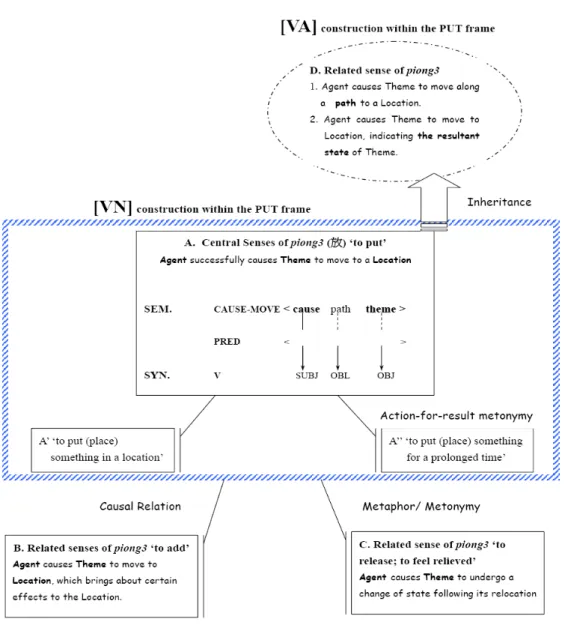
level, the typical use of piong3 describes a change of location, signifying ‘to put’, ‘to put (place) in a location’ and ‘to put (place) something for a prolonged time’ as indicated by the rectangles A, A’, and A’’. Next, strengthened by the causal relation, the use of piong3 comes to denote ‘to add’ as represented in Rectangle B. Next, motivated by metaphor or metonymy, the extended use of piong3 indicates a change of state, signifying ‘to release’ or ‘to relieve’ as shown in Ellipse C. On the other hand, the interplay between piong3 and the various complements (i.e., path and result) enriches the semantics of the basic piong3 in that the path of the motion and the resultant state of certain participants are overtly expressed.
At the sentential level, we have explored canonical and non-canonical constructions denoted by piong3. With regard to the canonical construction, the agent is mapped to the subject; the theme to the object; and the location to an oblique. Two canonical patterns are represented in the piong3 constructions in that they differ in their oblique positions (i.e., constructions with a preverbal or a postverbal locative phrases) and in the choice of locative markers. The construction with a preverbal locative phrase (introduced by dai (待)) typically highlights the starting point of the event, whereas one with a postverbal locative phrase (introduced by du3 (佇) or do3 (到)) emphasizes the very moment at which an action is completed. As for the non-canonical constructions (including TUNG constructions, locative inversion, and the deprofiled object constructions), certain obligatory participants are syntactically unexpressed owing to certain pragmatic factors.
Figure 5 The interrelated senses denoted by piong3
Several issues remain to be resolved with regard to the phenomena in question. First of all, as demonstrated above, Hakka piong3 in the examples in the caused-motion construction shows a strikingly similar pattern of polysemy. Inherited from the central sense, each of the extensions can be applied to a minimally different construction such as the ditransitive construction as exemplified in (11). The phenomenon captures the semantic relation between the caused-motion construction and the ditransitive construction remains for future study. Furthermore, issues related to the congeners of piong3, their interplay with various constructions, and their degree of lexicalization still remain to be explored. Hence, a detailed analysis of these congeners requires future research. Finally, and most importantly, the establishment of a systematic Hakka database will be a paramount task in the near future as it will be able to provide more authentic linguistic sources to advance Hakka studies.
NOTES
* This study is partially based on the NSC research project 客語近義動詞之詞彙化類型 (NSC-90-2411-H-004-013). An early version of this paper was presented at Chinese Lexical Semantics Workshop 2007. Special thanks extend to Chin-Chuan Cheng and Chinfa Lien for their valuable comments and suggestions.
i
The Hakka data set comes from daily use of Dongshi Hakka, Hakka magazine (客家雜 誌), and Hakka Stories from Dongshi (1) to (7) (東勢客語故事集一~七).
ii
There are certain dialectal differences among the sub-dialects of Hakka, including Hailu Hakka, Northern Sixian Hakka, Southern Sixian Hakka, and Taipu Hakka (Dongshi). The data presented in this paper are derived chiefly from Taipu Hakka (Dongshi). The pronunciation of the Hakka is rendered according to The Manual of Taiwan Hakka Tongyong Romanization
System (台灣客語通用拼音使用手冊), authorized by the Ministry of Education in Taiwan, is
used to render the Hakka pronunciation.
iii
The following abbreviations are used for their corresponding grammatical functions: PM, a patient marker; LOC, location; CL, a classifier; COMP, a complementizer; CP, a complement; NEG, a negative marker; REFL, reflexive. SFP, a sentence final particle; ASP, an aspect marker; GE, de; TUNG, a patient marker; DET, a determiner; KIN, a durative marker; DU, a marker of the end of location of the motion; and AUX, an auxiliary verb.
iv
The fusion of the participant roles of a verb with the argument roles of a construction must conform to two general principles: the Semantic Coherence Principle and the
Correspondence Principle. The former guarantees semantic compatibility of the participant
roles and argument roles. In other words, the more specific participant roles of a verb must be qualified as an instance of the more general argument roles of a construction. On the other hand, the default principle, the Correspondence Principle, ensures that each obligatory lexically-profiled participant role must be fused with an argument role of the construction.
v
There are various types of part-and-part relations such as Action ICM, Perception ICM, Causation ICM, and Containment ICM. In their discussion of Action ICM, Kovecses and Radden (1998) indicate that there are types of metonymic relationships within an Action ICM, including ACTION-FOR-RESULT, INSTRUMENT-FOR-ACTION, AGENT-FOR-ACTION, ACTION-FOR-AGENT, OBJECT-FOR-ACTION, ACTION-FOR-OBJECT,
RESULT-FOR-ACTION, MEANS-FOR-ACTION, MANNER-FOR-ACTION,TIME PERIOD-FOR-ACTION, DESTINATION-FOR-ACTION, and
TIME-OF-MOTION-FOR-ACTION.
vi
Lien (2004:403) argues at length that the caused-motion construction in Taiwanese Southern Min has developed into the ditransitive, sometimes called the “benefactive” construction in that ditransitive expressions are syntactically unique in allowing two noun phrases to occur after the verb: the agent role
must be fused with the subject; the patient role with the indirect object position; and the recipient role, contributed by the construction, is linked to the direct object position.
vii
Originally acting as a verb, denoting ‘to get rid of’, the resultative complement phet4 in Hakka has developed into a phase marker, used to indicate situation in time relation as in
piong3 phet4 (放 phet4) ‘to let go’ or sit phet4 (吃 phet4) ‘to eat up’. However, a wealth of
Hakka data have shown that the phase marker phet4 is starting to evolve into an aspect marker as in soi3 phet (睡 phet4) ‘to fall asleep’. An account of the syntactic and semantic development of phet4 will be left for another context.
viii
Wang (2005) discusses the development of wu4 se4 (物色) ‘to search’. He claims that in ancient Chinese texts, the collocation of wu4 se4 as an adverbial was used exclusively to indicate a means as in di4 sih1 ci2 sian2, nai3 wu4 se4 ciou2 jhih1 (帝思其賢,乃物色求之) ‘the Emperor thinks that he (Yan2 Gong1) is a person of high caliber and moral excellence, so the Emperor presented some pure unworked silk to Yan2 Gong1 in recognition of his skills and as an inducement to Yan2 Gong1 to work in his service’. Strengthened by high frequency
in most contexts, the adverbial wu4 se4 is informative in conveying a relation between the action and the means, as in yi4-rih4, wu4 se4 jhih1, guo3 de2 ci2 ren2 (翌日,物色之,果得 其人) ‘Next day, he visited the competent person and managed to recruit the person’. Such a development is an illustration of grammaticalization/lexicalization in that although some facets of a word become dormant, and others come to be activated (Sweetser 1998, Epstein 1994).
ix
The ambiguous phrase piong3 ngin5 (放人) takes a different stress. When it is used literally, the stress falls upon the noun, i.e. ngin5 (人). When it takes on the idiomatic reading, in contrast, the stress moves to the verb, i.e. piong3 (放).
x
The following abbreviations are used for their corresponding grammatical functions: DU, a marker of the end of location of the motion; KIN, a durative marker; DET, a determiner; AUX, an auxiliary.
xi
The locative marker do3 (到) is widely used in Hakka. The choice of do3 (到)or du3 (佇) is a matter of dialectal variation.
xii
Grice’s maxim of quantity refers to one of the cooperative principles in that speakers are assumed to make their contribution as informative as is required.
xiii
Goldberg’s (2006) Pragmatic Mapping Generalization indicates that any semantic participants that are irrelevant and recoverable from the context can be deprofiled while the participants that are relevant to the context must be overtly expressed.
xiv
According to Chiang (2006), the resumptive pronoun ki2 (佢) with TUNG in a TUNG construction can be used in bipartite ways: referential and non-referential. In its referential use, 佢 refers to its antecedent patient NP1 (i.e., co-referentiality with NP1) except in cases where NP1 denotes a kind of instrument. On the other hand, ki2 (佢) seems to lose its referential property and come to blend with TUNG, together functioning as a patient marker, and allowing another NP to attach to it as shown in an3 ok7 kai3 ngin2 min2, po3 kiam5 oi5
ti2 ki2 kam3 phet7 hi5 (恁惡 ge 人民,寶劍要同佢佢砍掉去) ‘Such a wicked person should
be beheaded with a sword’.
REFERENCES
Boas, Hans Christian. 2003. A Constructional Approach to Resultatives. Stanford: CSLI Publications.
Bybee, Joan, Revere Perkins and William Pagliuca. 1994. The Evolution of Grammar, 281-302. Chicago: The University of Chicago Press.
Chiang, Min-hua. 2006. Grammatical characteristics of tung and bun in Dongshi Hakka and the relatedness of the two markers. Language and Linguistics 7.2: 339-364.
Croft, William. 1998. The structure of events and the structure of language. The New
Psychology of Language: Cognitive and Functional Approaches to Language Structure, ed. by Michael Tomasello, 67-92. Mahwah, N.J.: Lawrence Erlbaum
Associates.
Dong, Siou-fang. 2002. Lexicalization of syntactic structure. Linguistics Study 3: 56-65.
Fillmore, Charles J. 1985. Frames and the semantics of understanding. Quaderni di