行政院國家科學委員會專題研究計畫 成果報告
台閩語字調連結與界限強度
研究成果報告(精簡版)
計 畫 類 別 : 個別型
計 畫 編 號 : NSC 98-2410-H-009-038-
執 行 期 間 : 98 年 08 月 01 日至 100 年 01 月 31 日
執 行 單 位 : 國立交通大學外國語文學系
計 畫 主 持 人 : 潘荷仙
計畫參與人員: 碩士班研究生-兼任助理人員:林厚邑
碩士班研究生-兼任助理人員:潘鈺楨
大專生-兼任助理人員:呂紹任
大專生-兼任助理人員:謝依伊
其他-兼任助理人員:柯怡朱
處 理 方 式 : 本計畫可公開查詢
中 華 民 國 100 年 03 月 21 日
行政院國家科學委員會補助專題研究計畫
成果報告
期中進度報告
(台閩語字調連結與界限強度)
計 畫 類 別 :
個 別 型 計 畫 □ 整 合 型 計 畫
計 畫 編 號 :
NSC
98 - 2410 - H - 009 - 038
執行期間: 2009 年 08 月 01 日至 2011 年 01 月 31 日
計
畫
主
持
人
:
潘
荷
仙
計畫參與人員:
柯怡朱、呂紹任
、謝依伊、林厚邑、潘鈺楨。
成果報告類型(依經費核定清單規定繳交):□精簡報告
完整報告
本
成
果
報
告
包
括
以
下
應
繳
交
之
附
件
:
□
赴
國
外
出
差
或
研
習
心
得
報
告
一
份
□ 赴 大 陸 地 區 出 差 或 研 習 心 得 報 告 一 份
□ 出 席 國 際 學 術 會 議 心 得 報 告 及 發 表 之 論 文 各 一 份
□國際合作研究計畫國外研究報告書一份
處理方式:除產學合作研究計畫、提升產業技術及人才培育研究計畫、列
管計畫及下列情形者外,得立即公開查詢
□涉及專利或其他智慧財產權,□一年□二年後可公開查詢
執行單位:國立交通大學外國與文學系
中 華 民 國 100 年 2 月 28 日
附件一1. 中、英文摘要及關鍵詞 (keywords)。
本研究以台閩語句法歧異句中不同強度界線在聲學線索上所產生影響,研究發現由於台閩語有豐富變調規則,歧異句界線 可藉由本調、變調不同唸法加以區分,因此聲學線索如界線前音節長度加長,跨界線基頻範圍增大等現象,均不甚明顯, 為驗證在變調規則較簡略之語言中,聲學線索扮演較重要角色,本研究亦收集國語資料加以比對,結果發現在國語中強界 線前,音節加長,跨界線基頻範圍明顯增大,界線後音節強度亦有增強傾向。 關鍵字:句法歧異、界線、國語、台閩、基頻、長度、強度。Syntactically ambiguous sentences have identical texts but different intended meanings depending on the parsing structures. Different parsing structures lead to boundaries of different strengths in ambiguous sentences. The higher level a boundary is in syntactic hierarchy, the stronger the boundary strength. This study investigates how prosodic cues such as duration and f0 vary according to boundary strength. Both final lengthening, f0 reset range, and intensities at corresponding target boundaries were compared. Results show that neither duration lengthening, f0 reset, nor average f0 of pre- and post-boundary syllables were used to facilitate top down information during nature language parsing to identify intended meanings of Taiwan Min syntactic ambiguous sentences. Results of Mandarin data showed that boundaries across higher branching in syntactic tree structure are marked by longer pre-boundary final lengthening, larger cross boundary f0 reset range and stronger post-boundary intensity. The role acoustic cues play in disambiguate sentences varied in different languages.
The Effect of Boundary Strength on Taiwan Min and Mandarin Tonal
Coarticulation
Ho-hsien Pan
1,2, Yuh-jen Pan
11
Graduate Institute of Foreign Literatures and Linguistics, National Chiao Tung University, Taiwan
2Department of Foreign Languages and Literatures, National Chiao Tung University, Taiwan
[email protected], [email protected]
Abstract
Syntactically ambiguous sentences have identical texts but different intended meanings depending on the parsing structures. Different parsing structures lead to boundaries of different strengths in ambiguous sentences. The higher level a boundary is in syntactic hierarchy, the stronger the boundary strength. This study investigates how prosodic cues such as duration and f0 vary according to boundary strength in Taiwan Min and Taiwan Mandarin. Both final lengthening and f0 reset ranges at corresponding target boundaries were compared. Results showed that neither duration lengthening, f0 reset, nor average f0 of pre- and post-boundary syllables were used to facilitate top down information during nature language parsing to identify intended meanings of Taiwan Min syntactic ambiguous sentences. However, results of Mandarin data showed that boundaries across higher
branching in syntactic tree structure are marked by longer pre-boundary final lengthening and larger cross pre-boundary f0 reset range. The role acoustic cues play in disambiguate sentences varied in different languages.
Index Terms: Taiwan Min, Mandarin, Tonal coarticulation,
Syntactically ambiguous sentences, Boundary, F0, Duration, Intensity
1. Introduction
Prosodic cues can disambiguate competing syntactic structures during speech processing, especially contrasting ambiguous pairs with a contrast at a boundary location [1]. When speakers are aware of the syntactic ambiguities in spoken sentences, they are able to produce sufficient prosodic cues to help listeners disambiguate intended meanings [2]. For example “Feed her dog biscuit,” means “Feed a female with dog biscuit,” or “Feed biscuit to a female’s dog.” The first meaning contain a stronger boundary between ”her” and “dog,” than the second meaning.
At a segmental level, both articulatory and resulting acoustic cues mark boundary strength by varying the extent of (a) final lengthening of syllables at boundary edges and (b) cross-boundary coarticulation. Articulatory electropalatography (EPG) data for alveolar contacts indicated that the extent of the linguo-alveolar contact in word initial [n] correlates significantly with boundary strength. The extent of the alveolar contact gradually decreased as the level of prosodic separation decreased from utterance, intonational phrase, phonological phase, and word boundary [3]. Moreover, there was a greater difference in EPG contact areas between /n/ and
/o/ in /no/ at initial than in medial position. Acoustic cues such as lengthening at pre-boundary position were also found to correlate significantly with prosodic boundary strengths [4]. In fact, duration can be used to separate up to four levels of prosodic boundaries.
Cross-boundary coarticulation also varies with boundary strength. At a segmental level, it was found that the stronger the boundary, the weaker the cross-boundary coarticulation [5, 6, 7, 8]. Also, the stronger the boundary, the more canonical like the pre-boundary and post-boundary segments. Though there have been many studies on prosodic boundary strength and segmental articulation, there are few on prosodic boundary strength and suprasegmental features, including lexical tones. In Taiwan Min, lexical tone is a property of a syllable. Assimilation and dissimilation patterns have been found to exist between neighboring tone-bearing syllables in Mandarin and Taiwan Min [9, 10].
This study observes duration and f0 of lexical tones around corresponding boundaries of weak and strong strengths and so extends previous analyses of segmental changes to supra-segmental changes. Both preboundary final lengthening and cross boundary tonal coarticulation were investigated to explore the effect of boundary strength on the realization of lexical tones in syntactically ambiguous sentences of Taiwan Mandarin, the standard variety of Mandarin spoken in Taiwan.
2. Taiwan Min
2.1.
Method
2.1.1. Subjects
Six native Taiwan Min speakers who were students at National Chiao Tung University participated in the production experiment. They also speak Mandarin and English. Six female native Mandarin speakers studying at National Chiao Tung University participated in the production experiment. They had no known speech, language or reading difficulties when they were recorded.
2.1.2. Corpus
There were two types of syntactically ambiguous sentence pairs with structures contrasting at a boundary location. In sentence (1a) with a structure [V] [Adjp Np], the target boundary was located between main verb “love” and the noun
(NP) object “Chinese girls”, whereas in sentence (1b) with a structure [V Adjp] [Np], the target boundary was located within the verb phrase, /ai51/ “love” and “China,” in embedded relative clauses. That is, as shown in Figure 1, within the verb (VP), the verb /ai51/ “love” and following country names, e.g. “China,” in (1b) was syntactically closer than the corresponding verb and noun phrase in (1a). The closer the two words were in syntactic relationship, the weaker the boundaries were between target words. Thus the boundary in (1a) is stronger than the boundary in (1b).
[aɪ 51] [[ʐ oŋ55 ɡ uo35 tə0] [ny214 haɪ 35]] (1a) [love] [[China] adj-marker] [girl]
愛 中國 的 女孩 “(He) loves Chinese girls.”
[aɪ 51 [ʐ oŋ55 ɡ uo35] tə0] [ny214 haɪ 35]] (1b) [love [China] adj-marker ] [girl]
愛 中國 的 女孩 “A girl who loves China”
(1a) [love] [[China] adj-marker] [girl] tree structure
(1b) [love [China] adj-marker ] [girl] tree structure
Figure 1: Tree Structures of syntactic ambiguous sentences pair “關心中國的學生”. The boundary between “心” and “中” in the top tree is stronger than the boundary in the bottom tree.
For tree structures (2a) [Adjp] [N1 N2] and (2b) [Adjp N1] [N2], the boundaries between the adjective markers [e] and
following nouns (N1) are strong than the corresponding boundary in (2b) with a structure of [Adjp N1] [N2].
(2a) [adjP] [N1 and N2] tree structure
Figure 2: Tree Structures of syntactic ambiguous sentences
pair “小英的媽媽和爺爺”. The boundary between “的” and “媽” in the top tree is stronger than the boundary in the bottom tree.
For each ambiguous sentences (1a) and (1b), the verb phrases preceding the boundary were controlled to carry six Min lexical tones, excluding tone 13. The first syllable of country names were controlled to carry six Min lexical tones 55, 13, 53, 31, 33, 5 and 3. There were 216 sentences (6 verb 6 country names 2 syntactic structures 3 repetitions). For sentence (2a), the second syllables of the adjective, before adjective marker [e], were controlled to carry seven Min lexical tones, whereas the first syllable of the noun phrase after the adjective marker were controlled to carry six Min lexical tones, excluding tone 13. There were 252 sentences (6 VP 7 NP 2 syntactic structures 3 repetitions) All together each speaker produced 468 sentences (216 sentences (a) + 252 sentences (b)). The orders in which the 468 sentences were produced were randomized.
2.1.3. Instrument
An AKG HSD200 microphone was used to pick up speech which was then recorded with to a SONY compact disc recorder CDR-W66.
2.1.4. Procedure
The recording was conducted in a sound treated room at the phonetic lab of National Chiao Tung University. Both the experimenter and the speaker were present in the sound treated room. The target sentence was shown on a computer screen, and then the experimenter read a small passage describing a scenario in which the displayed sentence can be used. After describing the scenario, the experimenter asked a question to elicit the target sentence with a meaning intended for the specific scenario. There were two scenarios for each pair of syntactic ambiguous sentences. One scenarios is for eliciting structure (1a) and (2a) with strong target boundaries, whereas the other scenario was for sentence structure (1b) and (2b) with weak target boundaries.
For example, to elicit the (1a) sentence with strong boundary, the experimenter would first describe a scenario such as “Even though my older brother is not a Chinese, but has many Chinese girlfriends. Then the experimenter would ask a question “What kind of boy is he?” to elicit the (1a) sentence “(He) loves Chinese girls.” To elicit the target sentence with weak boundary and the contrasting ambiguous syntactic structure as in (1b) “A girl who loves China,” the
experimenter would first read a scenario “She visited China many times and was passionate about Chinese culture,” then the experimenter asked a question “What kind of girl is she?” The speaker then answered with the target sentence “A girl who loves China.”
2.1.5. Data analysis
As pre-boundary final lengthening and cross-boundary f0 reset has been observed around prosodic boundaries, it was hypothesized that these final lengthening and initial f0 resets would be observed around syntactic boundaries as well. Thus
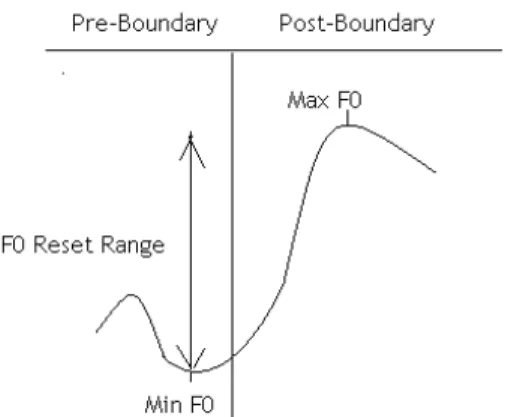
after the recording, Praat was used to tag the onset and offset of the syllables in the sentences. To measure the range of f0 reset, as shown in Figure 3, the minimum f0 of the pre-boundary syllable and maximal f0 in the post-pre-boundary syllable of target words were taken. Then the f0 reset ranges were derived by subtracting the minimal f0 of pre-boundary syllable from the maximal f0 of following syllable. It was hypothesized that the stronger the syntactic boundary the longer the pre-boundary final lengthening and the larger the cross-boundary f0 reset range.
Besides F0 reset, the duration of the syllables before and after the target boundaries were also taken.
For Taiwan Mandarin data, the raw value of duration, f0, and intensity were adjusted using function (1) to calculate the percentile of the duration of a target syllable within the duration range of the same target items produced by the same speaker.
X ker spea X ker spea X ker spea X ker spea X ker spea
value
MIN
value
MAX
value
MIN
value
value
Adjust
To control for speech rate, the portion of syllable duration within each utterance was calculated. Function (2) was used to calculate the portion of the target syllable duration within an utterance.
n k k X ker spea X ker spea X ker speaduration
Adjust
duration
Adjust
duration
Normalize
1where n is the syllable number of a sentence, and k is the syllable order in the sentence.
Figure 3: F0 measurement taken from pre-boundary and
3. Results
3.1.
Taiwan Min
3.1.1. Duration
The preliminary data in Figure 4 showed that in both sentence structure (1a) with strong target boundary between V and Adjp, and sentence structure (1b) with weak target boundary between V and Adjp, the duration of preboundary tones 55, 31, and 33 across are longer than postboundary tones 55, 31 and 33, regardless of boundary strengths. For checked tones verbs were shorter than the post-boundary Adjp syllables. In other words, the syllable duration difference did not vary according to boundary strengths.
The preliminary duration data of syllables before and after the target boundary located between V and Adjp in (1)
[V]*[Adjp+N] structure with strong boundary and (2b) [V*Adjp]+N with weak boundary showed similar pattern regardless of the strength of boundaries (Figure 4). That is, besides Tone 53, the duration of unchecked tone in pre-boundary positions was longer than the duration of unchecked tones in post-boundary duration. As for the checked tones, the duration of pre-boundary checked tones were shorter than the duration of corresponding post-boundary syllables (Figure 4). As for the duration of pre-boundary syllables and post-boundary syllables located between Adjp and N1 in (2a) [Adjp]* [N1 + N2] with strong boundary and in (2b) [Adjp* N1]+ [N2] with weak boundary, preliminary results showed similar patterns regardless of the strengths of boundaries. That is, the duration of penultimate pre-boundary syllables were longer than the final syllable [e] which carries a neutral tone. Whereas the post-boundary syllable were longer than pre-boundary syllables. In other words, the sentence structure and boundary strength did not affect the syllable lengthening pattern in Taiwan Min (Figure 5).
Uncheck Tones Duration Differences
syllables pre-boundary post-boundary Dura tio n (m s) 160 180 200 220 240 260 280 300 Tone 55 weak Tone 53 weak Tone 31 weak Tone 33 weak Tone 55 strong Tone 53 strong Tone 31 strong Tone 33 strong
Checked Tones Duration Differences
syllables preboundary postboundary Dura tion ( m s) 160 180 200 220 240 Tone 5 weak Tone 3 weak Tone 5 strong Tone3 strong
Figure 4: Duration of syllables before and after target
boundaries for sentences with structure (2a)[V]*[Adjp+N] across strong boundary and (2b) [V*Adjp]+N across weak boundary.
Figure 5: Duration of syllables before and after target
boundaries for sentences with structure (2a)[Adj]*[N1+N2] across strong boundary and (2b) [Adj*N1]+N2 across weak boundary.
3.1.2. F0 reset
As shown in Figure 6, the f0 reset ranges across strong and weak boundaries were about the same. In other words, f0 reset range was not an effective parameter in discriminating boundary strength of sentences with ambiguous structures.
Figure 6, F0 reset (max f0 of post-boundary – min f0 of pre-boundary) across weak and strong syllables
3.1.3. Average F0
Results of average f0 for pre-boundary and post-boundary across weak and strong boundary in V*Adj+N structure showed that the average f0 differences between pre-boundary and boundary ton53 and between pre-boundary and post-boundary tone 5 across strong boundaries are larger than those across weak boundaries (Figure 7). However, this pattern was not observed in any other tones in sentences with V* Adj+N structure. In other words, average f0 were not a cue to mark boundary strengths. As for Figure 8, the average f0 of pre- and post- target boundary syllables showed similar patterns across strong and weak boundaries. In sum the
(v*Adj)+N preboundary post-boundary F0 (Hz ) 100 120 140 160 180 200 220
V*(Adj+N) preboundary post-boundary F0 (H z) 100 120 140 160 180 200 ton 55 tone 53 tone 31 tone 33 tone 5 tone 3
Figure 7. Average f0 of pre-boundary and post-boundary syllables across weak boundary in (V* Adj)+N structure and strong boundary in V* (Adj+N) structure
(Adj*N1)+N2
Syllables
Adjp penultimate Adjp final N1 1st
Aver a g e F0 ( H z) 80 100 120 140 160 180 Tone 55 weak Tone 53 weak Tone 31 weak Tone 33 weak Tone 5 weak Tone 3 weak Adj*(N1+N2) Syllables
Adjp penultimate Adjp final N1 1st
Ave rage F 0 (Hz) 80 100 120 140 160 180 Tone 53 strong Tone 31 strong Tone 33 strong Tone 5 strong Tone 3 strong
Figure 8: F0 averages for ambiguous sentences with
structure Adj*(N1+N2) and (Adj *N1)+N2
In sum, cross-boundary duration, f0 reset range and average f0 did not reveal a clear influence of weak and strong boundaries.
3.2.
Taiwan Mandarin
3.2.1. Duration
Figure 9 shows the normalized durations of
pre-boundary syllables and post-pre-boundary syllables.
Paired Sample T-tests was performed for the
normalized syllable duration. This showed that the
duration of the pre-boundary syllable is
significantly longer before a stronger boundary
than before a weaker boundary (V*adj+N: t(71) =
2.525, p <.05; Adj*N1+N2 : t(71) = 12.595, p
<.001).
V*AdjP+N
Normalized Pre-boundary Syllable Duration
0.0 0.1 0.2 0.3 0.4 0.5 N o rmaliz ed P o s t-bounda ry Syllable D u ration 0.0 0.1 0.2 0.3 0.4 0.5 0.6 0.7 Strong Weak Adj*N1+N2
Normalized Pre-boundary Syllable Duration
0.00 0.05 0.10 0.15 0.20 0.25 0.30 N o rm alize d Pos t-B oun da ry Du ra tion 0.00 0.05 0.10 0.15 0.20 0.25 0.30 Strong Weak
Figure 9: Normalized duration of
pre-boundary syllables and post-pre-boundary
syllables in 8 types of ambiguous sentences.
3.2.2. F0 reset range
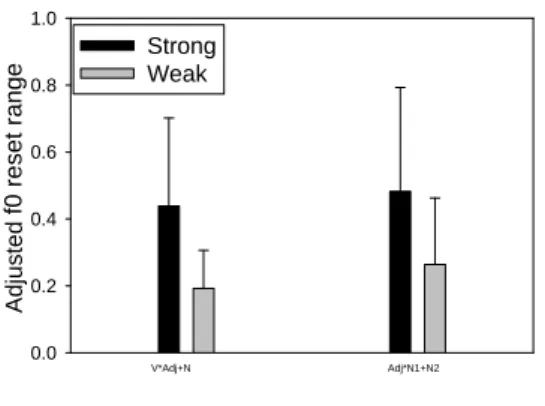
Figure 10 shows the normalized f0 reset range in
different types of sentences. Paired Sample T-tests
showed that the adjusted f0 reset range is
significantly higher across stronger boundaries
than across weaker boundaries. (V*Adj+N: t(71) =
7.015, p < 0.001; Adj*N1+N2: t(71) = 5.803, p <
0.001).
Adjusted f0 reset ran g e 0.0 0.2 0.4 0.6 0.8 1.0 Strong Weak *** *** *** V*Adj+N Adj*N1+N2Figure 10: Adjusted f0 reset range in 8 types of
ambiguous sentences. *: p<0.05, **: p<0.01, ***:
p<0.001
4. Discussion
The longer final lengthening found in
pre-boundary syllables and the greater extent of f0
reset between boundaries indicate a greater
disconnect between syntactic phrases. Lexical
tonal coarticulation cues can help disambiguate
syntactically ambiguous sentences. Here no
consistent prosodic patterns were observed across
strong and weak prosodic boundaries in Taiwan
Min. It is proposed that Taiwan Min with seven
sandhi rules make use of sandhi and juncture tones
to mark the boundaries of syntactic ambiguous
sentences. Thus acoustic cues, such as f0 reset,
final lengthening, and initial amplitude
strengthening, frequently observed in marking
boundaries in syntactic ambiguous sentences in
Mandarin, were not as important here. Through
alternation of juncture and sandhi tones, speakers
could convey their meanings effectively.
However, in Mandarin,
we found that more final
lengthening in pre-boundary syllables indicates a
syntactic branching of higher syntactic hierarchy.
The f0 reset range was also significantly different
between stronger and weaker boundaries. The
greater extent of f0 reset range indicated a stronger
boundary. Such a pattern has been interpreted as
initial strengthening. In sum, Taiwan Mandarin
syntactically ambiguous sentences can be
distinguished with acoustical cues such as the
duration of pre-boundary syllables and f0 range
reset across boundaries.
5. References
[1] Price, P. J., Ostendorf, M., Shattuck-hufnage, S. and Fong, C., “The Use of Prosody in Syntactic Disambiguation”, J. Acoustical Society of America, 90: 2956-2970, 1991.
[2] Allbritton, D. W., McKoon, G. and Ratcliff, R., “Reliability of Prosodic Cues for Resolving Syntactic Ambiguity”, J. of
Experimental Psychology: Learning, Memory, and Cognition, 22(3): 714-35, 1996.
[3] Fougeron, C., and Keating, P. A. “ Articulatory Strengthening at Edges of Prosodic Domains”, J. of Acosutical Society of America, 101(6): 3728-3740, 1997.
[4] Wightman, C. W., Shattuck-Hufnagel, S., Ostendorf, M. and Price, P. J. “ Segmental Durations in the Vicinity of Prosodic Phrase Boundaries”, J. of Acoustical Society of America, 91(3): 1707-1717, 1992.
[5] Tabain, M. “Effects of Prosodic Boundary on /aC/ Sequences: Acoustic Results”, J. of Acoustical Society of America, 113(1): 516-531, 2003.
[6] Tabain, M. “Effects of Prosodic Boundary on /aC/ Sequences: Articulatory Results”, J. of Acoustical Society of America, 113(5): 2834-2849, 2003.
[7] Cho, T. “ Prosodically Conditioned Strengthening and Vowel-to-Vowel Coarticulation in English”, J. of Phonetics, 32: 141-176, 2004.
[8] Pan, H. –H. “ The Effects of Prosodic Boundaries on Nasality in Taiwan Min”, J. of Acoustical Society of America, 121(6): 3755-3769, 2007.
[9] Xu, Y. “ Context Tonal Variations in Mandarin”, J. of Phonetics, 25:61-83, 1997.
[10] Peng, S. –H. “ Production and Perception of Taiwanese Tones in Different Tonal and Prosodic Contexts”, J. of Phonetics, 25: 371-400, 1997.

![Figure 5: Duration of syllables before and after target boundaries for sentences with structure (2a)[Adj]*[N1+N2] across strong boundary and (2b) [Adj*N1]+N2 across weak boundary](https://thumb-ap.123doks.com/thumbv2/9libinfo/8359372.176734/8.892.489.810.142.422/figure-duration-syllables-boundaries-sentences-structure-boundary-boundary.webp)