Overview
The Hypothesis of NMDA
Receptor Hypofunction for
Schizophrenia
Huey-Jen Chang, M.D.1,2, Hsien-Yuan Lane, M.D., Ph.D.1,3,
Guochuan E. Tsai, M.D., Ph.D.4*
Schizophrenia, a multifactorial mental disorder with polygenic inheritance as well as environmental influences, encompasses a characteristic group of symptoms and neurocognitive deficits. Cognitive function, a major determinant of quality of life and overall function in schizophrenia, contributes more to the prognosis of the disease than positive symptoms, such as delusions or hallucinations. Although its exact etiological mechanisms remain relatively unknown, extensive studies are ongoing to explore. Among them, one of the primary causal factors is dysfunction of the N-methyl-D-aspartate (NMDA)-type glutamate receptors. This article reviews the clinical limitations of current antipsychotics in treating the core symptoms of schizophrenia and the trend in the reconceptualization of the disease nature and treatment modalities. The NMDA receptor model plays a critical role in the revolution of pharmaceutical industry as a new set of drug targets in addition to those based on the traditional monoaminergic models is proposed. The evidence of NMDA receptor hypofunction in schizophrenia is accumulating from the investigations on the modulation of glutamatergic system, particularly the intrinsic NMDA/glycine site, through genetic research and various clinical trials. A group of “NMDA-enhancing agents,” being used either as adjuncts to typical/atypical antipsychotics or as monotherapy, in schizophrenic patients, particularly those with refractory negative and cognitive symptoms, offer efficacy in preclinical and early clinical trials. Novel therapeutic agents acting as NMDA enhancers show promise as the next wave of drug development for schizophrenia.
Key words: schizophrenia, NMDA receptor hypofunction, negative symptoms, cognitive
function (Taiwanese Journal of Psychiatry [Taipei] 2012; 26: 147-61)
1
Institute of Clinical Medical Science, China Medical University, Taichung, Taiwan 2
Department of Psychiatry, Chiayi and Wanqiao Branch, Taichung Veterans General Hospital, Chiayi, Taiwan 3
Department of Psychiatry, China Medical University Hospital, Taichung, Taiwan 4
Department of Psychiatry, Harbor-UCLA Medical Center, Torrance, CA, U.S.A. Received: August 21, 2012; revised: August 23, 2012; accepted: August 24, 2012 *Corresponding author. No. 1000, West Carson Street, Torrance, CA 90509, U.SA. E-mail address: Guochuan E. Tsai <[email protected]>
• 148 • The NMDA Hypofunction in Schizophrenia
Introduction
Schizophrenia, affecting about 1% of the population worldwide, is a devastating and costly illness due to its resistance to treatment, the con-sequences of relapse, and substantial economic burden. Clinical symptoms of schizophrenia have three (positive symptoms, negative symptoms, and neurocognitive defi cits) main categories. The latter two possess high predictive value for clinical outcomes [1] and account for much of the long-term morbidity of this illness. Optimizing the treatment of schizophrenia will be an important goal in the early era of 21st century, particularly on negative symptoms, and neurocognitive deficits.
Drug models have been applied
extensively to study the
pathophysiology of schizophrenia and thus provide a better insight into the neurobiology of the disorder. Hypofunction of N-methyl-Daspartate receptor (NMDAR) mediated neuro-transmission is implicated in the critical deficits associated with many
brain disorders, especially
schizophrenia [2]. This is evidenced by observations of the clinical simulation exerted by the noncompetitive antagonists of NMDAR, phencyclidine (PCP) and ketamine on nonpsychotic individuals and schizophrenic patients [3]. Therefore, in addition to the dopamine and serotonin hypotheses, the NMDA hypofunction model of schizophrenia has recently gained extensive attention.
Enhancing NMDAR neurotransmission has been considered as a novel treatment approach, in particular through the glycine “modulatory” component (the coagonist site) at these receptors to avoid the
excitotoxicity mediated through the glutamate binding site [4]. Recent advances in understanding the
function, pharmacology, genetics and
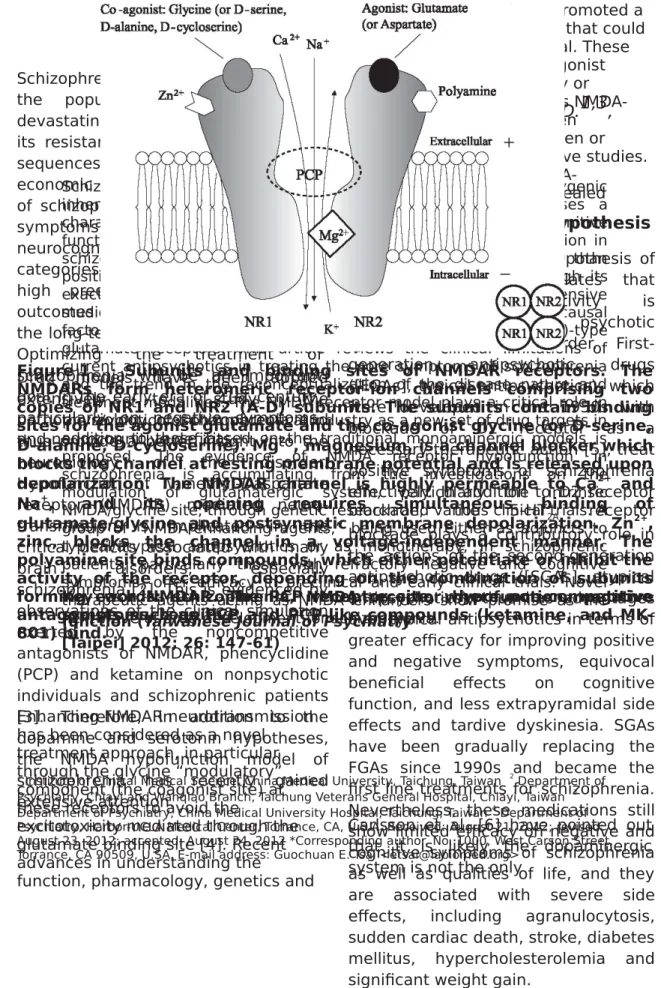
structure of NMDAR have promoted a search for new compounds that could be therapeutically beneficial. These compounds act on the coagonist binding sites, either directly or indirectly (Figure 1). Various NMDA-enhancing agents have been proposed and they have been or currently are under extensive studies. Many clinical trials on
NMDA-enhancing agents have revealed encouraging results.
Glutamatergic Hypothesis
The classical dopamine hypothesis of schizophrenia [5] postulates that dopaminergic hyperactivity is responsible for the psychotic symptoms of this disorder. First-generation antipsychotic drugs ([FGAs], typical antipsychotics), which were developed in the 1950s with blockade of D2 receptor as a necessary therapeutic action [5], treat positive symptoms of schizophrenia effectively. In addition to D2 receptor blockade, the 5-HT2A receptor blockade plays a contributory role in the actions of the second-generation antipsychotic drugs ([SGAs], atypical antipsychotics), thus has advantages over typical antipsychotics in terms of greater efficacy for improving positive and negative symptoms, equivocal beneficial effects on cognitive function, and less extrapyramidal side effects and tardive dyskinesia. SGAs have been gradually replacing the FGAs since 1990s and became the first line treatments for schizophrenia. Nevertheless, these medications still show limited efficacy on negative and cognitive symptoms of schizophrenia as well as qualities of life, and they are associated with severe side effects, including agranulocytosis, sudden cardiac death, stroke, diabetes mellitus, hypercholesterolemia and significant weight gain.Carlsson et al. [6] have pointed out that it is likely the dopaminergic system is not the only
Figure 1. Subunits and binding sites of NMDAR receptors. The NMDARs form heteromeric receptor-ion channels comprising two copies of NR1 and NR2 (A-D) subunits. The subunits contain binding sites for the agonist glutamate and the co-agonist glycine (or D-serine, D-alanine, D-cycloserine). Mg2+, magnesium, is a channel blocker which
blocks the channel at resting membrane potential and is released upon depolarization. The NMDAR channel is highly permeable to Ca2+ and
Na+, and its opening requires simultaneous binding of
glutamate/glycine and postsynaptic membrane depolarization. Zn2+,
zinc, blocks the channel in a voltage-independent manner. The polyamine site binds compounds, which either potentiate or inhibit the activity of the receptor, depending on the combination of subunits forming each NMDAR. The PCP receptor site, where non-competitive antagonists such as PCP and PCP-like compounds (ketamine, and MK-801) bind.
154 • The NMDA Hypofunction in