行政院國家科學委員會專題研究計畫 期中進度報告
關於組合設計理論及其相關應用的研究(2/3)
計畫類別: 個別型計畫
計畫編號: NSC92-2115-M-009-006-
執行期間: 92 年 08 月 01 日至 93 年 07 月 31 日
執行單位: 國立交通大學應用數學系
計畫主持人: 黃大原
報告類型: 精簡報告
報告附件: 出席國際會議研究心得報告及發表論文
處理方式: 本計畫可公開查詢
中 華 民 國 93 年 5 月 25 日
Strongly Regular Graphs associated with Bent Functions
Tayuan Huang and Kuei-Hung You
Department of Applied Mathematics
National Chiao Tung University
Hsinchu Taiwan
[email protected]
Abstract
Following results of Bernasconi, Codenotti, and Van-derKam on a characterization of bent functions, feasible pa-rameters and corresponding eigenvalues of the associated Cayley graphs of bent functions are given; in particular, all of those graphs with at most 280 vertices are included.
1. Introduction
The problem of analyzing the spectral coefficients of Boolean functions has been brought to the framework of spectral analysis of graphs though their associated Cayley graphs, and hence the using of tools from algebraic graph theory for investigations related to the spectral coefficients of Boolean functions with small numbers of distinct coeffi-cients is possible. Among others, a characterization of bent functions in terms of strongly regular graphs by Bernasconi, Codenotti, and VanderKam [1,2] is a successful example. It was shown in [1] that the associated Cayley graph of a bent function is a strongly regular graph by showing that it has exactly three distinct eigenvalues. They further showed that bent functions are the only Boolean functions f with asso-ciated strongly regular graph by studying the integral solu-tions of a quadratic equation in [2]. As a consequence, bent functions can be characterized as Boolean functions with a certain class of strongly regular graphs, followed by a nice interpretation of bent functions in terms of strongly regular graphs.
Further investigation of those strongly regular graphs involved in the characterization of bent functions consid-ered in [1,2] is the purpose of this paper. The definitions of Fourier transformation of Boolean functions, bent func-tions, and strongly regular graphs are given in section 2. In section 3, some properties of Cayley graphs associated with bent functions are recalled first, then feasible parame-ters and their corresponding eigenvalues of associated Cay-ley graphs of bent functions are given; in particular, those
graphs with at most 280 vertices are included. As a closed relative of those strongly regular graphs studied in the pre-vious section, strongly regular graphs SRG(n, k, λ, λ) are studied in section 4.
2. Bent Functions
The Fourier transform of a Boolean function f (x) :
Zn2 → Z2 is defined to be f∗(x) = 21n
P
∀x∈Zn 2f (x) ·
(−1)hλ,xi, which satisfies the property that f (x) = 1
2n
P
∀λ∈Zn 2 f
∗(λ) · (−1)hλ,xi. The Cayley graph G f
as-sociated with a Boolean function f : Zn
2 → Z2 is
de-fined on the vertex set Zn
2, with u, w ∈ Zn2 adjacent if
w ⊕ u ∈ Ωf = f−1(1) , or equivalently f (w ⊕ u) = 1.
For a Boolean function f : Zn2 → Z2, the spectrum of Gf
is usually denoted by Spec(Gf) = (|Ωf|, λ1, ..., λ2n−1)
where λi=P∀x∈Zn
2 f (x) · (−1)
hb(i),xi= 2n· f∗(b(i)) and
b(i) is the binary representation of i; the multiplicity of its largest eigenvalue f∗(b(0)) is 2n−dimhΩfi (which implies
the graph Gf is |Ωf|-regular with 2n−dimhΩfi connected
components and the graph Gf is connected if dimhΩfi =
n). A Boolean functions is characterized by its spectrum if it is possible to identify its associated graph (i.e., deter-mine all the details of its topology) only on the basis of the knowledge of its distinct eigenvalues, i.e., without using any information regarding their eigenvectors, see [6] for exam-ple. It is interesting to note that the fewer the number of distinct spectral coefficients are, the stronger are the alge-braic properties of the set Ωf; for instance, it is well-known
that if a connected graph has exactly m distinct eigenvalues, then its diameter d satisfies d ≤ m − 1.
A Boolean function f : Zn2 → Z2is called a bent func-tion if ((−1)f (x))∗(x) = ±√1
2n for any λ ∈ Z
n
2, the term
of bent was coined by Rothaus [8]. If f (x) is a bent func-tion on Zn
2 with n ≥ 3, then n = 2k must be even, and the
degree of f (x) is at most k; moreover f (x) is irreducible whenever deg(f (x)) = k ≥ 3, see [8] for details. The ex-istence of bent functions f (x) is equivalent to the fact that
whether [(−1)f (x+y)] is a Hadamard matrix.
A k-regular graph G is strongly regular if there exist non-negative integers λ and µ such that for all vertices x, y, the number |G1(x)T G1(y)| of vertices adjacent to both x
and y is λ if x and y are adjacent, and µ otherwise, where G1(x) = {z|z ∈ V (G) is adjacent to x}. A k-regular
con-nected graph is strongly regular if and only if it has ex-actly three distinct eigenvalues θ0 = k, θ, τ , with
multi-plicities 1, mθ, and mτ respectively. This type of graph G
is usually denoted by SRG(v, k, λ, µ) with v = |V (G)|, and Spec(G) = (k1, θmθ, τmτ). A rephrase of
Parse-val’s identity gives that f∗(b(0)) =P2n−1
i=0 (f∗(b(i))) 2and
then yields the following useful equality (k − θ)(k − τ ) = 2r(k + θτ ) where k = |Ω
f|, and r must be replaced by
dimhΩfi if G is not connected. If G is strongly regular,
then λ = k + θτ + θ + τ and µ = k + θτ . It was also ob-served that the class of bent functions is associated to a very special class of strongly regular graphs, and indeed identi-fies the bent functions precisely. Refer to [3,5] for more details on strongly regular graphs.
3. The Cayley Graphs associated with Bent
Functions
If f is a Boolean function on Zn2with connected strongly
regular graph Gf, then there exists y ∈ Ωf such that
x ⊕ y ∈ Ωf for each x ∈ Zn2 \ Ωf, and there exist h
el-ements z ∈ Ωf such that y ⊕ z ∈ Ωf, where h = λ if
y ∈ Ωf, and µ if y /∈ Ωf for each y ∈ Ωf. In order to find
a complete characterization of the class of functions with three distinct nonzero spectral coefficients with additional properties, it was proved in [2] that the quadratic equation x2− 2nx + (2n− 1)y2 = 0 has integer solutions in x and
y only if y2= 0, 1, 2n−2. As a consequence, bent functions
can be characterized as binary functions with a certain class of strongly regular graphs.
Theorem 3.1. [1, 2] The associated Caley graph Gf of a bent function f is a strongly regular graph
SRG(v, k, λ, λ); moreover, the bent functions are the only
Boolean functions f whose associated graph Gf is a strongly regular graph SRG(v, k, λ, λ)
Those graphs Gf with small numbers of distinct
eigen-values are considered: if Gf has a single eigenvalue, then
Gf = K2n−1 ; if Gf has two distinct eigenvalues, then
Gfis either 2
n
|Ωf|+1K|Ωf|+1when b(0) /∈ Ωf, or
2n
|Ωf|K|Ωf|
with loops otherwise; if Gf has three eigenvalues, then
(k, θ, τ ) = (|Ωf|, 0, −|Ωf|) if and only if Gf is the
com-plete bipartite graph between vertices in Ωfand in Zn2\ Ωf;
(k, θ, τ ) = (|Ωf|, 0, τ ) if and only if Gfis a complete
mul-tipartite graph with Gf = (−|Ωτf|+ 1)K−τ. If Gf is
con-nected, then Gfis a SRG(2n, |Ωf|, λ, µ) with
Spec(Gf) =(|Ωf|1, (12(λ − µ + √ ∆))(−τ (2n −1)−|Ωf |θ−τ ), (1 2(λ − µ − √ ∆))(−θ(2n −1)+|Ωf |θ−τ )) where ∆ = (λ − µ)2− 4(µ − |Ωf|).
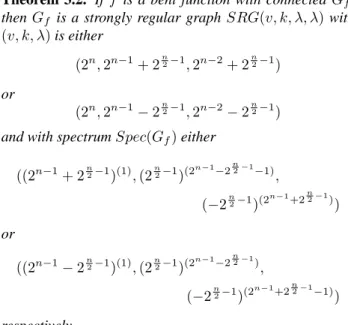
Theorem 3.2. If f is a bent function with connected Gf, then Gf is a strongly regular graph SRG(v, k, λ, λ) with
(v, k, λ) is either (2n, 2n−1+ 2n2−1, 2n−2+ 2n2−1) or (2n, 2n−1− 2n2−1, 2n−2− 2 n 2−1)
and with spectrum Spec(Gf) either ((2n−1+ 2n2−1)(1), (2n2−1)(2 n−1−2n2−1 −1), (−2n2−1)(2 n−1+2n2−1) ) or ((2n−1− 2n2−1)(1), (2 n 2−1)(2 n−1−2n2−1) , (−2n2−1)(2 n−1+2n2−1−1) ) respectively.
A table of all feasible parameters of strongly regular graphs with at most 280 vertices and related information is given in [4, pp671]. Those strongly regular graphs men-tioned above with at most 280 vertices are included below in table 1, 2 respectively for complete purpose.
Table 1. case 1
Parameters Spectrum Examples
4, 3, 2, 2 (3(1), 1(0), −1(3)) K4 16, 10, 6, 6 (10(1), 2(5), −2(10)) Clebsch graph; two graph 64, 36, 20, 20 (36(1), 4(27), −4(36)) Two graph 256, 136, 72, 72 (136(1), 8(119), −8(136)) Two graph Table 2. case 2
Parameters Spectrum Examples
4, 1, 0, 0 (1(1), 1(1), −1(2)) K 4 16, 6, 2, 2 (6(1), 2(6), −2(9)) Shirkhande; two graph; projective binary [6, 4] code 64, 28, 12, 12 (28(1), 4(28), −4(35)) QA(4, 8); two graph; projective binary [28, 6] code 256, 120, 56, 56 (120(1), 8(120), −8(135)) QA(8, 16); two graph; projective binary [120, 8] code
4. Strongly Regular Graphs SRG(v, k, λ, λ)
The Friendship theorem shows that a connected graph with a unique common neighbor for any pairs of distinct vertices has a vertex adjacent to all other vertices, and K3
is the unique such regular graph. We now consider those connected k-regular graphs such that any two distinct ver-tices has a constant λ common neighbors, they are indeed strongly regular graphs SRG(v, k, λ, λ). When λ = 1, then G = K3 as just mentioned. The Cayley graphs
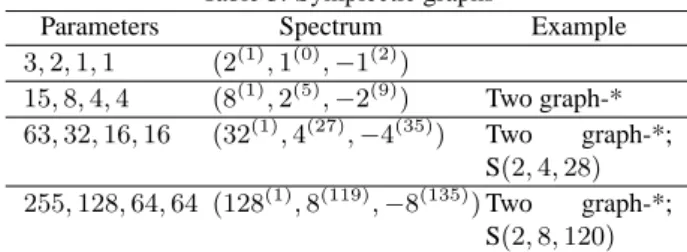
associ-ated with bent functions provide a family of such graphs, as shown in Theorem 3.2.The symplectic graphs Sp(2m) [5] offer another family of such strongly regular graphs with parameters (22m−1, 22m−1, 22m−2, 22m−2) for positive
in-tegers m, note that K3is the symplectic graph Sp(2); some
examples with small number of vertices are known already, for example:
Table 3. Symplectic graphs
Parameters Spectrum Example
3, 2, 1, 1 (2(1), 1(0), −1(2)) 15, 8, 4, 4 (8(1), 2(5), −2(9)) Two graph-* 63, 32, 16, 16 (32(1), 4(27), −4(35)) Two graph-*; S(2, 4, 28) 255, 128, 64, 64 (128(1), 8(119), −8(135)) Two graph-*; S(2, 8, 120)
where two graph-* is the graph with isolated point added belongs to the switching class of a regular two graph, and S(2, k, v) is the block graph of a 2-(v, k, 1) design. Some necessary conditions among v, k, λ and their spectrum is given in the following theorems.
Theorem 4.1. Suppose there exists a SRG(v, k, λ, λ) with
λ > 1, and with distinct eigenvalues k > θ > τ , then
1. θ = −τ = √k − λ, θτ = −(k − λ) are integers
with multiplicities mθ = 12((n − 1) − √k
k−λ), and
mτ =12((n − 1) +√k−λk ) respectively. 2. θ | λ and (v, k) = ((θ2+θ+λ)(θλ 2−θ+λ), θ2+ λ). Proof. 1. Omitted. 2. Let t = √k
k−λ, which is a
pos-itive integer by 1. Hence k = t2±t
√ t2−4λ
2 , both t and
b =√t2− 4λ are of the same parity; since t2− 4λ = b2, it
follows that 4λ = (t + b)(t − b), t + b = √k k−λ+ q (√k k−λ) 2− 4λ and t − b = √k k−λ− q (√k k−λ) 2− 4λ
must be even. Let t + b = 2h1and t − b = 2h2for some
positive integers h1> h2, hence λ = h1h2, then t = h1+
h2, b = h1− h2, and k is either h1(h1+ h2) or h2(h1+ h2).
Note that θ = √k − λ is either h1( in case k = h1(h1+
h2)) or h2(in case k = h2(h1+h2)), hence θ | λ. It follows
that n = (θ2+θ+λ)(θλ 2−θ+λ) in either case as required.
Since θ = −τ as shown in Theorem 4.1, a
SRG(v, k, λ, λ) turns out to be a Ramanujan graph [7]. Indeed, the above lemma paves a way for studying pos-sible feapos-sible parameters (v, k, λ, λ) for a given λ with a pair (h1, h2) either (θ,λθ) or (λθ, θ). The trivial
decom-position of λ = 1 · λ with (h1, h2) = (λ, 1) leads to
(v, k, λ) = (λ2(λ+2), λ(λ+1), λ) or (λ+2, λ+1, λ).
An-other extremal cases with h1, h2closed to
√
λ are consid-ered for λ = 22mand 2m(2m+ 1) respectively. If λ = 22m
with (h1, h2) = (2m, 2m), then
(v, k, λ) = (22m+2− 1, 22m+1, 22m)
which is identical with those of the symplectic graphs; if λ = 2m(2m+ 1) with (h1, h2) = (2m+ 1, 2m), then
(v, k) = (22(2m+ 1)2, (2m+ 1)(2m+1+ 1)) or (2m(2m+2), 2m(2m+1+ 1));
and the former type is realized by a set of 2m MOLS of
order 2m+1+ 2, called Latin square graphs.
Theorem 4.2. Suppose λ = p · q for distinct primes with
p > q.
1. If q ≥ 3, then (v, θ) = (p(p+q−1)(p+q+1)q , p) , and p = 2cq ± 1 for some integer c.
2. If q = 2, then (v, θ) = (p(p+1)(p+3)2 , p) or (16, 2).
Proof. Let v = q(p+q−1)(p+q+1)p by Theorem 4.1. Since p, q are primes and v is an integer, (p + q − 1)(p + q + 1) ≡ 0(mod p), and hence q2≡ 1(mod p), and hence q ≡ 1 or − 1(mod p). Because p is a prime, it follows that q = cp ± 1 for some even integer c.
If 3 ≤ q < p, then q = 1 or p − 1, a contradiction. Because p and q are odd primes and p = cq ± 1 for some even integer c if v = p(p+q−1)(p+q+1)q . It is easy to check that θ = p by theorem 4.1.
For q = 2, since p is odd, (p + 1)(p + 3) is even, then ei-ther (v, θ) = (p(p+1)(p+3)2 , p) or (v, θ) = (2(p+1)(p+3)p , 2). The only choice for p in the later case is 3, and hence (v, θ) = (16, 2).
References
[1] A. Bernasconi and B. Codenotti, ”Spectral Analysis of Boolean Functions as a Graph Eigenvalue Problem”,
IEEE Trans. Computers, Vol.48, No.3, Mar. 1999, pp.
345-351.
[2] A. Bernasconi and B. Codenotti, and J. VanderKam, ”A Characterization of Bent Functions in terms of Strongly Regular Graphs”, IEEE Transactions on
Computers, Vol.50 No.9, September 2001, pp.
[3] N. Biggs, Algebraic Graph Theory 2nd edition, Cam-bridge University Press, 1993.
[4] C. J. Colbourn and J. H. Dinitz, The CRC Handbook
of Combinatorial Designs, CRC Press, 1996.
[5] C. Godsil and G. Royle, Algebraic Graph Theory, Springer GTM 207, 2001.
[6] T. Huang and C. R. Liu, ”Spectral Characterization of Generalized Odd Graphs”, Graph and Combinatorics, 15, 1999, pp.195-209.
[7] A. Lubotzky, R. Phillips, and P. Sarnak, ”Ramanujan Graphs”, Combinatorical, vol.8, 1988, pp. 261-277. [8] O. S. Rothaus, ”On Bent Functions”, J. Combinatorial