of
Epoxy-Polycarbonate Blends Catalyzed
by Quarternary Ammonium Salt
MING-SHIU 11,’ CHEN-CHI M. MA’,* MING-SHIU LU,’ MIAW-LING LIN; and FENG-CHIH CHANG’ ’Institute of Chemical Engineering, National Tsing Hua University, Hsinchu 30043, Taiwan, Republic of China, ’Institute of Applied Chemistry, National Chiao Tung University, Hsinchu 30043, Taiwan, Republic of China
SYNOPSIS
T h e reaction of oxirane with carbonate using quarternary ammonium salts as catalyst has been studied. Curing is caused by t h e transesterification reaction of t h e oxirane cycle with t h e carbonate group t h a t proceeds by a n “insertion” mechanism in t h e stoi- chiometric system. T h e ratio of t h e reactants is two oxirane groups t o one carbonate group. I n t h e nonstoichiometric system, t h e epoxide content is more t h a n t h e stoichio- metric quantity required. A cyclization reaction is followed by the transesterification reaction. T o identify the finished products, a model reaction was proposed using diphenyl carbonate and phenyl glycidyl ether which results in the formation of 4-phenoxymethyl- 1,3-dioxolane-2-one (PMD). T h e mechanism of forming t h e cyclic structure is assumed t o proceed through t h e chain scission of t h e network in which t h e molecular chain crosslinked with carbonate group by a transesterification reaction. 0 1996 John Wiley & Sons, Inc.
Keywords: epoxy blend polycarbonate transesterification cyclization
INTRODUCTION
I t has been well known that oxiranes can react with various active esters in the presence of quar- ternary ammonium salts. Nishikubo et al.’ iden- tified the finished products from the reaction be- tween oxirane and ester, and confirmed t h a t a n insertion reaction of epoxy compounds with ester linkage of poly[4-(4-nitrobenzoyloxy)styrene] oc- curred. The rate of the addition reaction of epoxide group with a n activated ester using quarternary ammonium salts as a catalyst is proportional to the third-order reaction kinetics involving the ep- oxide, ester, and catalyst concentrations. The mechanism of the addition reaction is assumed to proceed by a transition state t h a t is composed by epoxide, ester, and quarternary ammonium salts.2
A polyfunctional active ester was employed as a
* To whom all correspondence should be addressed.
Journal of Polymer Science: Part A Polymer Chemistry, Vol. 34,3303-3312 (1996) 0 1996 John Wiley & Sons, Inc. CCC OSS7-624X/96/163303-10
new curing agent for epoxy resins and the relation between the degree of conversion and catalytic ac- tivity was discussed by Nishikubo et al.3-5 Ko- marova et a1.6 studied the interaction of epoxy oligomer with polycarbonate and discovered that the solubility of the mixture decreased while the thermomechanical properties increased after ther- mal treatment. This phenomenon was interpreted as the formation of a crosslinked structure. Bell et al.7 also investigated PC-epoxy blends cured by a quarternary ammonium salt and reported t h a t the crosslink density of the resultant three-di- mensional network can be controlled by adjust- ing the epoxy/carbonate ratio. However, most earlier studies were carried out based on a 1 : 1 stoichiometric system of the epoxide polycarbon- ate copolymer networks, and very few provided the spectrometric identification of the chemical structures of the nonstoichiometric reaction products. In our previous article,’ the results of the study on the PC-epoxy blends cured by a ter- tiary amine using great excess of oxirane groups 3303
Table I.
of the PC-Epoxy Blends
Codes, Compositions, and TBs
PCIEpoxy PCIEpoxy TB
Code Weight Ratio Mole Ratio ("C) A1 2 5 4 / 2 0 4 100/120 147 A2 2541272 100/160 149 A3 2541340 100/200 153 A4 254/408 1001240 140 A5 2541476 100/280 118 B1 2541102 l00/60 143 B2 254168 100140 136 B3 254134 l00/20 133 B4 254117 100/10 131 B5 25416.8 10014 138 PC - 100/0 154
/ /
I / 1 3500 3000 2500 2000 1800 1600 1400 1200 1000 800 600 400 Wavenumber (cm-1)Figure 1. Infrared spectra of (A) PGE, (B) DPC, (C) PGE-DPC mixture with weight ratio of PGE/DPC of 1200 : 214 (w/w).
I \ 1 - 1
L
1950 1900 1850 1800 1750 1700 1650Wavenumher (cm-1)
Figure 2. Infrared spectra of DPC-PGE-TBAB mix- ture with a weight ratio of 214 : 1200 : 2.4 (wlw) recorded in the carbonyl stretching region a t 80OC: (A) initial; (B) 60 min; (C) 120 min; (D) 120 min at 80°C and 120 min a t 100OC; (E) 120 min at 80°C, 120 min at 100°C, and 120 min at 120'C; and (F) 120 min at 80°C, 120 min at 1OO"C, 120 rnin a t 12OoC, and 120 min at 15OoC.
relative to the carbonate group were reported. Transesterification reactions of the original diary1 carbonate to form the aromatic/aliphatic and/or the aliphatic/aliphatic carbonates were verified by infrared spectroscopy, and the formation of a cyclic carbonate structure was also detected. The mechanism for the cyclic carbonate formation is assumed to proceed through a zwitterion and a nucleophilic species that attacks the aromatic/ aliphatic or aliphatic/aliphatic carbonate group.
0 @ - O - ! ! - O a + (R),NX + CH
\ >
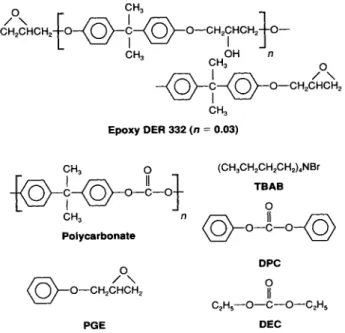
CHCH,-0 0 CH-0-C-0-CH Scheme 1. Itures of DER 332, PC, TBAB, PGE, DPC, and DEC are illustrated below:
, I
I
4000 3500 3000 2500 2000 1800 1600 1400 1200 1000 800 600 400
Wavenumber (cm-')
Figure 3. Infrared spectrum of the end product sepa- rated from the DPC-PGE-TBAB mixture with a weight ratio of 214/1200/2.4.
In this study, the reaction of a nonstoichiometric system of epoxide and carbonate catalyzed by a quarternary ammonium salt is investigated. The in- frared spectroscopic results revealed that an unusual structure is produced in the system when the epoxide is in excess. This unknown structure has been iden- tified and the reaction mechanism for the formation of that unknown structure has been proposed. The relationship between the structure and thermal properties of the resulting copolymer will be dis- cussed.
EXPERIMENTAL
Materials
The epoxy prepolymer used in this study was DER 332 which is a low molecular weight liquid diglyc- idyl ether of bisphenol A (DGEBA) with a epoxide equivalent weight of 174. The polycarbonate used in this study was Calibre 301-15 which is based on bisphenol A, with a melt index of 15. Both PC and epoxy were purchased from the Dow Chemical Company. The quarternary ammonium salt, te- trabutylammonium bromide (TBAB), was pur- chased from the Aldrich Chemical Company as a catalyst. T h e solvent used to dissolve the poly- carbonate is dichloromethane which was pur- chased also from the Aldrich Chemical Company. Silica Gel 60 used in column chromatography was supplied by the Merck Company. The chemicals used in the model reaction study, phenyl glycidyl ether (PGE), diphenyl carbonate (DPC) and di- ethyl carbonate (DEC), were purchased from the Aldrich Chemical Company. T h e chemical struc-
I L CH3 OH n CH3 n CH3 Epoxy DER 332 ( n = 0.03) (CH3CHzCH,CH,),NBr TBAB n - CH3 0
-@-L*-"-o
CH3j
v Polycarbonate DPC 0 PGE DECProcedures and Instrumentation
The experimental procedure for the model reaction was conducted by dissolving DPC and TBAB into PGE at 100°C. One drop of this mixture was used to prepare a thin film between two sodium chloride plates and then mounted on a sample holder located at the IR instrument. Infrared spectra were obtained on a Perkin-Elmer 842 Infrared Spectrometer with a resolution of 2.4 cm-' in the transmission mode. IR spectra a t elevated temperatures were obtained using a heated cell mounted inside the sample chamber. The resultant products obtained from the model reaction were separated by a silica gel column
I l l
I , I , I . , . , . , . ! . , . 160 150 140 130 120 110 100 90 80 70 L w m IFigure 4. 13C-NMR spectrum of the end product sep- arated from DPC-PGE-TBAB mixture with a weight ratio of 214/1200/2.4.
C=C stretchin! of benrem
i
1950 1900 1850 i m n 1750 1700 1650 I G O O I!
Wavenumber (cm-1)
Figure 5. Infrared spectra of (A) DPC, and the end product of DPC-PGE mixture with weight ratio of (B) 214/150, (C) 214/300, (D) 214/600, and (E) 214/1200.
chromatography using dichloromethane as the eluent. The structure identification of the unknown compound obtained from column chromatography was determined by high-resolution 13C nuclear mag- netic resonance (I3C-NMR) spectrometry. The
'%-
NMR spectra were measured with a Bruker 400 FT-
NMR spectrometer with a magnetic field strength of 9.4 Tesla (e.g., 13C = 100.6 MHz). Samples were diluted with deuterated chloroform (CDC13). The experimental procedure of PC-epoxy blends was to dissolve PC into dichloromethane at room temper- ature to prepare a 15 wt % solution and to dissolve 2 phr TBAB into the epoxy prepolymer at 100°C. When the prepolymer was cooled to near room tem- perature, the PC solution was added and mixed. The resulting clear solution was then heated at 120°C for 1 h, 160°C for 2 h, and 200°C for an additional 2 h. The sample was prepared as a KBr pellet to detect the variation in the carbonyl group by an in- frared spectrometer. The glass transition tempera- tures of the composites were determined using a Du Pont Differential Scanning Calorimeter (DSC 10)
with a heating rate of lO"C/min. The compositions of the blends, and their codes are listed in Table I.
RESULTS AND DISCUSSION
The Model Reaction of Oxirane and Carbonate To study the reaction of oxiranes with carbonate groups, PGE and DPC were selected for the model reaction study. Spectrum (A) of Figure 1 shows the IR spectrum of PGE which can be identified from the main absorption peaks as follows: (1) 1595cm-', C = C (benzene) ring stretch; (2) 1492 cm-', C = C (benzene) ring stretch; (3) 1241 cm-',C -0
-
C (ether) asymmetrical stretch, (4) 1036 cm-', C-
0 - C (ether) symmetrical stretch; (5) 910 cm-', C - 0 - C (oxirane) asymmetrical stretch.Spectrum (B) of Figure 1 shows the spectrum of DPC which can be identified from the main absorp- tion peaks as follows: (1) 1783 cm-', C=O (car- bonate) stretch; (2) 1593 cm-', C=C (benzene) ring stretch; (3) 1489 cm-', C = C (benzene) ring stretch; (4) 1229 cm-': 0 - C - 0 (carbonate) asymmetrical stretch.
Spectrum (C) of Figure 1 presents the spectrum of a DPC-PGE mixture with a weight ratio of DPC/ PGE/TBAB of 214/1200/2.4 (mole ratio of DPC/ PGE is 1/8). Comparing spectrum (C) with spectra
(A) and (B) of Figure 1 comfirms that no reaction occurs between DPC and PGE during the dissolving procedure. Figure 2 shows the spectra in the carbonyl stretching region of the above DPC-PGE mixture that has been catalyzed by TBAB at 80°C. Curves (B) and (C) show that the carbonyl absorption band of DPC broadens and shifts to lower frequency. The shift of IR of the carbonyl stretching absorption can be explained as the result of the transesterification reaction. The transesterification reaction proceeds through the formation of an intermediate composed by epoxide, carbonate, and quarternary ammonium salt. The mechanism of transesterification reaction is shown in Scheme 1.2
The transesterification reaction converts the orig- inal carbonate group of DPC, between two aromatic nuclei
Ar
-
0-
CO - 0-
Ar, to either one aromatic and one alkyl groups (Ar-0-CO-0-R), or to two alkyl groups (R-0-CO-0-R). The ab- sorption frequencies of the aromatic/aromatic car- bonate(Ar
- 0 - CO - 0 - Ar), aromatic/aliphaticcarbonate (Ar - 0 - CO - 0 - R), and aliphatic/ aliphatic carbonate (R - 0 - CO - 0 - R) are at 1776,1762, and 1746 cm-', respectively? The fraction of the original carbonate (Ar
-
0 - CO - 0-
Ar) is+
(R),NX + CH,CHCH,-0 \ / 0 (R),A 0-CH, X \ / CH CH,-O-(Q I 0 II 0 II Scheme 2.expected to decrease with the extent of transesterifi- cation while the quantity of carbonates from the tran- sesterification increases. This phenomenon is expected to cause the absorption band of carbonyl stretching shifting to lower frequencies. Curve (D) of Figure 2
clearly shows the absorption band splitting into two bands at 1746 and 1810 cm-', respectively. Curves (E)
and (F) show that the intensity of the carbonyl groups at lower frequency further decreases while the ab- sorption of the unknown structure at higher frequency increases substantially. The resulting products ob- tained from the model reaction can be separated by a silica gel column chromatography into several frac- tions. However, only one major fraction among them shows the strong characteristic absorption at 1804 cm-'. The fraction of this unknown component with IR band at 1804 cm-' was used for further structural identification.
The IR and 13C-NMR spectra of the unknown component are shown in Figures 3 and 4, respec-
tively. The IR spectrum (Fig. 3) shows that the C = 0 absorption at 1804 cm-', a benzene ring ab- sorption between 1600 and 1400 cm-', some C
-
0 absorptions in the region from 1300 to 1000 cm-', and a monosubstituted aromatic ring pattern at 757 and 707 cm-l.l0 The 13C-NMR spectrum (Fig. 4) of the downfield region shows the chemical shifts at 6114.65, 6122.04, 6129.70, and 6157.78 corresponding to the six carbon atoms of the substituted benzene. The chemical shift a t 6154.57 is attributed to the carbonate group. The chemical shift of the two CHP groups is a t 666.25 and 666.94 and the CH group isa t 674.06." Comparing Figure 3 and Figure 4 with the previously reported spectra of 4-phenoxymethyl- 1,3-dioxolane-Z-one (PMD),' the finished product of this model reaction is also PMD. In other words, the model reaction between PGE and DPC with a weight ratio of PGE/DPC of 1200/214 can yield the PMD when the system is catalyzed by either BDMA (tertiary amine) or TBAB (quarternary ammonium
1s C=C snetchng of benzene I ' I ~ I ' I ' I ~ I ' I ' ' 1900 1850 1800 1750 1700 1650 1600 1550 Wavenumber (cni-1)
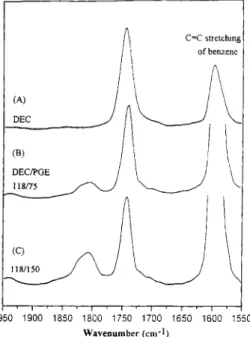
Figure 6. Infrared spectra of (A) DEC, and the end product of DEC-PGE mixture with weight ratio of (B) 118/75 and (C) 118/150.
salt). This phenomenon is somewhat unexpected because PMD is the product of PGE transesterifi- cation and cyclization with DPC proceeding through a zwitterion that is formed by oxirane and tertiary amine." In this PGE/DPC/TBAB system, the zwitterion is not expected to be present in this sys- tem. Different cyclization mechanisms must be in- volved in these two catalytic systems.
To understand the mechanism of cyclization in this system, the formulations of the model reaction were varied with different weight ratios of DPC to
I 100 150 200 250
Temperature ( O C )
Figure 7. Dynamic DSC runs in the temperature range between 30°C and 300°C: (A) PC/epoxy/TBAB blend with weight ratio 10/100/2, (B) PC/epoxy blend with weight ratio 10/100, (C) epoxy/TBAB mixture with weight ratio 100/2.
I " ' < ' "
1900 1850 1800 1750 1700 11 Wavenumber (cni-1)
,0
Figure 8. Infrared spectra of PC-epoxy blend catalyzed by TBAB with weight ratio of PC/epoxy/TBAB of 10/ 100/2, recorded in the carbonyl stretching region a t 80°C: (A) initial; (B) 60 min; (C) 120 min at 80°C and 60 min at 100OC; (D) 120 rnin at 80°C, 120 rnin at 100°C, and 120 min at 120OC; and (E) 120 rnin at 80"C, 120 min at lOO"C, 120 min at 120"C, and 120 min at 150°C.
PGE. Two parts TBAB catalyst to one hundred parts of PGE were added to this system. Curve (A) of Figure 5 shows the IR band of the unreacted DPC in the carbonyl region. Curves (B)-(E) of Figure 5 show that the IR spectra of the end products from reaction mixtures with weight ratios of DPC/PGE of 214/150, 214/300, 214/600, and 214/1200 (i.e. mole ratios are 1 to 1, 1 to 2, 1 to 4 and 1 to 8), respectively. Curve (B) of Figure 5 is the system with excess DPC and with a DPC/PGE weight ratio of 214/150. Since the carbonate group is excess, the oxirane can only transform a fraction of the original aromatic/aromatic carbonate group to the aromatic/ aliphatic carbonate. Curve (C) presents the stoi- chiometric system of the DPC/PGE mixture with a
I
PCiepnyRBAB
I 1850 1800 1750 1700 1650 1600
Wavenumber (cm-1)
Figure 9. Infrared spectra of the products from PC/ epoxy mixtures catalyzed by 2 phr TBAB with a weight ratio of 254/204 (curve Al), 254/340 (curve A3) and 254/ 476 (curve A5).
I
0 0 I c=o 0 CH, CH, I Scheme 3.weight ratio of 214/300. From this IR spectra, the aromatic/aromatic carbonate mainly interchanges to the aliphatic/aliphatic carbonate. Additionally, the IR absorption of PMD can be detected in this system. Curves (D) and (E) illustrate the IR spectra of the mixtures with PGE in excess where the weight ratios of DPC/PGE are 214/600 and 214/1200, re- spectively. These two IR spectra with non-stoichio- metric PGE rich systems show that the absorption of aliphatic/aliphatic carbonate is gradually reduced in response to the increase of the band of PMD. This phenomenon clearly indicates that the for- mation of cyclic carbonate (PMD) is closely related to presence of both oxirane and aliphatic/aliphatic carbonate. Thus, the following mechanism is pro- posed to explain the formation of PMD through the intermediate of transesterification reaction shown in Scheme 2.
Another approach to verify this proposed mech- anism is utilizing the aliphatic/aliphatic carbonate (diethylcarbonate, DEC) to proceed the model re- action. Curve (A) of Figure 6 shows the band of DEC in the carbonyl region. As mentioned previously, the
absorption band of aliphatic/aliphatic carbonate lo- cates at 1743 cm-'. Curves (B) and (C) of Figure 6 show the IR spectra of the end products from DEC/ PGE mixtures with reactant weight ratios of 118/ 75 and 118/150 (mole ratios are 1 to 0.5 and 1 to l ) , respectively. Curve (B) of Figure 6 shows that even
with excess carbonate, the oxirane still can trans- form portion of the aliphatic/aliphatic carbonate to the cyclic carbonate. This result supports the above proposed mechanism that the formation of cyclic carbonate proceeds through the intermediate of the transesterification reaction.
Structure of the PC-Epoxy Blends
Figure 7 shows the DSC results of dynamic runs in the temperature range between 30 and 300°C. Curve (A) shows the reaction of PC-epoxy blend catalyzed by TBAB. The weight ratio of PC/epoxy/TBAB is 10/100/2. Curve (B) presents the PC-epoxy blend with a weight ratio of PC/epoxy is 10/100. Curve (C) presents the epoxy that mixed with 2 phr TBAB. From these curves, it can be concluded that epoxy does not react with polycarbonate in the absence of quarternary ammonium salt and the presence of the quarternary ammonium salt also does not catalyze the homopolymerization of the epoxy monomer.
Figure 8 presents the IR spectra in carbonyl stretching regions of the reacting PC-epoxy blend catalyzed by TBAB, the weight ratio of PC/epoxy/ TBAB is 10/100/2. Comparing Figure 8 with Figure 2, one can find that the same transesterification and cyclization reactions occur in the PC-epoxy blend as in the model reaction.
CH, CH3 (R),NX
I
Transesterification 0 I 0 I C=O I CH, 0 CH, Cyclization CH,I
+ 0 I1 0 /c\o Scheme 4.Curves ( A l ) , (A3), and (A5) of Figure 9 show that the IR spectra of the products from the mixtures of PC/epoxy catalyzed by 2 phr TBAB with weight ratios of 254/204,254/340, and 254/476 (mole ratio of carbonate to oxirane is 50/60, 50/100, and 50/
140). Curve (A3) presents the stoichiometric system which two oxirane groups react with one carbonate group. The resulted carbonate absorption at 1755 cm-' indicates that the original aromatic/aromatic
carbonate (Ar - 0 - CO
-
0-
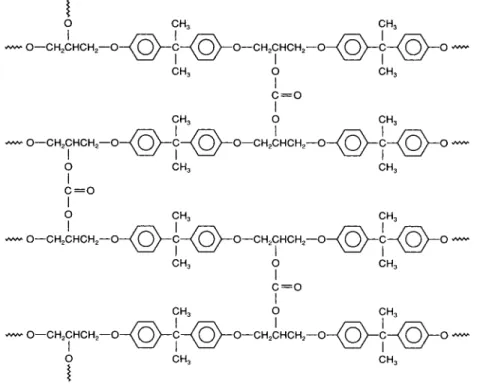
Ar) has been con- verted into the aliphatic/aliphatic carbonate (R - 0 - CO - 0 - R) almost completely. In other words, the epoxy prepolymer is crosslinked by car- bonate groups. The structure of the epoxy network crosslinked by the carbonate groups is illustrated in Scheme 3.7Curve (A5) of Figure 9 shows the IR spectrum of the nonstoichiometric system with excess oxirane group. As can be seen from the spectrum, the car- bonate absorption peaks appear at 1755 and 1805 cm-'. The band at lower frequency is the product of the transesterification reaction as mentioned pre- viously and the band of higher frequency comes from the cyclization reaction that has been verified by the model reaction. The crosslink density is expected to decrease with the increase of the cyclization re- action. Based on the proposed mechanism of cycli- zation, formation of cyclic carbonate will generate chain ends in the network, which are illustrated in Scheme 4.
Curve ( A l ) of Figure 9 shows the spectrum of non- stoichiometric system with excess carbonate group. The peak of the band at 1765 cm-' indicates that the oxirane transforms some of the original carbonate
(Ar- 0 - CO - 0 - Ar) to aromatic/aliphatic car- bonate (Ar
-
0 - CO-
0 - R) and aliphatic/ali- phatic carbonate (R-
0 - CO - 0 - R). The ali- phatic/aliphatic carbonate represents the crosslinking point of the network. The aromatic/aliphatic carbon- ate represents the point of carbonate insertion by the oxirane. The aromatic/aromatic carbonate reveals that the original PC segments remain in the system. These segments linked with epoxy prepolymer proceed through the aromatic/aliphatic carbonate. The struc- ture of the PC rich nonstoichiometric system is pro- posed as shown in Scheme 5.The glass transition temperatures of the blending systems with various compositions measured by dif- ferential scanning calorimeter (DSC) are summa- rized in Table I. Table I shows that TB of the blended system increases when the ratio of the components carbonate/oxirane is increased and reaches a max- imum with the stoichiometric ratio (as shown in the composition of A3 in Table I), and then decreases.
The stoichiometric ratio of carbonate/oxirane will result in the highest crosslink density, and therefore, possesses the highest
Tg
TheTs
of nonstoichio- metric systems are always lower than those of the stoichiometric system. It is worthy to mention here that decrease of the Tg from the epoxy-rich systems is much more drastic than that of PC-rich systems. This phenomenon can be interpreted as a result that the cyclization reaction occurred, in the epoxy-richt
CH3-C-CH3 IQ
0t
CH3-C-CH3 IQ
0L
CH2 I 0 0 I c=o I 0 CH, I I c=o 0-
- ~ H C H Z - O ~ ~ ~ O - C H ~ C H C H ~ - O - C H , C H C H ~ - O I 3 < CH3 Scheme 5 .systems, more chain ends in the network are created and this decreases the crosslink density. Group B
of Table I lists the Tgs of the systems with excess carbonate group in the blends. The chemical struc- ture of these blending systems can be considered as PC being crosslinked or branched by epoxy resin. However, essentially all of the Tgs of these blended
systems observed are lower than the virgin PC. A
reasonable explanation was previously proposed by Nielsen13 by considering the influence of crosslink- ing on
Tg:
(1) the crosslinking effect, and (2) a co- polymer effect. Indeed, the crosslinking of the chain of a polymer can cause restriction on the molecular motions, however, a copolymer effect should also be taken into account. A crosslinked unit usually is notstructurally the same as the rest of the p01ymer.l~ For example, the Tg of the cured epoxy resin (DER 332) catalyzed by benzyl dimethyl amine (BDMA)
is only 117"C.15 From the viewpoint of the copolymer effect, the transesterification reaction which intro- duces the epoxy moieties into PC should decrease the Tg of the resultant PC-epoxy blend. The copol-
ymer effect is probably responsible for the observed lower Tg due to the chemical composition change by
increasing the degree of crosslinkage.
CONCLUSIONS
The PC-epoxy blends catalyzed by quarternary am- monium salt undergoing transesterification and cy- clization reactions were verified by the model re- action. A mechanism has been proposed to explain
the formation of the cyclic carbonate structure which proceeds through a transition state of transesterifi- cation attacked by the anion of quarternary am- monium salt. With the stoichiometric composition of the PC-epoxy blend which may be cured by transesterification reaction, a network of crosslinked chain will be formed with carbonate groups. The
Tg
of end product is increased and reaches a maximum when the ratio is at stoichiometric value. However,
Tg decreases drastically in the nonstoichiometric
epoxy-rich system. This phenomenon can be ex- plained by chain scissions of the network due to the cyclization reaction; consequently, more chain ends are formed in the network. In the PC-rich system, the epoxy moiety is inserted into PC by the transes- terification reaction, and results in crosslinked or branched PC structure. Due to the copolymer effect of PC inserted by epoxy, the Tgs of blends are lower than those of the virgin PC.
This research was financially supported by the National Science Council, Taiwan, Republic of China, under the Contract no. NSC 84-2622-E-007-001. The authors thank Chiu-Ming Chen for helpful discussion and Epolab Chemical Co. for the donation of materials.
REFERENCES AND N O T E S
1. T. Nishikubo, T. Shimokawa, T. Hirano, and A. Shiina, J. Polym. Sci. Part A: Polym. Chem., 27,2519 (1989).
2. T. Nishikubo, T. Iizawa, and S. Saita, J. Polym. Sci.
Part A: Polym. Chem., 24,1685 (1986).
3. T. Nishikubo and K. Tanaka, J . Appl. Polym. Sci.,
3 3 ( 8 ) , 2821 (1987).
4. T. Nishikubo, S. Saita, and T. Fujii, J. Polym. Sci. Part A: Polym. Chem., 25,1339 (1987).
5. T. Nishikubo, A. Kameyama, C. Maejima, and Y. Ya- mamoto, Macromolecules, 27,7240 ( 1994).
6. L. I. Komarova, S. N. Salazkin, I. A. Bulgakova, M. I. Malaniya, S. V. Vinogradova, and V. V. Korshak,
J. Polym. Sci. Polym. Chem. Ed., 16, 1643 (1978).
7. Y. Yu and J. P. Bell, J. Polym. Sci. Part A: Polym.
Chem., 26,247 (1988).
8. M. S. Li, C. C. M. Ma, and F. C. Chang, et al., Mac-
romolecules, 29 ( 2 ), 499 ( 1995).
9. X. Yang, P. C. Painter, and M. M. Coleman, Macro-
molecules, 25,4996 ( 1992).
10. D. L. Pavia, G. M. Lampman, and G. S. Kriz, Jr.,
Introduction to Spectroscopy, Saunders College Pub-
lishing; Philadelphia, 1979.
11. R. M. Silverstein, G. C. Bassler, and T. C. Morrill,
Spectrometric Identification of Organic Compounds,
Wiley, Singapore, 1991.
12. M. S. Li, C. C. Ma, and F. C. Chang, et al., Proceedings
of the International Chinese Symposium on Polymer
Blends, Hsin Chu, Taiwan, July 1995.
13. L. E. Nielsen, Mechanical Properties of Polymers and
Composites, Dekker, New York, 1974.
14. T. G. Fox and S. Loshaek, J. Polym. Sci., 16, 371, 391 (1955).
15. M. S. Li, C. C. M. Ma, and F. C. Chang, et al., Polymer, t o appear.
Received December 1 1 , 1995