
在無線隨建即連網路中以標記法增進廣播效能之研究
54
0
0
全文
(2) 在無線隨建即連網路中以標記法增進廣播效能之研究. 指導教授:吳俊興 博士(教授) 國立高雄大學資訊工程學系. 學生:李嘉偉 國立高雄大學資訊工程學系. 摘要. 本論文針對無線隨建即連網路中的訊息廣播,提出以標記法在訊息中提供涵蓋節點 資訊減少網路中廣播訊息負荷並增進廣播效能的方法。由於無線隨建即連網路中並無固 定的架構,節點之間必需透過廣播傳遞訊息。簡單的泛流式廣播讓網路上的每一個節點 收到封包後就再廣播給鄰近節點,確保網路中每一個可涵蓋的節點都能收到訊息;但泛 流式廣播也造成大量重覆的封包在網路上流動而影響訊息傳輸的效能。標記法利用無線 隨建即連網路中節點彼此交換的鄰居節點資訊,在廣播的封包中增加已涵蓋的節點資 訊,使接收的節點得以判斷轉遞收到的封包是否能夠涵蓋額外的節點。本論文提出三種 標記法,使用不同的方式在封包上標記涵蓋的節點資訊,並使用不同的決策方式判斷轉 遞是不是能涵蓋額外的節點。透過使用不同的標記資訊與轉遞決策,標記法對於減少重 覆封包的數量也會達到不同程度的改進。由於標記法需要在封包上增加額外的標記資訊 而影響封包大小,而封包大小增加時傳輸時間與封包碰撞機率也會增加。為了減少封包 大小對廣播效能造成的影響,標記法利用減少封包上標記的數量與保持標記的間隔數降 低封包上負載的標記數量,以及透過壓縮標記進一步減少單一標記所使用的空間,藉此 提升整體廣播的效能。. 關鍵字:標記法、廣播、無線網路、隨建即連網路.
(3) Stamping Approaches to Efficient Broadcast for Wireless Ad Hoc Networks Advisor(s): Dr.(Professor) Chun-Hsin Wu Department of Computer Science and Information Engineering National University of Kaohsiung. Student: Chia-Wei Li Department of Computer Science and Information Engineering National University of Kaohsiung. ABSTRACT. Broadcasting is one of the most important operations for wireless ad hoc networks that provide a way to implement network wide control and route establishment functionality for numerous routing protocols. In this thesis, we propose the stamping approaches to efficient broadcast for wireless ad hoc networks with the stamping information of covered nodes in each packet. Simple flooding broadcasts each packet to each reachable node in a wireless ad hoc network but suffers from the problems of network congestion, resource contention and signal collisions. In this thesis, we study the main ideas of some existing efficient broadcast algorithms and propose a new broadcast scheme using stamps of covered nodes on each packet and neighbor information to reduce the broadcast redundancy in wireless ad hoc networks. With different strategies on stamping information and determining whether to rebroadcast a packet, stamping can achieve different levels of improvement. Since the size of each packet is increased with stamping, the transmission delay and collision rate on broadcasting is also increased. To reduce the problems introduced by stamping, we try to further improve the performance with reduction on the stamp level, number of stamps in each packet and stamp compression.. Keywords : stamping, broadcasting, wireless networks, ad hoc networks.
(4) Contents Contents .....................................................................................................iii List of Figures ............................................................................................. v List of Tables .............................................................................................. vi 1. 2. Introduction .......................................................................................... 7 1.1. Wireless Ad Hoc Networks ........................................................... 8. 1.2. Challenges .................................................................................... 9. 1.3. Contributions .............................................................................. 10. 1.4. Organization of the Thesis .......................................................... 11. Background and Related Work ......................................................... 12 2.1. Simple Flooding ......................................................................... 13. 2.2. Probability-Based Methods ........................................................ 13 2.2.1 2.2.2. 2.3. Area-Based Methods .................................................................. 15 2.3.1 2.3.2. 2.4. 3. 4. Probabilistic Scheme................................................................................ 14 Counter-Based Scheme ............................................................................ 14. Distance-Based Scheme ........................................................................... 15 Location-Based Scheme........................................................................... 15. Neighbor Knowledge Methods ................................................... 16 2.4.1 2.4.2. Flooding with Self Pruning ...................................................................... 17 Scalable Broadcast Algorithm (SBA) ...................................................... 17. 2.4.3. Dominant Pruning .................................................................................... 18. 2.4.4 2.4.5. Multipoint Relaying ................................................................................. 18 Ad Hoc Broadcast Protocol (AHBP) ....................................................... 19. 2.4.6. CDS-Based Broadcast Algorithm ............................................................ 19. Stamping Broadcast Algorithm ......................................................... 21 3.1. Basic Stamping ........................................................................... 22. 3.2. Advanced Stamping .................................................................... 24. 3.3. Hybrid Stamping ........................................................................ 26. Evaluation ........................................................................................... 29.
(5) 4.1. 4.2. 5. Simulation Parameters ................................................................ 30 4.1.1 4.1.2. Numbers of Nodes ................................................................................... 31 Network Size............................................................................................ 35. 4.1.3. Transmission Range ................................................................................. 37. 4.1.4. Data Size .................................................................................................. 40. Protocol Overhead Reduction ..................................................... 43 4.2.1. Stamp Level ............................................................................................. 43. 4.2.2 4.2.3. Number of Stamps ................................................................................... 45 Stamp Compression ................................................................................. 47. Conclusion and Future Work ............................................................ 49. Bibliography ............................................................................................. 51.
(6) List of Figures Figure 3-1 Pruning with Basic Stamping............................................................................... 22 Figure 3-2 Broadcasting with Basic Stamping ...................................................................... 23 Figure 3-3 Pruning with Advanced Stamping........................................................................ 24 Figure 3-4 Pruning with Advanced Stamping........................................................................ 24 Figure 3-5 Broadcasting with Advanced Stamping ............................................................... 25 Figure 3-6 Pruning with Advanced Stamping........................................................................ 27 Figure 3-7 Broadcasting with Advanced Stamping ............................................................... 27 Figure 4-1 Ratio of Forwarding Nodes with Various Number of Nodes ............................... 32 Figure 4-2 Ratio of Forwarding Nodes with Various Number of Nodes without Protocol Overhead .......................................................................................................................... 33 Figure 4-3 Number of Signal Collisions with Various Number of Nodes ............................. 34 Figure 4-4 Ratio of Forwarding Nodes with Various Network Size...................................... 36 Figure 4-5 Number of Signal Collisions with Various Network Size.................................... 37 Figure 4-6 Ratio of Forwarding Nodes with Various Transmission Range ........................... 38 Figure 4-7 Number of Signal Collisions with Various Transmission Range ......................... 39 Figure 4-8 Ratio of Forwarding Nodes with Various Data Size ............................................ 41 Figure 4-9 Number of Signal Collisions with Various Data Size .......................................... 42 Figure 4-10 Ratio of Forwarding Nodes with Various Stamp Level ....................................... 44 Figure 4-11 Ratio of Forwarding Nodes with Various Number of Stamps ............................. 46 Figure 4-12 Ratio of Forwarding Nodes with Various Number of Nodes and Stamp Compression..................................................................................................................... 48.
(7) List of Tables Table 4-1. Simulation Parameters for Evaluation ............................................................... 30. Table 4-2. Delivery Ratio with Various Number of Nodes ................................................. 35. Table 4-3. Delivery Ratio with Various Network Size ........................................................ 38. Table 4-4. Delivery Ratio with Various Transmission Range ............................................. 40. Table 4-5. Delivery Ratio with Various Data Size .............................................................. 43. Table 4-6. Delivery Ratio with Various Stamp Level ......................................................... 45. Table 4-7. Delivery Ratio with Various Number of Stamps................................................ 47. Table 4-8. Delivery Ratio with Various Transmission Ranges and Stamp Compression ... 48.
(8) 1 Introduction A wireless ad hoc network is a decentralized form a wireless network. A network is considered as an ad hoc network if it does not rely on an infrastructure like using routers in wired networks or access points in wireless networks. Instead, an ad hoc network uses a self-configuring approach to form a dynamic network by the nodes in the network. In a wireless ad hoc network, each node has a transmission range and nodes lived within the transmission range are regarded as the neighbor nodes of the node. To send a message to other nodes, a node broadcasts the message to its neighbor nodes, and each node received the message determines whether to forward the message based on the network connectivity [1]. Since it is not possible to maintain a well- formed infrastructure of network in a highly dynamic environment, the decentralized nature of wireless ad hoc networks make it suitable for building applications in such environment. As a wireless ad hoc network requires less configuration compared to a managed network, it is commonly used for quick deployment in emergency situations like disasters and wars. The wireless ad hoc network is also introduced into mobile devices to provide ubiquitous communication between people in recent years. Although the wireless ad hoc network provides more scalability, there is still some limitation on its capacity [2][3]. In a wireless ad hoc network, sending a message to the target node requires each node received the message to forward it based on the network connectivity. In the absence of an appropriate strategy, each node in the network generates many redundant transmissions and causes more power consumption. Moreover, signal collisions may be produced since more packets are likely to be transmitted over the same wireless 7.
(9) channel at the same time. Signal collisions then make these colliding packets being lost and the number of nodes that actually received the message is also affected. In order to solve these problems, many broadcast algorithms have been proposed to improve the efficiency of broadcasting in wireless ad hoc networks. In this thesis, we propose a broadcast algorithm to improve the performance of broadcasting in wireless ad hoc networks. With the algorithm, the network connectivity of each node on the routing path is used for verifying redundant transmissions. This algorithm is called stamping since it requires each node to stamp the information of network coverage on each message while forwarding it.. 1.1. Wireless Ad Hoc Networks. Wireless ad hoc networks are networks organized by nodes communicated with each other using wireless connections without a pre-defined infrastructure. Due to the growth of wireless communication technologies like Wi-Fi, WiMAX and LTE, more and more devices are capable of communicating with eac h other immediately. As the result, more and more applications are built on top of wireless ad hoc networks formed by these wireless devices. With the appearance of mobile Internet devices (MIDs), the research on mobile ad hoc networks (MANETs) and vehicular ad hoc networks (VANETs) becomes more popular in recent years. MANETs are a form of wireless ad hoc networks that are consisted of mobile nodes connected by wireless links. Each node in a MANET is free to move in any direction independently, thus the wireless links between nodes are changed frequently. Since the network connectivity varied constantly in a MANET, it is required for each node to continuously maintain the routing information. MANETs are usually used in deploying applications in dynamic environments to explore the information in those 8.
(10) environments. Recently the One Laptop per Child Association has developed a laptop with an IEEE 802.11s based wireless networking chip therefore these laptops can communicate with each other within the MANET. VANETs are a kind of MANETs that are formed by vehicles like cars, motorcycles or bicycles with mobile devices. The main difference between VANETs and MANETs is that each node in a VANET is moving towards a direction as most vehicles do in the real world. Since a node in a VANET has a clear direction of movement, each node can update the routing information with some prediction. VANET allows vehicles to communicate with each other or the roadside units and improves safety and comfort of driving. In recent years, many motor companies are trying to development motors with integrated inter-vehicle communication via VANETs to provide better transportation experiences.. 1.2. Challenges. Due to the nature of ad hoc networks, broadcasting becomes an important operation for transmitting packets from source nodes to destination nodes in these networks. Most of routing protocols like DSDV [4], DSR [5], AODV [6], ZRP [7] and LAR [8] rely on broadcasting for route discovery, route maintenance and network topology update. A simple form of broadcasting is simple flooding [9], with each node rebroadcasts each received unique packet to its neighbor nodes exactly once until all reachable nodes have received the packet. This algorithm guarantees that a message broadcasted can reach all connected nodes if there is no collision. Although the algorithm is simple, it also causes serious network problems because all nodes rebroadcast the same packet and makes the network full of duplicate packets. The problem caused by flooding is referred to as the broadcast storm problem [10]. 9.
(11) From the analysis of broadcast redundancy observed, about only 41% of additional area can be covered by a rebroadcasting in average. For each forwarding node in a broadcasting event, the additional area can be covered by its rebroadcasting decreases as its upstream nodes increases. Nodes with more than 3 upstream nodes are seemed to have only 0.05% additional coverage by a rebroadcasting. To address on the broadcast storm problem, the time-to-live (TTL) is used to reduce the broadcast redundancy caused by simple flooding. For simple flooding using TTL, an extra field is added for indicating how many hops are allowed for broadcasting the packet. Although simple flooding with TTL can reduce some broadcast redundancy, it is difficult to estimate how many hops are required to achieve sufficient coverage. Besides, nodes within the same hops are treated equally without taking other information into consideration. Since TTL introduces the concept for providing routing information via additional fields, we then extend this concept to obtain more information on each step of the route. This approach for keeping routing information is called stamping since it is similar to the procedure of official documents being stamped in each responsible station for processing.. 1.3. Contributions. In the thesis, we propose the stamping broadcast algorithm to solve the broadcast storm problem in wireless ad hoc networks. Each node on the routing path stamps its own identification and optional information of identification of its neighbor nodes to a packet while broadcasting the packet. Upon the reception of a new message, each node determines whether to forward the message based on the routing information from the stamps to minimize the redundant transmission for covering each node in the network. With the stamping broadcast algorithm, the number of forwarding nodes is 10.
(12) significantly reduced while the ratio of covered nodes is remained high compared to other algorithms. As the result, the power consumption and transmission time can be further reduced with the reduction of redundant transmission. Furthermore, we study the performance improvement of stamping broadcast algorithm with various size of information stamped on the broadcast message. Since stamping broadcast algorithm requires each message to carry additional routing information, the network load of broadcasting is also increased. In order to solve the problem, we can limit the size of information used as stamps but the performance improvement of the algorithm is also affected. To find out the trade-off between the performance improvement and protocol overhead, we use various approaches on stamping information and analyze the simulation results.. 1.4. Organization of the Thesis. The rest of the thesis is organized as follows. Chapter 2 discusses the background knowledge and related work on efficient broadcast algorithms. In Chapter 3, we describe the details about stamping broadcast algorithm. Analysis and simulation results are shown in Chapter 4. Finally, Chapter 5 concludes the thesis and outlines the future work.. 11.
(13) 2 Background and Related Work Due to the rapid growth of applications on wireless ad hoc networks, many algorithms have been proposed to reduce redundancy overhead for broadcasting packets in these networks. Existing broadcast algorithms are usually classified into four categories based on the information they utilized: simple flooding, probability based methods, area based methods and neighbor knowledge methods [11]. More details about these categories are provided in Section 2.1 to Section 2.4. To prevent infinite loops from transmitting packets over wireless ad hoc networks, a terminal condition is required for each broadcast algorithm to stop rebroadcasting a packet. Most broadcast algorithms require each node to cache identification of each unique packet it received. Therefore nodes can identify whether a packet is duplicate upon receiving the packet. Some other broadcast algorithms make use of the TTL field in each packet to indicate maximal hops the packet should be forwarded [12]. In a homogeneous wireless ad hoc network, each node has similar hardware and distances between its neighbors. If a node broadcast a new packet in the network, all its neighbors will receive the packet almost simultaneously. Since these neighbors are similar, they are likely to rebroadcast the packet at the same time. If some nodes can be covered by more than one of these neighbors, collisions will be happened and none are received on the nodes. To avoid this problem, each node schedules for a rebroadcasting with a randomly generated delay. This delay is regarded as jitter and can be used in network layer or MAC layer to reduce collisions in wireless ad hoc networks. Some broadcast algorithms require each node to utilize packet information to determine whether to rebroadcast a packet. More information of packets can be used to 12.
(14) help nodes to make more accurate decisions. In order to obtain more information for processing a packet, each node keeps receiving duplicate packets for a short time upon reception of an unseen packet. The short time is termed as the random assessment delay (RAD) and is randomly chosen within a range specified by each broadcast algorithm [11]. It allows each node to collect more information from duplicate packets to decide to rebroadcast a packet or drop it. Besides, the random behavior of the RAD also prevents rebroadcasting from producing collisions.. 2.1. Simple Flooding. Simple flooding, also called as pure flooding or blind flooding, requires each node to rebroadcast each packet the first time it receives the packet. Since nodes forward each unique packet to its neighbors, this guarantees that each packet will be broadcasted to every reachable node in the network if there is no collision. Although this approach seems to be effective, it makes nodes produce unnecessary broadcasting and lead to serious collisions. It is commonly used in wireless ad hoc networks with low node densities or high node mobility.. 2.2. Probability-Based Methods. Probability based methods use none or very limited network information to provide a probability for nodes to rebroadcast [13]. Although some of other broadcast algorithms also use probabilities on forwarding packets, methods described here only require each node to use its own information to provide the probability for rebroadcasting. Probabilistic scheme and counter-based scheme are the main broadcast algorithms under this category.. 13.
(15) 2.2.1. Probabilistic Scheme. Probabilistic scheme [10] works like simple flooding except each node decides whether to rebroadcast a packet with a pre-defined probability. In dense networks, randomly have some packets dropped is helpful to reduce duplicate packet without affecting coverage. Since each node has more neighbors in networks with higher densities, packets are likely to be sent to each node by many nodes even if some of them are dropped on some nodes. In sparse networks, each node is covered by fewer neighbors. Therefore, packets may be never transmitted to some nodes with a low probability because they are dropped on all routes to those nodes. With the probability 1, probabilistic scheme works the same as simple flooding.. 2.2.2. Counter-Based Scheme. Counter-based scheme [10] comes from the idea that broadcasting a packet seems to have lower additional coverage if the packet is received more times on a node. Instead of making decisions immediately with a probability, counter-based scheme uses a threshold for each node to determine whether to rebroadcast a packet. On receiving each packet the first time, a node schedules a RAD. A counter for the packet is increased by one for each duplicate packet the node received during the RAD. After the RAD expires, the packet is forwarded if the counter is less than a pre-defined threshold value. In dense networks, nodes drop packets received many times since it may already be rebroadcasted by other nodes. In sparse networks, each node forwards almost each packet it received because there is only a little chance for a node to be covered by many other nodes.. 14.
(16) 2.3. Area-Based Methods. Area based methods use distance of location information of senders and receivers to ensure that each forwarding node can cover sufficient additional area [12]. Area based information don’t require nodes to obtain their neighbor information, therefore covering more additional area is not equal to covering more additional nodes. But cover more additional area is still more likely to cover more additional nodes. For each receiver at the edge of a sender’s transmission range, at most 61% of additional area can be covered by forwarding the packet broadcasted by the sender. The representative broadcast algorithms of area based methods are distance-based scheme and location-based scheme.. 2.3.1. Distance-Based Scheme. For each node using distance-based scheme [10], it can evaluate distances between itself and other nodes by using signal strength of previous trans missions. On receiving a packet the first time, the receiver schedules a RAD and collects all duplicate packets during the RAD. After RAD expires, if the minimal distance between the receiver and senders of those packets is more than a pre-defined threshold value, the receiver forwards the packet. Otherwise, the packet is dropped.. 2.3.2. Location-Based Scheme. With global positioning system (GPS), location-based scheme [10] can have more precise estimation on calculating additional area can be covered by each forwarding node. When a node broadcasts or forwards a packet, it adds its location information to the packet. On receiving a non-duplicate packet, each node calculates the distance 15.
(17) between it and the sender of the packet. If the distance is more than a pre-defined threshold, the node schedules a RAD and keeps receiving duplicate packets. If a duplicate packet is received during the RAD, the nodes checks if the distance to the sender is sufficient. If not, the node cancels the RAD and drops the packet. Otherwise, the packet is rebroadcasted after the RAD expires.. 2.4. Neighbor Knowledge Methods. Neighbor knowledge methods require each node to use neighbor information for ensuring additional nodes can be covered by rebroadcasting. Neighbor knowledge methods are classified into broadcast algorithms use 1-hop neighbor information and 2-hop or more neighbor information [14]. For each node to obtain their neighbor information, each node periodically broadcasts a “hello” packet with its identification. On receiving a “hello” packet, each node adds the identification on the packet to its neighbor list. For broadcast algorithms using 2-hop neighbor information, 1-hop neighbor information of the sender is also contained in each “hello” packet. Most existing broadcast algorithms under this category make use of 2-hop neighbor information. There are two strategies for neighbor knowledge methods to choose forwarding nodes: sender-based strategy and receiver-based strategy. With sender-based strategy, each sender chooses a subset of its neighbors as next forwarding nodes [15][16][18][19][20]. With receiver-based strategy, each receiver makes its own decision on whether to forward a packet [15][24][26][27][28][29]. Since each sender has to determine which neighbors to forward a packet based on information of these receivers, broadcast algorithms using sender-based strategy are usually using 2-hop or more neighbor information. 16.
(18) 2.4.1. Flooding with Self Pruning. Flooding with self-pruning [15] is a simple neighbor knowledge method using 1-hop neighbor information. When a node broadcasts a packet, it adds its neighbor information to the packet. For each node receives a packet the first time, it compares its neighbor information to the information on the packet. If some additional nodes can be covered by rebroadcasting, the node then rebroadcasts the packet with its neighbor information.. 2.4.2. Scalable Broadcast Algorithm (SBA). Scalable broadcast algorithm (SBA) [24] is a simple neighbor knowledge methods using 2- hop neighbor information. Since each sender of a packet is a neighbor of its receivers, a receiver can use their 2-hop neighbor information to find out if some of its neighbors are already covered by the sender. On first receiving a new packet, each node checks if all its neighbors are covered by the sender. If not, the node schedules a RAD and keeps receiving duplicate packets during the RAD. On receiving a duplicate packet, the node continues checking if it can cover additional nodes. If not, the RAD is canceled and the packet is dropped. After RAD expires, the packet is rebroadcasted by the node. The authors of SBA proposed a method for dynamically adjusting RAD based on network information. For a node to schedule a RAD, it first finds out the maximal node degree of it neighbors and uses it to calculate a RAD ratio to its node degree. Then the node schedules a RAD multiplied with the RAD ratio. With this approach, nodes with more neighbors have shorter RAD intervals therefore they can forward packets to more neighbors before others. 17.
(19) 2.4.3. Dominant Pruning. Dominant pruning [15] is also a neighbor knowledge method using 2-hop neighbor information but with the sender-based strategy. That is, a node broadcasts or forwards a message is required to explicitly choose some of its neighbor nodes to be the next forwarding nodes. Nodes only forward a received message only if it is explicitly specified in the packet header of the message. With the knowledge of 2-hop neighbor information, each node using dominant pruning picks the next forwarding nodes with the greedy set cover algorithm. When a node receives a new message, it computes the cover set by the neighbor information of the sending node. Then the node picks its 1-hop neighbors recursively to cover the maximal number of uncovered 2-hop neighbors until all 2- hop neighbors are in the cover set.. 2.4.4. Multipoint Relaying. Multipoint relaying [16][17] is another broadcast algorithm using 2- hop neighbor information with sender-based strategy. Multipoint relaying requires each sender to determine a subset of its neighbors for forwarding a packet. To choose the forwarding nodes, the sender first finds out the 2-hop neighbors that can be only reached through one neighbor and add these neighbors into forwarding node set. For remaining 2-hop neighbors, the sender chooses each node which covers most 2-hop neighbors until all 2-hop neighbors are covered. After the forwarding node set is completed, the sender adds it to the packet and broadcasts the packet. On the reception of a new packet, a receiver checks the information on the packet to see if it is in the forwarding node set. If so, the receiver then decides the next forwarding set of the packet and forwards it with the set. Otherwise, the packet is immediately dropped by receiver. 18.
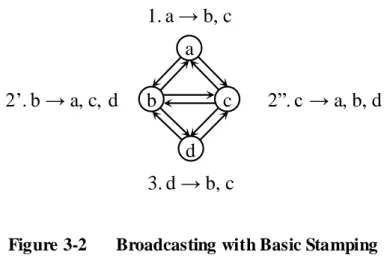
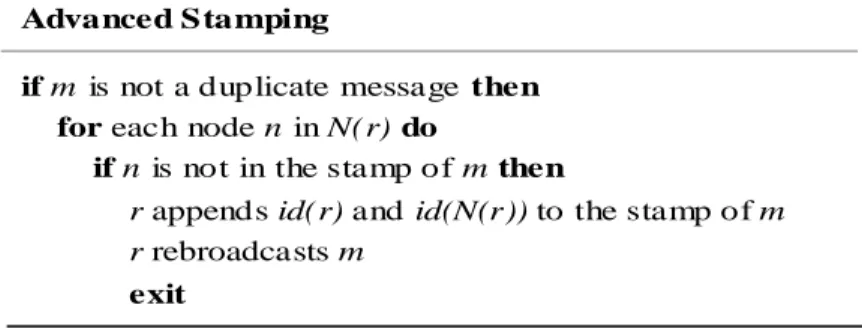
(20) 2.4.5. Ad Hoc Broadcast Protocol (AHBP). The AHBP has a similar approach as multipoint relaying, despite it computes the broadcast relay gateway (BRG) for choosing the next forwarding nodes. The algorithm for computing BRG is merely identical to the algorithm used by multipoint relaying but different on calculating the cover set. Upon the reception of a new message, each node first builds the cover set for the message. Unlike multipoint relaying, the node using AHBP then puts the sending node and all neighbor nodes of the sending node to the cover set. Following the node starts picking the next forwarding nodes for covering 2-hop neighbors can be only covered by one of its 1-hop neighbors. If there are uncovered 2-hop neighbors, the greedy set cover is used for choosing remaining forwarding nodes until all 2-hop neighbors are covered.. 2.4.6. CDS-Based Broadcast Algorithm. An important technique used in neighbor knowledge methods is the connected dominating set (CDS). A CDS is a group of connected node set that each node is either in the set or in the edge contains a node from the set. Finding minimum CDS (MCDS) is a way to optimize broadcast redundancy in networks, but it requires global knowledge of whole networks. Some methods for comp uting MCDS with approximation ratio have been proposed but maintain CDS is costly in mobile ad hoc networks [21][22][23]. CDS-based broadcast algorithm [19] works like multipoint relaying but different on determining the cover set. When a source node broadcasts a packet, the node chooses the forwarding node set as in multipoint relaying. In CDS-based broadcast algorithm, a node has a higher priority if it is selected in an earlier step. On the 19.
(21) reception of a new packet, each node checks if it is on the forwarding node set of the packet. If not, the packet is immediately dropped. Otherwise, the node creates a cover set which contains nodes in the forwarding node set with higher priorities. After building the initial cover set, the node selects next forwarding nodes as in multipoint relaying until all its 2-hop neighbors are in the cover set.. 20.
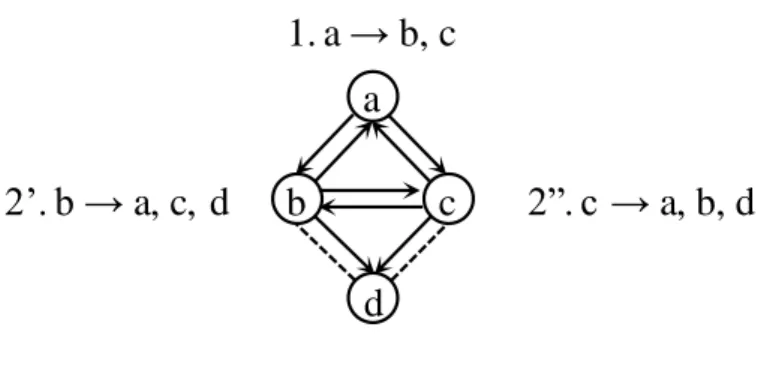
(22) 3 Stamping Broadcast Algorithm Before going into details, we describe some assumptions and denotations in our algorithm. A network can be regarded as a graph G(V, E), where V is the nodes in the network and E is the connections between these nodes. Each node v in V has its own unique ID denoted as id(v), and all nodes have the same transmission range R. Nodes in the transmission range of node v are neighbors of v and denoted by N(v). In order to make each node obtain its neighbor information, packets that contain ID and neighbor information of each node are periodically broadcasted in the network. The main idea of stamping comes from that most neighbor knowledge methods use 2-hop neighbor information to check about redundancy. However, sometimes redundancy is made by forwarding of nodes which don’t have neighbor information about each other. On the other hand, relying on only 2- hop neighbor information is less reliable in mobile ad hoc networks. In order to solve these problems, each node appends some information to a packet when forwarding it. After a node receives a packet, it can take the information appended into account when deciding whether to forward the packet. This process is called stamping because it looks like dealing with an official document in several departments within an organization. After each node validates a packet, it stamps on the packet to make others know that it has processed the packet. With the differences on stamping information when forwarding and evaluation for additional coverage, stamping broadcast algorithm has three variations: basic stamping, advanced stamping and hybrid stamping. Details of these variations are described respectively in following paragraphs.. 21.
(23) 3.1. Basic Stamping. Basic stamping is one of neighbor knowledge methods that use 1-hop neighbor information. By using the algorithm, each node uses its own unique ID as the stamping information that would be appended to packets it forwards. By stamping forwarder's ID on rebroadcasted packets, receivers of these packets can use stamps on them to check if their neighbors have been already covered. As the algorithm shown in Figure 3-1, after node r receives a broadcast message m, it checks if m is a duplicate message or not. If not, r then uses the stamp of the message to see if its entire neighbor N(r) is covered. If there are uncovered neighbors, r appends id(r) to the stamp of m and schedules for a rebroadcasting. Figure 3-2 shows a simple flow of broadcasting in a small network with basic stamping. The numbers of broadcast redundancy and duplicate packets are 4 and 10 respectively. We use node a as the source node of this demonstration. At the beginning, a broadcasts the packet with stamp “a”. After nodes b and c receive the packet, they first check if it is a duplicate packet. Because they don’t receive this packet before, they then use the stamp to check if all its neighbors have received it before. After. Basic Stamping if m is not a duplicate message then for each node n in N(r) do if n is not in the stamp of m then r appends id(r) to the stamp of m r rebroadcasts m exit. Figure 3-1. Pruning with Basic Stamping. 22.
(24) 1. a → b, c. a 2’. b → a, c, d. b. c. 2”. c → a, b, d. d. 3. d → b, c Figure 3-2. Broadcasting with Basic Stamping. ensuring that some neighbors have not been covered before, b and c rebroadcasts the packet with stamps “a, b” and “a, c” respectively. On receiving packets rebroadcasted by b and c, a immediately drops them because they have been broadcasted by a before. Nodes b and c also receive a packet from each other, and drop them because they have received the same packet before. Node d receives two packets during the forwarding, and the node only rebroadcasts the message for the first time because it has not received the packet before at the time. Packets rebroadcasted by the last forwarding of d are dropped by all receiving nodes because they have already been covered by previous broadcasting. However, the broadcast redundancy produced by using basic stamping is seem to be the same as using flooding shown in Figure 3-2. Since basic stamping uses nodes’ IDs that already passed as the stamp to avoid unnecessary rebroadcasting, it makes effects mainly on nodes that have only one neighbor. Since both flooding and basic stamping have history information for verification of duplicate packets, the stamping information used here is not sufficient as it provides little improvement over flooding. By using RADs, there are chances that some additional redundancy can be reduced if nodes receive packets from all their neighbors before RADs expire. But as we will 23.
(25) show in simulation results, the improvement of basic stamping is still limited with RAD. Therefore, simply adding IDs of each passed node to the stamp is not enough to reduce broadcast redundancy in ad hoc networks.. 3.2. Advanced Stamping. Advanced stamping is also a kind of neighbor knowledge methods using 1-hop neighbor information. Besides appending unique ID of each forwarding node to the stamp, IDs of each forwarding node’s neighbors are also appended in this scheme. Since neighbors of each forwarder are in the transmission range of the forwarder, they should receive every packet forwarded by the forwarder. Therefore, using stamps which contain 1-hop neighbor information can be used to provide more accurate information of already covered nodes. Algorithm shown in Figure 3-3 demonstrates the pruning process by using advanced stamping. After a node r receives a broadcast message m the first time, it uses the stamp of m to check if all its neighbors N(r) are already covered. If so, there is no need to rebroadcast the message because it doesn’t make additional coverage; otherwise, r appends id(r) and id(N(r)) to the stamp and schedules for a rebroadcasting.. Advanced Stamping if m is not a duplicate message then for each node n in N(r) do if n is not in the stamp of m then r appends id(r) and id(N(r)) to the stamp of m r rebroadcasts m exit. Figure 3-3. Pruning with Advanced Stamping 24. Figure 3-4. Pruning with Advanced Stamping.
(26) Figure 3-4 shows a simple flow of using advanced stamping in a small network. We use node a as the source node of broadcasting. At first, a broadcasts the message with a stamp “a, b, c”. When nodes b and c receive the message, they find out that the message is a new message and use the stamp of the message to evaluate additional coverage. Because one of their neighbors, node d, is not in the stamp, b and c then schedule for rebroadcasting using the stamp “a, b, c, d”. After rebroadcasting, a and d receives two broadcast messages from b and c. At the same time, b and c receive a broadcast message from each other. For all of these nodes, stamps of the received messages contain all of their neighbors. Hence there is no need to schedule for further forwarding. As we can see in Figure 3-4, broadcast redundancy is decreased by one compared to the basic stamping. From the simple flow, we can notice the broadcast redundancy reduced by using advanced stamping is found in the corner of the network. This is because nodes in the corners of a network usually have some overlapped neighbors and no additional coverage can be reached by them. The simulation results are similar to flooding with self-pruning, but some longer loop can be reduced since the stamp is accumulated to each packet. The RAD also plays an important role in reducing broadcast redundancy. In the situation after both b and c schedule with RADs in. 1. a → b, c a. 2’. b → a, c, d. b. c. 2”. c → a, b, d. d Figure 3-5. Broadcasting with Advanced Stamping 25.
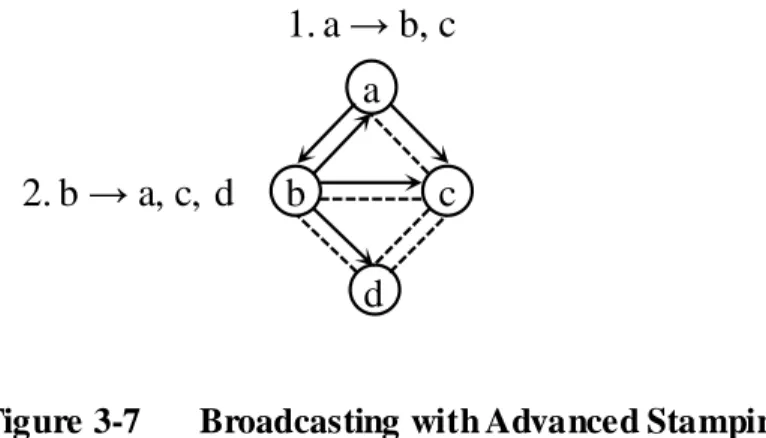
(27) previous example, if the RAD in b is expired earlier then c will receive the redundant broadcast message before rebroadcasting. Because the stamp of the message forwarded by b indicates all nodes have already been covered, c then immediately aborts its scheduling for rebroadcasting. Although RAD can make some improvement on advanced stamping, with more neighbor information it is still possible to reduce more broadcast redundancy with stamping.. 3.3. Hybrid Stamping. Unlike other forms above, hybrid stamping utilizes 2-hop neighbor information for pruning. Although advanced stamping can avoid the situation for receivers of the same packet to resend it to each other, there are chances that these receivers share some neighbors not in the stamp. With hybrid stamping, each node further checks if some of its neighbors can also be reached by other nodes in the stamp. If so, the node decides whether to forward for these neighbors by implementation of actual system design. In this thesis, we assume that the node which has the ID of lowest alphabetic order is responsible to forward a packet to a node if several nodes can cover the node. Algorithm of hybrid stamping is shown in Figure 3-5. When node r receives a new message m, it first checks if its neighbors N(r) are all contained in the stamp of m. For each neighbor n not contained in the stamp, r then tries to find if there is a neighbor m in N(n) is in the stamp. If m has higher priority than r, r can assume n will be covered by broadcasting from m or node with even higher priority. Figure 3-6 demonstrates a simple broadcast flow using hybrid stamping in the same network as above. Node a broadcasts the message with stamp “a, b, c” in the beginning. When nodes b and c receive the message, they know it is a new message and check the stamp for covered node set. After examining the stamp, both of them 26.
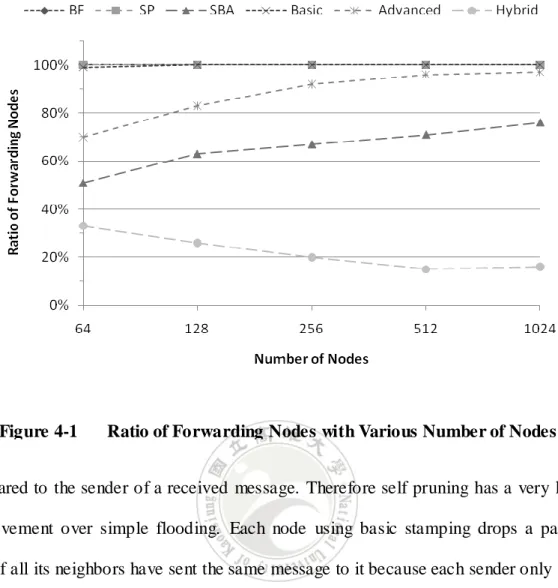
(28) Hybrid Stamping if m is not a duplicate message then for each node n in N(r) do if n is not in the stamp of m then for each node o in N(n) do if o is in the stamp of m and o has a higher priority than r then break r appends id(r) and id(N(r)) to the stamp of m r rebroadcasts m exit. Figure 3-6. Pruning with Advanced Stamping. find a neighbor, node d, is not covered but can be reached by each other. With the pre-defined comparison method, node c knows that node b has a higher precedence than itself and cancels following processing. On reception of the broadcast message sent by b in other nodes, each node immediately drops the message because all of their neighbors are in the stamp of the message. Compared to advanced stamping, hybrid stamping can be effectively reduce broadcast redundancy generated by nodes try to cover some overlapped neighbors. This algorithm is especially suitable for delivering packets in a dense network since receivers of the same broadcasting event seem to have some shared neighbors. From. 1. a → b, c. a 2. b → a, c, d. b. c. 2”. c → a, b, d. d Figure 3-7. Broadcasting with Advanced Stamping 27.
(29) the simulation results, hybrid stamping provides evident improvement over other broadcast algorithms. The method we used for selecting the forwarding node sometimes make nodes can be covered by a single node to be forwarded by several other nodes. Therefore, using a better node selection method can also improve the performance of hybrid stamping.. 28.
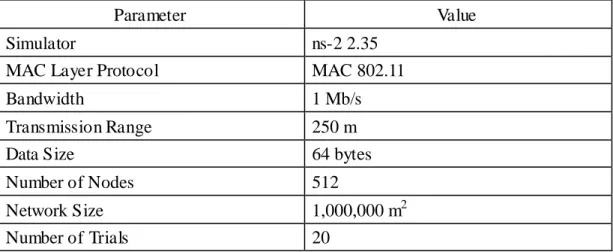
(30) 4 Evaluation To analyze the performance of stamping, we compare it with another three algorithms: simple flooding, self pruning and SBA. Self pruning is chosen because it is an algorithm similar to stamping that utilizes neighbor information to indicate nodes already covered. It can be considered as a specialized version of advanced stamping with stamps replaced by each forwarder. SBA is a simple algorithm using 2-hop neighbor information. However, the method for dynamically adjusting RAD proposed by the authors of SBA can improve the performance of broadcast algorithms based on the network information. Since all forwarding nodes of a broadcast event form a CDS of the network, the number of forwarding nodes is not less than the number of nodes form the MCDS of the network. Although computing the MCDS of a network is a NP-hard problem, an approximation algorithm is proposed to solve the problem. Minimal forwarding nodes are computed with the algorithm and used as the lower bound for each simulation. We use the network simulator ns-2 to evaluate the performance improvement of the broadcast algorithms. The default simulation parameters are shown in Table 4-1. We use IEEE 802.11 specification as the MAC layer protocol and two-ray ground reflection model as the radio propagation method. The bandwidth of each wireless channel is 1 Mbps as the default value of the IEEE 802.11 module in ns-2. The transmission range of each node is 250 meters as the default setting o f ns-2 wireless environment. Each data packet contains the protocol headers and 64 bytes of data payload. The network size is 1,000,000 square meters and the number of nodes in the network is 500. We generate the certain number of nodes and randomly place them on the network. For each simulation, a node is randomly picked as the source node of.
(31) Parameter. Value. Simulator. ns-2 2.35. MAC Layer Protocol. MAC 802.11. Bandwidth. 1 Mb/s. Transmission Range. 250 m. Data Size. 64 bytes. Number of Nodes. 512. Network Size. 1,000,000 m2. Number of Trials. 20. Table 4-1. Simulation Parameters for Evaluation. broadcasting. Packet are broadcasted without additional control besides the operations used by each broadcast algorithm. Most of the broadcast algorithms require each node to send a hello message periodically and these messages are ignored in the simulation results. In the following sections, we first study the simulation results against several different simulation parameters. The simulation results show that the RAD and protocol header size would lead to different performance improvement of stamping. Therefore, we then study the simulation results of stamping with various RAD generation methods and stamps size reduction approaches.. 4.1. Simulation Parameters. In this section, we compare the simulation results of the broadcast algorithms against four parameters: number of nodes, network size, transmission range and data size. The main goal of efficient broadcast algorithms is reducing the number of forwarding nodes therefore the number of redundant packets can be also reduced. Thus, the ratio of forwarding nodes is used to evaluate the performance of these broadcast 30.
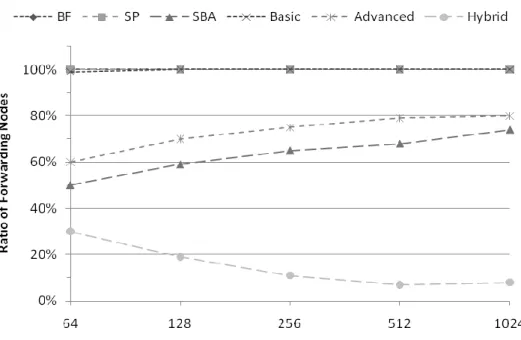
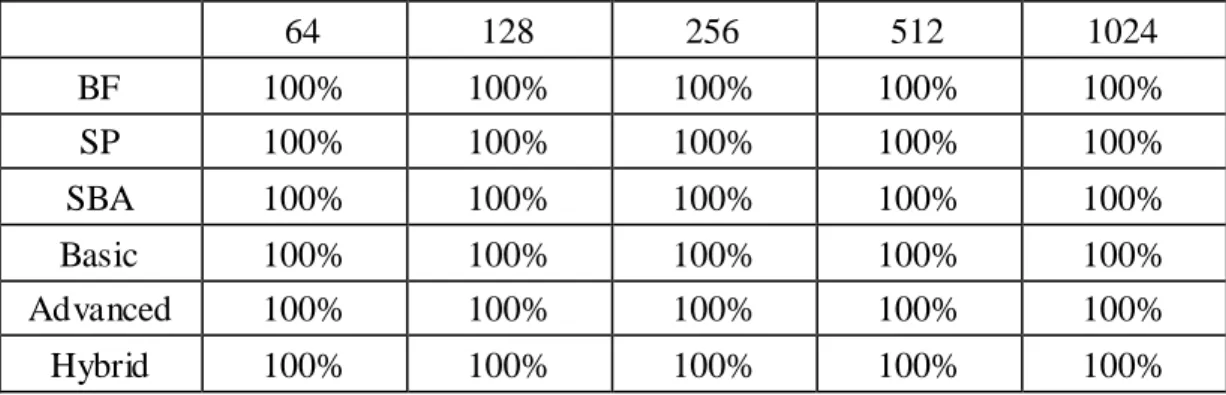
(32) algorithms. The ratio of forwarding nodes is defined as the number of forwarding nodes of a broadcast event over the total number of nodes in the network. More signal collisions would cause more packet loss or retransmission, therefore minimizing signal collisions is another import goal of broadcast algorithms. As the number of redundant transmission decreased, signal collisions are also reduced. Since the IEEE 802.11 module provides the capability to trace the occurrence of signal collisions, we also use them to measure the efficiency of the broadcast algorithms. The delivery ratio of a broadcast event leads to different behavior on the application level of a system. Broadcast algorithms have to ensure that most nodes will be covered after broadcasting. The delivery ratio, defined as the number of covered nodes over the total of nodes in the network, is used to evaluate the reliability of these broadcast algorithms.. 4.1.1. Numbers of Nodes. In this simulation, 64, 128, 256, 512 and 1024 nodes are randomly placed on a network of size 1,000,000 square meters. The simulation result is evaluated until all packets generated in the broadcast event by the chose algorithm are sent to their target nodes. The simulation results are shown in Figure 4-1, Figure 4-2 and Table 4-4. Figure 4-1 shows the ratio of forwarding nodes with various numbers of nodes in the network. As we can see from Figure 4-1, hybrid stamping has a significant improvement on reducing the number of forwarding nodes. As the number of nodes increases, the ratio of forwarding nodes is also increased besides hybrid stamping until certain network density is met. Without using RAD, self pruning mainly reduce redundant transmission from the nodes that have the same or a subset of neighbors of their upstream nodes. Since each node has the same transmission range in this simulation, there is little chance for a receiver to have no additional neighbors 31.
(33) Figure 4-1. Ratio of Forwarding Nodes with Various Number of Nodes. compared to the sender of a received message. Therefore self pruning has a very little improvement over simple flooding. Each node using basic stamping drops a packet only if all its neighbors have sent the same message to it because each sender only uses its own identifier as the appended stamp of a message. Due to this reason, basic stamping also has very limited improvement on reducing the number of forwarding nodes. Although SBA has a similar approach on checking redundant transmissions with advanced stamping, it gains more performance improvement in this simulation. The main differences between SBA and advanced stamping are the RAD generation method and protocol header size. As shown in Figure 4-2, advanced stamping would gain significant performance improvement if the protocol header is omitted. The RAD introduced by SBA also allows SBA to collect more network information via duplicate messages before processing a newly received message. Therefore, advanced stamping 32.
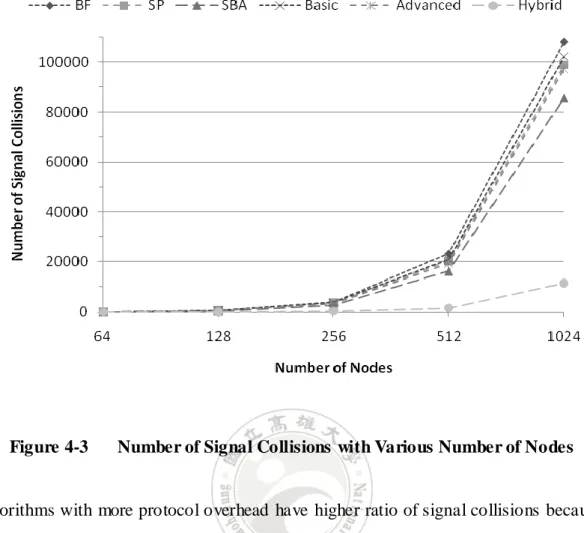
(34) Figure 4-2. Ratio of Forwarding Nodes with Various Number of Nodes without Protocol Ove rhead. examines redundant transmissions with less network information than SBA. Hybrid stamping relies on stamps and 2-hop neighbor information to check redundant transmissions. Although a receiver seems not to have the same or subset of neighbors of the sender of a message, it is likely their neighbors may be reached by each other when taking the transmission range into consideration. As the result, hybrid stamping gains more improvement when the number of nodes grows since it can prune more unnecessary transmissions with more neighbor information. Still, the number of packets received during RAD is decreased as the number of nodes becomes large with large packet size and the performance is also affected. Figure 4-3 shows the number of signal collisions generated by each broadcast algorithm with various numbers of nodes. The curves of algorithms without much protocol overhead in Figure 4-3 have similar trends with the curves in Figure 4-1. 33.
(35) Figure 4-3. Number of Signal Collisions with Various Number of Nodes. Algorithms with more protocol overhead have higher ratio of signal collisions because each packet is transmitted over the same wireless channel with longer time. Since hybrid stamping aims to minimize the number of forwarding nodes to each uncovered node, it is unlikely that multiple simultaneous transmissions targeting the same node would be occurred. With the decreasing on simultaneous transmissions at the same node, the number of signal collisions is further reduced in hybrid stamping. As shown in Table 4-2, almost all nodes in the network are covered with these broadcast algorithms. However, we observe that a very small amount of nodes are not covered with hybrid stamping with a small number of nodes during the simulation. Since hybrid stamping tries to minimize the forwarding node to cover each node in the network, the packet has higher probability to be lost in a node if signal collisions occurred while rebroadcasting from forwarding nodes covering it. But as we can see 34.
(36) 64. 128. 256. 512. 1024. BF. 100%. 100%. 100%. 100%. 100%. SP. 100%. 100%. 100%. 100%. 100%. SBA. 100%. 100%. 100%. 100%. 100%. Basic. 100%. 100%. 100%. 100%. 100%. Advanced. 100%. 100%. 100%. 100%. 100%. Hybrid. 100%. 100%. 100%. 100%. 100%. Table 4-2. Delivery Ratio with Various Number of Nodes. from Figure 4-3 the number of signal collisions is smaller compared to other broadcast algorithms therefore the average delivery ratio is still about 100% as shown in Table 4-2.. 4.1.2. Network Size. In this simulation, the node density of the network is fixed at 1 node per 1,000 square meters and the network size is 40,000, 160,000, 360,000, 640,000 and 1,000,000 square meters. The transmission range of each node is fixed at 100 meters. The simulation result is computed after all packets generated with the chosen broadcast algorithm in the network have been processed. The simulation results are shown in Figure 4-4, Figure 4-5 and Table 4-3. As the curves shown in Figure 4-4, hybrid stamping is still the best broadcast algorithm among these algorithms with different network size. Although the node density remains the same for each network, the network is separated into more chunks since each node uses a fixed transmission range. The performance improvement of all broadcast algorithms decreases as the networks size grows. SBA and advanced stamping mainly reduce redundant transmissions on a node with neighbors already 35.
(37) Figure 4-4. Ratio of Forwarding Nodes with Various Network Size. covered by previous senders. Since most senders and receivers do not share the same neighbors, nodes at the edge of the network are more possible to meet the condition. As the node density is fixed, the ratio of forwarding nodes reduced with RAD is also fixed. Therefore, the ratio of nodes at the edge of the network would affect the performance improvement significantly for SBA and advanced stamping. As we can see in Figure 4-4, the curves of SBA, advanced and hybrid stamping get closer to some fixed values as the network size grows. This is because of the ratio of nodes at the edge becomes relatively less as the network size increases with the same node density. Since hybrid stamping gains more improvement via reducing unnecessary transmissions to each uncovered nodes, the ratio of nodes at network edge is less likely to affect the total performance improvement of hybrid stamping. Figure 4-5 shows the simulation result on the number of signal collisions using picked broadcast algorithms with various network sizes. Curves in Figure 4-5 have 36.
(38) Figure 4-5. Number of Signal Collisions with Various Network Size. similar trends with Figure 4-4 since the node density remains the same for efficient broadcast algorithms. Since self pruning has more protocol overhead and reduces a very little ratio of forwarding nodes, the number of signal collisio ns is relatively higher in a smaller network. The ratio of covered nodes of each broadcast algorithm is shown in Table 4-3. The network load in this simulation is very low as there is only one message transmitted over the network. Therefore, the ratio of covered nodes for each broadcast algorithm is at about 100%. Since the network density is the same for different network size, the delivery ratio would not be directly affected by the network size.. 4.1.3. Transmission Range. In this simulation, the transmission range of each node is 100, 150, 200, 250 and 300 meters. The simulation result is computed until all packets are transmitted to target 37.
(39) 62,500. 125,000. 250,000. 500,000. 1,000,000. BF. 100%. 100%. 100%. 100%. 100%. SP. 100%. 100%. 100%. 100%. 100%. SBA. 100%. 100%. 100%. 100%. 100%. Basic. 100%. 100%. 100%. 100%. 100%. Advanced. 100%. 100%. 100%. 100%. 100%. Hybrid. 100%. 100%. 100%. 100%. 100%. Table 4-3. Delivery Ratio with Various Network Size. nodes generated by the chosen broadcast algorithm. The simulation results are shown in Figure 4-6, Figure 4-7 and Table 4-4. As we can see from Figure 4-6, hybrid stamping still has the most significant improvement over other broadcast algorithms. As the transmission range of each node becomes larger, the number of neighbors for each node also becomes larger. Therefore,. Figure 4-6. Ratio of Forwarding Nodes with Various Trans mission Range 38.
(40) Figure 4-7. Number of Signal Collisions with Various Trans mission Range. hybrid stamping gains more improvement as the transmission range grows compared to other broadcast algorithms. Although the redundant transmissions can be reduced with duplicate packets received during RAD becomes lesser when the transmission range grows in each node, the number of nodes at the network edge is also increased. With the growing number of nodes at network edge, the performance improvement of SBA and advanced stamping becomes a little better when the transmission range goes relatively high. Figure 4-7 shows the number of signal collisions of each broadcast algorithm. The trend of each curve is similar to the ratio of forwarding nodes when the number of neighbors of each node becomes larger. Since there is the same number of nodes in the network, the influence of protocol overhead of self pruning and advanced stamping is not as significant as previous simulations. When the transmission range increases, each node has more neighbors thus there are more chances for the signal collision to be 39.
(41) 100. 150. 200. 250. 300. BF. 100%. 100%. 100%. 100%. 100%. SP. 100%. 100%. 100%. 100%. 100%. SBA. 100%. 100%. 100%. 100%. 100%. Basic. 100%. 100%. 100%. 100%. 100%. Advanced. 100%. 100%. 100%. 100%. 100%. Hybrid. 100%. 100%. 100%. 100%. 100%. Table 4-4. Delivery Ratio with Various Trans mission Range. occurred during broadcasting. Since each node has more neighbors as the transmission range becomes larger, there are more chances for a node to find out that all its neighbors are already covered by some other nodes in the stamps with hybrid stamping. As the result, the ratio of signals collisions with hybrid stamping becomes lesser compared to other broadcast algorithms. Table 4-4 shows the delivery ratio of each broadcast algorithm. Since there is only a packet broadcasted over the network, the network load is relatively light and the delivery ratio of each broadcast algorithm is almost about 100%. Since increase transmission range also increase the average node degree like increasing the number of nodes in the network, each node has more possibility to cover more nodes in the network. Even the number of signal collisions rises as the transmission range increases, there are more chances for other nodes to cover a node that originally can be covered by a lost packet. For this reason, the delivery ratio of hybrid stamping is still close to 100% when transmission range goes higher.. 4.1.4. Data Size. In this simulation, the data size of each packet is 64, 128, 256, 512 and 1024 bytes 40.
(42) respectively. The simulation results are computed after packets generated by each broadcast algorithm are processed. The simulation results are shown in Figure 4-8, Figure 4-9 and Table 4-5. The ratio of forwarding nodes of each broadcast algorithm with various data size is shown in Figure 4-8. As the data size increases, the transmission time of eac h packet is also increased. Therefore, the number of duplicate packets received during the RAD is reduced. The performance improvement of broadcast algorithm using RAD is decreased since lesser additional information can be obtained via duplicate packets. As Figure 4-8 shows, the ratio of forwarding nodes using SBA increases as the data size grows. However, stamping is not significantly affected since the protocol overhead is high compared to other algorithms. As the simulation results shown in Figure 4-8, the ratio of forwarding nodes with stamping remains merely the same as the data size increases.. Figure 4-8. Ratio of Forwarding Nodes with Various Data Size 41.
(43) Figure 4-9. Number of Signal Collisions with Various Data Size. Figure 4-9 shows the number of signal collisions with various data size of each broadcast algorithm. As shown in Figure 4-9, the trend of each broadcast algorithm is similar to Figure 4-8. With more forwarding nodes, packets are more likely to collide on each receiving node. The number of signal collisions in stamping is not significantly increased since the data size is relatively small in its packets. The delivery ratio of each broadcast algorithm is shown in Table 4-5. The delivery ratio is also about 100% for each broadcast algorithm since the number of signal collisions is not changed significantly. As the ratio of signal collisions grows with SBA as the data size grows, the number of forwarding nodes is also increased. Therefore the target of a collided packet has more possibility to be covered by other forwarding nodes.. 42.
(44) 64. 128. 256. 512. 1024. BF. 100%. 100%. 100%. 100%. 100%. SP. 100%. 100%. 100%. 100%. 100%. SBA. 100%. 100%. 100%. 100%. 100%. Basic. 100%. 100%. 100%. 100%. 100%. Advanced. 100%. 100%. 100%. 100%. 100%. Hybrid. 100%. 100%. 100%. 100%. 100%. Table 4-5. 4.2. Delivery Ratio with Various Data Size. Protocol Overhead Reduction. As we can see from Figure 4-2 and Figure 4-3, reduce the protocol overhead can further improve the performance of stamping. The size of a packet becomes larger when it is forwarded via more hop of nodes with stamping since it carries more stamps for identifying nodes already received the packet. Therefore, the transmission time of the packet is increased and the possibility on causing signal collisions is also raised. In a system environment with heavy network load, the increasing of signal collisions would seriously affect the delivery ratio. To further improve the performance of stamping, we propose several methods to reduce the protocol overhead while maintaining a reasonable delivery ratio. In the following sections, we show the simulation results with the ratio of forwarding nodes and the delivery ratio. Since broadcast algorithms are designed to solve the broadcast storm problem, reducing more forwarding nodes while ensuring the delivery ratio leads to a better performance of broadcasting.. 4.2.1. Stamp Level 43.
(45) In this simulation, we limit each node to forward packets with stamps appended by nodes lived within a specific number of hops. The network size is 1,000,000 square meters and the transmission range of each node is fixed at 100 meters. There are 1,000 nodes randomly distributed within the network. We make each node to keep stamps appended by nodes within 1, 2, 4, 8 and 16 hops and compare the simulation results of all selected broadcast algorithms. The simulation results are shown in Figure 4-10 and Table 4-6. Figure 4-10 shows the ratio of forwarding nodes using stamping with stamps appended within specific hops and other broadcast algorithms. Since algorithms other than stamping are not affected by the limitation, they are showed in Figure 4-10 to compare with the simulation results of stamping. As shown in Figure 4-10, the ratio of forwarding nodes using stamping is not significantly affected by the stamp level limited in the simulation. This means using stamps provided nodes within one hop is. Figure 4-10. Ratio of Forwarding Nodes with Various Stamp Level 44.
(46) 1. 2. 4. 8. 16. BF. 100%. 100%. 100%. 100%. 100%. SP. 100%. 100%. 100%. 100%. 100%. SBA. 100%. 100%. 100%. 100%. 100%. Basic. 100%. 100%. 100%. 100%. 100%. Advanced. 100%. 100%. 100%. 100%. 100%. Hybrid. 100%. 100%. 100%. 100%. 100%. Table 4-6. Delivery Ratio with Various Stamp Level. sufficient for stamping to cancel unnecessary retransmissions. Furthermore, keep stamps within higher stamp level would decrease the duplicate packets received during RAD and reduce the performance of stamping. Table 4-6 shows the delivery ratio of the broadcast algorithms with various stamp level. From the delivery ratio of stamping, we can confirm that stamps appended by nodes within one hop are sufficient for reducing forwarding nodes and maintaining the delivery ratio.. 4.2.2. Number of Stamps. In this simulation, we limit the number of stamps appended on each stamp to reduce the protocol overhead of stamping. The network size is 1,000,000 square meters and the transmission range of each node is 100 meters. 1,000 nodes are randomly placed in the network. Each node keeps stamps within the number of 4, 8, 16, 32 and 64 and the simulation results are compared with all selected broadcast algorithms. The simulation results are shown in Figure 4-11 and Table 4-7. Figure 4-11 shows the ratio of forwarding nodes using stamping with fixed number of stamps and other broadcast algorithms. Since algorithms other than stamping are not 45.
(47) Figure 4-11. Ratio of Forwarding Nodes with Various Number of Stamps. affected by the limitation, they are showed in Figure 4-11 to compare with the simulation results of stamping. As shown in Figure 4-11, the ratio of forwarding nodes using hybrid stamping is reduced as the number of stamps in each packet grows. The average node degree in the network is 31 but the performance improvement is not as good as keeping stamps within 2 hops. This is because nodes in the dense area of the network need more stamps to store the coverage information. To achieve a better performance, about all stamps appended within one hop are kept in the packets. Table 4-7 shows the delivery ratio of the broadcast algorithms with various numbers of stamps. When the number of stamps is small, there are more nodes trying to forward packets to the same node. Therefore, the delivery ratio with a small number of stamps is 100%. When the number of stamps grows, stamping uses more information to determine redundant transmissions and ensures each uncovered node can be covered by a minimal number of forwarding nodes. Without serious signal 46.
(48) 4. 8. 16. 32. 64. BF. 100%. 100%. 100%. 100%. 100%. SP. 100%. 100%. 100%. 100%. 100%. SBA. 100%. 100%. 100%. 100%. 100%. Basic. 100%. 100%. 100%. 100%. 100%. Advanced. 100%. 100%. 100%. 100%. 100%. Hybrid. 100%. 100%. 100%. 100%. 100%. Table 4-7. Delivery Ratio with Various Number of Stamps. collisions, the delivery ratio of stamping can be kept at 100%.. 4.2.3. Stamp Compression. In this simulation, we compress each stamp from 4 bytes to 1 byte to reduce the protocol overhead of stamping. To observe the effects of stamp compression, we run the simulations with the four simulation parameters discussed in Section 4.1. As the number of nodes in the network increases, there are more possibilities for two stamps to be compressed into the same value. Therefore, the delivery ratio would show the relationship between these simulation parameters and stamp compression. Figure 4-12 and Table 4-8 show the number of forwarding nodes and delivery ratio of stamping with compression and other algorithms with various transmission ranges. When the transmission range of each node is smaller, the reduced protocol overhead is relatively high and improves the reception rate of duplicate packets during RAD. When the transmission range grows, the protocol o verhead still grows since the number of stamps appended in each hop is increased. After the transmission range is increased to contain many nodes that can be compressed to the same value, the ratio of forwarding nodes is reduced since some nodes are mistaken of being already covered. 47.
(49) Figure 4-12 Ratio of Forwarding Nodes with Various Number of Nodes and Stamp Compression The performance improvement of hybrid stamping with compression is about 20% better than the original one. Since there are 500 nodes inside the network, the 50% of miss rate leads to about 90% of delivery ratio. The trend of curve of hybrid stamping is nearly identical to the one without compression thus the stamp compression seems to not have much effect on different transmission ranges.. 100. 150. 200. 250. 300. BF. 100%. 100%. 100%. 100%. 100%. SP. 100%. 100%. 100%. 100%. 100%. SBA. 100%. 100%. 100%. 100%. 100%. Basic. 100%. 100%. 100%. 100%. 100%. Advanced. 100%. 100%. 100%. 100%. 100%. Hybrid. 91%. 91%. 86%. 82%. 88%. Table 4-8. Delivery Ratio with. Various Trans mission Ranges and Stamp Compression 48.
(50) 5 Conclusion and Future Work In this thesis, we propose the stamping broadcast algorithms to solve the broadcast storm problem for wireless ad hoc networks. With different strategies on stamping information and detecting redundant transmissions, stamping leads to different level of performance improvement on reducing broadcast redundancy. From the simulation results, hybrid stamping shows significant performance improvement over other broadcast algorithms. Furthermore, the performance improvement of hybrid stamping is increased as the average node degree of the network is increased until the protocol overhead affects duplicate packets received during RAD. As the network size grows, the performance of hybrid stamping is smoothly reduced while others are significantly decreased. Therefore hybrid stamping provides stable performance on reducing broadcast redundancy compared to other broadcast algorithms. On protocol overhead reduction, stamping can achieve about 99% performance improvement by keeping stamps attached by nodes within two-hop distance. With more stamps kept in each packet, the performance is reduced due to the reduction of duplicate packets received during RAD. Stamp compression provides a way to further reduce the packet size but also leads to false positive on identifying covered nodes. Since hybrid stamping tries to minimize forwarding nodes for each uncovered node, stamp compression may affect the reliability if uncovered nodes can be compressed to the same stamps on forwarding packets. Although stamp compression reduces the delivery ratio of hybrid stamping, it reduces more redundant transmissions while maintaining about 90% of coverage thus it may be useful under fault-tolerant environments..
(51) Although hybrid stamping provides significant performance improvement on broadcasting, the strategy on sending packets to uncovered nodes by nodes with lower ID value still causes redundant retransmissions. With protocol overhead reduction methods proposed above, the protocol overhead of stamping still increases as the average node degree of the network grows. To address on these problems, we will keep working on different schemes for choosing forwarding nodes and compressing stamps into fixed size with techniques like bloom filter. Since the stamp information used by stamping records covered neighbor nodes, it can be used to provide dynamic network connectivity information while broadcasting. With this characteristic, stamping may be useful for providing dynamic routing information for high mobility environments without other maintenance overhead. Therefore, the integration of stamping broadcast algorithms on MANETs and VANETs is also under progressed.. 50.
(52) Bibliography [1]. Chai K. Toh, “Ad Hoc Mobile Wireless Networks,” Prentice Hall, 2001.. [2]. Piyush Gupta and P. R. Krumar, “The Capacity of Wireless Networks,” IEEE Transactions on Information Theory, vol. 46, no. 4, pp. 388-404, 2000. [3]. Jinyang Li, Charles Blake, Douglas S. J. De Couto, Hu lmm Lee and Robert Morris, “Capacity of Ad Hoc Wireless Networks,” Proceedings of the 7th ACM International Conference on Mobile Computing and Networking, pp. 61-69, 2001.. [4]. Charles. E.. Perkins. and. Pravin. Bhagwat,. “Highly. Dynamic. Destination-Sequenced Distance-Vector Routing (DSDV) for Mobile Computers,” In Proceedings of the ACM SIGCOMM ’94 Conference on Communications Architectures, Protocols and Applications, pp. 234-244, 1994. [5]. David B. Johnson and David A. Maltz, “Dynamic Source Routing in Ad Hoc Wireless Networks,” In Mobile Computing, Tomasz Imielinski and Henry F. Korth, eds., pp. 153-181, Kluwer Academic Publisher, 1996.. [6]. Charles E. Perkins, “Ad-Hoc On-Demand Distance Vector (AODV) Routing,” Request for Commends 3561, 2003. [7]. Zygmunt J. Haas, Marc R. Pearlman and Prince Samar, “The Zone Routing Protocol (ZRP) for Ad Hoc Networks,” Mobile Ad Hoc Networking Working Group of the Internet Engineering Task Force, 1997.. [8]. Young-Bae Ko and Nitin H. Vaidya, “Location-Aided Routing (LAR) in Mobile Ad Hoc Networks,” Proceedings of the International Conference on Mobile Computing and Networking, pp. 66-75, 1998.. [9]. Katia Obraczka, Kumar Viswanath and Gene Tsudik, “Flooding for Reliable Multicast in Multi-Hop Ad Hoc Networks,” Proceedings of the International Workshop on Discrete Algorithms and Methods for Mobile Computing and Communications, pp. 64-71, 1999.. [10]. Sze-Yao Ni, Yu-Chee Tseng, Yuh-Shyan Chen and Jang-Ping Sheu, “The Broadcast Storm Problem in a Mobile Ad Hoc Network,” Proceedings of the International Conference on Mobile Computing and Networking, pp. 151-162, 1999..
(53) [11]. Brad Williams and Tracy Camp, “Comparison of Broadcasting Techniques for Mobile Ad Hoc Netowkrs,” The International Symposium on Mobile Ad Hoc Networking and Computing, pp. 194-205, 2002.. [12]. Min-Te Sun, Wuchi Feng and Ten-Hwang Lai, “Location Aided Broadcast in Wireless Ad Hoc Networks,” Proceedings of the Global Commnunications Conference, 2001.. [13]. Yoav Sasson, David Cavin and Andre Schiper, “Probabilistic Broadcast for Flooding in Wireless Mobile Ad hoc Networks,” Technical Report IC/2002/54, Swiss Federal Institute of Technology, 2002.. [14]. Hai Liu, Xiaohua Jia, Peng-Jun Wan, Xinxin Liu, Frances F. Yao, "A Distributed and Efficient Flooding Scheme Using 1-Hop Information in Mobile Ad Hoc Networks," Transactions on Parallel and Distributed Systems, vol. 18, no. 5, pp. 658-671, 2007. [15]. Hyojun Lim and Chongwon Kim, “Multicast Tree Construction and Flooding in Wireless Ad Hoc Networks,” Proceedings of the International Workshop on Modeling, Analysis and Simulation of Wireless and Mobile Systems, pp. 61-68, 2000.. [16]. Anis Laouiti, Amir Qayyum, and Laurent Viennot, “Multipoint Relaying: An Efficient Technique for Flooding in Mobile Wireless Networks,” Proceedings of the International Conference on System Sciences, 2001.. [17]. Amir Qayyum, Laurent Viennot and Anis Laouiti , “Multipoint Relaying for Flooding Broadcast Messages in Mobile Wireless Networks,” Proceedings of the International Conference on System Sciences, 2002.. [18]. Wei Peng and Xicheng Lu, “AHBP: An Efficient Broadcast Protocol for Mobile Ad Hoc Networks,” Journal of Computer Science and Technology, pp. 507-519, 2002.. [19]. Wei Peng and Xicheng Lu, “Efficient Broadcast in Mobile Ad Hoc Networks using Connected Dominating Sets,” Journal of Software, pp. 529-536, 1999. [20]. Wei Lou and Jie Wu, “Double-Covered Broadcast (DCB): A Simple Reliable Broadcast Algorithm in MANETs,” Proceedings of the International Conference on Computer Communications, 2004.. [21]. Jie Wu and Hailan Li, “On Calculating Connected Dominating Set for Efficient Routing in Ad Hoc Wireless Networks,” Proceedings of the 52.
數據

+7
Outline
相關文件
In this thesis, we have proposed a new and simple feedforward sampling time offset (STO) estimation scheme for an OFDM-based IEEE 802.11a WLAN that uses an interpolator to recover
Understanding and inferring information, ideas, feelings and opinions in a range of texts with some degree of complexity, using and integrating a small range of reading
• To introduce the use of the LPF as a tool for planning the school English Language curriculum; and
Understanding and inferring information, ideas, feelings and opinions in a range of texts with some degree of complexity, using and integrating a small range of reading
Note: Each department of a tertiary institution and each SSB may submit one application under the New Project Scheme in each application cycle. Try HKECL’s matching
In this paper, we build a new class of neural networks based on the smoothing method for NCP introduced by Haddou and Maheux [18] using some family F of smoothing functions.
In summary, the main contribution of this paper is to propose a new family of smoothing functions and correct a flaw in an algorithm studied in [13], which is used to guarantee
The purpose of this talk is to analyze new hybrid proximal point algorithms and solve the constrained minimization problem involving a convex functional in a uni- formly convex
(A)憑證被廣播到所有廣域網路的路由器中(B)未採用 Frame Relay 將無法建立 WAN
