Semiconductor quantum-well saturable absorbers for
efficient passive Q switching of a diode-pumped
946 nm Nd:YAG laser
Y. P. Huang, H. C. Liang, J. Y. Huang, K. W. Su, A. Li, Y. F. Chen,* and K. F. Huang Department of Electrophysics, National Chiao Tung University, Hsinchu, Taiwan
*Corresponding author: [email protected]
Received 2 April 2007; revised 8 June 2007; accepted 12 June 2007; posted 12 June 2007 (Doc. ID 81665); published 23 August 2007
InGaAs quantum wells and a Bragg mirror structure are grown on a GaAs substrate to simultaneously serve as a low-loss saturable absorber and an output coupler for highly efficient Q switching of a diode-pumped Nd:YAG laser operating at 946 nm. With an incident pump power of 9.2 W, the laser produces pulses of 38 ns duration with average pulse energy of as much as 20J at a pulse repetition rate of 55 kHz. © 2007 Optical Society of America
OCIS codes: 140.3480, 140.3540, 140.3580.
1. Introduction
Passively Q-switched all-solid-state lasers are of great interest because of their potential applications in remote sensing, ranging, micromachining, and nonlinear wavelength conversion. The Nd:YAG crys-tal has certainly been one of the preferred gain media for all-solid-state laser systems because of its excel-lent optical and mechanical properties [1–3]. The ma-jority of the work on the Nd:YAG crystal was focused on the4F3兾2→4I11兾2transition in the 1064 nm range. Nevertheless, the lasing wavelength near 946 nm in the4F
3兾2→4I9兾2transition has attracted much
atten-tion during the last decade [4 –11], since it is of in-terest for second-harmonic generation into the blue region. Kellner et al. employed a Cr4⫹:YAG crystal as a saturable absorber in a passively Q-switched 946 nm Nd:YAG laser to achieve as much as 1.6 W average output power with pulse width of 70–100 ns [6]. Recently, Zhang et al. demonstrated an average output power of 2.1 W with pulse width of 40.8 ns by using a Nd, Cr:YAG saturable absorber [7]. More recently, Wang et al. used a GaAs saturable absorber
to obtain an average output power of 1.24 W with pulse width of 70 ns [8]. However, so far the overall
Q-switching efficiencies (ratio of the Q-switched
av-erage output power to the cw output power at the same pump power) were in the range of 30%–50%. The low Q-switching efficiencies arise from the non-saturable losses of the non-saturable absorbers. Since the gain of the Nd:YAG crystal at 946 nm is quite low, a small amount of nonsaturable losses may lead to a considerable reduction in the efficiency. In view of that, it is practical to develop a saturable absorber with low nonsaturable losses for the low gain Nd: YAG laser at 946 nm.
InGaAs兾GaAs quantum wells (QWs) have been developed to be semiconductor saturable-absorber mirrors (SESAMs) for Nd-doped lasers in the 4F
3兾2
→4I
11兾2 transition [12]. However, the nonsaturable
losses of such QWs were usually rather high in com-parison with the gain of the4F
3兾2→4I9兾2transition in
Nd-doped lasers. Nevertheless, the contemporary ad-vancement of the growth methodology has success-fully realized the InGaAs QWs with extremely low nonsaturable losses [13–17]. Even so, to the best of our knowledge, InGaAs QWs have not as yet been employed to be a SESAM in a Nd:YAG laser at 946 nm. In this work we report, for what is believed
0003-6935/07/256273-04$15.00/0 © 2007 Optical Society of America
to be the first time, on utilizing InGaAs QWs as a saturable absorber in a diode-pumped passively
Q-switched 946 nm Nd:YAG laser. With an incident
pump power of 9.2 W, the compact laser cavity pro-duces an average output power of 1.1 W at 946 nm with a repetition rate of 55 kHz and pulse width of 38 ns. The corresponding pulse energy and peak power are up to 20J and 0.53 kW, respectively. The extremely low nonsaturable losses of the SESAM bring about the Q-switching efficiency greater than 90%.
2. InGaAs Quantum-Well Saturable Absorber and Experimental Setup
The present saturable absorber was fabricated to com-bine a SESAM with an output coupler (SESAMOC) that was originally proposed by Spühler et al. to sim-plify the cavity configuration in passively Q-switched lasers [18]. The SESAMOC device was monolithi-cally grown on an undoped 350m thick GaAs sub-strate by metal-organic chemical-vapor deposition (MOCVD) to comprise three strained In0.15Ga0.85As兾
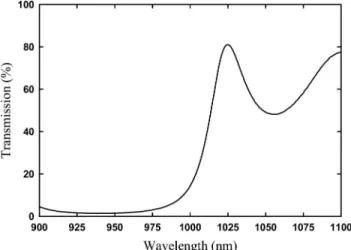
GaAs QWs grown on the Bragg mirror. The QWs have a thickness of 8 nm and are separated by 10 nm thick GaAs layers. The Bragg mirror consists of eleven AlAs兾GaAs quarter-wavelength layers; de-signed for a reflectivity in the region of 97%–98% at 946 nm. The back side of the GaAs substrate was coated for antireflection at 946 nm共R ⬍ 1%兲. Figure 1 shows the measured result for the low-intensity transmission spectrum of the SESAMOC. It can be seen that the low-intensity transmission was approx-imately 1.5% at 946 nm and 56% at 1064 nm. The experimental result for the room-temperature pho-toluminescence (PL) spectrum of the SESAM device is depicted in Fig. 2. The peak wavelength of the PL spectrum of the absorber is found to be in the vicin-ity of 946 nm and the full width at half maximum (FWHM) is approximately 20 nm. The saturation measurements were performed using nanosecond
Q-switched laser pulses to coincide with the present Q-switched experiment. Experimental results
re-vealed that the present SESAM device had a modu-lation depth of 1.5% and a saturation fluence of 20J兾cm2.
Figure 3 shows the experimental configuration of the passively Q-switched 946 nm Nd:YAG laser with InGaAs QWs as a SESAMOC. The active me-dium was 1.1 at. % Nd:YAG crystal with a length of 2.0 mm. Since a short crystal length was used to reduce the reabsorption losses, only approximately 52% of the pump light was absorbed in the gain me-dium. The entrance surface of the laser crystal was coated to be high reflection at 946 nm 共R ⬎ 99.8%兲 and high transmission at 808 nm 共T ⬎ 90%兲 and 1064 nm 共T ⬎ 85%兲. The other surface of the laser crystal was coated for antireflection at 946 nm 共R ⬍ 0.2%兲. The laser crystal was wrapped with indium foil and mounted in a water-cooled copper block. The pump source was a 10 W 808 nm fiber-coupled laser diode with a core diameter of 600m and a numer-ical aperture of 0.16. A focusing lens with 5 mm focal length and 92% coupling efficiency was used to reim-age the pump beam into the laser crystal. The pump spot radius was approximately 160m. The cavity length was approximately 15 mm. The spectral
infor-Fig. 1. Measured results for the low-intensity transmission spectrum.
Fig. 2. Room-temperature PL spectrum of the InGaAs QW satu-rable absorber.
Fig. 3. Schematic of a diode-pumped passively Q-switched Nd: YAG laser at 946 nm HR, high reflection; HT, high transmission; and AR, antireflection.
mation of the laser was monitored by an optical spec-trum analyzer (Advantest Q8381A). The specspec-trum analyzer employing diffraction lattice monochroma-tor can be used for high-speed measurement of pulse light with the resolution of 0.1 nm. The pulse tem-poral behavior was recorded by a LeCroy digital os-cilloscope (Wavepro 7100, 10 G samples兾s, 1 GHz bandwidth) with a fast p-i-n photodiode.
3. Experimental Results
The optimum cw operation at 946 nm was first in-vestigated to obtain the baseline for evaluating the passively Q-switched efficiency. For this investiga-tion an output coupler with partial reflecinvestiga-tion at 946 nm was used instead of the above-mentioned SESAMOC. Based on thorough experiments the op-timum reflectivity of the output coupler was found to be approximately 97%. The average output powers at 946 nm with respect to the incident pump power in cw and passively Q-switching operations are depicted in Fig. 4. The output power in the cw operation reached 1.21 W at an incident pump power of 9.2 W. In the passively Q-switching regime an average out-put power of 1.1 W was obtained at an incident pump power of 9.2 W. Experimental results indicate that the Q-switching efficiency (ratio of the Q-switched output power to the cw one at the maximum pump power) exceed 90%. The extremely high Q-switching efficiency signifies the nonsaturable losses of the present SESAMOC to be considerably low.
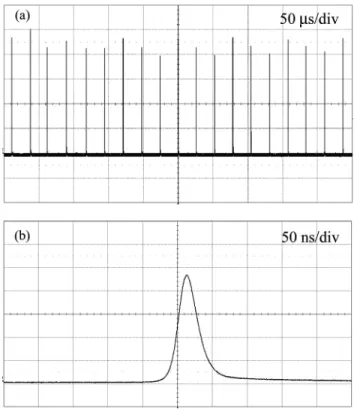
Figure 5 shows the pulse repetition rate and the pulse energy versus the incident pump power. It was found that the pulse repetition rate was linearly pro-portional to the pump power and reached approxi-mately 55 kHz at an incident pump power of 9.2 W. Like typically passively Q-switched lasers, the pulse energy is almost unrelated to the pump power and its value is 20J on average. On the whole, the pulse duration was approximately 38 ns. With the mea-sured pulse energy and pulse width, the peak power can be found to be up to 0.53 kW. A typical
oscillo-scope trace of a train of output pulses and an ex-panded shape of a single pulse are shown in Fig. 6. Under the optimum alignment condition, the pulse-to-pulse amplitude fluctuation was less than⫾5% for the pump power lower than 6 W and within⫾15% at the maximum pump power of 9.2 W. The peak-to-peak instability was experimentally found to come from the switching of the polarization state. Although controlling the polarization state can improve the output stability, the lasing efficiency will be consid-erably reduced. In other words, the trade-off between the output stability and the lasing efficiency is a de-sign issue.
Fig. 4. Average output powers at 946 nm with respect to the incident pump power in CW and passively Q-switching opera-tions.
Fig. 5. Experimental results for pulse repetition rate and pulse energy versus incident pump power.
Fig. 6. (a) Typical oscilloscope trace of a train of output pulses and (b) expanded shape of a single pulse.
4. Conclusion
We have, for the first time to the best of our knowl-edge, demonstrated the use of InGaAs QWs to be low-loss semiconductor saturable-absorber output couplers for passive Q switching of a diode-pumped Nd:YAG laser operating at 946 nm. An average out-put power of 1.1 W was obtained at an incident pump power of 9.2 W. The maximum peak power was found to be up to 0.53 kW and the overall Q-switching effi-ciency was generally greater than 90%. The present result indicates the possibility of using InGaAs QW structures to generate the high-peak-power blue laser at 473 nm with intracavity second-harmonic genera-tion.
The authors gratefully acknowledge InGaAs QW saturable absorbers from TrueLight Corporation, Hsinchu, Taiwan. The laser experiments of this work were supported by the National Science Council of Taiwan (contract NSC-95-2112-M-009-041-MY2).
References
1. W. Koechner, Solid-State Laser Engineering, 5th ed., Vol. 1 of Optical Sciences (Springer, 1999).
2. Y. Kaneda, M. Oka, H. Masuda, and S. Kubota, “7.6 W of continuous-wave radiation in a TEM00mode from a laser-diode
end-pumped Nd:YAG laser,” Opt. Lett. 17, 1003–1005 (1992). 3. T. Kellner, F. Heine, and G. Huber, “Efficient laser perfor-mance of Nd:YAG at 946 nm and intracavity frequency dou-bling with LiJO3,-BaB2O4, and LiB3O5,” Appl. Phys. B 65,
789 –902 (1997).
4. T. Y. Fan and R. L. Byer, “Modeling and cw operation of a quasi-three-level lasers 946 nm Nd:YAG laser,” IEEE J. Quan-tum Electron. 23, 605– 612 (1987).
5. T. Y. Fan, “Optimizing the efficiency and stored energy in quasi-three-level lasers,” IEEE J. Quantum Electron. 28, 2692–2697 (1992).
6. T. Kellner, F. Heine, G. Huber, and S. Kuck, “Passive Q-switching of a diode-pumped 946-nm Nd:YAG with 1.6-W average output power,” Appl. Opt. 37, 7076 –7079 (1998). 7. L. Zhang, C. Y. Li, B. H. Feng, Z. Y. Wei, D. H. Li, P. M. Lu, and
Z. G. Zhang, “Diode-pumped passive Q-switched 946-nm
Nd:YAG laser with 2.1-W average output power,” Chin. Phys. Lett. 22, 1420 –1422 (2005).
8. S. M. Wang, Q. L. Zhang, L. Zhang, C. Y. Zhang, D. X. Zhang, B. H. Feng, and Z. G. Zhang, “Diode-pumped passively Q-switched 946 nm Nd:YAG laser with a GaAs saturable ab-sorber,” Chin. Phys. Lett. 23, 619 – 621 (2006).
9. S. Spiekermann, H. Karlsson, and F. Laurell, “Efficient fre-quency conversion of a passively Q-switched Nd:YAG laser at 946 nm in periodically poled KTiOPO4,” Appl. Opt. 40, 1979 –
1982 (2001).
10. X. Zhang, A. Brenier, J. Wang, and H. Zhang, “Absorption cross-sections of Cr4⫹:YAG at 946 and 914 nm,” Opt. Mater.
26, 293–296 (2004).
11. S. Johansson, S. Bjurshagen, C. Canalias, V. Pasiskevicius, and F. Laurell, “An all solid-state UV source based on a fre-quency quadrupled, passively Q-switched 946 nm laser,” Opt. Express 15, 449 – 458 (2007).
12. G. J. Spühler, R. Paschotta, R. Fluck, B. Braun, M. Moser, G. Zhang, E. Gini, and U. Keller, “Experimentally confirmed de-sign guidelines for passively Q-switched microchip lasers us-ing semiconductor saturable absorbers,” J. Opt. Soc. Am. B 16, 376 –388 (1999).
13. J. Y. Huang, H. C. Liang, K. W. Su, H. C. Lai, Y. F. Chen, and K. F. Huang, “InGaAs quantum-well saturable absorbers for a diode-pumped passively Q-switched Nd:YAG laser at 1123 nm,” Appl. Opt. 46, 239 –242 (2007).
14. F. Bugge, G. Erbert, J. Fricke, S. Gramlich, R. Staske, H. Wenzel, U. Zeimer, and M. Weyers, “12 W continuous-wave diode lasers at 1120 nm with InGaAs quantum wells,” Appl. Phys. Lett. 79, 1965–1967 (2001).
15. S. Mogg, N. Chitica, R. Schatz, and M. Hammar, “Properties of highly strained InGaAs兾GaAs quantum wells for 1.2-m laser diodes,” Appl. Phys. Lett. 81, 2334 –2336 (2002).
16. T. Kondo, D. Schlenker, T. Miyamoto, Z. Chen, M. Kawaguchi, E. Gouardes, F. Koyama, and K. Iga, “Lasing characteristics of 1.2m highly strained GaInAs兾GaAs quantum well lasers,” Jpn. J. Appl. Phys., Part 1 40, 467– 471 (2001).
17. M. J. Lederer, V. Kolev, B. Luther-Davies, H. H. Tan, and C. Jagadish, “Ion-implanted InGaAs single quantum well semi-conductor saturable absorber mirrors for passive mode-locking,” J. Phys. D 34, 2455–2464 (2001).
18. G. J. Spühler, S. Reffert, M. Haiml, M. Moser, and U. Keller, “Output-coupling semiconductor saturable absorber mirror,” Appl. Phys. Lett. 78, 2733–2735 (2001).