Synthesis and characterizations of a vinyl-terminated benzoxazine
monomer and its blending with polyhedral oligomeric silsesquioxane
(POSS)
Yuan-Jyh Lee
a, Jieh-Ming Huang
b, Shiao-Wei Kuo
a, Jem-Kun Chen
a, Feng-Chih Chang
a,*
aInstitute of Applied Chemistry, National Chiao-Tung University, Hsin-Chu, Taiwan, ROC b
Department of Chemical Engineering, VanNung University, Chung-Li, Taiwan, ROC Received 26 September 2004; accepted 6 January 2005
Available online 2 February 2005
Abstract
Benzoxazine was synthesized through the Mannich condensation of phenol, formaldehyde, and primary amines through ring-opening polymerization. Polybenzoxazines are phenolic-like materials that possess dimensional and thermal stability, and they release no toxic byproducts during their polymerization. To further improve the thermal stability of polybenzoxazines, a hydrosilane-functionalized polyhedral oligomeric silsesquioxane (H-POSS) was incorporated into the vinyl-terminated benzoxazine monomer (VB-a) which we then subjected to ring-opening polymerization. In addition, we also prepared hybrids from a non-reactive POSS (IB-POSS) and VB-a. The glass transition temperature (Tg) of a regular polymerized VB-a (i.e. PVB-a) is 307 8C, while the hybrid containing 5 wt% of H-POSS is 333 8C.
The IB-POSS modified PVB-a hybrids, in general, results in lower Tgthan the pure PVB-a due to poor missibility.
q2005 Elsevier Ltd. All rights reserved.
Keywords: Polybenzoxazine; POSS; Nanocomposite
1. Introduction
Benzoxazines are heterocyclic compounds generated by the Mannich condensation of phenol, formaldehyde, and a primary amine[1]. They can be polymerized, as indicated in
Scheme 1, by ring-opening polymerization without the need for a strong acid or base as catalyst in a process in which no toxic gases and other byproducts are generated. Polyben-zoxazines have many outstanding performance features, such as low flammability, high thermal stability, and low dielectric properties[2,3]. The glass transition temperature of a typical polybenzoxazine prepared from a monomer having a difunctional oxazine ring (B-a) is 180 8C and the degradation temperature is ca. 310 8C [4]. To further improve the thermal stability of polybenzoxazines, poly-merizable acetylene side groups have been introduced into the benzoxazine monomer[5–7]. The
acetylene-functiona-lized benzoxazine can be polymerized into three-dimen-sional network products with high thermo-oxidative stability, solvent and moisture resistances. The acetylene-functionalized benzoxazines can be polymerized in the temperature range of 190–220 8C and the product has a char yield above 50% at 800 8C under nitrogen. Another approach to improve the thermal stability of polybenzox-azines is to blend them with other polymers[8–10], such as poly(imide-siloxane), polyurethane, and epoxy resin, or by incorporating clay into the polybenzoxazine matrix. Recently, a novel class of organic/inorganic hybrid materials has been developed that is based on polyhedral oligomeric silsesquioxane (POSS). POSS possesses an inorganic Si8O12 core upon which can be appended seven inert organic hydrocarbon groups and an eighth, unique polymerizable functional group [11–13]. POSS-containing copolymers have been used widely for the preparation of hybrid materials with perfectly defined structures. When inorganic POSS particles are distributed evenly within an organic matrix on a nanometer scale (1–100 nm), usually they dramatically improve the matrixes thermal stability and www.elsevier.com/locate/polymer
0032-3861/$ - see front matter q 2005 Elsevier Ltd. All rights reserved. doi:10.1016/j.polymer.2005.01.025
* Corresponding author. Tel.: C886 3 5727077; fax: C886 3 5719507. E-mail address: [email protected] (F.-C. Chang).
mechanical strength[14]. POSS nanoparticles have advan-tages over clays or conventional fillers because they have monodispersion, a well-defined structure, low density, high temperature stability, no trace metals, and can accommodate a sizable number of interfacial interactions between composite particles and polymer segments. POSS com-pounds can be modified to contain one or more reactive sites and, therefore, they can be readily incorporated into common polymers. Syntheses of linear polymers containing POSS units have been reported from the use of conventional free radical[15,16], atom transfer radical[17], ring-opening
[12,18], and condensation polymerizations [19,20].
Enhanced properties have been reported for a wide range of POSS-functionalized acrylates [15,16] and other vinyl polymers[12,18].
The formation of silicon–carbon bonds is important when exploiting organosilicon chemistry to create new organic/inorganic materials. Hydrosilylation is the addition of an Si–H unit across an unsaturated bond, such as CaC or CbC units[21]. The hydrosilylation of an olefin results in a saturated hydrocarbon that can be accomplished by either a free radical process or by the use of transition metal catalysts [22,23]. In this study, we synthesized an
allylamine-based vinyl-terminated benzoxazine (VB-a) and transformed it by a radical-type hydrosilylation[24].
In the free radical hydrosilyation process, the radicals usually are initiated thermally or photolytically from azo compounds or peroxides. We synthesized the vinyl-terminated benzoxazine monomer, VB-a, by the process depicted inScheme 2. The vinyl group of this benzoxazine can also be reacted through thermally induced, cationic, free radical, or photolytic reaction. Thermally induced reactions of the terminal vinyl group lead to chain extension, hydrosilylation, or cross-linking of the polymer. We performed the polymerization of VB-a via a hydrosilyation reaction using the hydrosilane-functionalized POSS (H-POSS) by a two-step sequence. The Si–H group of the POSS derivative is able to couple with the vinyl group at 1408C and the remaining vinyl groups can then be polymerized at a higher temperature. This organic/inorganic hybrid material contains the smallest silica units ever reported to be linked to a polymer chain. In this paper, we report the preparation of polybenzoxazine/POSS nanocomposites that contain various amounts of covalently bonded H-POSS. These polybenzoxazine/POSS hybrid materials possessing a small degree of POSS content have noticeably improved thermal stability confirmed by thermal gravimetric analysis (TGA) and dynamic mechanical thermal analysis (DMTA).
2. Experimental
2.1. Materials
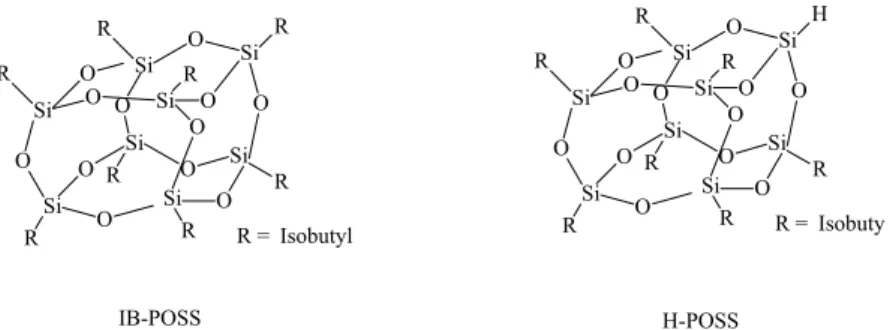
Formaldehyde aqueous solution (37%), allylamine, and bisphenol A were purchased from Aldrich. The benzoxazine monomer, B-a, was purchased from Shikoku Chemicals Co., Japan. The POSS derivatives, surrounded by eight isobutyl groups or seven isobutyl and possessing a hydrosilane group Scheme 3, were purchased from the Hybrid Plastic Co., USA.
Scheme 1. Benzoxazine monomers and the polymerization of P-a and B-a.
2.2. Characterizations
1H NMR spectra were obtained at 300 MHz using a Bruker DPX-300. Infrared spectroscopic measurements were performed in the range 4000–400 cmK1at a resolution
of 1.0 cmK1using a Nicolet Avatar 320 FTIR Spectropho-tometer. All sample preparations were conducted under a continuous flow of nitrogen to minimize sample oxidation or degradation.
The thermal and viscoelastic properties of these hybrids
Scheme 3. Structures of two POSS monomers: H-POSS and IB-POSS.
were determined by thermal gravimetric analysis (TGA) and dynamic mechanical thermal analysis (DMTA). TGA was carried out using a TA Instruments TGA 2050 Thermogravimetric Analyzer operated at a heating rate of 10 8C/min from room temperature to 700 8C under a continuous flow of nitrogen. DMTA measurements were performed using a TA Instruments DMA Q800 (DuPont) in a single cantilever bending mode over a temperature range from 40 to 340 8C. Data acquisition and analysis of the storage modulus (E0), and loss tangent (tan d) were recorded automatically by the system. The heating rate and frequency were fixed at 3 8C/min and 1 Hz, respectively. Samples for DMTA experiments were prepared by molding. Cross-sectional images of the polybenzoxazine/POSS nanocom-posite films (0.2–0.4 mm) were studied by SEM. The SEM images were obtained using a Hitachi-S4700I Microscope operated at an acceleration voltage of 15 kV.
2.3. Synthesis of the vinyl-terminated benzoxazine (VB-a) To prepare the polybenzoxazine/POSS nanocomposite, we synthesized a vinyl-terminated version of the benzox-azine monomer, VB-a. The presence of the vinyl group allows ring-opening polymerization to be conducted under moderate conditions. The benzoxazine monomer VB-a was prepared according to the procedure outlined inScheme 2. Aqueous formaldehyde solution (16.5 g) and bisphenol A (11.4 g) were mixed with THF (50 mL) in a 250 mL three-necked flask. Using a dropping funnel, allylamine (11.4 g) was added dropwisely into the mixture, and then cooled in an ice bath. After stirring for an additional 30 min, the temperature of the mixture was raised gradually to 90 8C and then it was refluxed for 3 h. The solvent and water was removed under vacuum and the residue was dissolved in ethyl ether (100 mL). The solution was washed with water and 2 N aqueous NaOH several times to remove any
impurities and unreacted monomers. The ether solution was then dried (sodium sulfate) and the solvent evaporated at room temperature. The product was obtained as a light-yellow solid (23.5 g).
2.4. Preparation of VB-a-type polybenzoxazine and POSS hybrids
VB-a-type benzoxazine monomer (0.95 g) and H-POSS (0.05 g) were dissolved in THF (10 mL). The mixture was stirred for 2 h at room temperature and then it was poured onto an aluminum plate and dried for 6 h in the open air, then placed in an oven and heated under vacuum at 100 8C for 2 h. The cast film was polymerized in a stepwise manner, at 140 and 160 8C for 3 h each and then at 200 8C for 4 h. The product was post-cured at 220 and 240 8C for 30 min each. These procedures were repeated for other samples containing different amounts of H-POSS (2 and 10%). The cured product was extracted over 24 h into refluxing THF in a Soxhlet extractor to remove unreacted monomers.
3. Results and discussion 3.1. Characterizations of the VB-a
The1H NMR spectrum of the vinyl-terminated benzox-azine (VB-a) is shown inFig. 1(a). The vinyl group appears as two resonances, at 5.4 and 6 ppm, whose intensities have a 2:1 ratio. We assign the peaks at 4.2 and 5.0 ppm to protons in the methylene bridge of the oxazine. The signal of the protons located between the vinyl group and the nitrogen atom appears at 3.4 ppm. The13C NMR spectrum of VB-a is presented inFig. 1(b). The signals of the carbon atoms of the terminal olefin unit appear at 116 and 138 ppm. We assign the characteristic signals at 52 and 82 ppm to the
carbon atoms of the oxazine ring. These NMR spectra confirm that we had successfully synthesized VB-a.
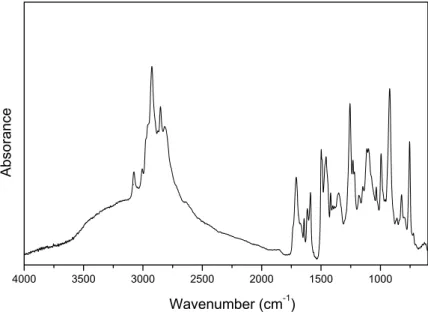
The FTIR spectrum of the difunctional benzoxazine compound VB-a has been reported previously[25].Fig. 2
displays the IR spectrum of the vinyl-terminated benzox-azine monomer VB-a. We assign the band at ca. 3100 cmK1 to the C–H stretching vibration of the vinyl group of the benzoxazine monomer. The corresponding CaC stretching bands appear at 910 and 980 cmK1. Another characteristic band of this compound is the antisymmetric C–O–C stretch, which appears at 1230 cmK1. The carbon–carbon stretching vibration of the 1,2,4-substituted benzene ring of the VB-a monomer appears at 1490 cmK1.
3.2. Curing reaction and polymerization of the VB-a/H-POSS copolymers
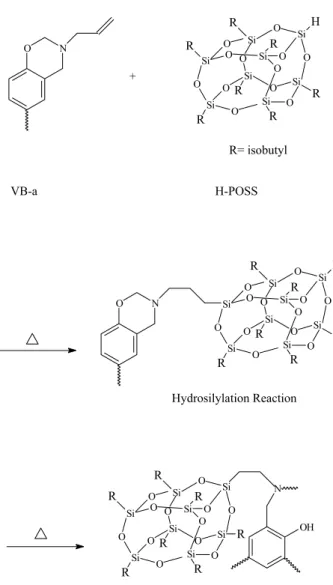
The copolymerization of VB-a and H-POSS is depicted
in Scheme 4. The monomers VB-a and H-POSS are both
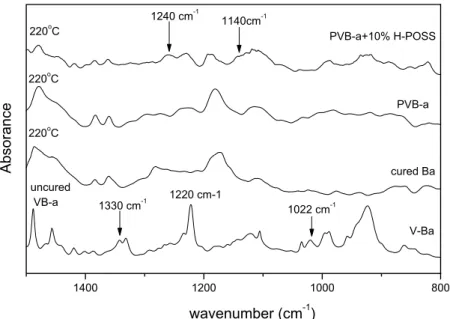
soluble in most common solvents, such as THF, toluene, chloroform, and acetone. We performed the reaction by thermally induced hydrosilylation, implying that these easily processible monomers can be polymerized without the need for a catalyst. We monitored the reaction of VB-a with H-POSS at various temperatures using FTIR spec-troscopy.Fig. 3presents the IR spectra of a mixture of VB-a containing 10 wt% H-POSS after each temperature. When the stepwise polymerization begins, the H-POSS macro-monomer units tend to react with the vinyl groups of the VB-a monomers in their vicinity. The C–H bending bands of the vinyl group of VB-a at 910 and 980 cmK1gradually decreased. The absorption band of the hydrosilane group (Si–H) of the H-POSS (2215 cmK1) totally disappeared after curing at 160 8C. The VB-a/H-POSS copolymer obtained at this stage (160 8C) still displays a C–O–C stretching band at 1050 cmK1 for the oxazine ring and a band for a 1,2,4-substituted benzene ring at 1490 cmK1. The presence of these bands suggests that the ring-opening polymerization of the VB-a-type benzoxazine occurs at higher temperatures. At higher POSS concentrations (O 10 wt%), the hybrid material was unable to polymerize completely and the prepared film was clouded. The bulky POSS particles (1–3 nm) may physically aggregate and retard both the hydrosilylation and the oxazine ring-opening polymerization. Fig. 4 presents the IR spectra of the benzoxazine monomers B-a and VB-a and the PVB-a-POSS copolymer obtained after curing. The absorption bands of the C–H bending of the vinyl group (910 and 980 cmK1) decreases and almost disappears completely after polymerization at 220 8C. The ring-opening polym-erization of the benzoxazine ring is also confirmed in this case by the disappearance of the symmetric and asymmetric C–O–C stretching bands at 1022 and 1220 cmK1. In addition, the absorption band at 940 cmK1, which we assign to the C–H vibration of the oxazine ring of the benzoxazine, has almost disappeared. A new band for the tetrasubstituted aromatic ring of the polymerized VB-a (i.e. PVB-a) appears at 1478 cmK1with a corresponding decrease in the intensity of the band representing the trisubstituted aromatic ring of VB-a (1488 cmK1). The synthetic PVB-a-POSS copolymer was also confirmed by the disappearance of the Si–H stretching peak at 2200 cmK1and the appearance of a new band (1240 cmK1) reflecting its Si–C bonds.
3.3. Viscoelastic properties of polybenzoxazine/POSS hybrids
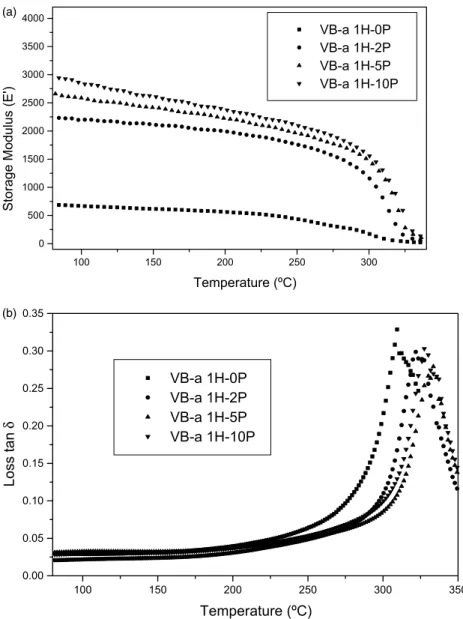
Fig. 5(a) and (b) display the storage modulus (E0) and the loss tan d curves of the polymerized VB-a hybrids having various contents of H-POSS. InFig. 5(a), the storage moduli (E0) of VB-a polymerized in the absence of H-POSS (i.e. PVB-a) is 750 MPa at 80 8C, while the values of E0 of hybrids containing 2, 5, and 10 wt% of H-POSS are 2260, 2680, and 2980 MPa, respectively. Clearly, these values of E0 of the hybrids increase drastically even when the POSS
Scheme 4. An organic/inorganic hybrid material prepared from VB-a and H-POSS.
content is small. The presence of the bulky and rigid POSS particles tends to stiffen the crosslinked polybenzoxazine network and results in a significant increase in the storage modulus.
Fig. 5(b) presents the loss tan d peak temperatures,
obtained by DMTA, which represents the glass transition temperatures (Tg) of these materials. The value of the Tgof PVB-a is 307 8C, while hybrids containing 2, 5, and 10 wt% of H-POSS are 321, 333, and 327 8C, respectively. The glass transition temperature increases upon increasing the H-POSS content up to 5 wt% H-POSS and then decreases at 10 wt% POSS. We expect that, at 5 wt% or less, these H-POSS particles are distributed evenly within the polymer
matrix on a molecular scale. As expected, the strong hydrogen bonding and the presence of the rigid POSS particles both hinder the mobility of the polymer chains and result in the higher values of Tg. When the H-POSS content is increased to 10 wt%, Tgactually decreases slightly. The hydrosilane group in H-POSS consumes portion of the polymerizable olefin groups in VB-a and, as a result, the cross-linking density of the hybrid containing high POSS content is reduced. It is well known that the value of Tgof a crosslinked network decreases upon decreasing its cross-linking density. The presence of strong hydrogen bonds and the rigid POSS structure both favor an increase in Tg, but the lower crosslinking density tends to cause lower Tg.
Fig. 3. IR spectra of VB-a incorporating 10 wt% of H-POSS after reactions at different temperatures.
3.4. Viscoelastic properties of polybenzoxazine/IB-POSS hybrids
To compare the results obtained for the H-POSS blends, a POSS derivative bearing eight inert isobutyl hydrocarbon substituents (IB-POSS) was employed for comparison
purpose. The structure of the IB-POSS is quite similar to that of the H-POSS, except it does not contain any functional group that can react with VB-a during the curing process. We expected that the thermal properties of these IB-POSS hybrids would be different from those of the H-POSS hybrids. Fig. 6(a) displays the storage modulus (E0)
Fig. 5. (a) Storage modulus (E0) and (b) loss tan d vs. temperature of PVB-a/H-POSS composites by DMTA.
Table 1
Thermal properties of the VB-a/H-POSS hybrids
Sample H-POSS in feed Glass transition temperature (8C) Decomposition temperaturea (8C, in N2) Char yield in N2at 750 8C (%) wt% mol% B-a 0Pb 0 0 180 311 35 VB-a 1H-0P 0 0 307 365 34 VB-a 1H-2P 2 0.002 324 370 42 VB-a 1H-5P 5 0.005 333 375 45 VB-a 1H-10P 10 0.011 327 368 46 a 5-wt%-Loss temperature. b
curves of the PVB-a and IB-POSS hybrids. The value of E0 of the IB-POSS hybrid having a POSS content of 10 wt% increases only slightly relative to that of the pure polymeric VB-a (790 vs. 700 MPa). At lower IB-POSS contents, the hybrids’ values of E0(600 MPa) are actually lower than that of the unmodified PVB-a.
Fig. 6(b) presents the tan d curves of the PVB-a and
IB-POSS blends, where the values of Tgof the pure PVB-a and its 2 wt% POSS hybrid are both at 306 8C. At higher POSS contents (5 and 10 wt%), two values of Tg are clearly visible. These results indicate that it is impossible to create a well-dispersed POSS hybrid if the POSS monomer is not covalently bonded to the oxazine monomer. In addition, the lack of compatibility also induces phase separation of the
Fig. 6. (a) Storage modulus (E0) and (b) loss tan d vs. temperature of PVB-a/IB-POSS composites by DMTA.
Table 2
Thermal properties of the VB-a/IB-POSS hybrids
Sample IB-POSS in feed Glass transition temperature (8C) Decomposition temperaturea (8C, in N2) Char yield in N2at 750 8C (%) wt% mol% B-a 0Pb 0 0 180 311 35 VB-a IB-0P 0 0 307 365 32 VB-a IB-2P 2 0.002 306 370 41 VB-a IB-5P 5 0.005 268, 318 355 42 VB-a IB-10P 10 0.011 270, 320 350 38 a 5-wt%-Loss temperature. b
POSS-rich and polybenzoxazine-rich phases. The non-reactive IB-POSS units tend to aggregate during the curing process to form their own domain within the network and act as an inorganic filler. As a result, at a higher IB-POSS contents, the glass transition temperature of the hybrid does not increase as expected.
3.5. Thermal properties of the hybrid materials
Tables 1 and 2summarize the thermal properties of these polybenzoxazine/POSS copolymers and blends. No thermal transitions by DSC can be detected for the VB-a and POSS copolymers, probably due to their highly crosslinked nature. We investigated the thermostability under nitrogen of these POSS copolymers using TGA. In Fig. 7, we observe a gradual increase in the decomposition temperature of the PVBa/H-POSS and PVPa/IB-POSS hybrids upon increasing the POSS content. At higher temperatures (i.e. above the decomposition temperature), the char yields of the PVB-a/ H-POSS copolymers display their improved thermostability because the H-POSS units are linked with the PVB-a polymer chains. We speculate that both decomposition of polybenzoxazine and rearrangement of POSS occur at the decomposition temperature. The rigid protective layer formed on the composites surface is responsible for the improved thermal stability [26]. As we had expected, increasing the POSS content in these copolymers does improve their thermal properties. The results indicate that the thermal properties of polybenzoxazines are improved by covalently linking the vinyl group to the POSS particles. A consideration of the microstructural features is useful when explaining the changes in the thermal properties (Tgand Td) detected by DMTA and TGA.
3.6. Microstructure analyses
We investigated the morphologies of the polybenzox-azine/POSS hybrids by SEM.Fig. 8(a)–(d) display the SEM cross sectional images of the PVB-a/POSS hybrids having different POSS contents. InFig. 8(c), the SEM image of the PVB-a/10 wt% POSS hybrid indicates that the POSS moieties are still dispersed evenly within the polybenzox-azine matrix because the formation of POSS copolymer enhances the miscibility between polybenzoxazine and POSS. When the stepwise polymerization begins, the H-POSS macromonomer units tend to react with the VB-a monomers in their vicinity, imply that the H-POSS units become dispersed on a molecular scale in the VB-a-type polybenzoxazine even at higher H-POSS contents. In comparison, the domain sizes of the IB-POSS hybrid are significantly greater as indicated inFig. 8(d). Even at an IB-POSS content as low as 2 wt%, the PVB-a/IB-IB-POSS blend exhibits gross POSS aggregation. We observe that the domain sizes of the IB-POSS/PVB-a blends are significantly greater than those of the H-POSS/PVB-a blends at the same level of POSS content (2 wt%). Serious aggregation of IB-POSS occurs in the B-a-type polybenzoxazine matrix due to poor than the VB-a-type benzoxazine.
4. Conclusions
We have synthesized a novel benzoxazine monomer featuring terminal vinyl groups and subjected it to oxazine ring-opening polymerization. The vinyl group undergoes chain extension through hydrosilylation during benzoxazine polymerization conditions to yield high-performance nano-composite materials. These POSS-containing nano-composite
materials display significant improvements in their thermal stability relative to the typical polybenzoxazines formed in the absence of POSS. The glass transition temperature increases from 307 8C for the PVB-a to 333 8C for the copolymer hybrid incorporating 5 wt% of POSS. The degradation temperature and char yield under nitrogen increase with the increase of the POSS content implying that modifying the polybenzoxazine by incorporating POSS improves the thermal stability of the composite materials. The values of E0for the blends incorporating IB-POSS are actually lower than that of the unmodified PVB-a. Furthermore, the tan d curves display two transitions from the hybrids having higher IB-POSS contents (5 and 10 wt%). Serious aggregation of IB-POSS occurs in the B-a-type polybenzoxazine matrix due to poorer miscibility than of the VB-a-type benzoxazine. Higher content of non-reactive IB-POSS units tend to aggregate during curing and result in two Tgof the PVB-a/IB-POSS hybrids.
References
[1] Burke W. J Am Chem Soc 1954;76:1677.
[2] Ning X, Ishida H. J Polym Sci, Chem Ed 1994;32:1121. [3] Higginebottom H. US Patent, 4, 557, 979; 1985. [4] Ishida H, Allen D. J Polym Sci, Phys Ed 1996;34:1019. [5] Agag T, Takeichi T. Macromolecules 2001;34:7257. [6] Kim HJ, Brunovska ZB, Ishida H. Polymer 1999;40:1815. [7] Rimdusit S, Ishida H. Polymer 2000;41:7941.
[8] Takeichi T, Guo Y, Agag T. J Polym Sci, Chem Ed 2000;38:4165. [9] Takeichi T, Guo Y. Polym J 2001;33:437.
[10] Ishida H, Lee Y. J Polym Sci, Phys Ed 2001;39:736. [11] Feher FJ, Newman DA. J Am Chem Soc 1990;112:1931. [12] Zheng L, Farris RJ, Coughlin EB. Macromolecules 2001;34:8034. [13] Mather PT, Jeon HG. Macromolecules 1999;32:1194.
[14] Sellinger A, Laine RM. Macromolecules 1996;29:2327. [15] Haddad TS, Lichtenhan JD. Macromolecules 1996;29:7302. [16] Lichtenhan JD, Otonari YA, Carr MJ. Macromolecules 1995;28:8435. [17] Pyun J, Matyjaszewski K. Macromolecules 2000;33:217.
[18] Zheng L, Farris RJ. J Polym Sci, Chem Ed 2001;39:2920. [19] Leu CM, Chang YT, Wei KH. Macromolecular 2003;36:9122. Fig. 8. SEM cross sectional micrographs of PVB-a/POSS hybrids: (a) pure VB-a-type polybenzoxazine; (b) composite containing 2 wt% of H-POSS content; (c) composite containing 10 wt% of H-POSS content; (d) composite containing 2 wt% of IB-POSS content.
[20] Leu CM, Chang YT, Wei KH. Chem Mater 2003;15:3721. [21] Sommer LH, Pietrusza EW, Whitmore FC. J Am Chem Soc 1947;69:
2687.
[22] Muller R, Kohne F, Sliwinski S. J Prakt Chem 1959;9:71. [23] Jackson RA. Adv Free Radical Chem 1969;3:231.
[24] Ojima I. The chemistry of organic silicon compounds. New York: Wiley; 1989.
[25] Balcar H, Kalisz T, Sedlacek J, Blechta V, Matejka P. Polymer 1998; 39:4443.
[26] Landrock AH. Handbook of plastics flammability and combustion toxicology. Park Ridge, NJ: Noyes Publications; 1983.