國 立 交 通 大 學
電信工程學系
碩 士 論 文
基於 IEEE802.16e 排程省電演算法
Power-Conserving Scheduling Algorithms for
Broadband Wireless Networks
研 究 生:曾信龍 Student:Hsin-Lung
Tseng
指導教授:方凱田 博士
Advisor: Dr. Kai-Ten Feng
基於 IEEE802.16e 排程省電演算法
Power-Conserving Scheduling Algorithms for
Broadband Wireless Networks
研 究 生:曾信龍 Student:Hsin-Lung
Tseng
指導教授:方凱田 博士
Advisor: Dr. Kai-Ten Feng
國立交通大學
電信工程學系碩士班
碩士論文
A Thesis
Submitted to Department of Communication Engineering
College of Electrical Engineering and Computer Engineering
National Chiao Tung University
in Partial Fulfillment of the Requirements
for the Degree of
Master of Science
in
Communication Engineering
September 2008
Hsinchu, Taiwan, Republic of China
基於 IEEE802.16e 排程省電演算法
研究生:曾信龍
指導教授:方凱田 博士
國立交通大學電信工程學系碩士班
摘要
在移動式網路由於電池壽命的限制,省電是一個很重要的
議題。為了適應不同的傳輸型態,各種不同的省電方法都被
提出來,然而很多報告都只考慮單一型態的傳輸型態,這篇
論文提供可以解決多種傳輸型態的排程方法。一個演算法叫
做近似省電演算法它處理了多種傳輸型態的聚合而且他也符
合規範的服務品質,不幸的是他不是一個最佳化的演算法,
所以我們為了求得最佳演算法而假設了一種特別的傳輸型態
來驗證近似省電演算法的正確性。為了要求得最佳化我們也
假設了無限的頻寬從而證明最少甦醒演算法的是一個最佳化
演算法同時為了要減少復甦跟睡眠模式的切換我們也提出了
一個演算法叫做最少切換演算法來達到這個目的。
Power-Conserving Scheduling Algorithms for
Broadband Wireless Networks
Student: Hsin-Lung Tseng
Advisor: Dr. Kai-Ten Feng
Department of Communication Engineering
National Chiao Tung University
Abstract
The limitation on the battery lifetime has been a critical issue for the advancement of mobile computing. Different types of power-saving techniques have been proposed in various fields. In order to provide feasible energy-conserving mechanism for the Mobile Subscriber Stations (MSSs), three power-saving types have been proposed for the IEEE 802.16e broadband wireless networks. However, these power-saving types are primarily targeting for the cases with a single connection between the Base Station (BS) and the MSS. With the existence of multiple connections, the power efficiency obtained by adopting the conventional scheduling algorithm can be severely degraded. In this work, a Heuristic Power Saving Scheme (HPSS) scheduling algorithm is proposed to consider the aggregated effect from the multiple connections to the power efficiency. Moreover, the Quality-of-Service (QoS) constraints from downlink traffic are employed in the design of the HPSS algorithm in order to facilitate the corresponding MSS to fulfill its QoS requirements. Unfortunate, even though the performance of the HPSS is efficient, it is not optimal. Since of this reason, we simplify the problem by special traffic type of the CID and an optimal algorithm called Maximal Power-Conserving (MPC) is proposed. It is designed to optimal the energy efficiency based on the pre-specified Quality-of-Service requirements. In order to optimize the power saving efficiency, It is needed to assumed the resource of bandwidth is unlimited. An optimal algorithm called Least Awake Frame Scheme (LAFS) is proposed. The design concept of LAFS focus on scheduling the deadline of the data burst. Moreover, an algorithm called Least Switching Times Scheme (LSTS) is proposed. the LSTS algorithm reserve the advantage of the LAFS, It is design for optimal the MSS switching times between listen interval and sleep interval. The minimal awake frames and minimal switching times of the MSS will also be proved in this paper. Numerical results show that the proposed HPSS scheduling algorithm outperforms the conventional 802.16e power-saving mechanism, the Periodic On-Off Scheme (PS) and the Aperiodic On-Off Scheme (AS).
Acknowledgement
Firs of all, I would like to express my deepest gratitude to my advisor, Dr. Kai-Ten Feng, for his enthusiastic guidance and great patience. I learn a lot from his positive attitude in way of research and many other areas. Secondly, I really appreciate Dr. Wei-Kua Liao and Dr. Hsi-Lu Chao for serving as my committees. Heartfelt thanks are also offered to all members in the Mobile Intelligent Network Technology Laboratory (MINT Lab) for their constant encouragement and assistance whenever I need.
I would like to show my sincere thanks to my parents for their invaluable care and love. When I was depressed, they comforted and encourage me, and whenever I met difficulty, their heart and mind were always by my side. I also appreciate for their supply to every thing I need without any complaining. Without them, I would not exist in this world. Without them, I would not live to this age. Without them, I would not be here today. Sincerely, it is not enough to give all my appreciation to my dear parents. I would like to attribute all my achievement and honor to them. Thank you mom and dad, I love you forever.
Finally, I appreciate all my true friends for their immediately encouraging when I was down. They let me know that someone other than my parents in this world are caring me, I am not alone to fight. I am willing to share my honor with you guys, thank you every one.
Contents
Chinese Abstract
I
English Abstract
II
Acknowledgement III
Contents IV
List of Figures
VI
Chapter 1 Introduction ... 1
Chapter 2 Problem Statement ... 5
2.1 IEEE 802.16e Sleep Mode Operation ... 5
2.2 Problem Associated with IEEE 802.16e Sleep Mode Operation ... 6
Chapter 3 Related Work ... 9
3.1 Periodic On-Off Scheme (PS) ... 9
3.2 Aeriodic On-Off Scheme (AS) ... 12
Chapter 4 Proposed Power-Conserving Scheduling Algorithms 14
4.1 Heuristic Power Saving Scheme (HPSS) ... 154.1.2 Adjust Procedural of Heuristic Power Saving Scheme ... 17
4.2 Maximal Power-Conserving (MPC) scheme ... 18
4.3 Least Awake Frame Scheme (LAFS) ... 22
4.3.1 Operation of LAFS Algorithm ... 23
4.3.2 Proof of LAFS Algorithm ... 24
4.4 Least Switching Times Scheme (LSTS) ... 25
4.4.1 Operation of LSTS Algorithm ... 26
4.4.2 Proof of LSTS Algorithm ... 26
Chapter 5 Performance Evaluation ... 30
5.1 Evaluation Environment ... 30
5.2 Evaluation Result and Analysis ... 32
Chapter 6 Conclusion ... 37
List of Figures
Figure 2.1: Power-saving classes de¯ned in the IEEE 802.16e. ... 7
Figure 2.2 : Schematic diagram of three connections with sleep mode between the BS and the MSS with the adoption of the conventional IEEE 802.16e power-saving algorithm ... 7
Figure 3.1: Schematic diagram of three connections with sleep mode between the BS and the MSS with the adoption of (a) the conventional IEEE 802.16e power-saving algorithm and (b) the PS scheduling algorithm ... 10
Figure 3.2: Feasible area for the PS scheduling algorithm under constraints ... 12
Figure 3.3: AS scheduling algorithm under different cases ... 13
Figure 4.1: The main procedural of the HPSS. ... 16
Figure 4.2: The algorithm of the HPSS vs. AS .. ... 17
Figure 4.3: The adjust procedural of the HPSS. ... 18
Figure 4.4: Schematic diagram of the solution set and the QoS constraints by adopting the proposed MPC scheduling algorithm. ... 22
Figure 4.5: The main procedural of the LAFS. ... 24
Figure 5.1: Performance comparison under the random traffic parameters: Power efficiency and average packet delay vs. number of connections ... 33
Figure 5.2: Performance comparison under the TIi>= Di Power efficiency and average
packet delay vs. number of connections ... 33 Figure 5.3: Performance comparison under the TIi <=Di : Power efficiency and average
acket delay vs. number of connections ... 34 Figure 5.4: Performance comparison under the different Di : Power efficiency and
average packet delay vs. number of connections ... 35 Figure 5.5: Performance comparison under the different bandwidth allowance : Power efficiency and average packet delay vs. number of connections ... 36 Figure 5.6: Performance comparison under the different bandwidth allowance : Power efficiency and average packet delay vs. number of connections ... 36
Chapter 1
Introduction
The IEEE 802.16-2004 standard [1] for the Wireless Metropolitan Area Networks (WMAN) is designed to fulfill various demands for higher capacity, higher data rate, and advanced multimedia services. Furthermore, the IEEE 802.16e standard [2] enhances the origi-nal IEEE 802.16-2004 standard by addressing the power-saving and the mobility issues for the Mobile Subscriber Stations (MSSs). In order to satisfy the requirements for broadband wireless transmission, the design of a feasible power-saving mechanism has become an important topic to prolong the battery lifetime of the MSS.
In an IEEE 802.16e point-to-multipoint (PMP) network, The Base Station (BS) is responsible for controlling the communications with multiple MSSs. The Time Division Duplexing (TDD) and the Frequency Division Duplexing (FDD) are the two duplexing techniques supported for the MSSs to share the common channels, where the TDD scheme is employed as the well-adopted method for current commercial products. The MAC frame structure within the TDD scheme consists of a downlink (DL) subframe and an uplink (UL) subframe for conducting packet transmission in both directions. Moreover, it has been stated in the specification that multiple connections (specified by different Connection IDs (CIDs)) can be established between a single BS/MSS pair.
There are two operating modes defined in the standard for each MSS, i.e. the sleep and the normal modes. The sleep mode is intended to minimize the MSS’s power consumption with decreased usage of the air interface resources from its serving BS. Furthermore, it is mentioned in the specification that the connections with similar traffic type are grouped power-saving classes for the sleep mode operation. Three different power-saving types are specified (i.e. Type I, II, and III) in order to fulfill different demands among the traffic types. The power-saving class of Type I defines the exponential-growing sleep intervals associated with fixed listen intervals. On the other hand, periodic occurrences of both the sleep and listen intervals are considered in Type II. The power-saving class of Type III consists of the pre-determined longer sleep interval without the existence of the listen period.
There are significant amounts of research work [3] [4] [5] focusing on the energy-saving issues for battery-powered mobile devices. Different types of energy efficient algorithms have been studied in [3] for generic central-controlled wireless data net-works. Based on the IEEE 802.11 power-saving mechanism, several energy conservation schemes have been proposed in both centralized [4] and decentralized [5] manners. How-ever, these techniques are not designed and intended to satisfy the requirements as de-fined in the IEEE 802.16e standard. In recent research studies, the performance analysis of the IEEE 802.16e power-saving types are investigated. Most of the work concentrate on constructing the analytical models for power-saving class of Type I [6] [7] [8] [9] [10]; while the enhanced model as proposed in [11] switches the power saving class between Type I and II according to the network traffic. A Longest Virtual Burst First (LVBF) scheduling algorithm has been proposed in [12], which considers both the energy conser-vation and resource allocation between the BS and multiple MSSs. Nevertheless, these analytical results and scheduling schemes only consider a single connection between the BS and each MSS, i.e. a single CID is assigned to each MSS. Only one research is
focus on multiple connections between a single BS/MSS pair. In [13], It proposed two algorithms called Periodic On-Off Scheme(PS) and Aeriodic On-Off Scheme (AS). The objective of the PS scheme is to provide a QoS- guaranteed and periodic scheduling algorithm in order to maximize the power efficiency under the multi-connection scenar-ios. Since the PS always sleep and listen for a fixed period. the MSS might have to stay awake in some frames in the listen period even there is no data to send or to receive. Thus, an aperiodic on-off scheduling scheme (AS) is further proposed to determine if an MSS should go to sleep or not in a frame basis. In other words, the AS tries to schedule the packet transmission in the minimal number of OFDM frames without violating the QoSs of all connections.
It is apparent that multiple connections between a single BS/MSS pair can result in infeasible power-saving capability without appropriate adjustment on the scheduling algorithm. In this paper, a Heuristic Power Saving Scheme (HPSS) scheduling algo-rithm is proposed for the IEEE 802.16e networks. With the consideration of multiple connections between the BS and each MSS, the HPSS scheme is designed to maximize the energy efficiency based on the pre-specified Quality-of-Service (QoS) requirements. The design concept of the power-saving algorithm is focus on the deadline of data burst. Simulation results that the proposed HPSS scheduling algorithm can provide better en-ergy efficiency comparing with the conventional scheme, PS and AS under the cases with multiple connections. Unfortunate, even though the performance of the HPSS is efficient, it is not optimal. Since of this reason, we simplify the problem by special traf-fic type of the CID and an optimal algorithm called Maximal Power-Conserving (MPC) is proposed. It is designed to optimal the energy efficiency based on the pre-specified Quality-of-Service (QoS) requirements.
In order to optimize the power saving efficiency without defining the special traffic type, we assumed the bandwidth is unlimited and an optimal algorithm called Least
Awake Frame Scheme (LAFS) is proposed. The design concept of LAFS is base on the HPSS. The design concept of this power-saving algorithm is focus on the deadline of data burst and it always aggregates data at the dateline frame. The other algorithm called Least Switching Times Scheme (LSTS) is proposed ,too. Moreover, The design concept of the power-saving algorithm keeps the advantage of the LAFS algorithm. It always combining the awake frames scheduling by LAFS and it not only optimize the power saving efficiency but also optimize the MSS switching times.
The rest of the paper is organized as follows. The operations of the IEEE 802.16e power-saving mechanism and power saving problem are briefly summarized in Section 2. Section 3 explains the related work scheduling algorithm , Section 4 explains the pro-posed scheduling algorithm; while the performance evaluation of the propro-posed scheme is conducted in Section 5. Section 6 draws the conclusions.
Chapter 2
Problem Statement
2.1
IEEE 802.16e Sleep Mode Operation
According to the IEEE 802.16e specification [2], the sleep mode is defined to reduce the power consumption of a MSS. As a connection is established between the BS and the MSS, the MSS can be switched to the sleep mode if there is no packet to be transmitted or received during a certain time period. The time duration within the sleep mode is divided into cycles, where each cycle can contain both the sleep and the listen intervals. In the listen interval, the MSS can either transmit/receive data or listen to the MAC messages acquired from the BS. During the sleep interval, on the other hand, the MSS may turn into its sleep power state or associate with other neighbor BSs for handover scanning purpose. It is noticed that the sleep mode can be initiated by either the MSS or the BS. For the MSS-initiated process, the MSS sends a MOB SLP-REQ massage to the BS for requesting the permission of entering the sleep mode. The BS will reply with a MOB SLP-RES massage, which also includes the parameters of the connection type, the size of the sleep and listen intervals, and the starting time for the sleep mode. As mentioned in Section I, three power saving types are specified for the connections
between the BS and the MSS in order to facilitate different characteristics of services. The sleep mode of the MSS with the power-saving class of Type I consists of exponential-growing sleep intervals and fixed-length listen intervals. Within its listen intervals, the MSS will listen for the MOB TRF-IND massage obtained from the BS in order to determine if it should return back to the normal mode. In the case that the MSS is determined not to switched back to the normal mode, the length of the next sleep interval will be doubled until the pre-defined maximum sleep window size has been reached. Based on the QoS requirements as defined in [1], this type is suitable for non-realtime traffic variable-rate (NRT-VR) connections and the Best-Effort (BE) services between the BS and the MSSs. The power-saving class of Type II defines the repetitive occurrences of the sleep and listen intervals, where the sizes of both intervals are pre-determined fixed parameters. The MSS is allowed to transmit/receive data periodically within the listen intervals. It is noticed that this power-saving type is especially suitable for QoS-guaranteed services, e.g. the Unsolicited Grant Service (UGS) and the realtime traffic variable-rate (RT-VR) connections. Furthermore, without the assignment of the listen interval, the power-saving class of Type III pre-specifies a long sleep interval for the MSS before it returns back to the normal mode. This type is suggested to be utilized for multicast connections and management operations. Fig. 2.1 shows the three type power saving mode.
2.2
Problem Associated with IEEE 802.16e Sleep
Mode Operation
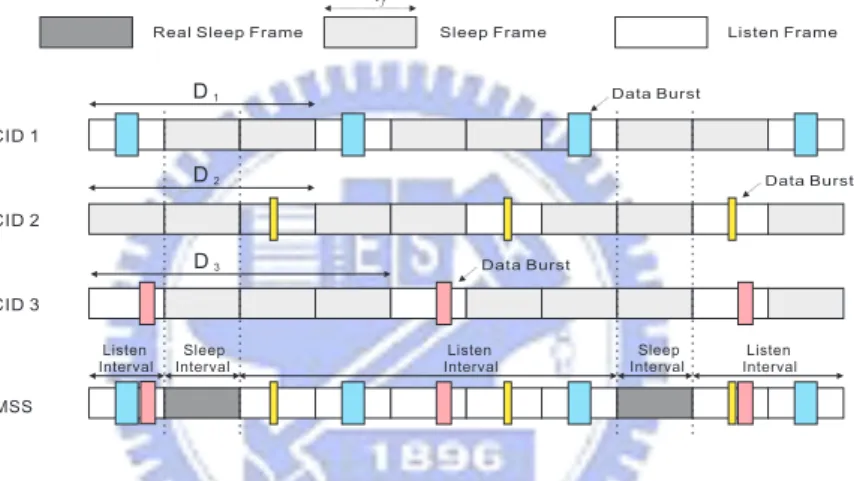
Since the power-saving types are defined based on a single connection between the BS and the MS, the degraded effect from the allowable multiple connections has not been considered in the specification. The parameter Di is denoted as the DL delay constraint
Power Saving Class II Operation
Power Saving Class III Operation Power Saving Class I Operation
Normal Mode Sleep Mode Normal Mode
Sleep Interval Listen interval
Figure 2.1: Power-saving classes defined in the IEEE 802.16e.
Sleep Frame Listen Frame
CID 1 CID 2 CID 3 MSS D1 D2 D3 Listen Interval Sleep Interval Listen Interval Sleep Interval Listen Interval tf Data Burst Data Burst Data Burst Real Sleep Frame
Figure 2.2: Schematic diagram of three connections with sleep mode between the BS and the MSS with the adoption of the conventional IEEE 802.16e power-saving algorithm for the ith connection. Moreover , ∆t
f is defined as the time duration of a frame as
shown in Fig 2. It is noted that the power-saving class of Type II is considered for all the three connections (i.e. with CID 1, 2, and 3), which are characterized as follows: (i) CID 1 with DL traffic: period = 3∆tf, sleep interval = 2∆tf, listen interval = ∆tf,
and DD
1 = 3∆tf; (ii) CID 2 with UL traffic: period = 3∆tf, sleep interval = 2∆tf,
listen interval = ∆tf, and D2U = 3∆tf; (iii) CID 3 with UL traffic: period = 4∆tf,
sleep interval = 3∆tf, listen interval = ∆tf, and DU3 = 4∆tf.
by directly combining the sleep intervals from these three connections, i.e. with the adoption of the conventional 802.16e scheme as shown in Fig. 2.2. It can easily be extended that the sleep interval may become zero frame in certain multi-connection scenarios, which can severely degrade the efficiency for power conservation. Therefore, it is necessitate to provide a feasible scheduling algorithm in order to reschedule the sleep intervals based on the combined effects from the multiple connections.
In this work, only packet scheduling issues for MSSs with multiple real-time con-nections (UGS) are considered. Non-real-time packets that can tolerate delays could be scheduled in any listen period with available radio resources for an MSS.
Chapter 3
Related work
3.1
Periodic On-Off Scheme (PS)
The objective of the proposed periodic on-off scheme (PS) scheme is to provide a QoS-guaranteed scheduling algorithm in order to maximize the power efficiency under the multi-connection scenarios. The PS algorithm is primarily designed for the connections with power-saving class of Type II due to its most stringent QoS requirement comparing with the other two types. Nevertheless, the connections with either Type I or III traffic can also be scheduled and assigned in the case that there are remaining time slots after the scheduling process for the Type II traffic has been completed. Even though the PS scheme is illustrated to design for a single BS/MSS pair, the IEEE 802.16e PMP scenario between a single BS and multiple MSSs can easily be extended with appropriate assignment of the bandwidth requirements from the BS to each MSS.
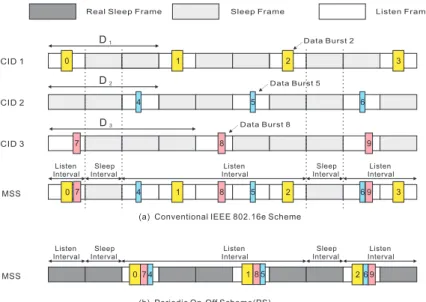
PS allow an MSS to sleep for a fixed period and then to listen for another fixed period in a round-robin basis. The scheme maximizes the length of a sleep period in the type-two power-saving class defined in the IEEE 802.16e without violating QoSs of all connections. During listen periods, an MSS transmits and receives packets, and on
CID 1 CID 2 CID 3 MSS D1 D2 D3 Listen Interval Sleep Interval Listen Interval Sleep Interval Listen Interval Data Burst 5 Data Burst 2 Data Burst 8 MSS Listen Interval Sleep Interval Listen Interval Sleep Interval Listen Interval 1 7 6 5 4 3 2 8 0 0 9 6 6 5 5 4 4 0 7 7 1 1 8 8 2 2 9 9 3 (a) Conventional IEEE 802.16e Scheme
(b) Periodic On-Off Scheme(PS)
Sleep Frame Listen Frame
Real Sleep Frame
Figure 3.1: Schematic diagram of three connections with sleep mode between the BS and the MSS with the adoption of (a) the conventional IEEE 802.16e power-saving algorithm and (b) the PS scheduling algorithm.
other hand, the MSS sets the interface idle to conserve the energy during sleep periods. Fig. 3.1 gives an example of a packet schedule for two real-time connections by applying the PS approach.
To minimize power consumption of an MSS with multiple real-time connections, the PS determines the length of a sleep period and a listen period under the radio resource and QoS constraints. Considering an MSS with N real-time connections, the QoS parameters of connection i can be denoted as CIDi{BWi, T Ii, Di} , where Di
is the delay constraint of any two consecutive packets for connection i, BWi is the
average packet size for connection i, and T Ii is the average inter-packet arrival time for
connection i. Without loss of generality, this study considers the above-mentioned QoS parameters to present the basic idea behind the proposed scheduling schemes. Other parameters such as delay jitters can be also specified as the QoS of a connection and taken into account in the presented approaches.
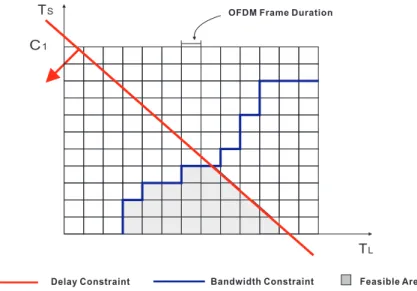
delay constraints specified by all connections need to be considered. For the bandwidth constraint, since an MSS cannot transmit and receive packets during a sleep period, the total amount of packets that an MSS can transmit and receive during a listen period must be large enough to provide the needs for all connections during the listen and sleep period. For the delay constraint, the length of a sleep period must not exceed delay requirements of all connections. Assume the length of an OFDM frame is Tframe, and a BS can supply the maximal resources, say Bframe, in an OFDM frame to the MSS. The relationship between the number of OFDM frames in a sleep period, say TS, and
the number of OFDM frames in a listen period, say TL, for the MSS can be derived.
First, TS and TL must satisfy the Delay constraint. That is:
C1 : TS+ TL≤ min
∀i {Di} (3.1)
Second, NS and NA must satisfy the bandwidth constraint. That is:
Xn
i=1{BWi× d
(TS+ TL) × Tf rame
T Ii
e} ≤ Bf rame× TL (3.2)
Equation (3.2) presents the maximal amount of data that the MSS can transmit and receive during a listen period, i.e. TL× Bf rame, must be larger than the total amount
of data needed during TS+ TL OFDM frames for all N connections.
By consideration of these two question, The feasible area is derived and it is shown in Fig. 3.2. It illustrates the schematic diagram of the solution set and the corresponding QoS constraints by exploiting the PS scheduling algorithm. The sleep interval TS and
the listen interval TL are considered as the y-axis and x-axis respectively.
From the above equation that the maximal TS
TS+TL achieves the minimal power con-sumption of an MSS. By trying all spots of the feasible area, the optimal TL and TS
Delay Constraint Bandwidth Constraint Feasible Area
C1
TL
TS OFDM Frame Duration
Figure 3.2: Feasible area for the PS scheduling algorithm under constraints.
3.2
Aeriodic On-Off Scheme (AS)
Since the PS always sleep and listen for a fixed period. the MSS might have to stay awake in some frames in the listen period even there is no data to send or to receive. Thus, an aperiodic on-off scheduling scheme (AS) is further proposed to determine if an MSS should go to sleep or not in a frame basis. In other words, the AS tries to schedule the packet transmission in the minimal number of OFDM frames without violating the QoSs of all connections. The length of sleep and listen periods are variable. While a new connection on an MSS is initiated or any existing connection is released, the AS on a BS is activated to schedule or re-schedule resources in the following frames for the MSS.
First, the AS sorts all connections based on their delay requirements, and schedules these connections with tight delay requirements first. The reason to schedule connec-tions with tight delay requirements first is that packets of these connecconnec-tions need to be sent or received within a small time window. The scheduler has to consider these pack-ets first in order not to violate their QoSs. After the scheduler decides the scheduling priorities of connections, the packets from the first priority connection start to schedule.
0 1 1 0 Di 2 2 0 1 CID i 0 1 MSS Case 1 MSS Case 2 MSS Case 3
Sleep Frame Listen Frame Real Sleep Frame
Used Data Burst
Frame 1 2 3 4 5 6 7 8 9 10 11
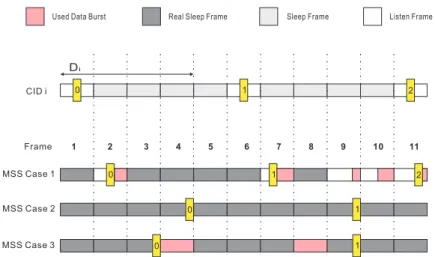
Figure 3.3: AS scheduling algorithm under different cases.
the packets start to fill in the MS OFDM scheme by sequence. At first, the i-th packet will be schedule in the MS OFDM scheme which have been used before. If the OFDM frames which have been used are full, the MSS scheduler will fill this packet in the empty MS OFDM scheme.
As shown in Fig. 3.3, three cases are showed to explained that how the MS operation. In case 1, the data burst 0 will be fill in frame 2 since only frame 2 is used before and data burst 0 can be schedule in it without violating the delay QoS. The data burst 1 can be fill in frame 7, 9 and 10 since they are used before. the previous frame has higher priority, so it will be put in frame 7. In case 2, there are no used frames between burst 0 scheduling interval. The back frame has higher priority, so it will be put in frame 4.In case 3, there is only one used frame between burst 0 scheduling interval and the frame is full. MSS scheduler will try to used the frame as back as possible, so it will be put in frame 3.
Chapter 4
Proposed Power-Conserving
Scheduling Algorithms
It is apparent that multiple connections between a single BS/MSS pair can result in infeasible power-saving capability without appropriate adjustment on the scheduling algorithm. In this paper, a Heuristic Power Saving Scheme (HPSS) scheduling algorithm is proposed. With the consideration of multiple connections between the BS and each MSS, the HPSS scheme is designed to maximize the energy efficiency based on the pre-specified Quality-of-Service (QoS) requirements. It will be demonstrated in the simulation results that the proposed HPSS scheduling algorithm can provide better energy efficiency comparing with the conventional scheme, PS and AS under the cases with multiple connections. Unfortunate, even though the performance of the HPSS is efficient, it is not optimal. Since of this reason, we simplify the problem by special traffic type of the CID and an optimal algorithm called Maximal Power-Conserving (MPC) is proposed. It is designed to optimal the energy efficiency based on the pre-specified Quality-of-Service (QoS) requirements.
of bandwidth is unlimited. An optimal algorithm called Least Awake Frame Scheme (LAFS) is proposed. The design concept of LAFS is base on the HPSS and it is focus on scheduling the deadline of data burst and it always aggregates data at the dateline frame. This algorithm still satisfy the delay QoS and it is the optimal power-saving algorithm, and it will be proved in the subsection of the (LAFS). Moreover, a algorithm called Least Switching Times Scheme (LSTS) is proposed. (LSTS) reserve the advantage of the LAFS, It is design for reducing the MSS switching times between listen interval and sleep interval. It not only optimize the power saving efficiency but also minimize the MSS switching times and the minimal switching times of the MSS will also be proved later.
4.1
Heuristic Power Saving Scheme (HPSS)
The objective of the proposed Heuristic Power Saving Scheme (HPSS) scheme is to pro-vide a QoS-guaranteed scheduling algorithm in order to maximize the power efficiency under the multi-connection scenarios. Just like the algorithm in related work, the HPSS algorithm is primarily designed for the connections with power-saving class of Type II ,too. Since the AS scheme always sort all the CID depend on the Delay QoS Di in
the MSS. The AS let the CID with the most difficult delay QoS has higher priority to schedule. and it ignore the deadline of each data burst. The HPSS scheme let the data burst with the close deadline to schedule first and it is also satisfy the delay QoS and the Bandwidth QoS. It keep the advantage of AS and and avoid the disadvantage of the AS. The following is two subpart of HPSS, the first one part explains how the HPSS algorithm operate and compares with AS with a simple example, second part is to explains the adjustment of HPSS algorithm when the HPSS scheduler detect the bandwidth is unavailable.
(a) Data Bust Lifetime(DBL)
(b) The HPSS Step 1 (C) The HPSS Step 2
1 2 3 4 5 6 7 8 9 1 2 3 4 5 6 7 8 9 1 2 3 4 5 6 7 8 9 H ig h e rP ri o ri ty
Original Data Burst Scheduled Data Burst Deadline Area DBLi
Si Ti
Second-rater Area
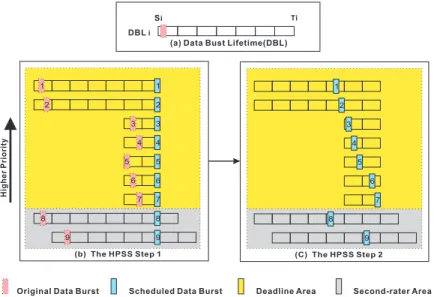
Figure 4.1: The main procedural of the HPSS.
4.1.1
Main Procedural of Heuristic Power Saving Scheme
Considering the MSS with N real-time connections, the QoS parameters of connection i can be denoted as CIDi{BWi, T Ii, Di} and it is defined in previous chapter. Moreover,
we break all the CID in the MSS into many Data Burst Lifetimes (DBL) and each DBL means a data burst with start time and deadline time the parameter of the DBL can be denoted as DBLi{Bi, Si, Fi}, where Bi is the Bandwidth require, Si is the data burst
start frame and Ti is the Termination deadline frame of the data burst. Each DBL have
a Data bust and we can schedule this data burst between the Si and Ti as shown in
Fig. 4.1.a.
In step 1 as shown in Fig. 4.1.b., we should sort all the DBL by Ti. and the DBL
with smaller Ti has higher priority. If the Ti is the same, the DBL with the smaller Ti
has higher priority as as shown in Fig. 4.1.a. Second, We start to increase system time until the system time is equal to any DBL’s Ti, and them we switch the DBL’s data
burst to the system time if the system time is between any DBL’s Si and Ti.
In step 2 as shown in Fig. 4.1.c., we should calculate the total bandwidth of the data burst requirement whose data burst is scheduled to the same frame and the DBL’s
D1 D2 1 0 2 6 8 3 4 5 CID2 CID2 AS HPSS 0 1 2 3 4 5 6 7 8 7 0 4 51 26 7 83
Sleep Frame Listen Frame
Real Sleep Frame
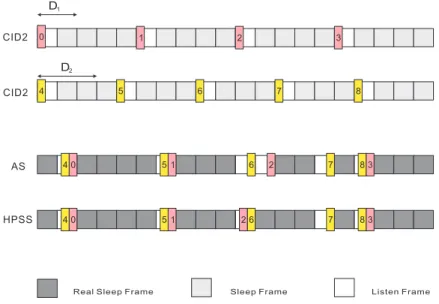
Figure 4.2: The algorithm of the HPSS vs. AS.
Ti is equal to system time. Second, we can get Backf rame. where Backf rame is equal
to dtotal bandwidth requirementB
f rame e − 1. Third, we switch the DBL’s data burst with most
high priority to systemtime − Backf rame, and other DBL in the deadline area try to
switch their data burst to the systemtime − Backf rame If it is not available it, let
Backf rame = Backf rame− 1. Go no this procedural to finish are the DBL in deadline
area. Forth, see if there any available bandwidth to satisfy the DBL in second-rather Area. The difference between the PS and the HPSS algorithm is show in Fig. 4.2. We can know the MSS with HPSS schedular listen 5 frames and the MSS with AS schedular listen 6 frames.
4.1.2
Adjust Procedural of Heuristic Power Saving Scheme
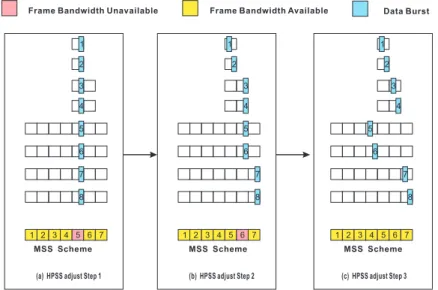
Sometimes the HPSS need some modification if the remain bandwidth is unavailable as shown in Fig. 4.3.a. The HPSS scheduler operation is from Fig. 4.3.a to Fig. 4.3.c. It is noticed that in step 2, there are 4 data bursts scheduled in the same frame. The bandwidth is unavailable if these 4 data bursts scheduled in the same frame. The modification of the HPSS is needed. In step 3, data burst 5 will scheduled to frame 6
(a) HPSS adjust Step 1 (b) HPSS adjust Step 2 (c) HPSS adjust Step 3 MSS Scheme MSS Scheme MSS Scheme
Frame Bandwidth Available Frame Bandwidth Unavailable
2 3 4 1 6 7 8 5 2 1 3 4 5 6 7 8 2 3 7 8 5 6 4 1 2 3 4 5 6 7 1 2 3 4 5 6 7 1 2 3 4 5 6 7 Data Burst 1
Figure 4.3: The adjust procedural of the HPSS.
and it will push the data burst 4 to frame 5 and data burst 4 will push data burst 1 to frame 4, but it fail, and them, The data burst 5 will scheduled to frame 5 , it will push the data burst 1 to frame 4 and data burst 4. it fails again by recursive until the data burst 5 is schedule to frame 4. The data burst 6 is congenerous.
4.2
Maximal Power-Conserving (MPC) scheme
The objective of the proposed MPC scheme is to provide a QoS-guaranteed scheduling algorithm in order to maximize the power efficiency under the multi-connection scenar-ios. The MPC algorithm is primarily designed for the connections with power-saving class of Type II due to its most stringent QoS requirement comparing with the other two types. Nevertheless, the connections with either Type I or III traffic can also be scheduled and assigned in the case that there are remaining time slots after the schedul-ing process for the Type II traffic has been completed. Even though the MPC scheme is illustrated to design for a single BS/MSS pair, the IEEE 802.16e PMP scenario between a single BS and multiple MSSs can easily be extended with appropriate assignment of
the bandwidth requirements from the BS to each MSS.
It is assumed that there are N connections existed between a single BS/MSS pair. The QoS requirements for the MSS is defined as Q = {Qi| ∀i, 1 ≤ i ≤ N} =
{(Di, τi) | Di > 0, τi ≥ 0, ∀i, 1 ≤ i ≤ N}, where the parameter i denotes the ith
con-nection between the BS and the MS. Di represents the DL delay constraint for the ith
connection. On the other hand, the parameter τi indicates either the average DL data
requirements per frame for the ith connection (with unit in time slots).
The primary purpose of the proposed MPC scheduling algorithm is to obtain the number of sleep frames per period by maximizing the power efficiency based on the various QoS requirements. Considering that the sleep and listen intervals are denoted as TS and TL (both have units in ms) respectively, the first constraint C1 based on the
QoS delay requirements can be acquired as
C1 : TS+ TL≤ min
∀i {Di} (4.1)
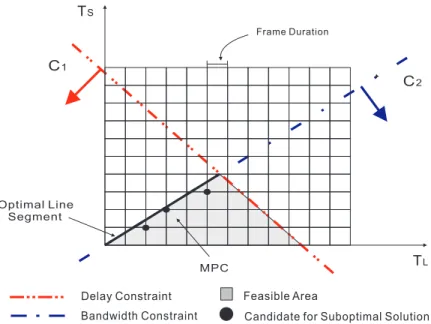
Fig. 4.4 illustrates the schematic diagram of the solution set and the corresponding QoS constraints by exploiting the proposed MPC scheduling algorithm. The sleep interval TSand the listen interval TLare considered as the y-axis and x-axis respectively.
It can be observed that the constraint C1 is drawn in the first quadrature since the delay
constraint Di is considered greater than zero.
On the other hand, the bandwidth requirement is utilized as the second constraint for the design of the MPC scheme. The total DL data requirements (in time slots per frame) for an MSS can be obtained by summing the average data requirements for each connection as ΓD =
PN
i=1τi. Based on the resource allocation, the total DL and DL
bandwidth allowances for each MSS that are assigned by the BS is pre-specified as BD
in time slots per frame, i.e. ΓD < BD. It is noticed that even with the inclusion of
less than the allowable bandwidth assigned by the BS. Furthermore, in the case with multiple MSSs, the concept can be extended in a similar manner. Different values of
BD will be assigned by the BS to each MSS based on its resource allocation policy.
Since the main design concept is to compress the total data requirements from the original (TS + TL) time duration into the listen interval TL for power-saving purpose,
the following inequality has to be satisfied:
TS+ TL TL · N X i=1 τi ≤ BD (4.2)
With appropriate arrangement of (4.2), the second constraint C2 for the QoS
band-width requirements can be obtained as
C2 : TS
TL
≤ {BD− ΓD
ΓD
} (4.3)
The bandwidth constraint C2 is also denoted as in Fig. 4.4. It can be observed that
the C2 line passes through the origin point in the two-dimensional coordinate; while the
slope of C2 is positive and is dependent to both BD and ΓD. Consequently, the main
target of the MPC scheduling is to obtain the corresponding listen and sleep intervals by maximizing the power-saving efficiency subject to the QoS constraints, i.e.
(TL∗, TS∗) = arg max C1,C2,TL>0,TS>0 ½ TS TL+ TS ¾ (4.4)
It is noted that that optimization process is subject to the delay and the bandwidth constraints (i.e. C1 and C2 as acquired from (4.1) and (4.3)) associated with the
condi-tions that TL > 0 and TS > 0. Based on the constraints, the solution set (TL∗, TS∗) will be
and intuitive observations, the optimal sets of the listen and sleep intervals (T∗ L, TS∗)
are obtained to constitute the continuous line segment of C2, i.e. the bolded black line
segment as shown in Fig. 4.4.
However, the listen and sleep intervals should be integer multiplier of a frame dura-tion. As a result, it is necessitate to obtained the discretized suboptimal set of solution M = {(m∗
L(ζ), m∗S(ζ)) | ∀ζ}. As illustrated in Fig. 4.4, the grids in the two-dimensional
space indicate the integer multiplier of the frame duration. Intuitively, the brute-force method can be utilized by searching all the grid points within the shaded region for ob-taining the suboptimal solutions. However, excessive computation cost will be incurred by the extensive searching algorithm. Intuitively, the number of discretized suboptimal solution can be reduced by considering the grid points based on the optimal set (T∗
L, TS∗) as defined in (4.4), i.e. (m∗L(ζ), m∗S(ζ)) = µ» T∗ L ∆tf ¼ , ¹ T∗ S ∆tf º ¶ (4.5)
where the suboptimal solution m∗
L(ζ) and m∗S(ζ) are denoted as the numbers of listen
and sleep frames per iterative period. It is noted that (m∗
L(ζ), m∗S(ζ)) should be chosen
within the confined rectangular region. As shown in Fig. 4.4, it can be observed that there are three discretized suboptimal solutions associated with the continuous optimal line, i.e. (m∗
L(ζ), m∗S(ζ)) = (2, 1), (3, 2), and (5, 3) for ζ = 1, 2, and 3. Two schemes
are proposed for the selection of the suboptimal solution (m∗
L(ζ), m∗S(ζ)) as follows:
For the purpose of achieving maximal power-saving, the proposed MPC scheme is to obtain the suboptimal solution which has the shortest distance to the optimal line segment (T∗
L, TS∗) as indicated in Fig. 4.4, i.e.
(m∗L, m∗S)M P C = min
∀ζ {Dist [(m ∗
Delay Constraint Bandwidth Constraint Feasible Area C1 TL TS
Candidate for Suboptimal Solution
Optimal Line Segment
MPC
C2 Frame Duration
Figure 4.4: Schematic diagram of the solution set and the QoS constraints by adopting the proposed MPC scheduling algorithm.
where the function Dist[a, b] in (4.4) corresponds to the shortest distance from point a to line b. The main concept of the MPC approach is to acquire a suboptimal solution which is considered to have the shortest distance to the original optimal solution. As can be observed from Fig. 4.4, the suboptimal solution obtained from the MPC scheme becomes (m∗
L, m∗S)M P C = (3, 2). The MPC selection algorithm requires certain amount
of computational cost for the calculation of the Dist[a, b] function. However, it it intu-itive to observe that the solution exploited by the MPC scheme is served as the best selection among the other suboptimal solutions for power-saving purpose.
4.3
Least Awake Frame Scheme (LAFS)
In order to optimize the power saving efficiency without defining the special traffic type, the power-saving scheduling problem is NP problem, It is hard to get the optimal solution. In order to optimal the power saving efficiency, we assumed the bandwidth is unlimited and an optimal algorithm called Least Awake Frame Scheme (LAFS) is
proposed. The design concept of LAFS is base on the HPSS. The design concept of this power-saving algorithm is focus on the deadline of data burst and it always aggregates data at the dateline frame.
4.3.1
Operation of LAFS Algorithm
The objective of the proposed Least Awake Frame Scheme (LAFS) power- saving Al-gorithm is to provide a QoS-guaranteed scheduling alAl-gorithm in order to optimize the power efficiency under the multi-connection scenarios. The LAFS algorithm is primar-ily designed for the connections with power-saving class of Type II ,too. The LAFS scheme let the data burst with the close deadline to schedule first and it is also satisfy the delay QoS. It keep the advantage of HPSS. The following is the operation of the LAFS.
Considering the MSS with N real-time connections, the QoS parameters of connec-tion i can be denoted as CIDi{BWi, T Ii, Di} and we break all the CID in the MSS into
many Data Burst Lifetimes(DBL) and each DBL means a data burst with start time and deadline time the parameter of the DBL can be denoted as DBLi{Bi, Si, Fi}, where
Bi is the Bandwidth require, Si is the data burst start frame and Ti is the deadline
frame of the data burst and it is defined in previous chapter. Each DBL have a Data bust and we can schedule this data burst between the Si and Ti as shown in Fig 4.5.
As shown in Fig 4.5, We start to increase system time until the system time is equal to any DBL’s Ti, and them we switch the DBL’s data burst to the system time if the
system time is between any DBL’s Si and Ti. This scheduling have optimal least awake
DBL0 DBL3 DBL1 DBL2 DBL4 DBL5 DBL6 DBL7 LAFS LSTS 0 1 2 3 4 5 6 7 4 6 7 1 0 2 3 5 4 6 7 1 0 2 3 5 Switching times = 6 Switching times = 4
Sleep Frame Awake Frame Data Burst
Figure 4.5: The main procedural of the LAFS.
4.3.2
Proof of LAFS Algorithm
Definition 1 (Data Burst Lifetimes). Given a frame s with a pre-scheduled grant
for a connection Ci, a Data Burst Lifetimes (DBL) is defined as the adjacent frames
ranging from s to t = s + di, where di is the maximum grant delay for Ci. In addition,
the frames s and t are respectively called the start and the termination for this DBL.
Definition 2 (Head Group). Given a set Φ of DBLs, the Head Group (HG) of Φ is
defined as the set
ΥΦ= {ζ ∈ Φ | Fs(ζ) ≤ min(Ft(Φ))}, (4.7)
where the functions Fs(·) and Ft(·) are used to find the start and the termination of a
DBL.
Definition 3 (Reduced Data Burst Lifetimes). Given an HG ΥΦ, the Reduced
to t = min(Ft(ΥΦ)), where the frames s and t are also called the start and the
termi-nation for this RDBL.
Algorithm 1: LAFS Algorithm
Data: Φ Result: Ω begin 1 (Ω, k, Φ0, ω) ←− (∅, 0, Φ, ∅) 2 while Φk6= ∅ do 3 let ζ be the RDBL of ΥΦk 4
select one awake-frame ω in ζ 5 insert ω into Ω 6 Φk+1 ←− Φk− ΥΦk 7 k ←− k + 1 8 end 9 end 10
Fact 1. For some integer K, let L(ΦA) = K be the least number of awake-frames for
a set ΦA of DBLs. Given another GS set ΦB of size M, L(ΦA∪ ΦB) lies in the integer
set {K, K + 1, ..., K + M}.
Lemma 1. Given an HG ΥΦ and a frame λ in the corresponding RDBL of ΥΦ, all
DBLs in ΥΦ can share the frame λ as the common awake-frame.
Proof 1. Based on Definition 3, the frame λ in the RDBL of ΥΦ must lie in the
range [max(Fs(ΥΦ)), min(Ft(ΥΦ))]. For each DBL ζ in ΥΦ, the range of awake-frame
candidates is [Fs(ζ), Ft(ζ)], which covers the range [max(Fs(ΥΦ)), min(Ft(ΥΦ))]. It
completes the proof.
4.4
Least Switching Times Scheme (LSTS)
In order to optimize the power saving efficiency, We assumed the bandwidth is unlim-ited. The other algorithm called Least Switching Times Scheme (LSTS) is proposed
,too. Moreover, The design concept of the power-saving algorithm keeps the advantage of the LAFS algorithm. It always combining the awake frames scheduling by LAFS and it not only optimize the power saving efficiency but also optimal the MSS Switching Times.
4.4.1
Operation of LSTS Algorithm
The objective of the proposed LSTS power-saving Algorithm is to provide a QoS-guaranteed scheduling algorithm in order to optimize the power efficiency under the multi-connection scenarios. It have the same performance with LAFS . Moreover, (LSTS) is better than LAFS since it optimal the MS Switching Times. After the procedure of the LAFS algorithm, the LSTS try to Combining the awake frames if it is available. i.e, the 2-th awake frame try to combine with first awake frame to reduce the MSS switching times, the 3-th awake frame try to combine with 2-th awake frame vise versa and it is shown in Fig 4.5.
Considering the MSS with N real-time connections, the QoS parameters of connec-tion i can be denoted as CIDi{BWi, T Ii, Di} and we break all the CID in the MSS into
many Data Burst Lifetimes(DBL) and each DBL means a data burst with start time and deadline time the parameter of the DBL can be denoted as DBLi{Bi, Si, Ti}, where
Bi is the Bandwidth require, Si is the data burst start frame and Ti is the deadline
frame of the data burst and it is defined in previous chapter. Each DBL have a Data bust and we can schedule this data burst between the Si and Ti as shown in Fig 4.5.
4.4.2
Proof of LSTS Algorithm
Theorem 1. Given a non-empty finite set Φ of DBLs, the LAFS algorithm has the
Proof 2. According to the expression Φk+1= Φk− ΥΦk in the LAFS algorithm shown
in Algorithm 1, the equation
Φk−1 = Φk∪ ΥΦk−1 (4.8)
is also true. In addition, based on the loop discriminant and the property of the non-empty finite set Φ, there must exist an integer number of N such that ΦN = ∅ and
ΦN −16= ∅. Let L(Φk) = K be the least number of awake-frames of Φk for some integer
K. Then, based on Equation 4.8 and Fact 1, L(Φk−1) = L(Φk∪ ΥΦk−1) lies in the
integer set {K, K + 1, ..., K + M}, where M is the size of ΥΦk−1. Based on Definition
2, there exists a GS in ΥΦk−1 whose termination is equal to min(Ft(Φk−1)). This GS is
not overlapped by the DBLs in Φk, causing L(Φk∪ ΥΦk−1) 6= K. Moreover, according
to Lemma 1, there must exist one kind of awake-frame selection that all DBLs in Φk are
aggregated into K awake-frames and those in ΥΦk−1 are merged into exact one
awake-frame. Therefore, L(Φk−1) = L(Φk∪ ΥΦk−1) = K + 1. By using the induction method
with the initial condition L(∅) = 0, the equation L(Φ) = L(Φ0) = N is always true. It
is noted that the LAFS algorithm produces N HGs and selects exact one awake-frame from each corresponding RCS. Therefore, the LAFS algorithm has the least number of awake-frames i.e. N. It completes the proof.
Algorithm 2: LSTS Algorithm Data: Φ Result: Ω begin 1 (Ω, k, Φ0, ω) ←− (∅, 0, Φ, ∅) 2 while Φk6= ∅ do 3 let ζ be the RDBL of ΥΦk 4 if ζ is adjacent to ω then 5
let the awake-frame ω be the termination Ft(ζ) 6
else 7
let the awake-frame ω be the start Fs(ζ) 8 end 9 insert ω into Ω 10 Φk+1 ←− Φk− ΥΦk 11 k ←− k + 1 12 end 13 end 14
Lemma 2. The RDBLs generated by the LAFS algorithm are non-overlapped.
Proof 3. Based on the expression Φk+1 = Φk− ΥΦk in the LAFS algorithm shown in
Algorithm 1, the inequality
min(Ft(ΥΦk)) < min(Fs(ΥΦk+1)) < max(Fs(ΥΦk+1)) (4.9)
is hold. Therefore, the termination of the RDBL derived from ΥΦk is smaller than the
start of the RDBL derived from ΥΦk+1. It completes the proof.
Theorem 2. Given a non-empty finite set Φ of DBLs, the LSTS algorithm has the
least number of switch times.
Proof 4. As shown in Algorithm 2, the LSTS algorithm is directly derived from the
LAFS algorithm by simply changing the selection rule of the awake-frames of RDBLs. Based on Lemma 2 and the fact that the number of adjacent awake-frames must be
maximized for minimizing the switch times, the awake-frame candidate must be either the start or the termination of a RDBL.
A RDBL ζ and a frame λ left-adjacent to the start Fs(ζ) of ζ are given. In the
case that the size of ζ is unity, it is trivial that the optimal and the only awake-frame is Fs(ζ) = Ft(ζ), and in the opposite case that the size of ζ is not unity, this case can
be further divided by whether λ is an awake-frame or not. If λ is an awake-frame, the optimal awake-frame is the start Fs(ζ) of ζ because the awake-frame in ζ has a single
adjacent awake-frame at most. If λ is not an awake-frame, the optimal awake-frame is the termination Ft(ζ) of ζ since the probability of awake-frame adjacency is non-zero.
Using the above procedure on the very first RDBL, the LSTS algorithm has the maximum number of adjacent awake-frames, leading to the least number of switch times. It completes the proof.
Chapter 5
Performance Evaluation
5.1
Evaluation Environment
In this section, simulations are conducted to evaluate the performance of the proposed HPSS scheduling algorithms in comparison with the original power-saving mechanism in the IEEE 802.16e specification. A single BS/MSS pair with multiple connections are considered as the simulation scenario. Only the DL traffic are adopted, which are randomly selected and dispatched in the connections between the BS and the MSS. The associated simulation parameters are listed as in Table I. Two metrics are utilized for performance comparison:
• Power Efficiency (PE): the ratio between the sleep interval to the combination of
the sleep and listen intervals, i.e. PE = TS/(TS+ TL).
• Average Packet Delay: the average time delay which consists of both the
TABLE I
SIMULATION PARAMETERS
Parameter Type Parameter Value
Traffic Type Constant Bit Rate (CBR)
Data Rate [28.8, 57.6] Byte/ms
Bandwidth Allowance 216 Byte/ms
Average Packet Service Time 2.5 ms
Duration of Time Slot 13 µs
Frame Duration 5 ms
Simulation Time 10 sec
Fig. 5.1 to 5.5 show the performance comparison (i.e. the PE and the average packet delay) under different scenarios. Figs. 5.1 to 5.3 are Three different situations, Figs. 5.1 within the range of Di = [26, 50] and T Ii =[26, 50]. Figs. 5.2 within the
range of Di = [26, 50] and T Ii =[51, 75] and Figs. 5.3 within the range of Di = [51,
75] and T Ii =[26, 50]. In other word, We consider three different situations, including
Di ≥ T Ii, Di ≤ T Ii and both of these situation. It is also noted that the x-axis in all
these three figures indicates the number of connections goes from one to five within the network. Figs. 5.4 show the PE and the average packet delay) variance under different
Di interval within the range [ [1 25], [26 50], [51 75], [76 100], [101 125] ], Ti is fix to [26,
50] and 5 connections are considered. Figs. 5.5 show the PE and the average packet delay) variance under different Bandwidth Allowance within the range [216 392.8] and 5 connections where the parameters of Di and Ti is the same with Fig 5.1 are considered.
Other simulation parameters are listed in Table I.
The bandwidth allowance is unlimit in Fig 5.6, and We show the PE and the average packet delay) variance under different Di interval within the range [ [1 25], [26 50], [51
5.2
Evaluation Result and Analysis
As can be seen from the upper plot of Fig. 5.1 with random parameters, the pro-posed HPSS scheduling schemes can provide higher PE comparing with the conven-tional 802.16e power-saving mechanism, PS and AS. i.e. more than 60% of increased PE under 5 connections in the network. It can also be observed that the PE obtained from the conventional scheme goes down drastically as the number of connections is augmented, i.e. 60% of PE under 1 connection and 10% of PE with 5 connections. Moreover, the HPSS scheme slightly outperforms the PS algorithm with around 2% to 7% of increases in PE under different numbers of connections. and it is outperforms the AS algorithm with around 2% to 5% of increases in PE under different numbers of connections. It is also noted that the packet aggregation based on the QoS constraints also incurs certain delay time under the single connection case. However, even though additional packet delay is resulted from these two proposed schemes, the outcomes are still within the QoS delay requirements for all the connections.
In case of Di ≥ T Ii, It is also noted that the PE of the IEEE802.16e is better than
the PS in 1 and 2 connections. it is because the PS tend to use the periodic scheduling and one condition of the PS is:
C1 : TS+ TL≤ min
∀i {Di} (5.1)
The T Ii ≥ Di the performance might become bad since the periodic will be bounded
smaller than Di
In case of Di ≤ T Ii, It is also noted that the PE of the IEEE802.16e is pretty
inefficient than the PS, the AS and the HPSS. it is because these three scheduling algorithms have more space to schedule the data burst.
1 2 3 4 5 0.5 0.6 0.7 0.8 0.9 1
Power Efficiency (PE)
1 2 3 4 5 0 10 20 30 Number of Connections Delay(msec) 16e PS AS HPSS
Figure 5.1: Performance comparison under the random traffic parameters: Power effi-ciency and average packet delay vs. number of connections.
1 2 3 4 5
0.7 0.8 0.9 1
Power Efficiency (PE)
1 2 3 4 5 0 10 20 30 40 Number of Connections Delay(msec) 16e PS AS HPSS
Figure 5.2: Performance comparison under the T Ii ≥ Di : Power efficiency and average
1 2 3 4 5 0.5 0.6 0.7 0.8 0.9 1
Power Efficiency (PE)
1 2 3 4 5 0 10 20 30 40 50 Number of Connections Delay(msec) 16e PS AS HPSS
Figure 5.3: Performance comparison under the T Ii ≤ Di : Power efficiency and average
packet delay vs. number of connections.
interval within the range [ [12 50], [26 50], [51 75], [76 100], [101 125] ], Ti is fix to [26,
50] and 5 connections are considered. We can easily observe the PE of the PS, the AS and the HPSS getting better with more loose delay constraints and the IEEE802.16 power-saving mechanism have the same performance even the loose delay constraints. The HPSS scheme slightly outperforms the PS algorithm with around 3% to 19% of increases in PE under different numbers of connections. and it is outperforms the AS algorithm with around 1% to 6% of increases in PE under different numbers of connections.
Fig. 5.5 shows the PE and the average packet delay) variance under different band-width allowance within the range [216 392.8] and 5 connections where the parameters of Di and Ti is the same with Fig 5.1 are considered. We can easily observe the PE of
the PS, the AS and the HPSS getting better with more bandwidth allowance and the IEEE802.16 power-saving mechanism have the same performance even more bandwidth
1~25 26~50 51~75 76~100 101~125 0.5 0.6 0.7 0.8 0.9
Power Efficiency (PE)
1~250 26~50 51~75 76~100 101~125 20 40 60 80 100
Delay Constraint (msec)
Delay(msec)
16e PS AS HPSS
Figure 5.4: Performance comparison under the different Di : Power efficiency and
average packet delay vs. number of connections.
allowance. The HPSS scheme slightly outperforms the PS algorithm with around 3% to 7% of increases in PE under different numbers of connections. and it is outperforms the AS algorithm with around 1% to 3% of increases in PE under different numbers of connections.
Fig. 5.6 shows the PE and the average packet delay) under different Di interval
within the range [ [12 50], [26 50], [51 75], [76 100], [101 125] ], Ti is fix to [26, 50] and
5 connections are considered ,and the bandwidth allowance is unlimit. We can easily observe the PE of the PS, the AS and the LAFS getting better with more loose delay constraints. It is noted that the PS might better than AS and increasing of the Di it
216 260.2 304.4 348.6 392.8 0.5 0.6 0.7 0.8 0.9 1
Power Efficiency (PE)
216 260.2 304.4 348.6 392.8 0 20 40 60 80 Bandwidth Allowance(Byte/ms) Delay(msec) 16e PS AS HPSS
Figure 5.5: Performance comparison under the different bandwidth allowance : Power efficiency and average packet delay vs. number of connections.
1~25 26~50 51~75 76~100 101~125 0.5 0.6 0.7 0.8 0.9 1
Power Efficiency (PE)
1~250 26~50 51~75 76~100 101~125 20 40 60 Delay Constraint(msec) Delay(msec) 16e PS AS LAFS
Figure 5.6: Performance comparison under the different bandwidth allowance : Power efficiency and average packet delay vs. number of connections.
Chapter 6
Conclusion
In this paper, a Heuristic Power Saving Scheme (HPSS) Scheduling algorithm is pro-posed for the IEEE 802.16e broadband wireless network. With the consideration of multiple connections between the base station and a single mobile subscriber station, the HPSS scheme maximizes the duration of the sleep interval based on the pre-defined Quality-of-Service (QoS) requirements. Numerical results illustrate that the HPSS scheme outperforms the conventional IEEE 802.16e , Periodic On-Off Scheme (PS) an APeriodic On-Off Scheme (AS) power-saving mechanism, especially under the situa-tions with multiple connecsitua-tions.
In order to optimize the power saving efficiency, It is needed to assumed the resource of bandwidth is unlimited. An optimal algorithm called Least Awake Frame Scheme (LAFS) is proposed. This algorithm still satisfy the Delay QoS and it is the optimal power-saving algorithm, and it is proved in this paper. Moreover, a algorithm called Least Switching Times Scheme (LSTS) is proposed, too. base on LAFS. It is design for reducing the MSS switching times between listen interval and sleep interval. It not only optimize the power saving efficiency but also minimize the MS Switching Times and it is also be proved in this paper.
Bibliography
[1] IEEE Standard for Local and Metropolitan Area Networks - Part 16: Air
Interfer-ence for Fixed Broadband Wireless Access Systems, IEEE Standard 802.16-2004,
2004.
[2] IEEE Standard for Local and Metropolitan Area Networks - Part 16: Air
Inter-ference for Fixed Broadband Wireless Access Systems, Amendment 2: Physical and Medium Access Control Layers for Combined Fixed and Mobile Operation in Licensed Bands and Corrigendum 1, IEEE Standard 802.16e-2005, 2006.
[3] J. A. Stine and G. de Veciana, “Improving energy efficiency of centrally controlled-wireless data networks,” ACM/Baltzer Wireless Networks, vol. 8, pp. 681–700, 2002.
[4] R. Krashinsky and H. Balakrishnan, “Minimizing energy for wireless web access with bounded slow-down,” in Proc. ACM/IEEE International Conference on
Mo-bile Computing and Networking (MobiCom), Sept. 2002, pp. 119–130.
[5] K. T. Feng and K. H. Chou, “Intelligent router-assisted power saving medium access control for mobile ad hoc networks,” in Proc. IEEE Vehicular Technology
Conference (VTC-2006 Spring), Melbourne, Australia, May 2006, pp. 304–308.
[6] Y. Xiao, “Energy saving mechanism in the ieee 802.16e wireless man,” IEEE
[7] K. Han and S. Choi, “Performance analysis of sleep mode operation in ieee 802.16e mobile broadband wireless access systems,” in Proc. IEEE Vehicular Technology
Conference (VTC-2006 Spring), 2006, pp. 1141 – 1145.
[8] Y. Park and G. U. Hwang, “Performance modelling and analysis of the sleep-mode in ieee802.16e wman,” in Proc. IEEE Vehicular Technology Conference (VTC-2007
Spring), Apr. 2007, pp. 2801 – 2806.
[9] Y. Zhang, “Performance modeling of energy management mechanism in ieee 802.16e mobile wimax,” in Proc. IEEE Wireless Communications and
Network-ing Conference (WCNC), Mar. 2007, pp. 3205 – 3209.
[10] Y. Xiao, “Performance analysis of an energy saving mechanism in the ieee 802.16e wireless man,” in Proc. Consumer Communications and Networking Conference
(CCNC), Jan. 2006, pp. 406 – 410.
[11] L. Kong and D. H. Tsang, “Optimal selection of power saving classes in ieee 802.16e,” in Proc. IEEE Wireless Communications and Networking Conference
(WCNC), Mar. 2007, pp. 1836–1841.
[12] J. Shi, G. Fang, Y. Sun, J. Zhou, Z. Li, and E. Dutkiewicz, “Improving mobile station energy efficiency in ieee 802.16e wman by burst scheduling,” in Proc. IEEE
GLOBECOM 2006, Nov. 2006, pp. 1–5.
[13] Y.-L. Chen and S.-L. Tsao, “Energy-efficient sleep-mode operations for broadband wireless access systems,” in Proc. IEEE Vehicular Technology Conference