行政院國家科學委員會專題研究計畫 成果報告
奈米複材積層板承受高溫疲勞作用其機械性能之探討
計畫類別: 個別型計畫
計畫編號: NSC93-2218-E-110-019-
執行期間: 93 年 08 月 01 日至 94 年 07 月 31 日
執行單位: 國立中山大學機械與機電工程學系(所)
計畫主持人: 任明華
計畫參與人員: 曾育鍾、黃育信
報告類型: 精簡報告
報告附件: 出席國際會議研究心得報告及發表論文
處理方式: 本計畫可公開查詢
中 華 民 國 94 年 11 月 17 日
中華民國行政院國家科學發展委員會研究計畫成果報告
奈米複材積層板承受高溫疲勞作用其機械性能之探討
THERMAL-MECHANICAL FATIGUE RESPONSE IN NANOCOMPOSITE
APC-2 LAMINATES
計畫類別:個別型計畫
計畫編號:
NSC93-2218-E-110-019
執行期間:93 年 08 月 01 日至 94 年 07 月 31 日
計畫主持人:
國立中山大學機械與機電系 任明華教授
計畫參與人員:
曾育鍾、黃育信研究生
E-mail:[email protected]
成果報告類型(依經費核定清單規定繳交):▓精簡報告 □完整報告
本成果報告包括以下應繳交之附件:
□赴國外出差或研習心得報告一份
□赴大陸地區出差或研習心得報告一份
▓出席國際學術會議心得報告及發表之論文各一份
□國際合作研究計畫國外研究報告書一份
處理方式:除產學合作研究計畫、提升產業技術及人才培育研究計畫、列
管計畫及下列情形者外,得立即公開查詢
□涉及專利或其他智慧財產權,▓一年□二年後可公開查詢
執行單位:
國立中山大學機械與機電系
中 華 民 國 94 年 09 月 19 日
THERMAL-MECHANICAL FATIGUE RESPONSE IN
NANOCOMPOSITE APC-2 LAMINATES
ABSTRACT
The fatigue response of mechanical properties and life due to constant stress amplitude tension-tension (T-T)cyclic loading at elevated temperature in nanocomposite APC-2 laminates was investigated. From the basic testing the total amount of 1% by weight of SiO2 spreaded in the interfaces was proved
optimally. The S-N curves at room and elevated temperatures were expressed by curve fitting from top to bottom as temperature increasing from RT to 150oC for both cross-ply and quasi-isotropic nanocomposite laminates. However, when applied maximum stress was normalized by corresponding ultimate strength, the positions of S-N curves were reverse. That strongly hints us the resistance to fatigue at elevated temperature in both lay-ups of nanocomposite laminates is indeed significantly improved.
Keywords: Nanocomposite laminate, fatigue, elevated temperature, mechanical properties. INTRODUCTION
Composite materials have been applied widely to many industries, such as aerospace, defense and civil, mainly due to their superior properties of high specific strength and stiffness, low density, easy manufacturing, dimensional stability, and high resistance to fatigue load. Nowadays, ”lighter, thinner, stronger and cheaper” are the goal of materials science and engineering, especially in nanoscale age. Engineering materials at the atomic and molecular levels are creating a revolution in the field of materials and processing. The discovery of new nanoscaled materials, such as nanoclays, carbon nanotubes, and others offer the promise of a variety of new composite, adhesive, coating and sealant materials with specific properties.
The rapid development of nano science and technology not only stimulates the research work rigorously at universities and institutes, but also accelerates the potential applications in many fields. However, our concern is focused on a small part of engineering application, i.e., adding nanoparticles on the interfaces in APC-2 composite laminates to make a significant improvement of mechanical properties due to static and cyclic loadings at elevated temperature. Thus, the survey of literature is limited to the related research and some are cited as references. Hussain et al. [1,2] found the mechanical properties are highly increased in Carbon/Epoxy composites by adding Al2O3 particles.
Kim [3] revealed the improvement of interface properties by spreading SiC nanoparticles. The effect on wear and friction by adding SiC nanoparticles in PEEK was studied by Lin [4]. Practically, PEEK matrix mixed with nano carbon fibers of 15% by wt. can reach the optimal strength and stiffness [5]. Qi [6] investigated the synthesis of polymer colloids, hollow nanoparticles and nanofibers. Li [7] presented the manufacturing and processing methods in nanocomposites, nanometals and semi-conductor particles. As for Carbon/PEEK composites, our lab has been supported by the National Science Council ( NSC) for many years, and the research work on the tensile tests, notched effects and T-T fatigue tests of APC-2 composite laminates at room and elevated temperatures is fruitful, [8-11] selected for examples.
EXPERIMENTS
The prepregs of Carbon/PEEK (ICI Fiberite Co., USA) unidirectional plies were cut and stacked into cross-ply [0/90]4s and quasi-isotropic [0/45/90/-45]2s
laminates. The nanoparticles SiO2 (Wah-Li Co.)
possessed the average diameter 15±5 nm, specific surface area 160±20 m2/g, spherical crystallographic and amorphous powder. The optimal amount of SiO2
was found 1% by wt. of laminate (3% by wt. of PEEK, Vf =61%) spreaded uniformly on ten plies in laminates
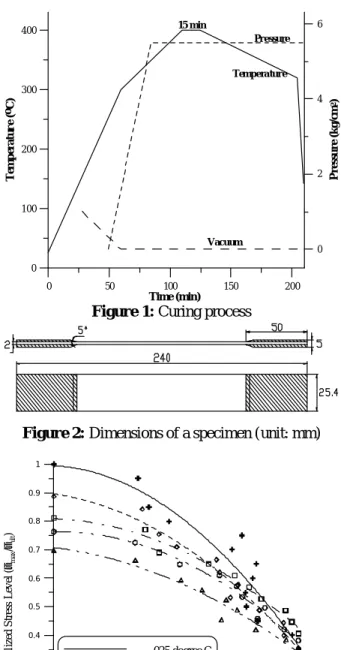
[12]. The modified diaphragm curing process was adopted as shown in Fig. 1 [8]. The APC-2 nanocomposite panels were cut into specimens with the dimensions as shown in Fig. 2.
An MTS-810 servohydraulic computer-controlled dynamic material testing machine was used to conduct the constant stress amplitude T-T cyclic testing with stress ratio = 0.1, frequency= 5 Hz, sinusoidal wave form under load-controlled mode at elevated temperatures, such as 25 oC (RT), 75, 100, 125, 150 oC (slightly above APC-2 Tg=143 oC) [10]. An MTS-651 hot chamber was also installed to keep and control the specific temperature of a specimen inside for cyclic testing. A 25.4-mm MTS-634.11F-25 extensometer was used to monitor the strain continuously during the fatigue tests.
RESULTS AND DISCUSSION
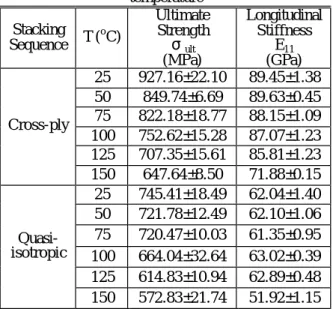
The mechanical properties, such as ultimate strength and longitudinal stiffness, of optimal nano-composite APC-2 cross-ply and quasi-isotropic laminates at elevated temperature were listed in Table 1 [12]. The fatigue data of stress vs. cycles of nanocomposite laminates at different temperatures were tabulated in Table 2 for both cross-ply and quasi-isotropic specimens. When the applied maximum stresses divided by ultimate strength at RT, the normalized S-N curves in nanocomposite laminates at elevated temperature were plotted in Fig. 3 for cross-ply specimens and in Fig. 4 for quasi-isotropic specimens, respectively. It is reasonable to see that the fatigue response decays as temperature increasing in both
lay-ups of nanocomposite laminates. That can be explained by the S-N curves shown from top to bottom as temperature increases from RT to 150 oC.
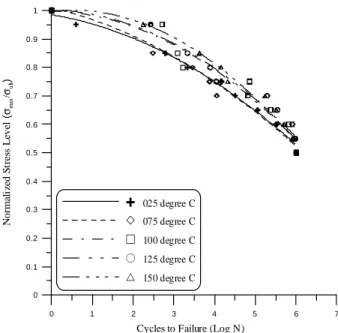
However, if the applied maximum stresses over ultimate strength at the corresponding temperature, the normalized S-N curves were illustrated in different way as shown in Fig. 5 for cross-ply laminates and Fig. 6 for quasi-isotropic laminates, respectively. It is a surprise to see that the sequence of normalized S-N curves was totally reverse. That means the resistance to fatigue failure of nanocomposite APC-2 laminates was significantly improved.
CONCLUSION
The APC-2 nanocomposite laminates, such as cross-ply and quasi-isotropic specimens, were fabricated optimally, and the cyclic tests at elevated temperature were performed systematically. The concluding remarks were summarized as follows.
1. The S-N curves were obtained and expressed from top to bottom as temperature increasing from RT to 150 oC.
2. The normalized S-N curves, divided by the corresponding ultimate strength at specific temperature, were almost reverse in sequence. 3. In addition to the increase of mechanical properties,
such as ultimate strength and longitudinal stiffness, the fatigue properties were also significantly improved.
4. The superior features of nanocomposite laminates were proved.
Acknowledgments
The authors gratefully acknowledge the sponsorship from National Science Council under the Project No. NSC 93-2218-E110-019.
References
[1] Hussain, M., Nakahira, A., Niihara, K., Mechanical Property Improvement of Carbon Fiber Reinforced Epoxy Composites by Al2O3 Filler Dispersion, Materials Letter, Vol. 26, No. 3, p. 185, 1996.
[2] Hussain, M., Niihara, K., Control of Water Absorption and Its Effect on Interlaminar Shear Strength of CFRC with Al2O3 Dispersion, Materials Science and Engineering, A, Vol. 272, p.
264, 1999.
[3] Kim, K. H., Study of Fiber/Matrix Interface in SiC Fiber Reinforced Calcium Aluminosilicate Matrix Composites, Ph. D. Dissertation, Stevens Institute of Technology, 1993.
[4] Lin, J., Synthesis and Phase Behavior Investigation of Inorganic Materials in Organic Polymer Solid Matrices, Ph. D. Dissertation, Department of Chemistry, The Pennsylvania State University, 1992.
[5] Wang, Q. H., Xue, Q. J., Liu, W. M., and Chen, J. M., The Friction and Wear Characteristics of Nanometer SiC and Polytetrafluoroethylene Filled Polyetheretherketone, Wear, Vol. 243, p. 140, 2000. [6] Qi, Z., Synthesis of Conducting Polymer Colloids,
Hollow nano-particles, and nanofibers, Ph. D.
Dissertation, Department of Chemistry, McGill
University, Canada, 1993.
[7] Li, T., Fabrication and Characterization of Nanometer-sized Metal and Semiconductor Particles and Nano-sized Composites. Ph. D.
Dissertation, Department of Materials Science
Engineering, University of Florida, 1996.
[8] Lee, C. -H., Jen, M. -H. R., Strength and Life in Thermoplastic Composite Laminates under Static and Fatigue loadings, Part 1:Experiment, Int. J. of
Fatigue, Vol. 20, No. 9, p. 605, 1998.
[9] Lee, C. -H., Jen, M. -H. R., Strength and Life in Thermoplastic Composite Laminates under Static and Fatigue loadings, Part II: Formulation, Int. J. of
Fatigue, Vol. 20, No. 9, p. 617, 1998.
[10] Lee, C. -H., Jen, M. -H. R., Fatigue Response and Modeling of Variable Stress Amplitude and Frequency in AS-4/PEEK Composite Laminates, Part 1: Experiments, J. of Composite Materials, Vol. 34, No. 11, p. 906, 2000.
[11] Lee, C. -H., Jen, M. -H. R., Fatigue Response and Modeling of Variable Stress Amplitude and Frequency in AS-4/PEEK Composite Laminates, Part 2: Analysis and Formulation, J. of Composite
Materials, Vol. 34, No. 11, p. 930, 2000.
[12] Jen, M. -H. R., Tseng, Y. -C., Wu, C. -H., Manufacturing and Mechanical Response of Nanocomposite Laminates, in Press, Composites
Science and Technology, Nov. 2004.
Table 1: Mechanical properties of optimal
nanocomposite APC-2 laminates at elevated temperature Stacking Sequence T ( o C) Ultimate Strength σult (MPa) Longitudinal Stiffness E11 (GPa) 25 927.16±22.10 89.45±1.38 50 849.74±6.69 89.63±0.45 75 822.18±18.77 88.15±1.09 100 752.62±15.28 87.07±1.23 125 707.35±15.61 85.81±1.23 Cross-ply 150 647.64±8.50 71.88±0.15 25 745.41±18.49 62.04±1.40 50 721.78±12.49 62.10±1.06 75 720.47±10.03 61.35±0.95 100 664.04±32.64 63.02±0.39 125 614.83±10.94 62.89±0.48 Quasi- isotropic 150 572.83±21.74 51.92±1.15 Notes: 1. APC-2 cross-ply laminates at RT.
σult = 835.96±6.50 MPa, E11 = 83.83±0.91 GPa.
2. APC-2 quasi-isotropic laminates at RT. σult = 662.73±4.91 MPa, E11 = 51.73±0.40 GPa.
Table 2: Data of stress vs. cycles in cross-ply and in
quasi-isotropic nanocomposite laminates at different temperatures
Cross-ply
T=25 oC Quasi-isotropic T=25 oC Stress
(MPa) Cycles Stress (MPa) Cycles 927.16 1 745.41 1 880.80 117 708.14 4 788.09 216 633.60 620 741.73 671 596.33 2134 695.37 41181 559.06 14606 649.01 23844 521.79 32141 602.65 92105 484.52 114673 556.30 75766 447.25 325701 509.94 50472 409.98 926896 463.58 54034 372.71 1000000 417.22 101167 - - 370.86 721438 - - 324.51 1000000 - - T=75 oC T=75 oC 822.18 1 720.47 1 781.07 149 684.45 273 698.85 379 612.40 308 657.74 1039 576.38 2859 616.64 9850 540.35 7531 575.53 11780 504.33 11276 534.42 32907 468.31 112306 493.31 21414 432.28 339948 452.20 111696 396.26 971489 411.09 434391 360.24 1000000 369.98 444820 - - 328.87 1000000 - - T=100 oC T=100 oC 752.62 1 664.04 1 714.99 176 630.84 513 639.73 387 564.43 1249 602.10 6391 531.23 1689 564.47 27328 498.03 71891 526.83 61361 464.83 66452 489.20 122409 431.63 238006 451.57 485634 398.42 661349 413.94 691379 365.22 924374 376.31 1000000 332.02 1000000 T=125 oC T=125 oC 707.35 1 614.83 1 671.98 99 584.09 269 601.25 1236 522.61 2145 565.88 11577 491.86 7823 530.51 30504 461.12 11026 495.15 42149 430.38 194988 459.78 151173 399.64 346369 424.41 100405 368.9 806872 389.04 444123 338.16 956413 353.68 1000000 307.42 1000000 T=150 oC T=150 oC 647.64 1 572.83 1 615.26 100 544.19 177 550.49 1310 486.91 4269 518.11 4347 458.26 14415 485.73 16860 429.62 21035 453.35 31826 400.98 172267 420.97 12968 372.34 330252 388.58 91028 343.7 506135 356.20 502807 315.06 802232 323.82 1000000 286.42 1000000 0 50 100 150 200 Time (min) 0 100 200 300 400 T em p er a tu r e (o C ) 0 2 4 6 P re ss u re ( k g /c m 2) 15 min Pressure Temperature Vacuum
Figure 1: Curing process
Figure 2: Dimensions of a specimen (unit: mm)
0 1 2 3 4 5 6 7
Cycles to Failure (Log N)
0 0.1 0.2 0.3 0.4 0.5 0.6 0.7 0.8 0.9 1 N o rm al iz ed S tr es s L ev el ( σmax / σult ) " 025 degree C $ 075 degree C ( 100 degree C + 125 degree C . 150 degree C
Figure 3: Normalized S-N curves by ultimate strength
at RT in cross-ply nanocomposite laminates at elevated temperature.
0 1 2 3 4 5 6 7
Cycles to Failure (Log N)
0 0.1 0.2 0.3 0.4 0.5 0.6 0.7 0.8 0.9 1 N o rm al iz ed S tr es s L ev el ( σmax /σu lt ) " 025 degree C $ 075 degree C ( 100 degree C + 125 degree C . 150 degree C
Figure 4: Normalized S-N curves by ultimate strength
at RT in quasi-isotropic nanocomposite laminates at elevated temperature.
0 1 2 3 4 5 6 7
Cycles to Failure (Log N)
0 0.1 0.2 0.3 0.4 0.5 0.6 0.7 0.8 0.9 1 N o rm al iz ed S tr es s L ev el ( σmax /σult ) " 025 degree C $ 075 degree C ( 100 degree C + 125 degree C . 150 degree C
Figure 5: Normalized S-N curves in cross-ply
nanocomposite laminates at elevated temperature
0 1 2 3 4 5 6 7
Cycles to Failure (Log N)
0 0.1 0.2 0.3 0.4 0.5 0.6 0.7 0.8 0.9 1 N o rm al iz ed S tr es s L ev el ( σmax /σu lt ) " 025 degree C $ 075 degree C ( 100 degree C + 125 degree C . 150 degree C
Figure 6: Normalized S-N curves in quasi-isotropic