犯罪與經濟誘因: 以美國州資料 1970-2000 為例
研究成果報告(精簡版)
計 畫 類 別 : 個別型 計 畫 編 號 : NSC 95-2415-H-002-019- 執 行 期 間 : 95 年 08 月 01 日至 96 年 07 月 31 日 執 行 單 位 : 國立臺灣大學經濟學系暨研究所 計 畫 主 持 人 : 林明仁 計畫參與人員: 學士級-專任助理:游嵐婷 處 理 方 式 : 本計畫可公開查詢中 華 民 國 96 年 09 月 14 日
Does Unemployment Increase Crime? Evidence from
1974-2000 US State Data
Ming-Jen Lin
*Abstract
OLS may understate the effect of unemployment on crime because of the endogeneity problem (Raphael and Winter-Ember 2001). In this paper, we use changes in the real exchange rate, state manufacturing sector percentage and state union membership rates as novel instrumental variables to carry out 2SLS estimations. We find a 1 percentage point increase in unemployment would increase property crime by 1.8 percent under the OLS method, but that the elasticity goes up to 4 percent under 2SLS. The larger 2SLS effect has significant policy implications since it explains 30 percent of the property crime change during the 1990s.
Keywords: Crime; Unemployment; Instrumental variables; Real exchange rate.
JEL Code: K4.
* Ming-Jen Lin is an associate professor at the Department of Economics, National Taiwan University. The
author thanks Steven Levitt, David Mustard, Tom Miles, Mark Duggan, and two anonymous referees for their help comments. Financial support from National Science Council, Taiwan is greatly acknowledged. The data used in this article can be obtained beginning August 2007 through July 2010 from Ming-Jen Lin, Department of Economics, National Taiwan University, [email protected].
I. Introduction
Crime imposes enormous economic costs on society,1 with unemployment also being thought to have an important role to play in the supply function of crime.2 The coincidence between the longest economic expansion since World War II and the overall reduction in crime rates in
the 1990s seems to confirm this argument. Between 1991 and 2000, there was a significant
fall in the annual unemployment rate in the US, from 6.8 percent to 4.8 percent. Furthermore,
as noted by Levitt (2004), according to calculations based upon the ‘Uniform Crime Report’
(UCR), over the same period, there were considerable reductions in acts of murder (-42.9
percent), violent crime (-33.6 percent) and property crime (-28.8 percent). Such a strong
correlation provides policymakers with confirmation that reducing the level of unemployment
is one of the most effective ways of fighting crime.
Economists typically conclude that unemployment (or a decline in labor market
conditions) can lead to an increase in crime, because the worsening opportunities in the legal
employment sectors make committing crime more attractive (Becker 1968). And such
propensity is expected to have more relevance to property crime because of its pecuniary
nature (Levitt 2004). In terms of empirical evidence, recent studies reach consensus that
unemployment does have a positive, significant, but only small effect on property crime, and
unemployment increases property crime by 1.0 to 2.0 percent (Freeman 1995; Bushway and
Reuter 2002; Levitt 2004). This trend is seen more clearly when, as opposed to the average
unemployment rate, better measures are used to identify those who are on the margin of
committing crime.3
This paper contributes to the existing knowledge in this area by providing a better means
of identifying the causal link between labor market conditions and crime. We focus on
breaking down the endogeneity between unemployment and crime, and on how the policy
implications of the magnitude of the 2SLS estimations differ from those in the prior literature
obtained under OLS estimations. Adopting US state panel data, we use changes in the
exchange rate, state union membership percentage and state manufacturing percentage as
novel instrumental variables in unemployment, and find that although a 1.0 percentage point
increase in unemployment would increase property crime by 1.8 percent under OLS
estimation, this elasticity goes up to between 4.0 and 6.0 percent under the 2SLS method. We
also confirm that unemployment has no significant effect on violent crime.
Our results contribute to the existing literature in three ways. First of all, and quite
surprisingly, although the more recent studies have shown that changes in labor market
conditions can affect property crime with regard to those who are more likely to be on the
Levitt (2001), when using panel data, the instrumental variable approach is a preferable means
of identifying the link between crime and unemployment, since simultaneity, omitted
variables and measurement error can all lead to bias in the OLS results. To the best of our
knowledge, only Raphael and Winter-Ember (2001) and Gould, Weinberg, and Mustard (2002)
attempt to explore the instrumental variable (IV) method, although the measures they obtained
are quite different.5
Given that our 2SLS estimates are twice the size of the OLS estimates, this also confirms
the suspicions of Raphael and Winter-Ember (2001), that the available evidence understates
the effects of unemployment on crime.6 The 2SLS results obtained in this study consequently contribute to the literature by better controlling for endogeneity, and thereby providing more
precise estimations than those reported in the prior literature.
Secondly, the magnitude of our 2SLS estimations also points to very different policy
implications than may have previously been considered. As opposed to the traditional results of
1.0 to 2.0 percent under the OLS method, there is a two- to three-fold increase in the 2SLS
estimates of the effect of unemployment on property crime, rising to about 4.0-6.0 percent. This
indicates that the 2 percentage point reduction in unemployment in the 1990s would reduce
property crime by between 8.0 and 12.0 percent. This would also explain about 33 percent of the
effect of the legalization of abortion (Levitt and Donohue 2001). However, if, as suggested in the
prior OLS literature, elasticity is only 1.0-2.0 percent, then unemployment may have only a minor
role to play, if any role at all, in the reduction in crime in the 1990s (Levitt 2004).
Finally, although the recent literature shows that average unemployment may not be an
appropriate measure – in terms of identifying those who are at the financial margins of
committing crime – our results show that such a positive effect can still be identified if
endogeneity is properly controlled. This may be because the variations picked up in the
present study through the IV method are for those people working in manufacturing who are
thus more likely to be substituted by foreign competition. 8 Our study adds support to the growing opinion within the literature that, when better measures are obtained, there is
increasing evidence of labor market conditions affecting crime.
The remainder of this paper is organized as follows. Section 2 reviews the extant literature,
followed in Section 3 by a description of the data and a discussion of the identification problem.
The empirical results are presented in Section 4, where we justify the use of the instruments by
building up a causal link between exchange rate fluctuations, union membership and
unemployment. We then undertake a comparison of the 2SLS and OLS results in Section 5, and
Section 6 concludes.
The theoretical approach to the ways in which economic incentives affect criminal behavior
can be seen in Becker (1968), Ehrlich (1973) and various later works. When unemployment,
the opportunity cost of committing a crime, namely, the legal wage, declined, which makes
illegal income more appealing. A graphic version of this argument can also be seen in
Grogger (2000) and Raphael and Winter-Ember (2001). This prediction is also likely to be
more relevant for property crime which leads to direct financial gain (Levitt 2004).
As to the empirical evidence, the early studies on the positive effect of unemployment on
crime are described as ‘inconsistent, insignificant and weak’ (Chiricos 1987). Furthermore,
there is surprisingly little evidence to support the proposition that crime rates are driven by
economic conditions (Piehl 1998); this has, however, changed over the past ten years, with the
more recent articles consistently reporting the positive, significant and small effects of
unemployment on property crime, but not on violent crime.
Using the OLS method and US panel data on states, counties and cities, a number of
studies find that a 1 percentage point increase in the unemployment rate increases property
crime by just 1.0 to 2.0 percent.9 Using time series data on New York City, Corman and Mocan (2005) finds that elasticity was about 1.8-2.2 percent for only burglary and motor theft,
while Papps and Winkelmann (2002) also finds the elasticity of unemployment on property
Spengler (2000) calculates that the elasticity of unemployment on total crime in Germany is
around just 0.5 percent.10
Such significant changes can be attributed to three factors. Firstly, the recent studies are
better at identifying the more relevant variables, since the average unemployment or wage
measures may not be appropriate, in terms of identifying those on the margin of committing
crime. From their focus on young, unskilled and low-educated males, Gould, Weinberg, and
Mustard (2002) finds that a 1.0 percentage point increases in the unemployment rate of this
‘at-risk’ group would increase property crime by only 1.0 to 2.0 percent. Machin and Meghir
(2004) also found strong evidence to support the effect on crime from conditions in the
low-wage labor market.11 The second factor for consideration is recognition of the need for controlling the potential problems caused by endogeneity; however, to the best of our
knowledge, only Raphael and Winter-Ember (2001) and Gould, Weinberg, and Mustard (2002)
make such attempts by using 2SLS. The third factor is that we are now at a much better stage
in terms of extensively controlling for the independent variables, as well as in the usage of
panel data, given that the periods under examination are now much longer.
The overall picture from the above literature and many of the survey articles is that
unemployment has a small, positive and significant effect (of about 1.0 to 2.0 percent) on
which does not control for endogeneity. In the only two studies which adopt the use of
instrumental variables, the magnitude of the effects obtained, and hence the policy
implications, are very different.12
This research therefore sets out to add to the literature by using a set of novel instruments
as the means of solving the rarely-discussed problem of endogeneity, and by discussing the
differences in the estimations, as well as their impact on crime policy.
III. The Data and the Problem of Identification III-A. The Data
The data used in this paper comprise of a panel of 49 US states with observations covering the
period from 1974 to 2000.13 Following Levitt (1996), seven crime categories from the UCR are included. These are: murder, rape, assault and robbery, collectively referred to as ‘violent
crime’, and burglary, larceny and auto theft, collectively referred to as ‘property crime’. The
overall numbers of local and state police forces are also listed in the UCR.
The total number of prisoners and details on the use of the death penalty are obtained
from the Criminal Justice Statistics Source Book produced by the Bureau of Justice, while the
figures for the total consumption of ethanol per person are taken from the website of the
economic incentive variables, which include state income per capita, hourly wages,
unemployment rates, state public aid, health and education expenditure, the proportions of
metropolitan and African-Americans, poverty levels, age structure and the AFDC (TANF) per
recipient family per year, are taken from various issues of the Statistical Abstract of the
United States.
As to the instrumental variables, the real exchange rates are taken from the historical data
archives at the Federal Reserve Bank of New York, and the oil price series can be found in the
Annual Energy Review published by the Department of Energy within the US Central
Government. The percentages of employees in manufacturing, manufacturing value and union
membership are also taken from various issues of the Statistical Abstract of the United States.
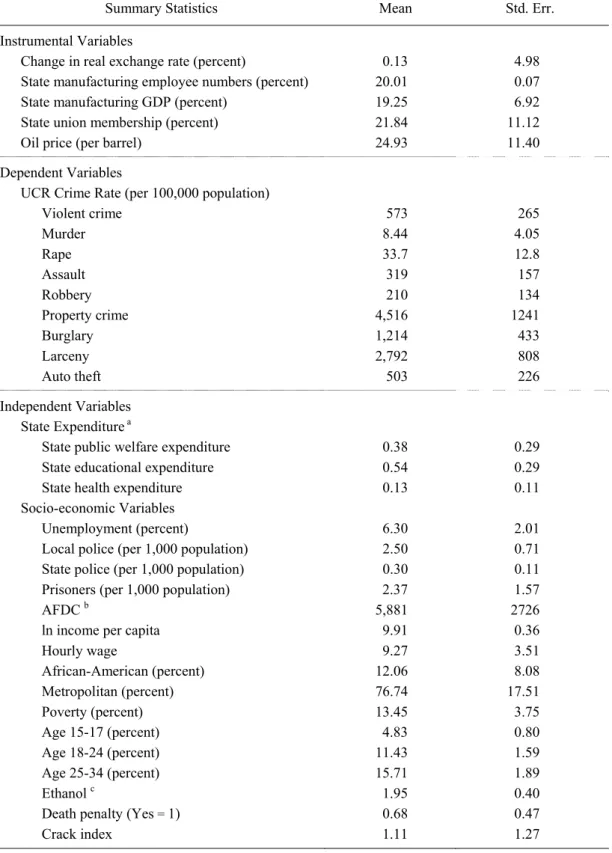
The summary statistics provided in Table 1 show that between 1974 and 2000, there
were approximately 5,000 crimes committed each year for every 100,000 persons in the US,
albeit relatively minor property crimes in the great majority of cases. The table also shows that
there were approximately 237 prisoners, 250 local police and 30 state police per 100,000 of
the population. The average state expenditure per capita per year was $380 on public welfare,
$540 on education and $130 on health, while the average hourly wage was $9.76.
Approximately 76 percent of the population lived in urban areas, with African-Americans
<Table 1 is inserted about here>
As to the key variables, the average unemployment rate was 6.30 percent and the price of
oil was $24.93 per barrel. The manufacturing sector accounted, on average, for 20.01 percent
of state total employees and 19.25 percent of all state GDP, with 21.8 percent of the workers
holding union membership at state level.
III-B. The Problem of Identification
In general, there are three factors which can explain bias in the OLS results, the first of which
is the problem of omitted variables. If, for example, any pro-cyclical crime-related commodity
consumption is omitted, then the OLS method would underestimate the true effects (Raphael
and Winter-Ember 2001).14 Cook and Zarkin (1985) suggests that legitimate employment
opportunities, criminal opportunities, crime-related commodities and the responses by the
criminal justice system are all important variables in the crime supply function. In this paper,
we use unemployment rates, state income per capita, hourly wages and poverty rates as
independent variables to represent the economic incentive factors. Special attention should be
paid to hourly wage and poverty rates, since wages and the economic conditions of lower
percentile workers are very important to the determination of crime (Grogger 1998; Gould,
Other control variables include state education, public aid and health expenditure
(government spending), prisoner and police numbers,16 the death penalty (deterrence), alcohol (crime-related goods), age structure and metropolitan percentages. To further control for
unobserved variables that do not follow a specific trend or that do not change overtime, we
add in state, year and state-specific linear and quadratic trends as control variables to fully
explore the advantages of our state panel data.17 Although it is not possible to prove that all the relevant independent variables have been included in the specifications, our main
conclusions hold, both with and without state trend dummies, and also remain insensitive to
the inclusion or exclusion of particular control variables.
The second possible explanation for bias in OLS estimations is the problem of
simultaneity between crime and unemployment. The overall effect of unemployment may be
underestimated under OLS if criminal activity reduces the employability of offenders
(Raphael and Winter-Ember 2001) or if crime increases unemployment as a result of the flight
of employers (Cullen and Levitt 1999). The third explanation is that the OLS method would
underestimate the effect if there is random measurement error in unemployment.
Overall, as noted by Raphael and Winter-Ember (2001), omitted variables and
simultaneity lead to some suspicion that the available evidence understates the effect of
unemployment on property crime being both positive and consistently larger than the OLS
estimates, and indeed, this is the major finding in our empirical results section.
IV. Empirical Results
IV-A. OLS Regression Results
In the first instance, we report the OLS results as a reference point under the following
specifications:
ln (Crime ijt) = ρUnemployment it + βXit + φi
(1)
+ Year t + φi*Year t + φi*Year t2
+ξijt
where the dependent variables are different crime rates, j indicates the crime category, i is
state, t is year, Xit represents all the independent variables outlined earlier in Table 1, φi and
Year t represent state and year dummies, and the final two terms are state specific linear and
quadratic linear trends.
For each crime category, we present three different specifications by gradually adding in
linear and quadratic linear trends. The results are presented in Table 2.
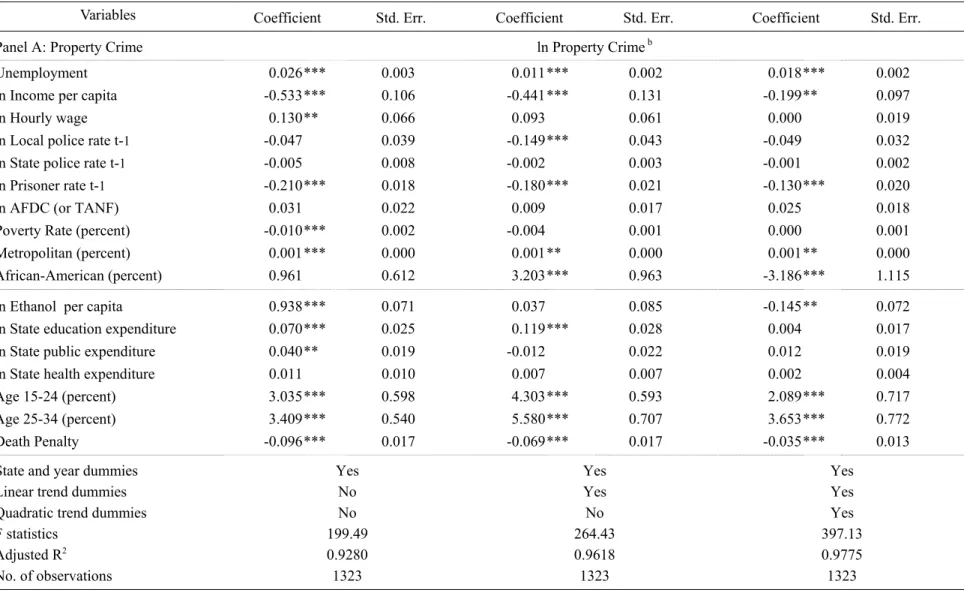
<Table 2 is inserted about here>
are positive and significant at the 99 percent level. When state and year dummies and other
independent variables are added, the elasticity is 0.026, or 2.6 percent. After adding in the
linear and quadratic linear trends, the respective estimates become 1.1 percent and 1.8
percent. It is clear, therefore, that unemployment has a positive and significant, but
relatively small, effect on property crime. However, its effects on violent crime are
insignificant since economic incentives often play a much smaller role in violent crime
vis-à-vis property crime.
Alcohol consumption is positively related to violent crime, and we also find that more
prisoners, more police, higher per capita income, the death penalty and fewer young people all
result in crime reduction. Overall, the standard specification shows that a 1.0 percentage point
increase in unemployment can increase property crime by around 1.1 to 1.8 percent, although
it has no significant impact on violent crime. This result is similar to those reported in the
prior literature.
IV-B. Instrumental Variables and the First Stage Results
As noted earlier, the OLS results may contain bias stemming from omitted variables,
simultaneity or simple measurement error. To obtain a consistent estimator, we need to find an
two conditions for a valid IV are relevance, namely Cov (Z, Unemployment)≠0, and
exogeneity, Cov (Z, μ)=0. According to Levitt (1997) and Angrist and Krueger (2001), the
three criteria that must be met are: (i) detailed knowledge of the economic mechanisms and
institutions for the instrumental variables selected; (ii) an over-identification test if there are
more IVs than endogenous variables; and (iii) a weak IV test.
In this paper, we use the changes in the real exchange rate between adjacent years,
RERCt = 1 -t 1 t RER RER
RER − t− , multiplied by the percentage of state manufacturing sector
employees or GDP value (that is, RERCit=RERCt*Manufacturing percentit) to instrument
unemployment. It should be noted that the real exchange rate (RER) is calculated by the
average foreign exchange rates of all trade partners weighted by trade volume. By weighting
the manufacturing employee percentage, we can measure the specific RERC shock (dollar
appreciation or depreciation) to which each state is exposed in any given year. This is the
strategy adopted by Raphael and Winter-Ember (2001), in which oil costs are used as the
instrumental variable.
The effects of exchange rate movement and unemployment, particularly in the
manufacturing sector, are well documented in the prior literature. As argued by Revenga
(1992), the link between dollar appreciation and industry employment is ‘straightforward’,
tend to shift employment in the same direction. In theory, currency appreciation can affect the
domestic labor market by altering profit (Sheets, 1992; Clarida 1997), investment (Campa and
Goldberg 1999) or production location (Goldberg 1993). As to the prior empirical estimations,
Branson and Love (1988) finds that the US manufacturing sector lost over one million jobs as
a direct result of the 1981-1985 appreciation of the US dollar.
Using industry level manufacturing sector data covering the period between 1977 and
1987, Revenga (1992) finds that import prices appeared to have a sizable effect on
employment. A number of other studies also reports that most of the adjustments to an adverse
trade shock came through employment.18 In addition, since exchange rate equilibrium is determined in the global money market, although the US is a relatively large economy within
that market, it is unlikely that any state-specific unemployment rate change (the variation used
in our 2SLS estimations) would affect overall US exchange rates.
Furthermore, using macro-level variables as instruments for micro-level decisions is not
uncommon within the literature (see for example, Evans and Ringel 1999; Currie and Moretti
2003); however, there is a need to take into account whether exchange rates are correlated
with certain omitted variables which may affect crime, but which may not have been
controlled within the regression. To mitigate this issue, we control for the economic variables
each of which may be correlated with exchange rate shocks, and which may also affect crime
rates. We also include state, year and trend dummy variables to identify those variables that
are not included in the independent variables. Of course, the list cannot be exhaustive, and we
acknowledge the possible pitfall in our analysis here.
In addition to using the percentage of state employees and the percentage of GDP
accounted for by the manufacturing sector, we also use the percentage of state union
membership as our weighting for real exchange rate movements. As noted by Freeman and
Medoff (1984), unions are simply “organizations [that] have monopoly power which they can
use to raise wages above competitive levels”. As a consequence, an excess supply of labor is
created due to the deviation from the competitive market equilibrium, resulting in
unemployment.19
We have so far introduced three weighting methods, the percentage of state
manufacturing sector employees, the percentage of state manufacturing sector GDP and the
percentage of state union membership, as the real exchange rate change variables. We also
add in oil price (weighted by these three variables) as the instrumental variables for
comparison with Raphael and Winter-Ember (2001). The justification for the impact of oil
shocks on unemployment can be seen in Davis and Haltiwanger (1999), in which they
We can now begin our 2SLS analysis. In the first stage we run:
Unemployment it = σIVit + βXit + φi + Year t
(2)
+ φi*Year t + φi*Year t2
+ ξit
where Xit refers to all of the state expenditure and social economic variables used in equation (1).
Our instrumental variables are the two macroeconomic variables weighted by the three different
procedures: (i) RERC*state manufacturing sector employee percent; (ii) RERC * state
manufacturing sector GDP percent; (iii) RERC * state union membership percent; (iv) Oil price *
state manufacturing sector employees percent; (v) Oil price * state manufacturing sector GDP
percent; and (vi) Oil price * state union membership percent. Once the first stage results are
obtained, the predicted value of unemployment will replace the observed unemployment rates in
stage 2, namely, Equation (3):
ln (Crimeijt) = ρUnemployment it + βXit + φi + Year t
(3) + φi*Year t +φi*Year t2 +ξijt
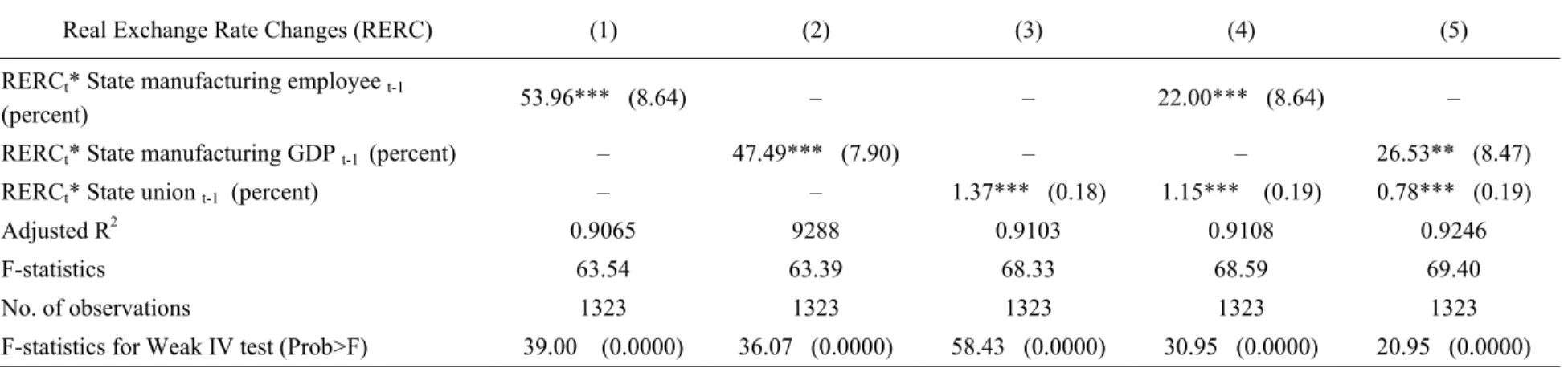
Table 3 presents the first stage results using real exchange rate movements. The positive
and highly significant coefficient estimates indicate that dollar appreciation, along with
manufacturing and union membership percentages, are positively correlated with the
<Table 3 is inserted about here>
By carrying out a simple calculation, we can determine whether our estimation results
are comparable with those of the earlier studies. We know that from 1980-1985, there was
appreciation of about 33 percent in the real exchange rate, and, as column (1) of Table 3
indicates, the coefficient estimate of RERCt*manufacturing employee t-1 percent is 54, which
means that the unemployment rate increase due to this appreciation would be 55*0.33 (dollar
appreciation)* 0.2(mean of manufacturing employee percent)=3.63 percent, or roughly four
million unemployed people. This number is similar to the 4.0-7.5 percent unemployment
estimated by Revenga (1992).
We also use state manufacturing percentage (GDP or employee numbers) plus union
membership as a set of instrumental variables for the first stage when subsequently carrying
out the over-identification test, with both the sign and significance of the coefficient estimates
all fitting our prediction. Furthermore, as argued by Bound, Jaeger, and Baker (1995), Staiger
and Stock (1997) and Stock and Yogo (2004), the first stage joint F test value should be large
enough to pass the weak IV tests. Table 3 shows that the F-statistics for the null hypothesis,
namely that all of the coefficient estimates of the instrumental variables in the first stage
regression are not jointly different from zero, range from 21 to 58, significantly larger than the
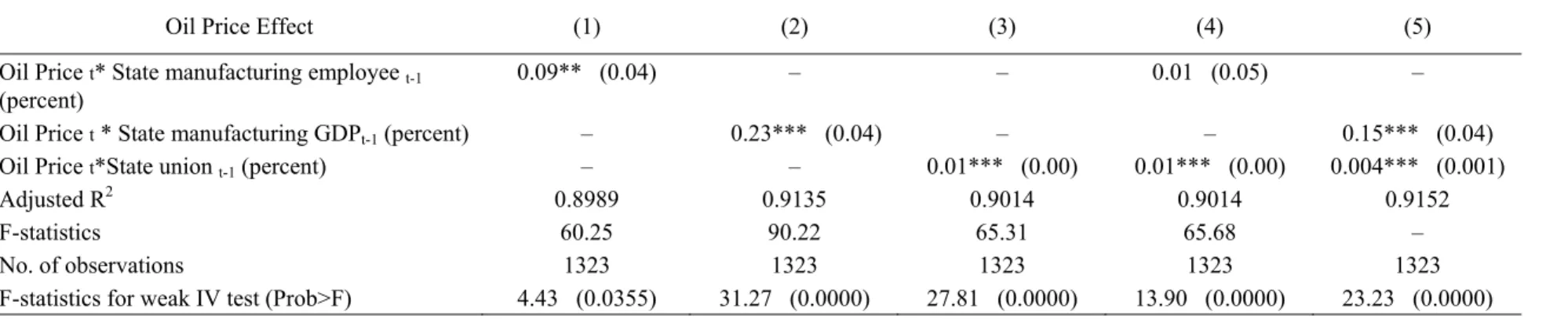
For the purpose of comparison, oil prices weighted by the three different methods are
also used as instrumental variables. It should be noted that we do not put oil price and
exchange rate together because these two variables have high collinearity. The procedure is
the same as that in Table 3. The results, which are presented in Table 4, indicate that oil price
shocks weighted by manufacturing or union percentages lead to an increase in the
unemployment rate; the weak IV test is also passed, with the single exception of column (1).
<Table 4 is inserted about here>
IV-C. 2SLS Regression Results
The final step in the 2SLS regression is to enter the predicted value of the unemployment rates
obtained from Equation (2) into our second stage regression, namely Equation (3). We first
use ‘Real exchange rate change * state manufacturing employees percent’ to perform a single
IV 2SLS regression. To test the sensitivity of the model specifications, we report the
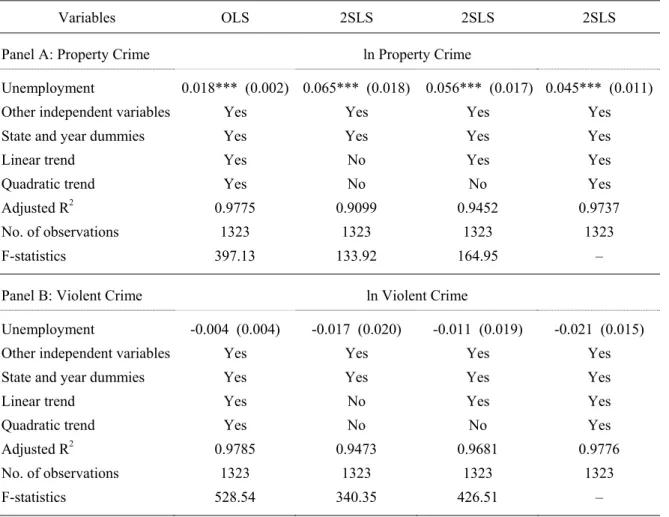
regression results by gradually adding in the state specific linear trend and quadratic trend
dummy variables. The results are reported in Table 5.
<Table 5 is inserted about here>
As we can see, the OLS estimation of the elasticity of unemployment on property crime
range between 4.4 and 6.5 percent, consistently greater than the OLS results, and dependent
on whether or not state specific linear or quadratic trends are included. Unemployment
appears to have no significant effect on violent crime, in both the OLS and 2SLS estimations.
To further investigate this issue, we first use the six instrumental variables to obtain the
first stage prediction value of unemployment. We then use all seven UCR crime categories
(murder, rape, assault, robbery, burglary, larceny and auto theft) as the dependent variables to
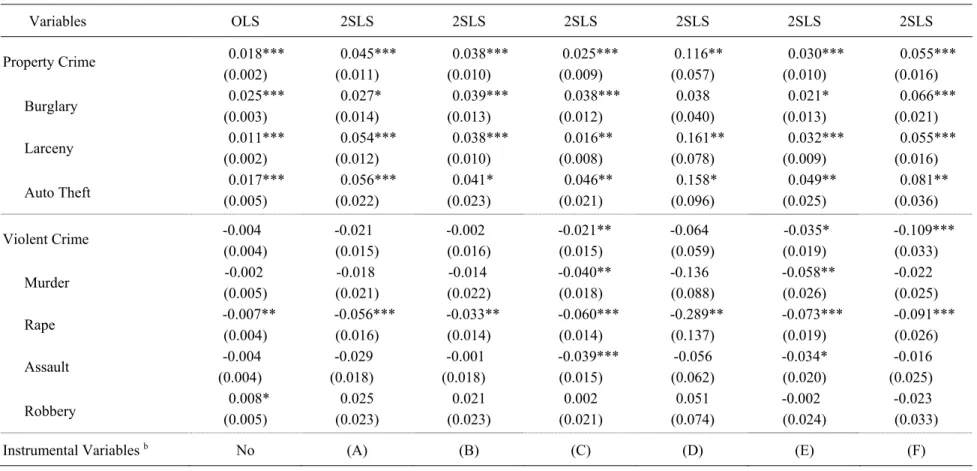
perform a single IV 2SLS regression using the full model specifications of Equation (3). The
results are presented in Table 6.
<Table 6 is inserted about here>
It is clear that for property crime, the 2SLS estimations of unemployment elasticity for
the six different single instrumental variables range between 2.5 and 5.5 percent, much greater
than the OLS estimation (1.6 percent). Furthermore, the ranges of the respective 2SLS results
for the property crime category (burglary, larceny and auto theft) were 2.1-6.6 percent, 1.6-5.4
percent and 4.1-15.8 percent. These are consistently greater than the OLS results (2.5 percent,
1.1 percent and 1.7 percent). The unemployment effect on violence is also insignificant,
except for its negative relationship with rape (strong) and murder (much weaker).
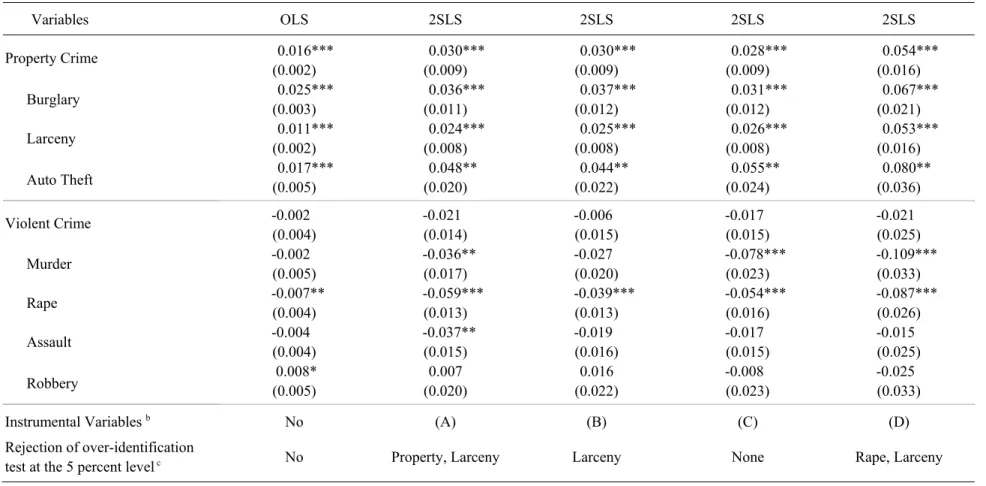
perform an over-identification test. This can be carried out by regressing the predicted residuals
of the 2SLS on all of the exogenous and instrumental variables, and then calculating the χ2 value
of n (the number of observations) x R2. The results presented in Table 7 show that, with the
exception of larceny, all of the crime categories pass the over-identification test, with most of
the statistics being less than 2. This indicates that the 2SLS method remains insensitive to the
instrumental variables chosen.
<Table 7 is inserted about here>
As to the estimation of unemployment elasticity, it is also clear that the 2SLS method
produces 2.9-5.4 percent for property crime, 3.0-6.7 percent for burglary, 2.5-5.0 percent for
larceny and 4.7-8.0 percent for auto theft. Again the effects of unemployment on violent crime
are unclear, with the exception of the negative effects for both rape and murder. These
numbers are similar to the single IV results presented in Table 6, and also similar to those
reported by Raphael and Winter-Ember (2001).
So far, we show a greater effect of unemployment on property crime under the 2SLS
method than under the OLS method. However, we can find no significant effect of
unemployment on violent crime. Our results also pass the first stage weak IV test and the
however, several issues in need of further attention; these are discussed in the following
section.
V. Discussion
The first issue of importance is the negative sign of unemployment on violent crime, although
some of them are insignificant. In some model specifications, unemployment also has a
significant negative effect on murder (weak) and rape (very strong). Although unemployment
can basically increase property crime, the negative correlation between unemployment and
violent crime is not immediately obvious from the theory. Furthermore, the positive effect of
unemployment on robbery is also generally weak, which is somewhat strange, since the
motivation for committing robbery, namely, economic gain, is similar to that for property
crime. We offer two alternatives for reconciliation of this point.
Firstly, the overall unemployment rate may not be capable of identifying those people
who are on the margin of committing a particular crime, even after controlling for
endogeneity. For example, since almost all rape offenders are male, the gender specific
unemployment rate should be a better measurement than the overall unemployment rate.
Indeed, Raphael and Winter-Ember (2001) shows that while overall unemployment has a
when the male unemployment rate is used.
Secondly, as pointed out by Raphael and Winter-Ember (2001), the failure to control for
crime-related commodity variables, such as alcohol, guns and drugs, each of which
demonstrate pro-cyclical pressure, can lead to underestimation of the true effects of
unemployment. Levitt (2004) also argued that since most crime-related commodities, such as
alcohol and cocaine, were normal goods, improvements in economic conditions can have a
negative impact on crime. It is likely that the reason we obtain a negative unemployment
effect on violent crime is because we do not control variables which are pro-cyclical and have
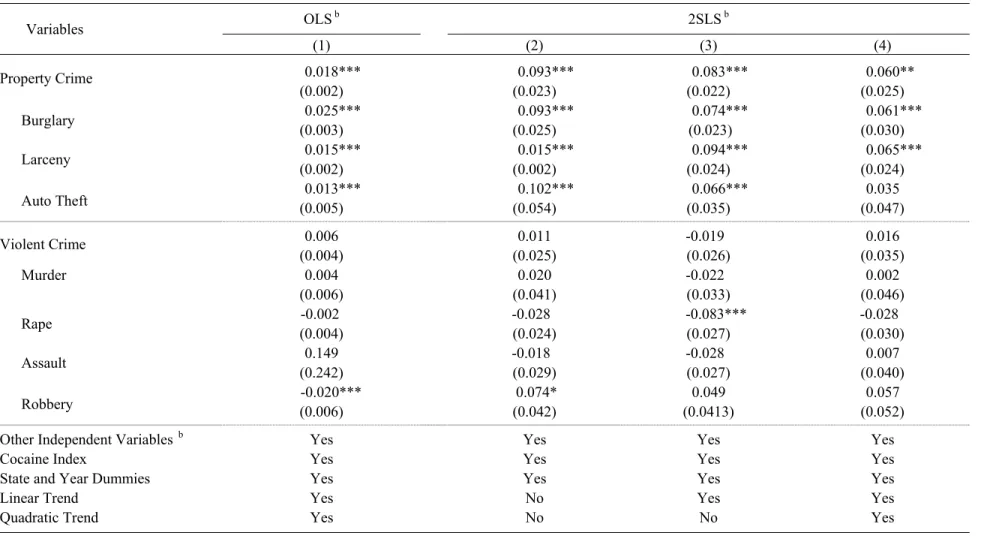
particularly profound effects on violent behavior; cocaine appears to be one of them.20 To explore this point further, we include the ‘state crack cocaine index’ calculated by
Fryer et al. (2005) – which includes data from 1980 to 2000 only – as a control variable into
all of our OLS and 2SLS regressions. The process is essentially the same as those outlined in
Equations (2) and (3). The results presented in Table 8 show that when adding in the crack
index and using data from 1980 to 2000, the effect of unemployment on violent crime
(including both murder and robbery) becomes positive (although not significant). Furthermore,
the estimates of unemployment on robbery are about 5.0 to 7.0 percent under the 2SLS
method, which is similar to the effect on property crime. This shows when a proper measure
violent crime becomes positive, small and insignificant. Nevertheless, the positive, significant,
and larger estimates of unemployment on property crime under the 2SLS method remain.
<Table 8 is inserted about here>
Finally, we also attempt to introduce as many combinations of the independent variables
as possible, and find that the results are not at all sensitive to the inclusion or exclusion of any
particular controls; that is, unemployment has a significantly positive effect on property crime,
with the magnitude of the effect larger under the 2SLS methods. Nevertheless, one might
suspect that it may be the employment conditions among certain particular demographic
groups that drive our results. This direction may well be worthy of further investigation if
more detailed data were to become available.21
IV. Conclusions
Obtaining a precise measure of the impact of unemployment on crime is very important,
insofar as it facilitates a cost benefit analysis for the assessment of possible public policy
interventions. Although economic theories predict that unemployment should have a positive
effect on property crime, most of the prior literature has reported that a 1.0 percentage point
increase in the unemployment rate is associated with a 1.0 percent increase in property crime,
method, which does not control for endogeneity.
In this paper, we begin with a discussion of the ways in which the problems of omitted
variables and simultaneity can lead to bias in the OSL estimations. We control for an
extensive set of independent variables, including deterrence, economic conditions,
demographics, year and state dummies, and state-specific linear and quadratic trends, so as to
mitigate the problem of omitted variables. We then use a set of novel instrumental variables,
namely changes in the real exchange rate, state union membership percentage, oil price and
state manufacturing employee percentages to mitigate the problem of simultaneity.
Our first stage regression shows that appreciation in the US dollar and in oil prices,
together with union membership and manufacturing employee percentages, have a strong
positive effect on unemployment. Furthermore, the results of the first stage easily pass the
weak IV test. In the second stage analysis, we show that the 2SLS estimation of the elasticity
of unemployment on property crime is 4.0 to 6.0 percent for the full model specifications, as
compared to the 1.8 percent obtained under the OLS method. The fact that the 2SLS results
are consistently greater than those obtained under the OLS method indicates that the two
major sources of bias stemming from the OLS method are the positive response of
unemployment to the problem of crime, and the omitted variables which cause crime, but
As for violent crime, there is no apparent significant effect attributable to unemployment,
in either the OLS or 2SLS estimations. We also use the over-identification test in an attempt
to reveal the sensitivity of the choice of instrumental variables; however, with the single
exception of larceny, all of the 2SLS results hold. Finally, our results remain insensitive to
both the different model specifications and the choice of independent variables.
The 4.0 to 6.0 percent estimates obtained in this study on the effect of unemployment on
property crime have important policy implications, since they indicate that roughly one-third
of the reduction in property crime during the 1990s may have been attributable to changes in
unemployment, a conclusion that is very different to those drawn in much of the prior
References
Anderson, David. 1999. “The Aggregate Burden of Crime.” Journal of Law and Economics
42(2): 611-42.
Angrist, Joshua, and Alan Krueger. 2001. “Instrumental Variables and the Search for
Identification: From Supply and Demand to Natural Experiment.” Journal of Economic
Perspective 15(4): 69-85.
Becker, Gary. 1968. “Crime and Punishment: An Economic Approach.” Journal of Political
Economy 76(2): 169–217.
Belman, Dale, and Thea Lee. 1995. “International Trade and the Performance of US Labor
Markets.” In US Trade Policy and Global Growth, ed. Robert Blecker, 61-107. Armonk,
New York: ME Sharpe.
Blumstein, Alfred, and Richard Rosenfeld. 1998. “Explaining Recent Trends in US Homicide
Rates.” Journal of Criminal Law and Criminology 88(1): 1175-216.
Branson, William, and James Love. 1988. “United States Manufacturing and the Real
Exchange Rate.” In Misalignment of Exchange Rates: Effects on Trade and Industry, ed.
Bound, John, David Jaeger, and Regina Baker. 1995. “Problems with Instrumental Variables
Estimation when the Correlation between the Instruments and the Endogenous
Explanatory Variable is Weak.” Journal of the American Statistical Association 90(430):
443-50.
Burgess, Simon, and Michael Knetter. 1998. “An International Comparison of Employment
Adjustment to Exchange Rate Fluctuations.” Review of International Economics 6(1):
151-63.
Bushway, Shawn, and Peter Reuter. 2002. “Labor Market and Crime.” In Crime: Public
Policies for Crime Control, James Wilson, and Joan Petersilia, eds. San Francisco, CA: ICS Press.
Campa, Jose, and Linda Goldberg. 1999. “Investment, Pass-through and Exchange Rates: A
Cross-Country Comparison.” International Economic Review 40(2): 287-314.
__________. 2001. “Employment versus Wage Adjustment and the US Dollar.” Review of
Economics and Statistics 83(3): 477-89.
Chiricos, Theodore. 1987. “Rates of Crime and Unemployment: An Analysis of Aggregate
Clarida, Richard. 1997. “The Real Exchange Rate and US Manufacturing Profits: A
Theoretical Framework with Some Empirical Support.” International Journal of Finance
and Economics 2(3): 177-88.
Cook, Philip, and Gary Zarkin. 1985. “Crime and the Business Cycle.” Journal of Legal
Studies 14(1): 115-28.
Corman, Hope, and Naci Mocan. 2005. “Carrots, Sticks and Broken Windows.” Journal of
Law and Economics 48(1): 235-66.
Cullen, Julie, and Steven Levitt. 1999. “Crimes, Urban Flight and the Consequences for
Cities.” Review of Economics and Statistics 81(2): 159-69.
Currie, Janet, and Enrico Moretti. 2003. “Mother’s Education and the Intergenerational
Transmission of Human Capital: Evidence from College Opening.” Quarterly Journal of
Economics 118(4): 1495-532.
Davis, Steven, and John Haltiwanger. 1999. ” NBER Working Paper No.7095. Cambridge,
MA: National Bureau for Economic Research.
Donziger, Steven. 1996. The Real War on Crime. New York: Harper Collins.
of Economics 116(2): 379-420.
Ehrlich, Isaac. 1973. “Participation in Illegitimate Activities: A Theoretical and Empirical
Investigation.” Journal of Political Economy 81(3): 521-65.
Entorf, Horst, and Hannes Spengler. 2000. “Socioeconomic and Demographic Factors of
Crime in Germany: Evidence from Panel Data of the German States.” International
Review of Law and Economics 20(1): 75-106.
Evans, William, and Jeanne Ringel. 1999. “Can Higher Cigarette Taxes Improve Birth
Outcomes?” Journal of Public Economics 72(1): 135-54.
Friedberg, Leora. 1997. “Did Unilateral Divorce Raise Divorce Rates? Evidences from Panel
Data.” American Economic Review 88(3): 608-27.
Freeman, Richard. 1995. “The Labor Market.” In Crime, James Wilson, and Joan Petersilia,
eds. San Francisco, CA: ICS Press, 171-92.
Freeman, Richard, and Morris. Kleiner. 1990. “The Impact of New Unionization on Wages
and Working Conditions.” Journal of Labor Economics 8(1), Part 2: S8-S25.
Fryer, Richard, Paul Heaton, Steven Levitt, and Kevin Murphy. 2005. “Measuring the Impact
of Crack Cocaine.” NBER Working Papers No.11318. Cambridge, MA: National Bureau
of Economic Research.
Goldberg, Linda. 1993. “Exchange Rates and Investment in United States Industry.” Review
of Economics and Statistics 75(4): 575-88.
Goldberg, Linda, and Joseph Tracy. 2000. “Exchange Rates and Local Labor Markets.” In The
Impact of International Trade on Wages, ed. Robert Feenstra. Chicago, Ill: University of Chicago Press.
Gould, Eric, Bruce Weinberg, and David Mustard. 2002. “Crime Rate and Local Labor
Market Opportunities in the US: 1979-1997.” Review of Economics and Statistics 84(1):
45-61.
Gourinchas, Pierre. 1998. “Exchange Rates, Job Creation and Job Destruction.” In NBER
Macroeconomics Annual, Ben Bernanke, and Julio Rotemberg, eds. Cambridge, MA: MIT Press.
Grogger, Jeff. 1998. “Market Wage and Youth Crime.” Journal of Labor Economics 16(4):
__________. 2000. “An Economic Model of Recent Trends in Violent Crime.” In The Crime
Drop in America, Alfred Blumstein, and Joel Wallman, eds. Cambridge, MA: Cambridge University Press, 266-87.
Grogger, Jeff, and Michael Willis. 2000. “The Emergence of Crack Cocaine and the Rise in
Urban Crime Rates.” Review of Economics and Statistics 82(4): 519-29.
Jarrell, Stephen, and T. D. Stanley. 1990. “A Meta-analysis of the Union/Non-union Wage
Gap.” Industrial and Labor Relation Review 44(1): 54-67.
Kletzer, Lori. 2000. “Trade and Job Losses in US Manufacturing, 1979-1994.” In The Impact
of International Trade on Wages, ed. Robert Feenstra. Chicago, Ill: University of
Chicago Press.
Layard, Richard, and Steven Nickell. 1986. “Unemployment in Britain.” Economica
53(Supplement): S121-170.
Lewis, Gregg. 1985. Union Relative Wage Effect. Chicago, Ill: University of Chicago Press.
Levitt, Steven. 1996. “The Effect of Prison Population Size on Crime Rate: Evidence From
Prison Overcrowding Litigation.” Quarterly Journal of Economics 111(2): 319-51.
on Crime.” American Economic Review 87(3): 270-90.
__________. 1998. “Juvenile Crime and Punishment.” Journal of Political Economy 106(6):
1156-85.
__________. 2001. “Alternative Strategies for Identifying the Link between Unemployment
and Crime.” Journal of Quantitative Criminology 17(4): 377-90.
__________. 2004. “Understanding Why Crime Fell in the 1990s: Four Factors that Explain the
Decline and Six that Do Not.” Journal of Economic Perspective 18(1): 163-90.
Lin, Ming-Jen. 2006. “Does Unemployment Increase Crime? Evidence from County Data of
Taiwan 1978-2003 (In Chinese).” Taiwan Economic Review 34(4): 445-483.
Linneman, Peter, Michael Wachter, and William Carter. 1990. “Evaluating the Evidence on
Union Employment and Wages.” Industrial and Labor Relations Review 44(1): 34-53.
Marvell, Thomas, and Carlisle Moddy. 1996. “Police Levels, Crime Rates and Specification
Problems” Criminology 24(3): 606-46.
Meghir, Costas, and Steve Machin. 2004. “Crime and Economic Incentives.” Journal of
Miller, Ted, Mark Cohen, and Brian Wiersema. 1996. “Victim Costs and Consequences: A
New Look.” National Institute of Justice Research Report, NCJ-155282, available at
website: http://www.ncjrs.org/pdffiles/victcost.pdf.
Papps, Kerry, and Rainer Winkelmann. 2002. “Unemployment and Crime: New Evidence for
an Old Question.” New Zealand Economic Papers 34(2): 53-72.
Piehl, Anne. 1998. “Economic Conditions, Work and Crime.” In Handbook of Crime and
Punishment, ed. Michael Thorny. New York: Oxford University Press.
Piehl, Anne, and Kristin Butcher. 1998. “Cross-city Evidence on the Relationship between
Immigration and Crime.” Journal of Policy Analysis and Management 17(3): 457-93.
Raphael, Steven, and Rudolf Winter-Ember. 2001. “Identifying the Effect of Unemployment
on Crime.” Journal of Law and Economics 44(1): 259-83.
Revenga, Ana. 1992. “Exporting Jobs? The Impact of Import Competition on Employment
and Wages in US Manufacturing.” Quarterly Journal of Economics 107(1): 255-84.
Ruhm, Cristopher. 1995. “Economic Conditions and Alcohol Problems.” Journal of Health
Economics 14(5): 583-603.
115(2): 617-750
Sheets, Nathan. 1992. “The Exchange Rate and Profit in Developed Economies: An
Inter-sectoral Analysis.” Working paper, Board of Governors of the Federal Reserve System.
Stock, James, and Douglas Staiger. 1997. “Instrumental Variables Regression with Weak
Instruments.” Econometrica 65(3): 557-86.
Stock, James, and Mark Watson. 2003. Introduction to Econometrics, Addison-Wesley,
348-372.
Stock James, and Yogo Motohiro. 2004. “Testing for Weak instruments in Linear IV
Regression?” In Identification and Inference in Econometric Models: Essays in Honor of
Thomas J. Rothenberg, Donald Andrews, and James Stock, eds. Cambridge: Cambridge University Press.
US Department of Energy, Annual Energy Review (various issues), available at website:
Table 1 Summary statistics, weighted by population, 1974-2000
Summary Statistics Mean Std. Err.
Instrumental Variables
Change in real exchange rate (percent) 0.13 4.98 State manufacturing employee numbers (percent) 20.01 0.07
State manufacturing GDP (percent) 19.25 6.92
State union membership (percent) 21.84 11.12
Oil price (per barrel) 24.93 11.40
Dependent Variables
UCR Crime Rate (per 100,000 population)
Violent crime 573 265 Murder 8.44 4.05 Rape 33.7 12.8 Assault 319 157 Robbery 210 134 Property crime 4,516 1241 Burglary 1,214 433 Larceny 2,792 808 Auto theft 503 226 Independent Variables State Expenditure a
State public welfare expenditure 0.38 0.29
State educational expenditure 0.54 0.29
State health expenditure 0.13 0.11
Socio-economic Variables
Unemployment (percent) 6.30 2.01
Local police (per 1,000 population) 2.50 0.71 State police (per 1,000 population) 0.30 0.11
Prisoners (per 1,000 population) 2.37 1.57
AFDC b 5,881 2726
ln income per capita 9.91 0.36
Hourly wage 9.27 3.51 African-American (percent) 12.06 8.08 Metropolitan (percent) 76.74 17.51 Poverty (percent) 13.45 3.75 Age 15-17 (percent) 4.83 0.80 Age 18-24 (percent) 11.43 1.59 Age 25-34 (percent) 15.71 1.89 Ethanol c 1.95 0.40
Death penalty (Yes = 1) 0.68 0.47
Notes:
a State education expenditure, state public welfare expenditure and state health expenditure are US$1,000 per capita, and are adjusted by the CPI.
b AFDC is per recipient family per year (TANF after 1997). c Ethanol is gallons consumed per capita per year.
Table 2 OLS results of unemployment and state demographic variables on property and violent crime, 1974-2000 a
Variables Coefficient Std. Err. Coefficient Std. Err. Coefficient Std. Err.
Panel A: Property Crime ln Property Crime b
Unemployment 0.026*** 0.003 0.011*** 0.002 0.018*** 0.002
ln Income per capita -0.533*** 0.106 -0.441*** 0.131 -0.199** 0.097
ln Hourly wage 0.130** 0.066 0.093 0.061 0.000 0.019
ln Local police rate t-1 -0.047 0.039 -0.149*** 0.043 -0.049 0.032
ln State police rate t-1 -0.005 0.008 -0.002 0.003 -0.001 0.002
ln Prisoner rate t-1 -0.210*** 0.018 -0.180*** 0.021 -0.130*** 0.020
ln AFDC (or TANF) 0.031 0.022 0.009 0.017 0.025 0.018
Poverty Rate (percent) -0.010*** 0.002 -0.004 0.001 0.000 0.001
Metropolitan (percent) 0.001*** 0.000 0.001** 0.000 0.001** 0.000
African-American (percent) 0.961 0.612 3.203*** 0.963 -3.186*** 1.115
ln Ethanol per capita 0.938*** 0.071 0.037 0.085 -0.145** 0.072
ln State education expenditure 0.070*** 0.025 0.119*** 0.028 0.004 0.017
ln State public expenditure 0.040** 0.019 -0.012 0.022 0.012 0.019
ln State health expenditure 0.011 0.010 0.007 0.007 0.002 0.004
Age 15-24 (percent) 3.035*** 0.598 4.303*** 0.593 2.089*** 0.717
Age 25-34 (percent) 3.409*** 0.540 5.580*** 0.707 3.653*** 0.772
Death Penalty -0.096*** 0.017 -0.069*** 0.017 -0.035*** 0.013
State and year dummies Yes Yes Yes
Linear trend dummies No Yes Yes
Quadratic trend dummies No No Yes
F statistics 199.49 264.43 397.13
Adjusted R2 0.9280 0.9618 0.9775
Table 2 (Contd.)
Variables Coefficient Std. Err. Coefficient Std. Err. Coefficient Std. Err.
Panel B: Violent Crime ln Violent Crime b
Unemployment 0.005 0.004 -0.007** 0.004 -0.004 0.003
ln Income per capita -0.227 0.171 -0.188 0.166 -0.065 0.142
ln Hourly wage -0.263 0.198 0.076 0.048 0.013 0.042
ln Local police rate t-1 -0.051 0.048 -0.131*** 0.050 -0.012 0.047
ln State police rate t-1 0.018* 0.010 0.001 0.005 0.003 0.004
ln Prisoner rate t-1 -0.091*** 0.023 -0.143*** 0.029 -0.131*** 0.027
ln AFDC (or TANF) -0.024 0.033 -0.036 0.033 -0.032 0.030
Poverty Rate (percent) 0.001 0.003 -0.004* 0.002 0.002 0.002
Metropolitan (percent) 0.001 0.001 0.000 0.001 -0.000 0.000
African-American (percent) -1.939*** 0.794 2.155 1.832 -3.060 2.253
ln Ethanol per capita 0.766*** 0.102 0.426*** 0.029 0.331*** 0.127
ln State education expenditure -0.001 0.041 0.071* 0.038 -0.097*** 0.030
ln State public expenditure 0.010 0.026 0.048 0.029 0.035 0.027
ln State health expenditure 0.043*** 0.014 0.016** 0.009 0.012* 0.008
Age 15-24 (percent) 2.863*** 0.700 3.974*** 0.869 2.257* 1.296
Age 25-34 (percent) 6.703*** 0.872 6.508*** 1.154 4.874*** 1.099
Death Penalty -0.134*** 0.028 -0.083*** 0.022 -0.095*** 0.022
State and Year Dummies Yes Yes Yes
Linear Trend Dummies No Yes Yes
Quadratic Trend Dummies No No Yes
F statistics 346.97 434.69 528.54
Adjusted R2 0.9496 0.9685 0.9785
No. of observations 1323 1323 1323
Notes:
a Regressions are weighted by population.
Table 3 First stage results of the effect of changes in real exchange rates on unemployment a,b
Real Exchange Rate Changes (RERC) (1) (2) (3) (4) (5)
RERCt* State manufacturing employee t-1
(percent) 53.96*** (8.64) – – 22.00*** (8.64) –
RERCt* State manufacturing GDP t-1 (percent) – 47.49*** (7.90) – – 26.53** (8.47)
RERCt* State union t-1 (percent) – – 1.37*** (0.18) 1.15*** (0.19) 0.78*** (0.19)
Adjusted R2 0.9065 9288 0.9103 0.9108 0.9246
F-statistics 63.54 63.39 68.33 68.59 69.40
No. of observations 1323 1323 1323 1323 1323
F-statistics for Weak IV test (Prob>F) 39.00 (0.0000) 36.07 (0.0000) 58.43 (0.0000) 30.95 (0.0000) 20.95 (0.0000)
Notes:
a Standard errors are in parentheses.
Table 4 First stage results of the effect of oil price on unemployment
Oil Price Effect (1) (2) (3) (4) (5)
Oil Price t* State manufacturing employee t-1
(percent)
0.09** (0.04) – – 0.01 (0.05) –
Oil Price t * State manufacturing GDPt-1 (percent) – 0.23*** (0.04) – – 0.15*** (0.04)
Oil Price t*State union t-1 (percent) – – 0.01*** (0.00) 0.01*** (0.00) 0.004*** (0.001)
Adjusted R2 0.8989 0.9135 0.9014 0.9014 0.9152
F-statistics 60.25 90.22 65.31 65.68 –
No. of observations 1323 1323 1323 1323 1323
F-statistics for weak IV test (Prob>F) 4.43 (0.0355) 31.27 (0.0000) 27.81 (0.0000) 13.90 (0.0000) 23.23 (0.0000)
Notes:
a Standard errors are in parentheses.
Table 5 OLS and 2SLS results of the effect of unemployment on property and violent crime
Variables OLS 2SLS 2SLS 2SLS
Panel A: Property Crime ln Property Crime
Unemployment 0.018*** (0.002) 0.065*** (0.018) 0.056*** (0.017) 0.045*** (0.011)
Other independent variables Yes Yes Yes Yes
State and year dummies Yes Yes Yes Yes
Linear trend Yes No Yes Yes
Quadratic trend Yes No No Yes
Adjusted R2 0.9775 0.9099 0.9452 0.9737
No. of observations 1323 1323 1323 1323
F-statistics 397.13 133.92 164.95 –
Panel B: Violent Crime ln Violent Crime
Unemployment -0.004 (0.004) -0.017 (0.020) -0.011 (0.019) -0.021 (0.015)
Other independent variables Yes Yes Yes Yes
State and year dummies Yes Yes Yes Yes
Linear trend Yes No Yes Yes
Quadratic trend Yes No No Yes
Adjusted R2 0.9785 0.9473 0.9681 0.9776
No. of observations 1323 1323 1323 1323
F-statistics 528.54 340.35 426.51 –
Notes:
a The instrumental variable is ‘Real Exchange Rate Change*State manufacturing employees percentage’; standard errors
are in parentheses.
Table 6 Single instrumental variable results on the effect of unemployment on different crime categories a Variables OLS 2SLS 2SLS 2SLS 2SLS 2SLS 2SLS Property Crime 0.018*** 0.045*** 0.038*** 0.025*** 0.116** 0.030*** 0.055*** (0.002) (0.011) (0.010) (0.009) (0.057) (0.010) (0.016) Burglary 0.025*** 0.027* 0.039*** 0.038*** 0.038 0.021* 0.066*** (0.003) (0.014) (0.013) (0.012) (0.040) (0.013) (0.021) Larceny 0.011*** 0.054*** 0.038*** 0.016** 0.161** 0.032*** 0.055*** (0.002) (0.012) (0.010) (0.008) (0.078) (0.009) (0.016) Auto Theft 0.017*** (0.005) (0.022) (0.023) (0.021) (0.096) (0.025) (0.036) 0.056*** 0.041* 0.046** 0.158* 0.049** 0.081** Violent Crime -0.004 -0.021 -0.002 -0.021** -0.064 -0.035* -0.109*** (0.004) (0.015) (0.016) (0.015) (0.059) (0.019) (0.033) Murder -0.002 -0.018 -0.014 -0.040** -0.136 -0.058** -0.022 (0.005) (0.021) (0.022) (0.018) (0.088) (0.026) (0.025) Rape -0.007** -0.056*** -0.033** -0.060*** -0.289** -0.073*** -0.091*** (0.004) (0.016) (0.014) (0.014) (0.137) (0.019) (0.026) Assault -0.004 -0.029 -0.001 -0.039*** -0.056 -0.034* -0.016 (0.004) (0.018) (0.018) (0.015) (0.062) (0.020) (0.025) Robbery 0.008* (0.005) (0.023) (0.023) (0.021) (0.074) (0.024) (0.033) 0.025 0.021 0.002 0.051 -0.002 -0.023
Instrumental Variables b No (A) (B) (C) (D) (E) (F)
Notes:
a Instrumental variables are: (A) Real exchange rate change* state employee percentage in the manufacturing sector; (B) Real exchange rate* state GDP percentage in the
manufacturing sector; (C) Real exchange rate change* state union membership percentage; (D) Oil price * state employee percentage in the manufacturing sector; (E) Oil price* state GDP percentage in the manufacturing sector; (F) Oil price* state union membership percentage.
b All crime rates are in log form; Standard errors are in parentheses; *** indicates significance at the 99 percent level; ** indicates significance at the 95 percent level; and *
Table 7 Multiple instrumental variable and over-identification test results on the effect of unemployment on different crime categories Variables OLS 2SLS 2SLS 2SLS 2SLS Property Crime 0.016*** 0.030*** 0.030*** 0.028*** 0.054*** (0.002) (0.009) (0.009) (0.009) (0.016) Burglary 0.025*** 0.036*** 0.037*** 0.031*** 0.067*** (0.003) (0.011) (0.012) (0.012) (0.021) Larceny 0.011*** 0.024*** 0.025*** 0.026*** 0.053*** (0.002) (0.008) (0.008) (0.008) (0.016) Auto Theft 0.017*** (0.005) (0.020) (0.022) (0.024) (0.036) 0.048** 0.044** 0.055** 0.080** Violent Crime -0.002 -0.021 -0.006 -0.017 -0.021 (0.004) (0.014) (0.015) (0.015) (0.025) Murder -0.002 (0.005) (0.017) (0.020) (0.023) (0.033) -0.036** -0.027 -0.078*** -0.109*** Rape -0.007** (0.004) (0.013) (0.013) (0.016) (0.026) -0.059*** -0.039*** -0.054*** -0.087*** Assault -0.004 (0.004) (0.015) (0.016) (0.015) (0.025) -0.037** -0.019 -0.017 -0.015 Robbery 0.008* (0.005) (0.020) (0.022) (0.023) (0.033) 0.007 0.016 -0.008 -0.025
Instrumental Variables b No (A) (B) (C) (D)
Rejection of over-identification
test at the 5 percent level c No Property, Larceny Larceny None Rape, Larceny
Notes:
a Instrumental variables are: (A) Real exchange rate change* state employee percentage in the manufacturing sector + Real exchange rate change* state union membership
percentage; (B) Real exchange rate* state GDP percentage in the manufacturing sector + Real exchange rate change* state union membership percentage; (C) Oil price* state GDP percentage in the manufacturing sector + Oil price* state union membership percentage; (D) Oil price* state employee percentage in the manufacturing sector + Oil price* state union membership percentage.
b All crime rates are in log form; Standard errors are in parentheses; *** indicates significance at the 99 percent level; ** indicates significance at the 95 percent level; and *
indicates significance at the 90 percent level.
Table 8 US state data on the effect of unemployment on different crime categories with the inclusion of the cocaine index as an independent variable, 1980-2000 a Variables OLS b 2SLS b (1) (2) (3) (4) Property Crime 0.018*** 0.093*** 0.083*** 0.060** (0.002) (0.023) (0.022) (0.025) Burglary 0.025*** 0.093*** 0.074*** 0.061*** (0.003) (0.025) (0.023) (0.030) Larceny 0.015*** 0.015*** 0.094*** 0.065*** (0.002) (0.002) (0.024) (0.024) Auto Theft 0.013*** (0.005) 0.102*** (0.054) 0.066*** (0.035) (0.047) 0.035 Violent Crime 0.006 0.011 -0.019 0.016 (0.004) (0.025) (0.026) (0.035) Murder 0.004 0.020 -0.022 0.002 (0.006) (0.041) (0.033) (0.046) Rape -0.002 -0.028 -0.083*** -0.028 (0.004) (0.024) (0.027) (0.030) Assault 0.149 -0.018 -0.028 0.007 (0.242) (0.029) (0.027) (0.040) Robbery -0.020*** (0.006) 0.074* (0.042) (0.0413) (0.052) 0.049 0.057
Other Independent Variables b Yes Yes Yes Yes
Cocaine Index Yes Yes Yes Yes
State and Year Dummies Yes Yes Yes Yes
Linear Trend Yes No Yes Yes
Quadratic Trend Yes No No Yes
Notes:
a The instrumental variable is Exchange rate change * state manufacturing GDP percentage; All crime rates are in log form; Standard errors are in parentheses; *** indicates significance at the
99 percent level; ** indicates significance at the 95 percent level; and * indicates significance at the 90 percent level.
Endnotes
1 Miller, Cohen, and Wiersema (1996), for example, estimates that the annual cost of crime in the US is about $450 billion, while Anderson
(1999) subsequently raises the estimation to $1,100 billion; these respective figures are equivalent to $1,800 and $4,000 per capita per year.
2 For example, in the leading newspapers, ‘a strong economy’ is the No.6 explanation (ranked by frequency of citing) between 1991 and 2001
(Levitt 2004). In a report to the National Criminal Justice Commission, Donziger (1996) suggests that $1billion should be spent to generate jobs for the disadvantaged in the inner city to reduce crime.
3 See for example, Freeman (1995), Grogger (1998) and Gould, Weinberg, and Mustard (2002), where young, unskilled and low-educated
males are the main groups of interest.
4 As noted by Piehl (1998), most of the prior literature treats the economy as ‘exogenous’.
5 Raphael and Winter-Ember (2001) finds that the elasticity of unemployment on property crime was around 2.8-5.0 per cent under 2SLS;
however, the 2SLS estimations found by Gould, Weinberg, and Mustard (2002) are very close to those under OLS (1.8-2.0 per cent).
6 The two reasons suggested are “a failure to control for those variables which exert pro-cyclical pressure on crime rates (the problem of
omitted variables) … to the extent that criminal activity reduces the employability of offenders (the problem of simultaneity)”. Measurement error in unemployment would also induce the same result (see Section 3 of this paper for a more detailed discussion).
7 In numerical terms, according to the 2SLS estimations, reducing unemployment by 1.0 percentage point would save about $20 billion to $100
8 That is, the male, low-wage, low-education workers.
9 See for example, Levitt (1996, 1997, 1998, 2001), Levitt and Donohue (2001), Raphael and Winter-Ember (2001) and Gould, Weinberg, and
Mustard (2002)
10 However, Butcher and Piehl (1998) could not reject the hypothesis that unemployment had no effect on any crime. Ruhm (2000) even found
that unemployment was negatively correlated with murder. Lin (2006) found a larger effect of unemployment on theft using Taiwan’s data.
11 See also, Freeman (1996), Grogger (1998).
12 Raphael and Winter-Ember (2001) uses oil price shock weighted by a state’s percentage of manufacturing employees as an instrumental
variable and find that the elasticity of unemployment on property crime under 2SLS was around 2.8-5.0 per cent. Gould, Weinberg, and Mustard (2002) uses the initial industrial composition and the national composition trend in state employment as the instrumental variables; however, the 2SLS estimations are very close to those under OLS (2.0 per cent).
13 The District of Columbia and Hawaii are excluded since they do not have state police numbers; however, the results are basically the same
when the observations of these two states are included (by omitting the state police variable).
14 The finding by Ruhm (1995), that there is a positive relationship between alcohol consumption and economic conditions, legitimizes this
concern.
16 As argued Levitt (2004), the impact of the economy on crime is indirect (through state and local government budgets, both of which are highly
correlated with macroeconomic performance). Including state-expenditure variables, such as expenditure on education, prisons, police, welfare and health programs, can avoid any bias of this nature.
17 See Marvel and Moody (1996), Friedberg (1997) and Raphael and Winter-Ember (2001).
18 See for example, Belman and Thea (1995), Gourinchas (1998), Burgess and Knetter (1998), Kletzer (2000), Goldberg and Tracy (2000) and
Campa and Goldberg (2001)
19 Lewis (1985), Layard and Nickell (1986), Freeman and Kleiner (1990), Linneman, Wachter, and Carter (1990) and Jarrell and Stanley (1990)
each report the existence of the large union wage premium and its negative effect on employment.
20 Blumstein and Rosenfeld (1998), Grogger and Wills (2000), Levitt (2004) and Fryer et al. (2005) all argue that cocaine is a major
explanatory variable in violent crime in the US.
21 We replace the overall unemployment rates by ‘age 16 to 19’, ‘male’, ‘manufacturing sector’ and ‘African-American’ unemployment rates;