Fabrication and Characterization of Well-Dispersed and Highly
Stable PtRu Nanoparticles on Carbon Mesoporous Material for
Applications in Direct Methanol Fuel Cell
Shou-Heng Liu,† Wen-Yueh Yu,‡ Ching-Hsiang Chen,§ An-Ya Lo,† Bing-Joe Hwang,§ Shu-Hua Chien,‡,⊥ and Shang-Bin Liu*,†
Institute of Atomic and Molecular Sciences, Academia Sinica, Taipei 10617, Taiwan, Institute of Chemistry, Academia Sinica, Taipei 11529, Taiwan, and Department of Chemistry, National Taiwan UniVersity, Taipei 10617, Taiwan, and Department of Chemical Engineering, National Taiwan UniVersity
of Science and Technology, Taipei 10617, Taiwan
ReceiVed September 27, 2007. ReVised Manuscript ReceiVed NoVember 20, 2007
Well-dispersed, highly stable PtRu nanoparticles of ca. 2–3 nm on carbon mesoporous materials (PtRu-CMMs) were synthesized directly using SBA-15 mesoporous silica as the template, furfuryl alcohol and trimethylbenzene as the primary carbon source, and platinum and ruthenium acetylacetonates as the cofeeding metal and carbon precursors. Results obtained from X-ray diffraction and X-ray photoelectron spectroscopy show that the Pt metal in the PtRu-CMMs was present in the form of a face-centered cubic (fcc) crystalline structure and the alloyed PtRu nanoparticles were composed mainly of Ru oxides, Ru(0), and Pt(0) metals. Further studies by X-ray absorption spectroscopy confirmed that a highly alloyed state of the PtRu nanoparticles is responsible for the superior electrocatalytic performance observed for the PtRu-CMMs, as compared to typical commercial electrocatalysts. The Pt50Ru50-CMM sample was found to possess the best electrocatalytic performance and long-term durability and should appeal to direct methanol fuel cell applications as anodic electrodecatalyst.
Introduction
Direct methanol fuel cell (DMFC) is a promising portable power source because of its merits, such as suitable power range for small electronic devices, high energy efficiency, and ambient operating conditions.1–7To realize this potential for commercial applications, it is desirable to develop DMFCs and polymer electrolyte membrane fuel cells (PEMFCs) that are cost-effective, have low power loss, and possess high electrocatalytic activities and long-term durability. As such, many crucial issues remain as major challenges in the development of DMFCs and PEMFCs, in particular, the
developments of high-performance proton-exchange mem-brane and electrocatalyst materials, and related memmem-brane electrode assembly (MEA).8
In terms of material development of electrodecatalysts for fuel cells, the prerequisites for their performances and practical applications include: (i) cost-down effectiveness, (ii) desirable electrical conductivity, (iii) fast reactant/product mobility (diffusion), (iv) high electrocatalytic activity, and (v) long-term stability. The first three mainly involve lowering the noble metals loading and the properties of the catalyst–supports, whereas the last two perquisites are closely related to the dispersion and alloying of the noble metals and the overall performance of the supported catalysts. Long-term operation of fuel cells normally leads to dissolution and/ or agglomeration of noble metal particles and thus degra-dation of the electrocatalysts. For DMFC and PEMFC applications, the effects of cathodic potential on the degrada-tion of electrocatalysts have been widely investigated.9–11 However, relatively few studies on the anodic electrocata-lysts, which have a much lower potential than the cathode, can be found. Carbon supported PtRu (PtRu/C) catalysts, which are pertinent to DMFC applications as anodic elec-* Corresponding author. Tel.: 886-2-23668230. Fax: 886-2-23620200. E-mail:
[email protected]. Address: Institute of Atomic and Molecular Sciences, P.O. Box 23-166, Taipei 10617, Taiwan, Republic of China.
†
Institute of Atomic and Molecular Sciences, Academia Sinica.
‡
Institute of Chemistry, Academia Sinica.
§
Department of Chemical Engineering, National Taiwan University of Science and Technology.
⊥Department of Chemistry, National Taiwan University.
(1) Liu, H.; Song, C.; Zhang, L.; Zhang, J.; Wang, H.; Wilkinson, D. P.
J. Power Sources 2006, 155, 95.
(2) Lee, Y. H.; Lee, G.; Shim, J. H.; Huang, S.; Kwak, J.; Lee, K.; Song, H.; Park, J. T. Chem. Mater. 2006, 18, 4209.
(3) Wang, K. W.; Huang, S. Y.; Yeh, C. T. J. Phys. Chem. C 2007, 111, 5096.
(4) Wasmus, S.; Küver, A. J. Electroanal. Chem. 1999, 461, 14. (5) Arico, A. S.; Srinivasan, S.; Antonucci, V. Fuel Cells 2001, 2, 133. (6) (a) Lebedeva, N. P.; Janssen, G. J. M. Electrochem. Acta 2005, 51, 29. (b) Chen, W. M.; Sun, G. Q.; Liang, Z. X.; Mao, Q.; Li, H. Q.; Wang, G. X.; Xin, Q.; Chang, H.; Pak, C. H.; Seung, D. J. Power
Sources 2006, 160, 933.
(7) Su, F.; Zeng, J.; Bao, X.; Yu, Y.; Lee, J. Y.; Zhao, X. S. Chem. Mater. 2005, 17, 3960.
(8) (a) Carrette, L.; Friedrich, K. A.; Stimming, U. ChemPhysChem 2000,
1, 162. (b) Mehta, V.; Copper, J. S. J. Power Sources 2003, 114, 32.
(c) Chang, H.; Joo, S. H.; Pak, C. J. Mater. Chem. 2007, 17, 3078.
(9) (a) Colón-Mercado, H. R.; Kim, H.; Popov, B. N. Electrochem.
Commun. 2004, 6, 795. (b) Antolini, E.; Salgado, J. R. C.; Gonzalez,
E. R. J. Power Sources 2006, 160, 957. (c) Shao, Y. Y.; Yin, G. P.; Gao, Y. Z.; Shi, P. F. J. Electrochem. Soc. 2006, 153, A1093. (10) (a) Colón-Mercado, H. R.; Popov, B. N. J. Power Sources 2006, 155,
253. (b) Seo, S. J.; Joh, H. I.; Kim, H. T.; Moon, S. H. J. Power
Sources 2006, 163, 403.
(11) (a) Yup, P.; Pemberton, M.; Plasse, P. J. Power Sources 2005, 144, 11. (b) Koh, S.; Leisch, J.; Toney, M. F.; Strasser, P. J. Phys. Chem.
C 2007, 111, 3744.
1622 Chem. Mater. 2008, 20, 1622–1628
10.1021/cm702777j CCC: $40.75 2008 American Chemical Society Published on Web 01/01/2008
Downloaded by NATIONAL TAIWAN UNIV on September 10, 2009 | http://pubs.acs.org
trocatalysts, have been extensively studied because of their superior electrocatalytic activities for methanol oxidation and excellent ability for CO tolerance.6 Nonetheless, severe ruthenium dissolution and cross-over through the polyelec-trolyte membrane (from anode to cathode) were observed for PtRu/C anodic catalysts during long-term DMFC operations.6b,12Thus, further investigations on the stability of the supported PtRu electrocatalyst under anode potential of DMFC remain as an urgent task. Likewise, the activ-ity of anodic electrocatalysts, which depends strongly on the properties of the PtRu metals, including their particle size,13 shape,14dispersion, and extent of alloying,15are also of major consideration. There are several conventional techniques for embedding PtRu nanoparticles on porous supports, including impregnation,7,16 colloidal,17 or microemulsion method.18 However, these methods normally lead to an uncontrolled growth of the metal size and shape of particles. For example, the colloidal method is complex and time-consuming, and tends to result in undesirable loss of the noble metals.
In this paper, we report on a novel procedure, based on the pyrolysis of carbon, Pt, and Ru precursors in SBA-15 mesoporous silica, to fabricate a bifunctional PtRu-carbon nanocomposite that possesses highly stable and well-dispersed PtRu nanoparticles on ordered carbon mesoporous materials (CMMs) that are suitable for use as anodic electrocatalysts in DMFCs/PEMFCs.
Experimental Section
Catalyst Preparation. SBA-15 mesoporous silica was
synthe-sized according to the procedure reported by Zhao et al.19
Subsequent direct replication of SBA-15 material into bifunctional PtRu-CMMs with various relative noble metal loading was ac-complished by adopting a strategy analogous to that for the preparation of monometal Pt-CMMs reported earlier.20In this case,
however, ca. 0.5 g of calcined SBA-15 was first dehydrated at 673 K for 4 h under a vacuum while various amounts of platinum acetylacetonate (Pt(CH(COCH3)2)2), denoted as Pt(acac)2(98%, Acros)) and ruthenium acetylacetonate (Ru(CH(COCH3)2)3),
de-noted as Ru(acac)3 (97%, Acros) were codispersed in furfuryl alcohol (FA; 98%, Acros) and trimethylbenzene (TMB; 98%, Acros) under ultrasonication. Oxalic acid (98%, Acros) was used as the acid catalysts for polymerization of FA and TMB. The mixture solution was then infiltrated in SBA-15 at room temperature (298 K) by an incipient wetness impregnation method, followed by polymerization at 333 K and then 353 K, each for 16 h under air. The resulting composite was treated at 423 K for 3 h and ramped to 573 K with a heating rate of 1 K/min. The temperature was then increased to 1073 K with a heating rate of 5 K/min and maintained at that temperature for 4 h. The above carbonization procedure was performed under a vacuum. Finally, the resultant black powders were leached with HF (1 wt %) aqueous solution for at least 24 h to remove the silica template, washed with distilled water and alcohol, and then dried at 373 K to obtain the PtRu-CMMs.
Characterization Methods. X-ray diffraction (XRD) patterns
of all samples were recorded on a PANalytical (X’Pert PRO) instrument using Cu KR radiation (λ) 0.1541 nm). The
composi-tions of various PtRu-CMM catalysts were measured by energy-dispersive X-ray analysis (EDX, JEOL JEM-2100F). X-ray pho-toelectron spectra (XPS) were acquired through an energy analyzer with a constant pass energy of 20 eV followed by irradiating a sample pellet (6 mm in diameter) with a monochromatic Al KR (1486.6 eV) X-ray under ultrahigh vacuum conditions (1× 10⁻¹⁰ Torr). Nitrogen adsorption isotherms were measured at 77 K on a Quantachrome Autosorb-1 volumetric adsorption analyzer. For transmission electron microscopy (TEM) experiments, samples were first suspended in acetone (99.9 vol %) by ultrasonication, followed by deposition of the suspension on a lacey carbon grid, then the TEM images were obtained at room temperature using an electron microscope (JEOL JEM-2100F) that has a field-emission gun at an acceleration voltage of 200 kV. The Pt LIII-edge and Ru K-edge XANES and EXAFS spectra of the PtRu-CMMs were collected at the Wiggler beamlines 01C1 of the Synchrotron Radiation Research Center (SRRC) in Taiwan. A Si(111) double-crystal monochromator was used for selection of energy with a resolution of 2× 10⁻⁴ (eV/eV). Two gas-filled ionization chambers were used in series to measure the intensities of the incident beam (Io) and the beam transmitted through the sample (It) on a reference foil (Ir). A third ion chamber was used in conjunction with a reference sample (Pt foil or Ru powder for Pt LIII-edge or Ru K-edge measurements, respectively). Standard procedures were employed to analyze the spectra acquired by X-ray absorption spectroscopy (XAS). Each EXAFS function (χ) was obtained by subtracting the postedge
background from the overall absorption and then normalized with respect to the edge jump step. Subsequently, k3-weighted χ(k)
spectra in the k-space, ranging, respectively, from 3.6 to 12.5 Å-1 for the Pt LIII-edge and from 3.6 to 11.6 Å-1for the Ru K-edge, were Fourier transformed (FT) to the r-space to separate the EXAFS contributions from different coordination shells. A nonlinear least-squares algorithm was applied to fit (without phase correction) the EXAFS spectra in the r-space between 1.7 and 3.2 Å for Pt and between 1.5 and 3.2 Å for Ru, respectively. The Pt-Ru reference file was determined by theoretical calculation. All computer programs were implemented in an UWXAFS 3.0 package21with
the backscattering amplitude and the phase shift for the specific atom pairs being theoretically calculated using the FEFF7 code.22 Electrochemical Measurements. Electrocatalytic activity
mea-surements of various PtRu-CMMs and a commercial Johnson-Matthey PtRu/C sample (20 wt % Pt and 10 wt % Ru on activated (12) (a) Piela, P.; Eickes, C.; Brosha, E.; Garzon, F.; Zelenay, P. J.
Electrochem. Soc. 2004, 151, A2053. (b) Taniguchi, A.; Akita, T.;
Yasuda, K.; Miyazaki, Y. J. Power Sources 2004, 130, 42. (13) Bergamaski, K.; Pinheiro, A. L. N.; Teixeira-Neto, E.; Nart, F. C. J.
Phys. Chem. B 2006, 110, 19271.
(14) (a) Teng, X. W.; Maksimuk, S.; Frommer, S.; Yang, H. Chem. Mater. 2007, 19, 36. (b) Tian, N.; Zhou, Z. Y.; Sun, S. G.; Ding, Y.; Wang, Z. L. Science 2007, 316, 732.
(15) Nitani, H.; Nakagawa, T.; Daimon, H.; Kurobe, Y.; Ono, T.; Honda, Y.; Koizumi, A.; Seino, S.; Yamamoto, T. A. Appl. Catal., A 2007,
326, 194.
(16) (a) Ding, J.; Chan, K. Y.; Ren, J.; Xiao, F. S. Electrochim. Acta 2005,
50, 3131. (b) Raghuveer, V.; Manthiram, A. Electrochem. Solid-State Lett. 2004, 7, A336. (c) Raghuveer, V.; Manthiram, A. J. Electrochem. Soc. 2005, 152, A1504. (d) Guo, J. W.; Zhao, T. S.; Prabhuram, J.;
Chen, R.; Wong, C. W. Electrochim. Acta 2005, 51, 754.
(17) (a) Bensebaa, F.; Patrito, N.; Page, Y. L.; Ecuyer, P. L.; Wang, D. J.
Mater. Chem. 2004, 14, 3378. (b) Xue, X.; Lu, T.; Liu, C.; Xing, W. Chem. Commun. 2005, 1601. (c) Liu, Z. F.; Ada, E. T.; Shamsuzzoha,
M.; Thompson, G. B.; Nikles, D. E. Chem. Mater. 2006, 18, 4946. (18) (a) Zhang, X.; Chan, K.-Y. Chem. Mater. 2003, 15, 451. (b) Rojas, S.; Garcia, F. J.; Jaras, S.; Huerta, M. V.; Fierro, J. L. F.; Boutonnet, M. Appl. Catal., A 2005, 285, 24. (c) Tu, H. C.; Wang, W. L.; Wan, C. C.; Wang, Y. Y. J. Phys. Chem. B 2006, 110, 15988. (d) Kim, M.; Hwang, S.; Yu, J. S. J. Mater. Chem. 2007, 17, 1656.
(19) Zhao, D.; Feng, J.; Huo, Q.; Melosh, N.; Fredrickson, G. H.; Chmelka, B. F.; Stucky, G. D. Science 1998, 279, 548.
(20) Liu, S. H.; Lu, R. F.; Huang, S. J.; Lo, A. Y.; Chien, S. H.; Liu, S. B.
Chem. Commun. 2006, 3435.
(21) Stern, F. A.; Newville, M.; Ravel, B.; Yacoby, Y.; Haskel, D. Physica
B 1995, 208–209, 117.
(22) Zabinsky, S.; Rehr, J. J.; Ankudinov, A. L.; Albers, R. C.; Eller, M. J.
Phys. ReV. B 1995, 52, 2995.
1623
Chem. Mater., Vol. 20, No. 4, 2008 Bifunctional PtRu-CMM Electrodecatalysts for DMFC
Downloaded by NATIONAL TAIWAN UNIV on September 10, 2009 | http://pubs.acs.org
presence of Ru. Among them, the bifunctional Pt50Ru50-CMM catalyst, having the highest If/Ir value, exhibits the best electrocatalytic activity. It is noted that, unlike the commercial JM-PtRu/C catalyst (20 wt % Pt; 10 wt % Ru), the PtRu-CMMs catalysts reported herein contain only ca. 8 wt % Pt and 2–14 wt % Ru (Table 1). Thus, in terms of the production cost and the mass activity of the PtRu catalyst, PtRu-CMMs are far superior than JM-PtRu/C.
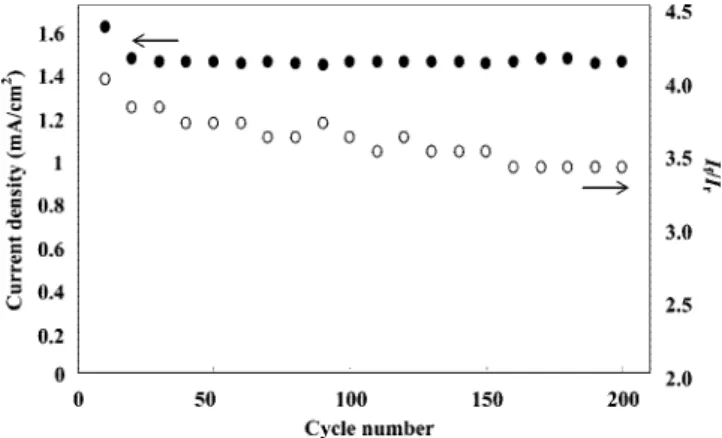
The electrocatalytic stability of the Pt50Ru50-CMM catalyst was evaluated by repeated CV tests (scans) performed using 0.5 M H2SO4 with 1 M CH3OH at room temperature.6,35 Up to 200 scan cycles of 3 min each were examined. As shown in Figure 5, a nearly constant peak current density (measured at 0.60 V vs Ag/AgCl) of the electrooxidation of methanol accompanied by only a slight variation in If/Irratio was observed for Pt50Ru50-CMM over the total scanned
period of ca. 10 h, indicating that the catalyst indeed possesses a stable electrocatalytic activity for the oxidation of methanol.
Conclusions
The novel bifunctional PtRu-CMM catalysts reported herein possess stable alloyed PtRu nanoparticles (2–3 nm) well-dispersed in ordered mesoporous carbon with high surface area and regular pore channels, which facilitate reactant/product diffusion. Furthermore, these PtRu-CMM catalysts, fabricated by a novel direct replication method using mesoporous silica as template and by cofeeding carbon sources and metal precursors during synthesis, were found to have superior electrocatalytic properties and stabilities compared to common commercial catalysts during the oxidation of methanol. Thus, the supported PtRu-CMM catalysts so fabricated should render future practical and cost-effective applications in hydrogen-energy related areas, for example, as electrodecatalysts for PEMFCs and DMFCs.
Acknowledgment. The support of this work by the National
Science Council, Taiwan (NSC95-2113-M-001-040-MY3) and by the Academia Sinica Research Project on Nano Science and Technology are gratefully acknowledged. The authors thank Mr. Ding-Goa Liu and Dr. Jyh-Fu Lee (National Synchrotron Radiation Research Center, Taiwan) for their assistance and helpful discussions on the X-ray absorption measurements.
Supporting Information Available: N2adsorption/desorption measurements, additional TEM, XPS, EXAFS, and CV results (PDF). This information is available free of charge via the Internet at http://pubs.acs.org.
CM702777J (35) Zhao, D.; Xu, B. Q. Angew. Chem., Int. Ed. 2006, 45, 4955.
Figure 5. Stability of the Pt50Ru50-CMM catalyst during methanol
elec-trooxidation.
1628 Chem. Mater., Vol. 20, No. 4, 2008 Liu et al.
Downloaded by NATIONAL TAIWAN UNIV on September 10, 2009 | http://pubs.acs.org