Optical Properties of self-assembled InGaAs Quantum wires grown
on (100) GaAs Substrate
Jong-Horng Dai, Yi-lung Lin, and Si-Chen Lee
Graduate Institute of Electronics Engineering, National Taiwan University, Taipei, Taiwan, 10617
Shih-Yen Lin and Jim-Yong Chi
Nanophotonic Center, Opto-Electronics & Systems Labortories, Industrial Technology Research
Institute, Taiwan
Abstract — A method is proposed to grow InGaAs
quantum wires on (100) GaAs substrates by solid-source molecular beam epitaxy via Stranski-Krastanov growth mode. The shape of the nano-wire structures are measured by the atomic force microscopy (AFM). Their optical properties are studied by temperature-dependent photoluminescence (PL). The integrated PL intensity at room temperature reduced to 10% of that at 20 K. From 20 to 300 K, the PL peak energy shifts only 70 meV.
Index Terms — AFM, GaAs substrate, Nano structure,
Potoluminescence, Quantum wire, Solid- source MBE
I. INTRODUCTION
Low-dimensional semiconductor structures such as zero-dimensional quantum dots (QD), one-dimensional quantum wires (QWR) and two-dimensional quantum wells (QW) were well known in quantum heterostructures in which electrons are confined in one or more dimensions, but are free in the other dimensions. Quantum dots and quantum wires have already been made by mature growth techniques and have many applications. Although there are many fabrication techniques such as e-beam, micro lithograph or laser to form one dimensional QWR [1]-[3], it is difficult to get QWR on normally oriented (100) GaAs substrate. In recent years, there are many reports that anisotropic quantum dots (wire-like QDs) could be formed on misoriented (001) InP, vicinal (001) GaAs and (311)-oriented GaAs substrates [4]-[6]. In this paper, we present a method to grow InGaAs quantum wires on norminally oriented (100) GaAs substrate. The samples were characterized by atomic force microscopy (AFM). Temperature dependent photoluminescence (PL) exhibits the ground state emission. The PL intensities and peak energies vary with temperature. The results are correlated with the optical anisotropy of the nano-wire as indicated by polarized photoluminescence (PPL).
II. EXPERIMENTS
The sample was grown by Riber Epineat solid-source molecular beam epitaxy (MBE) on (100) GaAs substrate. The substrate temperature was measured using an infrared pyrometer. After thermal desorption of native oxide on the GaAs substrates, a 500-nm GaAs buffer layer was grown. The growth temperature was fixed at 600 . The growth rate is 1µm/h. Then the temperature of the substrate is lowered to 510 , and a 2.4 ML of InAs were grown at a 0.1ML/s growth rate. The arsenic pressure was fixed at 7×10⁻⁷ Torr. InAs QDs are formed on the GaAs buffer layer. After InAs deposition, the sample was capped with 3 nm GaAs at the same temperature. Then the growth was interrupted for 30 sec under same As pressure. The sample was subsequently cooled, at a cooling rate of 20 /s, to room temperature and removed from the system.
Sample was scanned by a NT-MDT Instruments atomic force microscope (AFM) operated in the tapping mode. In order to characterize the carrier confinement in these quantum wires by PL measurements, the samples were capped with a 60 nm GaAs layer. The PL spectra were obtained in the 20-300K temperature range and excited using the 514.5 nm line of argon laser. The power dependent photoluminescence (PL) spectra of quantum wires with power changing from 50 to 400 mW were measured at 20K. For polarization photoluminescence (PPL) measurements the [0-11] direction of the samples is oriented at 45˚with respect to the polarization of the laser to get both balanced pumping along [0-11] and [011] directions. A polarizer at the entrance slit of the monochromator is used to measure PL intensity along both directions. The linear polarization degree P defined as ( [0-11]-[011]) / ([0-11]+[011] ) of the emitted light. As a reference a QD sample was grown at the same
Proceedings of 2005 5th IEEE Conference on Nanotechnology Nagoya, Japan, July 2005
conditions but without the 3 nm GaAs layer partially capping the dots.
Fig. 1. (a) 1 um × 1um AFM images of quantum wires. (b) 200 nm × 200 nm in 3D image and (c) the cross section profile taken from (b).
Fig. 2. PL of InGaAs quantum wires under different excitation power. All the measurements were performed at T=20K.
III. RESULTS AND DISCUSSION
Fig. 1 shows the AFM images of quantum wires. Wire shaped structure oriented along the [0-11] direction is observed in Fig. 1(a). The 3D image and cross section profile was shown in Fig. 1(b) and (c). After stretching them out, some of them may bumped into each other; some may bifuracate or break. But quantum wires still keep in [0-11] direction. The average width is 40 nm, 1.5 nm in height. The length of the wire is between 300 to 600 nm.
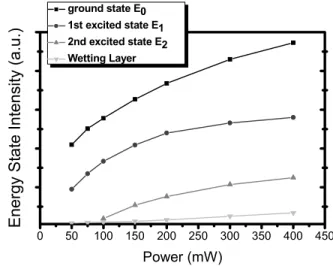
Fig. 3. Four PL peak intensities increase with laser power density.
Fig. 2 shows the PL spectra at 20K. There are 3 major peaks plus a small wetting layer emission peak. The PL spectra were taken under different excitation power from 50 to 400 mW. Four peaks increased with the laser power. From Fig. 3, each peak intensity increases with different slope. The four peaks with different strength located at 1.094 eV (ground state peak E0), 1.168eV (first excited state peak E1), 1.233eV (second excited state peak E2), 1.309 eV (wetting layer peak WL). Fig. 4. shows temperature dependence of the PL peak positions of the QWR ground state, excited state and QD ground state from 20 to 300K. The QD and QWR peak energies are both shifted 70 meV. The PL intensity of the QWR at room temperature remains 10% of the PL intensity at 20K.
Fig. 5 shows the PL peak associated with quantum wires which exhibits a large anisotropy for the orthogonal [0-11] and [011] polarization with a peak intensity ratio of 1.82. The degree of linear polarization for the quantum wires samples is near 28%.
0 50 100 150 200 250 300 350 400 450 En ergy St at e I n tens ity (a. u .) Power (mW) ground state E0 1st excited state E1 2nd excited state E2 Wetting Layer 900 1000 1100 1200 1300 400 mW 300 mW 200 mW 150 mW 100 mW 75 mW 50 mW P L in te ns ity (a .u .) Wavelength (nm)
Fig. 4. Temperature dependence of the PL peak (a) energy; (b) intensiy for quantum wires compared with quantum dots samples.
Fig. 5. RT polarized PL spectra of the quantum wires sample observed for [011] and [0-11] polarization.
IV.CONCLUSION
From this study, it is found that a wire-like shape of self-assembled nanostructures of InGaAs/(100)GaAs can be formed without any regrowth or patterned process. The optical properties of the quantum wire were observed from PL spectra which satisfied quantum confinement of nano structure. Additional information about the temperature dependence of the integrated PL peak energy and intensity has stable characteristics that remain very strong at room temperature for infrared optoelectronic device. Besides using quantum dot structures, quantum wire devices on the GaAs substrate can be realized.
ACKNOWLEDGEMENT
The authors are grateful to C. Y. Liang for helpful discussion about PL measurment.
REFERENCES
[1] S. J. Rehse, R. W. McGowan, and S.A. Lee, “Optical manipulation of group III atoms” Appl. Phys. B, vol. 70, pp. 657-660, April 2000.
[2] Hideaki Saito, K. Nishi, S. Sugou, and Y. Sugimoto, “Controlling polarization of quantum-dot surface-emitting lasers by using structurally anisotropic self-assembled quantum dots” Appl. Phys. Lett, vol. 71, no. 5, pp. 590-592, August 1997.
[3] M. Takahashi, P. Vaccaro, K. fujita, T. Watanabe, T. Mukaihara, F. Koyama, and K. Iga, “An InGaAs-GaAs Vertical-Cavity Surface-Emitting Laser Grown on GaAs(311)A Substrate Having Low Threshold and Stable Polarization” IEEE Photonic. Tech. Let., vol. 8, no. 6, pp. 737-739, June 1996.
[4] M. Henini, S. Sanguinetti, S. C. Fortina, E. Grilli, and M. Guzzi, M. D. Upward, P. Moriarty, P. H. Beton, and L. Eaves “Optical anisotropy in arrow-shaped InAs quantum dots” Phys. Rev. B, vol. 57, no. 12, pp. R6815-R6818, March 1998.
[5] J. Brault, M. Gendry, G. Grenet, G. Hollinger, J. Olivares, B. Salem, T. Benyattou, and G. Bremond, “Surface effects on shape, self-organizatioin and photoluminescence of InAs islands grown on InAlAs/InP(001)” J. Appl. Phys., vol. 92, no. 1, pp. 506-510, July 2002.
[6] J. Brault, M. Gendry, O. Marty, M. Pitaval, J. Olivares, G. Grenet, and G. Hollinger, “Staggered vertical self-organization of stacked InAs/InAlAs quantum wires on InP(001)” InAlAs/InP(001)” Appl. Surf. Sci., vol. 162-163, pp. 584-589, 2000. 950 1000 1050 1100 1150 1200 1250 1300 PL I n tensity (a.u. ) Wavelength(nm) [011] [0-11] 0 50 100 150 200 250 300 PL p ea k In te nsity (a.u.) Temperature (K) QD Ground State E0 QWR Ground State E0 QWR 1st Excited State E1 (b) 0 50 100 150 200 250 300 1.02 1.04 1.06 1.08 1.10 1.12 1.14 1.16 1.18
PL Peak position (eV)
Temperature (K) QWR 1st excited state
QD Ground state QWR Ground state