目 次
第一章 八大詞類、五大基本句型與三大子句
第二章 動詞時態
第三章 主動語態與被動語態
第四章 主詞與動詞的一致
第五章 假設語氣
第六章 動狀詞(不定詞、動名詞、分詞)
第七章 形容詞
第八章 副詞
第九章 介系詞
第十章 連接詞
第一章 八大詞類、五大基本句型與三大子句
一、八大詞類
英文的詞類總共可分為八大類: 1. 名 詞: (noun) 可分為可數名詞與不可數名詞。可數名詞為可以計數的名詞,有單複數之分,複 數名詞字尾加 s 或 es;可數名詞又分為普通名詞與集合名詞,前面加上數詞或冠 詞。不可數名詞沒有單複數之分,可分為抽象名詞、物質名詞與專有名詞。 種 類 特 性 說 明 例 字 可 數 名 詞 普 通 佔所有名詞中絕大多數,表示一般的人或事物的名稱。 pen (筆) book (書) 集 合 表示生物或事物的一種集合體的特性。單數為整體;複數 為組成的分子。 people (人們;民族) family (家庭;家人) 不 可 數 名 詞 抽 象 表示可感受得到卻無法觸摸的性質、概念或狀態的名稱。 fear (恐懼) beauty (美) 物 質 不具形狀的材質或物體。 water (水) gold (黃金) 專 有 特定的人、地、事物的專用的名稱,如人名、地名、國名、 月份、星期等。 America (美國) May (五月) 2. 代名詞: (pronoun) 代名詞是用來代替已經提過或暗示過的名詞,之前使用過的名詞在第二次提到時 就一定要用代名詞,不可以連續使用。代名詞分為人稱代名詞、指示代名詞、不 定代名詞、疑問代名詞及關係代名詞。人稱代名詞 I, you, he, she, it, myself, yourself, himself, mine, yours, his...
指示代名詞 this, that, these, those...
不定代名詞 some, any, other, one...
疑問代名詞 who, what, which...
關係代名詞 who, which, that...
3. 動 詞: (verb)
動詞是用來表示動作及狀態的字,可分為及物動詞和不及物動詞。及物動詞後面 必須接受詞,如:like, hate, eat, take, see, watch, have...等;不及物動詞則不用接受 詞,如:jump, run, live, happen, work, rise, fall, come, go, rain...等。部分不及物動 詞須接受詞時,前面必須先加介系詞,如 look at, listen to, live in, insist on(堅持) arrive in/at(抵達)...等。
4. 形容詞: (adjective)
形容詞是用來修飾名詞的字,形容詞若在名詞之前稱為前位修飾,如:beautiful girl,若在名詞之後則稱為後位修飾,如:something wrong。
5. 副 詞 : (adverb)
副詞可用來修飾動詞、形容詞、副詞及全句。
修 飾 動 詞
We need to run quickly, or we may miss the train. V. Adv.
(我們要跑快一點,要不然就會錯過火車了。) 修 飾 形 容 詞
Your sister is so beautiful.
Adv. Adj.
(你妹妹真漂亮。) 修 飾 副 詞
He can run very fast. Adv. Adv.
(他可以跑得非常快。) 修 飾 全 句
Luckily, he didn’t get hurt.
Adv. 全句
(很幸運地,他沒有受傷。) 6. 連 接 詞:
(conjunction)
連接詞的功用為連接單字、片語、子句或句子的字。種類可分為對等連接詞如:and, but, or...等,另外還有從屬連接詞如:before, after, when, if, unless...等。
7. 介 系 詞:
(preposition)
介系詞後面必須接受詞,是用來表示其後面的受詞在句中與其它字詞之間的關係。 如:in, at, on, of, with, over, from, to, up, under...等。
8. 感 嘆 詞:
(interjection)
感嘆詞用來表示說話時產生的情緒,可放在句子的開頭、結尾或中間。 例句:1.Hi, how are you?(嗨!你好嗎?)
2.We won the game. Hurray!(我們贏了比賽了!萬歲!)
二、五大句型
句子依照動詞的種類,可分成五大基本句型: 1. 主詞 + 完全不及物動詞:S + Vi 2. 主詞 + 不完全不及物動詞 + 主詞補語:S + Vi + SC 3. 主詞 + 完全及物動詞 + 受詞:S + Vt + O 4. 主詞 + 不完全及物動詞 + 受詞 + 受詞補語:S + Vt + O + OC 5. 主詞 + 授與動詞 + 間接受詞 + 直接受詞:S + Vt + IO + DO 句型 主詞 (S) 動詞 (V) 受詞 (O) 補語 (C) 1. Birds fly.2. Jason seems sad.
3. I like your puppy.
4. Exercise makes one’s health better.
5. He gave me a book.
句型 1:主詞+完全不及物動詞:S + Vi 說明 動詞為完全不及物動詞,動詞之後不接受詞,且句子意思完整,故也不需 加上補語,但還是可加上副詞(片語或子句)來修飾動詞。 例句 1. Time flies. (時光飛逝。) 2. It rained a lot. (雨下得很大。) 修飾語 句型 2:主詞+不完全不及物動詞+主詞補語:S + Vi + SC 說明 動詞為不完全不及物動詞,因為意思不完全,需要加上主詞補語。此句型 通常與 be 動詞和連綴動詞連用。
be 動詞:am / is / are / was / were
連綴動詞:seem, feel, look, sound, smell, taste, become, get, keep...等等。
例句 1. Her mother is a housewife. (她的媽媽是家庭主婦。)
2. The food tastes delicious. (這食物嚐起來真好吃。)
句型 3:主詞+完全及物動詞+受詞:S +Vt + O
說明 動詞為完全及物動詞,動詞之後須接受詞,受詞型態有很多,如:名詞(片
語或子句)、代名詞、不定詞、動名詞等。
例句
1. Everybody studies English. (大家都學英文。) 2. Nobody likes her. (沒人喜歡她。)
3. He hopes to see his girlfriend. (他想見他的女友。) 4. I hate telling lies.(我討厭說謊。)
句型 4:主詞+不完全及物動詞+受詞+受詞補語:S + Vt + O + OC
說明 動詞為不完全及物動詞,動詞後面接完受詞之後語意仍不完整,須接受詞
補語才完整。受詞補語的形式有形容詞、名詞、分詞、不定詞等。
例句
1. Listening to music makes me happy. (聽音樂使我開心。) 2. My boss made me his assistant. (我老闆雇我做助手。)
3. I found the boy stealing her money. (我發現那男孩偷她的錢。) 4. I had my car repaired. (我把車子拿去修了。)
5. The teacher asked his students to do the homework.(老師要求學生寫作業。)
※註:現在分詞當受詞補語的受詞表「主動」;過去分詞當受詞補語的受詞 表「被動」。 句型 5:主詞+授與動詞+間接受詞+直接受詞:S + Vt + IO + DO 說明 動詞為授與動詞,動詞後面接兩個受詞,為間接受詞(通常表人)和直接受 詞(通常表物)。若先接直接受詞再接間接受詞時,需加上適當的介系詞。 常見的授與動詞有:give, offer, lend, bring, tell, pay, sell, send, buy 等。
例句
1. My mother gave me a present.(媽媽給我一個禮物。) = My mother gave a present to me.
2. John asked her a question.(約翰問她一個問題。) = John asked a question of her.
三、三大子句
在英文裡有三大子句,有名詞子句、形容詞子句及副詞子句三種。
1.名詞子句:
※名詞子句可作主詞、受詞、補語、及同位語。 ※可引導名詞子句的連接詞有:
(1)從屬連接詞:that, if, whether
(2)疑問代名詞:who, whom, whose, which, what
(3)疑問副詞:where(表地方), when(表時間), why(表原因), how(表方法) (4)複合關係詞:whoever, whomever, whosever, whatever, whichever
功 用 例 句
作 主 詞 1. That the sun rises in the east is true. (太陽從東邊升起是真的。)
2. What he said is wrong. (他所說的是錯的。)
作 受 詞 1. I don’t know where Bob lives. (我不知道鮑伯住哪裡。)
2. I appreciate what you have done. (我感激你所做的。)
作 補 語
1. My suggestion is that you should finish your work first. (我建議你應該先完成你的工作。)
2. Mary’s parents made her what she is today. (瑪莉的父母造就今天的她。)
作 同 位 語
1. The fact that he’s a famous artist is true. (他是有名的藝術家這件事情是真的。)
2. The news that the president had an accident is wrong. (總統發生意外這消息是錯誤的。)
2.形容詞子句:
※形容詞子句可修飾主詞(補語)和受詞(補語)。 ※可引導形容詞子句的連接詞有:
(1)關係代名詞:who(主格), whom(受格), whose(所有格), which(表事、物), that (2)關係副詞:where(表地方), when(表時間), why(表原因), how(表方法) (3)關係形容詞:which, what, whose, whichever, whatever
※形容詞子句(或稱關係子句)所修飾的名詞在子句之前,其名詞又稱為「先行詞」,形容 詞子句與名詞子句之最大不同為形容詞子句是不完整子句,而名詞子句為完整子句。
功用 例 句
修 飾 主 詞 The boy who is sitting there is my brother. (坐在那裡的男孩是我弟弟。)
修 飾 受 詞 I like the dictionary which you bought last night. (我喜歡你昨天買的那本字典。)
修 飾 補 語 That is the place where I lived when I was young.
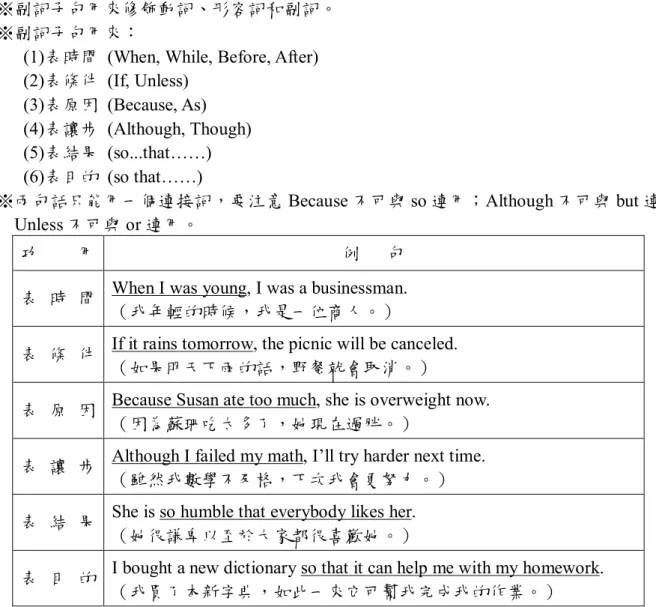
3.副詞子句:
※副詞子句用來修飾動詞、形容詞和副詞。 ※副詞子句用來:
(1)表時間 (When, While, Before, After) (2)表條件 (If, Unless)
(3)表原因 (Because, As) (4)表讓步 (Although, Though) (5)表結果 (so...that……) (6)表目的 (so that……)
※兩句話只能用一個連接詞,要注意 Because 不可與 so 連用;Although 不可與 but 連用; Unless 不可與 or 連用。
功 用 例 句
表 時 間 When I was young, I was a businessman. (我年輕的時候,我是一位商人。)
表 條 件 If it rains tomorrow, the picnic will be canceled. (如果明天下雨的話,野餐就會取消。)
表 原 因 Because Susan ate too much, she is overweight now. (因為蘇珊吃太多了,她現在過胖。)
表 讓 步 Although I failed my math, I’ll try harder next time. (雖然我數學不及格,下次我會更努力。) 表 結 果 She is so humble that everybody likes her.
(她很謙卑以至於大家都很喜歡她。)
表 目 的 I bought a new dictionary so that it can help me with my homework. (我買了本新字典,如此一來它可幫我完成我的作業。)
【練習題】
1. Lisa is a very ______ girl.
(A) beautify (B) beautifully (C) beautiful (D) beauty (莉莎是個很漂亮的女孩。)
2. I am not the tallest in my family. My _______ very tall.
(A) families are all (B) family is all (C) all family are (D) family are all (我不是家裡面最高的,我的家人都很高。)
3. Please make the most of your time. Wasting ______ is wasting life. (A) time (B) the time (C) a time (D) that time
(請善用你的時間,浪費時間就是浪費生命。) 4. Alice: How is your cousin, Joseph?
Betty: ______ is fine. Thank you. (A) Joseph (B) He (C) She (D) My cousin
(艾莉絲:你的表弟約瑟夫好嗎? 貝蒂:他很好,謝謝妳。) 5. The food of the restaurant tastes ______.
(A) good (B) wonderfully (C) well (D) terribly (這家餐廳的餐點嚐起來很棒。)
6. I like to ______ music in my free time.
(A) listen (B) hear (C) listen to (D) hear of (我喜歡在空閒時聽音樂。)
7. ______ I didn’t pass the test, my mom doesn’t let me go out. (A) Although (B) Until (C) If (D) Because
(因為我考試不及格,所以我媽媽不讓我出門。)
8. The old lady ______ is standing over there is my grandmother. (A) whom (B) which (C) whose (D) who
(站在那裡的老婦人是我的祖母。)
9. The fact ______ you made the mistake is true. (A) how (B) that (C) where (D) when (你犯了錯的這件事實是真的。)
10. These books belong to you, while ______ are mine. (A) this (B) that (C) those (D) which (這些書屬於你的,而那些是我的。)
11. Laura is the girl ______ I have worked for three years. She is my best friend among my colleagues. (A) who (B) whom (C) for whom (D) with whom
(蘿拉是我共事三年的女孩,她是我同事裡最要好的朋友。) 12. People ______ English is very good can find jobs more easily.
(A) who (B) whose (C) that (D) of which (英文很好的人可以更容易找到工作。)
13. Ruth was so shocked to hear that bad news. She didn't know _______ to do to help her friend. (A) that (B) what (C) when (D) how
14. They will arrive here on Friday, ______ my brother is leaving for New York. (A) where (B) which (C) when (D) how
(他們會在星期五抵達這裡,那時我哥哥正前往紐約。)
15. You'd better explain the reason ______ you are late for work again to the manager yourself. (A) where (B) why (C) when (D) how
(你最好自己跟經理解釋為什麼你上班又遲到。)
16. ______ you go to John’s party tomorrow, I will go with you. (A) Although (B) How (C) If (D) So
(如果你明天去約翰的派對,我就會跟你去。) 17. My father gave ______.
(A) me to a gift (B) a gift me (C) me a gift (D) a gift of me (我爸爸給我一個禮物。)
18. Tracy was reading a novel when we ______ her.
(A) saw (B) looked (C) thought (D) laughed (當我們看到崔西的時候,她正在看小說。)
19. He ______ me that you had won the lottery.
(A) talked (B) said (C) spoke (D) told (他告訴我你中了樂透。)
20. Applicant: When can I know the result? Office: We'll ______ as soon as possible. (A) inform you of the news (B) inform you the news
(C) inform the news of you (D) inform the news to you
(應徵者:我什麼時候可以知道結果? 雇方:我們會盡快通知你消息。)
【解答】
題號 1 2 3 4 5 6 7 8 9 10 11 12 13 14 15 16 17 18 19 20
第二章
動詞時態
在英文中,隨著時間的變化,動詞的形式也會跟著有所不同。試比較下列兩句: 1. I eat breakfast every day.(我每天吃早餐。)
2. I ate breakfast yesterday.(我昨天吃早餐。)
由上面兩句可發現,在中文裡動詞的「吃」不會隨著時間而變化;英文的“eat”在過去式時就會 產生變化,這種因時間而改變動詞型態就是動詞的時態。 「時態」是由「時間」跟「狀態」結合而成的。時間分為過去、現在,及未來三種;狀態則有 簡單、進行、完成,及完成進行四種。在本章節中,會介紹英語動詞的基本九大時態(在此不 包含完成進行式)。 時間 狀態 現 在 過 去 未 來 簡 單 式 I do my homework. I did my homework. I will do my homework. 進 行 式 I am doing my homework. I was doing my homework. I will be doing my homework. 完 成 式 I have done my homework. I had done my homework.
I will have done my homework.
一、現在簡單式
1.現在簡單式表示習慣性的動作、現在的狀態,和不變的真理。 2.現在簡單式若主詞為第三人稱單數,動詞之後需加上 s 或 es。
字尾加上 es 的情況有:
(1)字尾是“ch, s, sh, x,或 z”如:push → pushes catch → catches
(2)字尾是“子音+y”時,要先去掉 y 再加上 ies。如:cry → cries study → studies ※若字尾是“母音+y”時,加 s 即可。如:play → plays say → says
(3)子音+o 如:go → goes do → does
用 法 例 句
表示現在的動 作或狀態
1. She teaches English at school.(她在學校教英文。) 2. I am very hungry now.(我現在好餓。)
表示習慣的動 作
1. Jason goes to school by bus every day.(Jason 每天搭公車上學。) 2. I usually get up at 7:30 in the morning.(我通常早上七點半起床。) 不變的真理或
格言
1. The sun rises in the east.(太陽從東邊升起。) 2. Honesty is the best policy.(誠實是最上策。) 在條件子句中
代替未來式
1. If it rains tomorrow, I won’t go.(如果明天下雨,我就不去。) 2. When Mom comes back, please tell her I’ll be right back.
二、過去簡單式
1.過去簡單式表示過去某時間所發生的動作或狀態,通常都會搭配明確的過去時間,如 yesterday, last year, an hour ago, last summer 等時間副詞。
2.過去簡單式表示過去的習慣動作或過去有頻繁性動作的行為。
3.過去式規則變化動詞需加上 ed,字尾如果是 e 則加 d,其他的情況有: (1)字尾若是“子音+y”時,則去掉 y,加上 ied,如:try → tried。 (2)字尾若是“母音+y”時,則直接加 ed,如:stay → stayed。
(3)字尾若是“短母音+子音”,則重複字尾的子音字母後,再加 ed,如 stop→ stopped。 (4)字尾若是字母 c,且發音為[k]時,則需加字母 k,再加 ed,如 picnic→picnicked。 4.過去式不規則變化是指動詞不按一定的規則變化,如 read→read,put→put, sit→sat,say→said。 用 法 例 句 過去定點時間發 生的事情或動作
1.I went to the U.S. last month. (我上個月去美國。) 2.I had a great time yesterday. (我昨天玩得很愉快。) 表示過去習慣的
動作
1.He used to jog in the morning. (他以前會晨間慢跑。) 2.My father used to be a doctor. (我爸爸以前是位醫生。)
3.When I was young, I usually kept a pet.(我年輕時通常都會養寵物。)
三、未來簡單式
1.未來式表示未來某時間發生的動作或狀態,通常會和未來時間副詞搭配連用,如 tomorrow, next month, next year 等。
2.未來簡單式為“will + 原形動詞”。
3.表示即將發生的未來,也可以用“be going to+原形動詞”或“be about to+原形動詞”表示未來式。
用 法 例 句
未來發生的動作 或狀態
1.I will go to a Chinese restaurant tomorrow.(我明天會去中國餐廳用餐。) 2.I am going to visit New York next month.(下個月我要去紐約。)
四、現在進行式
1.現在進行式表示動作正在發生或持續發生,經常和 now, at present 等表示現在的時間副詞連用。 2.若句首為 Look!或 Listen!時,也是表示動作正在發生,必須用現在進行式。
3.現在進行式為 is / am / are + V-ing。
4.有些動詞是沒有進行式的,常見的有:have(擁有), own, know, understand, hear, see, smell, sound, taste, seem, appear, like, love, hate...等。
用 法 例 句
表示現在正在進行 的動作或狀態
1.Susan is reading a novel.(蘇珊正在讀一本小說。) 2.I am eating lunch now.(我現在正在吃午餐。) 以 Look!或 Listen!
為首的句子
1.Look! A bird is flying in the sky.(你看!有隻鳥在天空飛。) 2.Listen! Someone is singing.(你聽!有人在唱歌。)
表示即將發生的動 作或計畫
1.I am leaving.(我要走了。)
五、過去進行式
1.過去進行式代表過去的某個時間點正在發生的動作,通常會有過去時間幾點幾分的時間副詞。 2.當一個過去簡單式的動作發生時,另一個動作正在進行或發生,就必須用過去進行式。 3.過去進行式為 was / were + Ving。
用 法 例 句
表示過去某時間點 進行的動作
1.I was reading a book at seven o’clock yesterday evening. (我昨天晚上七點的時候在閱讀一本書。)
2.She was jogging at eight this morning.(她今天早上八點時在慢跑。) 過去簡單式的動作
發生時,另一個動 作正在進行
1.When Peter came to my house last night, I was watching TV. (昨晚彼得來我家時,我正在看電視。)
2.When you called me, I was taking a shower. (你打電話給我的時候,我正在洗澡。)
六、未來進行式
1.未來進行式表示未來的某個時間點正在發生的動作,通常和表示未來的某時之副詞片語或 副詞子句並用。
2.當一個未來簡單式的動作發生時,而另一個動作正在進行或發生,就必須用未來進行式。 3.未來進行式為 shall / will + be + V-ing。
用 法 例 句
表示未來某時間點 正在進行的動作
1.I will be studying English at nine this evening. (我今晚九點的時候將會正在讀英文。)
2.The students will be leaving for home at this time tomorrow. (學生們在明天此時將會回家。)
未來簡單式的動作 發生時,另一個動 作正在進行
1.The teacher shall be correcting your homework when you come. (你來的時候,老師會正在改你的作業。)
2.I will be eating dinner when you come home. (你到家時,我會正在吃晚餐。)
七、現在完成式
現在完成式表示:1.從過去延續到現在所累積一段時間的動作發生。 2.剛完成的動作,常與 just, already, yet 等副詞連用。 3.先前的經驗,其經驗確切發生的時間未指明或不知道。 4.現在完成式為 have / has + p.p.。
用 法 例 句
動作累積 1. I have played basketball for 10 years.(我打了十年的籃球。)
2. I have studied English for 3 hours.(我讀了三小時的英文。)
動作完成 1. I have just finished my job.(我剛完成我的工作。)
2. I have already paid the bill.(我已經付完帳單了。)
經 驗 1. Have you ever been to Europe?(你去過歐洲嗎?)
八、過去完成式
1.過去完成式表示比過去某時的動作更早發生或完成的動作。 2.過去完成式為 had + p.p.。 用 法 例 句 過去某動作發生之 前所發生的動作1.When I arrived at the station, the train had left. (我到達車站時,火車早已離開。)
2.Before I entered the room, they had just begun their supper. (在我進入房間之前,他們剛剛開始吃晚飯。)
九、未來完成式
1.未來完成式表示在未來的某時間之前動作的完成或者比未來的動作還要更早發生的動作。 2.未來完成式為 shall / will + have + p.p.。
3.英文中 By the time~(到了...的時候)的句型,也要用未來完成式。
用 法 例 句
未來某動作發生之 前所發生的動作
1.By next Friday, I will have completed my job. (在下星期五之前我會完成我的工作。)
2.When you reach the station, the train will have started. (當你到達車站時,火車將早就開走了。)
【練習題】
1. My brother is a history teacher. He ______ at a senior high school. (A) taught (B) has taught (C) will teach (D) teaches (我哥哥是歷史老師,他在高中教書。)
2. Dad: Where is Mom, Ken? Ken: She ______ in the kitchen. (A) cooks (B) is cooking (C) has cooked (D) will cook (爸爸:肯,媽媽在哪裡? 肯:她在廚房煮飯。)
3. My uncle and his family ______ to the United States in 1978.
(A) was going to move (B) moved (C) would move (D) had moved (我叔叔和他家人在 1978 年時搬到美國。)
4. When the telephone rang, I ______ a bath. Mom answered the phone and took a message for me. (A) took (B) was taking (C) would take (D) had taken
(當電話響的時候,我正在洗澡。媽媽接聽電話並為我傳口信。)
5. I don't know why I still can't speak English well. I ______ English for more than three years. (A) study (B) am studying (C) studied (D) have studied
(我不知道為什麼我英語還說得不好,我已經學超過三年了。) 6. By the end of this month, I ______ twenty books in a year.
(A) will be reading (B) will have finished reading (C) will have finished to read (D) will be finished reading (在這個月底前,我將在一年內看完二十本書。)
7. How many countries ______?
(A) did you ever go (B) had you ever gone (C) have you gone to (D) have you ever been to (你曾經去過多少個國家?)
8. She ______ some last-minute shopping before she went to the airport.
(A) have done (B) would do (C) had done (D) could have been doing (在去飛機場之前,她做了行前最後一分鐘的採購。)
9. I ______ that he ______ come.
(A) didn't know; could (B) don't know; should (C) didn't expect; would (D) didn't think; might (我沒有料到他會來。)
10. Peggy: Do you have any message from Martha? Tracy: No. I ______ anything from her since she left.
(A) don't know (B) haven't been knowing (C) haven't heard (D) haven't been hearing
(佩吉:妳有瑪莎的消息嗎? 崔西:沒有,自從她離開後,我都沒收到她的音訊。) 11. I ______ the money to you as soon as I get my salary.
(A) am returning (B) would return (C) will be returning (D) will return (我一領到薪水,就會把錢還給你。)
12. Zoe ______ her grandmother once a week. She loves her grandma very much. (A) will visit (B) visits (C) is visiting (D) visited
13. I don't have much time now for traveling around the world. However, I ______ by the year 2015. Can you wait until then?
(A) will be having retired (B) will be retired (C) am going to retire (D) will have retired (我現在沒有很多時間可以環遊世界。不過我到 2015 年會退休,你可以等到那時嗎?) 14. I usually ______ my teeth before I go to bed.
(A) brush (B) am brushing (C) brushed (D) will brush (我通常睡覺前會刷牙。)
15. As soon as Rita finished talking on the phone, she ______ the room. (A) left (B) would leave (C) was leaving (D) had left (麗塔一講完電話,就離開房間了。)
16. Marvin didn't expect that Sharon would be so angry. He regretted that he ______ such rude words to her.
(A) says (B) has said (C) said (D) had said
(馬文沒料到莎朗會這麼生氣。他後悔對她說了粗魯的話。) 17. I ______ TV when he came home.
(A) have watched (B) am watching (C) watched (D) was watching (當他回到家時,我正在看電視。)
18. I ______ at this time tomorrow morning.
(A) will jog (B) jog (C) will jogging (D) will be jogging. (明天早上的此時我將會正在慢跑。)
19. When I arrived at the airport, the plane ______.
(A) has taken off (B) took off (C) had taken off (D) had been taken off (當我到機場的時候,飛機已經起飛了。)
20. By next June, we ______ the project.
(A) will finish (B) will have finished (C) will be finishing (D) will be finished (到明年六月時,我們將已完成計畫。)
【解答】
題號 1 2 3 4 5 6 7 8 9 10 11 12 13 14 15 16 17 18 19 20
第三章 主動語態與被動語態
一、語態種類:
在英文中,大部分的及物動詞,都可分成兩種語態:主動語態與被動語態。 以下面兩句為例:
1.The police officer caught a thief.(那位警察抓到了一個小偷。) 2.A thief was caught by the police officer.(一個小偷被那警察抓了。)
在第一句中主詞(警察)是動詞的行為者,所以此句的語態為主動語態;第二句的主詞(小偷) 為動詞的接受者,所以第二句為被動語態。
大部分的情況下,動詞都是用主動語態,但下列情況,被動語態則較為適當: 1.當動詞的行為者不清楚時,如:
(1)My wallet was stolen.(我的錢包被偷了。) (2)Our plan was stopped.(我們的計畫被終止了。) 2.當行為者不重要,或句子中要強調接受者時。如:
(1)The competition will be held tomorrow.(比賽將在明天舉行。)
(2)Many people were killed in this accident.(很多人在這場意外中喪生了。)
二、主動語態與被動語態的轉換:
1.被動語態的形式為:be 動詞+ p.p.。 2.主動句的受詞會變成被動句的主詞。 3.主動句的主詞在變成被動句時,需改成受格並置於 by 之後。 4.主動句與被動句的轉換如下圖: (主動語態) I use my computer.(我使用我的電腦。) (主詞) (受詞)(被動語態) My computer is used by me.(我的電腦被我使用。) (原受詞變成主詞) (原主詞會接在 by 之後)
(主動語態) Jason ate those apples.(傑森吃了那些蘋果。) (主詞) (受詞)
(被動語態) Those apples were eaten by Jason.(那些蘋果被傑森吃了。) (注意單複數和時態變化)
三、被動語態與時態:
在第二章裡有提到英文原則上總共有十二種時態,但是若句子為被動語態時,時態總共只有八種。 被動語態時態 句 型 例 句 現在簡單式 am 主詞 + is + p.p. areChinese is spoken in Taiwan. (中文在台灣被說。)
過去簡單式
was
主詞 + + p.p. were
The party was held last week. (派對上星期舉辦過了。)
未來簡單式 主詞 + will be + p.p. Computers will be used all over the world.
(電腦將在全世界被使用。)
現在進行式
am
主詞 + is + being + p.p. are
The book is being read by me. (這本書正在被我閱讀。)
過去進行式
was
主詞 + + being + p.p. were
The bridge was being built then. (那座橋當時正被建造中。) 未來進行式 無 無 現在完成式 have 主詞 + + been + p.p. has
My homework has been finished. (我的功課已經完成了。)
過去完成式 主詞 + had + been + p.p. The car had been fixed before I got here.
(在我來之前,這台車已被修理。)
未來完成式 主詞 + will have been + p.p.
The classroom will have been cleaned by the students when the teacher comes tomorrow. (老師明天來的時候,教室將已被學生清理。) ※ 完成進行式(現在、進行、未來)皆無被動語態。
四、授與動詞與被動語態:
授與動詞 (give, lend, tell, teach, write...等)的句子會有兩個受詞(直接、間接),所以轉換時也可
轉換成兩種句型。原來的直接、間接受詞都可以轉換成主詞,不過,通常把人稱受詞當被動句 主詞會比較好。轉換的結果如下圖:
(主動語態) Lisa gave me a dog.(麗莎送了我一隻狗。) (主詞) (間接受詞) (直接受詞)
(被動語態) I was given a dog by Lisa.(我被麗莎送了一隻狗。) (間接受詞變成主詞) (直接受詞) (原主詞會接在 by 之後)
(主動語態) Lisa gave me a dog.(麗莎送了我一隻狗。) (主詞) (間接受詞) (直接受詞)
(被動語態) A dog was given (to) me by Lisa.(一隻狗被麗莎送給了我。) (直接受詞變成主詞) (間接受詞) (原主詞會接在 by 之後)
例句:
1. I gave him my new magazine.(我給了他我的新雜誌。) → He was given my new magazine by me.
→ My new magazine was given to him by me.
2. My teacher sent me a Christmas card.(老師送我一張聖誕卡。) → I was sent a Christmas card by my teacher.
→ A Christmas card was sent to me by my teacher.
五、否定句與被動語態:
否定句的主被動語態轉換時,要注意轉換過後的新主詞與動詞需一致,轉換結果如下圖: (主動語態) Bob didn’t hurt the girl.(鮑伯沒有傷害那女孩。) (主詞) (受詞)
(被動語態) The girl wasn’t hurt by Bob.(那女孩沒有被鮑伯傷害。) (新主詞) (動詞須與新主詞一致) (原主詞)
例句:
1. He didn’t write the novel.(他沒寫這本小說。) → The novel was not written by him.
2. The dog never bites me.(這隻狗從不咬我。) → I am never bitten by the dog.
六、疑問句與被動語態:
疑問句的被動語態改法,是將原本的 do, does, did 改成搭配的 be 動詞,並調到句首,而將原本 的主詞與受詞互換即可。若是主動句為 Who 起始的問句,則改成 By whom+be +新主詞+ p.p.。
如下圖:
(主動語態) Did you eat the food?(你吃掉這食物嗎?) (助動詞) (主詞) (受詞)
(被動語態) Was the food eaten by you?(食物被你吃掉了嗎?) (助動詞換 be 動詞) (新主詞) (動詞改為 p.p.) (新受詞)
(主動語態) Who drew the picture?(誰畫了這幅畫?) (受詞)
(被動語態) By whom was the picture drawn?(這幅畫是誰畫的?)
(受詞轉成新主詞)
例句:
1. Did he clean his bedroom?(他清理他的臥室了嗎?) → Was his bedroom cleaned by him?
2. Did you help your sister?(你幫你妹妹了嗎?) → Was your sister helped by you?
七、助動詞與被動語態:
若遇到 can, should, must 等助動詞時,被動語態為 S + 助動詞 + be + p.p. (“by+受詞”若不重要, 常被省略)。試看下列例句:
1.The window should be closed.(窗戶應該被關上。) 2.The house must be cleaned.(這房子必須被清理。) 3.The water can be drunk.(這水可以喝。)
八、感官動詞與使役動詞的被動語態:
若遇到感官動詞(see, hear, feel, watch)或使役動詞(make)的主動句時,通常句子中會出現 兩個動詞,在轉成被動句時,be + p.p.之後還要加上 to + 原形 V。試看下列例句:
1. I saw him steal the money.
→ He was seen to steal the money (by me).(他被我看到偷錢。) 2. He made me do this.
→ I was made to do this (by him).(我是被他強迫做這件事的。)
另外,使役動詞 have 後面所接的受詞與受詞補語的關係也會因為主被動而有所不同。試看下列 例句:
1.I had my student do his job. → 受詞 my student 與受詞補語 do 的關係是主動時用原形 V。 (我要我的學生做他的工作。)
2. I had my computer fixed. → 受詞 my computer 與受詞補語 fix 的關係是被動時用 p.p.。 (我把我的電腦拿去修理。)
九、祈使句與被動語態:
遇到祈使句時,主動轉被動一律為 Let + 受詞 + be + p.p.。試看下列例句: 1.Open the door.
→ Let the door be opened.(把門打開。) 2.Finish it right now.
→ Let it be finished right now.(立刻完成它。) 3.Close your eyes.
→ Let your eyes be closed.(閉上你的眼睛。)
十、情緒動詞與被動語態:
在英文中,「人+be+情緒動詞的過去分詞」這種句型表示「某人感到…」的意思。換言之,在 大部分的情緒動詞中,如果要表示「感到…」的話,都必須要用被動語態來呈現。常見的情緒 動詞有 delight(使…高興), interest(使…感興趣), excite(使…興奮), please(使…高興或滿意), satisfy (使…滿意), amaze(使…驚奇), surprise(使…驚訝), shock(使…震驚), tire(使…疲憊), disappoint (使…失望), confuse(使…困惑), scare(使…驚嚇)...等。例句如下:
1.I am interested in English.(我對英文感興趣。)
2.She was satisfied with your work.(她對你的作品很滿意。) 3.I was shocked to hear that news.(我聽到那消息感到震驚。) 4.His parents were disappointed at him.(他的父母對他很失望。) 5.We were scared by the movie.(我們被那電影嚇了一跳。)
十一、被動語態的介系詞:
由上述的句子可發現到,並非所有的被動語態之介系詞都是用 by。有一些特定的動詞有其特定 搭配的介系詞,大都為慣用語,必須牢記。 be covered (覆蓋) with pleased (高興) satisfied (滿意) tired (疲憊) bored (厭倦) occupied (佔據) acquainted (認識) equipped (裝備) obsessed (著迷) be interested (有興趣) in engaged (從事於) be surprised (驚訝) at disappointed (失望) be excited (興奮) about be convinced (相信) of be devoted (奉獻給) to dedicated (奉獻給) married (結婚)十二、無被動語態的動詞:
雖然大多數的及物動詞都有被動語態,但是還是有一些及物動詞的主動句是不能轉成被動語態 的,如下列的句子都不能轉成被動語態:
1.John resembles his father.(約翰很像他的爸爸。) 2.The shirt really suits you.(這件襯衫很適合你。)
3.The activity took me one hour.(這活動花了我一小時。) 4.The ticket cost me 200 dollars.(這張票花了我兩百元。) 5.I have a puppy.(我有一隻小狗。)
※另外,要注意像 happen(發生),break out(爆發)以及 take place(舉行)等字或片語,也 是沒有被動的形式。
【練習題】
1. ______ careful! The chair ______.
(A) Please; is breaking (B) Be; is broken (C) Be; has broken (D) Be; has been breaking (請小心!這椅子壞了。)
2. Everybody believes his words. Therefore, he ______ to be honest. (A) believes (B) has believed (C) is believing (D) is believed (大家相信他說的話。因此,他被認為是誠實的。)
3. The workers have worked on that house for two years. When will the house ______ anyway? (A) finish (B) be finished (C) be finishing (D) have finishing
(工人已經做了兩年了,這房子何時將會完成?)
4. Sophia is a famous writer. There are at least ten books which ______ by her up to this year. (A) have written (B) are writing (C) have been writing (D) have been written
(蘇菲亞是個有名的作家。直至今年,至少有十本她寫的書。) 5. John: When will we have the final exam?
Stella: It ______ in mid June.
(A) will be held (B) will be holding (C) will hold (D) will be taken place (約翰:我們何時考期末考? 史黛拉:它將在六月中舉行。)
6. Look at your messy desk! It's ______ books and magazines! How can you find any room to do your homework?
(A) covering (B) covered with (C) covering of (D) covered by
(看看這亂七八糟的桌子,都佈滿了書和雜誌,你怎麼找得到空間做你的作業?) 7. A terrible big fire ______ in the eastern part of the city last month.
(A) broke out (B) was broken out (C) had been broken out (D) had broken out (上個月,這個城市的東部爆發了一場可怕的火災。)
8. When you return to Taiwan next time, hopefully, the traffic ______ by then. (A) will improve a lot (B) improves very much
(C) will be much improved (D)will be improving quite a lot (希望下次你回來台灣時,交通已經改善許多。)
9. Something is wrong with my car. Could you send it to the garage and have it ______ for me? (A) to repair (B) repairing (C) repaired (D) to be repaired
(我的車子出了問題。你可以幫我送去修車廠修理嗎?) 10. Peggy: May I use your bathroom, Cathy?
Cathy: Sure. But, do you mind waiting for one more second? It's ______ right now. (A) using by others (B) being used (C) having used (D) had used
(佩吉:凱西,我可以用你的浴室嗎? 凱西:當然,不過你介意再等一下嗎?有人正在使用。) 11. Mary ______ the coffee shop by a friend of mine.
(A) is seen enter (B) has been seen to enter (C) had been seen enter (D) was seen to enter (Mary 被我的一位朋友看見走進咖啡廳。)
12. I didn't enjoy having dinner with those guests at all. I was ______ so.
(A) made to do (B) making doing (C) making done (D) made doing (我一點兒都不喜歡跟那些客人吃飯。我是被迫這麼做的。)
13. Mom: Don't move the stove, Jenny. I mean, ______.
(A) do not let the stove move (B) don't let the stove be moving (C) let the stove not be moved (D) don't be moving the stove
(媽媽:珍妮,不要移動火爐。我是說,別讓火爐被移動了。) 14. English ______ all over the world.
(A) speaks (B) is speaking (C) is spoken (D) is being spoken (全世界都在說英文。)
15. When they told me that they ______, I ______ .
(A) divorced; extremely surprised (B) had been divorcing; was extremely surprising (C) had divorced; had extremely surprised (D) had been divorced; was extremely surprised (當他們告訴我他們已離婚時,我非常驚訝。)
16. There are always so many traffic accidents every day. Most traffic accidents ______ because of drunk driving and speeding.
(A) happen (B) are happened (C) have happened (D) are happening (每天總有很多車禍,大部分的車禍都是因為酒駕和超速。)
17. Nicole ______ her husband's explanation at all. She was somewhat upset. (A) didn't satisfy about (B) wasn't satisfying to
(C) wasn't satisfied with (D) hadn't satisfied in (妮可完全不滿意她先生的解釋。她有些生氣。) 18. 選出正確的句子
(A) Has the table clean? (B) Is the table cleaned? (C) Is the table cleaning? (D) Has the table cleaned? (桌子清理了嗎?)
19. I ______ learning English.
(A) interest in (B) am interesting (C) interested in (D) am interested in (我對英文有興趣。)
20. To see the movie ______ me four hours.
(A) was taken (B) is cost (C) took (D) cost (看這部電影花了我四小時。)
【解答】
題號 1 2 3 4 5 6 7 8 9 10 11 12 13 14 15 16 17 18 19 20
第四章 主詞與動詞的一致
在每一句英文句子中,都會有一個主詞跟動詞。我們常聽到的「主詞必須與動詞一致」,意思就
是說動詞的形式必須跟主詞的人稱和數相配合。比如說: 1. I like to play basketball.
2. He likes to play basketball.
由上面例句可發現,在現在簡單式主詞為第三人稱單數時,動詞就需加上 s 或做其它的變化。 現在簡單式且主詞為第三人稱單數時的動詞變化如下:
動詞變化說明 例字
大部分的動詞都是加上 s likes, reads, looks, eats, walks, runs, jumps...
字尾是 o,則加上 es does, goes
字尾若為 s, sh, ch, x, z,則加 es pushes, watches, teaches, fixes... 字尾若為「子音 + y」時,則去掉 y
並加上 ies studies, tries, cries, buries(埋葬)...
字尾若為「母音 + y」時,則直接
加上 s 即可 enjoys, plays, stays, obeys(服從)...
雖然我們知道主詞跟動詞要一致,但困難的地方在於要如何找到真正的主詞和該主詞到底是單 數還是複數。
一、視為單數的主詞
視為單數主詞 例 句 等同於代名詞 he, she, it 的主詞1. Sara likes to eat sandwiches.(莎拉喜歡吃三明治。) 2. Honesty is the best policy.(誠實為最上策。)
3. Fire is very useful but also terrible.(火很有用,但也很可怕。) 4. Tiger Woods plays golf very well.(泰格伍茲高爾夫球打得很好。) 一些以 s 結尾的特殊字
如:news、politics(政治 學)、physics(物理學)、 economics(經濟學)等
1. No news is good news.(沒消息就是好消息。)
2. Politics is a difficult subject.(政治學是門困難的學科。) 3. Economics is one of my favorite subjects.
(經濟學是我最喜歡的科目之ㄧ。)
each
every + N many a
1. Every man is supposed to respect every woman. (每個男性都該尊重女性。)
2. Each student has his own student number. (每個學生都有自己的學號。)
3. Many a course is useful at school.(學校很多課程都很有用。) 表面為複數的專有名
詞
1. The United States is a very powerful country. (美國是個非常強大的國家。)
2. The New York Times is a famous newspaper. (紐約時報是非常有名的報紙。)
any
every one no + body some thing
1. Be quiet! Someone is sleeping.(小聲點!有人在睡覺。) 2. Everything is well prepared.(一切事情都準備好了。) 3. Nobody likes her.(沒人喜歡她。)
4. Anyone who wants to get extra points can join the contest. (想要加分的人可以參加比賽。)
動名詞片語 不定詞片語 名詞子句
1. Doing exercise every day improves our health. (每天運動改善我們的健康。)
2. To say is one thing; to do is another. (說跟做是兩回事。)
3. That Jason stole my money is true. (傑森偷了我的錢是事實。)
二、視為複數的主詞
視為複數主詞 例 句
等同於代名詞 they 的複數主詞
1. Most teachers are respectable. (大部分的老師都是值得尊敬的。)
2. All the workers were killed because of the accident last night.
(由於昨晚意外,所有工人都喪命了。)
3. Jason and Mary are good friends. (傑森和瑪莉是好朋友。)
雖然沒有加上 s 卻 可表示複數的字
1. People are greedy sometimes.(人們有時是貪心的。)
2. The police have found the lost girl.(警方已找到失蹤的女孩。) 3. There are many fish in the pond.(池塘裡有好多魚。)
4. Mice are scary.(老鼠很嚇人。)
三、N + of/with/in + N
在找出真正的主詞時,不要被後面的介系詞片語給混淆了,後面的介系詞詞組只不過是修飾語 罷了,前面的名詞才是真正的主詞,比如說在「A + of + B」的結構裡,of + B 只是修飾語,A 才是真正的主詞。試看下列例句:
例 句
N +介系詞組 1. A list of names is written on the blackboard.(一組名字的清單寫在黑板上。)
2. May with her sisters was invited to the party.(梅和她的妹妹們被邀請去舞會。)
3. The water in those bottles is clean.(那些瓶裡的水很乾淨。)
4. The magazines in the box are the latest.(盒子裡的雜誌是最近期的。)
另外,還有一些常見的作為修飾語的介系詞片語為:along with(以及)、in addition to(還有)、
together with(以及)、as well as(跟)、no less than(和)、rather than(而非)。
四、表示「許多」的單複數判定
在英文裡的「許多」各有分別修飾可數名詞和不可數名詞的字,要仔細判定才不會搞錯,不過 主詞仍然為其後面所修飾的名詞。
修飾可數複數 N 的「許多」 只修飾不可數 N 的「許多」 皆可修飾可數及不可數的「許多」 many = a large number of = a good many of much = a great deal of = a large amount of a lot of = lots of = plenty of = a large quantity of 例句:
1. A lot of tickets were sold. (賣出了很多票。) 2. A great deal of money was gone. (很多錢不見了。)
3. A large number of cars were stolen last night. (昨晚許多車子失竊了。)
五、集合名詞
所謂的集合名詞,是指若干的單位體所組合而成的集合體名稱,而集合名詞可依照表達方式的 不同而視為單數或複數。如果我們把整個群體視為一個獨立的單位,則該集合名詞為單數,且 用單數動詞;如果將群體成員分開來看的話,則集合名詞為複數,且用複數動詞。試比較下列例句:
用 法 例 句
family(家庭、家人) 1. My family is going to move to the downtown.(我們家將要搬到市區。)
2. Jack’s family are all very hard-working.(傑克全家人都很努力。)
audience(觀眾)
1. The audience was excited last night.(昨晚觀眾非常興奮。) 2. There were many audience joining the concert.
(有很多觀眾參加這場音樂會。)
committee(委員會)
1. The committee is made up of ten members.(委員會由十個人組成。) 2. All of the committee are in the meeting room now.
(現在所有的委員都在會議室了。)
class(班級、班級成員) 1. My class is a big one. (我的班是個大班級。)
2. My class are cleaning the playground.(我班上的同學正在清理操場。)
六、度量衡
表示時間、距離、重量、金錢數等的度量衡也可視為單數或複數名詞,如果把它當做總數,則 用單數動詞;如果把它視為個別單位中的一小部份則用複數動詞。試比較下列例句:
用 法 例 句
時間
1. Ten days is too long for me to wait.(十天對我來說等太久了。) 2. Three years have passed since I started to learn English.
(從我開始學英文已經三年過去了。)
金錢 1. One hundred dollars is too much for a lunch box.(一百元對一個便當來說太貴了。)
七、N and N
並不是所有名詞加上另一個名詞就一定是複數,如果兩個名詞加起來為同一種事物或同一種概 念的話,還是要將其視為單數。試比較下列例句: 用 法 例 句 N and N + 單數動詞1. Toast and jam is popular food.(果醬土司是很受歡迎的食物。)
2. A professor and writer teaches in our school.(一位教授兼作家在我們學校教書。)
N and N + 複數動詞
1. Toast and jam are supposed to be found in the refrigerator. (土司和果醬應該可以在冰箱裡找得到。)
2. A professor and a writer write this novel together. (一位教授和作家一起寫這本小說。)
八、…or…/Either...or / Neither...or / Not only...but also...
如果遇到「A or B」(…或…)、「Either A or B」(不是…就是…)、「Neither A nor B」(既不是…
也不是…)、「Not only A but also B」(不僅是…而且還…)等句型的話,動詞須與最靠近動詞的
主詞一致。試看下列例句:
例 句
1. Were you or your wife present at the party?(你或你的太太出席宴會了嗎?) 2. Either you or he likes to play the guitar.(不是你就是他喜歡彈吉他。) 3. Neither you nor Jessica likes to swim.(你和傑西卡都不喜歡游泳。) 4. Not only the kid but also his parents wish they could have a better life.
(不僅是那小孩而且還有他的父母親都希望能有更好的生活。)
九、…as well as…/…no less than…/…together with…/…along with…
「A as well as B」(…和…)、「A no less than B」(…正如…)、「A together with B」(…與…一起)、
「A along with B」(…連同…)的句型中,含意較著重於A主詞,所以動詞須與A主詞一致。 試看下列例句:
例 句
1. John as well as you is my good friend.(約翰和你都是我的好朋友。) 2. She no less than you is guilty.(她正如你一樣有罪。)
3. The bat together with the balls was stolen.(球棒與球一起被偷了。) 4. The principal along with the teachers is going to make the decision.
(校長連同老師們將要做決定。)
十、A number of / The number of
A number of + 複數 N 和 The number of + 複數 N 分別接不同的動詞形式。A number of 通常視
為「一些」,修飾複數名詞,所以主詞是後面的複數名詞,其後面所接的也是複數動詞;The number
of + N 表示其複數名詞的「數量」,of + N 是修飾語,number 才是真正的主詞,故後面接單數
用 法 例 句
A number of + N → 複數動詞 The number of + N → 單數動詞
1. Because of the rain, a number of students were late this morning. (由於下雨,有一些學生早上都遲到了。)
2. A number of today's newspapers were put into that box. (有一些今天的報紙被放在那箱子裡面。)
3. The number of the students in our class is too large. (我們班上學生的人數太多了。)
4. The number of our members is decreasing. (我們會員的人數正在減少。)
十一、all/most/some/half/the rest + of + the N
如果遇到 all(全部) most(大部分) some(一些) + of + the(one’s,…...) N 的句型,動詞的數則視 N 的數而定。 half(一半) the rest(其餘) 試看下列例句: 例 句
1. All of the children listen to what the teacher says.(所有的小朋友都聽老師的話。) 2. All of the water was used up.(所有的水都用光了。)
3. Most of the magazines have many pictures.(大部分的雜誌都有許多圖片。) 4. Most of my money is gone.(我大部份的錢都不見了。)
5. Some of the visitors don't follow the rule.(有些遊客不遵守規定。) 6. Some of the light comes from that hole.(有些光從那個洞照出來的。) 7. The rest of the textbooks are useful.(其他的教科書很有用。)
【練習題】
1. We all agree that ______ are men's best friends. (A) a dog (B) dog (C) dogs (D) the dog (我們都同意狗是人類最好的朋友。)
2. I am not the tallest in my family. My _______ very tall.
(A) families are all (B) family is all (C) all family are (D) family are all (我不是家裡面最高的。我的家人都很高。)
3. Please make the most of your time. Wasting time ______ wasting life. (A) were (B) was (C) are (D) is
(請善用你的時間。浪費時間就是浪費生命。) 4. The number of the students ______ increasing.
(A) is (B) are (C) has (D) have (學生的數量正在增加。)
5. Don't sit on that chair. ______ are broken.
(A) The chair's leg (B) The chairs' leg (C) The legs of the chair (D) The leg of the chairs (不要坐那張椅子。椅子的腳壞掉了。)
6. ______ made from white grapes. It tastes great.
(A) This wine is (B) These wines are (C) These wine are (D) This wine are (這酒是用白葡萄製成的。嚐起來很棒。)
7. Thanks to the two ______ from my uncle, I escaped the trouble.
(A) advices (B) pieces of advices (C) advice (D) pieces of advice (幸虧我叔叔的兩則忠告,讓我免於麻煩。)
8. Because of the flu, ______ students were absent from school yesterday.
(A) hundreds of (B) hundreds (C) ten hundreds of (D) two hundreds (因為流感的關係,數百位學生昨天沒有到校。)
9. The twin sisters are very clever. ______ are my good friends.
(A) Both of them (B) Both them (C) All of them (D) They all (這對雙胞胎姐妹非常聰明。她們都是我的好朋友。)
10. George Brown is ______. He paints well and also writes great novels.
(A) painter and writer (B) a painter and writer (C) a painter and a writer (D) writer and novelist (喬治布朗是一位畫家兼作家。他畫得很棒而且很會寫小說。)
11. I know Wendy very well. She is ______.
(A) a close friend of mine (B) my a close friend (C) one of my close friend (D) a mine close friend (我很了解 Wendy。她是我其中一位親密好友。)
12. Look! There are beautiful ______ on the ground.
(A) fallen leaf (B) a fallen leaf (C) fallen leaves (D) fallen leafs (看!地上有好多落葉。)
13. This is an international village. ______, such as French, Japanese, German and Chinese, live in this village.
(A) Many people (B) Many peoples (C) A lot people (D) Lots people
(這是一個國際村。有很多民族如法國人、日本人、德國人和中國人都住在這個村莊。) 14. I don't think it's appropriate to have such a game. ______ is too long and tiring for ten-year-old kids.
(A) A two-mile race (B) Two-mile's-race (C) Two mile race (D) Two miles race (我覺得舉辦這場比賽並不適合。一場兩英哩的競賽對十歲小孩來說太長也太累了。) 15. Jackson as wellas his two sisters ______ good at English.
(A) do (B) does (C) is (D) are
(傑克森和他的兩個姐姐都很擅長英文。)
16. What he just said ______ not true. You have to believe me. (A) was (B) were (C) is (D) are
(他剛剛說的都不是真的。你必須相信我。)
17. There ______ in this house. Each of you could have your own room.
(A) are enough rooms (B) are enough room (C) is a lot of rooms (D) are much room (這房子有足夠的房間。你們每一個人都可以擁有自己的房間。)
18. When I was in the market place last Sunday morning, ______ was doing their shopping. (A) many a woman (B) many woman (C) many a women (D) quite a woman (上星期天早上我在市場的時候,很多婦人都在購物。)
19. Neither Jason nor I ______ going to move out. (A) is (B) am (C) are (D) were (傑森和我都不要搬出去。)
20. A number of girls ______ in the playground.
(A) is playing (B) are played (C) is played (D) are playing (一些女孩在操場玩耍。)
【解答】
題號 1 2 3 4 5 6 7 8 9 10 11 12 13 14 15 16 17 18 19 20
第五章 假設語氣
在英文中,如果說話者想要表達幾乎不可能發生或者是與事實相反的事情,這個時候動詞就 會產生形式上特殊的變化,這就是英文中所謂的「假設語氣」。試比較下列的動詞:
1. I don’t know Susan’s telephone number. (我不知道蘇珊的電話號碼。)
2. I wish (that) I knew Susan’s telephone number.
(我真希望我知道蘇珊的電話號碼。) → 表示說話者不知道蘇珊的電話號碼。 從上面兩句話中,可發現第一句的現在簡單式表示事實的陳述,表示說話者不知道蘇珊的電話 號碼是事實;第二句我們看到動詞 wish(希望),雖然一樣是現在簡單式,但是因為事實上說 話者是不知道 Susan 的電話,所以假設語氣裡面的動詞不能跟現實上的動詞衝突,所以 wish 後 面接的子句裡的動詞 know 就變成了過去式動詞 knew,這就是所謂的假設語氣動詞形式變化。 再看一個例子:
1. I didn’t know Tony had no money at that time. (我當時不知道湯尼沒有錢。)
2. If I had known he had no money, I would have lent him my money. (如果我當時知道他沒錢的話,我就會把我的錢借給他了。)
= I wish I had lent him my money. (我真希望我當時有借錢給他。) 這次我們發現到句子時態變成過去簡單式,表示說話者當時不知道湯尼沒有錢這件事情是事 實,在第二句的 if(假如)子句中,因為不能跟事實的動詞衝突,所以不能用 knew,而要用 had known,這就是過去式假設語氣的動詞形式變化。 以下分別介紹跟現在、過去、未來事實相反的假設語氣所要注意的動詞變化形式。
假設語氣(if)的動詞變化公式
if 假設語氣種類 if 子句形式 主要子句形式與現在事實相反 If + S + V-ed / were, S + would / should / could / might + V
與過去事實相反 If + S + had + p.p., S + would / should / could / might + have + p.p.
表未來萬一或未來 不可能的假設
If + S + were to + V,
If + S + should + V, S + would / should / could / might + V ※在對未來猜測的假設語氣中,were to 表示「不可能」,should 表示「萬一」。 以上是三種 if 假設語氣的動詞形式變化,同學們要注意的是,只有在表達幾乎不可能發生或者 與事實相反的句子時,說話者才會用到假設語氣。 如果是一般的陳述,if 所引導的條件子句(從屬子句),表示未來或現在有可能發生,應為直述 語氣,句型如下:
未來或現在可能發生(if)的動詞變化公式
If 從屬子句 主要子句 If + S + 現在式 V S + will / shall + V can / may接下來,我們就繼續探討與現在、過去、未來相關的假設語氣句型。
一、「與現在事實相反」的假設語氣
If 從屬子句 主要子句 If + S + were..., 過去式動詞..., S + would / should + 原形 V… could / might 例 句 1. If I were you, I might work harder.(假如我是你,我可能會更努力。)
2. If I had enough money, I could buy the house. (假如我有足夠的錢,我就可以買那棟房子了。)
3. If Jack didn’t cheat on his girlfriend, she wouldn’t break up with him. (假如傑克沒有欺騙他女友的話,她就不會跟他分手了。)
4. If the vase were not broken, it should be sold. (假如那花瓶沒破掉的話,它應該會被賣掉。) ※ be 動詞不論人稱一律用 were。
二、「與過去事實相反」的假設語氣
If 從屬子句 主要子句
If + S + had + p.p., S + would / should + have + p.p.
could / might 例 句
1. If John hadn’t been late, the teacher wouldn’t have punished him. (假如約翰當時沒有遲到的話,老師就不會懲罰他了。) 2. If I had had enough time and money, I could have studied abroad. (假如當時我有足夠的時間和金錢的話,我就可以出國留學了。) 3. If I had studied harder, I should have passed the exam.
(假如我當時更用功一點的話,我應該可以通過考試。)
4. If you had finished your homework, you could have gone to the party with us. (假如你當時完成你的作業的話,你就可以跟我們去派對了。)
三、表示「未來或現在很可能發生」的猜測
並不是所有的 if 子句都是表示與事實相反或者不可能會發生的假設語氣,它也是可以表示有可 能會發生的條件子句,但是 if 從屬子句和主要子句所接的動詞形式都與假設語氣不同,要特別 注意。
If 從屬子句 主要子句
If + S + 現在式 V…, S + will / shall + V…
can / may 例 句
1. If Bob comes here tomorrow, we will be very happy to see him. (如果鮑伯明天來這裡,我們將會很高興見到他。)
2. If you can’t finish your job, you won’t get any money. (如果你沒辦法完成工作的話,你將拿不到任何的錢。) 3. If it rains tomorrow, they won’t come.
(如果明天下雨,他們就不會過來了。) 4. If you take off your coat, you may catch a cold. (如果你脫掉大衣,你可能會感冒。)
四、表示「未來萬一」或「未來不可能」的假設語氣
If 從屬子句 主要子句 If + S + should + V, were to + V, S + would / should + V… could / might 例 句1. If I should win the lottery tomorrow, I would travel around the world. (萬一我明天中樂透的話,我就會去環遊世界。)
2. If the end of the world should happen, I would use up all of my money. (萬一世界末日會發生的話,我會花光我所有的錢。)
3. Sara would marry Kevin if the sun were to rise in the west. (要是太陽從西邊升起的話,莎拉才會嫁給凱文。)
4. If I were to live to be 200 years old, I still could not learn all the things. (就算我活到兩百歲,我仍然無法學會所有的事情。)
※表示 should「萬一」的句型,如果主要子句是 S + will / shall / can / may 的話, 表示有可能會發生,但是發生的機率微乎其微。試看下列例句:
1. If I should fail the exam, I will try it again next year. (萬一我考試沒過的話,我明年還會再試一次。)
2. According to the weather forecast, it will be a sunny day tomorrow. If it should
rain tomorrow, we will cancel the picnic.
(根據氣象報告,明天會是好天氣。萬一明天下雨,我們會取消野餐。) 3. If you should meet him, ask him to give me a call.
五、省略 If 的倒裝句
用法 句 型
現在 Were + S + N / Adj , S + would + V… 過去 Had + S + p.p., S + would + have + p.p…. 未來 Should + S + V, S + would (will) + V…
例 句 1. Were I strong enough, I could protect you. = If I were strong enough, I could protect you. (假如我夠強壯的話,我就可以保護你了。)
2. Had I earned lots of money, I would have had a better life. = If I had earned lots of money, I would have had a better life. (假如那時我賺很多錢的話,我就會過更好的生活了。) 3. Should you meet her later, give this file to her.
= If you should meet her later, give this file to her. (萬一你待會兒遇到她的話,把這個檔案交給她。)
六、I wish 的假設法
I wish 後面接的假設語氣子句表示不可能實現的願望,而且通常子句中的連接詞 that 會被省略 掉。句型「I wish (that) + S + V-ed /were」表示現在不可能實現的願望;而「I wish (that) + S + had + p.p.」表示過去不可能會實現的願望。試看下列例句:
例 句 1. I wish I could fly. (我真希望我可以飛。)
2. How I wish I were a rich man. (我多麼希望我是個有錢人。) 3. I wish I hadn’t lost my money. (我希望我當時沒有把錢弄丟。) 4. I wish I had known the truth. (我希望當時我知道真相。)
七、as if 的假設法
as if 表示「好像是」,但是事實上是「不是」的,所以後面接的也是假設語氣的子句,用法跟 I
wish 所接的子句類似。但是如果 as if 是表達與事實非常接近的情況則用直述句。 例 句
1. He talks as if he were a professor.
(他說話的樣子,好像他是一位教授。) → 事實上他並不是教授
2. Sue talked as if she had known everything.
(蘇當時說話的樣子,好像是她已經知道所有的事情了。) → 事實上她並不知道
3. It looks as if it is going to rain.(看起來好像會下雨。) → 與未來事實非常接近
4. He sounded as if he was very happy.(他聽起來好像很快樂。 → 與過去事實非常接近