Synthesis, phase transformation and dielectric properties
of sol–gel derived Bi
2
Ti
2
O
7
ceramics
Wei-Fang Su
∗, Yen-Ting Lu
Department of Materials Science and Engineering, National Taiwan University, Taipei, Taiwan Received 12 April 2002; received in revised form 12 November 2002; accepted 29 November 2002
Abstract
Sol–gel derived Bi2Ti2O7ceramic powders have been prepared from methoxyethoxides of bismuth and titanium (molar ratio of Ti/Bi
= 1.23 and water/alkoxides = 1.31). The Bi2Ti2O7phase was stable at a low temperature (700◦C), but it then transformed into mixed phases
of Bi4Ti3O12and Bi2Ti4O11at 850–1150◦C. The single phase of Bi2Ti2O7reoccurred at 1200◦C. Dielectric properties and ferroelectric
behavior of samples sintered at 1150 and 1200◦C were examined. Under frequency of 1 MHz, samples sintered at 1150 and 1200◦C had a dielectric constant of 101.3 and 104.2, and a loss tangent of 0.0193 and 0.0145, respectively. Only the sample sintered at 1150◦C showed ferroelectric behavior, where remanent polarization is 3.77C cm−2and coercive field is 24 kV cm−1. Thus, the Bi2Ti2O7did not exhibit
ferroelectricity, but the mixed phase of Bi4Ti3O12and Bi2Ti4O11did.
© 2003 Elsevier Science B.V. All rights reserved. Keywords: Sol–gel; Bi2Ti2O7; Ferroelectricity; Metal alkoxides
1. Introduction
Bismuth titanate ceramics have been studied widely due to their electro-optical property, piezoelectricity, ferroelectric-ity, ionic conductivferroelectric-ity, and low sintering temperature. The materials are useful in the following applications: actuators, capacitors, non-volatile memory devices [1], microwave filters [2], etc. Depending on the chemical compositions and processing conditions, many different phases of bis-muth titanate[3–5]were formed such as Bi24TiO38(B24T),
Bi12TiO20(B12T), Bi8TiO14(B8T), Bi4Ti3O12(B4T3),
Bi2Ti2O7(B2T2), Bi2Ti3O9(B2T3), Bi2Ti4O11(B2T4).
Although, the perovskite structure of B4T3 compound has been established as a good ferroelectric material with a high Curie temperature of 675◦C, different results have been reported in the literature concerning the ferroelec-tricity of B2T2. Shimada et al.[6] grew single crystals of B2T2 from oxide melt process. They posses a cubic struc-ture without piezoelectricity and ferroelectricity. Yordanov et al.[7] prepared B2T2 from corresponding oxides using conventional ceramic technology. They observed dielectric hysteresis, at room temperature, and believed the pyrochlore structure leads to ferroelectricity. Jiang et al.[8]studied the phase transformation behavior of chemically precipitated
∗Corresponding author.
E-mail address: [email protected] (W.-F. Su).
B2T2. B2T2 transformed into a solid solution of B4T3 and B2T4 after sintering at 975◦C 1 h−1. This solid solution showed good ferroelectricity.
In solid phase reactions between Bi2O3 and TiO2
pow-ders, the separation of Bi2O3 or TiO2 is possible during
the transformation of B2T2; this results in composition and structure variations, which may be responsible for the in-consistent results of B2T2 ferroelectricity. A sol–gel process can eliminate these problems since liquid phase reaction provides homogeneous mixing and reaction at an atomic scale for each component of the ceramic materials. There-fore, we synthesized B2T2 ceramics using a sol–gel method and studied their properties. The results are described and discussed in the following sections.
2. Experimental
2.1. Synthesis of metal alkoxide precursors 2.1.1. Sodium methoxyethoxide
Sodium (1.0 g, Aldrich) and tetrahydrofuran (70.0 g, Fisher Scientific Company) were placed in a three-neck reaction flask with stirrer, water condenser and nitrogen purge, then methoxyethanol (3.4 g, Acros Chemical Com-pany) was added into the flask gradually. The reaction was carried out under reflux condition until all the sodium
0254-0584/03/$ – see front matter © 2003 Elsevier Science B.V. All rights reserved. doi:10.1016/S0254-0584(03)00089-0
had reacted. This produced a sodium methoxyethoxide in tetrahydrofuran solution. By removing the tetrahydrofuran under vacuum, NaOC2H4OCH3 was obtained and
identi-fied by1H NMR (CDCl3, 200 MHz) δ = 3.34, 3.37 ppm,
(CH3); 3.45–3.55 ppm, (CH2); 3.67–3.71 ppm, (CH2).
2.1.2. Bismuth methoxyethoxide
The bismuth methoxyethoxide was synthesized accord-ing to Hubert–Pfalzgraf procedure[9] with modifications. To make a bismuth trichloride solution, bismuth trichloride (4.7 g, Aldrich) was dissolved in tetrahydrofuran (70.5 g); then the solution was added gradually into a flask containing the above sodium methoxyethoxide solution (74.4 g). The reaction was carried out at 35–40◦C for 8 h with stirring and nitrogen purge. The tetrahydrofuran was removed by vac-uum. Bismuth methoxyethoxide was obtained by extracting the residue with hexane or isopropyl ether (Aldrich) several times. The extracts were combined and filtered through a 0.5m filter in a closed system to avoid contact with mois-ture. Finally, the extracts were dried using vacuum to re-move the solvent. The process yielded 45–80% product that was identified by using MAGNA-IR550 FT-IR (2800 cm−1 aliphatic C–H stretching, 1120 cm−1 ether stretching, 510–550 cm−1Bi–O stretching) and Bruker DMX-200 1H NMR (CDCl3, 200 MHz)δ = 3.39 ppm, (CH3); 3.49 ppm,
(CH2); 3.82 ppm, (CH2) and Bruker DMX-200 13C NMR
(58.402, 58.808 ppm (CH3); 62.184, 62.254, 62.909 ppm
(CH2); 71.396, 77.205 ppm (CH2, close to Bi–O)). The
product was stored in tetrahydrofuran as a 3% solution for long-term stability.
2.1.3. Titanium methoxyethoxide
Titanium isopropoxide (10.0 g, Aldrich) and methoxy-ethanol (20.0 g) were placed into a three-neck flask equipped with stirrer, nitrogen purge and reflux condenser. Reflux was carried out at 65◦C for 12 h. The reaction by-product, iso-propyl alcohol, was removed by vacuum distillation. The product was identified by 1H NMR (CDCl3, 200 MHz) δ
ppm= 3.18–3.29 (one H of CH2), 3.34 (CH3), 3.5–3.64
(another H of CH2), 4.28 (CH2).
2.2. Synthesis of sol–gel B2T2 powder
Titanium methoxyethoxide was mixed with bismuth methoxyethoxide to make an alkoxide mixture with a Ti to Bi molar ratio ranging from 0.95 to 1.25. A 1.14M water solution was prepared by adding water into a 1:1 solvent mixture (by weight) of methoxyethanol and tetrahydrofu-ran. This water solution was slowly added to the alkoxide mixture to carry out the gel reaction. The amount of water was kept at a 1.31:1 water to alkoxides molar ratio. After the mixture was hydrolyzed for 7 h, gelation began and continued for an additional 19 h at room temperature. The wet gel was aged at 70◦C for 12 h and dried at 145◦C for 17 h to obtain a xerogel. To reduce sodium impurities below 30 ppm, this xerogel was Soxhlet washed with
dou-bled distilled water for 24 h. The washed xerogel was dried at 145◦C for 17 h. The composition of the B2T2 xerogel was identified by EDX (SEM XL30, Philip) and ICP/mass (Sciex Elan 5000, Perkin-Elmer) to have a Ti/Bi molar ratio of 1.23:1. The xerogel has a BET surface area of 210 m2g−1 (measured by Micromeritics ASAP2000) and particle size of 0.59 micron (measured by Coulter, LS 230). To make B2T2 powder the xerogel was calcined at 350◦C for 10 h.
2.3. Characterization of B2T2 powders
The thermal properties of B2T2 were monitored with a Du Pont TGA51 Thermogravimetric Analyzer (room tem-perature to 600◦C at 5◦C min−1) and a Du Pont 1600 differ-ential thermal analyzer (DTA) (room temperature to 900◦C at 5◦C min−1).
The B2T2 powder was heat treated at various tem-peratures and duration in a tube furnace with automated temperature and time controls. The sintering schedule gen-erally followed was 25–150◦C, 2◦C min−1; 150–600◦C, 5◦C min−1; 600◦C 30 min−1; 600-desired temperature, 8◦C min−1; held at desired temperature/desired time. Then, the samples were oven cooled to room temperature. The phase changes of the powder at various process condi-tions were monitored by X-ray diffraction analysis (X-ray diffractometer (XRD) PW1830, Philip).
The B2T2 ceramic powder was Turbo milled in ethanol using 2 mm zirconia balls for 24 h. The milled powder was dried at 500◦C for 2 h, then pressed into disks of 1 cm (di-ameter) X 0.6–0.7 mm (thickness) at 55 MPa. Two samples were sintered at 1150◦C 90 min−1 and 1200◦C 45 min−1, respectively according to the schedule shown above in the experimental section of phase transformation study. The den-sity of the 1150◦C sample was 6.26 g cm−3and the 1200◦C sample was 5.54 g cm−3. The disk samples were used for dielectric measurements.
The dielectric constants and dissipation factors of samples were measured using a Wayne Kerr Precision Magnetics Analyzer PMA 3260A at 25◦C from 100 to 2×10⁶Hz. The hysteresis loop of samples at 50 kV cm−1electric field and 60 Hz frequency were measured by a Sawyer–Tower circuit.
3. Results and discussion
We have prepared sol–gel derived B2T2 ceramics from metal alkoxide precursors. The same alkoxide ligand (methoxyethoxide) was chosen for titanium and bismuth to have similar hydrolysis rates during the formation of the gel. Bismuth methoxyethoxide and titanium methoxyethox-ide were synthesized first, and then mixed at a Ti/Bi molar ratio of 1.23:1, and finally the mixture was hydrolyzed at a water/alkoxides molar ratio of 1.31 to obtain B2T2 gel. The dry gel has an average particle size of 0.58m and a surface area of 210 m2g−1.
Table 1
Phase structures of samples prepared from various solution compositions and sintered at 620◦C for 2 h
Sample Molar ratio of Ti/Bi Crystalline phase EDX ICP/mass
A 1.2 1.23 B2T2
B 1.1 1.02 B2T2+ B4T3 (little)
C 0.9 0.95 B4T3+ B2T2 (minor)
The thermogravimetric analysis showed that the organic ligand of the dry gel was completely decomposed at around 300◦C and the residual weight remained constant from 350 to 600◦C. The differential thermal analysis of the dry gel indicated a crystallization exothermic peak started at 550◦C. To find out the best composition of sol–gel solution for B2T2 ceramics, we prepared samples with various molar ra-tios of precursor alkoxides and sintered them at 620◦C for 2 h. Their final chemical compositions were determined by EDX and ICP-Mass and their phase structures were stud-ied by X-ray diffraction. The results are summarized in
Table 1. A composition containing approximately
equiva-Fig. 1. XRD patterns of B2T2 ceramics sintered at: (A) 700, (B) 750, (C) 800 and (D) 1150◦C for 2 h.
lent amounts of bismuth and titanium (1.0:1.02), produced a B2T2 phase sample that was contaminated with a small amount of B4T3 phase. A single B2T2 phase sample was ob-tained from a solution containing a 23% molar excess of tita-nium. However, as major B4T3 phase sample was obtained from a solution containing a 5% molar excess of bismuth. A high excess amount of Ti is required to obtain B2T2 phase suggests that the formation of B2T2 phase is a probably a kinetically controlled reaction according to the Arrehenius relationshipk = A exp−(Ea/RT). The excess amount of Ti would increase the frequency factor of the reaction at same temperature.
To study the stability of the B2T2 ceramic, the effects of processing conditions (temperature and time) on phase for-mation changes were studied for samples prepared with a composition of 23% molar excess of titanium. The results are summarized inTable 2. The B2T2 phase started to form at 550◦C. As shown in Fig. 1, the B2T2 phase was stable up to 700◦C for 2 h. When the temperature was raised to 750◦C, the B4T3 and B2T4 phases began to form. At tem-peratures between 850 and 1150◦C, the B2T2 phase disap-peared completely. However, the B2T2 phase reoccurred at
Table 2
List of crystalline phases of bismuth titanate sintered at various temper-atures and times
Temperature (◦C) Phases at temperature for 2 h Phases at temperature for 8 h 550 B2T2 B2T2 600 B2T2 B2T2 650 B2T2 B2T2 700 B2T2 B2T2+ B4T3 (little) + B2T4 750 B2T2+ B4T3 (little) + B2T4 B2T2+ B4T3 + B2T4 800 B2T2+ B4T3 + B2T4 B4T3+ B2T4 850 B4T3+ B2T4 B4T3+ B2T4 900 B4T3+ B2T4 B4T3+ B2T4 950 B4T3+ B2T4 B4T3+ B2T4 1000 B4T3+ B2T4 B4T3+ B2T4 1150 B4T3+ B2T4 – 1200 B2T2+ B2T4 (little) (1200◦C 45 min−1) – 1250 Ceramic melted
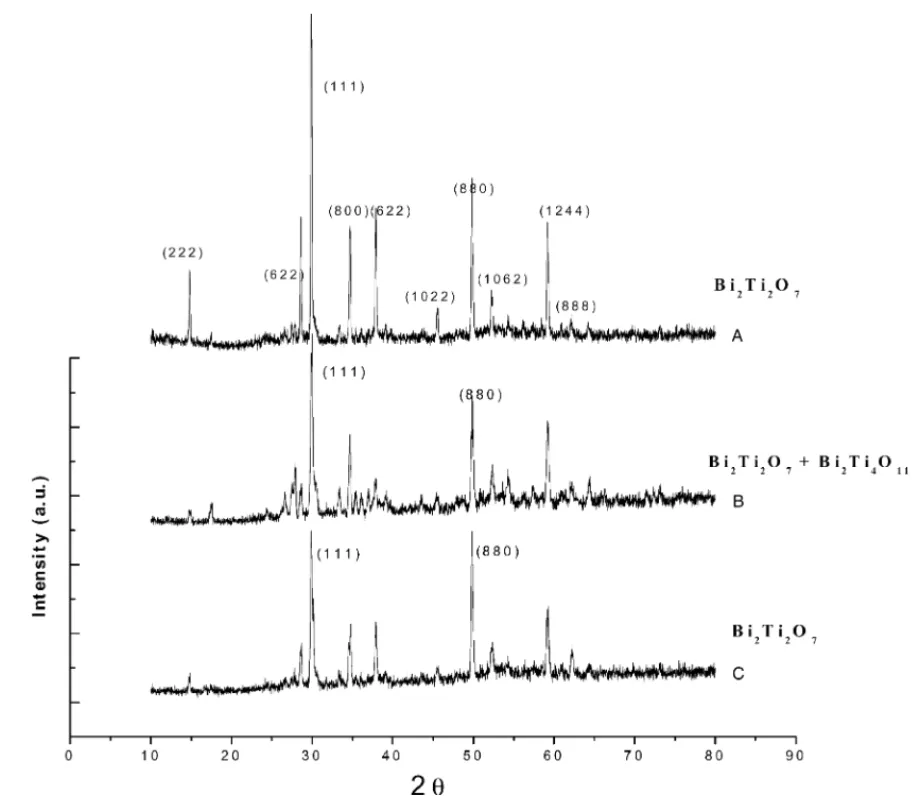
Fig. 2. XRD patterns of B2T2 ceramics sintered at 1200◦C for: (A) 45, (B) 90 and (C) 180 min.
1200◦C (Fig. 2). The observed low stability of B2T2 phase at temperatures higher than 700◦C was consistent with lit-erature reports. Nakamura et al. [10] observed that B2T2 changed to B4T3 at 640◦C when B2T2 was a buffer layer between B4T3 thin film and silicon substrate. Jiang et al.
[8]reported the formation of B2T2 at 600◦C from chemical co-precipitation of Bi(NO3)3 and (NH4)2TiO4, and
subse-quent change into B4T3 and B2T4 after a heat treatment at 975◦C. The B2T2 phase transformed into B4T3 and B2T4 by increasing the sintering temperature and time, indicat-ing that B4T3 and B2T4 are more thermodynamically fa-vored phases than B2T2. This is in agreement with the above chemical composition study. The reoccurrence of B2T2 at the highest studied temperature (1200◦C) may be due to a change in the powder’s composition. It is possible that the powder shifted to a Ti rich composition due to the volatiliza-tion of bismuth at high temperatures.
Dielectric properties were studied for two samples. One sample was sintered at 1150◦C 90 min−1 and exhibited a mixed phase of B4T3 and B2T4. The other sample was sin-tered at 1200◦C 45 min−1and exhibited a B2T2 phase. The
Fig. 3. Hysteresis loop of 1150◦C sample measured at 50 kV and 60 Hz.
dielectric constants of both samples decreased with increas-ing frequency and leveled off at 10 kHz. The maximum dis-sipation factor of samples was observed at 10 kHz. These results are consistent with the report by Yordanov et al. The data indicate that main contribution to the dielectric constant of the sample at low frequency was from space charges.[11]The 1150◦C sample showed a higher dielec-tric constant and a higher dissipation factor than those of the 1200◦C sample at low frequency, indicating that the 1150◦C sample contained more space charges than that of the 1200◦C sample. The high space charges may be from oxygen ion vacancies existing in the layer structure
Fig. 4. Hysteresis loop of 1200◦C sample measured at 50 kV and 60 Hz.
of B4T3 phase of 1150◦C sample. At a high frequency of 1 MHz, the contributions of dielectricity are from the dipoles of the material. Both samples exhibited similar dielectric properties. The 1150◦C sample had a dielectric constant of 101.3 and a loss tangent of 0.0193; and the 1200◦C sam-ple had a dielectric constant of 104.2 and a loss tangent of 0.0145.
Fig. 3shows the 1150◦C sample to be a ferroelectric ma-terial that exhibits a remanent polarization of 3.77C cm−2 and a coercive field of 24 kV cm−1. The ferroelectricity of the sample is from the B4T3 phase. Jiang et al.[8] re-ported that heat treated B2T2 samples exhibited a remanent
polarization of 5.5C cm−2 and a coercive field of 26 kV cm−1, values similar to our results. However, a com-pletely closed hysteresis loop was obtained for our sample whereas Jiang’s loop was not closed. This indicates that our sample was of good ferroelectric quality and had a minimal leakage current to the hystersis loop. The B2T2 material exhibited no evidence of ferroelectric behavior since a hys-teresis loop was not observed in the 1200◦C sample (Fig. 4). This is in contrast with Yordanov et al., who reported B2T2 to be a ferroelectric material. They made B2T2 by mixing equivalent amounts of Bi2O3and TiO2and sintered them at
1150–1200◦C for 2–3 h, but they did not have X-ray data to support the completed formation of B2T2 phase in their material. The observed ferroelectricity of their sample was most likely from the B4T3 phase, rather than from the B2T2 phase due to high sintering temperatures and equivalent amounts of Bi and Ti.
4. Conclusions
B2T2 ceramics were made from sol–gel method using bismuth methoxyethoxide and titanium methoxyethoxide at a Ti/Bi molar ratio of 1.23:1. The formation of B2T2 is possible a kinetically controlled reaction.
The B2T2 phase was stable at 700◦C for 2 h, but it changed into a thermal dynamically favored mixed phase of B4T3 and B2T4 at increased sintering temperatures and times.
The ferroelectric behavior of B2T2 ceramics is due to the B4T3 phase rather than from the B2T2 phase. The material sintered at 1150◦C 90 min−1 exhibited a mixed phase of B4T3 and B2T4. It exhibits a remanent polariza-tion of 3.77C cm−2 and coercive field of 24 kV cm−1; while, the material sintered at 1200◦C 45 min−1 exhibited a B2T2 phase, which did not exhibit ferroelectric hystersis behavior.
Acknowledgements
The financial support from the National Science Foun-dation of Republic of China under the grant of NSC-88-2216-E-022-041 was highly appreciated.
References
[1] T. Nakamura, Preparation of Bi4Ti3O12films by MOCVD and their application to memory devices, Integrated Ferroelectrics 6 (1995) 35–46.
[2] K. Fukuda, R. Kitoh, I. Awei, Microwave characteristics of TiO2 -Bi2O3dielectric resonator, Jpn. J. Appl. Phys. 32 (1993) 4584–4588. [3] L.W. Fu, H. Wang, S.X. Shang, X.L. Wang, P.M. Xu, Preparation and characterization of Bi2Ti2O7 thin films grown by metalorganic chemical vapor deposition, J. Cryst. Growth 139 (1994) 319–322. [4] Y. Masuda, H. Masumoto, A. Baba, T. Goto, T. Hirai, Crystal growth,
dielectric and polarization reversal properties of Bi4Ti3O12 single crystals, Jpn. J. Appl. Phys. 31 (Part I) (1992) 3108–3112. [5] M. Toyoda, Y. Hamaji, K. Tomono, D.A. Pan, Synthesis,
characterization of Bi4Ti3O12thin films by sol–gel processing, Jpn. J. Appl. Phys. 32 (1993) 4158–4162.
[6] S. Shimada, K. Kodaira, T. Matsushita, Crystal growth of bismuth titanates and titanium oxide from melts in the system, J. Cryst. Growth 41 (1977) 317–320.
[7] S.P. Yordanov, I. Ivanov, P. Carapanov, Dielectric properties of the ferroelectric Bi2Ti2O7 ceramics, J. Phys. D: Appl. Phys. 31 (1998) 800–806.
[8] A.Q. Jiang, Z.X. Hu, L.D. Zhang, Investigations of morphotropic phase transformations in the solid solution of Bi4Ti3O12 and Bi2Ti4O11 accompanied by defect dipole orientation and oxygen vacancy migration, J. Appl. Phys. 85 (3) (1999) 1739–1745. [9] M.C. Massiani, R. Papiernik, L.G. Hubert-Pfalzgraf, Molecular
precursors of bismuth oxides;-diketonates and alkoxides. Molecular structure of [Bi2(2,1-OC2H4OMe)4(1-OC2H4OMe)2]∞ and of Bi(OSiPh3)3(THF)3, Polyhedron 10 (4–5) (1991) 437–445. [10] T. Nakamura, R. Muhammet, M. Shimizu, T. Shiosaki, Preparation of
C-axis-oriented Bi4Ti3O12thin films by metalorganic chemical vapor deposition, Jpn. J. Appl. Phys. 32 (Part 1, 9B) (1993) 4086–4088. [11] H.S. Shulman, M. Testorf, D. Damuanovic, N. Setter, Microstrucrture,
electrical conductivity, and piezoelectric properties of bismuth titanate, J. Am. Ceram. Soc. 79 (12) (1996) 3124–3128.