IEEE PHOTONICS TECHNOLOGY LETTERS, VOL. 24, NO. 1, JANUARY 1, 2012 85
A 40-Gb/s OFDM PON System Based on 10-GHz
EAM and 10-GHz Direct-Detection PIN
Hsing-Yu Chen, Chia Chien Wei, Dar-Zu Hsu, Maria C. Yuang, Jyehong Chen, Yu-Min Lin, Po-Lung Tien,
Steven S. W. Lee, Shih-Hsuan Lin, Wei-Yuan Li, Chih-Hung Hsu, and Ju-Lin Shih
Abstract—This letter demonstrates a 40-Gb/s optical double-sideband (ODSB) orthogonal frequency-division multiplexing passive optical network (OFDM-PON) system using a cost-ef-fective 10-GHz-bandwidth electroabsorption modulator (EAM). By employing a subcarrier-adaptive modulation format and pre-emphasis, we successfully achieve 20-km EAM-based single-mode-fiber (SMF) transmission.
Index Terms—Electroabsorption modulator (EAM), orthogonal frequency-division multiplexing (OFDM), passive optical network (PON).
I. INTRODUCTION
P
ASSIVE optical network (PON) technology has been considered to be one of the most promising candidates for future broadband wired access. Currently, the gigabit PON (GPON) provides 2.5-Gb/s downstream and 1.25-Gb/s upstream services based on the nonreturn-to-zero (NRZ) modu-lation format [1]. Nevertheless, for future 40-Gb/s (and beyond) PON, NRZ format is no longer feasible due to constrains such as fiber dispersion, polarization mode dispersion (PMD), and expensive 40-GHz wideband electronics at transmitters and receivers, to name just a few. Although wavelength division multiplexing PONs (WDM-PONs) provide dedicated channel to each user, the high complexity and cost of WDM lasers and multiplexers urge researchers to yield an alternative and feasible solution.Thanks to the advance in digital signal processing technology, orthogonal frequency-division multiplexing (OFDM)-PON has been envisioned as a prominent candidate for future cost-ef-fective and flexible PONs [2]–[8]. With the flexibility of using
Manuscript received June 14, 2011; revised September 19, 2011; accepted October 10, 2011. Date of publication October 19, 2011; date of current version December 21, 2011.
H.-Y. Chen, Y.-M. Lin, and C.-H. Hsu are with the ICL/ITRI, Hsinchu 310, Taiwan.
C. C. Wei is with the Department of Photonics, National Sun Yat-sen Univer-sity, Kaohsiung 804, Taiwan.
D.-Z. Hsu is with the Department of Photonics, National Chiao-Tung Univer-sity, Hsinchu 300, Taiwan, and also with the ICL/ITRI, Hsinchu 310, Taiwan (e-mail: [email protected]).
M. C. Yuang, S.-H. Lin, J.-L. Shih are with the Department of Computer Sci-ence and Information Engineering, National Chiao-Tung University, Hsinchu, 300, Taiwan.
J. Chen and W.-Y. Li are with the Department of Photonics, National Chiao-Tung University, Hsinchu 300, Taiwan.
P.-L. Tien is with the Department of Electrical Engineering, National Chiao-Tung University, HsinChu 300, Taiwan.
S. S. W. Lee is with the Department of Communications Engineering, Na-tional Chung Cheng University Chia-Yi, 621, Taiwan.
Color versions of one or more of the figures in this letter are available online at http://ieeexplore.ieee.org.
Digital Object Identifier 10.1109/LPT.2011.2172595
higher order quadrature amplitude modulation (QAM) [4], [8], OFDM-PON effectively achieves high spectral efficiency and ultimately lowers the bandwidth requirement of components. Recently, 40-Gb/s optical single-sideband (OSSB) OFDM PON has been proposed and experimentally demonstrated [4]–[7]. OSSB OFDM is achieved by employing an optical I/Q modu-lator and two different wavelength external cavity lasers (ECLs) [4] or an optical interleaver [5]–[7]. However, the use of op-tical I/Q modulator and ECLs is expensive and complicated, and using optical interleaver requires precise wavelength con-trol, hence increasing the cost. Both methods are not suitable for cost-sensitive access networks.
Optical double-sideband (ODSB) OFDM-PON with directly modulated Distributed Feedback (DFB) laser (DML) or elec-troabsorption modulator (EAM) with DFB laser provides an economical alternative, but it gives rise to two hurdles that need to be crossed. First, ODSB OFDM signals result in power fading after fiber transmissions [9]. Second, the positive chirp of DMLs or EAMs has a detrimental effect on the maximum transmission distance over conventional fibers [10].
In this letter, to clear these hurdles we propose and demon-strate a 40-Gb/s ODSB OFDM PON, and we focus on the the-oretical and experimental studies of the transmission perfor-mance of 10-GHz EAM. By using a subcarrier-adaptive mod-ulation format and pre-emphasis, 40-Gb/s EAM-based 20-km standard single mode fiber (SMF) transmission is successfully achieved. We also investigate that adding erbium-doped fiber amplifier (EDFA) in the transmitter can improve the optical power budget to 21.5 dB, which can support 20-km SMF and 1:16 optical splitter in an ODSB OFDM PON.
II. THEORETICALANALYSIS OFDML-BASEDTRANSMISSION
Notice that both DML and EAM follow similar E/O char-acteristics. Namely, the output optical power is proportional to the input electrical signal, and additional frequency chirp will be generated after modulation. We hence choose DML to study the physical impairments induced by direct modulation. Based on our previous work [10], after square-law direct detection in the receiver, the normalized received signal after SMF trans-mission distance is
where is the chirp parameter, is the subcarrier number, and and are the encoded amplitude and phase informa-tion of the subcarrier, and are dispersion-induced and chirp-induced phase shifts, respectively. The second term at
86 IEEE PHOTONICS TECHNOLOGY LETTERS, VOL. 24, NO. 1, JANUARY 1, 2012
the RHS of above equation corresponds to the desired OFDM signal and the subcarrier power is proportional to
, the well-known formula of power fading [11]. Owing to positive , the power fading is intensified by an extra factor of , and therefore, the transmission band-width of DML-based OFDM signals is degraded by its positive chirp. In this work, subcarrier-adaptive modulation format and pre-emphasis are adapted to compensate the power fading. The modulation formats of subcarriers are adaptively adjusted based on the measured channel response by the OFDM training sym-bols. In the receiver, the measured signal to noise ratio (SNR) of
subcarriers, which is proportional to
, is used to calculate the pre-emphasis parameters, . Thus, is inversely proportional to the re-ceived SNR and can be used to adjust the power levels of transmitted subcarriers to homogenize the received SNRs of subcarriers. For example, subcarriers with poor SNRs will get extra power in the transmitter due to higher pre-emphasis pa-rameters . In the next section, we show the experimental re-sults and demonstrate that using subcarrier-adaptive modulation format and pre-emphasis improves the performance of 40-Gb/s ODSB OFDM signal transmission.
III. EXPERIMENTALSETUP ANDRESULTS
In the experiment, the OFDM signals are generated by an arbitrary waveform generator (AWG, Tektronix AWG7102) using the Matlab program. The OFDM transmitter consists of serial-to-parallel conversion, QAM modulation, inverse fast Fourier transform (IFFT), cyclic prefix (CP) insertion, and digital-to-analog conversion (DAC). The sampling rate and digital-to-analog converter resolution of the AWG are 12 GS/s and 8 bits, respectively. Other detailed parameters of generated OFDM signals include: FFT size , CP size , and every 100 OFDM symbols is added with 10 training symbols for channel response detection. Besides, the driving signal consists of an OFDM signal of 23.4375-MSym/s 128-QAM symbol that is encoded at channels 6–98 with a bandwidth of 2.18 GHz (band 1) and a total data rate of 15.2578 Gb/s. An-other OFDM signal of the same symbol rate but with 64-QAM format is encoded and up-converted to 4.406 GHz which oc-cupies from channels 99–186 and 200 to 287 with a combined data rate of 24.75 Gb/s (band 2). Combining these two OFDM bands, we achieve a total data rate of 40 Gb/s, including the training-symbol, CP, and 7% forward error correction (FEC) overhead, or 32.84 Gb/s excluding the overhead.
Fig. 1 shows the experimental setup with the insets dis-playing the corresponding OFDM electrical spectra without pre-emphasis. Two streams of electrical signals are generated from channels 1 and 2 of AWG, respectively. The channel-2 signal is amplified and up-converted to 4.406 GHz. Notably, since the channel number of the AWG is only 2, this up-con-verted signal is used to emulate band-2 signal which should be realized by independent I- and Q-channels in practice. Through a directional coupler, both signals are then com-bined and passed to a 10-GHz EAM. An EDFA is used in the transmitter to compensate the optical power loss induced by the SMF transmission and optical splitter, and an optical variable attenuator (Att ) is allocated after EDFA and used to avoid the nonlinear effects. The optical splitter is emulated by
Fig. 1. Experimental setup with electrical spectrum illustration. (a) Channel 2; (b) channel 1; (c) channel 1 after up-conversion; (d) combination of channels 1 and 2; and (e) combination of channels 1 and 2 after receiving.
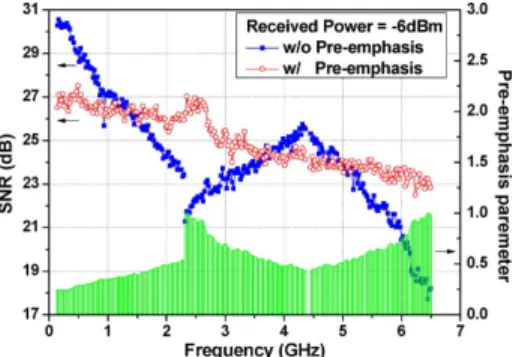
Fig. 2. Subcarrier SNR before and after pre-emphasis and the pre-emphasis parameters.
Att . Following 20-km SMF transmission, the optical signal is received by a 10-GHz PIN photo-detector. After square-law photo detection, the waveform is amplified and captured by a digital oscilloscope (Tektronix DPO 71254) with a 50-GS/s sampling rate and a 3-dB bandwidth of 16 GHz. Due to the limited buffer size of oscilloscope, 1000 OFDM symbols with 1.707 Megabits are captured. An offline Matlab digital signal processing program is employed to demodulate the OFDM signal. This demodulation process includes synchronization, fast Fourier transform (FFT), one-tap equalization, and QAM symbol decoding. From the constellations of the OFDM signal, we measure the SNR and in turn calculate the bit error rate (BER).
One important factor that limits the performance of EAM is the RF fading following fiber transmission. Because the gener-ated optical signal exhibits double side bands, after fiber disper-sion, the two side bands create different phase shifts resulting in signal power loss [9]. To overcome this problem, we employ a pre-emphasis algorithm. As shown in Fig. 2, we first display the SNR by the blue curve without power adjustment. Though some subcarriers maintain relatively high SNR, the subcarriers located at high frequency, nonetheless, suffer from RF fading that causes severe SNR degradation. After applying the pre-em-phasis algorithm and parameters as shown in the green lines, we attain a smoother SNR as shown in the red curve, hence an improved performance compared to that without the pre-em-phasis algorithm.
On the basis of the theoretical model presented in the pre-vious section, the chirp parameter of EAM is measured [12] and equal to 0.7 when the bias is set at V. In Fig. 3(a) and (b), we plot the theoretical and experimental results of power fading
CHEN et al.: 40-Gb/s OFDM PON SYSTEM BASED ON 10-GHz EAM AND 10-GHz DIRECT-DETECTION PIN 87
Fig. 3. Theoretical and experimental results of subcarrier ( = 0:7, L = 20 km). (a) Power fading; (b) SNR degradation.
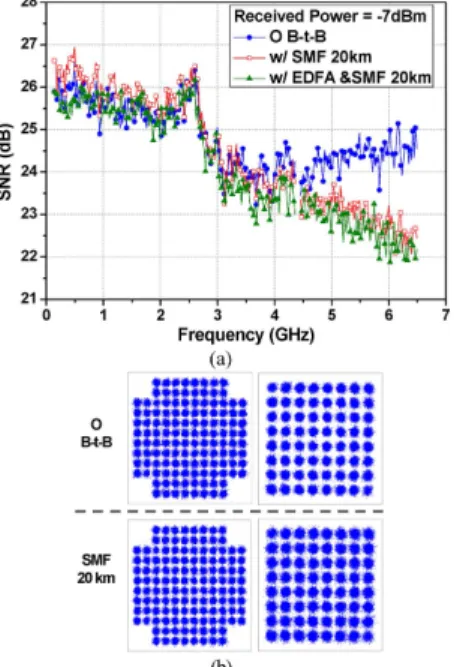
Fig. 4. (a) EAM SNR and (b) constellations before and after fiber transmis-sions.
Fig. 5. BER before and after fiber transmissions.
and SNR penalty of each subcarrier after a 20-km SMF trans-mission. We observe that the experimental results are consistent with theoretical results.
Fig. 4(a) depicts the EAM SNR of each subcarrier at back-to-back and following 20-km SMF transmission with and without an EDFA. The RF fading is intensified after taking into account the frequency chirp from the EAM. Because the fading is more substantial at higher frequency, to compensate the power loss from fading, extra power is given to high-frequency subcarriers. Thus they exhibit better SNR as can be seen from the blue line of Fig. 4(a). However, in the case of 20-km SMF transmission, due to RF fading, the higher frequency subcarriers suffer most and exhibit the lowest SNR. In Fig. 4(b), we plot the constellation of band 1 (128-QAM) and band 2 (64-QAM) before and after fiber transmissions. Fig. 5 shows the BER of EAM at back-to-back
and following 20-km of SMF transmissions with and without an EDFA, respectively. The BER of less than can be ob-tained at both receiving powers of dBm and dBm. After using an EDFA, the received power (BER ) is slightly reduced to dBm. Furthermore, due to the use of the pre-emphasis algorithm, we observe a negligible transmission penalty. The optical power after Att is 14 dBm, thus 21.5-dB optical power budget is obtainable, which can support 20-km SMF and 1:16 optical splitter in an ODSB OFDM PON.
IV. CONCLUSION
In this letter, we have presented the theoretical study and experimental results of a 40-Gb/s ODSB OFDM transmission system that efficiently employs EAM of 10-GHz bandwidth. Experimental and theoretical results delineate that the power and SNR considerably deteriorate as a result of the frequency chirp from the EAM via the RF fading effect. To compensate the power and SNR degradations of higher frequency subcarrier, we have employed a pre-emphasis algorithm and subcarrier-adap-tive modulation format at the transmitter. Experimental results then demonstrate that 40-Gb/s transmission of 20-km SMF and 1:16 optical splitter in an ODSB OFDM PON via EAM is suc-cessfully achieved. In the future, we will proceed to adopt the bit loading and pre-emphasis algorithms, which can further im-prove the bandwidth efficiency and mitigate subcarriers degra-dation at high frequency.
REFERENCES
[1] K. Grobe and J. P. Elbers, “PON in adolescence: From TDMA to WDM-PON,” IEEE Commun. Mag., vol. 46, no. 1, pp. 26–34, Jan. 2008.
[2] S. Skafidas and D. Hewitt, “Performance and applications of gigabit OFDM over optical fibre systems in metro and access networks,” in
Proc. ECOC 2006, Cannes, France, Sep. 2006, vol. 3, pp. 429–430.
[3] Y. M. Lin and P. L. Tien, “Next-generation OFDMA-based passive optical network architecture supporting radio-over-fiber,” IEEE J. Sel.
Areas Commun., vol. 28, no. 6, pp. 791–799, Aug. 2010.
[4] D. Qian, S. H. Fan, N. Cvijetic, J. Hu, and T. Wang, “64/32/16QAM-OFDM using direct-detection for 40G-“64/32/16QAM-OFDMA-PON downstream,” in
Proc. OFC 2011, Los Angeles, CA, Mar. 2011, Paper OMG4.
[5] D. Qian, N. Cvijetic, J. Hu, and T. Wang, “40-Gb/s MIMO-OFDM-PON using polarization multiplexing and direct-detec-tion,” in Proc. OFC 2009, San Diego, CA, Mar. 2009, Paper OMV3. [6] D. Qian, J. Yu, J. Hu, P. N. Ji, and T. Wang, “11.5-Gb/s OFDM
trans-mission over 640 km SSMF using directly modulated laser,” in Proc.
ECOC 2008, Brussels, Belgium, Sep. 2008, Paper Mo.3.E.4.
[7] N. Cvijetic, M. F. Huang, E. Ip, Y. K. Huang, D. Qian, and T. Wang, “1.2 Tb/s symmetric WDM-OFDMA-PON over 90 km straight SSMF and 1:32 passive split with digitally-selective ONUs and coherent re-ceiver OLT,” in Proc. OFC 2011, Los Angeles, CA, Mar. 2011, Paper PDPD7.
[8] D. Z. Hsu, C. C. Wei, H. Y. Chen, J. Chen, M. C. Yuang, S. H. Lin, and W. Y. Li, “21 Gb/s after 100 km OFDM long-reach PON transmission using a cost-effective electro-absorption modulator,” Opt. Express, vol. 18, no. 26, pp. 27758–27763, Dec. 2010.
[9] J. L. Wei, X. Q. Jin, and J. M. Tang, “The influence of directly modu-lated DFB lasers on the transmission performance of carrier-suppressed single-sideband optical OFDM signals over IMDD SMF systems,” J.
Lightw. Technol., vol. 27, no. 13, pp. 2412–2419, Jul. 1, 2009.
[10] C. C. Wei, “Small-signal analysis of OOFDM signal transmission with directly modulated laser and direct detection,” Opt. Lett., vol. 36, no. 2, pp. 151–153, Jan. 2011.
[11] U. Gliese, S. Ngrskov, and T. N. Nielsen, “Chromatic dispersion in fiber-optic microwave and millimeter-wave links,” IEEE Trans.
Mi-crow. Theory Tech., vol. 44, no. 10, pp. 1716–1724, Oct. 1996.
[12] J. Wang and K. Petermann, “Small signal analysis for dispersive optical fiber communication systems,” J. Lightw. Technol., vol. 10, no. 1, pp. 96–100, Jan. 1992.