This content has been downloaded from IOPscience. Please scroll down to see the full text.
Download details:
IP Address: 140.113.38.11
This content was downloaded on 28/04/2014 at 22:09
Please note that terms and conditions apply.
Power scale-up of high-pulse-energy passively Q-switched Nd:YLF laser: influence of
negative thermal lens enhanced by upconversion
View the table of contents for this issue, or go to the journal homepage for more 2012 Laser Phys. Lett. 9 625
(http://iopscience.iop.org/1612-202X/9/9/001)
Abstract: We develop a practical method to extend the power scale-up for a laser in a concave-plano cavity to be influenced by a large negative thermal lens. With the developed method, we successfully scale up the output power of a compact high-pulse-energy passively Q-switched Nd:YLF laser at 1053 nm with the Cr4+:YAG crystal as a saturable absorber. At an inci-dent pump power of 12.6 W, the maximum output power un-der the optimum operation at 1053 nm reaches 2.61 W with a pulse width of 6 ns and a pulse repetition rate of 4.6 kHz. More importantly, we experimentally verify that the energy-transfer upconversion significantly enhances the negative focal length of thermal lens in the passively Q-switched Nd:YLF laser.
fth , mm Ther mal f ocal length -1200 -1000 -800 -600 -400 -200 0 14 12 10 8 6 4 2 0
Incident pump power, W
PQS operation CW operation
Numerical calculations of the thermal focal length versus the incident pump power for the CW and PQS cases
c
⃝ 2012 by Astro, Ltd.
Power scale-up of high-pulse-energy passively Q-switched
Nd:YLF laser: influence of negative thermal lens enhanced
by upconversion
Y.J. Huang, C.Y. Tang, Y.P. Huang, S.C. Huang, K.W. Su, and Y.F. Chen∗ Department of Electrophysics, National Chiao Tung University, Hsinchu, Taiwan Received: 13 February 2012, Revised: 25 February 2012, Accepted: 1 March 2012 Published online: 12 June 2012
Key words: passive Q-switching; thermal lens; energy-transfer upconversion; Nd:YLF
1. Introduction
Diode-pumped solid-state lasers are useful in a great num-ber of industrial applications and scientific researches. Passive Q-switching of the solid-state laser with a sat-urable absorber provides a reliable pulsed operation that takes the advantages of high stability, inherent compact-ness, and low cost [1–3]. The laser crystal with long flu-orescence lifetime is highly desirable for continuously pumped passively Q-switched (PQS) laser to generate high-energy pulses. Consequently, the Nd:YLF crystal that is characterized by relatively long upper-state lifetime has large potential for developing a high-pulse-energy pulsed
laser with the Cr4+:YAG saturable absorber. Moreover, the Nd:YLF laser is inherently beneficial to be a master oscil-lator for the Nd:Glass power amplifier due to the excellent spectral overlap between the 1053-nm emission line and the gain peak of the Nd:Glass laser [4].
Practically, using the c-cut Nd:YLF crystal is a con-venient way for generating the emission line at 1053 nm, because it can completely avoid the complexities required for the suppression of the unwanted laser transition at 1047 nm. The fluorescence lifetime of 540 µs at 1053 nm in the c-cut Nd:YLF crystal is also expected to be more suitable for producing high-energy pulses as compared with that of 490 µs at 1047 nm in the a-cut counterpart [3]. ∗Corresponding author: e-mail: [email protected]
626
Laser Physics
Letters Y.J. Huang, C.Y. Tang, et al.: Power scale-up of high-pulse-energy PQS Nd:YLF laser
However, the implementation of high-pulse-energy PQS Nd:YLF lasers at 1053 nm has not been completely ex-plored yet. The main reason is that the behavior of the thermal-lensing effect in the c-cut Nd:YLF crystal is sig-nificantly different from the ones in other popular gain me-dia such as Nd:YVO4and Nd:YAG crystals. The critical difference is that the negative dependence of the refractive index on the temperature (dn/dT) over the positive contri-bution from the end-face bulging of the gain medium leads the c-cut Nd:YLF crystal to behave a defocusing thermal lens. Furthermore, the effect of the energy-transfer upcon-version (ETU) reduces the effective upper-state lifetime and increases the fractional thermal loading in the laser crystal [5–8]. The ETU effect inevitably causes the effec-tive focal length of the thermal lens in the PQS operation to be considerably more negative than the one in the con-tinuous wave (CW) operation. As a result, a reliable and efficient tactic for designing continuously pumped high-pulse-energy PQS laser at 1053 nm is highly desirable to be developed.
In this work, we develop a straightforward method to implement the power scale-up of a compact high-pulse-energy PQS Nd:YLF laser at 1053 nm with the Cr4+:YAG crystal as a saturable absorber in a concave-plano cavity. We numerically analyze the mode-to-pump size ratio as a function of the thermal focal length to verify that decreas-ing the radius of curvature (ROC) of the concave mirror can effectually extend the power scale-up for a laser in a concave-plano cavity to be influenced by a large negative thermal lens. With the developed method, we experimen-tally make a systematic comparison between the CW and PQS operations of the c-cut Nd:YLF laser to confirm the negative thermal-lensing effect enhanced by the ETU ef-fect. At an incident pump power of 12.6 W, the optimum 1053-nm laser produces the maximum output power of 2.61 W with a pulse width of 6 ns and a pulse repetition rate of 4.6 kHz. The corresponding pulse energy and peak power are estimated to be up to 570 µJ and 95 kW, respec-tively. To the best of our knowledge, these are the largest pulse energy and highest peak power ever reported among continuously pumped PQS Nd-doped crystal/Cr4+:YAG lasers with the same initial transmission.
2. Numerical analyses
Previous studies have demonstrated that the mode-to-pump size ratio plays an important role for power scaling in diode-end-pumped solid-state lasers, in which the op-timum mode-to-pump size ratio is practically found to be in the range 0.6 – 1.0 [9–11]. With the ABCD-matrix the-ory, here we take into account of the thermal-lensing ef-fect to numerically calculate the mode-to-pump size ratio as a function of the thermal focal length for the cases of
R = 50 mm, 100 mm, 200 mm, and 500 mm in a
concave-plano cavity, where R is the ROC of the input concave mir-ror. In the present analyses, the pump radius ωp0= 210 µm
Mode-to-pump siz e r a ti o 1.4 1.2 1.0 0.8 0.6 1200 1000 800 600 400 200 0 fth, mm Thermal focal length
(a) Lcav= 35 mm R = 500 mm R =200 mm R = 50 mm R = 100 mm Mode-to-pump siz e r a ti o 1.6 1.4 1.2 1.0 0.8 0.6 0 -1000 -800 -600 -400 -200 -1200 fth, mm Thermal focal length
(b) Lcav= 35 mm R = 500 mm R =200 mm R = 50 mm R = 100 mm
Figure 1 (online color at www.lasphys.com) Calculated results for the mode-to-pump size ratio as a function of the thermal fo-cal length for the cases of R=50 mm, 100 mm, 200 mm, and 500 mm. (a) – positive thermal-lensing effect and (b) – negative thermal-lensing effect
and the cavity length Lcav= 35 mm are used, and the
ther-mally induced lens is set to be adjacent to the input con-cave mirror.
When the positive thermal lens is considered, we find that the mode-to-pump size ratios for all cases are well located between 0.6 – 1.0 in the large operated region, as depicted in Fig. 1a. We also find that the magnitude of the thermal focal length|fth| should be larger than (RL)/(R− L) to satisfy the stability criterion. Because the magnitude
of the thermal focal length is inversely proportional to the incident pump power, the higher incident pump power can be allowed by using the concave mirror with larger ROC when the positive thermal lens is regarded.
On the other hand, we find that the ROC of the con-cave mirror needs to be small enough to fulfill the optimum mode-to-pump size ratio for the case of negative
thermal-c
⃝ 2012 by Astro, Ltd.
Laser diode
Coupling lens
Input mirror Output coupler
Nd:YLF
Cr4+:YAG
Lcav
Figure 2 (online color at www.lasphys.com) Configuration of the cavity setup for a diode-pumped PQS Nd:YLF/Cr4+:YAG laser
lensing effect, as shown in Fig. 1b. At the same time, the magnitude of the thermal focal length|fth| is derived to
need to be larger than R to keep the cavity stable. On the whole, it is numerically found that decreasing the ROC of the concave mirror is favorable for simultaneously achiev-ing good mode-to-pump size ratio as well as power scal-ing in a concave-plano cavity that is affected by a negative thermal lens.
3. Experimental setup
The experimental setup is schematically shown in Fig. 2. The input concave mirror was antireflection (AR) coated at 806 nm on the entrance face, and was coated for high transmission at 806 nm as well as for high reflection at 1053 nm on the second surface. The gain medium was a 0.8 at.% c-cut Nd:YLF crystal with the diameter of 4 mm and the length of 15 mm. The Nd:YLF crystal was placed adjacent to the input concave mirror. Both facets of the laser crystal were AR coated at 806 and 1053 nm. The Cr4+:YAG saturable absorber with an initial transmission of 80% was AR coated at 1053 nm on both surfaces, and it was placed near to the output coupler for achiev-ing a high-quality PQS operation. The laser crystal and the saturable absorber were wrapped with indium foil and mounted in water-cooled copper heat sinks at 16◦C. The pump source was a fiber-coupled laser diode at 806 nm with a core diameter of 400 µm and a numerical aperture of 0.14. The pump beam with the spot radius of 210 µm was re-imaged inside the laser crystal with a lens set that has the focal length of 25 mm and the coupling efficiency of 90%. The flat output coupler with the reflectivity of 74% at 1053 nm was employed throughout the experiment. The cavity length was set to be 35 mm for the construction of a compact PQS laser. The pulse temporal behaviors were recorded by a LeCroy digital oscilloscope (Wavepro 7100, 10 G samples/s, 1 GHz bandwidth) with a fast InGaAs photodiode. Output po w e r a t 1053 n m, W 3.0 2.5 2.0 1.5 1.0 0.5 0 14 12 10 8 6 4 2
Incident pump power at 806 nm, W (b) T PQS operation, 0 = 80% R = 500 mm R =200 mm R = 50 mm R = 100 mm Output po w e r a t 1053 n m, W 5 4 3 2 1 0 14 12 10 8 6 4 2
Incident pump power at 806 nm, W (a) CW operation R = 500 mm R =200 mm R = 50 mm R = 100 mm
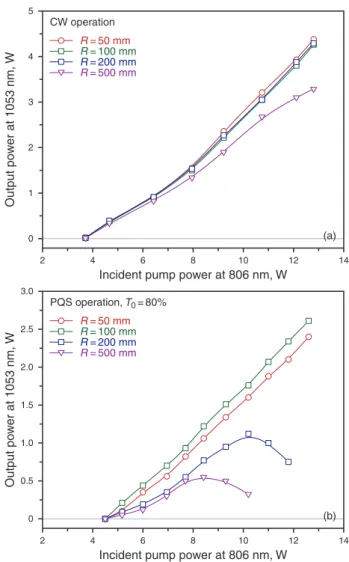
Figure 3 (online color at www.lasphys.com) Output power as a function of the incident pump power for the cases of R = 50 mm, 100 mm, 200 mm, and 500 mm. (a) – in the CW operation and (b) – in the PQS operation
4. Performance of CW and PQS operations
First of all, the CW operation without the saturable ab-sorber was studied. Fig. 3a shows the output power at 1053 nm as a function of the incident pump power at 806 nm for the cases of R = 50 mm, 100 mm, 200 mm, and 500 mm. It is obvious that although the pump thresh-olds for all cases are almost identical, the slope efficiency obtained with R = 500 mm is remarkably lower than those obtained with other three cases. This observation is a result of the poorer mode-to-pump size ratio, as can be referred to Fig. 1b for R = 500 mm case.When the Cr4+:YAG saturable absorber was inserted into the resonator, the degradation in the output power to-gether with the roll-over phenomena for R=200 mm and 500 mm in the PQS operation further highlight the crucial importance of using small ROC of the concave mirror for
628
Laser Physics
Letters Y.J. Huang, C.Y. Tang, et al.: Power scale-up of high-pulse-energy PQS Nd:YLF laser
power scale-up, as depicted in Fig. 3b. During the early re-searches on the Nd:YLF crystal, many investigations indi-cated that power scaling in the Nd:YLF laser is practically hindered by the ETU effect [5–8]. The combined effect of the ETU effect and its subsequent multiphonon relaxation brings in the considerable enhancement of the thermal-lensing effect in the Nd:YLF laser. As a consequence, the increased thermal-lensing effect in the present PQS oper-ation is believed to cause the deterioroper-ation in the output powers for R = 200 mm and 500 mm. From the analyses of the coupled rate equation, the criterion for good PQS operation is given by [12]: ln ( 1 T2 0 ) ln ( 1 T2 0 ) + ln ( 1 ROC )σgs σ A As ≫ γ 1− β, (1)
where T0 is the initial transmission of the saturable ab-sorber, ROC is the reflectivity of the output coupler, L
is the nonsaturable loss, σgs is the ground-state
absorp-tion cross secabsorp-tion of the saturable absorber, σ is the stim-ulated emission cross section of the gain medium, A/As
is the ratio of the mode area in the gain medium and in the saturable absorber, γ is the inversion reduction fac-tor, and β is the ratio of the excited-state absorption cross section to the ground-state absorption cross section in the saturable absorber. Since the σgsvalue of the Cr4+:YAG
crystal (∼ (20±5)×10−19 cm2) is remarkably larger than the σ value of the Nd:YLF crystal (1.2×10⁻¹⁹ cm2), the criterion for good PQS operation is generally satisfied in the Nd:YLF/Cr4+:YAG laser despite the ratio of the mode area A/Asvaries with the incident pump power and the
ROC of the concave mirror. In other words, the influence of the changing mode area in the saturable absorber on the PQS performance can be neglected undoubtedly.
To further investigate the influence of the negative ther-mal lens on the Nd:YLF laser, we evaluate the effective fo-cal length of the thermal lens with the following equation [13,14]: 1 fth = (2) =ξPin πKc l ∫ 0 αe−αz 1− e−αz 1 ω2 p(z) [ 1 2 dn dt+(n−1)αT ωP(z) l ] dz , ωp(z) = ωp0 v u u t1 +[M2λ p nπω2 p0 (z− z0) ]2 , (3)
where ξ is the fractional thermal loading, Pinis the
inci-dent pump power, Kc is the thermal conductivity of the
laser crystal, l is the length of the laser crystal, α is the absorption coefficient at the pump wavelength λp, dn/dT
is the temperature dependence of the refractive index, n is the refractive index, αT is the coefficient of the
ther-mal expansion, M2 is the pump beam quality factor, and fth , mm Ther mal f oca l len gth -1200 -1000 -800 -600 -400 -200 0 14 12 10 8 6 4 2 0
Incident pump power, W PQS operation
CW operation
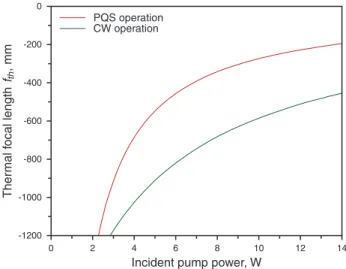
Figure 4 (online color at www.lasphys.com) Numerical calcula-tions of the thermal focal length versus the incident pump power for the CW and PQS cases
ωp(z) is the variation of the pump radius, where the pump
beam waist ωp0 is assumed a distance z0 from the en-trance of the laser crystal. With the following parameters:
Kc= 6.3 W/m K, l = 15 mm, α = 0.18 mm−1, λp= 806 nm, dn/dT = –2×10⁻⁶ K−1, n = 1.448, αT= 8.3×10⁻⁶ K−1, M2= 115, ω
p0= 210 µm, and z0= 3.8 mm, the thermal focal length with respect to the incident pump power is plotted in Fig. 4. Numerical calculations for the CW case with ξ = 0.24 are found to be consistent with the previ-ously published data, where the fractional thermal loading
ξ is derived from the quantum defect value. According to
the previous studies, the fractional thermal loading influ-enced by the ETU effect is usually magnified by a factor of ∼ 3 as compared with the value in the CW operation. Therefore, we use ξ = 0.7 to calculate the PQS case, as re-vealed in Fig. 4. Numerical calculations for the PQS case are found to be in good agreement with the estimated re-sults deduced from the experimental data shown in Fig. 3b. The deduction is based on the fact that the ROC of the concave mirror needs to be smaller than the magnitude of the thermal focal length to satisfy the stability criterion, as analyzed in Sec. 2. To be brief, a concave mirror with the ROC significantly smaller than the thermal focal length can be effectively used to achieve the power scale-up for a laser influenced by a negative thermal lens with a plano-concave cavity. Moreover, due to the ETU effect, the suit-able ROC of the concave mirror for the PQS case is con-siderably smaller than that for the CW case at the same incident pump power.
In Fig. 3b, the resonator with R = 100 mm is found to possess the highest maximum output power of 2.61 W at an incident pump power of 12.6 W. Therefore, we make a thorough study on the performance of the PQS Nd:YLF/Cr4+:YAG laser with R = 100 mm. Fig. 5a and Fig. 5b illustrate the dependences of the pulse width, pulse
c
⃝ 2012 by Astro, Ltd.
Pulse width, ns 17 15 13 9 7 5 6 5 4 3 2 1 0 Pulse repetition r ate , kH z 4 6 8 10 12 14
Incident pump power at 806 nm, W (a) Pulse width
Pulse repetition rate
Pulse energy , µ J 700 600 500 400 300 200 100 80 60 40 20 0 P eak p o w er , kW 4 6 8 10 12 14
Incident pump power at 806 nm, W
(b) Pulse energy
Peak power
Figure 5 (online color at www.lasphys.com) Dependences of (a) the pulse width, pulse repetition rate and (b) pulse energy, peak power on the incident pump power in the PQS operation with R = 100 mm
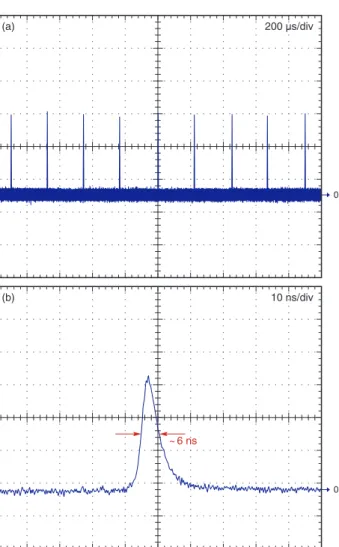
repetition rate, pulse energy and peak power on the cident pump power. When the incident pump power in-creases from 5.17 to 12.6 W, the pulse width dein-creases from 14s to 6 ns and the pulse repetition rate varies from 1.0 to 4.6 kHz, as shown in Fig. 5a. Accordingly, it can be seen that the pulse energy increases from 210 to 570 µJ and the peak power changes from 15 to 95 kW with in-creasing the incident pump power from 5.17 to 12.60 W, as revealed in Fig. 5b. Typical temporal behaviors of the output pulses at an incident pump power of 12.6 W are shown in Fig. 6a and Fig. 6b with the time span of 2 ms and 100 ns, respectively. The pulse-to-pulse amplitude fluctu-ation is generally found to be within±3%.
Finally, it is worthwhile to mention that so far the pulse energies obtained with the continuously pumped PQS Nd-doped crystal/Cr4+:YAG lasers, such as the Nd:YAG [1,2], c-cut Nd:YLF [3], Nd-doped vanadate crystals [1], and so on, are not more than∼ 300 µJ. That is to say, the pulse energy based on the4F
3/2→4I11/2 transition is signifi-cantly enhanced in our present work. This indicates that
0 (a) 0 (b) 200 µs/div 10 ns/div ~ 6 ns
Figure 6 (online color at www.lasphys.com) Typical temporal behaviors at 1053 nm with (a) – time span of 2 ms and (b) – time span of 100 ns
the c-cut Nd:YLF crystal is potentially favorable for the construction of high-pulse-energy lasers as long as the op-tical resonator is intricately designed to compensate for the large negative thermal-lensing effect in the gain medium.
5. Conclusion
In summary, we have found that decreasing the ROC of the concave mirror can usefully extend the power scale-up for a laser in a concave-plano cavity to be influenced by a large negative thermal lens. With this finding, we have de-veloped a practical tactic to scale up the output power of a compact high-pulse-energy PQS Nd:YLF laser at 1053 nm with the Cr4+:YAG crystal as a saturable absorber. At an incident pump power of 12.6 W, the optimum PQS laser at 1053 nm emits the maximum output power of 2.61 W with a pulse width of 6 ns and a pulse repetition rate of 4.6 kHz. The corresponding pulse energy and peak power are up to
630
Laser Physics
Letters Y.J. Huang, C.Y. Tang, et al.: Power scale-up of high-pulse-energy PQS Nd:YLF laser
570 µJ and 95 kW, respectively. We further experimentally confirmed that the negative focal length of the thermal lens is considerably enhanced by the ETU effect in the PQS Nd:YLF laser.
Acknowledgements The authors thank the National Science Council for their financial support of this research under Con-tract No. NSC-100-2628-M-009-001-MY3.
References
[1] A. Agnesi, S. Dell’Acqua, C. Morello, G. Piccinno, G.C. Reali, and Z.Y. Sun, IEEE J. Sel. Top. Quantum Electron. 3, 45–52 (1997).
[2] N. Pavel, J. Saikawa, S. Kurimura, and T. Taira, Jpn. J. Appl. Phys. 40, 1253–1259 (2001).
[3] S.D. Pan, K.Z. Han, H.M. Wang, X.W. Fan, and J.L. He, Chin. Opt. Lett. 4, 407–409 (2006).
[4] A.V. Okishev and W. Seka, IEEE J. Sel. Top. Quantum Electron. 3, 59–63 (1997).
[5] M. Pollnau, P.J. Hardman, M.A. Kern, W.A. Clarkson, and D.C. Hanna, Phys. Rev. B 58, 16076–16092 (1998). [6] P.J. Hardman, W.A. Clarkson, G.J. Friel, M. Pollnau, and
D.C. Hanna, IEEE J. Quantum Electron. 35, 647–655 (1999).
[7] J.D. Zuegel and W. Seka, Appl. Opt. 38, 2714–2723 (1999).
[8] L.C. Courrol, E.P. Maldonado, L. Gomes, N.D. Vieira, Jr., I.M. Ranieri, and S.P. Morato, Opt. Mater. 14, 81–90 (2000).
[9] Y.F. Chen, T.M. Huang, C.F. Kao, C.L. Wang, and S.C. Wang, IEEE J. Quantum Electron. 33, 1424–1429 (1997). [10] Y.F. Chen, T.M. Huang, C.C. Liao, Y.P. Lan, and S.C. Wang, IEEE Photon. Technol. Lett. 11, 1241–1243 (1999). [11] Y.F. Chen, Y.C. Chen, S.W. Chen, and Y.P. Lan, Opt.
Com-mun. 234, 337–342 (2004).
[12] Y.F. Chen, Y.P. Lan, and H.L. Chang, IEEE J. Quantum Electron. 37, 462–468 (2001).
[13] W. Koechner, Solid-State Laser Engineering, 6th ed. (Springer, Berlin, 2005), chapter 7.
[14] Y.J. Huang, P.Y. Chiang, H.C. Liang, K.W. Su, and Y.F. Chen, Opt. Commun. 285, 59–63 (2012).
c
⃝ 2012 by Astro, Ltd.