國立政治大學英國語文學系碩士在職專班碩士論文
指導教授: 余明忠博士 Adviser: Dr. Ming-chung, Yu
探討高中老師對英文選修課態度信念之個案研究
Senior High School Teachers’ Beliefs and Practices in English Electives: A Case Study
研究生: 劉家慧撰 Name: Chiahui, Liu 中華民國 105 年 1 月 January, 2016
‧
國
立
政 治 大
學
‧
N
a
tio
na
l C
h engchi U
ni
ve
rs
it
y
SENIOR HIGH SCHOOL TEACHERS’ BELIEFS AND PRACTICES IN ENGISH ELECTIVES: A CASE STUDY
A Master Thesis Presented to Department of English, National Chengchi University
In Partial Fulfillment
Of the Requirements for the Degree of Master of Arts By Chiahui Liu January, 2016
‧
國
立
政 治 大
學
‧
N
a
tio
na
l C
h engchi U
ni
ve
rs
it
y
‧
國
立
政 治 大
學
‧
N
a
tio
na
l C
h engchi U
ni
ve
rs
it
y
iii To Professor Ming-chung Yu 獻給我的恩師余明忠教授
‧
國
立
政 治 大
學
‧
N
a
tio
na
l C
h engchi U
ni
ve
rs
it
y
iv
Acknowledgments
My deepest gratitude, first and foremost, goes to my adviser Dr. Ming-chung Yu. Without his inspirational guidance and continuous support, this thesis would not have been completed. I am also grateful to Dr. Chen-kuan Chen and Dr. Yi-ping Huang for their invaluable advice on the revision of my thesis. My sincere thanks as well go to Brenda, the teacher participant in this research, for her generosity to share her English elective class with me and her patience to join me in this painstaking process of exploring a brand-new English teaching scenario. I feel equally indebted to my colleagues, Ya-ling, Yu-hui, Chun-mei, and many more, who kindly provided assistance that oftentimes came in handy for my research as well as warm support when I needed it the most. Among all those friends who had encouraged me all the way through, I owe a lot particularly to Chien-ling, Candy, and Mandy, who never hesitated to lend ears and shoulders to me whenever I felt down or was in doubt. The completion of this thesis, above all, would not be made possible without my truest friend and love of my life, Eric, who patiently
endured all the disturbance my devotion to this research had brought to our family life and gently supported me with both words and actions throughout these years. Most
important of all, I would like to share this thesis with my three lovely boys, Hank, Marvin, and Kai, who have since birth witnessed the arduous effort their mom put into making a dream possible.
‧
國
立
政 治 大
學
‧
N
a
tio
na
l C
h engchi U
ni
ve
rs
it
y
v
TABLE OF CONTENTS
ACKNOWLEDGEMENTS………iv
TABLE OF CONTENTS……….v
CHINESE ABSTRACT ... vi
ENGLISH ABSTRACT... .. vii
CHAPTER ONE: INTRODUCTION...1
Background and motivation...1
Purpose of the study... 4
Significance of the study...5
CHAPTER TWO: LITERATURE REVIEW...7
Curriculum Reform...7
More flexibility in senior high school curriculum...7
The implementation of electives...8
Implementation of English electives in senior high schools: a challenging task...9
Contextual factors...9
Teaching English in an elective...9
Backdrop: From EGP to ESP...10
Electives in senior high: Content-driven or Language-driven?...11
‧
國
立
政 治 大
學
‧
N
a
tio
na
l C
h engchi U
ni
ve
rs
it
y
The need to explore teachers' views and practices: at the classroom level...12
The complexity of teachers’ receptivity to curriculum change...12
What held back teachers in Taiwan?...14
Lack of qualitative data at classroom level...15
Research Questions...17
CHAPTER THREE: MATHODOLOGY...19
Setting of the case...19
Participant...20
Data collection method...22
Interviews...22
Classroom Observation...24
Teacher’s reflective journals...26
Document Collection...27
Data collection procedure...28
Pilot study...28 Main study...29 Data analysis... 31 Coding...31 Triangulation...32 Description...33
The researcher’s role...34
‧
國
立
政 治 大
學
‧
N
a
tio
na
l C
h engchi U
ni
ve
rs
it
y
CHAPTER FOUR: RESULTS...35
Findings...35
Brenda’ views on the implementation of English electives...35
Curriculum design...35
Goals of English electives...39
Impacts on teachers...40
Impacts on students...45
Brenda’s practice of teaching an English elective...47
Promoting students’ learning motivation...47
Class management...50
Dealing with an unfamiliar classroom and its facility...53
Planning working time and schedule...55
Designing and preparing for the elective...57
Constraints and difficulties Brenda faced in teaching an English elective....63
Students’ low motivation in choosing English electives...63
Confusion caused by administrative work...65
Assessment and grading...67
The teacher’s role in participating in English electives...70
Teacher-student and peer student interaction...70
The impact of entrance examination...72
‧
國
立
政 治 大
學
‧
N
a
tio
na
l C
h engchi U
ni
ve
rs
it
y
Answers to the three research questions...73
Research Question 1...73
Research Question 2...75
Research Question 3...77
CHAPTER FIVE: DISCUSSION...79
Teachers’ participation in the implementation of English electives...79
Adaptation to curriculum change...79
Favorable factors...81
Approval of the core value...82
Need for professional growth...83
Dilemma...84
A hard-won battle or a lucky victory?...85
Fear of increased workload v.s. Desire for change and growth...86
Teaching an English elective: critical issues...88
Teaching an elective rather than a required course...89
A novel experience or long-term practice?...89
Difficulty in evaluation: what and how...90
Elective as a course or a not-a-required-course?...91
Teaching English in an elective...91
Towards content-driven instruction?...91
The impact of entrance examinations...94
‧
國
立
政 治 大
學
‧
N
a
tio
na
l C
h engchi U
ni
ve
rs
it
y
CHAPTER SIX: CONCLUSION...97
Summary of the major findings...97
Implications... 99
Limitations... 100
Suggestions for future research...100
References... ...102 Appendixes... 107
‧
國
立
政 治 大
學
‧
N
a
tio
na
l C
h engchi U
ni
ve
rs
it
y
vi 國立政治大學英國語文學系碩士在職專班 碩士論文提要 論文名稱:探討高中老師對英文選修課態度信念之個案研究 指導教授:余明忠博士 研究生:劉家慧 論文提要內容: 在臺灣的高中實施學生自選跑班式英文選修課向來並非易事。文獻中提到許多 環境及個人之不利因素,且也少有老師實際參與這種課程。許多教育專家認為教師 觀點有助於深入探索了解任何課程設計的各種面向,但現有文獻卻缺乏相關研究。 因此,本研究旨在藉由追蹤一名高中教師首度教授一學期英文選修課的機會來探討 教師對於英文選修課的看法與做法。本質性研究採用的研究方法包括三項定期訪談、 課後訪談、教師反思紀錄、課堂觀察、以及文件蒐集。主要研究期間從 100 年 9 月 到 101 年 1 月。藉由解碼、交叉比對、描述、以及解讀等資料分析方式,本研究之 發現如下:(一)參與的教師認為學生自選的跑班式英文選修課整體而言對教師及學 生都有益處,且的確有可行性;(二)在課堂教學以及班級經營應變策略的輔助之下, 大部分課室內外各種不利實施英文選修課的因素都可被突破,教師也能夠順利在選 修課上嘗試新的英文教學方式;(三)目前存在的困境包括學生本身選修意願不高,
‧
國
立
政 治 大
學
‧
N
a
tio
na
l C
h engchi U
ni
ve
rs
it
y
以及行政配合不足、評分不易、課堂互動受限、以及升學考試衝擊等在授課期間遇 到的困難。這些研究發現帶出後續與教授英文選修課相關的討論,包括教師對於課 程價值的認可以及專業成長的需求如何影響她接受挑戰並發展適應策略、變動的選 修課條件會造成何種衝擊、以及教師如何在渴望嘗試突破以及擔憂工作量增加之間 取得平衡。其他同樣值得關注的議題還包括教授選修課而非必修課的新鮮感是否能 持續發展帶來更深刻長遠的影響、高中階段的英文選修課是否有可能發展內容導向 的教學、以及教師如何能夠在升學因素影響下增加多元英文教學與學習的面向。本 研究接著便提出兩項建議:教師善加把握這個另類教學的機會來嘗試各種英文教學 方式,校方強化並整合各項行政工作讓選修課程能順利運作。未來希望能有更多研 究投入在進一步探討升學考試對於英文選修課的衝擊影響,以及從學生觀點了解高 中生對於高中英文選修課的學習需求為何。
‧
國
立
政 治 大
學
‧
N
a
tio
na
l C
h engchi U
ni
ve
rs
it
y
vii
Abstract
The actual implementation of switch-classroom, student-chosen English electives had been a challenging task in most of the senior high schools in Taiwan. Although the existing literature has pointed out both contextual and personal barriers to such practices, there has been lack of teachers’ participation and related studies devoted to understanding these practitioners’ views which many educational experts believe can contribute to further and deeper understanding of the various aspects of curriculum design. Therefore, this research aims to explore English teachers’ views and practices in the implementation of English electives by focusing on a senior high school English teacher’s first-time experience of teaching an elective, News English, throughout a semester. The methods employed in this qualitative research include three periodical periodical interviews, post-class interviews, teacher’s reflective journals, class observation, and document collection. The main study spanned from September 2011 to January 2012. By coding, triangulation, description, and interpretation, the research had the following findings: (1) the teacher participant overall viewed English electives as a positive teaching and learning experience as well as a feasible practice in senior high school, (2) with
adaptation strategies regarding English teaching and class management in place, most of the contextual and inside-classroom challenges could be smoothly tackled and new teaching possibilities be experimented with, and (3) the existing difficulties included students’ low motivation in choosing electives and other operational problems such as confusion in administrative work, assessment and grading, class interaction, and the
‧
國
立
政 治 大
學
‧
N
a
tio
na
l C
h engchi U
ni
ve
rs
it
y
impact of entrance examination. These findings generate more discussions on issues regarding teaching English in an elective, including how the teacher participant’s
approval of the values of the elective and her need for professional enhanced her adaption to this new teaching scenario while she simultaneously faced dilemmas such as the impacts of changing circumstances in the implementation of electives and the balance between desire for change/growth and fear for increased workload. Other issues also deserving attention include whether the novel experience of teaching English in an elective rather than a required course can have longer and deeper impact, the possibility of an English elective in senior high school heading for content-driven instruction, and how teachers can deal with the ever-present influence of entrance examinations in an elective aimed to widen the scopes of teaching and learning English. The research then brings forward two suggestions: teachers expanding upon the alternative experience to explore more possibilities of teaching English and school administrations strengthening and incorporating all resources to help make the implementation of electives run more smoothly. It is also expected that more research can be devoted to further explore the impact of entrance examinations on implementing English electives in senior high school, and understand the learning needs of elective takers from students’ point of view.
‧
國
立
政 治 大
學
‧
N
a
tio
na
l C
h engchi U
ni
ve
rs
it
y
CHAPTER ONE
INTRODUCTION
Background and Motivation
In Taiwan, the government and the society have attached great importance to
developing students’ English proficiency. The importance of English as a linguistic
repertoire and a symbol of social status can be attributed to the fact that it assists
people in their connection with the world and serves as a tool for information and
knowledge exchange in terms of culture, technology, and business rather than simply
as a foreign language (Wang, 2000). The public’s prevalent expectation of more
instrumental and interpersonal use of English has given rise to the growing demands
for a more diverse, communicative, and integrative English curriculum.
However, it is an undeniable fact that, for many years, the focus of school
English has been placed on students’ scores on the entrance examinations rather than
the English proficiency that students may put to real use. Both teachers and students
devote their efforts to the mastery of examination-oriented English skills usually at
the expense of other skills and learning materials that are less useful on examinations.
In a sense, such centralized endeavors may cater to students’ immediate needs for
increasing their competitiveness in the entrance examinations while such failure to
pay attention to learners’ individuality may bring about negative effects such as their
low interests and motivation in learning English (Brown, 1994) and a great level of
anxiety and feelings of incompetence when they are required to use English other than
on test paper.
‧
國
立
政 治 大
學
‧
N
a
tio
na
l C
h engchi U
ni
ve
rs
it
y
To bridge the gap between the rising demand for developing English
proficiency for practical use and the current examination-oriented English instructions
in schools, the last two decades have seen a series of educational reforms in refining
English curriculum. One of the major moves is to push for the implementation of
English electives in senior high schools across Taiwan. According to the High School
Curriculum Guidelines issued in 2004 and updated in 2010 by M.O.E., senior high
school students in Taiwan are provided with two types of courses: required courses
and elective courses, or electives, in a wide range of knowledge areas. In English,
apart from the 4-credit required courses that are predetermined by the school
curriculum development committees and the classroom teachers in terms of objectives,
syllabus, and materials, the present senior high school curriculum offers English
electives that fall into four categories: (1) listening and speaking, (2) reading and
writing, (3) writing, and (4) grammar. Under these categories as well as their
guidelines (M.O.E., 2004), senior high schools across Taiwan can develop various
electives for students to choose for the purpose of meeting their individual learning
needs. The increased variety brought by the implementation of electives hopefully
will allow more flexibility for both teachers and students and add more dimensions to
their English teaching/learning.
To ensure that students can really have choices, the High School Curriculum
Guidelines, though not yet compulsorily, urge all senior high schools to provide the
number of electives that is one-and-a-half times more than the number that students
are required to take. That is to say, students are supposed to choose what interests
them the most or best fits their needs from a list of electives rather than take all the
electives pre-assigned to them. In practice, however, not every senior high school in
Taiwan follows this ideal path or is willing to take the consequences of this freedom
‧
國
立
政 治 大
學
‧
N
a
tio
na
l C
h engchi U
ni
ve
rs
it
y
of choice, such as students’ constant switch of classrooms. Statistics in Pan’s research
report (2005) points out that many schools admit their deep concern for the possible
chaos caused by the constantly switch-classroom electives. Only a very small portion
of the senior high schools in Taiwan have attempted to open the gate for students to
choose electives and the majority of these schools have reported frustrating
experiences in committing themselves to such tasks. Cheng’s research (2005) further
indicates that contextual factors such as insufficient time and space, lack of manpower
resource, budget limits, and increased difficulty of class and campus management
need to be dealt with to make the actual implementation of electives possible.
In the effort to implement an educational innovation, as a substantial body of
literature has suggested, teachers play a crucial role in determining the extent of
success. Their full understanding for the curriculum change, active participation in
developing relevant teaching methods, materials, and adaptive behaviors to the
impacts of changes are the key factors to bringing about positive results (Adams, 2000;
Ghaith, 2004; Kelly, 2009). However, in the wave of pushing for the actual
implementation of electives in Taiwan, most relevant discussions have been
conducted among educational experts and school administrators. The voices of
teachers have seldom been heard. One possible reason is that the majority of senior
high schools in Taiwan do not offer the switch-classroom and chosen-by-students
electives. Therefore, only a limited number of English teachers across Taiwan have
relevant experiences of teaching such electives. It is also a pity that even those
teachers with valuable experiences of teaching electives have not been invited to offer
their observations into the real scenarios of English electives as well as their deep
reflections on the whole teaching processes. In the researcher’s belief, teachers as “the
conduit of reform” (Adams, 2000, p.9.) are definitely worthy of research attention and
‧
國
立
政 治 大
學
‧
N
a
tio
na
l C
h engchi U
ni
ve
rs
it
y
the exploration into these teachers’ classroom experiences of teaching electives will
provide much insight into how we can develop and refine the English curriculum and
best meet the educational needs of our students.
Purpose of the study
In the on-going process of educational reform, policy makers, educational
experts and school administrators establish the conditions while curriculum
implementation responsibility often devolves to individual teachers who must manage
adjustments in materials, teaching strategies and classroom organization which
altogether determine the extent of success (Adams, 2000). Wang (2006) in his case
studies of the implementation of a new English language curriculum in China also
identifies the need to explore teachers’ beliefs narrated from their own perspectives
and see if they are sufficiently oriented to implement new ideas as language curricula
are being revised. Therefore, the present study intends to observe a Taiwanese senior
high school English teacher’s attitudes and responses toward English electives and
how her beliefs lead to her decisions in classroom practices. Another research focus is
the teacher’s adaptive behaviors toward the impacts brought by English electives
which differ in many ways from the traditional required English classes as well as the
underlying reasons that back up her decisions. In addition to the above aspects, the
researcher will also probe into the constraints and difficulties perceived by the teacher
in her classroom practices and look to exploring possible directions for meeting these
challenges.
‧
國
立
政 治 大
學
‧
N
a
tio
na
l C
h engchi U
ni
ve
rs
it
y
Significance of the study
The study of the teachers’ perspectives on English electives will help
educational policy makers, reformers, and school administrators view curriculum
changes from teachers’ point of view and further contemplate how they can prepare
and assist teachers in the curriculum change process. In addition, by identifying
barriers which have intimidated or frustrated schools and teachers in the provision of
English electives, it is hoped that better solutions can be sought out and will bring
about improved students learning results and achievements.
‧
國
立
政 治 大
學
‧
N
a
tio
na
l C
h engchi U
ni
ve
rs
it
y
‧
國
立
政 治 大
學
‧
N
a
tio
na
l C
h engchi U
ni
ve
rs
it
y
CHAPTER TWO
LITERATURE REVIEW
To better understand the implementation of English electives in Taiwan’s senior
high schools, this chapter reviews literature from two major dimensions. The review
begins with a brief introduction on the education reform in Taiwan in the past decades
and the implementation of electives in Taiwan’s senior high schools as the backdrop
of the current research. What follows is a further look into the the difficulties of
actually implementing English electives in Taiwan’s senior high schools regarding the
contextual barriers, content of English electives by drawing experiences from English
electives offered in colleges and graduate schools, and the need to understand
teachers’ views and practices at the classroom level. Based on these reviews and
perceived gaps between the existing literature and what is yet to be understood further
and deeper, the researcher presents the three research questions that the current study
aims to explore at the end of this chapter.
Curriculum reform
More flexibility in senior high school curriculum
In response to the rising call for educational reform that corresponds to the
current trends and demands for developing well-rounded schooling as well as
students’ competitiveness, the educational system in Taiwan has undergone
fundamental changes over the last two decades. Among them, one of the strongly
‧
國
立
政 治 大
學
‧
N
a
tio
na
l C
h engchi U
ni
ve
rs
it
y
advocated concepts is deregulation, which emphasizes the importance of loosening
inappropriate regulations and adjusting educational policies to guarantee diverse
learning needs, equal rights to education, and professional autonomy of teachers (Pan
and Yu, 1999). Based on these principles, the Ministry of Education proposed the
Senior High Curriculum Guidelines in 2004 (which was revised in 2010), whose
departure from Senior High Curriculum Standards ensures more flexibility in
curriculum design and implementation at all school levels and has brought about
many substantial changes along with impacts and challenges yet to be solved.
The implementation of electives
In senior high schools, one of the most promoted curriculum reforms is
providing students with more elective courses. In fact, the implementation of electives
is nothing new and has gone on the refining process since its onset almost half a
century ago. Starting from 1971, the Senior High Curriculum Standards included both
required courses and electives in all subjects. Until its revised version in 1995, the
required courses had far and away outnumbered the electives. In order to promote
school-based curriculum that adapt to regional and individual student differences, the
number of electives suggested by the 1995 Senior High School Curriculum Standards
amounted to fifty-four, which was more than twice the number of required subjects.
The 2004 Senior High Curriculum Guidelines (last updated in 2010) continued to
propose further decrease of required course credits to make room for more electives in
the curriculum. Also, it urged all schools to offer more electives than students need to
take so that students can choose what best caters to their interests and needs from a
list of electives rather than passively take the whole package of electives
predetermined and assigned to them. Besides, in order to offer as many electives as
‧
國
立
政 治 大
學
‧
N
a
tio
na
l C
h engchi U
ni
ve
rs
it
y
possible, schools are encouraged to make full use of all the available space in the
campus to accommodate the increased number of electives that are smaller in size and
take students from different classes.
Implementation of English electives in senior high schools: a challenging task
Contextual factors
Despite these efforts, the actual implementation of electives in senior high
schools has remained a very challenging task, as it clashes with many existing school
cultures, customs, and beliefs. Pan’s research report (2005) indicates that only a small
portion of senior high schools in Taiwan are willing to allow students to freely choose
electives and put students from different classes in one single elective. Cheng’s report
(2005) further identifies the barriers that discourage the majority of senior high
schools from implementing the ideal student-chosen and switch-classroom electives.
These barriers include contextual factors such as insufficient campus space, complex
allocation of class time and teacher resources as well as school administrators’ general
concerns such as difficult campus and classroom management, fairness of grading
schemes among different electives, and students’ low motivation.
Teaching English in an elective
Aside from the above-mentioned contextual barriers, teaching English in an
elective is another issue worth exploring as it is a relatively new and probably
multi-faceted teaching scenario in senior high school classrooms.
‧
國
立
政 治 大
學
‧
N
a
tio
na
l C
h engchi U
ni
ve
rs
it
y
Backdrop: From EGP to ESP
Until the 1950s, the prevalent focus of the English learning courses had been
placed on general English (Richards, 2001). Teachers devoted all their time and effort
to building students’ vocabulary and grammar competencies by using the same
textbooks on learners regardless of the possibly existing learner variety. Such a
“one-size-fits-all” (Graves, 1996, p.20.) view of language instruction came to be
under much criticism, for it overlooked the context, the content, and most importantly,
the learners’ needs.
Familiarity with the linguistic forms of English, as people came to understand,
would not help English learners solve their problems in real life. After World War II,
English began to take the role of a language for communication, with the growing
number of immigrants, refugees and foreign students seeking to survive and thrive in
English-speaking countries such as the United Kingdom, the United States, and
Australia. English instruction was then called for attending to the needs of learners
who expected to use English to perform tasks in their daily life routines, jobs, and
English-as-a-medium academic studies. It was this demand that altered the role of
English, making it no longer an academic subject but a means for communication.
Stemming from this change of perceptions of English was the emergence of
Communicative Language Teaching (CLT) and English for Specific Purposes (ESP).
Initially, these learners were identified in ESL (English as a Second Language)
contexts where they expected to achieve purposes of occupations, academic studies,
and business. Over time, ESP has become more common in EFL (English as a Foreign
Language) contexts as well, particularly in Asia, where learners of English perceive
the language to be a crucial means in pursuing careers or advanced academic studies
that employ English as the instructional language.
‧
國
立
政 治 大
學
‧
N
a
tio
na
l C
h engchi U
ni
ve
rs
it
y
Electives in senior high school: Content-driven or Language-driven?
With the increasingly perceived need for ESP learning, English elective courses
seem to be an option that the government currently embraces and pushes for to
enhance the language education in senior high schools.
As a matter of fact, in Taiwan, English electives are more often offered in
colleges and graduate schools, rather than in high schools, where they are directed as
ESP and EAP courses aimed at developing professional knowledge via English as the
medium language to fulfill requirements for college degrees or other academic
purposes. The majority of current research related to English electives in Taiwan thus
tended to occur in the contexts of universities and graduate schools.
Among these studies, some of them have shown the dilemma of whether
English electives are to be centered more on content-based or language-based
instructions. Huang (2003), for example, adopted a variety of news sources in an
elective for an EAP course offered to graduate students. She reflected that the
content-based instruction received positive responses from students, as they valued
the opportunities to be exposed to current issues and develop reading skills through
authentic materials. They also reported their progress in reading speed as a result of
extensive reading in this elective. At this point, it seemed that the content-based
instruction in an English elective had met both language and content learning
objectives. However, in the research Cheng et al (2010) conducted to compare
students’ opinions on content-driven and language-driven courses in English
departments in a national university in Taiwan, it was found that these surveyed
English majors preferred the language-driven course to content-driven course and
aspired for more language skill training.
‧
國
立
政 治 大
學
‧
N
a
tio
na
l C
h engchi U
ni
ve
rs
it
y
From the two studies, it is worth noting that students’ learning needs seemed to
be a crucial factor to determine how and where an English elective is directed, which
probably would vary as a result of students’ age, competence level, and academic
needs. Therefore, it seems that more researches are required to understand the
implementation of English electives in senior high schools, where the students are
younger, comparatively less proficient in English than undergraduate and graduate
students, and most notably, setting their sights on college entrance examinations
rather than other real life goals or advanced academic purposes. While it is hoped that
the actual implementation of English electives in senior high schools will open up
more possibilities in teaching and learning English, whether these electives will
differentiate themselves from the traditionally more grammar-focused instructions in
entrance-examination-oriented senior high schools and be transformed into either
language-based or content-based learning remains an issue to be further explored.
The need to explore teachers' views and practices: at the classroom level
The complexity of teachers’ receptivity to curriculum change
The role of teachers has remained crucial to the effectiveness of curriculum
implementation, whether at the macro level of national developments or at the micro
level of lesson planning (Davis, 2009; Jane, 2011; Kelly, 2009; Wang, 2006; Waugh,
2000). When new curriculum designs are introduced, the power-coercive strategies
may bring about change, but cannot lead to genuine improvement and long-term
innovation. Any attempts to make changes in curriculum can succeed only when the
teachers concerned are sufficiently oriented to them, committed to them and
‧
國
立
政 治 大
學
‧
N
a
tio
na
l C
h engchi U
ni
ve
rs
it
y
understand as well as accept the underlying principles. That is why researchers such
as Kelly (2009), who refers to teachers’ role in curriculum reform as “make or break”
(2009, p. 13), proposed that any innovation must start from obtaining the teachers’
understanding, approval, and support.
Studies in recent years have shown that nowadays teachers in general hold
positive beliefs in curriculum change and its effect to increase student learning (Davis,
2009; Savage, 2008). However, the formation of teachers’ receptivity to specific
system-wide curriculum changes is likely to be a complex process, because teachers’
opinions about education may vary among schools that are set up under different
education philosophies within both the government and independent sectors (Davis,
2009; Waugh, 2000). To help school administrators plan curriculum changes and
manage the implementation, Waugh (2000) proposes a model of measuring teachers’
receptivity to system-wide educational change. The model consists of four aspects:
characteristics of the change, managing the change at school, value for the teacher,
and teacher perceived value for students. Similarly, Ghaith (2004) suggests probing
into teachers’ beliefs about educational change from the following personal and
contextual dimensions: the goals and values of learning, teaching, program and
curriculum, as well as their perceptions of their roles within the context where they
work. Davis (2009) further pointed out more areas of consideration about teachers’
curriculum change experiences both from past literature, such as commitment,
workload, capacity, and collaboration, and from findings in her research, such as
support, motivation, adaptation, and student learning. These aspects will be useful in
generating a more complete understanding of teachers’ beliefs in curriculum changes
and providing insights for implementation of these educational changes.
‧
國
立
政 治 大
學
‧
N
a
tio
na
l C
h engchi U
ni
ve
rs
it
y
What held back teachers in Taiwan?
Without a doubt, there has also been research exploring teachers’ roles and
beliefs in curriculum reform in the context of Taiwan. Earlier studies reported many
English teachers’ frustration of being in a passive position when facing the reform
proposals. They felt that they were the subjects to be reformed rather than being the
change agents (Pan and Yu, 1999). Wang also indicated in her thesis (2000) that many
English teachers in Taiwan were frustrated by the constraints imposed by the current
teaching contexts, particularly the pressure of keeping up with unified syllabus,
materials and examinations. The thesis suggested that the government and schools
should encourage teachers to try out instructional practices and implement new
teaching concepts so as to address students’ learning needs rather than focus on
producing good test-takers.
On the other hand, more recent studies have pointed out that a growing number
of Taiwanese teachers express their positive beliefs in curriculum reform and
willingness to try out new teaching concepts. However, researchers such as Nien
(2002), Lu (2002), and Ku (2008) find that teachers’ classroom practices may not be
consistent with their expressed beliefs. Such discrepancy may result from contextual
constraints such as student motivation, time, schedule, school examinations, and class
size. These studies then suggested that teachers should recognize their roles as
decision-makers to weigh between different factors and take actions to resolve the
conflicts.
‧
國
立
政 治 大
學
‧
N
a
tio
na
l C
h engchi U
ni
ve
rs
it
y
Lack of qualitative data at classroom level
Apart from reliance on statistics, another perspective to inquire into educational
problems has been proposed. In recent years, qualitative research in educational issues
has begun to expand. Many researchers have indicated that systematic educational
change needs on-going and data-driven investigations that focus on individual
instructional practices and routines in the classrooms so as to achieve in-depth
understanding (Denzin, 2008; Davis, 2009; Kelly, 2009) that the researcher of the
present study expects to reach.
The implicational value of qualitative research in educational setting is another
important aspect. Stake (2010) argues that the professional practice of members in
professions concerned with experience and understanding of the human situation,
such as education, “relies heavily on qualitative inquiry” (p.199). He also points out
that qualitative researchers feel those who set policy can profit from becoming
acquainted with ethnographic, program evaluation, and other qualitative studies.
In Taiwan, research interests have been extended to teachers’ classroom
practices as well as observing the interplay between teachers’ beliefs and practices,
such as the studies conducted by Nien (2002), Lu (2002), and Ku (2008). It is a pity,
however, that the majority of the current literature related to curriculum changes in
Taiwan provided only quantitative data such as questionnaires answered by a handful
of seminar attendees, as was seen in You’s research (2009), which inquired English
teachers across Taiwan about their general perception toward the current curriculum
policies via symposium Q-and-A sessions and questionnaires and found that as much
as forty percent of senior high school English teachers in Taiwan were unfamiliar with
the Senior High Curriculum Guidelines and less than one-fourth of the surveyed
teachers agreed to the appropriateness of these curriculum policies regarding English
‧
國
立
政 治 大
學
‧
N
a
tio
na
l C
h engchi U
ni
ve
rs
it
y
education. Such deficiency of English teachers’ opinions might partly result from the
fact that only a limited number of senior high schools are providing switch-classroom
and student-chosen electives to students and has led to our limited understanding of
English teachers’ views and practices in teaching electives, let alone drawing
inspiration from them to refine the implementation of English electives in senior high
schools in Taiwan.
So far, these existing researches have pointed to teachers’ crucial role in
carrying out educational reforms and identified certain barriers perceived by
Taiwanese English teachers when they are practicing their beliefs in these curriculum
changes. However, gaps exist in the questions such as how English teachers respond
to and adapt to the English electives, which is a relatively new teaching scenario that
solves part of the reported contextual constraints such as big class size and unified
syllabus but presents new challenges such as class management problems. As was
previously mentioned, teachers play a key role in curriculum reform. Only with more
English teachers’ involvement in teaching electives and sharing of experiences can the
implementation of English electives keep on improving. Therefore, it is imperative
that more researches be conducted to obtain an in-depth understanding of how English
teachers judge and adapt to these curriculum changes in the classrooms. The
classroom-based qualitative research hopefully will open up new avenues for
Taiwan’s educational administrators, researchers and teachers alike to reflect on what
they have done and how these electives can better fit the educational goals and bring
about optimal benefits.
‧
國
立
政 治 大
學
‧
N
a
tio
na
l C
h engchi U
ni
ve
rs
it
y
Research Questions
The literature review in this chapter has so far revealed the need for further
research in the following three particular areas.
1. In a public senior high school, how does the teacher view the implementation of
English electives in senior high school curriculum?
2. How does the teacher cope with the impacts of the implementation of English
electives?
3. What are the constraints and difficulties the teacher has been faced with in
teaching English electives?
‧
國
立
政 治 大
學
‧
N
a
tio
na
l C
h engchi U
ni
ve
rs
it
y
‧
國
立
政 治 大
學
‧
N
a
tio
na
l C
h engchi U
ni
ve
rs
it
y
CHAPTER THREE
METHODOLOGY
The study aims to explore and describe a senior high school teacher’s views on
the implementation of English electives, the difficulties she has perceived in teaching
these electives, and how she managed to solve the newly encountered problems. In
order to obtain an in-depth understanding of these aspects, a case study approach is
adopted in this study because the meticulous description of a case and detailed
analysis of multiple sources rich in context can elicit an improved response or attitude
toward the issues under investigation (Ary, 2010; Creswell, 2007; Gillham, 2000) and
“provide insight into an issue or to revise a generalization” (Silverman, 2010, p.139).
This research involved a senior high school English teacher and took five
months to observe the English elective she taught. Qualitative data were collected
through interviews, the teacher participant’s reflective journals, classroom
observations, and documents. The employment of these qualitative data collection
methods helped the researcher obtain a multifaceted picture of what led to the
teacher’s classroom decisions which transform into her conducts (Davis, 2009; Hogan,
2009).
Setting of the case
The study was conducted in a well-acclaimed public senior high school in
Taipei. Statistics in Pan’s report (2005) showed that the majority of senior high
schools in Taiwan did not provide students with opportunities to freely choose
electives that catered to their interests and needs and nor did they offer sufficient
‧
國
立
政 治 大
學
‧
N
a
tio
na
l C
h engchi U
ni
ve
rs
it
y
number of choices of electives to students. The target senior high school in the present
study is one of the few exceptions that offer such student-chosen and
switch-classroom electives to students, though of limited choices due to many
contextual constraints. For years, a number of English teachers in this school have had
experiences of teaching electives or participating in the curriculum planning, while
the others have at least been aware of such practices. Therefore, investigation into
these teachers’ views on English electives as well as their hands-on experiences of
teaching English electives were expected to help build a better understanding of the
curriculum change and lead to reflections on how to support teachers to face the
impacts and challenges. Another consideration was that the school is the workplace of
the researcher, which gives the researcher an advantage to gain the participant’s
permission to join the study. Scholars such as Stake (2010) also see the
appropriateness for researchers to study their own places “with respect to a particular
issue” (p.164).
Participant
The participant of the study was a full-time female English teacher, Brenda,
who had taught English at the target school for seven years by the time the research
began. For ethical considerations, it was a pseudonym to be used throughout the study
to ensure the confidentiality of the teacher participant’s identity. The teacher
participant signed a consent form (See Appendix A) to show her agreement to the data
collection methods and her permission to the use of these data in the present study.
The selection of the teacher participant in the study was a “purposeful
sampling” (Seidman, 2006, p.52), or “purposive sampling” (Silverman, 2010, p.141).
She was chosen for the following two reasons.
‧
國
立
政 治 大
學
‧
N
a
tio
na
l C
h engchi U
ni
ve
rs
it
y
First, the target school where the teacher participant works is one of the few
schools in Taiwan that offer a number of student-chosen and switch-classroom
electives. She was assigned to teach a one-credit English elective, News English, for
seniors in the autumn semester of 2011 (September 2011- January 2012), so it was
easier and more meaningful to discuss her beliefs and practices in teaching English
electives, which was a fresh experience for her. Cheng’s report (2005) indicated that
one of the challenges senior high school teachers face in teaching such electives is
that students are prone to being late for class, as they need to rush between classrooms
during the 10-minute break. Another common problem in teaching electives arises
from the need to make roll-calls, which has been an omitted procedure in most regular
required classes, since the teachers and students already know each other well, to
trade for more time for classroom material instruction. Therefore, observation on the
teacher participant’s reactions and coping behaviors toward these new challenges on
class management was a valuable opportunity to understand the impacts of English
electives in the real classroom context.
The other determining factor was that the teacher participant is the researcher’s
colleague and has got along well with the researcher in the workplace for years. The
mutual trust and understanding between the participant and the researcher helped
lessen the participant’s anxiety and inhibition during the data collection process. This
collaborative rapport developed from the workplace relationship adheres to Creswell’s
suggestions (1998) that in one-on-one interviewing, the researcher needs individuals
who are not hesitant to speak and thus needs to determine a setting in which this is
possible. Also, the partnership between the researcher and the participants helped
reduce Gilbert’s concern (2009) of the interactional barriers resulting from the
interviewee’s attitude of viewing the interviewer as an objective outsider.
‧
國
立
政 治 大
學
‧
N
a
tio
na
l C
h engchi U
ni
ve
rs
it
y
Data Collection Method
This qualitative research employed a multi-method approach as a strategy to
provide data necessary for rigorous analysis (Flick, 2009) and to enhance the
credibility and trustworthiness of the present research. These data collection methods
included interviews, classroom observations, teachers’ reflective journals, and
document collection.
Interviews
Interviews are an essential source for case study evidences, because most case
studies are concerned with human affairs that should be reported and interpreted by
interviewees who can convey the meanings they make of experiences and provide
important insights into a situation (Seidman, 2006; Yin 1994). There were two types
of interviews carried on during the research period.
Three periodic interviews
Following Seidman’s (2006) three-interview framework that respectively aims
to understand the target interviewee’s past experiences, feedback on the present
occurrences, and overall reflection, the present study included three face-to-face
interviews with Brenda in the beginning, middle, and the end of the autumn semester
of 2011. These interviews consisted of a set of open-ended questions to elicit Brenda’s
thoughts, each of which lasted for about half an hour. These interviews proceeded in
Chinese, and the transcripts were later translated into English.
An initial interview held in the beginning of the semester aimed to inquire
Brenda about her overall understanding and views of English elective, the educational
‧
國
立
政 治 大
學
‧
N
a
tio
na
l C
h engchi U
ni
ve
rs
it
y
benefits of English electives for teachers and students, and how she was going to
prepare for the teaching as well as the reasons underlying her class plans. These
questions fell into the four categories in Waugh’s (2000) model of teacher receptivity
to system-wide educational change: (1) characteristics of the change, (2) managing
the change at school, (3) value for the teacher, and (4) teacher perceived value for
students. Specific questions were further developed regarding teachers’ perceptions
about curriculum change and some contextual factors as were suggested by Ghaith
(2004) and Davis (2009). To ensure that the questions meet the purpose of the study,
these interview questions were piloted by another English teacher who has previous
experience of teaching English electives in the target school. Based on the replies and
feedback collected from this teacher, the first interview questions went through a
slight modification into the current one (see Appendix B).
The second interview in the middle of the semester focused on both the
expected and unexpected challenges Brenda had perceived in teaching the electives
during the first half of the semester and her accounts for the coping behaviors. Also,
the researcher asked for Brenda’s clarification about the phenomena observed in the
previous classes by the researcher as well as her own reflections expressed in the
teacher journals (see Appendix C).
The final interview took place as soon as the elective came to the end.
Questions included Brenda’s overall reflections about teaching the elective in terms of
her beliefs, adaptations, perceived difficulties, and suggestions. The researcher also
invited Brenda to discuss the themes emerging in the previous classroom observations
and teacher journals (see Appendix D).
In the interviewing process, the researcher brought along an interview guide for
each interview on which the intended aspects of questions were listed (See Appendix
‧
國
立
政 治 大
學
‧
N
a
tio
na
l C
h engchi U
ni
ve
rs
it
y
B, C, and D). It is believed that the use of an interview guide can help the researcher
gain better control and prompt Brenda to articulate her thoughts more clearly in these
interviews, especially when she did not give organized or relevant responses to the
target questions (Seidman, 2006; Silverman, 2010) and the order of the questions was
varied according to the natural flow of conversations (Gibson, 2009).
Post-class interviews
The second type of interviews were conducted immediately after each class
meeting throughout the eighteen weeks of the semester. They were voice recorded to
provide a more accurate record for later transcription and analysis through which the
researcher can concentrate on the on-going conversations and maintain the dynamics
of the interviews (Ary, 2010; Kvale, 1996). The transcriptions of the voice recording
were sent to Brenda to correct errors and clarify her responses so as to ensure that her
perspectives were precisely presented. Such “member checking” technique can help
improve the validity of research (Lincoln and Guba, 1985; Creswell, 1994; Merriam,
1998; Seidman, 2006). Since the data collection period of the study lasted one
semester spanning five months, the internal consistency of Brenda can also be
checked throughout these interviews over this long period of time (Seidman, 2006).
Classroom Observation
Classroom observation is a common technique for researchers to document the
teaching activities, behaviors, and teacher-student interactions as they naturally
develop in the classrooms over a period of time (Ary, 2010). As a technique to “give
the illustrative dimension” (Gillham, 2000, p.49.), observations can provide more
detailed and precise evidence than other sources of data.
‧
國
立
政 治 大
學
‧
N
a
tio
na
l C
h engchi U
ni
ve
rs
it
y
In this study, classroom observations were originally intended to proceed every
week during the semester so that the researcher could observe how Brenda adjusted
her pedagogical practices over these weeks to what truly happened in the classes that
differed greatly from her previous teaching scenarios—the traditional required classes.
However, before the start of the semester, Brenda expressed her concern that the
researcher’s presence at the first few classes might be a disturbance. Since this
elective was a new course where Brenda and these elective takers were virtually
strangers, she needed to adjust herself to the pace of the course, orient her students to
the course outline and requirements, and establish sufficient teacher-student trust
before an observer got involved in this course. More importantly, Brenda needed to
make sure that students were informed of and willing to be part of the research project.
At the Brenda’s insistence, the classroom observation thus did not begin until the
fourth week of the semester, when she said that both she and her students agreed and
were ready to have the researcher with them in the classroom. Another modification
of the original plan was the frequency of classroom observation. It had been planned
that the researcher would visit Brenda’s every class. However, Brenda felt that the
research’s regular presence had more or less interfere the classes. Therefore, to ensure
that Brenda and these elective takers could be more at ease and the flow of class
meetings could be more natural and genuine, it turned out that the observation of
Brenda’s classes went on bi-weekly, amounting to eight times throughout the
semester.
During each classroom observation period, the researcher took passive
participation, sitting at the back and taking field notes so as to keep the disturbance of
the researcher’s presence to the minimum, hopefully reducing the “observer effect”
(Gillham, 2000, p.47). Routinely spending time in the classroom allowed the
‧
國
立
政 治 大
學
‧
N
a
tio
na
l C
h engchi U
ni
ve
rs
it
y
researcher to closely observe how Brenda developed her adaptive strategies in
handling problems arising in the classroom.
Based on Wang’s (2006) classroom observation scheme, the researcher’s field
notes of the classroom observation (See Appendix E) included descriptive notes that
identified the contextual information such as time and date, recorded the sequence and
duration of teaching activities, and described the key features of these activities,
problems that arose, things that were not intelligible to the researcher, or unexpected
aspects of behaviors (Gibson, 2009). The field notes also included reflective notes that
were the researcher’s own thoughts and comments (Ary, 2010; Creswell, 2003). The
researcher wrote down these reflective notes (See Appendix F) as soon as possible so
that they were easier to recall and more accurately recorded (Ary, 2010; Gillham,
2000). These field notes served as basis for later interviews, analyses, and discussions.
Teachers’ reflective journals
Substantial literature regarding qualitative studies has shown that teachers’
reflective journals are an important source of data where the participants can reflect
on their change experiences. In the present study, Brenda was asked to submit
journals that recorded her reflections every five weeks during which she could have
sufficient time to formulate she thoughts. Throughout the target semester, Brenda had
submitted four reflective journals (1st-5thweek, 6th-10thweek, 11th-15thweek, and
16-18thweek) in total, where she was asked to jot down her own observations on the
class proceedings as well as her thoughts or accounts for her class decisions. These
reflections (See Appendix G) were used by the researcher to develop questions for the
second and third interviews and were further analyzed for final discussions.
‧
國
立
政 治 大
學
‧
N
a
tio
na
l C
h engchi U
ni
ve
rs
it
y
Document collection
In a qualitative study, one of the most adopted instruments is documents which
describe how the people who produce the materials think about their world (Bogdan
& Biklen, 1992) and can “give the researchers ideas about important questions to
pursue through more direct observations and interviewing” (Patton, 1990, p.233). By
combining documents with other data sources, researchers will be able to explore the
research setting from more than one perspective (Gibson, 2009). In the study, the
documents collected for later analysis included the syllabus, lesson plans, handouts,
quiz papers, grading reports, etc. These physical, written records offered many details
about Brenda’s beliefs and thoughts in her practices of teaching the English electives
and were analyzed in conjunction with other data collected from interviews,
classroom observations, and Brenda’s reflective journals.
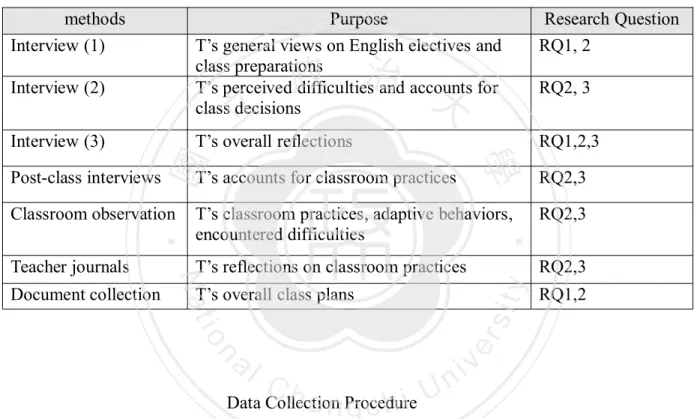
As mentioned above, the four data collection methods had specific purposes and
were aimed to provide answers to one or more research questions of the present study.
In Table 3.1, a summary of the purposes of each data collection method and its
targeted research question(s) are listed. As mentioned above, the four data collection
methods had specific purposes and were aimed to provide answers to one or more
research questions of the present study. To begin with, the three interviews that
spanned the semester could help the researcher discover and explore the changes of
Brenda’s views as she went through the teaching process, which could be included in
the answers to all the three research questions. Post-class interviews, classroom
observations, and teacher journals, on the other hand, provided supplementary
information of Brenda’s classroom practices, adaptive behaviors, encountered
difficulties, and her reflections. These contents were closely related to the second and
‧
國
立
政 治 大
學
‧
N
a
tio
na
l C
h engchi U
ni
ve
rs
it
y
third research questions involving Brenda’s teaching practices and encountered
difficulties. As for document collection, it was believed that the collected class
materials could help the researcher better understand Brenda’s class plans and thus see
how her views and in-class practices were correlated, which would help answer
research question one and two.
Table 3.1 Data collection methods, their purposes, and targeted research questions
methods Purpose Research Question
Interview (1) T’s general views on English electives and
class preparations
RQ1, 2
Interview (2) T’s perceived difficulties and accounts for
class decisions
RQ2, 3
Interview (3) T’s overall reflections RQ1,2,3
Post-class interviews T’s accounts for classroom practices RQ2,3
Classroom observation T’s classroom practices, adaptive behaviors, encountered difficulties
RQ2,3
Teacher journals T’s reflections on classroom practices RQ2,3
Document collection T’s overall class plans RQ1,2
Data Collection Procedure
The data collection in this study proceeded from August 2011 to January 2012.
The procedures were divided into two stages: pilot study and the main study.
Pilot study
In the first stage of data collection, all the questions in the first semi-structured
interview were piloted in August 2011 by an English teacher with previous
experiences of teaching English electives and being a member of curriculum planning
committee in the target school. Her responses and suggestions were seriously
‧
國
立
政 治 大
學
‧
N
a
tio
na
l C
h engchi U
ni
ve
rs
it
y
considered by the researcher in the revision of these interview questions before the
English elective began rolling in the first week of September 2011. This step followed
Yin’s recommendation (1994) that pilot case study can help researchers refine their
data collection plans regarding both the content of the data and the procedures to be
followed.
Main study
The one-credit English elective for seniors, News English, in the autumn
semester of 2011 proceeded from September 2011 to January 2012. The following
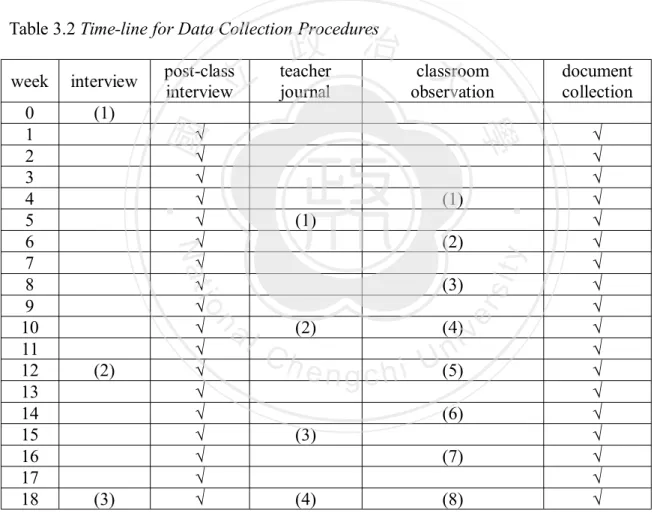
Table 3.2 shows a time-line as a simplified overview for these data collection
procedures during the eighteen weeks in this semester.
Interviews
There were three interviews that were respectively conducted to explore
Brenda’s beliefs and practices as well as the changes developed in the process. The
first one, a pre-course interview, was held before the semester started. In the 11thweek,
the second semi-structured interview was conducted to examine Brenda’s reflections
on her classroom experiences during the past 10 weeks as well as her preparation for
the following classes. In the 18thweek, Brenda discussed her experiences and
after-thoughts of teaching the elective in the third interview, an after-course reflection.
Post-class interviews
Throughout eighteen weeks in the target semester, a brief one-on-one,
post-class interview was carried out right after each class meeting. They were meant
for collecting Brenda’s views and own account of what happened during the class.
‧
國
立
政 治 大
學
‧
N
a
tio
na
l C
h engchi U
ni
ve
rs
it
y
Classroom observation
The first three weeks of the semester, at Brenda’ request, were the preparation
period for her. Classroom observations officially started from the fourth week. Since
then, the researcher had paid regular bi-weekly visits, eight times in total, to Brenda’s
classes to keep track of the classroom events and behaviors until the end of the
semester.
Table 3.2 Time-line for Data Collection Procedures
week interview post-class
interview teacher journal classroom observation document collection 0 (1) 1 √ √ 2 √ √ 3 √ √ 4 √ (1) √ 5 √ (1) √ 6 √ (2) √ 7 √ √ 8 √ (3) √ 9 √ √ 10 √ (2) (4) √ 11 √ √ 12 (2) √ (5) √ 13 √ √ 14 √ (6) √ 15 √ (3) √ 16 √ (7) √ 17 √ √ 18 (3) √ (4) (8) √ Teacher’s journal
In the 5th, 10th, 15thand 18thweek, four times in total, Brenda was asked to
submit her reflective journals to the researcher.
‧
國
立
政 治 大
學
‧
N
a
tio
na
l C
h engchi U
ni
ve
rs
it
y
Document collection
Documents such as syllabus, handouts, and test papers were collected as the
elective proceeded. Brenda provided copies of these class materials one or two days
prior to each class so that the researcher could take a look at them before they were
distributed to students in classes.
Data Analysis
In the present study, the collected data for analysis included transcripts of the
three interviews and eighteen post-class interviews, field notes taken from all the
interviews as well as classroom observations, teachers’ reflective journals, and
documents collected throughout the process of the electives. The analysis procedures
included coding, triangulation, description, and interpretation, following the methods
commonly used in qualitative research for data analysis (Gibson, 2009; Gillham, 2000;
Stake, 2010). The credibility, or trustworthiness, of the research was enhanced by data
triangulation, method triangulation, coding agreement, and “member checks” (Ary,
2010, p.500), or “respondent validation” (Silverman, 2010, p.278).
Coding
Coding is a process of sorting all data sets in order to generate meaningful units
important to the study (Patton, 1990; Stake, 2010).
In the present research, the researcher had devised the interview guides for the
three interviews (Appendix B, C, and D) and classroom observation form (Appendix
B) following the categories that the present research intended to explore before the
semester kicked off.