
隱喻及轉喻對英語為外語學習者之教學成效:以情緒語言為例 - 政大學術集成
237
0
0
全文
(2) THE EFFECTS OF TEACHING EFL LEARNERS METAPHOR AND METONYMY: WITH REFERENCE TO EMOTION EXPRESSIONS. A Dissertation Presented to Department of English,. 政 治 大. 立National Chengchi University ‧. ‧ 國. 學. n. er. io. sit. y. Nat. al. Ch. engchi. i n U. v. In Partial Fulfillment of the Requirements for the Degree of Doctor of Philosophy. by Yi-chen Chen October, 2011.
(3) Acknowledgement The past two years working on my dissertation were such an amazing journey. With the great support and warm companionship from teachers, family, and friends, I climbed over steep hills, crossed the trouble water, trudged along rocky paths, and finally reached my destination. Here I would like to express my sincere gratitude to those, who have walked me through the difficult time of writing this dissertation. I would like to thank my advisor, Dr. Huei-ling Lai, for her patience and guidance. She motivated me to conceive and develop the main idea of the dissertation, led me to design and conduct the experiments, advised me to refine and revise the writing, and most importantly, educated me to become an independent scholar. Without her help, this dissertation could not have been successfully completed. My gratitude also goes to Dr. Kuen-Hung Tsai, who assisted me with the statistical analyses for the dissertation. His meticulous attitudes toward and methodical thinking about doing research encouraged me to maintain a focused, careful, and critical attitude throughout the writing process. Also my appreciation goes to all my committee members, Dr. Feng-fu Tsao, Dr. I-li Yang, Dr. Chun-yin Doris Chen, and Dr. Ming-chung Yu, for the time and effort they spent providing. 立. 政 治 大. ‧. ‧ 國. 學. insightful comments on my manuscript. Responsibility for any remaining errors or. n. al. er. io. sit. y. Nat. omissions rests entirely upon the author. Special thanks go to Dr. Mei-lin Lee, for her kindness in sparing me the class hours needed for me to conduct the experiment with her students. Also, my sincere thanks go to Ying-shu Susan Liao, my great classmate, colleague, and friend, who never said no to my requests for favors and always encouraged me when I felt depressed. Moreover, thank you to my cherished classmates in the PhD program, Frances Wang, Michael Cheng, and Daniel Chiang, for the cheers and the support they gave me. Our ―gang‖ was awesome! My deepest gratitude goes to my parents and my parents-in-law. With their complete support, I could devote myself to my study wholeheartedly without fear or worries. My brother, Brian, helped me design and create the computer program for the experiment. I wish him success with his own upcoming graduate studies. My greatest and the most loving thanks go to my beloved husband, Yung-ho Christopher Chen. He accompanied me whenever I was sad, depressed, happy, or joyful. His persistent encouragement helped me see the light at the end of the tunnel.. Ch. engchi. i n U. v. His love was the power that pushed me to move forward without hesitation. Finally, thanks to everyone who tolerated my anxiety and complaints during these years. I do not own this success individually but share the ownership with all the people who helped me. iii.
(4) TABLE OF CONTENTS. Acknowledgement .......................................................................................................iii Chinese Abstract .......................................................................................................... x English Abstract .........................................................................................................xii CHAPTER 1 INTRODUCTION ................................................................................ 1 Background of the Study ....................................................................................... 1 Motivations of the Study ........................................................................................ 3 Current Trend of Language Acquisition Theory ............................................ 3 Cultural Similarities and Specificities for L2 Learners ................................. 5 Importance and Pervasiveness of Metonymy ................................................ 6 Definition of Terms ................................................................................................ 8 Figurative Expressions ................................................................................... 8 Metaphoric Competence ................................................................................ 8. 立. 政 治 大. ‧ 國. 學. Rationales of the Study and Research Questions ................................................. 12 Significance of the Study ..................................................................................... 15 Organization of the Present Study ....................................................................... 17. ‧. CHAPTER 2 THEORETICAL BACKGROUND AND RESEARCH. n. al. er. io. sit. y. Nat. HYPOTHESES ....................................................................................... 19 Metaphor and Metonymy..................................................................................... 19 Metaphor Theories ....................................................................................... 19 Metonymy Theories ..................................................................................... 22 Relationship between Metaphor and Metonymy ......................................... 23 Metaphor and Metonymy of Emotions ................................................................ 24 Metaphor and Metonymy of Anger.............................................................. 25 Metaphoric Metonymy and Metonymic Metaphor of Anger ....................... 27 Metaphor and Metonymy of Happiness ...................................................... 29 Metaphoric Metonymy and Metonymic Metaphor of Happiness................ 30 Metonymy-Metaphor Continuum of Anger and Happiness ........................ 32 Metaphor and Metonymy of Emotions in Other Languages ............................... 33 Metaphor and Metonymy of Anger in Chinese............................................ 34 Metaphor and Metonymy of Happiness in Chinese .................................... 38 Universality and Specificity ................................................................................. 41 Possible Relations of Metaphoric and Metonymic Expressions across. Ch. engchi. i n U. v. Languages .................................................................................................... 42 Possible Relations of Metaphoric and Metonymic Expressions in English and Chinese .................................................................................................. 44 iv.
(5) Learning Metaphor and Metonymy in L2 Context .............................................. 46 Cognitive Linguistic Viewpoints on Second Language Acquisition ........... 50 Teaching Figurative Language through Awareness-Raising Activities ....... 51 Comprising Teaching Method for L2 learners ............................................. 55 Rationales and Hypotheses .................................................................................. 57 CHAPTER 3 METHODOLOGY ............................................................................. 65 Pilot Studies ......................................................................................................... 65 Pilot Study I ................................................................................................. 65 Pilot Study II ................................................................................................ 69 Pilot Study III ............................................................................................... 74 Main Study ........................................................................................................... 79 Rationales of Research Design .................................................................... 79 Participants................................................................................................... 83 Instruments................................................................................................... 88 Procedures .................................................................................................... 95. 立. 政 治 大. Data Collection and Analysis ....................................................................... 99. ‧ 國. 學. ‧. CHAPTER 4 RESULTS AND DISCUSSION....................................................... 101 Results of the Awareness Test ............................................................................ 101 Ability to Recognize Metaphors and Metonymies .................................... 102. n. al. er. io. sit. y. Nat. Ability to Recognize Metaphors and Metonymies on the Continuum ...... 112 Ability to Recognize Metaphors and Metonymies with Bodily Descriptions .................................................................................................................... 115 Summary of the Results of the Awareness Test ................................................. 121 Discussions of the Awareness Test ..................................................................... 122 Individual Differences on Cognitive Style ................................................ 122 Individual Differences on Proficiency Level ............................................. 124 Results of the Comprehension Test .................................................................... 126 Inter-rater reliability ................................................................................... 126 Ability to Comprehend Metaphors and Metonymies................................. 127 Ability to Comprehend Metaphors and Metonymies of Different Possibilities ................................................................................................ 130 Qualitative Analyses of the Comprehension Test .............................................. 133 Sentences Belonging to Possibility One .................................................... 133 Sentences Belonging to Possibility Two.................................................... 138 Sentences Belonging to Possibility Three.................................................. 144. Ch. engchi. i n U. v. Sentences Belonging to Possibility Four ................................................... 148 Summary of the Results of the Comprehension Test ......................................... 153 Discussions of the Comprehension Test ............................................................ 153 v.
(6) L1-transfer Interference ............................................................................. 153 Extraneous Factors ..................................................................................... 156 Difficulty Levels of the Four Possibilities ................................................. 158 CHAPTER 5 CONCLUSIONS............................................................................... 161 Answers to the Research Questions ................................................................... 161 The First Research Question ...................................................................... 161 The Second Research Question ................................................................. 163 The Third Research Question .................................................................... 166 Implications........................................................................................................ 168 Beneficial Effects of Explicit Teaching on SLA ........................................ 168 Insights into Metaphor-metonymy Continuum .......................................... 170 Insights into Interlanguage System of L2 Acquisition ............................... 172 Insights into Cultural Universality and Specificity .................................... 173 Teaching Materials for EFL Learners ........................................................ 176 Limitations and Future Study............................................................................. 178. 立. 政 治 大. ‧. ‧ 國. 學. Variables of Cognitive Styles ..................................................................... 178 Control of Extraneous Variables ................................................................ 179 Control of Test Validity .............................................................................. 181 Ability to Produce L2 Metaphor ................................................................ 182. n. al. er. io. sit. y. Nat. APPENDICES .......................................................................................................... 187 Appendix 1 Awareness Test Used in the Second Pilot Study .................... 187 Appendix 2 Comprehension Test Used in the Second Pilot Study ............ 190 Appendix 3 Production Test Used in the Second Pilot Study .................... 192 Appendix 4 Teaching Materials of the Second Pilot Study ....................... 194 Appendix 5 Handout with subtitles made of metaphoric themes (conceptual metaphor) ................................................................................................... 195 Appendix 6 Handout with subtitles made of metaphoric mappings .......... 196 Appendix 7 Criteria Used in the Second Pilot Study to Evaluate Answers of the Comprehension Test ............................................................................. 197 Appendix 8 Test Items of the Awareness Test Used in the Third Pilot Study and the Main Study .................................................................................... 198 Appendix 9 Test Items of the Comprehension Test Used in the Third Pilot Study and the Main Study .......................................................................... 200 Appendix 10 Production Test Used in the Third Pilot Study ..................... 201 Appendix 11 Test Items Distributions of the Awareness Test in the Main. Ch. engchi. i n U. v. Study .......................................................................................................... 202 Appendix 12 Test Items Distributions of the Comprehension Test in the Main Study ................................................................................................. 204 vi.
(7) Appendix 13 The PowerPoint Slides Used during the Teaching Phase in the Main Study (for the CM Group) ................................................................ 205 Appendix 14 The PowerPoint Slides Used during the Teaching Phase in the Main Study (for the MM Group) ............................................................... 208 REFERENCES......................................................................................................... 211. 立. 政 治 大. ‧. ‧ 國. 學. n. er. io. sit. y. Nat. al. Ch. engchi. vii. i n U. v.
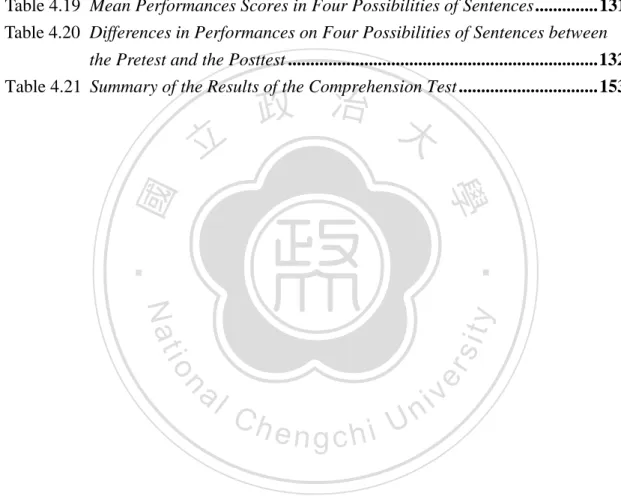
(8) LIST OF TABLES. Table 2.1. Literalness-Metonymy-Metaphor Continuum ........................................... 24. Table 2.2 Metonymy-Metaphor Continuum .............................................................. 33 Table 2.3 Five Possibilities of Translating Figurative Expressions from One Table 3.1 Table 3.2 Table 3.3 Table 3.4 Table 3.5. Language into Another.............................................................................. 43 Number and Distribution of the Participants ........................................... 83 Distribution of Test Items of the Awareness Test ....................................... 90 Distribution of the Four Categories of the Awareness Test ...................... 90 Distribution of the Body-related Expressions of the Awareness Test ........ 91 Four Possibilities of Metaphoric/Metonymic Expressions in Different. Languages ................................................................................................. 92 Table 3.6 Distribution of Test Items of the Comprehension Test ............................... 93 Table 4.1 Mean Performance Scores of Participants in the Awareness Test ......... 102 Table 4.2 Differences in Participants’ Performances on Sentences with. 立. 政 治 大. ‧ 國. 學. Table 4.4. Metaphoric/Metonymic Expressions between Pretest and Posttest ........ 104 Differences in Performances on Sentences with Metaphoric/Metonymic. ‧. Table 4.3. Metaphoric/Metonymic Expressions between Pretest and Posttest ........ 104 Differences in Participants’ Performances on Sentences without. Table 4.7. . …………………………………………………………………………109 Differences in Participants’ Performances on Sentences without Metaphoric/Metonymic Expressions between the CM and the MM Group. n. al. er. io. sit. y. Nat. Table 4.6. Expressions in Pretest between the CM and the MM group ................... 106 Differences in Participants’ Performances on Sentences with Metaphoric/Metonymic Expressions between the CM and the MM Group. Table 4.8. Ch. engchi. i n U. v. . …………………………………………………………………………110 Mean Performances Scores in Four Categories of Sentences with. Metaphoric or Metonymic Expressions .................................................. 113 Table 4.9 Differences in Performances on Four Categories of Sentences Containing Metaphoric/Metonymic Expressions between the Pretest and the Posttest . …………………………………………………………………………114 Table 4.10 Differences in Performances on Sentences with Body-related Metaphoric/Metonymic Expressions between the Pretest and the Posttest . …………………………………………………………………………117 Table 4.11 Differences in Performances on Sentences without Body-related Metaphoric/Metonymic Expressions between the Pretest and the Posttest . …………………………………………………………………………117 viii.
(9) Table 4.12 Differences in Performances on Four Categories of Sentences with Body-related Expressions between the Pretest and the Posttest ............. 118 Table 4.13 Differences in Performances on Four Categories of Sentences without Table 4.14 Table 4.15 Table 4.16 Table 4.17 Table 4.18 Table 4.19 Table 4.20. Body-related Expressions between the Pretest and the Posttest ............. 120 Summary of the Results of the Awareness Test ........................................ 121 Correlation of Ratings ............................................................................ 127 Mean Performances Scores of Participants in the Comprehension Test 128 Differences in the Grades between Pretest and Posttest ......................... 129 Differences in Grades between CM and MM Group .............................. 129 Mean Performances Scores in Four Possibilities of Sentences .............. 131 Differences in Performances on Four Possibilities of Sentences between. the Pretest and the Posttest ..................................................................... 132 Table 4.21 Summary of the Results of the Comprehension Test ............................... 153. 立. 政 治 大. ‧. ‧ 國. 學. n. er. io. sit. y. Nat. al. Ch. engchi. ix. i n U. v.
(10) 國立政治大學英國語文學系博士班. 博士論文中文提要 論文名稱:隱喻及轉喻對英語為外語學習者之教學成效:以情緒語言為例 指導教授:賴惠玲教授 研究生:陳怡蓁 論文提要內容:. 政 治 大. 隱喻(metaphor)及轉喻(metonymy)被廣泛的使用在日常生活語言中。認知語. 立. 言學主張:隱喻及轉喻實為人類思想與溝通的中心。因此,語言學習者必須具備. ‧ 國. 學. 覺察及理解用以表示抽象概念的隱喻及轉喻用語的能力。然而,因為語言及文化 的顯著差異,第二語言學習者在發展溝通能力時,也應培養譬喻能力(metaphoric. ‧. competence)。. Nat. sit. y. 許多學者提出各式教學方法。現存文獻中,使用以概念引喻(conceptual. n. al. er. io. metaphor)為主的教學方式,著重於點出用以對比的兩者間之相對特徵,已獲得. i n U. v. 實驗證實能提升語言學習者之覺察能力、理解能力、及記憶力。然而此教學方法. Ch. engchi. 忽略了語言文化間的差異填補,亦輕忽了轉喻的重要性。另一方面,使用隱喻映 射(metaphoric mappings)為主的教學方式,能藉由實體映射(ontological mappings) 及知識映射(epistemic mappings)有系統條理的闡述用以對比的兩者間之對照關 係,不僅有助於彌補因文化不同而造成的認知差異,亦將轉喻與譬喻視為同等重 要。因而以隱喻映射為主的教學方式被認為是具備潛力的教學方法,但仍缺少實 證。 本論文旨在以實證方式,研究以概念引喻及以隱喻映射為主的兩種教學方式 對於以英語為外語學習者在覺察能力、理解能力、及記憶力之學習成效。共有 115 位、分別來自一般大學及科技大學之大學一年級學生參與本實驗。參與者分 x.
(11) 成兩組,分別接受兩種教學方式。實驗分兩週進行:第一週先完成電腦化的譬喻 能力測驗之前測,接著進行教學,第二週則進行電腦化的譬喻能力測驗之後測。 測驗之結果則經由量化及質化方式進行分析。 實驗結果發現:兩種教學方式均對於參與者在覺察能力、理解能力、及記憶 力有正面成效。然而儘接受以隱喻映射為主之教學方式的參與者在覺察能力測驗 中獲得顯著進步,特別是對於不包含體驗性描述(embodied description)的轉喻性 隱喻(metonymic metaphor)及隱喻用語,表現尤佳。至於理解力測驗部分,以隱 喻映射為主之教學方式對於解讀含有文化差異性(cultural specificity)的用語特別. 治 政 大 方式造成參與者的學習成果呈現較一致且穩固的成長。總而言之,以隱喻映射為 立. 有助益。另一方面,相較兩組教學方式的表現成果而言,以隱喻映射為主之教學. 主之教學方式因為提供了具結構性、系統性及邏輯性的映射過程,而促進學習者. ‧ 國. 學. 較容易覺察包含抽象概念的譬喻用語,克服因文化差異性而造成的理解困難,及. ‧. 獲致較穩固的學習成長。. y. Nat. 本研究為以英語為外語學習者在學習譬喻用語—包含隱喻及轉喻—上提供. er. io. sit. 了三點貢獻。其一,透過學習者培養譬喻能力之實驗成果,直接教學(explicit teaching)方式對於第二語言習得的效益再次獲得證實。其二,本實驗成果顯示:. al. n. v i n 轉喻與隱喻實為密不可分的兩種概念,在教學過程中應把轉喻列為與隱喻一樣重 Ch engchi U 要。其三,學習者的中介語(interlanguage) 包含了語言的普同性及差異性概念, 因此應被視為連續體(continuum)而非階段性結構;在設計教學教材時,應把此連 續體的概念併入考量。總結而言,本實驗的成果不只在應用語言學領域提出見 解,亦在第二語言習得領域有所貢獻。. xi.
(12) Abstract Metaphor and metonymy, pervasively found in everyday language, has been shown by cognitive linguistic research to lie at the heart of human thought and communication. Thus, ability to notice and comprehend metaphoric and metonymic expressions in expressing abstract concepts is indispensible for language users. However, since languages and cultures vary in a wide array of ways to employ metaphor and metonymy, L2 learners should develop metaphoric competence along with communicative competence. Various methods to develop L2 learners‘ metaphoric competence have been proposed. In the extant literature, instruction involving conceptual metaphors (CM),. 政 治 大 raising learners‘ awareness, comprehension, and retention for Hungarian and Dutch 立 which focuses on correspondences of general traits, has been proved effective in. EFL learners. Its effectiveness in Chinese speaking context is worth attested. ‧ 國. 學. empirically. On the other hand, metaphoric mappings, which illustrate both ontological mappings and epistemic mappings of two concepts in more systematic. ‧. and detailed manners, offer a promising method for EFL language learning. Hence, instruction involving metaphoric mappings (MM) is assumed to be more effective. y. Nat. al. er. io. empirically.. sit. than instruction of CM. The effectiveness of such a method is also worth attested. n. The present study aimed to test the effects of CM and MM on EFL learners‘. Ch. i n U. v. awareness, comprehension, and retention of metaphoric and metonymic expressions. engchi. with empirical evidence from a carefully-designed experiment. Finer-grained analyses on three important issues were provided: first, an in-depth examination of the intricate interaction of metonymy and metaphor as a continuum, and its influences on figurative language learning was conducted. Second, cultural universality and specificity among languages and the different degrees of difficulties for EFL learners in transferring expressions between L2 and L1 were also investigated. Third, whether structural and logical mappings between languages and cultures could assist learners to better grasp abstract concepts was examined. The participants included 115 Taiwanese EFL learners, who were freshmen of a general university and a four-year technological university. The English proficiency of the former group was high-intermediate and that of the latter was low-intermediate. The experiment contained three phases: pre-teaching, teaching and post-teaching. The xii.
(13) participants were divided into two sub-groups: one received instruction involving CM, and the other received instruction involving MM. They were asked to complete the computerized metaphoric competence test before and after receiving instructions. The results of the tests were collected and analyzed both quantitatively and qualitatively. The results showed that both instructions could lead to better awareness, comprehension, and retention. However, only the participants of the MM groups performed significantly better in the posttest regarding the Awareness Test, especially in finding metonymic-metaphoric and metaphoric expressions that contained no bodily descriptions, the two categories which were considered the most abstract among the expressions. Regarding the Comprehension Test, MM instruction was found to be especially beneficial for the participants in interpreting expressions. 治 政 in convergent effects in the participants‘ performances 大 and led toward relatively more 立 To conclude, MM instruction, with its structural, consistent and steady progress. involving cultural-specific conceptual metaphors. Moreover, MM instruction resulted. ‧ 國. 學. systematic, and logical mapping processes, was found to be especially helpful in facilitating learners‘ awareness of expressions involving more abstract concepts,. ‧. overcoming difficulties caused by cultural specificity, and leading to longer-term effects on retention.. sit. y. Nat. The present study sheds light on the application of metaphor and metonymy to EFL teaching and learning of figurative language in three aspects. First, that explicit. io. er. instructions on second language acquisition carry beneficial effects is validated for the. al. n. v i n C important as metaphor, metonymy is suggested as equally h e n g c h i U and should be included in. development of learners‘ metaphoric competence in the target language. In addition, EFL language learning programs. Moreover, that learners‘ interlanguage system is a continuum encompassing expressions with universal and specific cultural characteristics is also validated. Therefore, designs of EFL teaching materials are suggested to take such a continuum into consideration. In brief, the results of the study contribute not only to applied linguistics but also to second language acquisition.. xiii.
(14) CHAPTER 1 INTRODUCTION. Background of the Study For centuries, metaphor and metonymy were viewed as decorative language used for poetry and literary work. However, since the 1970s, cognitive linguists have become increasingly convinced that metaphor and metonymy are central not only to language but also to thought. Both metaphor and metonymy, or figurative language,. 政 治 大. are no longer considered to be only novel or poetic language; they are now accepted. 立. as ordinary language that manifests what people think in daily life (Lakoff & Johnson,. ‧ 國. 學. 1980).. Metaphor and metonymy are two fundamental poles of human thought, as can be. ‧. witnessed through their prevalence in art, music, sculpture, literature, and even. y. Nat. io. sit. language (Jakobson, 2003). According to the survey done by Pollio and his colleague. n. al. er. in 1977, an average native English speaker uses about 5 metaphoric expressions per. i n U. v. minute, 300 per hour, and more than 1,000 per day at the rate of a 4-hour speaking. Ch. engchi. day (pp.8-9, also as cited in Dong, 2004). Since the internet and other communication tools have become widespread, the number of metaphoric expressions currently used in communication should be greater than it was 30 years ago. Figurative language is thus becoming more pervasive, and more necessary for everyday functioning. Figurative language is considered useful for the purpose of communication. Ortony (1975) points out that the communicative functions of figurative language are inexpressibility, compactness, and vividness. People can verbalize what is unknown or difficult to express by using figurative language, and can deliver compact and abundant information of the object in a limited amount of words. In addition,. 1.
(15) Littlemore and Low (2006) discuss the importance of metaphors under Bachman‘s (1990) framework of communicative competence, and argue that metaphoric competence has a great influence on second language learners‘ development of communicative competence. To both native and second language speakers, figurative language is an indispensable tool in communication. By the same token, for second and foreign language learners, figurative language is knowledge that must be acquired in the language learning process to reach a higher level of proficiency. In addition to the purpose of communication, metaphor and metonymy are. 政 治 大 Since metaphor and metonymy are formed on the basis of speakers‘ thoughts and 立. believed to be able to disclose insights into a culture (Black, 1993; Lantolf, 1999).. experiences, they are affected by the conventionalized models of the cultures to which. ‧ 國. 學. the speakers belong (Lakoff & Johnson, 1980). Without knowing figurative. ‧. expressions used in a target language, L2 learners might be ―kept in the dark‖ (Dong,. sit. y. Nat. 2004) and lack full understanding of the target language. Therefore, knowledge of. io. understanding of the culture behind a language.. al. er. figurative language can equip second and foreign language learners with. n. v i n Since figurative language isCbelieved to be centralUto the use of language and is hengchi. pervasive in the language system, it should be given an important place in the field of language learning and teaching. Low (1988) points out that, if second language learners hope to be seen as competent users of the language, they need to develop certain metaphor-related skills, which native speakers are expected to be good at. Regarding L2 figurative language learning, research carried by cognitive linguists (Boers, 2000a, 2000b, Boers and Demecheleer, 2001, Boers, Demecheleer & Eyckmans, 2004; Boers, Eyckmans & Stengers, 2007; Boers & Stengers, 2008; Dong, 2004; Deignan, Gabrys, & Solska, 1997; Kövecses, 2001; Skoufaki, 2005) has made significant progress. Cognitive linguists believe that language is not arbitrary but 2.
(16) motivated (Lakoff, 1987, p.346). To developing ―metaphoric competence‖ (Littlemore, 2001), L2 learners need raised awareness of semantic motivation, not rigid memorization on fixed form (Boers & Lindstromberg, 2006). However, for foreign language learners who may encounter difficulties caused by cultural and linguistic differences, they need particular assistance focusing not only on grasping cues with semantic motivation but also bridging crucial cultural gaps. The present study aims to probe into the issue of learning figurative language, including metaphor and metonymy. On the basis of findings and theories provided by. 政 治 大. the previous research, the present study would look for promising ways to facilitate gap bridging processes.. Motivations of the Study. 學. ‧ 國. 立. ‧. The motivations of doing the research on the issue are as follows. First,. sit. y. Nat. confusion caused by differences between L1 and L2 is a common feature during L2. io. er. learning process; the situation worsens with the involvement of various metaphoric and metonymic expressions. Previous approaches to teaching figurative language. al. n. v i n C h of expressionsUto L2 learners, but are lacking focus so much on providing motivation engchi concerns about cultural gaps. Research is needed to overcome the problem of the cultural gap. Moreover, previous research on teaching figurative expressions has rarely considered metonymy, which is as important and prevalent as metaphor. The oversight of such language traits is worth further research.. Current Trend of Language Acquisition Theory Since metaphors and metonymies are so useful and important that language learners must acquire them, many teaching materials are needed. However, metaphors and metonymies used to be described as dead or decorative, quoted from the Greece 3.
(17) philosopher Aristotle, and only appeared in the forms of idioms or literary devices. They were taught by memorization and drills (McCallum, 1970, 1978; Nandy, 1994) because they were believed to be fixed in form and meaning. Nevertheless, with the emergence of cognitive linguistics in recent years, the ideas about learning a language are changing and thus differ from previous ones. Language is believed not to be composed of discrete units from which form and meaning are separate (Tomasello, 2006). It is a reflection of general cognition (Littlemore, 2009), and should be derived from and informed by language use rather. 政 治 大 and inseparable, and the usages people employ are motivated, rather than arbitrary 立. than being presupposed and innate (Tomasello, 1995); form and meaning are related. (Boers & Lindstromberg, 2006). As a result, for L2 learners who have already. ‧ 國. 學. acquired many of the concepts while learning their L1, it is necessary to build a new. ‧. construal system of the target language. In other words, L2 learners should learn how. sit. y. Nat. to ―present and package information in different ways and from different viewpoints‖. io. er. (Littlemore, 2009, p.14). They may need to focus on different scenes and events, categorizing things in different ways, overcoming L1 entrenchment patterns, and. al. n. v i n C hby knowing the cognitive acquiring L2 usages or expressions process of motivation engchi U (Ellis, 2006a).. The viewpoints held by cognitive linguists provide a fresh inspiration to the development of metaphoric competence in the L2 learning context. For example, Boers (2000a, 2000b, 2001, 2004) suggests to acquaint L2 learners with the process of motivations through understanding conceptual metaphors, or metaphoric themes in his term, of figurative expressions. His idea has been proved in his research as an effective method to raise L2 learners‘ awareness of figurative language as well as to extend learners‘ retention of what they have learned. Lazar (2003), following Boers‘ claims, produces an EFL exercise book with a strong focus on raising awareness of 4.
(18) motivations of figurative expressions. However, the idea of providing L2 learners conceptual metaphors as an awareness-raising activity does not guarantee a complete development of L2 construal systems, and may not solve problems caused by cultural and linguistic differences between L1 and L2. Therefore, methods which compensate the method of conceptual metaphors are still and should be open to pursue. To follow the trend of cognitive linguistics, which focus on developing human cognition, and to broaden the scope of current figurative language learning approaches, which focus on raising awareness of semantic motivation, the present. 政 治 大. study hopes to shed light on research of the development of L2 acquisition theories.. 立. Cultural Similarities and Specificities for L2 Learners. ‧ 國. 學. Since metaphor and metonymy are based on people‘s knowledge of the world. ‧. and experiences of life, they represent similarities and differences between cultures. sit. y. Nat. and between languages. People around the world, no matter which culture they are. io. er. from or which language they speak, share common knowledge, such as concepts of love and life; they also have universal experiences, such as physiological responses.. al. n. v i n For instance, the emotion angerC causes similar physiological h e n g c h i U responses in humans,. including body heat, internal pressure, or redness in face and neck (Kövecses, 2000a). However, languages have specific characteristics that are exclusive to their users. For example, the emotion anger can be expressed in different ways by learners of the. same culture: some view anger as a hot fluid in a container, as in English I’ve reached the boiling point, and some regard anger as a hot gas, as in Chinese 他氣鼓鼓的 tā qì-gŭgŭ de (he gas-inflated COM ‗He is inflated with anger‘)(Yu, 1998). The differences that arise, due to specific cultural norms, or traditions of language use, can lead to difficulties for language learners in transferring native language and knowledge. Danesi (1993) reports a series of studies on second 5.
(19) language learners‘ learning and developing metaphoric competence. Danesi found that, after three to four years of study, though students developed a high level of proficiency in L2, they continued to think in terms of their native concepts, and performed poorly on metaphor comprehension and translation tasks. To help learners overcome the L1 interference, acquire L2 specific usages, and develop metaphoric competence, researchers (Deignan et al., 1997; Dong, 2004) suggest that second and foreign language learners‘ awareness of the existence of similarities and differences between their native language and target language should. 政 治 大 existing among languages to help learners in comprehension, and adopting conceptual 立 be raised. Moreover, Kövecses (2001) suggests utilizing the universal concepts. mappings between source and target domains to gain complete schematic knowledge. ‧ 國. 學. and form cognitive correspondences.. ‧. However, the suggestion made by Kövecses (2001) has not yet been. sit. y. Nat. implemented in the foreign language teaching context (Kövecses, 2001, pp.112-113). io. er. and thus empirical evidence and studies are needed. The present study adapts his suggestion by adding cultural elements into the experiment. The method would be. al. n. v i n C hin which only conceptual tested against the previous method, metaphors are focused engchi U on, and in which cultural elements have not been considered. The comparisons between two methods hope to provide inspiring insight on the L2 learners‘ development of metaphoric competence.. Importance and Pervasiveness of Metonymy Many researchers (Boers, 2000a, 2000b, 2001; Chung & Ahrens; 2002; Deignan et al., 1997; Dong, 2004; Skoufaki, 2005) have investigated the ways in which language learners understand and use metaphors; however, very few studies have ever taken metonymy into consideration despite its pervasiveness and importance. In 6.
(20) metonymy, an entity is used to refer to something that it is related to; the relation of contiguity, such as part-stand-for-whole or whole-stand-for-part relations, allows language users to understand and utter some expressions widely used in the daily life (Ungerer & Schmid, 2006, p.115). For example, very often a statement like the following appears in newspapers: the White House has released a new policy, where the White House stands metonymically for the American Government. This type of metonymic use is so prevalent in life that language users might not even notice the fact they are using it.. 政 治 大 instance, in the sentence His eyes were shining, the eyes stand for the person himself, 立 In some cases, metonymy can motivate metaphors (Barcelona, 2000). For. for a part of a subject can stand for a whole. The shining eyes can stand for happiness,. ‧ 國. 學. since happiness is mapped to light in the conceptual metaphors HAPPINESS IS. ‧. LIGHT. Another example is the expression foaming at the mouth: The reference to. sit. y. Nat. rabies and pathological mania stands for the angry feelings metonymically. The. io. er. interconnections between metaphor and metonymy are so close that they should not be taken as separate subjects but two interrelated features (Radden, 2003).. al. n. v i n Cpsychological In fact, cognitive research of (Gibbs, 1999; Gibbs, h e n g c hexperiments i U. Costa Lima, & Francuzo, 2004; Goosens, 1990) has already evidenced the close. interaction of metaphor and metonymy. Yet, research of metonymic and metaphoric interactions and their effects on figurative language learning in second language acquisition (SLA) is still scanty. The fact that metonymic thinking is so pervasive and the metonymic expressions are so widely used also suggests that an explicit focus on metonymies may be beneficial for language learners, especially for L2 learners. Thus, in the present study, metonymies as well as metaphors will both be investigated.. 7.
(21) Definition of Terms Figurative Expressions The term metaphor has been used in a variety of ways in contemporary metaphor research. It is used to refer to not only a concept but also an expression of figurative language. In order to distinguish the concept and its linguistic expression, Lakoff (2006) defines the word metaphor as a cross-domain mapping in conceptual systems, while the term metaphoric expression denotes a linguistic realization of such a domain mapping. Boers (2000a), on the other hand, uses the word metaphor to refer. 政 治 大 figurative expression to mean its linguistic realization. 立. to a conceptual metaphor which is entrenched in human thought, and the term. The present study, however, uses the term figurative expressions to refer to the. ‧ 國. 學. linguistic expressions formed on the basis of mappings between concepts. For one. ‧. thing, the present study includes two figures of language: metaphor and metonymy;. sit. y. Nat. the term metaphoric expression literally excludes the presence of metonymic. io. er. expression, and may cause a bias. For another, the usage targeted in the present study includes lexis with one or a few words and phrases; the word expression is not limited. al. n. v i n by word number and can refer toCboth types of language h e n g c h i U usages.. Yet, when quoting or citing other researchers‘ work, the terms used in their work. are retained in order to present the original meanings. For example, Littlemore (2001) specifies four abilities consisting of metaphoric competence; she uses metaphor when referring to each ability. Therefore, in the present study, when those abilities are mentioned, her usages are preserved to include both metaphor and metonymy in their original senses.. Metaphoric Competence Metaphoric competence refers to the ability that a language learner needs in 8.
(22) terms of understanding metaphoric and metonymic expressions. Many researchers try to define specific skills which compose the competence. Low (1988) contends that the metaphor-related skills that learners need to develop include the capability of interpreting and understanding meanings of metaphors figuratively, and interacting with and responding to metaphors pragmatically. The former capability focuses on learners‘ reception of figurative meanings whereas the latter one focuses on learners‘ production of expressions. The metaphor-related skills are later explored by Littlemore (1998, 2001). She. 政 治 大 novel metaphors in the target language‖ (Littlemore, 1998, as cited in Li & Cheng, 立. defines metaphoric competence as ―the ability of second language learners to interpret. 2007). The competence is composed of four components: the ability to find meaning. ‧ 國. 學. in metaphor, the speed in finding meaning in metaphor, the fluency of metaphor. ‧. interpretation, and the originality of metaphor production (Littlemore, 2001). The first. y. Nat. three abilities are receptive skills and the last one is productive skill.. er. io. sit. The present study takes Littlemore‘s (2001) ideas to define EFL learners‘ metaphoric competence. Though both Low‘s (1988) and Littlemore‘s (2001). al. n. v i n C h focus on receptive definitions of the metaphoric competence and productive skills of engchi U. language use, Littlemore‘s definition has four distinct abilities specified and thus can be analyzed separately with details. However, the present study only examines two abilities among the four: the ability to find meaning in metaphor and fluency of metaphor interpretation. Several reasons result in avoidance of considering speed in finding meaning in metaphor and originality of metaphor production. First, the metaphor that Littlemore adapts to display learners‘ metaphoric competence is limited to ―a statement which […] establishes a relationship between two parts of a sentence‖ (p.489), like a dog is a walking stick, which focuses on learners‘ creativities and ability to make logical 9.
(23) comparisons. Since the present study aims to investigate metaphoric and metonymic expressions which are conventional expressions rather than merely statements of relationships, the present study does not require the participants to display originality of metaphor production. Second, according to the statistical analyses reported in Littlemore‘s (2001) study, speed in finding meaning and originality of production are significantly related. Since originality of production is not under investigation in the present study, the highly related ability of speed in finding meaning is not taken into consideration, either.. 政 治 大 metaphoric competence, the present study adds another ability to define EFL learners‘ 立 In addition to the abilities which are specified in Littlemore‘s definition of. metaphoric competence: the ability to retain and to recall knowledge of metaphor and. ‧ 國. 學. metonymy. To sum up, the abilities of metaphoric competence which are defined and. Learners‘ awareness of figurative expressions is defined as their. sit. y. Nat. Awareness.. ‧. operated in the present study are awareness, comprehension, and retention.. io. er. ability to recognize figurative language use in whatever context. Cognitive linguists (Boers & Lindstromberg, 2006; Tomasello, 2006) believe that language is motivated. al. n. v i n rather than arbitrary; in order toC learn a language, a learner h e n g c h i U should be able to. recognize underlying semantic motivations of expressions or communicative. intentions of utterances. In terms of learning figurative expressions, learners should acquire the ability to notice the metaphoric or metonymic nature of expressions, to observe metaphoric and metonymic expressions in everyday language, and to recognize conceptual metaphors or conceptual metonymies behind the expressions (Boers, 2004). Therefore, the present study define the awareness of EFL learners as the capability of recognizing metaphoric or metonymic language use in given context and telling expressions with figurative meanings from expressions with only literal meanings. 10.
(24) Comprehension.. Learners‘ comprehension of figurative expressions is defined. as their ability to interpret metaphoric and metonymic expressions appropriately and correctly. Low (1988) indicates that learners should be able to construct plausible meanings for utterances containing metaphoric terms; thus, learners need to have clear ideas about combinations of topic and vehicle. In Littlemore‘s (2001) model of metaphoric competence, the comprehension is deemed as not only the ability to find more than one possible meanings for a single given metaphors but also the ability to determine one plausible meaning for the metaphoric expression. In other words,. 政 治 大 and vehicles. Therefore, the present study defines the comprehension of EFL learners 立 learners should be able to identify possible grounds for comparisons between topic. reasonable and sensible interpretations to the expressions.. 學. ‧ 國. as the capability of comprehending meanings of figurative expressions and giving. ‧. Retention. Learners‘ retention of figurative expressions is defined as the. y. Nat. prolonged effect of learners‘ raising awareness and comprehension of metaphoric and. er. io. sit. metonymic nature of expressions. In Boers‘ (2000a, 2000b, 2001) studies, the results of the follow-up tests found that participants whose awareness was raised after. al. n. v i n Ctargeted instruction could reproduce more expressions than those who did U h e n figurative i h gc not receive the awareness-raising instruction. The results suggest that learners‘ enhanced metaphoric awareness may contribute to the retention of figurative expressions. Verspoor and Lowie (2003) also found that participants who were provided awareness-raising clues would be more capable of guessing figurative senses of words than those who were asked to memorize words. The findings suggest that enhanced awareness can be beneficial in vocabulary acquisition. To take the practical effect and potential benefit of language teaching and learning into consideration, the issue of whether learners are able to retain and recall their knowledge of metaphor after a certain amount of time is worth investigating. 11.
(25) However, there is no common agreement on a proper length of time for examining retention. Choices of durations in studies which investigate the issue of retention range from immediacy (Boers, 2000b; Boers et.al., 2007), three days (Boers, 2000a), one week (Boers, 2001), two to three weeks (Verspoor & Lowie, 2003), to one year (Boers, 2004); no conclusive amount of time for retention test is suggested. Considering the possibilities that performances of immediate follow-up tests may be regarded as merely participants‘ temporary memories whereas performances after one year may be doubtable because of too many uncontrolled variables involved, the. 政 治 大 performances. On the one hand, the experiment of the present study was carried on in 立 present study decides to give the posttest after one week and to measure participants‘. regular classes, in which the participants needed to meet at the same time every week.. ‧ 國. 學. The one-week duration just fit schools‘ schedules. On the other hand, it is guaranteed. er. io. sit. y. Nat. that the results of the experiment could be claimed reliable.. ‧. that the experiment was not influenced or contaminated by other possible factors so. Rationales of the Study and Research Questions. al. n. v i n Researchers in the field ofCSLA contend that learners‘ h e n g c h i U awareness of motivations. is the key in second language acquisition (Ammar, Lightbown, & Spada, 2010;. O‘Mally & Chamot, 1990; R. Ellis, 2002). Cognitive linguists, too, share this idea about beneficial effects of enhanced awareness (Boers & Lindstromberg, 2006; N. Ellis, 2006a, 2006b), and apply the idea to research on figurative language learning (Boers, 2000a, 2000b, 2001; Boers & Demecheleer, 2001; Boers, Demecheleer, & Eyckmans, 2004; Boers, Eyckmans, & Stengers, 2007; Boers & Stengers, 2008; Chung & Ahrens, 2004; Deignan et al., 1997; Dong, 2004; Kövecses, 2001; Low, 1988; Skoufaki, 2005). Though the proposed methods are different in terms of ways of applications, they mainly rely on the concept of source-theme relationships, 12.
(26) implementing metaphoric themes—or conceptual metaphor—during the learning processes in order to raise L2 learners‘ awareness of semantic motivation behind figurative expressions. The results have proved that L2 learners‘ enhanced awareness of conceptual metaphor is indeed beneficial in comprehension and retention. However, the method of providing conceptual metaphor is not unproblematic. First of all, focusing mainly on awareness raising may lead to an underestimation of the effects of one important element: the gaps caused by different cultures between native and target languages. In the early stage of learning, both similarities and. 政 治 大 1989; Ringbom, 1987); with the advancement of L2 learning process, such as 立. differences between L1 and L2 may facilitate L2 learning (Kellerman,1977; Odlin,. metaphor and metonymy learning which involves not only languages but also cultures. ‧ 國. 學. and conventions, conflicts between L1 and L2 knowledge may cause greater. ‧. difficulties (Kövecses, 2001).. sit. y. Nat. Moreover, problems caused by the conflict could get worse when considering. io. er. different L1 learners. The participants of the research which adapts the method of conceptual metaphor are Dutch (Boers, 2000b, 2001) or French (Boers, 2000b; Boers. al. n. v i n C h learning English. & Demecheleer, 2001) native speakers Their L1 are Indo-European engchi U languages of the Germanic branch or Italic branch, which are closely related to. English, a member of the Germanic family of languages. However, when the distance between a native and a target language is farther, language learners may not be able to count on similarities and familiarities during the learning process. For example, English learners of Asian countries, whose native languages are far different from Indo-European languages, may need further supports to bridge the cultural and linguistic gaps during the learning process. In order to help numerous EFL learners around the world to acquire and develop metaphoric competence, researchers (Deignan et al., 1997; Dong, 2004; Kövecses, 13.
(27) 2001) propose several ways to solve problems caused by cultural and linguistic differences. Among those proposed solution, Kövecses‘ (2001) proposal of integrating metaphoric mappings seems very promising. It not only follows the trend of cognitive linguistics which emphasizes semantic motivations behind expressions, but also deals with cultural gaps by utilizing learners‘ already-existent world knowledge and universal concepts. However, up till now the idea hasn‘t been empirically tested yet; thus, it hasn‘t been able to claim its effects on L2 learning. The present study, therefore, intends to compare the two previously-proposed. 政 治 大 their effects on L2 figurative language learning, and find a compromising way for 立. methods in teaching EFL learners metaphoric and metonymic expressions, determine. EFL learners with different native languages. The two methods under investigation. ‧ 國. 學. include: the method of conceptual metaphor (CM), which focuses on giving. ‧. conceptual metaphors and has learners compare two domains to find associative. sit. y. Nat. characteristics, and the method of metaphoric mappings (MM), which emphasizes. io. er. mapping processes and has learners map between domains and between cultures. The present study targets at Chinese native speakers who are learning English as a foreign. al. n. v i n Ch language. Their metaphoric competence—ability of recognizing figurative engchi U. expressions, fluency of comprehending meanings, and retention of learned figurative expressions—are under investigation. The research questions are as follows: Research Question 1: Which teaching method would improve EFL learners‘ awareness of metaphoric and metonymic expressions of the emotions? In what way does the method help? Research Question 2: Which teaching method would facilitate EFL learners in comprehending metaphoric and metonymic expressions? In. 14.
(28) what way does the method help? Research Question 3: Which teaching method would facilitate EFL learners in retaining metaphoric and metonymic expressions of the emotions? In summary, the goal of the present study is to investigate and compare the effect of using two teaching methods—one focusing on conceptual metaphor (CM) and the other emphasizing metaphoric mappings (MM)—on developing the abilities of the metaphoric competence defined by Littlemore (2001). In addition to the effects on. 政 治 大. competence improvement, the influence of retention will also be examined.. 立. As for the targeted metaphoric and metonymic expressions, among all the. ‧ 國. 學. abstract subjects that would require figurative language in communication, emotion is one of the most commonly discussed topics in daily life and is universally possessed. ‧. by all human beings (Kövecses, 1986, 1990, 2000a, 2000b; Lakoff & Kövecses,. y. Nat. io. sit. 1987). The current study will therefore focus on teaching and learning emotion. n. al. er. expressions. The emotions are generally classified into anger, happiness, sadness,. i n U. v. fear, love, hate, and desire in traditional Chinese Confucian culture (King, 1989).. Ch. engchi. Considering the scope of the study, two common emotions—anger and happiness–are specifically chosen as the targets for analysis.. Significance of the Study The present study aims to investigate and compare the effect of using two teaching methods on developing the abilities of the metaphoric competence. The results of the study shall make several contributions to the field of applied linguistics as well as second language acquisition. First, the present study can provide more detailed analysis of L2 learners‘. 15.
(29) perceptions of figurative expressions. Since the present study includes not only metaphor but also metonymy, analyses on L2 learners‘ responses and perceptions could encompass the idea of metaphor and metonymy interaction. Unlike previous studies, which investigated only effects of learning (Boers, 2000a, 2000b, 2001, 2004), the present study has a finer-grained arrangement of the test items in terms of their degrees of semantic transparency and opaqueness. Figurative expressions used in the present study are considered as scattering on a continuum; the idea of slipperiness of metaphor and metonymy (Radden, 2003; Barnden, 2010) allows finer analyses of. 政 治 大 Secondly, the present study can provide empirical evidence of the previous 立. learners‘ responses.. hypothesis that figurative expressions may be culturally universal or specific among. ‧ 國. 學. languages (Kövecses, 2000a). Though the concepts of universality and specificity are. ‧. widely accepted by researchers, whether language users detect these traits and use. sit. y. Nat. them while processing expressions has not been validated by empirical studies. The. io. er. present study integrates the ideas of universality and specificity into the metaphor-metonymy continuum so that learners‘ folk knowledge will also become a. al. n. v i n C hthe results of the study variable of their performances; thus can serve to unravel the engchi U effects of cultural universality or specificity on language learning.. The present study investigates and compares two methods which are both based on cognitive linguistic theories, trying to determine the benefits each method may bring. The findings of the study hope to shed light on the field of L2 figurative language teaching and learning. Metaphor and metonymy should no longer be seen as fixed idioms or expressions whose meanings are arbitrary, but as expressions motivated by cognitive processes. The present study wishes to provide inspiring insight into material designs as well as classroom instructions for foreign language teachers and learners. 16.
(30) In the modern era of language teaching and learning, which values communicative competence, understanding and using figurative expressions are indispensible (Low, 1988; Ortony, 1975; Littlemore & Low, 2006). The results of this study can provide pedagogical guidelines for EFL teachers to follow in teaching figurative expressions, and for EFL learners to acquire metaphoric competence so as to develop native-like English language proficiency.. Organization of the Present Study. 政 治 大 Chapter 2 reviews literature related to the present study. Theories of metaphor 立 A summary of the study is presented below:. and metonymy are first reviewed to establish the theoretical background. In the. ‧ 國. 學. second section, to demonstrate similarities and differences between the two languages. ‧. under discussion, English and Chinese, metaphoric and metonymic expressions of the. sit. y. Nat. emotion anger and happiness in both languages are reviewed. Third, the research on. io. er. teaching methods regarding the EFL context is also reviewed. Based on the reviews, the research hypotheses are given.. al. n. v i n C hof the developmentUof the research design, and the Chapter 3 states the processes engchi. rationales of the test—the Metaphoric Competence Test—used in the present study. Background information on the participants, design of test items, and procedures of data collection are introduced separately, with detailed explanations. Chapter 4 reports and describes the results and analyses of the tests—the. Awareness Test and the Comprehension Test. The participants‘ performances on the tests provide evidence for and answer to the three research questions. The quantitative analyses of the results show how different teaching methods influence learners‘ awareness in terms of metaphor and metonymy. The qualitative analyses, on the other hand, provide evidence of how learners deal with similarities and differences between 17.
(31) their native and target languages. Chapter 5 summarizes the major findings of the two tests and three research questions, and provides pedagogical guidelines and implications. This study closes by pointing out its limitations and suggesting future research in other education milieu.. 立. 政 治 大. ‧. ‧ 國. 學. n. er. io. sit. y. Nat. al. Ch. engchi. 18. i n U. v.
(32) CHAPTER 2 THEORETICAL BACKGROUND AND RESEARCH HYPOTHESES. This chapter reviews literature related to theories of metaphor and metonymy, English and Chinese expressions of emotions, and cross-cultural universality and specificity. Teaching methods in an EFL context are also examined under the theoretical frameworks. Based on the literature, the research hypotheses of the study are raised.. 政 治 大. 立Metaphor and Metonymy. ‧ 國. 學. Metaphors and metonymies used to be viewed as figures of speech wherein one or more words were used outside of their conventional meanings (Lakoff, 2006). With. ‧. advances in linguistic research, metaphors and metonymies, which are no longer. y. Nat. io. sit. considered mere ―decorative and ornamental‖ language, have been pervasively found. n. al. er. in language, thought, and action to have everyday functions for communicative purposes.. Ch. engchi. i n U. v. Metaphor Theories Traditionally, metaphor was viewed as being based on the notions of similarity or comparison between literal and figurative meanings of an expression. The ancient Greek philosopher Aristotle argues that metaphor is an implicit comparison based on the principles of analogy. The sentence Man is a wolf is an example of the traditional comparison view: when comparing man to wolf, a semantic clash occurs, and thus results in a need to reconstruct the conceptual basis to interpret the comparative statement (Miller, 1993, p.382). Based on the comparison view, Black (1962, 1993). 19.
(33) moves further to propose an interactive view of metaphor, taking it as one subject projecting its associated implications onto the distinct other. Two subjects, namely the primary and secondary subjects, interact with each other by selecting related properties and constructing parallel implications. Black‘s interactive view of metaphors shows the concept that metaphor is more than a linguistic phenomenon but a way of thinking about things. His idea of mappings across two subjects, or two domains, is then developed into the contemporary theory of metaphor, which considers metaphor as a cross-domain. 政 治 大 believe that metaphor is a conceptual mechanism ―by which we understand and 立. mapping in the conceptual system (Lakoff & Johnson, 1980). Cognitive linguists. structure one domain of experience in terms of another domain of a different kind‖. ‧ 國. 學. (Johnson, 1987, p.15), and is a mapping of thoughts across different conceptual. sit. y. Nat. that is used to explain a concept is the source domain.. ‧. domains. The domain that requires explanation is the target domain, while the domain. io. er. In the contemporary theory of metaphor, each conceptual domain has its inherent structures, called image schema, constructed from the cognitive typology of daily life. al. n. v i n experiences. Image schema of aC target domain is invariant h e n g c h i U when mapping to a source domain; in other words, the image-schema structure of source domain should be consistent with the inherent structure of target domain. In other words, the systematicity and correspondences between the two domains are based on the Invariance Principle (Lakoff, 1993). As a result, metaphor can be explained and comprehended by analyzing the image schema of the two domains and matching corresponding traits.. A mapping relationship between the source domain and the target domain is called a conceptual metaphor (Lakoff & Johnson, 1980). Each mapping is a fixed set of ontological correspondences between entities in a source domain and entities in a 20.
(34) target domain. For example, the conceptual metaphor LIFE IS A JOURNEY shows the ontological mapping from the source domain JOURNEY to the target domain LIFE. The ontological mapping characterizes epistemic correspondences by mapping knowledge about journeys onto knowledge about life: according to conventional understandings of these two subjects, life is a progress through which one keeps moving on in order to reach goals, just as a journey is a process of moving forward to reach each subsequent destination. A person leading a life is like a traveler leading a journey; the goal of life is like the destination of the journey. Significant life events. 政 治 大 epistemic mapping further extend the conceptual metaphor. The mappings given in (1) 立 are like important experiences of journeys. These correspondences shown by the. below illustrate the conceptual metaphor LIFE IS A JOURNEY. (Materials are. ‧ 國. 學. adapted and modified from Lakoff, 1993). ‧. n. Ch. engchi. Epistemic mappings of LIFE IS A JOURNEY Source: JOURNEY When leading a journey, travelers may lose directions and miss their destination. Travelers need to choose which directions or roads to go. Travelers go through different places and have various experiences.. 21. sit er. io. al. y. Nat. (1) Ontological mappings of LIFE IS A JOURNEY Source: JOURNEY Target: LIFE Travelers People Journey Lifetime Destination Goal. i n U. v. Target: LIFE When live a life, people may lose directions and miss their life goals. People need to choose which ways and life to live on. People go through different life phases and have various life experiences..
(35) Examples: He‘s without direction in his life. I‘m where I want to be in life. I‘m at a crossroads in my life. He‘s never let anyone get in his way. He‘s gone through a lot in life.. Metonymy Theories Like metaphor, metonymy was traditionally viewed as only a figure of speech that substituted one thing for another. It worked by the contiguity, or association,. 政 治 大 purposes, i.e., to use one entity to stand for another (Lakoff & Johnson, 1980, p.36). 立. between two expressions. Metonymy was believed to be used primarily for referential. However, Radden and Kövecses (1999) oppose this traditional view and argue. ‧ 國. 學. that metonymy is a cognitive process in which one conceptual entity provides mental. ‧. access to another conceptual entity within the same idealized conceptual model (ICM).. sit. y. Nat. Barcelona (2000) also defines metonymy as a conceptual projection whereby one. io. er. experiential domain is partially understood in terms of another experiential domain included in the same common experiential domain. These definitions of metonymy. al. n. v i n C hand metonymy: both point out one similarity of metaphor serve the function of engchi U. providing understanding. The definitions also point out the major difference between metonymy and metaphor: metonymy involves the association of two entities within the same ICM, while metaphor involves a mapping between two separate domains. Metonymy allows language users to use one entity to stand for another in order to facilitate understanding. However, not every entity within ICMs can stand for each other and produce metonymies. The choice of vehicle and target in default cases of metonymy appears to be motivated or restrained by cognitive principles: the need to be accurate for the communicative purpose, and the natural inclination to think and talk explicitly about things that are cognitively salient rather than things that are less 22.
(36) obvious (Langacker, 1993). To illustrate, specific body parts would be chosen to represent a whole person. In the example She is just a beautiful face, the word face represents she as a person, meaning that she has nothing but an attractive appearance. Moreover, observable physiological effects can be used to stand for abstract and imperceptible feelings. For example, the sentence He turned red in the face displays the agitation of the person.. Relationship between Metaphor and Metonymy. 政 治 大 metonymy are different in essence: metaphor involves cross-domain mappings while 立 According to the definitions, the cognitive process of forming metaphor and. metonymy involves mappings within the same domain. However, researchers find. ‧ 國. 學. that the distinction between the notions of metaphor and metonymy is ―notoriously. ‧. difficult‖ (Radden, 2003, p.93), since metaphor and metonymy interact with each. sit. y. Nat. other in intricate ways.. io. er. Barcelona (2000) integrates previous studies and finds that, at the conceptual level, metaphor and metonymy can motivate each other. On the one hand, many. al. n. v i n C h by a metonymy,Uwhich is closer to their metaphors are motivated conceptually engchi. experiential basis. Take the emotion anger, for example. According to Lakoff and Kövecses (1987), the metonymies of anger conceptualize the physiological effects of being angry: BODY HEAT, PRESSURE, and AGITATION. These effects motivate the related metaphors of anger, such as ANGER IS A HOT FLUID IN A CONTAINER, as in I had reached the boiling point or I got all steamed up. On the other hand, metonymy can also be motivated by a metaphoric concept. This type of interaction happens when the target domain of a metaphor carries out a metonymic mapping in which a specific attribute can stand for its entity. For example, in the sentence She caught his ear and persuaded him to accept the plan, the phrase 23.
(37) his ear stands for this person‘s attention metaphorically, and at the same time belongs to a conventional metonymy BODY PART FOR FUNCTION (Goosens, 1990). Since both metaphor and metonymy are conceptually associated, the distinction between them is not a dichotomy, but rather a fuzzy boundary. Taylor (1995, 2003) uses the conceptual metaphor MORE IS UP as an example. The experience of piling things up establishes a natural association between quantity and vertical extent, which causes the height to be associated metonymically with quantity; only when the piling-up image becomes abstract and beyond the stereotypical situation can metaphor. 政 治 大 ―literalness-metonymy-metaphor continuum‖ shown in Table 2.1. 立. 學. ‧ 國. take over. Radden (2003, p.409) further develops the case and proposes the. Table 2.1 Literalness-Metonymy-Metaphor Continuum High tower. Metonymic. High tide. High temperature. ‧. Literal. High price. Metaphoric. Nat. sit. y. High quality. n. al. er. io. The existence of a continuum evidences that the conceptual metaphor MORE IS UP is. i n U. v. grounded in experience (Lakoff, 1993). By adding objects to a pile, the pile gets. Ch. engchi. higher; the vertical height metonymically stands for degrees of temperature, i.e., UP FOR MORE. The vertical height then becomes more abstract in a sense wherein higher means better, i.e. GOOD IS UP.. Metaphor and Metonymy of Emotions Since conceptual domains were formerly believed to be constructed from the cognitive typology of daily life experiences, metaphor and metonymy should be comprehended or represented on the experiential basis (Lakoff & Johnson, 1980, p.19). Human emotion is one subject that is grounded in experiences (Lakoff &. 24.
(38) Kövecses , 1987). People can experience a certain emotion and have abstract feelings that are difficult to communicate or express. As soon as they move away from concrete physical experience and start talking about abstractions or emotions, they resort to figurative expressions for help (Ortony, 1975). By using metaphoric and metonymic expressions, people can describe the process of experiencing the emotions, and demonstrate the intensity of them.. Metaphor and Metonymy of Anger. 政 治 大 metonymic expressions are based on the experiences of physiological reactions to 立. With respect to the descriptions about the emotion anger, many metaphoric and. anger. For example, being angry causes increased body heat, internal pressure, and. ‧ 國. 學. redness in the face and neck. The feelings of anger then results in agitation and. ‧. interferes with accurate perception. These embodied experiences yield the principle of. sit. y. Nat. metonymic expressions: THE PHYSIOLOGICAL EFFECTS OF AN EMOTION. io. er. STAND FOR THE EMOTION (Kövecses, 1990). Examples in (2) below list sentences related to this concept.. n. al. Ch. engchi. (2) BODY HEAT a. Don‘t get hot under the collar. INTERNAL PRESSURE c. Don‘t get a hernia!. i n U. v. b. Billy‘s a hothead.. d. When I found out, I almost burst a blood vessel.. REDNESS IN FACE AND NECK AREA e. She was scarlet with rage.. f. He got red with anger.. AGITATION g. She was shaking with anger.. h. I was hopping mad.. INTERFERENCE WITH ACCURATE PERCEPTION i. She was blind with rage. j. I was beginning to see red. 25.
數據
Outline
THEORETICAL BACKGROUND AND RESEARCH HYPOTHESES
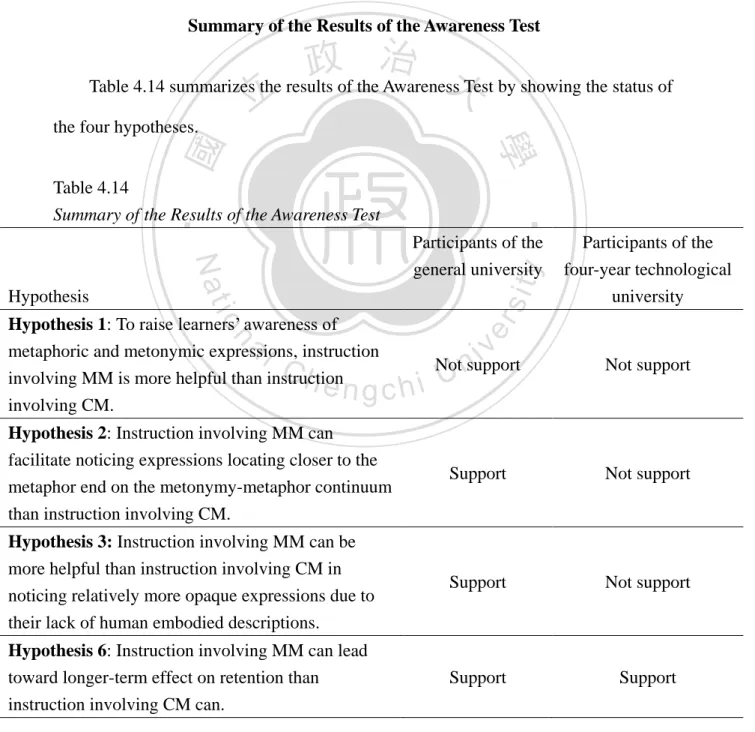
Instruction involving MM can lead toward longer-term effect on retention than instruction involving CM can
RESULTS AND DISCUSSION
Instruction involving MM can lead toward longer-term effect on retention than
How can I advance in my career when my competitor holds all the aces? The two raters agreed that an answer which earned a score of 5 should point
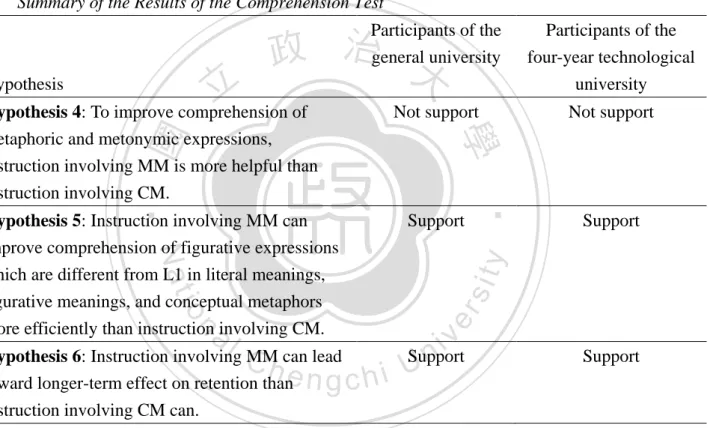
Instruction involving MM can improve comprehension of figurative expressions
相關文件
Enhance English Language Learning, Teaching and Assessment in Reading at Primary Level. • Designing Quality English Language Papers to Enhance Learning, Teaching
- allow students to demonstrate their learning and understanding of the target language items in mini speaking
The teacher explains to learners their duties: to present their ideas and findings on the questions on their role sheet, and lead the other group members to discuss the
Building on the strengths of students and considering their future learning needs, plan for a Junior Secondary English Language curriculum to gear students towards the
Language Curriculum: (I) Reading and Listening Skills (Re-run) 2 30 3 hr 2 Workshop on the Language Arts Modules: Learning English. through Popular Culture (Re-run) 2 30
Work in a collaborative manner with subject teachers to provide learners with additional opportunities to learn and use English in the school. Enhance teachers’ own
To help students appreciate stories related to the theme and consolidate their knowledge and language skills in writing stories, the English Club has organised a workshop on story
中學中國語文科 小學中國語文科 中學英國語文科 小學英國語文科 中學數學科 小學數學科.
