行政院國家科學委員會專題研究計畫 期中進度報告
半導體奈米結構的磁性與光學性質之研究(1/3)
計畫類別: 個別型計畫
計畫編號:
NSC91-2215-E-009-059-執行期間: 91 年 08 月 01 日至 92 年 07 月 31 日
執行單位: 國立交通大學電子工程學系
計畫主持人: 李建平
報告類型: 精簡報告
報告附件: 國外研究心得報告
出席國際會議研究心得報告及發表論文
處理方式: 本計畫可公開查詢
中
華
民
國 92 年 7 月 2 日
行政院國家科學委員會補助專題研究計畫期中報告
※※※※※※※※※※※※※※※※※※※※※※※
※
半 導 體 奈 米 結 構 的 磁 性 與 光 學 性 質 之 研 究 (1/3)
※
※
※※※※※※※※※※※※※※※※※※※※※※
計畫類別:
個別型計畫
計畫計畫編號:
NSC91-2215-E-009-059
執行期間:91 年 08 月 01 日至 92 年 7 月 31 日
計畫主持人:李建平
(theoretical part)(Abstr act): magnetic properties of nano-rings and dots, semiconductor spintronics, III-V semiconductor nano-systems, spin-orbit interaction.
This report summarizes the major results obtained from the first year of the project Two subjects are discussed in the following including, the magnetic properties of nano-scale semiconductor quantum rings and transformation of the magnetic properties of semiconductor quantum dots with presents of the spin-orbit interaction. Several publications were performed based on this year’s results.
In view of possible nano-scale semiconductor spintronic device and quantum computing implementations, we investigated in detail the quantized energy structures and magnetic properties of various nano-scale III-V semiconductor structures with strong spin-orbit interactions: semiconductor quantum nano-rings and semiconductor quantum dots. We have studied magnetic properties of nano-scale torus-shaped InAs/GaA quantum rings. The magnetization and magnetic susceptibility of the single electron rings were calculated. With increasing magnetic field, the ground-state changes from a state with (n=0,l=0,s=+1) to states with (n=0,l=-1,s=+1), (n=0,l=-2,s=+1), (n=0,l=-3,s=+1) and the ground-energy demonstrates aperiodic oscillations as the function on B. The aperiodic behavior is a clear consequence of the penetration of the magnetic field inside the ring region. The magnetization aperiodically jumps (see Figure 1). Each jump of the magnetization relays to the crossing of the single electron states and change in the ground states. The jump magnitudes are dependent on the ring dimensions. This is different from the Aharonov-Bohm periodic oscillations and uniform for one-dimensional models of meso-scopic rings.
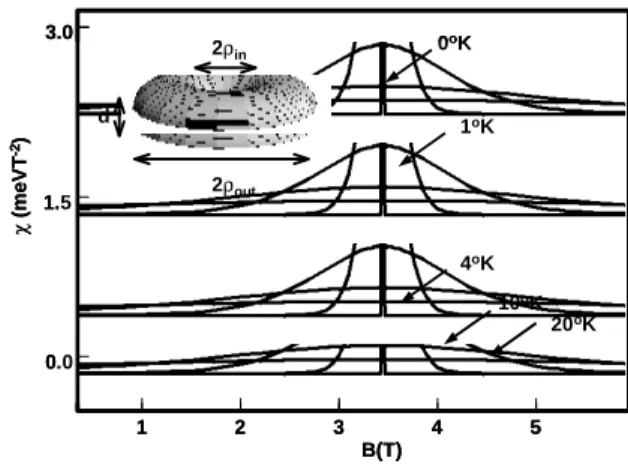
The above-described peculiarities in the magnetization generate interesting futures of the magnetic susceptibility (χ). At zero temperature, the obtained differential susceptibility has delta-like paramagnetic peaks, which are generated by the jumps of magnetization. With temperature increasing the peaks gradually disappear. In Figure 2 we present χ as the function of B in the region of the first jump for one-electron nano-ring with d = 2.4 nm, ρin = 10 nm, ρout = 30 nm. Note, that at the temperature 1
o
K the amplitude of the magnitude of the first paramagnetic peak is about 2.56 meVT-2. In Figure 3 we present the same dependencies for the ring with the dimensions: d = 2.4 nm, ρin = 10 nm, ρout = 60 nm. In this case the first peak
magnitude at 1o K is 4.47 meVT-2 (about twice as large as for the ring in Figure 2). Clearly, we found the dependence of the peaks amplitude on the dimensions of the rings (which does not exist in the conventional meso-scopic systems) and this is caused by the magnetic field penetration into the ring region. It follows form this theoretical study that experimental investigation of the magnetic properties of nano-scale quantum rings reveals interesting.
2. Magnetic pr oper ties of III-V semiconductor quantum dots in pr esents of the spin-or bit inter action
We calculated the magnetization and susceptibility of a cylindrical quantum dot with the parabolic confinement potential for electrons when the spin-orbit interaction is included into consideration. Application of a magnetic field along the dot axes generates a complicated structure of the electron energy levels and the theoretical analysis of the parabolic quantum dots in magnetic fields achieves a rich physics. Recently the well pronounced spin-splitting
was found by us for the parabolic confinement potential model of semiconductor quantum dots with parameters of InSb and InAs. The spin-splitting at zero magnetic field leads to a crossing of the energy levels in weak external magnetic fields (similarly to the general Paschen-Back effect) and can provide unusual magnetic properties of the quantum dots.
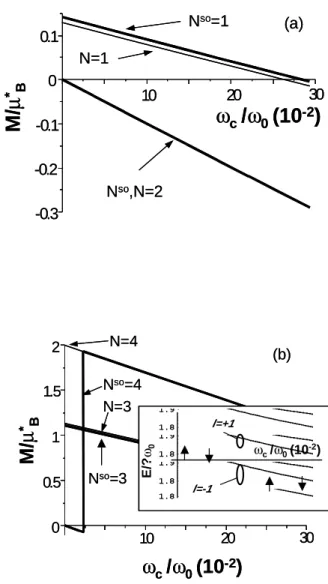
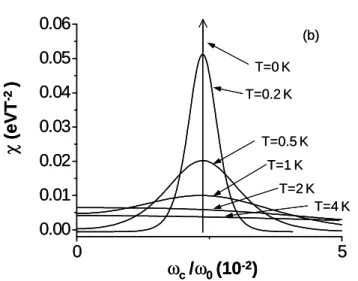
The magnetization for the same number of electrons with and without the spin-orbit interaction is also presented in Figure 4. The magnetization calculated without the spin-orbit interaction demonstrates a clear shell filling behavior: for N=2,6 (closed shells, see Fig. 4a, 4c) the magnetic momenta are canceled out at B=0; for N=1,3,4,5 (partially occupied shells, see Fig. 4a, 4b, 4c) the magnetization takes a positive value at B=0. Our calculation results suggest that the spin-orbit interaction keeps the cancellation for the closed shells and slightly changes the magnetization for N=1,3. The most interesting result we obtain for dots with four and five electrons. The spin-orbit splitting partially lifts up the degeneracy of levels and changes the electron structure. This assures the magnetization to be zero at B=0 for dots with four electrons in contrast to the case without the spin-orbit interaction. The crossing between levels for the quantum dot with four electrons a sharp jump in the magnetization and shifts the magnetic susceptibility peak (see Figure 5). For the quantum dot with five electrons the jump reflects the crossing between another levels for a higher magnetic field and generates an additional (in comparison to the case with absent of the spin-orbit interaction) peak for the magnetic susceptibility (Figure 6). One can control the spin coupling parameters in planar semiconductor systems by means of external or build-in electric fields. By variations of the fields one can change magnitudes of the parameters. From the above it appears that the peaks of the magnetic susceptibility which are generated by the spin-orbit interaction should have the following interesting properties. It is possible to perform a switching between the configuration with and without spin-orbit interaction by means of the external electric field or the design of quantum dots.
Publications:
1. O. Voskoboynikov and C. P. Lee, Magnetization and magnetic susceptibility of InAs nano-rings, Physica E, accepted, to appear in 2003.
2. O. Voskoboynikov, O. Bauga, C. P. Lee, and O. Tretyak, Magnetic properties of parabolic quantum dots in the presence of the spin-orbit interaction, Journal of Applied Physics, accepted, to appear in 2003.
3. O. Voskoboynikov and C. P. Lee, Spin-orbit interaction and all-semiconductor spintronics, Journal of Supercoductivity: Incorporating Novel Magnetizm, 16, 361 (2003).
4. O. Voskoboynikov, Magnetic properties of nano-rings, Proceedings of APAM 2002 International Conference on ICN: Creating a Global Nanotechnology Network, December 9-11, 2002, Hsinchu (Taiwan).
5. O. Voskoboynikov, Suppression of the Aharonov-Bohm effect in semiconductor nano-rings, Abstracts of the Workshop on quantum transport and mesoscopic physics, January 09-11, 2003, Hsinchu (Taiwan).
Figures:
Figure 1. Magnetization of the single electron torus-shaped nano-ring at zero temperature. The ring height – 2.4 nm, inner radius – 10 nm, outer radius – 30 nm.
Figure 2. Susceptibility of the single electron nano-ring at different temperatures (d = 2.4 nm,
ρin = 10 nm, ρout = 30 nm). 3.0 B(T) χ (m e V T -2) 1oK 1.5 1 0.0 3 4 5 2 4oK 0oK 20oK 10oK 2ρout d 2ρin 3.0 B(T) χ (m e V T -2) 1oK 1.5 1 0.0 3 4 5 2 4oK 0oK 20oK 10oK 2ρout d 2ρin 3.0 χ (m e V T -2) 1oK 1.0 1 0.0 3 4 5 2 4oK 0oK 20oK 10oK 2.0 -1.0 -2.0 3.0 χ (m e V T -2) 1oK 1.0 1 0.0 3 4 5 2 4oK 0oK 20oK 10oK 2.0 -1.0 -2.0
Figure 3. The same as in Figure 2, but d = 2.4 nm, ρin = 10 nm, ρout = 60 nm. -0.2 10 20 30 0 0.1 -0.1 -0.3
M/
µ
* Bω
c/
ω
0(10
-2)
Nso=1 Nso,N=2 N=1 (a) -0.2 10 20 30 0 0.1 -0.1 -0.3M/
µ
* Bω
c/
ω
0(10
-2)
Nso=1 Nso,N=2 N=1 (a)ω
c/
ω
0(10
-2)
10M/
µ
* B N=4 Nso=3 Nso=4 20 30 0 0.5 2 1 1.5 N=3 (b) ωc /ω0 (10-2) E/ ? ω0 l=+1 l=-1ω
c/
ω
0(10
-2)
10M/
µ
* B N=4 Nso=3 Nso=4 20 30 0 0.5 2 1 1.5 N=3 (b) ωc /ω0 (10-2) E/ ? ω0 l=+1 l=-1 ωc /ω0 (10-2) E/ ? ω0 l=+1 l=-1Figure 4. Magnetization of InAs parabolic quantum dot with and without spin-orbit interaction: (a) for one and two electrons; (b) for three and four electrons (insert shows the dot energy levels for the angular momentum |l|=1 with the spin-orbit interaction included, arrows refer to the spin polarizations); (c) for five and six electrons. Index "so" marks calculations with spin-orbit interaction. ìB=e /2m, ω0
is the characteristic confinement energy in the dot, ωC is the electronic cyclotron
frequency.
Figure 5. Temperature dependence of the susceptibility of InAs parabolic quantum dot with four electrons.
M/
µ
* Bω
c/
ω
0(10
-2)
N=5 Nso=5 Nso,N=6 10 20 0 0.5 1 -0.5 -1 (c)M/
µ
* Bω
c/
ω
0(10
-2)
N=5 Nso=5 Nso,N=6 10 20 0 0.5 1 -0.5 -1 10 20 0 0.5 1 -0.5 -1 (c) 0 5 0.00 0.01 0.02 0.03 0.04 0.05 0.06 χ (eV T -2 ) ωc /ω0 (10-2) T=0 K T=0.5 K T=1 K T=2 K T=4 K T=0.2 K (b) 0 5 0.00 0.01 0.02 0.03 0.04 0.05 0.06 χ (eV T -2 ) ωc /ω0 (10-2) T=0 K T=0.5 K T=1 K T=2 K T=4 K T=0.2 K (b)Figure 6. Temperature dependence of the susceptibility of InAs parabolic quantum dot with five electrons. 0 10 20 30 0.00 0.02 0.04 χ (eVT -2 ) ωc /ω0 (10-2) T=0 K T=0.5 K T=1 K T=2 K T=4 K T=0.2 K (d) 0 10 20 30 0.00 0.02 0.04 χ (eVT -2 ) ωc /ω0 (10-2) T=0 K T=0.5 K T=1 K T=2 K T=4 K T=0.2 K (d)