Synthesis, Structure, and Optical and
Electrochemical Properties of
Star-Shaped Porphyrin
−
Triarylamine
Conjugates
Wei-Nan Yen,
†Shang-Shih Lo,
†Ming-Cheng Kuo,
†Chi-Lun Mai,
†Gene-Hsiang Lee,
‡Shie-Ming Peng,
‡and Chen-Yu Yeh*
,†Department of Chemistry and Center of Nanoscience and Nanotechnology, National Chung Hsing UniVersity, Taichung 402, Taiwan, and Department of Chemistry, National Taiwan UniVersity, Taipei 106, Taiwan
[email protected] Received June 15, 2006
ABSTRACT
A series of novel star-shaped porphyrin−triarylamine conjugates were synthesized by palladium-catalyzed cross-coupling reactions. The spectroscopic and electrochemical studies show thatπ-conjugation of the porphyrin core is extended to the triarylamine moieties.
There has been continuous interest in the synthesis of porphyrins because they are widespread in nature1and have promising applications in electronic materials.2The physical and chemical properties of porphyrins can be precisely controlled by proper functionalization of the porphyrin core. In the meso-tetraarylporphyrins, the electronic perturbation is only moderate since the aryl groups twist out of the porphyrin plane resulting in the interruption of the π-con-jugation.3To increase the electronic interaction, numerous
linkers have been used to bridge the aryl groups and the porphyrin.4 It has been reported that acetylenic types of linkers exhibit effectiveπ-conjugation between aryl groups and the porphyrin core.4
Triarylamine-based oligomers and dendrimers have been intensively studied because of their potential applications in the field of organic light-emitting diode, information storage
†National Chung Hsing University. ‡National Taiwan University.
(1) (a) Chapman, S. K.; Daff, S.; Munro, A. W. Structure and Bonding; Springer-Verlag: Berlin, Germany, 1997; Vol. 88, pp 39-70. (b) Kadish, K. M.; Smith, K. M.; Guilard, R. The Porphyrin Handbook; Academic Press: San Diego, CA, 2000. (c) Ortiz de Montellano, P. R. Cytochrome
P450: Structure, Mechanism, and Biochemistry, 2nd ed.; Plenum: New
York, 1995.
(2) (a) Anderson, H. L. Chem. Commun. 1999, 2323-2330. (b) Kim, D.; Osuka, A. J. Phys. Chem. A 2003, 107, 8791-8816. (c) Guldi, D. M.; Rahman, G. M. A.; Zerbetto, F.; Prato, M. Acc. Chem. Res. 2005, 38, 871-878.
(3) (a) Kim, J. B.; Leonard, J. J.; Longo, F. R. J. Am. Chem. Soc. 1972,
94, 3986-3992. (b) Zuimby, D. J.; Longo, F. R. J. Am. Chem. Soc. 1975, 97, 5111-5117. (c) Spellane, P. J.; Gouterman, M.; Antipas, A.; Kim, S.;
Liu, Y. C. Inorg. Chem. 1980, 19, 386-391.
(4) (a) Anderson, H. L.; Wylie, A. P.; Prout, K. J. Chem. Soc., Perkin
Trans. 1 1998, 1607-1611. (b) Screen, T. E. O.; Blake, I. M.; Rees, L. H.;
Clegg, W.; Borwick, S. J.; Anderson, H. L. J. Chem. Soc., Perkin Trans. 1
2002, 320-329. (c) LeCours, S. M.; DiMagno, S. G.; Therien, M. J. J.
Am. Chem. Soc. 1996, 118, 11854-11864. (d) Lin, V. S.-Y.; DiMagno, S.
G.; Therien, M. J. Science 1994, 264, 1105-1111. (e) Arnold, D. P.; Heath, G. A.; James, D. A. J. Porphyrins Phthalocyanines 1999, 3, 5-31. (f) Wytko, J.; Berl, V.; McLaughlin, M.; Tykwinski, R. R.; Schreiber, M.; Diederich, F. HelV. Chim. Acta 1998, 81, 1964-1977. (g) Susumu, K.; Maruyama, H.; Kobayashi, H.; Tanaka, K. J. Mater. Chem. 2001, 11, 2262-2270.
ORGANIC
LETTERS
2006
Vol. 8, No. 19
4239-4242
10.1021/ol061478w CCC: $33.50 © 2006 American Chemical Society
Published on Web 08/22/2006
Downloaded by NATIONAL TAIWAN UNIV on August 19, 2009
devices, hole-transporting materials, field-effect transistors, and photovoltaic cells.5In recent years, significant interest
has focused on the synthesis of hybrid molecules containing triarylamine moiety.6 However, only a few examples of
porphyrin-triarylamine hybrids have been reported.7 Our
group has previously reported the synthesis of porphyrin-triarylamine conjugates, in which two porphyrin-triarylamine units are attached to the porphyrin core via ethynyl linkers.8 The
electrochemical studies showed that the triarylamine units display strong coupling via the diethynylporphyrin bridge. In this Letter we report a synthetic route to star-shaped porphyrin-triarylamine conjugates and their spectroscopic and electrochemical properties are presented.
While the synthesis and properties of meso-substituted tetraarylporphyrins have been intensively studied, the studies on the meso-tetraarylethynylporphyrins are relatively rare.9
Usually, 5,10,15,20-meso-tetraarylethynylporphyrins were synthesized from the reaction of pyrrole with the corre-sponding arylpropynal under Lindsey’s conditions.10 To
avoid the multistep syntheses of arylpropynal, we have developed a simple approach to this type of porphyrins by coupling of 5,10,15,20-tetraethynylporphyrin to the appropri-ate aryl iodides.11 We extended the palladium-catalyzed
coupling method to the synthesis of star-shaped porphyrin-triarylamine conjugates. As shown in Scheme 1, deprotection
of porphyrin 1 by TBAF afforded the key intermediate porphyrin 2, which was then coupled to 4-(N,N-diarylamino)-phenyl iodides to give the desired porphyrins 3-7. The coupling process proceeded efficiently for both electron-donating and electron-withdrawing substrates. The new compounds were characterized by various spectroscopic methods.
The electronic interaction between the triarylamine units and porphyrin macrocycle was investigated by UV-vis absorption spectroscopy. The electronic absorption data for porphyrins 3-7 and reference porphyrin 1 are summarized in Table 1. The absorption spectra of these conjugates are very different from the sum of their respective components, porphyrin 1 and the corresponding triarylamines, and show peak broadening, peak shifts, and changes in the oscillator
(5) (a) Yan, H.; Scott, B. J.; Huang, Q.; Marks, T. J. AdV. Mater. 2004, 16, 1948-1953. (b) Fuentes-Hernandez, C.; Thomas, J.; Termine, R.; Meredith, G.; Peyghambarian, N.; Kippelen, B.; Barlow, S.; Walker, G.; Marder, S. R.; Yamamoto, M.; Cammack, K.; Matsumoto, K. Appl. Phys. Lett. 2004, 85, 1877-1879. (c) Bender, T. P.; Graham, J. F.; Duff, J. M. Chem. Mater. 2001, 13, 4105-4111. (d) Majewski, L. A.; Schroeder, R.; Grell, M. AdV. Funct. Mater. 2005, 15, 1017-1022. (e) Satoh, N.; Nakashima, T.; Yamamoto, K. J. Am. Chem. Soc. 2005, 127, 13030-13038. (6) (a) Wang, Y. Z.; Epstein, A. J. Acc. Chem. Res. 1999, 32, 217-224. (b) Chen, C.-T.; Lin, J.-S., Moturu, M. V. R. K.; Lin, Y.-W.; Yi, W.; Tao, Y.-T.; Chien, C.-H. Chem. Commun. 2005, 3980-3982. (c) Sengupta, S.; Sadhukhan, S. K.; Muhuri, S. Tetrahedron Lett. 2002, 43, 3521-3524.
(7) (a) Li, B.; Xu, X.; Sun, M.; Fu, Y.; Yu, G.; Liu, Y.; Bo, Z. Macromolecules 2006, 39, 456-461. (b) Frampton, M. J.; Beavington, R.; Lupton, J. M.; Samuel, I. D. W.; Burn, P. L. Synth. Met. 2001, 121, 1671-1672. (c) Huang, C.-W.; Chiu, K. Y.; Cheng, S.-H. Dalton Trans. 2005, 2417-2422.
(8) Chang, J.-C.; Ma, C.-J.; Lee, G.-H.; Peng, S.-M.; Yeh, C.-Y. Dalton Trans. 2005, 1504-1508.
(9) (a) Proess, G.; Pankert, D.; Hevesi, L. Tetrahedron Lett. 1992, 33, 269-272. (b) Anderson, H. L. Tetrahedron Lett. 1992, 33, 1101-1104. (c) Milgrom, L. R.; Yahioglu, G. Tetrahedron Lett. 1995, 36, 9061-9064. (d) Milgrom, L. R.; Yahioglu, G. Tetrahedron Lett. 1996, 37, 4069-4072. (e) Anderson, H. L.; Wylie, A. P.; Prout, K. J. Chem. Soc., Perkin Trans. 1 1998, 1607-1611.
(10) Lindsey, J. S.; Wagner. R. W. J. Org. Chem. 1989, 54, 828-836.
(11) Kuo, M.-C.; Yen, W.-N.; Lo S.-S.; Yeh, C.-Y. Manuscript in preparation.
Table 1. Absorption, Emission, and Redox Data for Compounds 1 and 3-7a
oxidation (V) reduction (V) fwhm, B-band/ cm-1(nm)b fBc fwhm, Q-band/ cm-1(nm) fQd λeme
(nm) E1/2(ox1) E1/2(ox2) E1/2(ox3) E1/2(red1) E1/2(red2)
1 379 (458) 1.22f 481 (646) 0.09g 652, 716 1.24 -0.90 -1.38 3 1371 (500) 1.65 1019 (702) 0.39 727, 801 0.87 1.09 -0.94 -1.37 4 1420 (503) 1.58 1018 (709) 0.32 736, 801 0.84 0.99 1.26 -0.92 -1.34 5 1830 (504) 2.04 1174 (713) 0.41 742, 799 0.76 0.94 1.03 -0.97 -1.35 6 1181 (497) 1.26 932 (696) 0.22 716, 800 0.90 1.12 -0.90 -1.32 7 918 (490) 1.78 800 (684) 0.24 700, 799 1.06 1.42h -0.78 -1.23 aThe absorption and emission spectra were taken in CH
2Cl2and electrochemical data were recorded in THF.bfwhm is the full width at half-maximum
height; the number in parentheses is the absorption maximum.cOscillator strengths calculated over the region from 400 to 600 nm.dOscillator strengths calculated over the region from 600 to 800 nm.eEmission maximum.fOscillator strengths calculated over the region from 400 to 500 nm.gOscillator strengths calculated over the region from 500 to 700 nm.hIrreversible reaction.
Scheme 1. Synthesis of Porphyrins 3-7
4240 Org. Lett.,Vol. 8, No. 19, 2006
Downloaded by NATIONAL TAIWAN UNIV on August 19, 2009
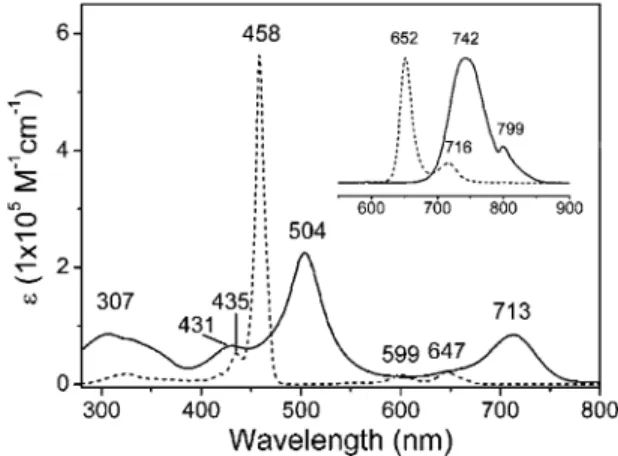
strength of absorptions.12,13As an example, Figure 1 shows
the UV-vis spectra of compounds 1 and 5. In CH2Cl2,
porphyrin 5 shows a Soret band at 504 nm, representing the longest wavelength for a planar single porphyrin, together with a smaller Q-band at 713 nm. The full width at half-maximum height (fwhm) of the Soret bands is much larger for 5 (1830 cm-1) than for 1 (379 cm-1), indicative of strong electronic interaction between the porphyrin and triarylamine units. The large red shifts of both the Soret and Q-bands indicate a decreased energy gap between the HOMO and LUMO orbitals as a consequence of the expanded
π-conju-gation.14,15It should be noted that compounds 3-7 exhibit
significantly enhanced oscillator strength of the Q-band, which is consistent with an enhanced energy splitting between the a1uand a2uorbitals, or the Egorbitals.13,14The
absorption spectra suggest that incorporation of triarylamine units via the carbon-carbon triple bonds produces profound perturbation to the ground-state properties of the porphyrin. The fluorescence spectra of porphyrins 1 and 5 are shown in the inset of Figure 1. The enlargement of theπ-conjugation
exhibits the emission characteristics. This is manifested in a red shift of the emission maximum as theπ-delocalization
increases. This finding is consistent with the similar trend observed in the absorption spectra.
The effectiveπ-conjugation of the triarylamine moieties
via acetylene bridges is expected to reflect on the electro-chemical behavior of porphyrins 3-7. The electroelectro-chemical data of the porphyrin-triarylamine conjugates are listed in Table 1. It is well-known that both the porphyrin and triarylamine units are redox active. In general, the former has two oxidation and two reduction processes and the latter
exhibits one reversible oxidation. Figure 2 shows the cyclic voltammograms of porphyrins 1 and 4. For porphyrin 4, the first two one-electron oxidations at E1/2) +0.84 and +0.99
V can be assigned to porphyrin-centered processes, which were further comfirmed by spectroelectrochemistry as will be discussed later on. The two-electron process at E1/2 )
+1.26 V corresponds to the oxidation for two of the
triarylamine units. As compared to that of porphyrin 1, the first oxidation of porphyrin 4 is anodically shifted by 400 mV, indicating that the triarylamine units can stabilize the oxidized porphyrin core. Interestingly, except for porphyrin
7 the reduction processes of 3-6 exhibit slight shift in the
range 0 to 70 mV relative to those of porphyrin 1, suggesting that the LUMO energy is only slightly perturbed as the
π-conjugation is expanded. In agreement with the absorption
and emission measurements, the potential difference between the HOMO and LUMO gap (estimated by∆E ) E1/2(ox1)
- E1/2(red1)) decreases with increasingπ-conjugation. For
example, the voltammetric HOMO-LUMO gap of +1.76 V for porphyrin 4 is smaller by 380 mV than that of porphyrin
1. The contraction of the HOMO-LUMO energy gap in 4 is
attributed to the elevated HOMO energy.
Substituent effects of porphyrins 3-7 on the redox potentials were observed. For example, the first oxidation for porphyrin 5 occurred at E1/2 ) +0.76 while that for
porphyrin 7 was observed at E1/2) +1.06. Considering the
long distance of about 12 Å between the substituents of the triarylamine units and the porphyrin core, such a large difference in the redox potential is remarkable.
The electrochemical reactions of our compounds were also studied by spectroelectrochemistry. The spectral changes of compound 4 at applied potentials of Eappl.) +0.90 and +1.15
V show a sharp decrease in the Soret band, indicating that the oxidations occur at the porphyrin ring. The most striking feature of the spectra for both one- and two-electron oxidized species is the presence of the broad near-IR band, which can be ascribed to the charge transfer between the triaryl-amine units and the porphyrin cation/dication.7c,8 The first
two one-electron oxidation processes are reversible.
How-(12) Taylor, P. N.; Wylie, A. P.; Huuskonen, J.; Anderson, J. L. Angew. Chem., Int. Ed. 1998, 37, 986-989.
(13) LeCours, S. M.; DiMagno, S. G.; Therien, M. J. J. Am. Chem. Soc. 1996, 118, 11854-11864.
(14) Odobel, F.; Suresh, S.; Blart, E.; Nicolas, Y.; Quintard, J.-P.; Janvier, P.; Questel, J.-Y. L.; Illien, B.; Rondeau, D.; Richomme, P.; Ha¨upl, T.; Wallin, S.; Hammarstro¨m, L. Chem. Eur. J. 2002, 8, 3027-3046.
(15) Schauer, C. K.; Anderson, O. P.; Eaton, S. S.; Eaton, G. R. Inorg. Chem. 1985, 24, 4082-4086.
Figure 1. The absorption of 5 (solid) and 1 (dash) in CH2Cl2.
Inset: Emission spectra, excited at 504 and 458 nm for 5 and 1, respectively.
Figure 2. The cyclic voltammograms of 1 and 4 in THF containing 0.1 M TBAPF6. Dashed lines show narrower scanned ranges.
Org. Lett.,Vol. 8, No. 19, 2006 4241
Downloaded by NATIONAL TAIWAN UNIV on August 19, 2009
ever, further oxidation at an applied potential of +1.35 V leads to decomposition of the complex.
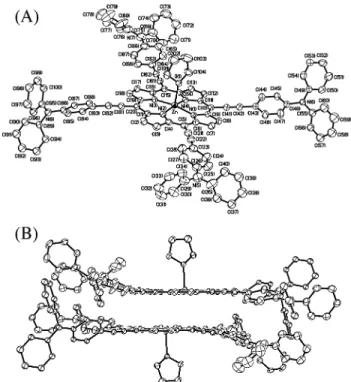
Figure 4 shows the ORTEP diagram of compound 3. The zinc ion is coordinated to a THF molecule. The bond distances and angles in the porphyrin ring are similar to those observed in the 5,10,15,20-tetraarylporphyrin system.15,16The
porphyrin framework is essentially planar. The acetylene carbons slightly deviate from the mean plane of the porphyrin in the range 0.008 to 0.136 Å. Strong electronic interaction requires efficientπ-orbital overlap and this can be examined
by the dihedral angles between the aromatic rings. The dihedral angles between the acetylene-bonded benzene rings and the porphyrin macrocycle are 15.41°, 15.41°, 18.69°, and 24.78°, respectively, which are smaller than those of 29.7° and 59.5° observed in meso-tetra(4-butylphenyl-ethynyl)porphyrin zinc.4a The distances of carbon-carbon
triple bonds fall into the range 1.193-1.201 Å, indicating that there is no cumulenic character in this compound. It is noteworthy that the porphyrin shows strongπ-π interaction
with a plane-plane distance of 3.30 Å, which is shorter by 0.26 Å than that observed in meso-tetra(4-butylphenyl-ethynyl)porphyrin zinc.4a
In conclusion, we have successfully synthesized a series of star-shaped porphyrin-triarylamine conjugates. Their optical and electrochemical properties show that the intro-duction of triarylamine units via acetylene bridges
signifi-cantly extends theπ-conjugation of the porphyrin core. These
new compounds exhibit large red shifts of Soret and Q-bands and these studies may lead to the development of new photosensitizers for applications in photodynamic therapy. The strongπ-π interaction of 3 in the solid state suggests
that upon proper modification this type of porphyrin may form columnar stacking supramolecules, which can be considered as “molecular wires” and may be used for charge-transporting or light-harvesting. Study along this line is currently underway in our laboratory.
Acknowledgment. We thank the National Science
Coun-cil of Taiwan for financial support. We also thank Professor Kuan-Jiuh Lin (National Chung Hsing University) for the access of the UV-vis-near-IR spectrometer.
Supporting Information Available: Synthetic
proce-dures, spectral data, and cyclic voltammograms for new compounds, and crystallographic data for 3. This material is available free of charge via the Internet at http://pubs.acs.org.
OL061478W (16) Scheidt, W. R.; Kastner, M. E.; Hatano, K. Inorg. Chem. 1978, 17,
706-710.
Figure 3. Spectral changes of 4 in THF containing 0.1 M TBAPF6
at applied potentials of +0.70 (solid), +0.90 (dash), and +1.15 V (dot).
Figure 4. (A) Crystal structure of 3. (B) Stacking pair of 3 with a plane-plane distance of 3.30 Å. Thermal ellipsoids were drawn at 50% probability levels.
4242 Org. Lett.,Vol. 8, No. 19, 2006
Downloaded by NATIONAL TAIWAN UNIV on August 19, 2009