行政院國家科學委員會專題研究計畫 期中進度報告
兩性分子之自組結構與機制的探討(2/3)
期中進度報告(精簡版)
計 畫 類 別 : 個別型 計 畫 編 號 : NSC 95-2113-M-002-011- 執 行 期 間 : 95 年 08 月 01 日至 96 年 07 月 31 日 執 行 單 位 : 國立臺灣大學化學系暨研究所 計 畫 主 持 人 : 陸駿逸 共 同 主 持 人 : 陳宣毅 報 告 附 件 : 出席國際會議研究心得報告及發表論文 處 理 方 式 : 本計畫可公開查詢中 華 民 國 96 年 12 月 12 日
行政院國家科學委員會補助專題研究計畫
期中進
度報告
兩性分子之自組結構與機制的探討(2/3)
計畫類別: 個別型計畫
計畫編號:NSC
95-2113-M-002-011-執行期間:
95 年
8 月
1 日至
96 年
7 月
31 日
計畫主持人:陸駿逸
共同主持人:陳宣毅
計畫參與人員:
成果報告類型(依經費核定清單規定繳交):精簡報告
本 成 果 報 告 包 括 以 下 應 繳 交 之 附 件 :
□ 赴 國 外 出 差 或 研 習 心 得 報 告 一 份
□ 赴 大 陸 地 區 出 差 或 研 習 心 得 報 告 一 份
□ 出 席 國 際 學 術 會 議 心 得 報 告 及 發 表 之 論 文 各 一 份
□國際合作研究計畫國外研究報告書一份
處理方式: 得立即公開查詢
執行單位:台大化學系
中
華
民
國
96 年
5 月
4 日
I.
Theoretical work
We finished the theoretical derivation of the SCFT for AnBm star copolymers with solvent. Consider a solution system of AnBm diblock copolymers with the solvent. The volume fraction of the polymer is,and the volume fraction of solvent is (1–). Each copolymer has polymerization index N, in which A-monomer occupy the fraction f. A schematic representation of the AnBm architecture is shown below. We assume that both the A and B monomers occupy the same volume, 1/0, and have the
same statistical length, a. The system is incompressible with total volume V. The local interaction between monomer I and J is quantified by the Flory-Huggins parameterIJ.
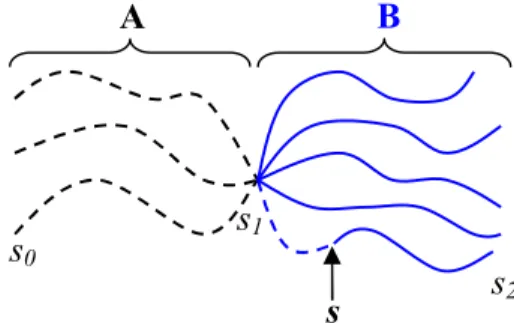
Each polymer is parametrized with a variable s that increases continuously along its length. At the A-monomer end, s = s0, at the junction point between A and B
monomers, s = s1, and at B-monomer end, s = s2. For diblock copolymer we set s0=0,
s1= f, and s2=1.
Fig. 1. A schematic of Branched Molecular architecture.
We then solve the partition function in order to get the density profile. One can write the partition function as Q
drq(r,1), where the q(r,s) is the end-segmentdistribution function. The distribution function satisfies the modified diffusion equation where the variable s plays the role of time. We solve the distribution
function within a given unit cell using the spectral method with the periodic boundary condition. The potential is given by the self-consistent condition via a Flory type interaction with the givenAS,BS,AB parameters.
We first consider a weak selective solvent, setAS= 0.7,BS= 0.4,ABN = 40, N=200,
f = 0.4. We compute the phase diagrams for A1B1and A1B3copolymers. The phase
diagrams are shown below.
B
A
s0
s s2
I.1. A1B1diblock copolymers
Here D denotes the disorder phase, MC means the micelle crystal phase, H and L means the hexagonal and lamellar phase, respectively.
We got the phase diagram by comparing the free energies per chain in the different phases. The common tangent construction is yet to be done. The free energy of these four phases as polymer concentration increase is also shown below.
-50.00 -45.00 -40.00 -35.00 -30.00 -25.00 -20.00 -15.00 -10.00 -5.00 0.00 0 0.2 0.4 0.6 0.8 1 Fr e e e n e rg y p e r ch a in Lam Hex mc dis
From this plot, we found that the free energies for three order phases are actually very close to each other. We replot the free energy difference of the three order phases relative to the free energy of disorder phase to make a clearer comparison.
-4.50 -4.00 -3.50 -3.00 -2.50 -2.00 -1.50 -1.00 -0.50 0.00 0.50 0 0.2 0.4 0.6 0.8 1 F( o rd e r) -F( d is o rd e r) Lam Hex MC
0 0.1 0.2 0.3 0.4 0.5 0.6 0.7 0.8 0.9 1 D MC H L I.2. A1B3diblock copolymers
A1B3block copolymers can form the lamellar phase, but such phase is always
metastable compared to the other mesophases. Here is the free energy plot.
-50.00 -45.00 -40.00 -35.00 -30.00 -25.00 -20.00 -15.00 -10.00 -5.00 0.00 0 0.2 0.4 0.6 0.8 1 Fr e e e n e rg y p e r ch a in Lam Hex mc dis -3.50 -3.00 -2.50 -2.00 -1.50 -1.00 -0.50 0.00 0.50 0 0.2 0.4 0.6 0.8 1 F( o rd e r) -F( d is o rd e r) Lam Hex MC
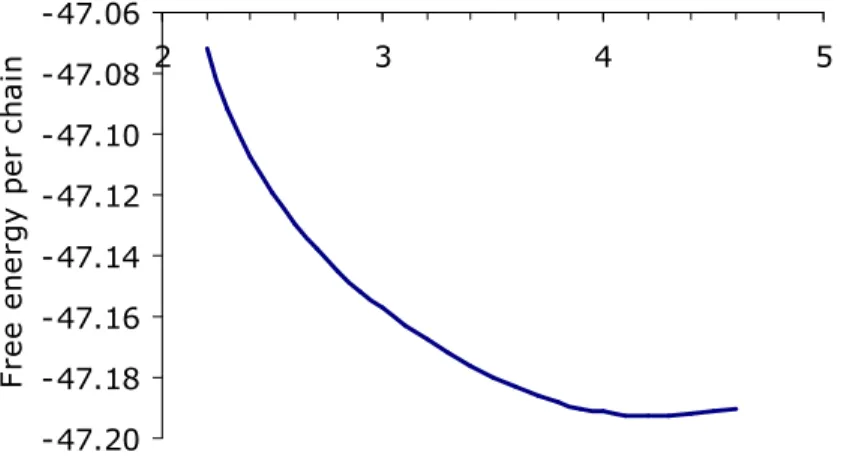
0 0.1 0.2 0.3 0.4 0.5 0.6 0.7 0.8 0.9 1 D MC H When dealing with an ordered periodic phase, we minimize the free energy with respect to the periodic length, D. The best periodic length will be chosen to give the lowest free energy. Here is an example of the free energy variation with the periodic length. -47.20 -47.18 -47.16 -47.14 -47.12 -47.10 -47.08 -47.06 2 3 4 5 periodic length, D (Rg) F re e e n e rg y p e r ch a in
I.3. The density profile
Sometime in the process of searching for the lowest free energy structure, we can get other metastable phases. The density profiles shown below is an example.
The two density profiles are from the A1B3star copolymers. The volume fraction of
A1B3is 0.50. We have got either the normal hexagonal phase or the reverse hexagonal
phase depending on the initial trial density function chosen.
Fig.1. The density profile of A1B3star copolymers at= 0.50. The
periodic length of such structure is 1.4Rg. The red one is the A monomer,
and the blue one is the B monomer.
Fig. The free energy as the function of the periodic length (A1B3
If we continuously enlarge the simulation box, both the normal and reverse hexagonal phase are adjusted in order to fit the new box size. The density of the normal
hexagonal phase change smoothly:
The reverse hexagonal phase shows partially merged cylinders in the smaller box:
Considering the free energy variation as the the box size changes, we found that the free energy of reverse phase is always higher than that of normal phase. It will be very interesting if such unusual structures become the more stable mesophase. We are analyzing the strong segregation region at the moment to explore such possibility.
1.5 1.7 1.9 2.1 2.3 periodic length D (Rg) Fr ee en er g t pe r ch ai n normal phase reverse phase
II.
Experimental work
D (Rg)
1.4 1.6 1.8 2.0
D (Rg)
We have used the instrumental funding from (1/3 and 2/3) NSC and from the NTU Chemistry department to purchase the Physica 301 Rheometer together with the cylinder geometry which can be connected to the external AC impedance meter. So far we have finished the installation and the standard testing procedure. The
electrorheology training is finished in April 2007. At the preliminary project we determine to study the jamming transition of the carbon black in the silicon oil. Below are the stress data of a steady shearing carbon black dispersion showing a jamming transition with the small delay time.
0 0.2 0.4 0.6 0.8 Pa 0.1 1 10 Pa·s 0 0.05 1/s 0.1 Rheoplus Anton Paar GmbH carbon0.25 3 CC27/E-SN10096; d=0 mm Shear Stress Viscosity 0 0.1 0.2 0.3 0.4 0.5 0.6 Pa 0.1 1 10 Pa·s 0 0.5 1/s 1 Rheoplus Anton Paar GmbH carbon0.25 4 CC27/E-SN10096; d=0 mm Shear Stress Viscosity
We find the classic behavior that the delay time got shorten as the carbon black volume fraction gradually approaching the percolation concentration. We are still measuring the dynamic phase diagram now. We anticipate to measure the low frequency impedance after we got the phase diagram.
參加國際會議報告
陸駿逸
會議名稱﹕ YITP workshop on “New Frontiers in Colloidal Physics : A Bridge between
Micro- and Macroscpic Concepts in Soft Matter"
會議地點與時間:
July 25-27, 2007地點:日本京都
主辦單位:
Yukawa Institute for Theoretical PhysicsThis is my fifth visit to the Yukawa Institute for the soft matter meetings. Although there is no
permanent founding for holding this meeting, but every year the related research group in
Japan makes application to the government to run this meeting. The number of the participant
is also increased steadily. In this meeting we also find Korea scientists. It is fair to say that this
is “the” soft matter meeting in asia. Interestingly, that we have not seen people from China.
In this year, the participant is close to two hundreds. As the Yukawa Institue is renovated this
year, the meeting is actually held in the guest house 東大會館.
The format of the meeting is as before, that there is a main topic. The related soft matter topics
are still actively presented in the meeting under the proper session. This year the focus is the
colloid system. The first talk is given by the invited speaker William van Megen from the
Royal Melbourne Institute of Technology, Australia. Van Megen presented a dynamic phase
diagram of the colloidal suspension where the glass transition is studied in detail. The phase
diagram summaries the first order freesing transition and the glass transition. Even though they
are very different from the thermodynamic point of view, the dynamic behaviors are actually
very close. The glass transition is traditionally studied by the mode-coupling theory, which is
now extended to the flow condition, and Megen also compared the behavior with the freezing
transition boundary. The work is interesting, and the presentation is very good too. Prof. Didi
Derks from Paris (Ecole Normale Superieure) talked about an interesting colloid system which
is very close to its second order phase transition point. The gas-liquid interface becomes very
broad that the confocal microscope can resolve in real time the fine details of the colloid
density variation. Even more interesting is that the small surface tension makes the interface
move slowly and it is possible to observe the interface capillary wave dynamics using the
microscope. Prof. Derks studied the effect of the shear on these interface. I think this is a
system with great potential, that the previous unobserved atomic scale dynamics can be check
in this colloid system.
In the meddle of the meeting, there are two special talks to memorize the death of Prof. P.-G.
De Gennes this year. Prof. M. Doi gave a very clean talk to survey De Gennes’ academic
activity. It is a very impressive career, that he changed fields every few years. The unchanged
feature is that in every field he has done work on, he made important contribution. De Gennes
also has very strong opinion on the science education. He put a lots of effort to improve the
science education in France. From this respect he is very similar to YT Lee. However in 2002
when De Gennes visited Taiwan and had a dinner with YT Lee, it is interesting to obser that
these two great scientists are so different. I wounder whether these differences will have
significant consequence on the young generations of Taiwn and France. The second talk is by
Prof. Ko Okumura, who worked with De Gennes for many years. From this talk, we have the
chance to see how De Gennes collaborate with other, his personality, and his working style.
A very interesting talk on the granular materials is given by Prof. Yoshihiro Yamazaki from
Waseda University. He talked about the patterns induce by the boundary motion. There are a
lots of simple experiments which show unexpected result on the pattern generation in the
granular system. Those experiments are not expensive, but the ideas are very clever. I think
this is the most interesting talk in this meeting. A good talk by Prof. Ryoichi Yamamoto
(Kyoto Univ.) is on the direct numerical simulations of the charge colloid suspensions under
the applied electric field. I find it very interesting because I work on the same set of the
constitutive equation for the polyelectrolyte system. It is good to confirm by Yamamoto that
the matched asymptotic method on the colloid system can get reasonable result. Yamamoto’s
method is the direct numerical method, which should get the true behavior of this constitutive
equations. I also happily find out that Yamamoto’s program is freely distributed on the web,
so that if I want to work on the numerical side of the dielectric problem, I can use his code as a
starting point.
A fundamentally important fluid mechanic work by Prof. Paul Chaikin was presented. In this
work, Chaikin studied the flow of the particles in the viscous fluid. The shear flow is carefully
applied for a given time, and the reverse flow followed, and the particle positions are
monitored with the great accuracy to see whether the flow is truly reversible, as proved by the
low Raynold number fluid mechanics book. To his surprise, the particles occasionally fail to
recover their initial position. Even more surprisingly, the reversibility depends on the shear
strain, that there is a critical strain amplitude for this system. If the applied strain is small, then
the system is reversible, whereas a large strain may induce the irreversibility. The particles
they used are very large so that the Brownian motion can be neglected, so that this is a pure
fluid mechanics problem. It is very interesting because this is a non-linear dynamic system
which may or may not break the time reversal symmetry depending on the applied strain
magnitude! Paul Chaikin has some interpretation that I do not fully understand. Nevertheless
the problem resemblance the second law of the thermodynamics, and the experimental
technique is capable to resolve the motion trajectory of the each individual particle. I think this
system will be a very good starting point to investigate the fundamental irreversibility in the
statistical mechanics.
In this meeting I also have the chance to talk to Prof. T. Ohta and Prof. Onuki about my recent
calculation of the chiral copolymer mesophases. The discussion with Prof. Ohta is particular
important as his work (with Prof. K. Kawasaki) is the classic in the block copolymer problem.
There are two approaches which relate the strong segregation free energy of the block
copolymer to the electrostatic problem. The interrelation between the two approaches, however,
is not addressed in the literature. In the problem I work on, the electrostatic analogy is also
very useful, so that I discuss with Prof. Ohta about the possible relation between the two
approaches. There is no clear answer after the discussion. Nevertheless, I now understand
better how Prof. Ohta thinks about this problem. He also expressed the interests on this
problem, so that we may think about some collaboration in the future. Overall, I enjoy this
meeting very much. There are some new problems that I find them very interesting and may
become my future research topics.
The Report of YIPT 2007 Workshop in Kyoto
林凡硯
此次到日本京都大學參與由湯川理論物理中心(YITP)所舉辦的New Frontiers in Colloidal Physics : A Bridge between Micro and Macroscpic Concepts in Soft Matter,此次會議所論及之膠體系統展現的 是在維度在10-1000nm的不均相現象,並且此種現象已成為軟物質學門的一新興領域。且最近隨 著電腦模擬技術的進步,使得在真實空間和時間下對膠體系統的結構和動力關係有創新性地發 展,能夠更進一步地了解膠體系統之形成與變化。以下將就所聽之部份演講整理重點,敘述如下:
Direct Numerical Simulations of Colloidal Dispersions under External Force
Ryoichi Yamamoto
現行在膠體系統上已經有許多的數值模擬方法,在此演講中作者提出將 colloid/fluid interfaces的擴散設定為 non-zero thickness ξ 會大幅改善模擬的效率,講者其團隊發展出在帶電膠 體分散系統中對於 electro-hydrodynamic phenome的直接數值模擬(DNS),在此方法中允許使用者 同時地計算 colloidal particles, ions, 及 host fluids的 time evolution,而其計算是透過解出 Newton, advection-diffusion, 及 Navier-Stokes equations,所以能將 electrohydrodynamic coupling也一起考 慮進去,這樣的數值模擬結果與 approximation theories相比,在稀薄的膠體系統時有著定量上的 吻合,而且不須任何經驗值的修正,然而,此一方法數值模擬方法在濃的膠體系統時可預期到有 顯著的偏差。
講者其團隊在最近修正其 DNS code將粒子的布朗運動也一併列入考慮,新的 DNS code 可將 hydrodynamic interaction 以及 thermal fluctuation同時一併考慮,其中一個很顯著的結果是 chain formations of likely charged particles,這是因為有外加電場的原因,這樣的現象已經可以用 DNS進行分析,同樣地,此項技術也可用以探討膠體系統中的 shear thickening行為。
Nonlinear rheology of soft glassy materials
Kunimasa Miyazaki
許多的 soft glassy material在增加 oscillatory-strain amplitude時都會展現非線性的黏彈行為,而許 多的 glassy system其 characteristic relaxation time對於 strain rate是相當敏感的,在 shear flow下結
構的 relaxation time大約為 ,最後一項為strain rate、倒數第二項為 relaxation time without shear, G*(ω) 的peak大約為 ω ≈ ωγ,因此假如頻率固定peak就應該為 γ ≈ 1,講者 為了確定此簡單的假設,以 mode coupling theory (MCT)來推論 glassy system在oscillatory shear
flow的情形下,這樣的假設最後產生了Strain-Rate Frequency Superposition (SRFS)— an analogue of the celebrated time-temperature superposition,SRFS使得推論 structural relaxation times變得可能 的,這通常在標準的線性流變量測是很難成功的。 上述兩篇演講摘要僅只為這眾多之演講中較為印象深刻的兩篇,最主要的原因是因為此兩 演講與我的研究較為相關,一個是利用電腦做數值模擬以了解其中的形成機制,另一個則是試圖 以一理論解釋非線性的流變黏彈現象,此次到日本京都大學參加YITP所舉辦的會議真是收穫良 多,因為在國內鮮少有機會聽到此種類型的演講,一方面是因為軟物質為一新興領域(在國內來 說),一方面是因為在國內做有關流變的研究本來就較少,所以此番到了日本著實開了眼界,看到 了許多有關流變與膠體的相關領域發展,不僅增長見聞也更看到從事此項學門的未來發展性,再 加上此次會議為一國際研討會,在這段時間聽著、看著不同國家的科學家之演講或是對於問題的 提問以及思考的方式,都讓我在在地領略了不同國籍的科學家其學術風範,最後要感謝國科會的 經費資助使此行得以順利成功。
The Report of YIPT 2007 Workshop in Kyoto
宋依霖
首先,非常感謝我的指導教授給我這次機會,參加由Yukawa Institude所舉辦的YITP Workshop
on “New Frontiers in Colloidal Physics : A Bridge between Micro- and Macroscpic Concepts in Soft
Matter"。這是我第一次參加國外會議,一切都顯得很新鮮。京都大學的感覺與我所在的台灣大學 略有不同,雖有許多房舍亦是差不多年代的日式老建築,但是台大新建不少系館,已較無濃厚的 日據時代風味,京都大學的建築,確有早期台灣大學的風情在。另一方面,第一次參與日本人所 舉辦的會議,雖不若某些台灣會議盛大,但邀請來的學者,許多皆為重量級大師,平常只能在書 本或期刊中見其人名,如今真人站在眼前,雖興奮,卻苦無膽量與之交談,我可能還需要再多充 實自己,希冀某天能無礙地與這些大師們對談。
京都大學物理系的研究組成有別於台灣大學,在台 灣,研究主力仍專注在量子與宇宙學上,然而,在京都 大學,有一大部分的人別於傳統,致力於軟物質與非線 性動力學這塊領域中,也因此,才會促成這個軟物質會 議,提供給在這個領域工作的,橫跨各科系的學者們有 機會發表最新的研究成果以及談論這塊領域的未來展 望,今年已是第6屆舉辦。今年的會議主題在於colloid physics,相對來講較少有關於polymers以及membranes的 成果發表;會議中有五大主題,分別為1. 軟物質的自組裝行為,2. 非平衡條件下之相變以及相分 離,3. 非線性流變學,例如jamming glass、以及非均相流體,4. 對於懸浮液之物理現象的微觀探
討,5. 多組成系統的行為探討,例如colloid with polymer、colloid with membrane等,6. 在工業上的
應用;會議的一開場,來自澳洲的W. van Megan即針對會議主題4講述其對於hard spheres懸浮液的
凝結相變和玻璃 相 變 的 觀 察 , Megan 試 著 利 用 動態光散射來探 討 是 否 hard spheres 懸 浮 液 的 玻璃相變和一階 凝結相變有所關聯,其研究成果指向這兩種相變是有關聯性的;來自北海道大學的K. Tsujii則是利 用數值模擬方法研究在二維平面上不同的granular材料形成碎晶的動力學,並試著得到可與實驗比 較的結果,由圖一可見,其模擬已可得到與實驗相似的碎晶型態,在real time的模擬上其碎晶長成 時間亦與實驗相近;另外,來自德國的G. Gompper發表的模擬成果很有趣,也令人不得不佩服其 模擬的功力,其模擬的是vesicle以及cell在hydrodynamic flow中的行為,在他的模擬條件中,vesicle 自動會形成類似於紅血球般的雙凹盤狀,這或許可以為微血管中紅血球的運動行為多一點解釋; 來自澳洲的D. Y. C. Chan則是利用AFM測量液滴-液滴 間、液滴-粒子間的受力,並利用高解析攝相技術將液滴受力時的介面行為記錄下來,Chan亦利用 SFA紀錄汞液滴與平板間的受力行為,其可提供在微米尺寸下,直觀的介面形狀觀察;此次會議
亦非常榮幸地邀請到F. Oosawa講述其致力於軟物質半世紀來的工作,著名的Depletion Forceru即為 Oosawa發表的,許多高分子電解質的關鍵想法亦是其提出的,目前Oosawa仍持續地研究生物膜因 為電擾動所引起的生物活性,Oosawa並沒有提到他的年紀,我想他一定七、八十歲有了,但仍未 停止其研究,真可謂人老心不老。 此次會議令人收穫良多,不僅止於學術成果上,對於日本 學界也有些許進一步地了解,期望下一次參加能與各國學 者在學術上進一步擦出更多火花。